Who’s In Charge Here?

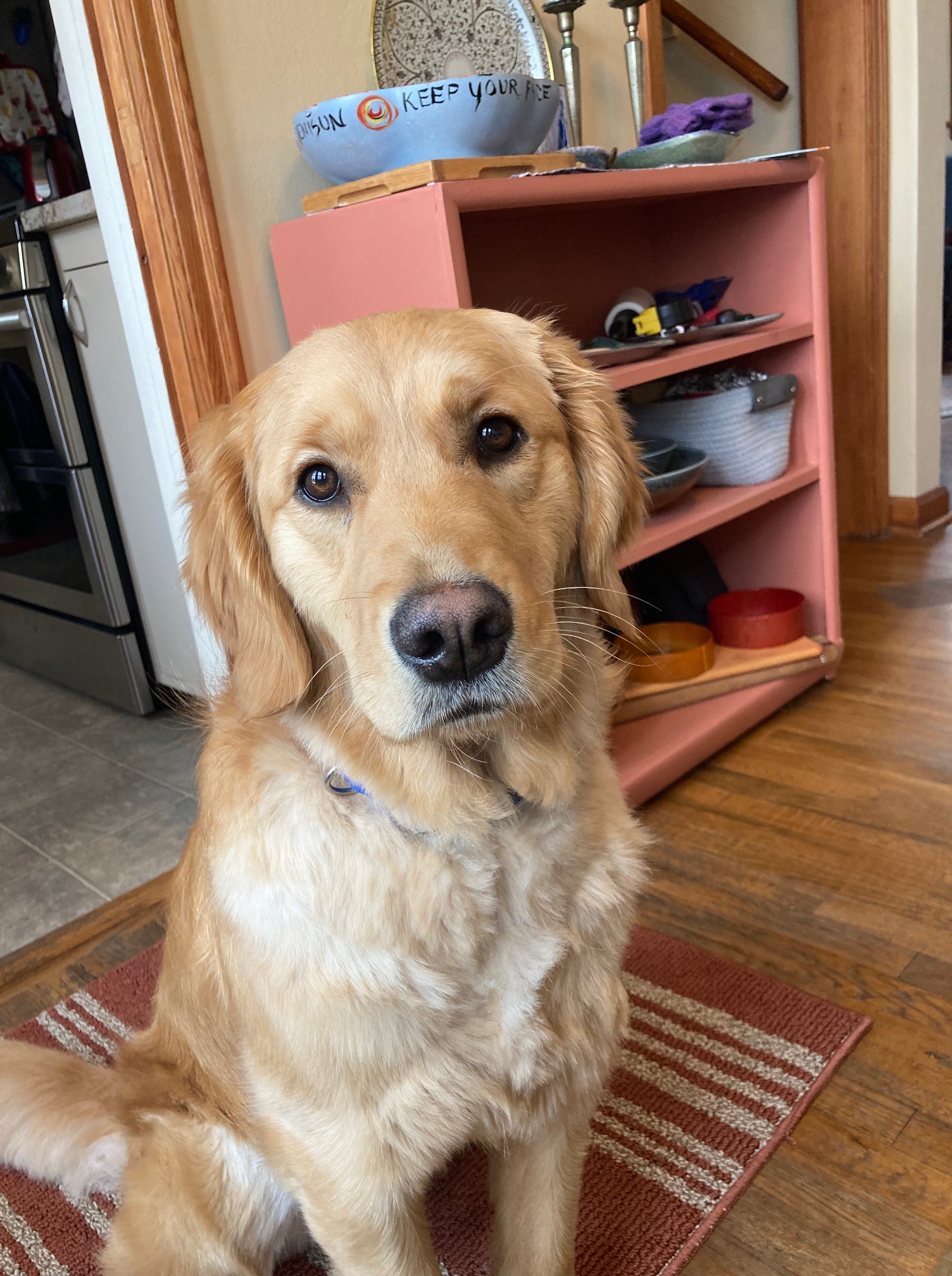
Orly, a golden retriever, wears an expectant lookIt seemed like a good idea at the time. And, to be fair, it was, for a while (and with a different dog).

The idea was to teach Cali not to react to fence-fighting, barking, or just plain rude dogs when we passed them on walks. We started with dogs in yards, but eventually were able to walk past reactive dogs on leashes. Cali remained calm and collected. And as soon as we were past, she’d pause and look at me expectantly. Because the reason she refrained from responding to the rude dogs was that she got a treat and a lot of praise.

Cali and I had several routes we’d choose from for our morning and afternoon walks, many of which included yards with rude dogs. I noticed that she started eagerly looking for the dogs as we approached. So far so good.

Then we got Orly. Cali and I taught Orly the drill. I made sure to have plenty of treats when we left for walks, though they were willing to wait until we got home to be paid, if I made it worth their while (better treats and more of them).

Orly takes over

We lost Cali to hemangiosarcoma when Orly was just over a year old. In the two-plus years since, Orly has matured into a smart, silly, thoughtful, and very resourceful dog. And, she’s engineered our walks, slowly, over time, to to the point where I am not sure who’s leading whom on these walks and other adventures (although I always drive).

I often let the dog choose which route we walk, primarily because walks are their time and their opportunity to experience new smells and catch up on neighborhood news.

A while ago, I noticed that Orly consistently chose the routes with the largest number of rude dogs. She’d peer ahead to see whether Milo and his brothers were out in the yard before deciding whether to go left or right at one corner, for example.

Gradually, I noticed that she liked taking detours from our usual routes. And that these detours always took us past yards with dogs in them.

She started to prefer turning into the alley after we said hi to George (a friendly, not at all rude, golden who is something of a neighborhood mascot. Or prince.) rather than continuing down the hill into the park. It only slowly dawned on me that there were not one but two rude-dog opportunities on the alley route that were not on the park route.

Then one day, I noticed her pulling toward the fence each time we passed one particular yard. It’s a typical 6-foot privacy fence, solid boards, maybe 4 inches of ground clearance under which we often see the nose and/or feet of a little terrier. A terrier who generally ignores us… unless Orly’s nose or feet are visible. Then, the dog would bark, Orly would not, and …

The terrier was no slouch, and soon learned to ignore Orly, so Orly upped the ante, bumping the fence or whining a bit. I was a little slow to catch on, assuming she was just excited — the terrier lives next door to the house with the treat hydrant. (Yes, more proof, for anyone who still needs it, that dogs are smarter than their humans.)

But no (duh!) Orly was doing her best to cause the other dog to react so that she could get a treat. Someone must have taught Orly about back-chaining, a technique to teach dogs (and humans) to perform a series of actions to earn a reward.
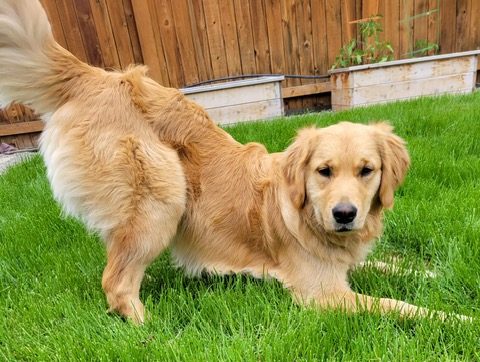
Golden retriever Orly, standing on grass, play bowsI did finally figure out her game.

Mostly I am impressed with the creativity and thought behind Orly’s conniving.

But when we merely pass a dog on a walk with her human, or a calm, relaxed dog in his yard, and she turns expectantly to demand payment, I find myself annoyed. I feel used. Is she a doggy mafia don demanding her due? Is our entire relationship transactional?

But then we get home and she cuddles up to me with a contented sigh … and no, I don’t want your thoughts on how she’s manipulating me in those moments, too. Just go cuddle your dog.
 

Walk Your Dog!

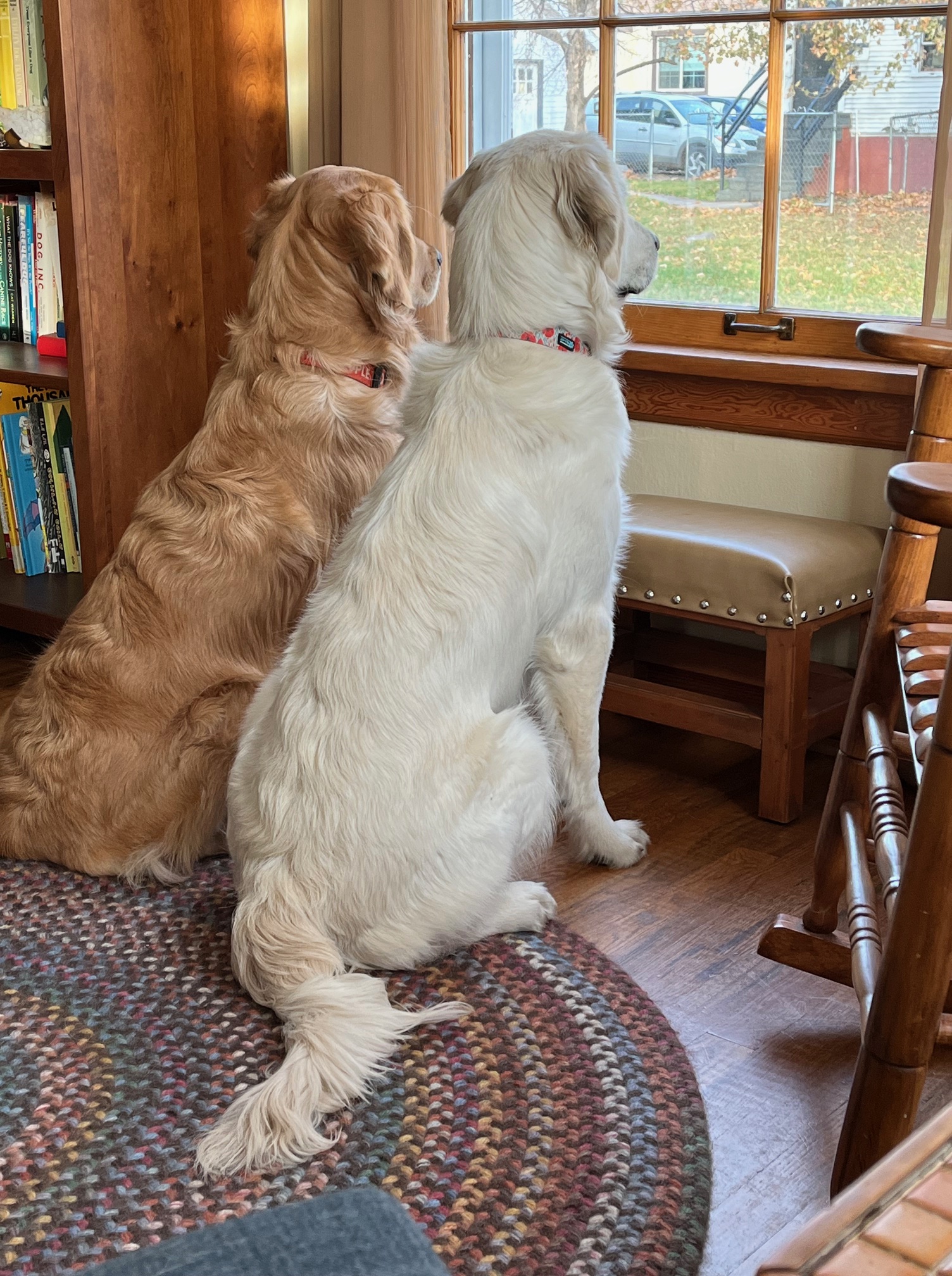
Golden retrievers Dotty (white) and Orly (gold) look out a large wood-framed window.
Watching the world go by is nowhere NEAR as much fun as smelling it!

Bored? Feeling stiff? Been staring at a screen — any screen — for too long?

Walk your dog.

A recent Washington Post article points out the many reasons to walk  your dog. Nothing earth-shatteringly new, but it bears repeating.

Walking your dog is good for your dog in so many ways — mostly not about exercise. Or not primarily about exercise.

Quality time

Your dog loves spending quality time with you. Walks are the pinnacle of quality time for dogs (well, for some dogs a game of fetch or tug or a belly rub might claim the top spot). This means no “multitasking,” mostly seen as fiddling with your phone while walking your dog. Focus on the dog — and on meeting the dog’s needs and wants.

I do this by letting the dog(s) choose the direction we walk and by letting them stop and sniff frequently.

Dogs need to sniff & learn

The sniffing is essential. As Kelly Conaboy, the Post writer says hanging out only in their own yard is like “reading the same book over and over again.”

Dogs discover so much about the neighborhood and its other canine (and squirrel, raccoon, and deer…) inhabitants by sniffing. Entire books have been written on the importance of sniffing (to dogs) and their astonishing abilities. Smell walks provide the kind of mental stimulation that we dull humans cannot provide, no matter how many treat toys, training sessions, and games of backyard fetch we offer.

For Dotty and Orly, the sniffing is huge — but so is the opportunity to see new things. They are ardent squirrel-watchers, love our safely distanced encounters with deer, and live for the frequent opportunities to greet friends, neighbors, and random strangers: Whenever we walk to the park, we get to say hi to George, an older golden retriever gentleman who is nearly always in the most beautiful yard in the neighborhood, and who comes running over to say hi (OK, maybe I am the one who gets the most out of these encounters …). A chance encounter with the neighbor who always carries top-grade dog treats is like winning the lottery! A stop at a different neighbor’s always-stocked treat jar (actually a plastic fire hydrant with an elaborate screw-off top) is a close second, more like winning $50 from a scratch-off. Some days, we get all three!

In the months she’s been with us, Dotty has watched a large house get a new roof; seen an old house be demolished, a new foundation dug, and walls begin to go up; and studied countless fire trucks, street sweepers, delivery trucks, motorbikes, and more. She’s met preschoolers at the playground and watched them splash in the turtle fountain and play on the climbing equipment. We see the neighbor kids board the school bus many mornings, often after they give each dog a pat or scritch.

Exercise for both (all) of you

With two young dogs at home, I could take the easy way out and let them play in the yard. They get plenty of exercise wrestling and chasing each other.

When it’s very cold and icy, I (very occasionally) do that. But we go for at least one and usually two (or more!) walks a day. I need the exercise and the break. They need the exercise and the break.

Most dogs will not get enough — or any — exercise alone in a yard. The exception is a young dog like Dotty, who has far too much energy for her own good: She often runs laps in the yard just to burn off steam. This makes me sad (and a little relieved …) since it makes clear how far I am from meeting her needs. Unless she’s training to run in the next Missoula marathon…?

Shockingly (?) a third of the respondents to a 2011 study admitted to not taking their dogs for regular walks. (How many more lied?) Don’t be one of them! Dress for the weather, leash up … and head off to wherever your dog takes you!

Take Me Out to the Dog Park …

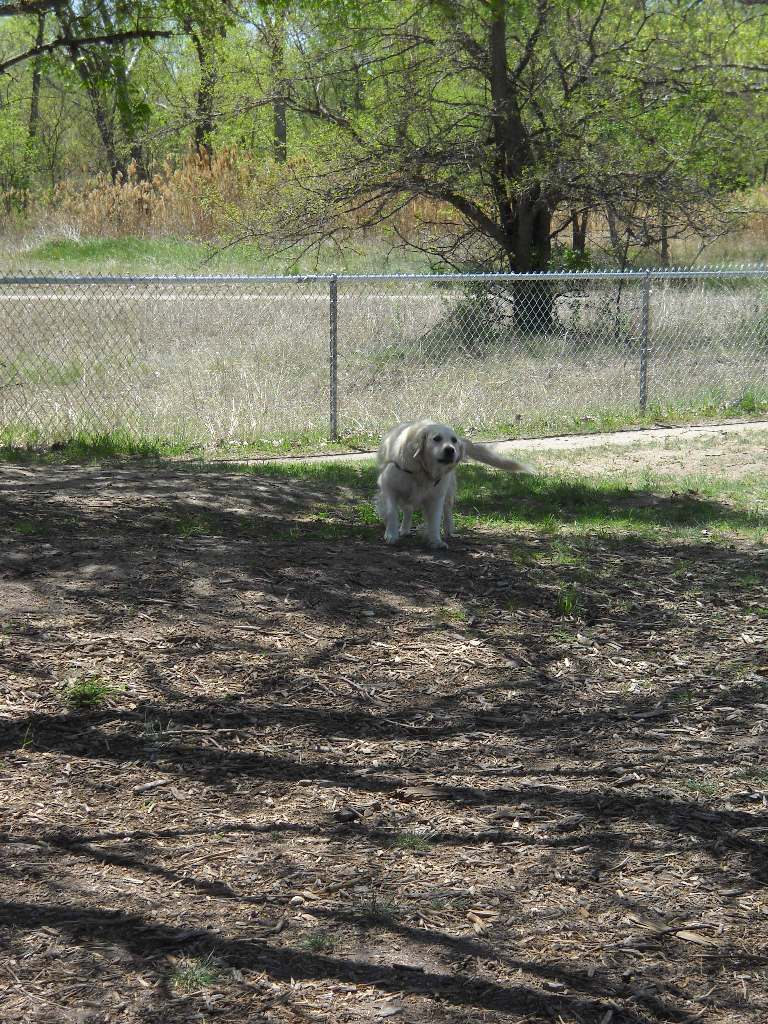
This dog park in North Platte, NE offered lots of shade, even on a 90-degree day.

Friends of ours are planning and building a dog park in their community. I am in awe of their energy and commitment; they’ve got the entire dog-owning community involved. Talking with them about their plans got me thinking about dog parks and some of the research I did with a college class I taught last spring. Dog parks can be a wonderful asset to city-dwelling dog lovers — or they can be rough-and-tumble, scary places. What makes the difference?

Planning is one of the keys to successful dog parks. The dog park culture is another. This post will talk about the physical features that contribute to making great dog parks succeed. My next post, Good Owners Make Good Dog Parks, will delve into dog park culture.[1]

As anyone with a large, fenced back yard knows, just having enclosed green space is not enough to get dogs to exercise; many dogs will just pick a sunny spot and take a nap. But add more dogs and you have a potential problem: in a plain, flat grassy area, dogs are more likely to chase other dogs. Often, once one dog starts a chase, other dogs eagerly join in.

Dog parks with natural or planned “breaks” in the open space are safer for dogs. They force running dogs to change direction or slow down, and give the “chasee” opportunities to escape. “Breaks” can be hills, paths, stands of trees or bushes, a pond or a beach. Benches can also break up open space, but benches encourage the humans to sit, chat with others, and not pay attention to their dogs — which contributes to bad dog park culture.

Besides breaks, dog parks — especially in warm climates — need shade. Plans should include lots of shade trees or even a shelter with a roof.

Water is a wonderful “break” and adds to the fun for the dogs. People tend to keep a closer eye on their dogs around water, too. If the space for a planned dog park is not on the edge of a natural body of water, consider a manmade pond! And of course, if there is a place to swim, a rinsing station is a great idea. At absolute minimum, a dog park should have a hose or fountain for drinking water.

In dog park planning — and visiting — size matters! In a smaller dog park, particularly if it is crowded, dogs are more likely to feel stressed — which leads to defensive behaviors or could make them targets for dog bullies.  In larger spaces, dogs who don’t want to play with the other dogs simply have more room to move away. Many urban areas have dog parks that are a half-acre (or less); for a large, high-energy dog, this is not enough room to really stretch those legs and burn off energy (I know; I live with a dog like that!).

In smaller parks, it is essential to have a separate small dog area. Parks that are several acres and include walking paths or a beach can be safe for dogs of all sizes (so long as the humans are paying attention), but in smaller parks, it is far too easy for small dogs to be injured, even if all of the dogs are behaving appropriately. Dogs in full play mode don’t always pay attention to what’s in their path, and they can’t (or won’t stop on a dime.

If you are choosing a dog park to visit, scope it out before releasing your dog. If it is small and crowded, you might be better off taking the dog for a leashed walk. On the other hand, if you are lucky enough to live near a large, well designed park, do what you can to ensure that the dog park culture will ensure a safe, fun experience for dogs of all sizes!


[1] Thanks to the APDT and Sue Sternberg for their wonderful Webinar, “A Look at Interactions Between Dogs in Public Dog Parks” for information referenced here.