Teach Your Old Dog New Games

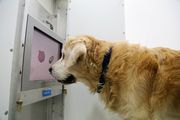
An elderly golden retriever touches a computer screen with her nose.A team of researchers at the Clever Dog Lab (oh, how I’d love to work there …) at the Messerli Research Institute in Vienna suggest teaching older dogs to play brain games on touchscreen computers and tablets. Yup, Lumosity for dogs.

The researchers have some games that they developed and tested out and that they are now trying to prepare for retail sale. That’s all well and good, but the real premise of their study is that older dogs need — and benefit greatly from — mental stimulation and training. And that most dog owners (and trainers) don’t really do much training with older dogs.

While dog sports like agility might be beyond the capabilities of, say, an arthritic golden retriever (as Jana was during her last years), some dog classes can work for older dogs. Jana loved every second of her nose work classes (well, except the seconds that other dogs got to look for treats and she was not in the ring). The instructor, at the beginning of the first class, told us handlers that the dogs could bark as much as they wanted and we were not to use the ‘N’ word. (No.) Jana had found her doggy paradise.

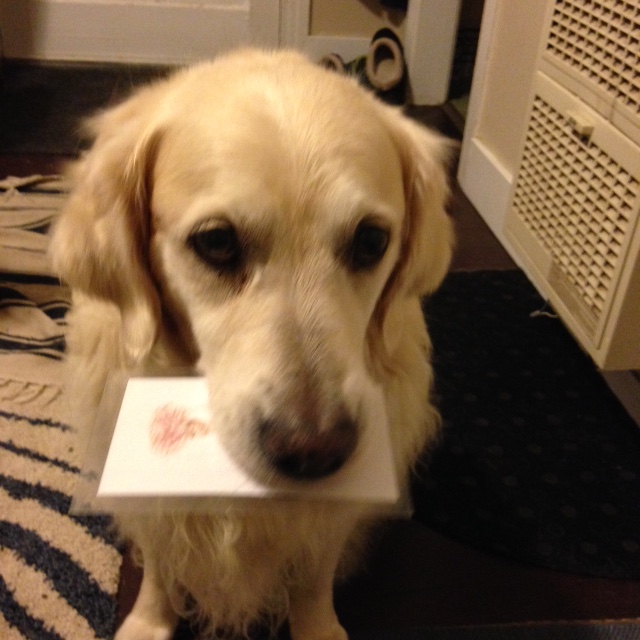
Throughout her life and well into old age, Jana’s mind was sharp and, if a cookie-earning opportunity arose, she’d stick with the challenge until she’d earned and eaten every last crumb. We did exercises on canine fitness equipment, practiced imitation games, and worked with picture cards that Jana could choose: ball, tug toy, popsicle. (For some reason, she always went for popsicle…) I never thought of teaching her to use a computer, but I am sure she’d have mastered that as well.
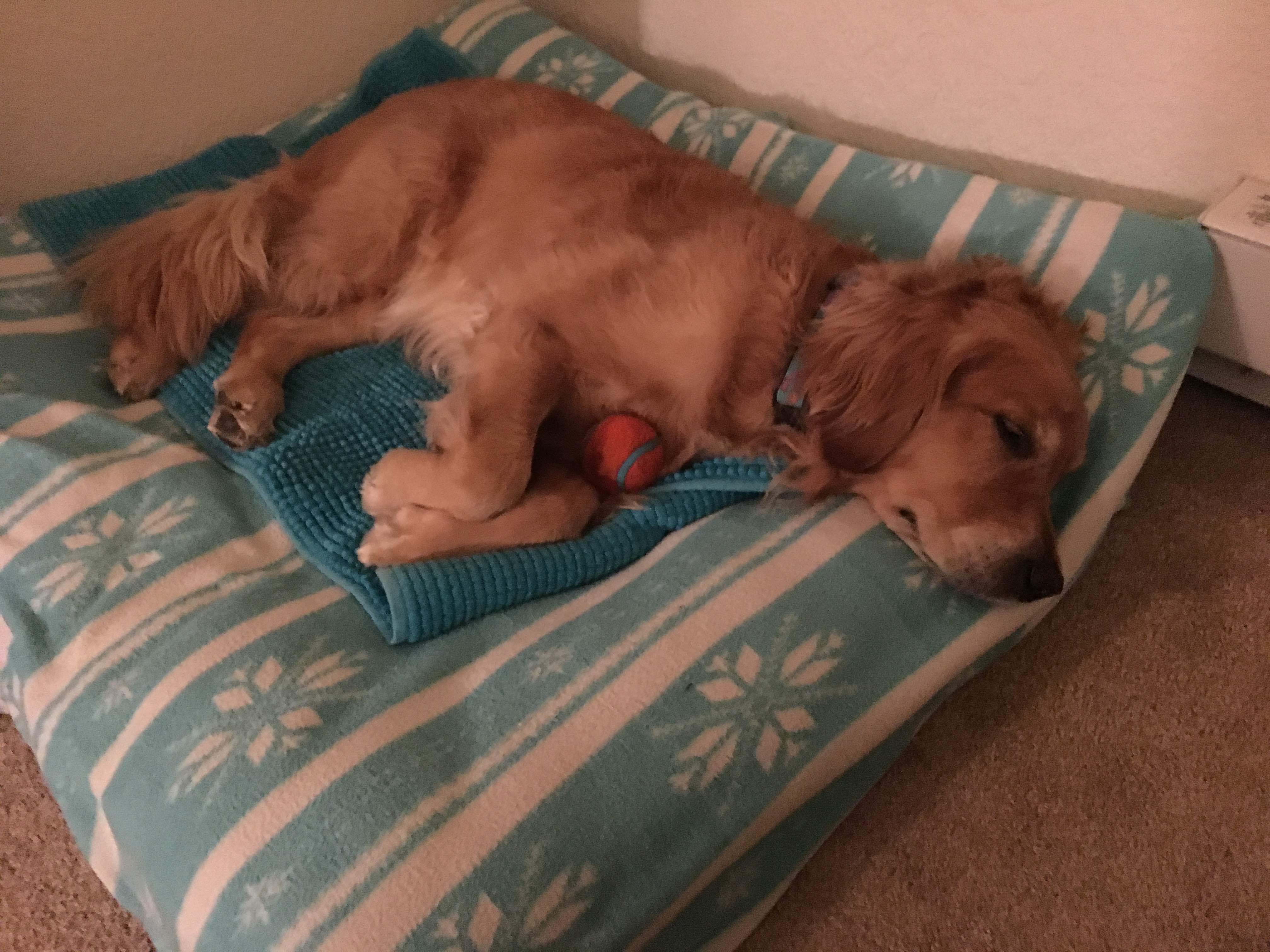
Cali sleeps on her dog bed, cradling a tennis ball with her paws.Cali is less intellectually oriented than Jana, but she does love nose work. I suspect that age is less of a factor than temperament. Cali’s not interested enough in learning (or earning treats) to really work at much. She’ll stick with a nose work search longer than she’ll work at a Kong or other food toy. And she’ll play with a tennis ball all day (and take it to bed at night). I doubt she’d enjoy computer games, though she does love TV, so I could be wrong about that.

My main takeaway from the dogs and computers study has nothing to do with whether dogs want to, need to, or should learn to use computers, though. It is all about us: Don’t give up on your older dog. Figure out what she loves about her favorite activities and adapt them for her changing physical needs. Keep challenging her and offering stimulation. It will keep her mentally fit — and keep your bond strong.

Cali and the Magic Box


This slideshow requires JavaScript.


Cali’s head whips around. Her body follows her nose. She’s on the scent.

She started doing this at her second or third “nosework” class — as she ambled around, haphazardly looking for the target. Suddenly, she’d catch the scent and be off, following that now-beloved birch scent to the magic box. All she had to do was touch this box and her devoted servant (me) would start showering her with praise and treats. Really good treats. Yum.

Cali “got it” very quickly. When practicing, I have to put her in the bedroom and close the door so I can hide the magic box. She trots out eagerly, nose in the air. Within seconds, that nose whips around and she’s dancing beside the box.

The road to nosework expertise is not without bumps. At one point, Cali started bashing the box with a large, soft paw. When we switched to cardboard boxes, she thought they might make a nice snack.

Despite the minor hiccups, Cali continues to progress in her scent-detection abilities. She’s putting them to work daily. Though Jana enjoyed the concept of smell walks throughout her life, Cali had never been interested in sniffing her way through town. Now she thoroughly investigates the many (many, many, many …) places along our daily walks that other dogs have marked. I never knew it could take so long to walk around a parking lot!

She’s suddenly developed a deep interest in squirrels, too. Montana squirrels are a lot more interesting than California squirrels, apparently. Especially the one that hangs out near the veterans’ apartment building next to our apartment complex. Oh, and the one that raids our bird feeder any chance it gets, whom Cali seems to enjoy watching.

Back in “nosework” class, we’ve moved from hiding the scent in boxes to moving it around. Cali quickly grasps each new step — at least, in class. Watching her try to understand the new “rules” at home is interesting. She is a living illustration that content and context both affect learning. In plain English — don’t change everything at once. She did find the scent hidden in a plastic container this morning, as well as under the sofa and on a shelf. She’s is following her nose for sure; she can’t see where I have hidden the tin with the scent stick. She’s not very methodical in her search, but she is thorough. And she gets very excited when she finds it.

What’s great about the scent game is that we can play it all winter, indoors, with little changes, and – so far — Cali’s enthusiasm hasn’t faded a bit.


Koala Cleans Up

Photo by Deni Elliott

Koala is learning a skill that all dogs need: She’s learning to pick up her toys before she goes to bed.

Wow, you might be thinking, that’s amazing.

It’s really pretty simple, once you get over the ridiculous human notions that dogs “can’t” do … whatever. Frankly, I believe that the only limitation on what dogs can learn is the imagination of the humans teaching them.

So, back to Koala. Koala is the smartest dog I know. She is also an excellent people-trainer. She’s got Deni really, really well trained. For instance, even though Koala celebrated her third birthday a few weeks ago (mazal tov Koala!), she has Deni convinced that she will not be able to work, and may well keel over and die, if she does not get puppy lunch every single day. Most Labs and goldens give up their puppy lunch at around 6 months of age. It was the single most terrible experience in Jana’s long and otherwise happy life.

The next thing that Koala trained Deni to do was provide a bedtime snack, just before the nightly cuddle. This actually was fortuitous, because it made teaching Koala to clean up very easy. While possibly not as smart as Koala, Deni is no slouch. She put one and one together and got a perfect back-chaining opportunity: Deni simply had to remember to ask that Koala clean up before she would get her bedtime snack.

OK, there is another step of course. Koala had to know to get her toys and to drop them in the toy basket. Koala is a very well-educated guide dog, but for some reason, a working retrieve was not part of her university curriculum. No matter. Deni easily taught her to bring toys to her. Koala did already know to drop items on cue, so getting her to drop them into a basket was also pretty easy.

With these essential pieces in place, and the very strong motivation of her snack, it took Koala only a few days to get into the routine. The biggest obstacle, to be honest, was Deni remembering to ask Koala to clean up before providing the snack. It’s nearly always the humans who hold dogs, back, not any lack of ability on the dog’s part.

A bonus: Koala, like most smart dogs, excels at finding shortcuts. She seems to have figured out the concept and, in the interest of making snack delivery speedier, she leaves fewer toys lying around. The other day, she had only two to pick up. Chores done, on to snacks and cuddles. Seems like an all-around win!

“Alpha” Stands for Abuse

Golden retriever rolls happily in the grass
This is the only kind of rolling I want my dogs to experience.

A few weeks ago, I saw someone essentially “alpha roll” her dog.

This week, I saw Patricia McConnell’s review of a book by the same folks who initially “popularized” the alpha roll, the Monks of New Skete. I don’t know what the Monks suggest in their new book, but I am confident that it is bad for dogs.

It’s well past time for this abuse to stop. We know enough about dogs to put to rest the notion that they “need” a strong leader who keeps them in check using force.

The alpha roll, for those fortunate enough never to have encountered it, is an abusive technique presented by incompetent, ignorant individuals who call themselves dog trainers. It’s based on the thoroughly debunked idea that dogs’ “packs” need to be ruled by an “alpha” who demonstrates “leadership” by beating up on other members of the pack. And that if you, the human, do not repeatedly enforce your “leadership,” the dog (any dog) will try to take over.

All of the elements of this belief are pure hogwash. But those beliefs have led to many cruel practices, including the alpha roll as discipline. Basically, if your dog does something you don’t like, you are supposed to punish him and reinforce your “leadership” by grabbing him and throwing him onto his back (rolling him if he’s too big for you to flip easily) and holding him down as you yell at him, shake him by the scruff, do both, or perform whatever other “disciplinary” tactics the abusive “trainer” has taught you.

So, the alpha roll I saw went like this: I was walking down a busy street. A woman was walking her smallish terrierish dog. Another person walking a larger Labish dog went by. I am not sure whether the dogs only sniffed at each other or whether one or both vocalized. Whatever the small terrier did was unacceptable to the woman who grabbed him, flipped him over, shook him, and yelled, “No! Bad! No!” several times.

Why?

What did she think she was teaching him?

Who knows what she thought she was teaching him. What she was teaching him was that she, his human protector, was crazy and unpredictable. That walking down the street with her, simply being a dog, was dangerous. That she might attack him out of the blue for no reason.

I was silently rooting for the dog to bite her in the face. A major downside of the alpha roll is that the person doing it is often ideally positioned for a really nasty (and richly deserved) face bite. That so few dogs snap and deliver the “discipline” that the people deserve is an enormous testament to dogs’ self-restraint and their long-suffering and forgiving natures — not to the effectiveness of the “discipline.”

The alpha myth is based on incorrect assumptions about wolves. See Alexandra Horowitz’s explanation in this link for more information, but in short, people who observed the behavior of captive wolves extrapolated from the behavior between males all kinds of nonsense about dogs. For openers, captive wolf behavior is nothing like wild wolf behavior, so the observation that, in captive groups made up of unrelated wolves thrown together by humans, males jockeyed for control — including fighting with other males — says nothing about wolf pack dynamics. Natural wolf packs are families. The so-called alpha pair are the parents or grandparents of the other pack members. True alpha wolves rarely use physical discipline, but the alpha pair does lead the pack and teach their offspring how to behave.

And even if natural wolf packs did behave as alpha theorists described— so what? That little terrier mix getting abused on the sidewalk has less in common with a wolf than you and I have with the average chimpanzee. Do we discipline children and rule workplace hierarchies based on the way chimps treat their troupe-mates? I certainly hope not! Thanks to thousands of years of partnership leading to domestication of dogs, and also thanks to generations of human-influenced genetic changes, dog behavior is very, very different from wolf behavior. And dog-dog behavior is, and should be, different from dog-human behavior.

Dog behavior is relationship-based; dogs are very social. That is about the only element of the dog pack mythology that is true. Humans are also social. Social animals have rules, whether formal or informal, that govern their interactions. Some involve status differences and even hierarchies. But leadership is about navigating and negotiating these relationships and differences and influencing the behavior of those with lower status or who are dependent on the leader in some way. There are lots of ways to lead. Sure, force is an option. But as anyone who’s survived an autocratic parent or boss knows, it is not terribly effective, it destroys relationships, and it is far from the only way to “lead.” In fact, I do not consider force or autocracy to be leadership.

McConnell’s blog offers alternative visions of leadership. I agree with her; our leadership of our dogs should be about building a relationship, letting the dog know he can count on us and trust us. It’s also about letting dogs think for themselves and making it safe for them to make mistakes sometimes. That is the polar opposite of what “being the alpha” accomplishes.

Please don’t buy into the alpha myths; instead, buy any (or all) books by McConnell and other positive, progressive trainers who treat dogs as the thinking, caring, sensitive beings they are.

Too Much Nurturing?

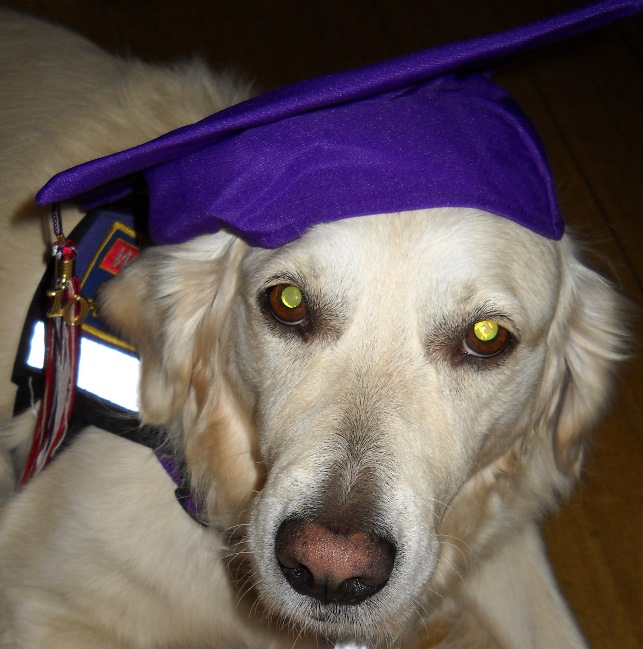
Jana, a white golden retriever, wears a mortarboardReading about this study will make you want to go back to college.  A team of undergrad researchers had the best job ever: Watching hundreds of hours of puppy videos.

They were looking at the differences in how moms at The Seeing Eye, a guide dog school in New Jersey, treated their pups. Some were very attentive, constantly licking and cuddling their newborn pups. Others spent as much time as they could out of the whelping box, away from the babies. Some lay down to nurse, making it easy for the pups to gorge themselves. Others stood, perhaps longingly eyeing the happy hour menu just out of reach. The researchers not only studied the moms’ behavior, they also measured their levels of cortisol, a hormone that indicates stress. Moms with higher anxiety tended to spend more time with their pups and coddle them more.

Guide dog puppies are set up to succeed. They have great genetics and prenatal health care, as well as top-notch vet care throughout their lives. They get early enrichment and socialization, lots of training. Even so, many don’t make it. A dog who is nervous or fearful makes a poor guide, as does one who can’t think independently and solve problems. Puppies who learn faster, solve puzzles faster, or figure out how to contend with obstacles naturally make better guide dogs. So do puppies who are confident and unafraid of new or potentially scary objects or situations. Temperament tests for puppies abound, but it’s still hard to reliably predict adult temperament or success.

It might seem that pups with attentive moms would be more confident and therefore more likely to succeed. But that’s not what the research indicated. The pups who had to work a little harder to eat and those who were less coddled by their moms turned out to be more independent and better problem solvers — scrappy, tough little dogs who had higher success rates in guide dog school. The coddled pups showed higher anxiety and less problem-solving ability. Even these pups are far ahead of the average pet dog in terms of temperament, ability to cope with the everyday stresses of life, and general health, though. But helicopter moms seemed to put their pups at a disadvantage.

It’s hard to determine just how much of the pups’ success or failure is linked to maternal behavior and how much is genetic, so more study is needed. But the attention to maternal behavior could help shape early training and enrichment. It could also point to ways that we could more successfully help our older puppies and adult dogs cope with anxiety (less coddling?).

Anyhow, doing more research is so appealing. Sign me up to watch those puppy cams!

The early study on maternal behavior is available online: Characterizing Early Maternal Style in a Population of Guide Dogs.

The abstract of the later study is available here: Effects of maternal investment, temperament, and cognition on guide dog success.

Bit by Bit

Her motto is “don’t fence me in”; she needs a reliable recall!

For a little over a year, I have been writing for an online “magazine” that covers online learning. Some of my articles touch on various learning theories and how these might be applied in “eLearning” or online training and performance support. Every so often, a source talks about “spaced learning” or “spaced repetition.” It’s funny to me that many of them think they’ve stumbled on a new secret weapon.

Spaced practice is simply practicing a skill or recalling information, maybe by taking a quiz or using flash cards, at short intervals over a period of time. It’s long been known to be effective both in the education of children (and adults) and in the education of dogs.

I first learned about spaced repetition in my first dog training classes. Particularly when working with very young puppies, we paired very short training sessions with spaced practice on the same set of skills. Hmmm, did we also discover microlearning, another current hot topic in eLearning? Maybe so.

Microlearning — very short lessons — certainly worked with our 4-week-old puppies. Two five-minute sessions a day (even one, if we got busy) were enough to teach one puppy I worked with about 15 cues by the time she was 10 weeks old. I’ve used the approach, with great success, with dozens of other puppies and adolescent dogs, but my training skills are becoming rusty from disuse.

I’ve been thinking about both microlearning and spaced learning for two different reasons this week.

One is a conversation I had about a friend of hers who wants to train her dog to help her with some aspects of her MS. The dog already has some foundational skills. The friend, due to her MS, has limited stamina and would only likely have enough energy to work with her dog for a few minutes a day. I found myself telling my friend that that was not an insurmountable obstacle. If she were able to spend a few minutes a day practicing a skill, the dog could learn it very well.

The second reason is my own lapse in spaced practice. When Cali was a puppy, I was very diligent about practicing her recall and working on her willingness to accept grooming, especially handling of her feet and nails. I did everything by the book, practiced almost every day, sometimes two or three short sessions. Cali was a great student. Then life got in the way and I stopped practicing. She now has a mediocre recall and hates having her feet handled. Great.

I know that I can find five minutes a day to work with Cali, and I know that, with the right treats, her recall could again become speedy and eager. That matters here in Montana, where there are many places that Cali could run off-leash.

I’m less sure about the feet, but I could probably get her to be a little less skittish and a little more cooperative. It’s certainly worth a few minutes a day to try. I have a new bag of very desirable treats; maybe I will use them for some remedial training. Wish us luck!


It’s Teaching, Not Training


Jana peruses several cards, then chooses "tug," asking to play tug.

Someone whom I admire greatly, though I have never met her, wrote a wonderful column a while back. It was emailed to me recently, and I’d like to bring it to readers’ attention. She describes an approach to educating dogs that she calls “Non-Training.” I’ve called this “Cognitive” dog training.

Whatever you call it, the idea is the same: Treat the dog as a partner and student, not as a robot who must obey.

It is a positive, motivation-based approach to teaching dogs that relies on their intelligence and problem-solving ability — not rote memorization of specific, inflexible responses to commands barked at them by an “alpha” human.

It starts with giving dogs choices. Teaching dogs a simple “yes” or “no” response is pretty easy. You can use your hands or ask the dog to do a different response, such as raise a paw or nose your knee. It’s up to you (and your dog) what response works. But once the dog gets the concept of a choice, the sky is the limit.

You can ask your dog whether she wants to go out, wants water, is hungry (use caution if you have a Lab or a golden!), wants the ball or the tug toy, wants a walk or a ball game, wants to rest, is hurting somewhere … Really, as in so many areas of our relationships with dogs, the limitations are imposed by our lack of imagination, not the dogs’ lack of ability or willingness.

Cognitive training goes beyond simple choices, though. It is about teaching dogs to think and solve problems, rather than waiting for us to tell them what to do. It is about shared goals, rather than humans ordering dogs around. It is a dramatic re-imagining of the human-dog partnership. It requires letting go, once and for all, of the idea that dogs “have to” obey humans, just because we have thumbs, or that they do stuff for us out of unconditional love.

A relationship with a dog is just that: A relationship. It takes work, mutual respect, a two-way avenue of communication that acknowledges what each contributes and what each needs from the other.

I won’t go so far as to say that it is or should be a completely equal relationship. Sometimes — often — the human gets to make the decisions. Much as some people loathe the comparison, it is like parenting in that way. The adult human is in charge, but that doesn’t mean there’s no room to respect and encourage the dog’s (child’s) individuality, allow for expression of preferences, and allow the dog to make choices when appropriate.

I encourage you to read the column, “Teaching Your Dog to Say Yes or No: The Art of Non-Training.”


A Dog Can Help You With That …

Whatever you need help with, chances are, a dog can help out. Need help finding your way around? Easy-peasy. Need a guide who also lets you know about important sounds? Dog’s got that handled too.

Funny thing is, not too many humans believe that dogs can do all that (and more). Fortunately for some people, Guiding Eyes is an organization that takes chances on people — and dogs.

As someone who’s sure that we haven’t come close to tapping dogs’ full potential, I see this as a sign that Guiding Eyes (or GEB) really “gets” dogs in a way that few people, even dog professionals, do.  This understanding leads the organization and its trainers to willingly take on challenges that few people would even think possible: Tasks that require a belief in dogs’ ability to be adaptable and to become creative problem solvers, for example. GEB dogs do things that it’s really not possible to teach them without a shared understanding and buy-in to shared goals, so the trainers have to know that dogs are capable of higher-level thinking, problem solving, and working toward goals.

What do I mean? GEB places dogs with a tremendous variety of clients, including individuals who have both visual impairments and another disability, such as a mobility or hearing impairment. The clients whose dogs alert to sounds as well as guiding range from people who are legally blind and hard of hearing to individuals who are both blind and deaf. I could be wrong about this, but I believe that GEB is the only U.S. guide dog school that is willing to provide these clients with a guide dog. In any case, it was the first organization to do so.

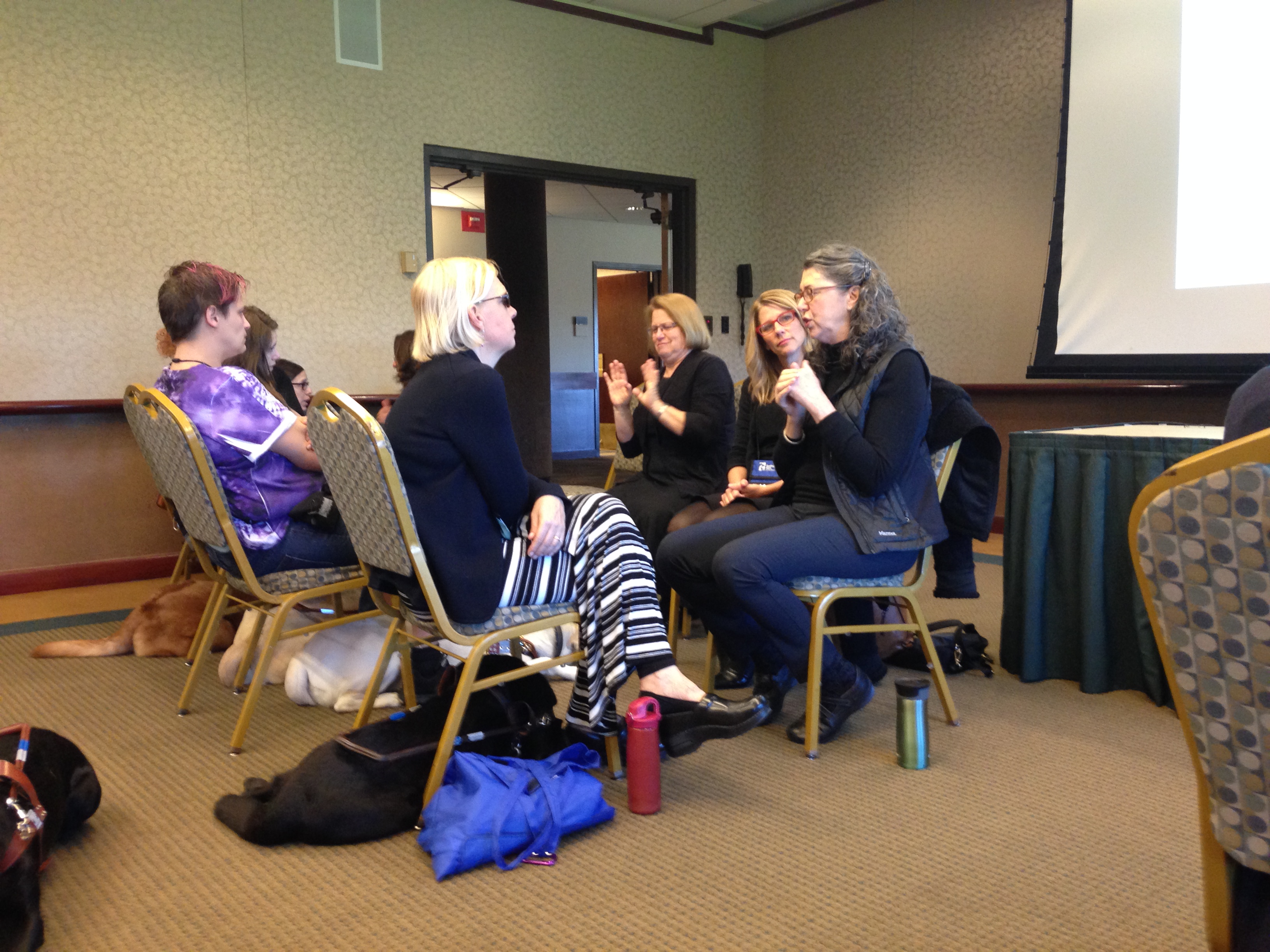
As registration opened for the Guiding Eyes continuing education weekend, a number of these grads registered. Planning committee member, grad, and GEB consumer outreach and graduate support manager Becky Barnes Davidson waved a magic wand and somehow found funding to bring a cadre of interpreters to the weekend, ensuring that all of the grads could participate fully in the events.

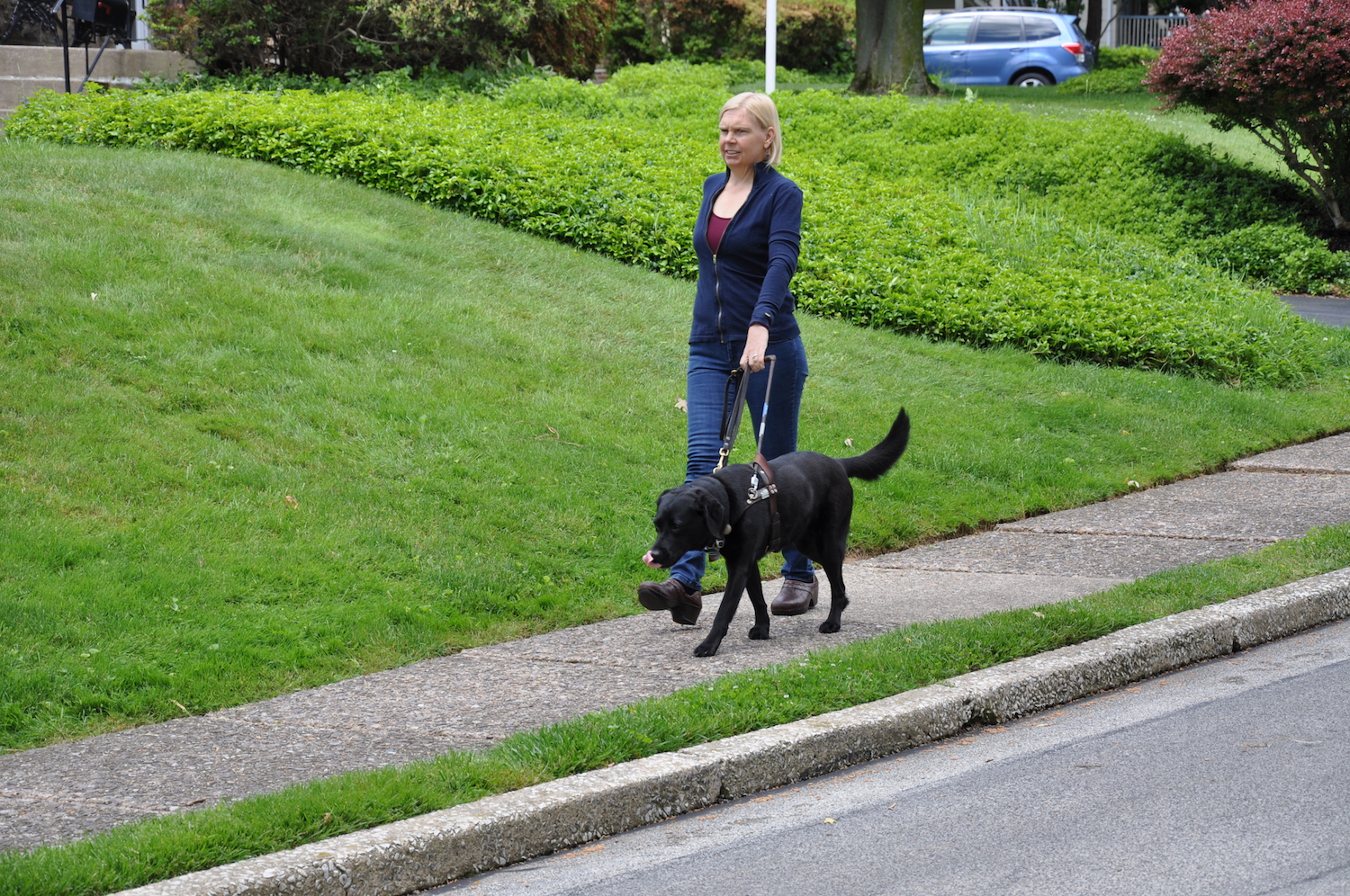
Deborah and Gypsy walk togetherI had the opportunity to chat with one of these grads, Deborah Groeber. She got her first Guiding Eyes dog in 1987. GEB didn’t yet have its “Special Needs” training program, which got off the ground in 1990, but, Deborah said, it was the only guide dog school willing to try training a guide for her.

Having guide dogs has, of course, made a tremendous difference for Deborah, especially in her frequent travels. She describes traveling with her dogs (current guide Gypsy is her fifth) as “phenomenally different” from traveling with a cane.

“I think Gypsy is a great match for me because she loves going from the suburbs into the city every day, loves taking trains, buses, escalators, stairs, revolving doors and working obstacles and construction sites. She is bright, confident and self-motivated, but she also loves praise and food rewards,” Deborah said.

Deborah is about to participate in another unique Guiding Eyes program. Gypsy is nearing retirement, and Deborah’s next guide will be a member of GEB’s new program, Running Guides.

Running Guides perform the usual guide dog work as well as guiding their partners while running. The first Running Guide team graduated in 2015. And Deborah’s dog will, as Gypsy has, learn to alert her to sounds, such as smoke alarms, phones, and doorbells. Deborah knows how to teach her additional alerts as needed. Sometimes Gypsy figures it out on her own, too.

Once, not long ago, Gypsy alerted her to a carbon monoxide alarm when Deborah’s husband was traveling for work. Gypsy is not allowed in the basement, Deborah explained, but she kept alerting to the basement door, because she heard the unexpected sound of the alarm. She’d not been trained to respond to that sound, but somehow understood that it was an urgent problem. Deborah got both the CO and smoke alarms, Gypsy told her which one was making noise, and she was able to respond and resolve the problem.

That story underscores the connection and communication that develop between members of a guide team. Many of us plain old pet-dog owners, who have the good fortune to be able to see our dogs’ body language and hear their vocalizations, are nonetheless unable to figure out what they are telling us. And I bet most of our dogs would react to an alarm and try really hard to get us to do something about it. That we’d all die of carbon monoxide poisoning anyhow would not be the dogs’ fault…

As someone who has tremendous faith in dogs’ abilities to figure things out, communicate, get what they need, figure out what their humans need, and so much more, I am not amazed that a single dog can perform both guide and hearing work, with a side gig as a personal fitness trainer. I am impressed that enough people at Guiding Eyes believed in dogs back in 1987 to give combined guiding and hearing dogs a try, and that the organization is continually coming up with new ways to stretch and grow the partnerships between their amazing dogs and clients.

The Value of a Tennis Ball

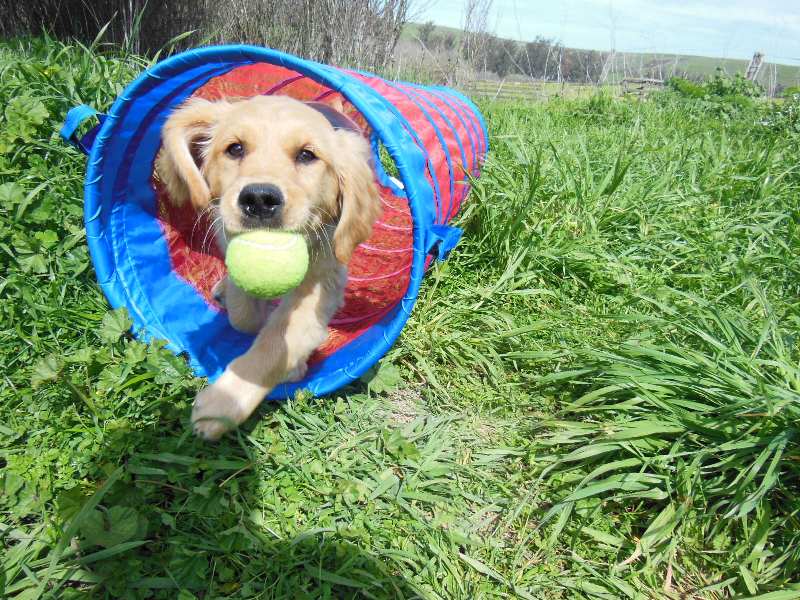
Cali, as a very young puppy, runs through a tunnel holding a tennis ball.
Cali was a young tennis ball addict

Cali showed her entrepreneurial spirit this week when she decided to buy a tennis ball. Cali adores tennis balls. She loves chasing them, holding them, drooling on them. She especially loves getting one really wet and drooly and then rolling it in the dirt she’s carefully prepared by digging a new hole in the yard. She then tries to sneak it into the living room. She’s not allowed to have tennis balls in the house.

I also like tennis balls. When my shoulders feel stiff and sore, I use a tennis ball to loosen the muscle cramp. I learned this trick from Jana, who loved to position a tennis ball under her shoulder and then roll it down the length of her spine while wriggling on her back. My yoga teacher advised using a tennis ball for this as well. There are two ways for people to do this: lying on your back on the floor, with the ball under your shoulder; or standing against a wall with the tennis ball pinned between your shoulder and the wall. Both work. The problem with the floor version, I have found, is that Cali cannot resist temptation, and she tries to steal the ball from under my shoulder. I end up with no tennis ball and a lot of drool on my neck. So I use the wall method.

The other day, there I was, leaning into the tennis ball. Cali was on her bed, watching intently.I think that part of the appeal for Cali is the “breaking the rules” aspect of getting her teeth on a tennis ball inside. She got up, rooted around in the blankets a bit, and found her Kong. Cali has two Kongs, and at the time I was working on the tennis ball, I knew that one was empty and one had a big chunk of a biscuit inside.

A very young Jana studies her Kong toy.
Jana was a young Kong addict

Now, Cali has only recently become a fan of Kongs. Jana was an early Kong addict, and by the time Jana was about 6 months old, there was nothing that I could pack into a Kong that she couldn’t devour in less than 30 seconds, leaving the Kong sparkling clean. But as long as Jana was on the scene, I could not give Cali a Kong. Cali is more leisurely in her approach to Kongs. She’ll work at it for a few minutes, get some of the food out, then abandon it. A few hours later, she’ll find it and work some more. It’s more of an all-day snack than a quick nosh. She’s also more likely to dribble bits of whatever is in the Kong onto the floor, the carpet, her bed … Jana would not let a drop or a crumb escape.

Cali picked up one of her Kongs, walked over to me, and sat. She looked at the shoulder where the tennis ball was, then looked me in the eyes. Back to the shoulder, back to the eyes. Then, still holding the Kong in her mouth, she poked her nose at me a few times, looking me right in the eyes. Oh, I said, are you offering me that Kong? I held out my hand. She placed the Kong in my hand and looked at the tennis ball shoulder again. I handed her the tennis ball. Purchase complete, Cali walked back to her bed, smiling.

I looked at my newly purchased Kong and discovered that it was the one with the biscuit. I pulled the biscuit out and called Cali back to me. She came, leaving her new purchase safely on her bed.

You’ve overpaid, sweetie, I told her. Here’s your change. She accepted her change, ate it, and returned to her tennis ball.

Dog trainers know that the dog gets to decide what a worthy reward is for any task. Cali is more obsessed with tennis balls (and less obsessed with food) than any other Lab or golden retriever that I’ve worked with. But she knows what she values and how to get it. She also knows that a Kong has value, and that one with food is worth more than one without. She doesn’t seem to understand scarcity and how it should affect value, though; we have lots and lots of tennis balls, but only two Kongs. To her, a tennis ball clearly has more value than even a Kong-with-snack, even though one is scarce and the other is common.

Or maybe the joke’s on me: She might also know that she’ll get the Kong back, filled with biscuits, each morning when I head out the door. So it’s not a scarce resource after all.

Now really, who’s the smart one here?

What Marshmallow Tests Mean

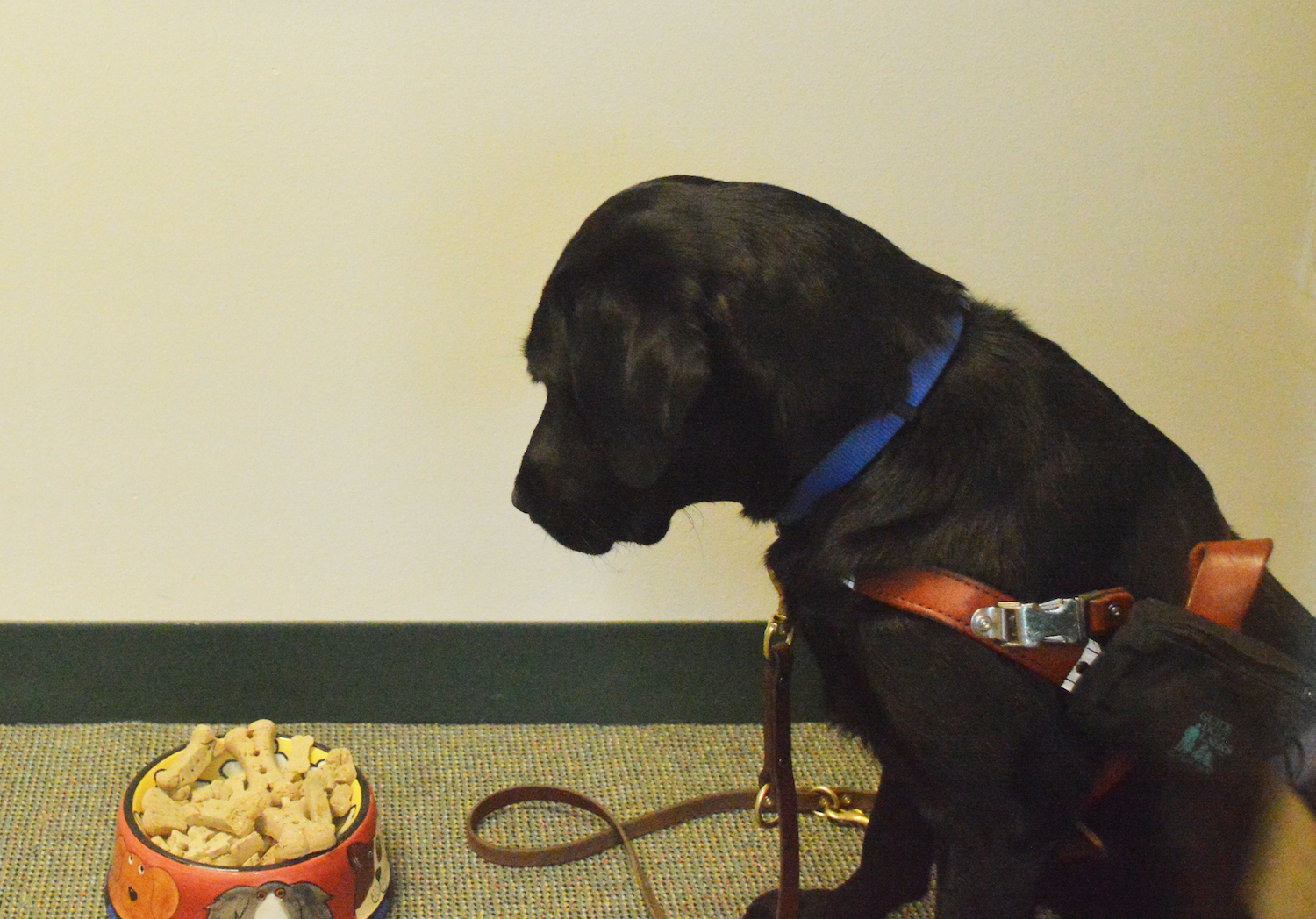
I’ve written about both Alberta’s and Koala’s adventures with the marshmallow test and I’ve been thinking about what it tells us about each dog. Is Koala a “better” dog because she didn’t have to work as hard as Alberta? Is she more obedient ? (No!) More — or less — intelligent?

Dr. Walter Mischel, the psychologist who originated the test, wrote a book about it a few years ago; he also was interviewed in The Atlantic. The topic of both book and interview was some common misunderstandings about the test.

Mischel said that it is less about self-control than about achievement and making choices. It’s also, to some extent, about how and when a person (or dog) chooses to exercise self-restraint, not whether she can. Other research shows a phenomenon called willpower fatigue; exercising self-control takes cognitive energy. Using that energy on one task means you have less of it available for other tasks, whether they are cognitive tasks or exercising self-restraint.

Maybe Koala would do less well on the marshmallow test after navigating Deni through a strange airport, hotel, and restaurant than she did in the morning on her home turf.

After reading the interview with Dr. Mischel, I don’t think that the test tells us whether a dog is “good” or smart or even obedient. It tells us that training helps a dog make good decisions, and that making those decisions comes more easily to some individuals or at some times. Dr. Mischel told The Atlantic, “What we do when we get tired is heavily influenced by the self-standards we develop and that in turn is strongly influenced by the models we have.”

In other words, when we’re challenged, we fall back on our training and experience.

Alberta and Koala both had excellent training and socialization. They were also both taught the “leave it” cue. The original children tested were from affluent, educated families. These children, as well as Koala and Alberta, had some respect for and trust in authority figures (the children were tested, as were the dogs, by a familiar adult). These circumstances set up a person or dog to succeed. A random puppy pulled from a shelter pen by a stranger would likely not fare so well on the test.

That’s why it is so important to teach puppies to sit quietly, even if only for a few seconds, before they get to eat or greet someone; it’s why it’s important to ask them to wait at doorways and before jumping out of a car. Yes, we are teaching them manners and protecting their safety. We’re also giving them models and a basis to form “self-standards” that include self-restraint.

They might slip up sometimes. Cali gets so excited about meeting new people that she wriggles and dances. And when we approach the office of her friend the cookie lady, she’s a jumping, pulling, dancing demon.

It’s not just Cali. We all experience willpower fatigue. For instance when the scent of fresh-baked chocolate chip cookies … mmmmm!