Cali Overcomes a Setback

Regular readers may be following the saga of Cali at the dog park. To bring the ball or not to bring the ball?

After getting some wonderful feedback from several readers, I decided to give the “no ball” regimen another shot. I stopped taking the ball to the park and started actively encouraging Cali to play with other dogs.

An important note here: I go to the same park at roughly the same time nearly every day. The same group of dogs is there. Occasionally, I am early or late, or there’s a new dog or an infrequent visitor. But I know most of the dogs there. A dog park with lots of unfamiliar dogs would not necessarily be a good place to encourage a shy dog to play with other dogs. But (mostly) I know that the dogs — and owners — are good people.

So, after several days spent mainly with Cali sitting, staring at me, willing me, trying to mind meld me: “Throw a ball … Throw a ball” while I talked to the amused other dog people, it happened. She played with another dog. 

She played with Daisy, a sweet Rhodesian ridgeback. She played with Zoe, a small mixed-breed. She had a great time with Bella, a gorgeous young Bernese mountain dog. She even played with Ronen, a large black Lab who’s a good friend of Alberta’s but more energetic than Cali usually will tolerate. She ran in circles around Lola and Lila and Lizzie as they played, barking and play bowing, but lacking the confidence to fully join in. She tried to engage other dogs, too, not always sure but definitely making the effort.

These bursts of play were short, but exhilarating. She returned, panting and smiling, to sit next to me and, yes, stare and mind-meld. But it was great progress.

Then the husky showed up.

I’d seen this young female husky a few times, and she seemed intense and high-energy, but otherwise fine. On this morning, though, her mom had decided to bring treats (really good ones, it seems) to try to work on the young dog’s recall.

Mom pulled out treats. Cali wandered over to investigate. I called Cali back. She came (good girl!!) but then wandered over again. Mom was calling her dog all this time. I called Cali back but, before she came back to me, the Husky saw Mom, treats — and another dog closing in. She attacked. I called Cali again, Cali ran toward me, but the husky ran after her and grabbed her again. Cali cried. I screamed at the husky as I ran toward them. I had a leash in my hand and swatted at the husky, who backed up. I grabbed Cali.

Cali and I went over to our usual group of people and I checked her for damage (there was none) and we all told her what a good girl she was. We then left. I was worried that the experience would dampen her enthusiasm for the park and make her fear other dogs.

On the walk home, she warily eyed a friendly dog who wanted to say hi. She tucked her tail and looked at me. We kept our distance.

But the next morning, she was eager to go to the park. We were early, and there were few dogs there, but she did play with a small terrier mix. The next morning, our usual friends were there, and Cali played briefly with a new puppy on her first visit to the park. And she barked and circled Lola and her friends as they played. So it seems that the attack hasn’t slowed Cali’s progress. What a relief.

Even so, if I see any huskies in the park, I am steering clear.
Jana Plays to Her Audience

Jana has been very playful lately. While she’s the park policedog, barking at any younger dogs who get too carried away having fun and being rambunctious, she’s more relaxed at home.

I don’t know if the cooler weather has anything to do with her increased playfulness or she’s just feeling good. She often picks up a rope toy and asks for a game of tug or just grabs a favorite toy and plays with it.

A long time ago, she had a “Gefilte Fish” toy that would sigh, “Oy Vey!” and then make a bubbling sound whenever she squeezed it. It never failed to elicit a laugh from me, and she got in the habit of getting the toy, standing near me, and Oy Vey-ing away. She’d squeeze, I’d laugh on cue, and she’d do a delighted little prance. After about 15 seconds, the fish would stop burbling, and she’d look at me and do it again. And again. Over and over some days, just to make me laugh.

She was only about 2, and I think that is when I discovered that Jana has a silly sense of humor.

That sense of humor is evident in her recent game with the glowing ball that Deni sent for Hanukkah. The ball flashes red for a few seconds if it is bounced on the floor.

When she’s not playing tug, Jana is likely to dig through the toy basket for the glowy ball, bounce it, then roll it around in her mouth. She looks like a fire-breathing golden retriever. Since she thinks she’s a princess, I laugh and call her a fire-breathing princess. And this antic always gets a laugh. She really does play to her audience.

Just Playin’ Around

I don’t know if the cooler weather has anything to do with it, or a recent visit from one of the girls’ favorite aunties, but Jana and Cali have been very playful lately.

Each is playful in her own way.

As a younger dog (uh, princess), Jana played hard and liked playing with the big boys. Labrador boys. Or golden retrievers. Occasional other breeds but her reaction on seeing a Lab or golden, even from a block away, was joyful excitement; other breeds were generally greeted more warily. She’d get to know individuals and decide that certain of them could have her attentions. She’s like that with people, too.

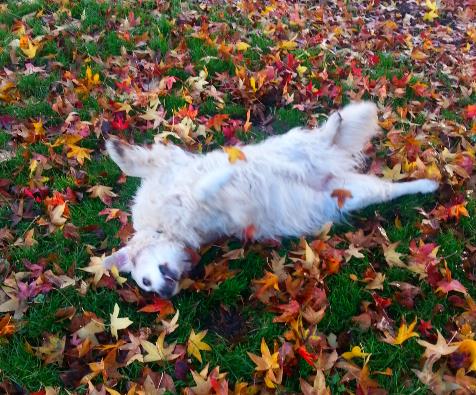
rolling in leavesNow, as she ages, she prefers gentle play. Tug with me or a (very few) special friends, whom she will approach, tug toy in mouth, and invite to play. Catch, if the again, specially selected, person gently throws the ball to her, she will either catch it or nose bump it back in the person’s direction. The person’s job is to get it from her or catch it and toss it again. She especially likes playing this game in the water.

But Jana’s all-time favorite recreation is rolling: Rolling in grass, especially if it is so freshly cut that the mower is still working. Best of all if it turns her green. Rolling in sand is also excellent, mostly because that means we must be at the beach. Mud is pretty great, too. Jana has has a lifelong goal of becoming a black golden retriever.

For Cali, of course, the only game in the world that matters is tennis ball. Frisbee will do in a pinch. I don’t call it fetch, since that is rarely what happens. (The bringing it back part, I mean … there is something about the “retriever” part of their name that eludes both girls).

Photo by Christina Phelps

Cali rarely plays with other dogs, except her sisters, Dora and Alberta. She will occasionally play with a smaller dog. Like Jana, her reaction to large dogs of other breeds is wary avoidance. Also like Jana, she’s more interested in meeting other golden retrievers and some Labradors, usually the smaller, calmer ones. Unlike Jana, Cali rarely warms up enough to play with them.

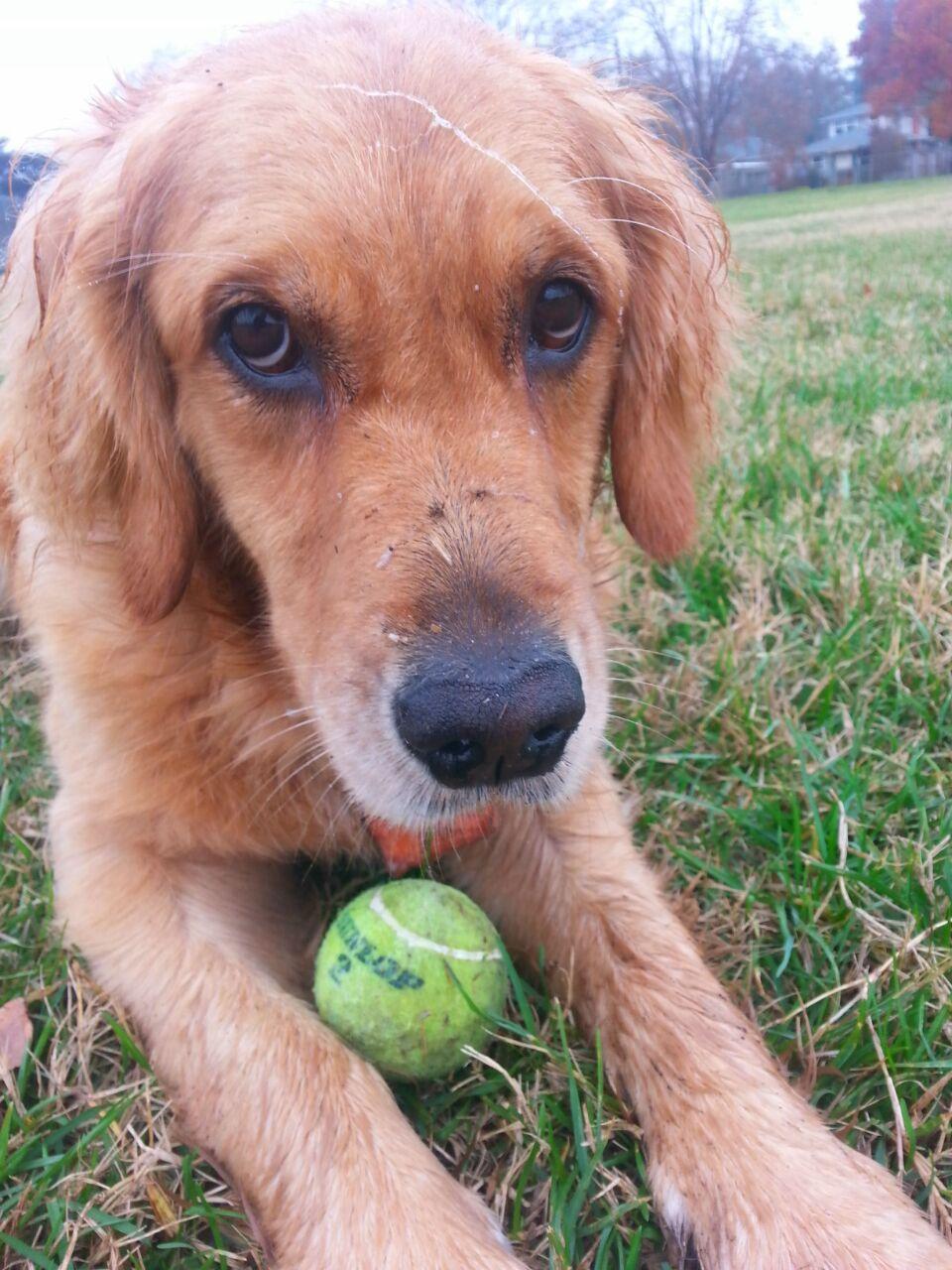
When she gets into a good game of running after her ball and sometimes bringing it back but usually just hanging out with it in the middle of the park, she gets a good drool worked up. She’s developed the unusual talent of drooling onto her own head, as the photo shows. She usually soaks her feet, too. The tennis ball gets a pretty thick coating too, mixed in with dirt and who knows what else. I know that dogs don’t sweat, but Cali also seems sweaty when she’s been running. And of course her feet and legs and tummy get covered in mud (as well as drool). Her messiness is a reliable measure of how much fun a play session has been.

She’s Very Patient; or Is She Stubborn?

A few weeks ago, Cali showed protective behavior when another dog at the park seemed to be interested in her ball. I wrote about it in a post that was published on Dec. 14, No More Toys.

I did stop taking the ball. We’d walk to the park, and Cali would get more and more excited as we got closer. I’d turn her loose and tell her to go play. And she’d sit and stare at me.

Stubborn CaliDay one. Fixed stare. Day two. Fixed stare. Days three, four, five … this went on for more than a week.
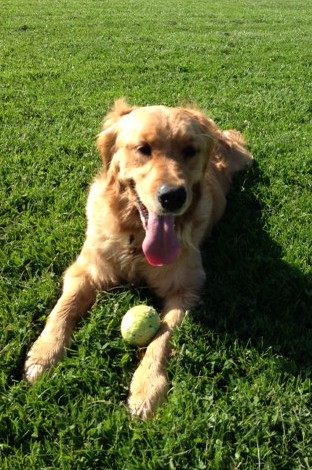
Cali did not play with another dog. She did walk around the park, following me, stopping every few feet to sit in front of me and stare.

Deni suggested that I bring a non-ball toy and try to get Cali to play with Ronen, Alberta’s Labrador friend. Cali watched Ronen run off with the tug toy. Then Cali sat. And stared at me.

A couple of times, there were no other dogs at the park when we got there. Cali sat and stared at me. Just the two of us, alone in a huge meadow, perfect for ball playing. I decided to bring a ball and only let Cali play with it if no other dogs were around.

Who was I kidding?

Now, Cali’s sit-and-stare-at-mes were punctuated by brief pop-ups. Up onto her hind feet, quick poke with her nose to my backpack (or pocket), where the ball was. Then pop back into her sit. And stare at me.

I was trying to out-stubborn Cali? I was delusional. Cali is very stubborn. Or, from her perspective, extremely patient.

My firm resolution softened. I decided to let her play ball if there were only a couple of other dogs there. Well, maybe if there were only four or five dogs. Or more, but not big ones. Or if they were far down the field … You can see where this is going.

So, once again, we play ball at the park.

I do stay far from the other dogs, and I put the ball away if the more rambunctious ball stealers are there. For her part, Cali is (a little) better about bringing the ball back to me. Sometimes. And she hasn’t so much as given another dog a dirty look.

I’m calling it a compromise.

No More Toys

It’s so obvious that even the young girl at the park knew it: Taking toys to the dog park is a bad idea because the dogs might fight over them. So spoke the wise sage, who couldn’t have been older than eight.

And yet, for months (years?), I’ve been taking Cali to the park to play ball. She’s obsessed with her ball. Only her ball; she won’t touch any other ball. And when she’s there, she gets nervous if too many other dogs are playing nearby. They might take her ball. It has happened; and, with some dogs, it’s a challenge to get her precious ball back.

With all that I know about dogs, you’d think I would see the writing on the wall. Smell the coffee. Choose your cliché. I didn’t, until this morning, when Cali actually lunged at another dog.

Yes. Sweet, gentle Cali, who loves all humans and nearly all non-humans. Who wants to befriend the cats and birds and squirrels that Jana is trying so hard to chase. Cali, who comically crouches and grovels, trying to convince tiny Chihuahuas and toy poodles that she’s eager to play with or submit to — not harm — them.

Barley, who owns the above-mentioned wise child and their mom, is a goofy, energetic, one-year-old golden doodle. He’s at that precarious stage where he’s lost his “puppy license” but doesn’t yet understand all the rules of civilized dog play. When he gets out of bounds, the grown-up dogs at the park reprimand him rather than tolerating the puppyish misbehavior. Most are very appropriate; he usually reacts well, and the play continues. We are very lucky to have an extremely nice group of regular dogs and dog parents, and the dog play is nearly always healthy and energetic; I’ve rarely seen dogs behave aggressively.

Barley was inviting Cali to play. His energy might well have been too much for her; she’s pretty sensitive. But she usually just hunkers protectively over her ball and ignores the other dogs. Or picks up her ball and walks away.

At least, she did. Until today.

Barley ran by, seemingly trying to take her ball, and she jumped up and barked. She might have even growled a little. Cali!

I scolded her and was on my way over to leash her up and go when … she did it again! Barley’s mom was very nice about it, but I was mortified. Cali usually has better manners than that. And I should know better.

The truth is, I had been thinking about leaving the ball at home. I was not expecting Cali to lash out at another dog, but I was hoping to encourage her to play with the other dogs. When Alberta is here, Alberta plays with other dogs and tries to get Cali involved. It seems like such a great way for Cali to get exercise. A lot better than lying in the grass clutching her ball, anyhow.

So that’s it. No more toys at the dog park for Cali. And a big bonk on the head with a rolled-up newspaper for me.

Maybe She Had a Cold

I watched Cali run to and fro one morning, searching for her ball at the field where we play. She was so busy anticipating my throw that she ran full-on in the wrong direction and therefore had no idea where the ball landed.

She does not use the logical grid search technique that Wylie, the German shepherd who once shared my life, used. She often runs right past the ball without seeing it. She usually seems to follow her nose, and she always does manage to find her ball, eventually. It’s a large field and sometimes the search takes a while. She wants only her ball; she sniffs and rejects any other ball that happens to be in her path.

But her nose seemed to be broken on this particular morning. Or maybe she just had a bad cold. She ran past the ball several times, almost touching it, without noticing it.

Cali also does not appear to have read those studies that say that dogs, even very young puppies, can and do follow human pointing gestures. Or the training manuals that assure us that our body language looms large in our dogs’ minds, and they will go in the direction that our body, eyes, and feet are pointing, no matter what verbal cues we’re giving them.

Nope. My voice, arms, feet, and body were all telling her the same thing. I even walked toward the ball, stood two feet away, and pointed. No response from Cali, who glanced briefly at me before continuing her random search.

She did, ultimately, strike gold. She then watched me throw the ball once, brought it back — and lost it again on the next throw.

Another thing. Those studies about how dogs know what people can see and therefore tend to deliver the ball to a person’s front rather than her back? Cali hasn’t read those either. Or maybe she thinks that, because I am her mom, I have eyes in the back of my head (my mom did!). I tell her that doesn’t work for adopted kids. I pretend not to know where the ball is. I beg her to bring it to me. I demand that she bring it. I walk away. No luck. She loves dropping the ball behind me. Maybe she just has an odd sense of humor.

I enjoy reading all these studies about dogs’ cognitive abilities, and I really believe that (most) dogs do have great potential for problem solving, interspecies communication, and other feats of intellectual greatness. But playing with actual dogs like Cali is a good reality check sometimes.

Better and Better

Montana just gets better and better.

Cali and Jana’s cousins came to visit recently. Ziggy and Hannah live in Kansas, where summer is full of scary thunderstorms and terrifying lawnmowers. Up here on the hilltop in Montana, there are no lawnmowers at all. Thunderstorms are rare. There’s a huge play yard and lot of places to go hiking. Ziggy was excited.

Cali, Jana, and their cousins went to Missoula to visit Scarlett and her sister, Gracie. Then they went for a walk by the river, saw a huge carousel, met some really friendly Montana kids, and then, best of all, they got to go out for ice cream. The nice lady at the Big Dipper gave each dog her own cone! Ziggy and Jana and Cali ate theirs really fast, but Hannah showed her good breeding and manners, licking her cone delicately and not dripping it anywhere.

Hannah and Ziggy quickly learned to use the automatic dog door, and they each got their own key. Hannah thinks that it opens when she barks at it. She likes to bark, so that suits her just fine. Jana’s friend Molly came for a visit, and she remembered how to use the dog door right away, even though she hadn’t been over to visit in a really long time! She’s super-smart because she’s a poodle. She knows that barking is not what makes the door open.

Molly likes to bark too, but with all the girls barking, Jana and Cali’s mom couldn’t get any work done, so she told everyone to be quiet. Meanie!

The cousins and Molly loved playing out in Cali’s big play yard. They chased the ball, chased Cali or Alberta chasing the ball, ate grass, barked at deer, chased each other some more … when they got tired, they went back inside and piled onto the dog beds or stretched out on a rug. Hannah and Ziggy thought that Montana was pretty awesome. Molly, a native Montanan, couldn’t agree more.

After Hannah and Ziggy and Molly went home, Cali, Alberta, and Jana finally made plans to go to Packer Meadow. Jana loves this place and told Cali and Alberta all about it, but Cali and Alberta had never been there. It’s huge and very green. Jana remembers being there when it was so full of purple flowers that it looked like water. Speaking of water, there’s this really great stream that runs through the meadow. Brrrr. The water is very cold. But a dog can jump in and climb out and jump in and climb out and jump in and … all day (or until her mom makes her leave. Meanie.).

Unfortunately, the day they went, Packer Meadow was closed because it was too close to some huge forest fires. Good thing that Mom always has a backup plan; the girls had a great afternoon at Jana’s second-favorite place, Fort Fizzle. Jana found the first of her heart-shaped rocks there. She loves splashing in the river, finding rocks, rolling on the bank, and chasing sticks. Cali chased tennis balls; one almost got lost way out on the rocks, and Alberta wouldn’t bring it back, but Cali finally agreed to go and get it. She got a bunch of cookies for that. Maybe Mom is not such a meanie after all.

And guess what! They still get to go to Packer Meadow in a couple of weeks. Montana sure is a great place to be a dog.


Playing Around

This slideshow requires JavaScript.

Cali and Alberta both have great social skills, and their play together is cooperative and fun. They never fight and are good at reading each other’s signals. When one wants a break, the other complies.

Bringing a third dog into play always changes the dynamic, and when it’s a puppy or adolescent who’s still learning the rules of social interaction, everything changes. So, when Scarlett joins Cali and Alberta in play, the energy level goes up — and sometimes the tension level escalates as well.

Often, the three girls have a ball chasing each other around Scarlett’s huge yard, tugging on Alberta’s ears, sneaking veggies from the garden, and generally being silly together. Sometimes, though, one dog — most often Cali — seems to be trying to calm things down. When she’s not able to do this, I know that I have to get involved.

How do dog owners know when play is going well and when they need to intervene? This question is especially important at dog parks, where the playing dogs might not know each other well and where, unfortunately, many owners don’t pay enough attention to what their dogs are doing.

As our dogs’ protectors and advocates, it’s important that we are aware of what’s going on whenever our dogs are playing with other dogs (or with children). I suspect that, even among friends and family, most dogs don’t play much when their people aren’t around. I think that our presence helps them feel safe and confident that things won’t spiral out of control. It’s our job to understand that responsibility — and to step in when our dogs need our help.

So, back to Cali, Alberta, and Scarlett. The photos at the top of this blog post show healthy play. The dogs’ tails are held high. Their faces are animated, and their mouths are open in relaxed (not stressed) smiles. They are not holding their ears back tightly or tucking their tails.

The way they are playing is also important: There is not one dog who is always being chased — or doing all of the chasing. When they are wrestling, again, there is not one dog who always seems to be the target (or aggressor). They change roles, change games, go from chase to wrestle to tug to chase with a fluidity that comes from reading each other’s body language and paying attention to each other’s signals.

What does it look like when it goes wrong?

I step in if I see Cali’s tail go down or I see her trying to walk away. If she’s trying to leave the group and one of the others (usually Scarlett, an energetic eight-month-old) jumps on her or runs after her, I know that Cali needs a little help. Sometimes, she just stands there with her head and tail down, looking overwhelmed. Calling her to me or gently redirecting Scarlett to a toy works. Scarlett is a smart girl and wants to play — she’s not bullying Cali. She simply is not always ready to stop playing or quick enough to read the signal that Cali has had enough. I know these dogs and can read their body language pretty well. I can step in and ask everyone to calm down — and get them all to cooperate.

In more public spaces, like dog parks, owners might need to intervene more forcefully to help their dogs if play with unfamiliar dogs starts to deteriorate into something too wild or rough. Also, if there are a lot of dogs around, “dogs getting carried away playing” can turn into bullying or even a fight in seconds, with more dogs piling on.

Owners of relatively soft dogs (like Cali) who won’t stand up for themselves should be prepared to extricate their dogs if a situation becomes overwhelming — and this can happen any time a softer dog is playing with other dogs. Body language to watch for includes repeated looks to you, as if seeking help; lowered ears or head; a tucked tail; or any baring of teeth.

If you’re not sure of the other dogs, it’s best to avoid the situation. We’re fortunate to have a play area where we live that attracts a regular crowd of very nice dogs. Cali has become comfortable with most of these dogs. Even so, she usually prefers to play ball with me and rarely engages with another dog. It’s not that she doesn’t enjoy lively play; when she’s with her sisters or a good friend, she lets her guard down completely.

If you don’t have a “regular” play group, look for a few well-matched (size and energy level) dogs and try to set up regular play dates. Or find ways to exercise your dog without other dogs. Plenty of dogs would rather play with their humans anyhow!


Agility Offers Fun for Thinking Dogs

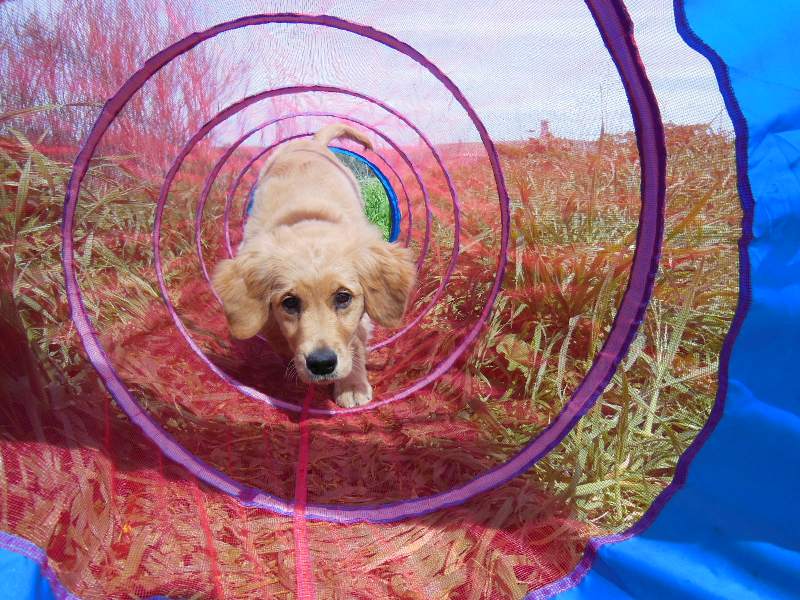
lost in the tunnelCali and Alberta started taking agility classes a few weeks ago. Watching Cali puzzle through things and figure out what we want has been fun. I can almost see the wheels turning in her little head.

Alberta is more experienced with dog sports and classes, having nearly completed her Rally Advanced Excellent title. She catches on very quickly, but knowing what we want her to do doesn’t keep Alberta from showing her silly side in class sometimes.

In the first couple of classes, we worked on targeting a small piece of foam on the floor. Both girls are proficient at hand targeting and were able to touch our hands, on cue, no matter whether we placed them high, low, on our backs, or anywhere else. Getting them to touch the foam mat was easy, too, but … both Cali and Alberta quickly went from simply touching it to retrieving it. Alberta, in particular, has a great working retrieve and has often been rewarded for bringing Deni items that Deni didn’t even know she had dropped.

I’ve been working on teaching Cali to bring my shoes, and, like Jana and Oriel before her, she has shown some entrepreneurial spirit, bringing things that I don’t even know that I need (or want) — in hopes of exchanging them for a small cookie.

So it’s not surprising that both Cali and Alberta think that we want them to retrieve the small mat, rather than simply touch it. Or perhaps they know that we want them to touch it but prefer to retrieve it.

They both are eager to jump onto the agility equipment, out of turn or when we’re waiting for our turn at a different piece of equipment. No fear from either of them; just eagerness to learn more and try out new challenges.

Practicing at home is also fun (and can become a three-dog circus pretty quickly). Jana wants in on the action, and when I was guiding Cali through some fake weave poles, Jana knocked one over with a swish of her tail — while grabbing another and running off with it in her mouth. Meanwhile, Alberta knocked over the other two! Poor Cali never had a chance. With more practice, though, we have managed to get all three girls to walk between the poles, though we still occasionally lose a pole or two to a swishing tail.

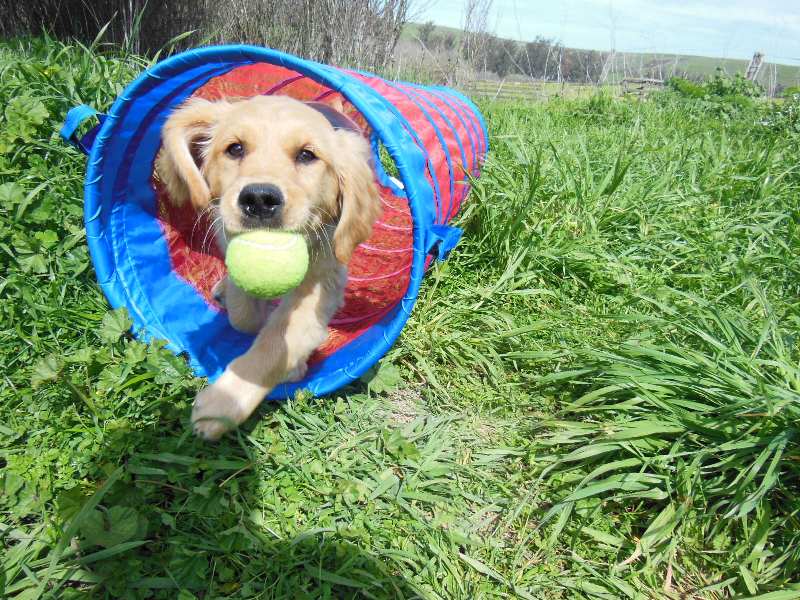
Out of the tunnelNone of our girls has any trouble with tunnels, though Cali did try to circumvent the tunnel once, taking a shortcut to where I was standing. She has always loved tunnels. Cali had a wonderful little play tunnel when she was a puppy, and Jana had plenty of exposure to tunnels before her first agility class. So neither of them hesitates, even when the tunnels are curved or have a piece of fabric covering one end, though many dogs resist entering a tunnel if they cannot see through to the end of it.

I thought about this last week as I was working with a neighbor’s dog, an adolescent golden retriever who is unwilling to use her dog door. The door flap makes her nervous. I rigged up a tunnel using a small table and a towel, and after a couple of sessions, she was willing (though still not exactly eager) to go through it for cookies. She’s uncomfortable with the small space, the towel brushing her back, and her inability to see what is coming. She’s improving, but she reminded me of how important it is to expose dogs to all sorts of tactile experiences, starting at a very young age.

Even that is not foolproof, though; this dog did use the door flap when she was younger, until she had a scary head-to-head confrontation with the cat as she went through the flap. My jerry-rigged tunnel will (I hope) help build her confidence in the same way that agility classes are boosting Cali’s confidence and awareness of where her body is. Classes in agility or other dog sports are a lot of fun — and they improve the dog’s focus on you and your communication with each other. Besides, they provide plenty of mental challenges to your thinking dog!

Play By the Rules

Dogs just seem to know how to play by the rules. Ethologist Marc Bekoff makes this argument based on years of observing dogs and their wild relatives — at play. In a 2010 article in Scientific American, “The Ethical Dog,” Bekoff describes four rules that dogs use to govern their social relations: Communicate clearly; mind your manners; admit when you are wrong; be honest.

Social play helps dogs (and humans and other social beings) manage and maintain social connections. Individuals who do not play well with others often suffer in other areas of their lives. Coyotes who don’t play fairly and are ostracized when young tend to leave their family packs more than better-socialized coyotes — and they have a significantly shorter life span.

While the stakes for domestic dogs are lower — they can survive nicely in one-dog homes — there are still consequences, as anyone who has lived with a poorly socialized dog knows well. Some people cannot board their dogs or must avoid any outing where another dog is likely to appear. Some walk their dogs very early in the morning to avoid other dog-walkers.

Some people, unaware or uncaring that their dogs lack social skills, go to the park anyhow. Fortunately for Cali and Alberta, they have a big sister who’s willing to enforce the rules.

Not long ago, Alberta was happily playing with another Lab at our neighborhood park. The Lab was excited and got overly rough. Alberta, in her sweet, polite way, told him that he was being too rough. That didn’t work. She tried to avoid him, but he still didn’t get the hint. Jana had had enough. She got up and, with all of her senior-dog-dignity, approached the other dog — and gave him an earful.

After being told off by his elder, the Lab finally got the message. He apologized, and play continued at a more appropriate energy level. All was immediately forgiven.

A dog I lived with many years ago even applied the principles of fair play to human-human interactions. We were on a walk once when we came upon a group of young boys, around 8 or 9 years old. Two or three of the boys were hassling a smaller boy. Timo, all 12 pounds of him, was incensed. Though leashed, he lunged, barked, and snarled at them. Startled, the bullies ran away. Timo shook himself off and strutted home.

Most dogs learn the “rules” from their littermates, which is one key reason that puppies should stay with their siblings until they are eight weeks old. Good puppy classes are another place for puppies to acquire these all-important social skills.

Wherever your pup learns, make sure to play, and play often with him. As I’ve written, it is the best way to maintain a close bond.