The Garden Is Going to the Dogs!

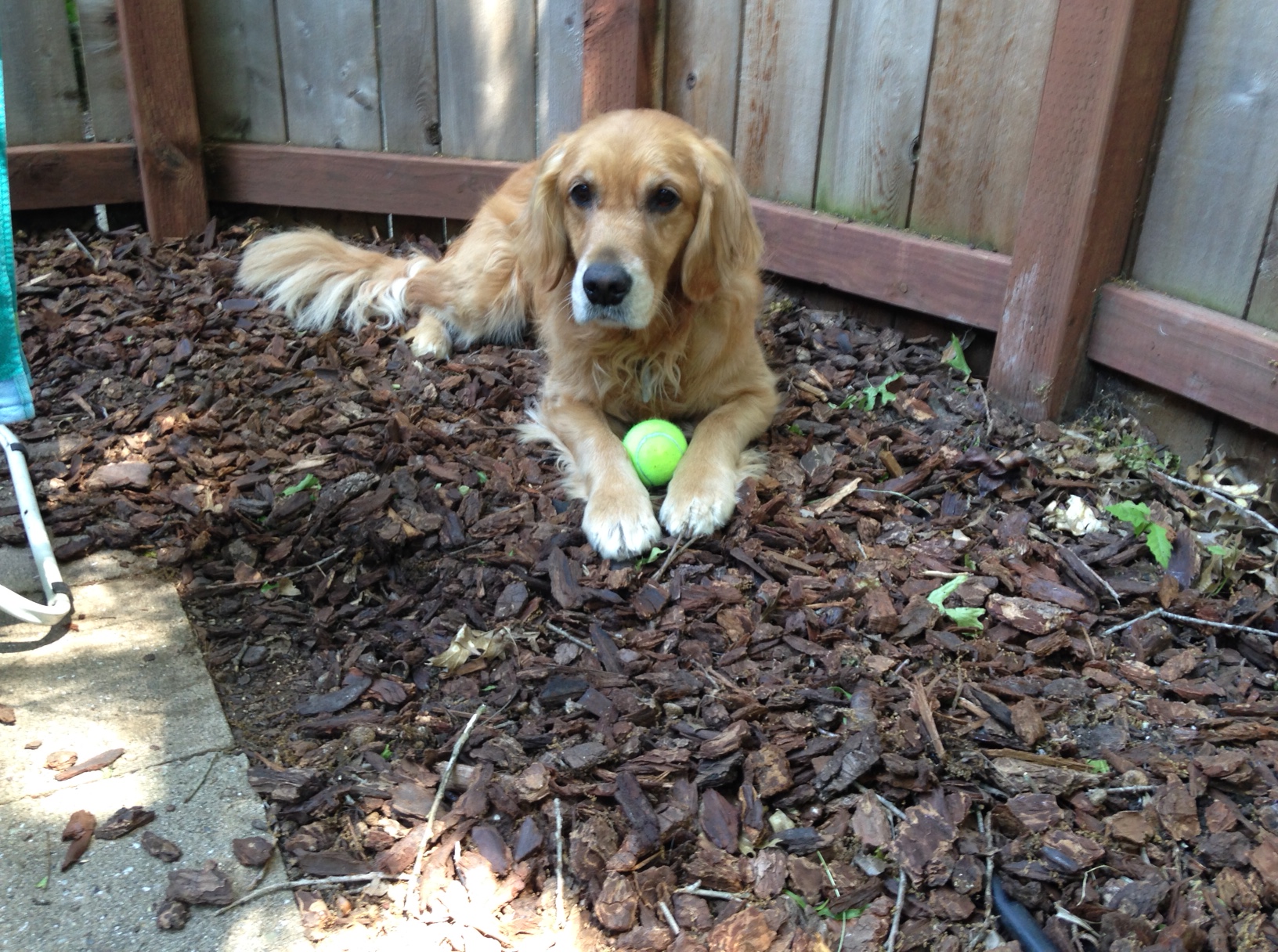
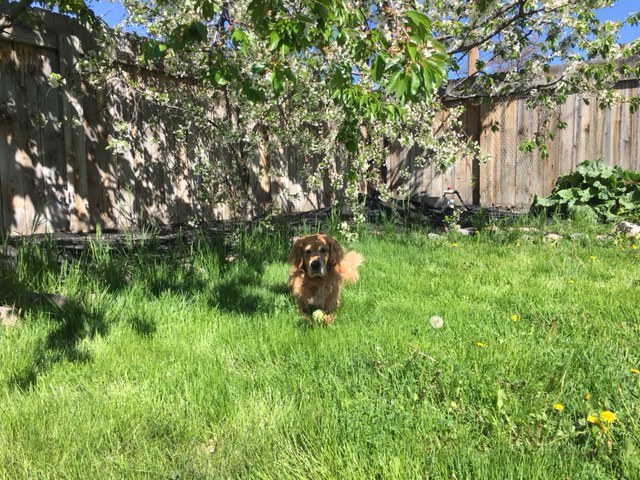
Cali, under the blossoming cherry trees, with her tennis ball.

It’s February in Montana, so reading an article about planning a “sensory garden” for dogs was a nice escape from the cold. Since Cali has staked her claim to the back yard of our house, though, and much landscaping is needed, it’s also great inspiration.

The first piece of advice is to watch how the dog uses the space — where she hangs out, where and what she sniffs. That’s easy. Cali’s favorite spot is under the cherry trees and next to the raspberries. In the summer, her favorite spot is in the raspberries, harvesting and eating as many berries as she can reach. But even in the winter, she’s most likely to be found in that corner of the garden.

Then, plan ways to enrich the garden for her enjoyment and mental stimulation. This means stimulating all of her senses.

Foremost for dogs is, of course, smell. Plant things that she enjoys sniffing. Ideally, plant several plants and flowers that will bloom and grow at different times of the year. Here in Montana, that’s a fairly small part of the year, so other senses will have to dominate in the winter.

For visual stimulation, the author of the article suggests rocks, logs, items of different heights to create variation.

To stimulate hearing, she suggests running water, wind chimes, or rustling plants. Those wouldn’t really work too well in a Montana winter either, but in our somewhat urban neighborhood, there is plenty of aural stimulation.
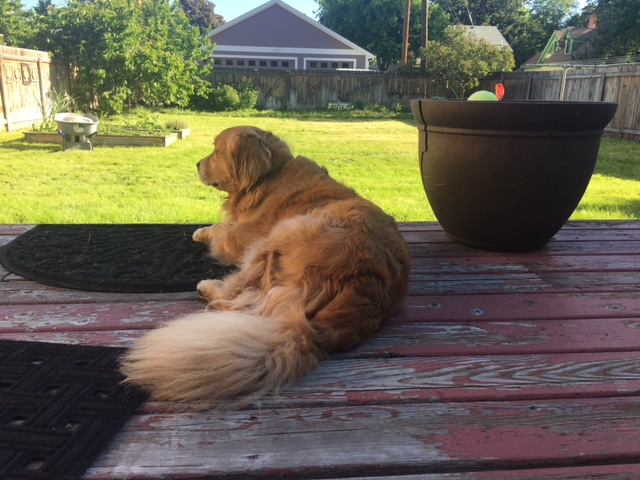
Cali surveys her yard from the deck
When not under the cherry trees, Cali enjoys her perch on the deck

Taste is a tough one. I have always discouraged my dogs from sampling the garden plants. Timo, my first dog, loved lemon verbena and once ate every single leaf from a small plant. The plant did not survive the assault, but Timo and the larger one coexisted happily for many years. As a puppy, Jana enjoyed harvesting strawberries and blackberries in our garden. Cali enjoys the cherries and raspberries in season, of course. But the suggestions of verbena, thyme, and other safe and appealing plants are worth considering.

Finally, tactile stimulation is essential. Cali loves to dig; I have thought about creating a digging spot for her in the garden. Another suggestion is using a variety of textures — grass, mulch (check and check) and paths made of stones or crushed granite, or even sand. We can definitely work more of that into our landscaping.

A final suggestion is creating opportunities for the dog to run around. When Cali has friends over, they do create a sort of circuit, looping into the cherry-tree corner and under the clotheslines.

Some other things to consider:

  • Know which plants are toxic to dogs and avoid these.
  • Use raised beds, pots, or plant borders to steer dogs away from no-go zones, like the vegetable patch. Interestingly, though Cali dug up all our baby tomato plants the day we planted them, she never bothered the vegetable gardens after that, even though she loves cucumbers, and the cukes were well within her reach. She quickly learned that the raised beds were my turf.
  • Consider your dog’s age and activity level. For some dogs, simple agility equipment or things they can climb or jump onto are a good addition.

The garden can be very appealing to humans, too. But too many yards are designed only for the people in the family. Since Cali spends exponentially more time in our yard than I do, it’s only fair to create a place she will enjoy fully!

3-Way Tug

Most of us probably think of “playing tug” as a one-person, one-dog game. Or a two-dog game. Or a two-team game: Those tug-o-war contests in management courses that intend to build teamwork feature two teams — two teams that are pitted against one another. It’s a reasonable understanding. The players are tugging at opposite ends of a rope, after all. There are only two ends.

But what happens when there are three dogs?

Option 1, one dog gets left out, is unacceptable.

Option 1a, the left-out dog has to play with Mom, is even worse.

Option 2, the third dog hassles the other two and badgers them into giving up their game, ends up making everyone miserable.

Enterprising dogs come up with Option 3, a solution that is better in so many ways.

This slideshow requires JavaScript.

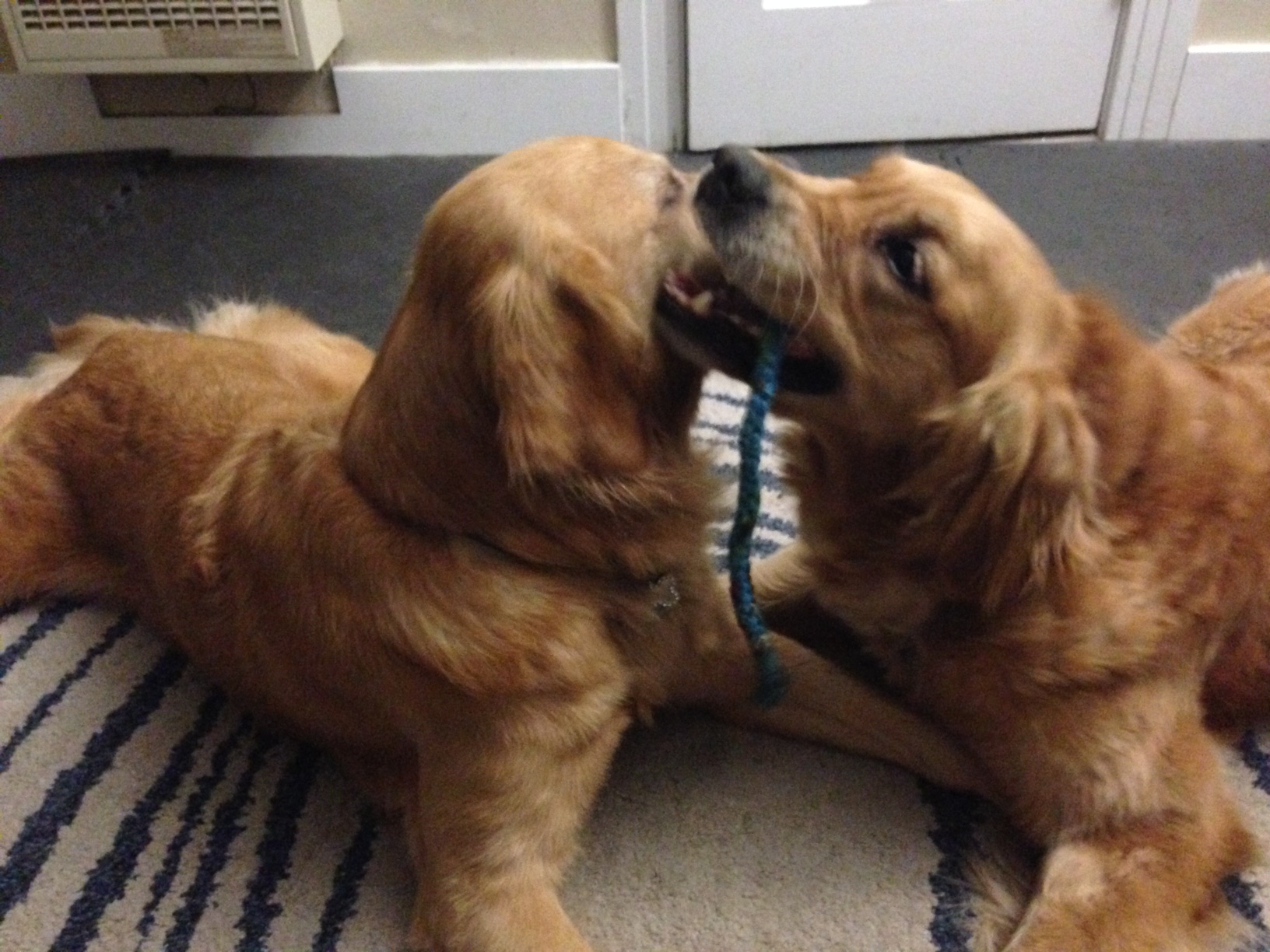
Option 3 is three-way tug. All three dogs get to engage, play, tug on the rope. No one wins. No one loses. No one is left out. Instead of tug being a zero-sum game, tug becomes an enjoyable, collaborative activity. The goal is having fun. And the more fun each dog has, the more fun they all have. Everyone wins. But Mom/auntie gets left out.

Actually, that is not true either. Mom gets to sit on the sidelines and take photos and enjoy the dogs enjoying themselves.

Truly, everyone wins.

So, what did I learn from watching Cali and her cousins invent and play three-way tug?

  • There are many ways to solve a problem.
  • It’s possible to find a solution that benefits everyone.
  • Collaboration is rewarding and, in some cases, a lot of fun.
  • Rather than sulking over being left out or bullying your friends, it’s possible to change the dynamic to something more positive.
  • Having fun until you’re too tired to stand, then taking a nice nap, is a better way to spend the afternoon than arguing or feeling resentful.
  • Dogs are smarter than people.

OK, I already knew that last one.

Dogs are great problem-solvers. They live in the moment and want to be part of whatever fun thing is happening. Maybe the solution was obvious; it didn’t take long for these three doggy friends to come up with it.

But if it’s so obvious, how come none of us ever thought of three-way tug?


Is Cali a Wagg’n Dog?

Cali plays with a new friend at Wagg'n indoor dog park

Last week, I wrote about dog parks in general. Here, I want to share Cali’s experience with an indoor dog park, Wagg’n, in Missoula. I think the concept is great. Missoula, Montana, has a lot of winter. Cold, gray winter. Plenty of fluffy snowy winter, too, the kind of days we want to play outside. But when it was 7 degrees, I was really happy to have an indoor play space available.

The park is set up nicely. It’s a huge warehouse-type space with a high ceiling — including several skylights, so it’s bright — and it is bright and clean. The floor is matted with recycled rubber mats, and there’s a potty area with fake grass, an efficient enzymatic cleaning system, and drinking fountains. It does not smell doggy or kennel-ey at all. There’s a double gate at the entrance, and there are always at least two staffers, usually three, on hand.

On the rare occasions that a dog has gotten out of hand while I’ve been there, the staff are calm and professional in how they de-escalate. I have never seen any dog show aggression while I’ve been there. The worst I’ve seen is overly exuberant play or a dog that keeps trying to engage another dog who is clearly saying he’s not interested, is overwhelmed, or is stressed out.

I have seen several dogs show signs of stress, however. Including Cali. Some dogs there for daycare spend their time under a sofa or on the lap of any available human, for example. Others hang out at the gate, trying to escape. Not good.

Cali is a bit of an enigma. She gets excited when we drive there, and she clearly knows where we’re going (it’s out by the Missoula airport in the middle of nowhere … we never drive that way when we’re going anywhere but Wagg’n). She’s excited when we get out of the car and happily — excitedly — greets the owner and staff. Then … she hangs back a bit when we head into the play area. She likes to be on the sofa or a bench, often with me, at first. Within a few minutes, though, she jumps into the fray and chooses a dog to play with. She can be a little bratty and pushy if the chosen dog doesn’t reciprocate … leading to intervention from me, Cali getting back on the sofa, etc.

She enjoys the playtime. She also spends a lot of time with me on the chairs there, drooling (a sign that she’s excited and/or stressed). She wants to go there, but while we’re there, I watch her pretty closely. When she’s had enough, which can be after 15 minutes or after an hour and a half, she wants to go. Now.

I wouldn’t leave Cali there all day for daycare or board her there. She’d be overwhelmed by that much stimulation and social time. Other dogs are fine with it; many of the regulars are happy and cheerful whenever I see them. But as a place to take a break, stretch her legs, and play, it’s great. And very necessary during a long, cold winter!

Are Dog Parks Worth the Risk?

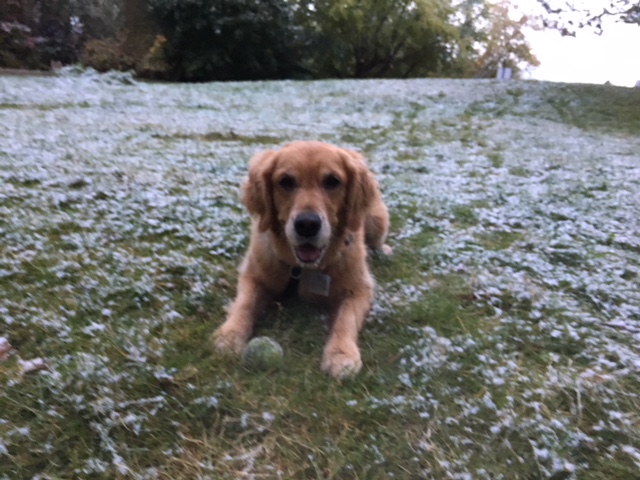
Cali holds her tennis ball at Jacob's Island dog park, early on a cold morning. A light dusting of snow covers the grass.

The current issue of the Whole Dog Journal has a section on dog parks. Though the article itself offers solid commentary and advice (of course it does; Pat Miller wrote it!), the sidebar with comments from several trainers is pretty negative. I’ve been to a lot of dog parks, so I figured this was a good chance to weigh in.

If you are thinking about heading out to the dog park, start with Miller’s seven things to consider, but don’t neglect an honest look at your dog(s), the dog’s needs, and your own circumstances.

My best dog park experience was in Petaluma, where Jana, Cali, and I walked to a local park every day (sometimes twice!). The park has posted off-leash dog run hours and is mostly fenced. When we discovered it shortly after moving to Petaluma, a regular group of dogs and their people could be found there. We soon became part of the 8 am crowd. Jana greeted each human and inspected their pockets and hands for treats, Cali occasionally played with suitable dogs but mostly bugged me to throw her ball, and I got to hang out with some fun and interesting dog-loving people. Over the three and a half years we lived in Petaluma, dogs passed away, new puppies joined the crowd, and the human group changed. Toward the end of our time there, Jana was gone, and Cali found the group of mainly young, high-energy dogs less to her liking. I was working in an office, so we went much earlier in the morning on weekdays and had the place mostly to ourselves. Weekends were more challenging.

Now, in our first Missoula, Montana, winter, we’ve joined Wagg’n, an indoor dog park. It’s also a daycare and boarding business, so the mix of dogs varies. We’re getting to know some of the daycare regulars, and Cali and I each have our favorites. Like the Petaluma park, it’s not divided into small- and large-dog areas, which would worry me more if I had a small dog. Cali’s not that interested in boisterous group play, but she usually finds one or two smaller dogs, goldens, or Labs to play with (she’s kind of a doggy racist and likes only retrievers and little dogs). Being inside changes the nature of the space considerably; it’s echo-ey in a way that an outdoor park is not, and dogs do play differently on the rubber-matted floor (with a nicely designed astroturf potty area) than they would on grass or dirt.

Before the weather turned cold and mornings became dark, we went to Jacob’s Island, Missoula’s downtown dog park, several times a week. We went early, though, on purpose, so Cali and I could play ball without her having to worry that some other dog would “steal” her ball.

These are my primary experiences of having a “regular” park, but I’ve been a drop-in visitor at dozens of dog parks. I’ve driven cross country multiple times with multiple dogs. And when traveling with dogs anywhere that’s more than about 4 hours, I generally look for a place to let the dog run and stretch her legs. Visiting dog parks “on the way” does not allow for the type of research that Miller advises, but I approach these visits as I would any new place I take my dogs. I watch for a few minutes to get a sense of the energy level, see what kinds of play the dogs are engaged in, and I look at whether the people are paying attention to their dogs or just looking at phones or talking to each other and “letting dogs be dogs.”

Like the trainers quoted in the WDJ article, I’ve heard lots of dog park horror stories, and I know that a bad experience can lead to serious injury (or worse); at minimum, it can set back your training and socialization goals considerable, shake your dog’s confidence, or lead him to fear other dogs. Though I have never personally had a bad dog park experience, I am not unaware of the risks.

I won’t take a dog into a park where I see lots of wild or rough play or people who are not paying attention to the dogs. If I cannot tell which people go with which dogs, I take that as a bad sign. The people need to be obviously watching what is going on with their dogs; otherwise, how can they intervene if needed? The person has to be the dog’s advocate and protector in any social situation, whether with other dogs or with humans (especially if children are around). I’ve leashed up my dogs and left parks where the dynamic changes, a particularly troublesome dog enters, or I feel that things are getting too wild.

At the same time, looking for dog parks is as much a part of my road-trip planning as looking for pet-friendly hotels. I can’t imagine asking my dog to spend 8-10 hours in the car without giving her a chance to run and play. Often, just wanting to throw the ball for a few minutes, I look for a corner or end of the park with fewer dogs and head there. If another dog seems overly interested in Cali’s ball, rather than subject her to the stress of worrying about it, I’ll pick up the ball and instead lead Cali on a brisk walk around the perimeter of the park.

The bottom line is that, while aware of potential problems with dog parks, I am usually willing to try out a park and find a way to make it work for my dog and our needs at the moment. I’d never leave Cali unsupervised, and that means no phone either — eyes on the dog at all times (I do sometimes take photos). It also means watching other dogs and intervening if they are rough, pushy, or overwhelming to Cali. Finally, it means being ready to pick up and leave quickly if necessary.

Two Rude Jerks Go Out For a Walk

As Cali and I were walking to the park, we saw a woman with a small terrier-looking dog. I said hello and she did too. Cali was taking a long sniff of the grass near some trash bins, so I moved aside to let them pass.

As we walked behind them, I noticed that the little dog kept picking up his rear right paw. He had impeccable leash manners, which means that the woman wouldn’t be able to see his back paws, since he was walking right next to her (paying attention, Cali?). Also, despite a lot of rain this winter, dry season has arrived. Stiff grass stubble is everywhere, as are foxtails. Cali comes home from walks full of tiny burrs. In other words, prickly things that could easily get embedded in a paw are everywhere.

So I said to the woman, “Your dog is picking up his paw; he might have something stuck in it.”

Her reply: “I’m a good pet owner.”

Is it me or was that an oddly hostile and/or defensive response? Quashing the impulse to say something defensive in return, I said, “I thought he might have a thorn or something in it. That happens to my dog a lot around here.”

She softened a little, I think, and told me that her dog has a congenital knee problem and that’s why he does that.

But, really, is the assumption that I am criticizing your parenting the go-to response for most people? That’s a sad comment on society.

Or maybe it is me. Because, a few blocks later, we encountered another dog walker. As I tend to, I detoured into the street to avoid passing close to an unfamiliar dog on a narrow stretch of the sidewalk. The other walker said, two or three times, “He’s friendly.”

When we were closer, I said, “My dog is nervous around unfamiliar dogs.”

All perfectly normal … except the implication that I was assuming negative things about her dog. Do I radiate an air of disapproval and judgment? (Please do not answer that question.)

The last encounter in this bizarrely social morning was at the park. This time, Cali was the jerk, running off an overly friendly poodle who showed too much interest in her ball. The joke was on Cali, though, because, while she was running him off and then I was reprimanding her, Maui, a dog Cali used to consider a friend, actually stole her ball. We beat an embarrassed retreat before she could challenge Maui to a duel.

I am going back to 7 a.m. walks; the park is empty and the other dog walkers are also trying to avoid dog encounters. That all makes it easier to avoid offending the entire dog and dog-owning population of Petaluma.

It’s All About Strategy

I recently wrote about how Koala uses tools, using a round chew toy as a base and holder to position a more desirable chew (an antler) for better chewing. But there’s more to her entertainment strategy than tool use.

Although she is a two-and-a-half-year-old working adult, Koala still gets puppy lunch. This is a point of contention in the family, because Jana thought she should get puppy lunch forever (but I did not agree), and Cali thinks, not unreasonably, that if Koala gets puppy lunch, she, too, should get puppy lunch.

What is puppy lunch, you ask. Large-breed puppies, because they are growing quickly, get three meals a day. Adult dogs, who only grow wider, get two (and in some cases, one!) meal a day. Puppy lunch is the mid-day meal that goes away when a dog is about a year old. Unless she’s Koala.

The first puppy-lunchless day is a day of infamy and trauma in the lives of goldens and Labs everywhere. Jana never really recovered.

Koala’s puppy lunch is a portion of kibble, served in a treat ball. The ball gets rolled and batted around, dribbling bits of food for Koala to munch. It’s fun. I have several treat balls, and sometimes give Cali food in one. She gets bored with it far more quickly than Koala, partly because she’s less food-focused. But Koala really enjoys her mid-day snack-and-play breaks.

All of that background offers the context for Koala’s strategic play approach. I was watching her eat her puppy lunch not long ago and I saw her using a fairly sophisticated tactic. We were at a hotel (at the Guiding Eyes weekend, actually) and the room had a dresser, sofa, bench, bed, etc. Lots of places a ball could roll out of reach. Koala is an exuberant dog, never more so than when playing, so the ball was getting batted around at a good clip. But it was not uncontrolled ball batting. She’d pounce, roll the ball, whap it with a paw … but always, always keeping track of the many sand-trap equivalents. Never once did she let the ball roll under or behind something. She’d pounce on it or bat it just in time, sending it in a different direction. She almost seemed to be gauging how close it could get to the edge of the bed, say, before she’d lose the ability to steer it out of danger. She’d watch, position herself, and, bam, send it careening away toward the next potential obstacle. It only takes her about 10 minutes to empty the treat ball, so this high-stakes bowling / golf game took place at an impressive level of intensity and speed. She’s really good at this entirely made-up game.

This is certainly not the first time that I’ve seen a dog play a game that she has created. What held me spellbound was both the intensity and the advanced strategy. She had an intuitive understanding of a fluid situation. Much as dogs do when they catch a Frisbee or dive into a river at the precise moment needed to grab the ball or stick as it floats by, she showed a far better grasp of physics than I ever could.

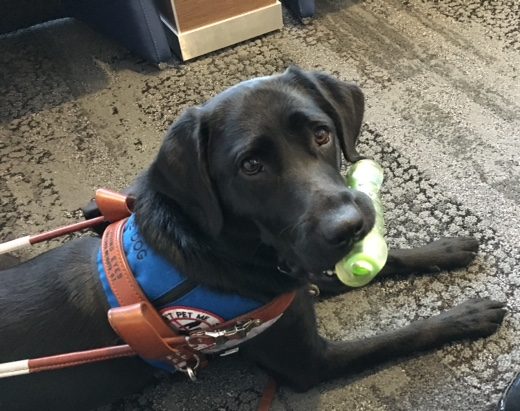
The geneticist at Guiding Eyes says that each generation of their dogs is “better” — smarter, more suited to guide work, healthier — than earlier generations. If the dogs get any smarter than Koala, we won’t need to worry about robots taking over our jobs; the dogs will beat them to it.


Social Dynamics

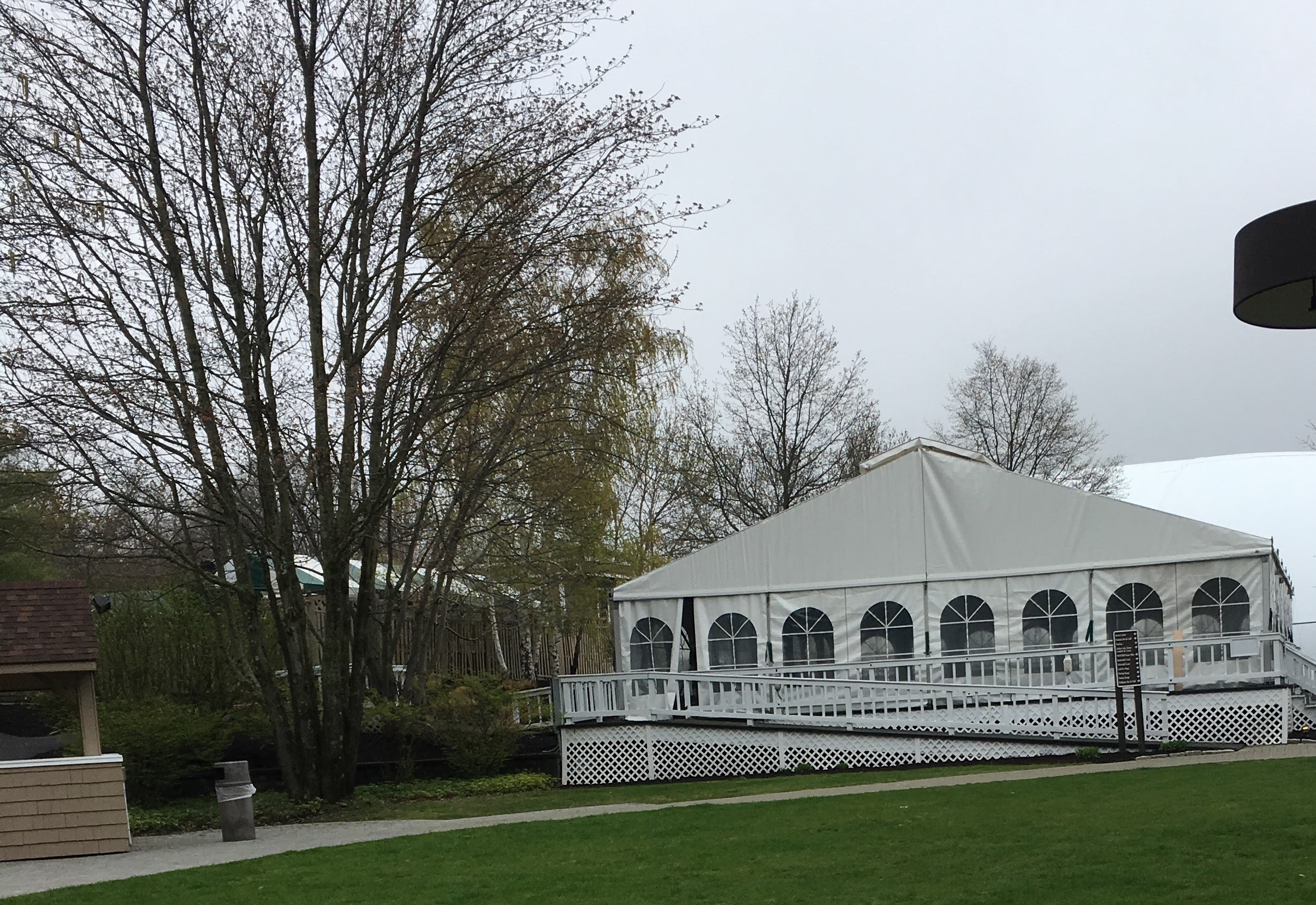
A large white structure that served as the dog play pavilion at the Guiding Eyes seminar
Photo by Michelle Russell

Watching dogs figure out the social dynamics of their constantly changing groups is fascinating. Many people assume that it’s OK to put dogs who’ve never met together in any group configuration and they’ll just instantly become friends and play nicely together. That’s an odd assumption, particularly considering that most people also don’t think that dogs communicate particularly well.

At the Guiding Eyes weekend I recently attended, I got to see how a group of experienced dog professionals handled group play. The hotel had given us the use of a covered pavilion — the type where wedding receptions might be held. It was a large space, walled in by a low fence and covered with a heavy, waterproof white cover.

Eighty guide dog teams attended the event, and they were given time slots for dog play. In addition, people wandered in and out of the play area during unscheduled evening and morning hours.

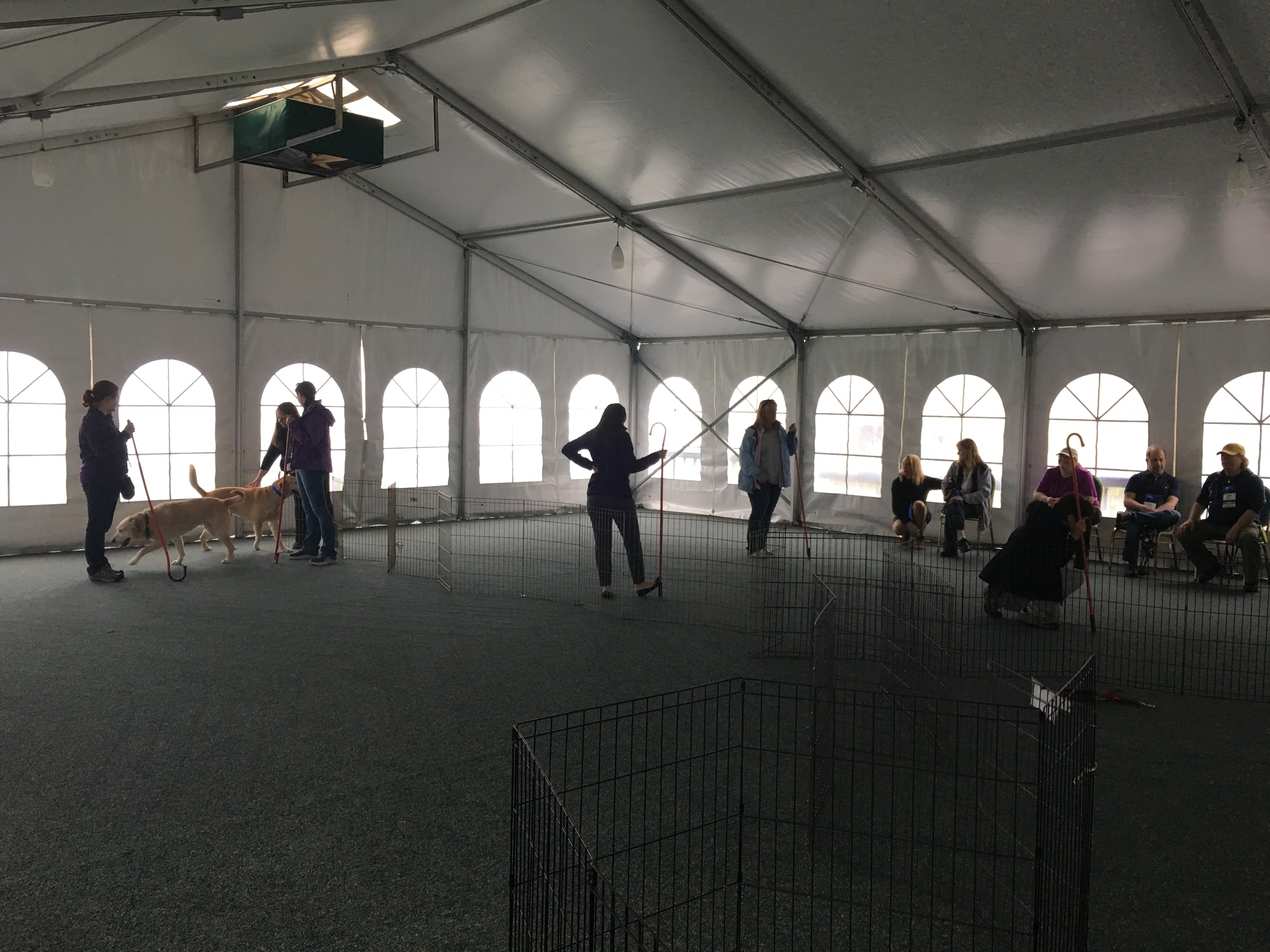
The trainers brought exercise pens to use as dividers and other equipment. It hadn’t even occurred to me that they’d divide up the space, but it was a great idea. They created three smaller play areas, never putting more than three or four dogs together. Each section had a couple of trainers keeping watch. Before putting a dog into a play yard, the trainer removed the dog’s collar, which had tags that could get caught on something (like another dog’s teeth), and replaced it with a plain collar. The dog’s partner was told the color of this temporary collar.

Trainers watch playing guide dogs at the Guiding Eyes seminar; the dogs' partners are seated along the side of the play area.
Photo by Michelle Russell

As the dogs played, the trainers watched them constantly. If a dog became overly excited or rough, the trainers used shepherd’s crooks, slipping the hook under the dog’s collar, to gently guide the dog in a new direction. During the times I was watching, I never saw any play morph into aggression or any dog get hurt, and dogs rarely needed separating.

When a dog was done playing, she’d get her collar back and return to her partner. Once, two similar-sized black Lab girls ended up with play collars of the same color. Though each partner was sure she had the right dog, the trainers scanned their microchips and checked the numbers against a list they’d brought, just to be 110 percent sure that no dog mix-up occurred.

The microchip check is probably not needed in the average dog day care or dog park, but the other precautions the trainers took are. The Guiding Eyes dogs are all very well trained, and many dogs at the weekend conference knew each other — they’d been in the same puppy raiser region or in the kennels for training at the same time. Even so, the trainers were careful to keep play groups small, match size and energy level, and monitor all the dogs’ interactions.

That’s how the pros do it.

That contrasts with what I often see at day cares and other places where dogs play. An indoor dog park a trainer friend recently described, for example, has one huge play space and minimal or no supervision. The managers allow as many as three dozen dogs to play at once. Sounds scary; much as I like the idea of an indoor play space, I doubt I’d feel comfortable letting my dog play there.

Even dogs who know each other well need close supervision when they are playing. In a large group, play can quickly escalate to aggression or bullying. Even dogs who know each other well can get over-excited or possessive of a particularly valuable toy or chew. That’s another thing; the trainers made sure that the only toys in the Guiding Eyes play pavilion were tug ropes, which the dogs, mostly Labradors, loved.

From breaking up the space to using shepherd’s crooks to ensuring constant supervision, the trainers provided a great model for dog play.

Speaking Dog

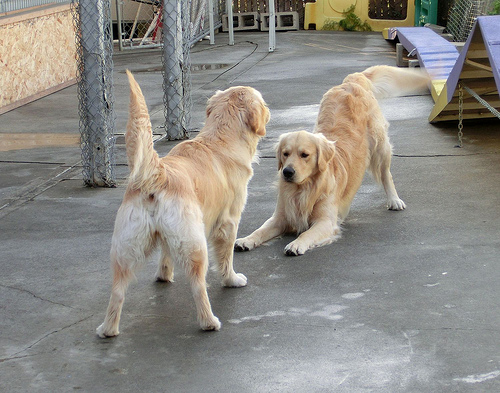
One golden retriever bows to invite another to playI saw a sad little exchange today. A brown dog and a black dog met, and, while their humans chatted, the brown dog play bowed and invited the black dog to engage. The black dog’s human reacted by jerking his dog backward, away from the brown dog in what seemed a defensive or fearful response. Brown dog’s human pulled his dog away too, then leaned down and gave brown dog a stern talking-to. It seemed that both humans completely misunderstood the play bow and the friendliness in brown dog’s approach and demeanor.

This happened just a few minutes after a conversation with a friend who had described her communication with her birds. She doesn’t teach them English; she doesn’t exactly speak their language, but they have all evolved a communication that goes beyond words and human language to describe a relationship and mutual respect and understanding.

I know little of birds; I do strive for that sort of communication with the dogs in my life, though. The dogs learn many words of English (Hebrew, too, in Jana’s case). They also excel at reading human body language. But there is another layer that comes from a deep, close relationship. It is communication. It might be language, but it’s not something anyone outside the group would understand. When a person gets to that level of communication with her dog (or her bird), it is very satisfying and intimate. Jana and I had that kind of connection, and it’s what makes her loss so hard.

Most dogs seem to try very hard to understand their people; many succeed at understanding lots of people and dogs, even cats, if they live with a cat or two. It would be nice if more people made the effort to learn the basics of dog-to-dog and dog-to-human communication.


Racial Profiling

A new dog shows up at our park play group. Is Cali interested in meeting or playing with this newcomer? Is she curious? Is she hesitant, cautious? Or does she simply head for the other side of the park and ignore the new pup? And what about Jana?

That depends on several things.

When the newcomer is a puppy, I can be absolutely certain that Jana wants nothing to do with him or her. Cali might, but she tends to watch new pup interact with some other dogs first.

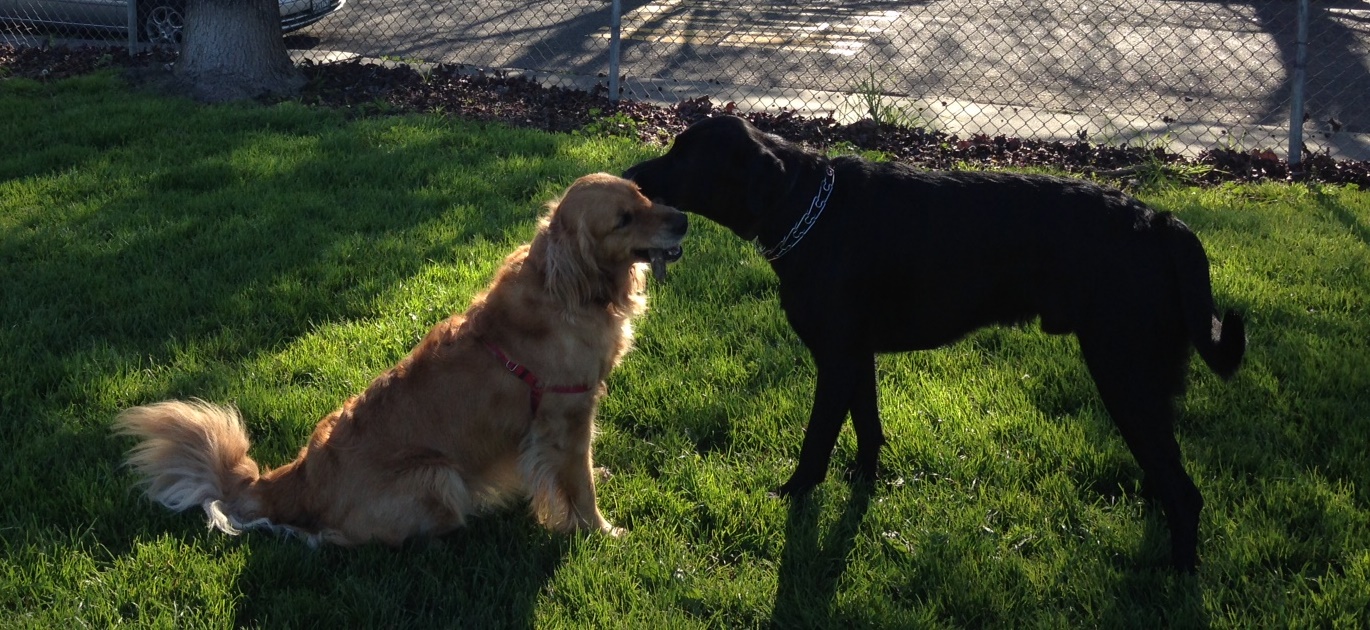
What about adolescent and adult dogs? Large dogs get a wide berth. Small dogs get more interest. But the one time I can be certain that Cali will go right over and say hello to a new dog is when that dog is a golden retriever.

Cali’s very wary of shepherds and huskies. She’s open to small poodles and terriers. A little nervous around very high-energy dogs. Very leery of big dogs, though once she gets to know them, she’s fine. She finds boy Labradors overwhelming, but has had a few Labby girlfriends. Cali’s the most relaxed with her sister Dora and a couple of other dogs she knows well, all Labs or goldens. Anyone who shows any interest in her ball is definitely off the potential friends list. Unless it’s a golden; then they can talk.

Cali is racially profiling dogs. Jana does it too. When Jana was a puppy, if we saw another dog up ahead on a walk (we didn’t have a great neighborhood park with a play group), she’d react completely differently, depending on the breed. Jana is a little broader-minded than Cali; she loved Labradors and goldens equally from early puppyhood. A Lab or golden up ahead would mean eager dancing at the end of the leash and maybe even pulling toward the potential pal. Any other dog, big or small, and Jana would slow down and walk very close to me, a bit nervous and unsure. She’d be fine once she met and got to know a dog of any breed, as long as the dog had good manners. But retrievers, dogs who looked like her — they were OK from the get-go.

It’s not just based on experience. One of the first nonfamily goldens Cali met at the park was an unusually bad-tempered young man who snarled and lunged at her. That did not make her wary the next time she saw an unfamiliar golden.

It’s not only a golden thing, either. A smooth-coated collie puppy I was working with, the lone collie in a sea of Lab puppies at a service dog training school, literally danced with joy the first time a staffer brought her smooth collie service dog to visit. I’d never seen him so happy, and he was generally a pretty cheerful guy. Then there are the German shepherds at the park. The young girl likes to play with Cali. Cali has, on a couple of occasions, accepted the play invitations. Sometimes, while she’s thinking about it, another shepherd, either a young male or an older, long-haired shepherd, will show up. Young girl is immediately off to play with the other shepherd. During breaks in that play, though, she tries again and again to invite Cali to play. She strongly prefers shepherds, but young golden girls are second.

We can’t really hold it against them; people racially profile dogs all the time. What else would you call legal restrictions on owning dogs of certain breeds or apartment rental policies or insurance policies that exclude specific breeds, without any attention to an individual dog’s personality and behavior? But I don’t think dogs learned it from us; I think they are hardwired to recognize — and feel more comfortable with — dogs of their own breed.

The (Not-So) Mean Girl at the Dog Park

Cali and Ronen play tug with a very small stick

A few weeks ago, I wrote about Cali’s unfortunate experience with a mean girl at the park. The mean girl has been back, and I think she really was just having an off day. An off couple of weeks, maybe.

Not long after she bullied Cali, I saw her go after a sweet older gentleman, a Labrador, who was lying down and minding his own business. A toy that Ms. Meanie wanted bounced too close; he must have moved to get it, and she was on him in a flash. Her dad reacted quickly and took her out of the park. Someone who was there commented that she’d done the same thing to a different dog earlier that week.

At this point, I was gunning for this dog. They’d better not bring her back to this park, I fumed.

Well, the dog came back. We had just arrived at the park when I saw them come in. My first instinct was to leash up the girls and leave. On the way out, I wandered over to a friend to chat for a moment. I said I didn’t feel comfortable with that dog there, and we talked about the best way to handle the Situation as we watched the mean girl.

She was playing energetically with Ronen, a sweet, goofy, year-old big male Labrador. Her hackles were up, and she was being very assertive, but not aggressive or even inappropriate. She played with a few other dogs, while I kept Jana and Cali close and on leash. She’s young, assertive, and high-energy, but she definitely wasn’t showing aggression or even bad manners. I finally decided to be a grown-up and actually talk to the mom.

She apologized for the Cali incident, and we talked about the other incidents and what to do about resource guarding. She said that they had signed the dog up for training  classes (hooray!), and they had exposed her to lots of other dogs for supervised play. They were working hard on a solid recall. The dog had been grumpy / reactive several times over a period of a couple of weeks, the mom said, but hadn’t had issues before or since. It sounds to me as if they are doing everything right, and they really care. I wish more dog parents were as concerned.

I’m still wary of this dog, but Cali seems to have completely let the incident go. She’s always thrilled to be at the park, happily plays with or alongside other dogs, and shows no fear of this or any other dog.

I need to learn from her: No grudges. Cali might well pick up on my anxiety about this dog, and I can create a problem where, at the moment, none exists. Wouldn’t we all be better off if we could learn to move on as effortlessly as our dogs do?