Agility Offers Fun for Thinking Dogs

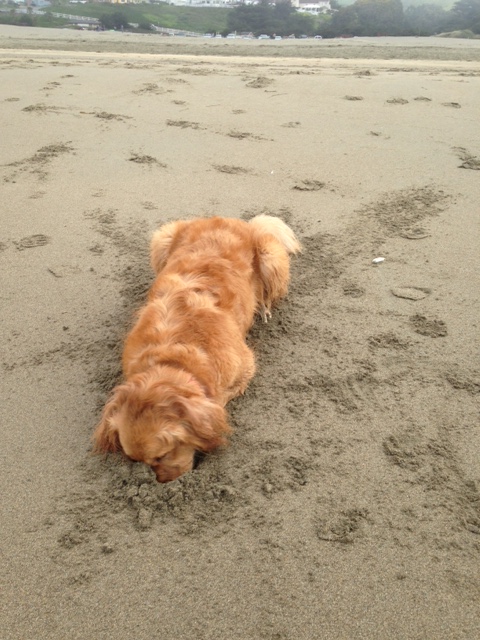
lost in the tunnelCali and Alberta started taking agility classes a few weeks ago. Watching Cali puzzle through things and figure out what we want has been fun. I can almost see the wheels turning in her little head.

Alberta is more experienced with dog sports and classes, having nearly completed her Rally Advanced Excellent title. She catches on very quickly, but knowing what we want her to do doesn’t keep Alberta from showing her silly side in class sometimes.

In the first couple of classes, we worked on targeting a small piece of foam on the floor. Both girls are proficient at hand targeting and were able to touch our hands, on cue, no matter whether we placed them high, low, on our backs, or anywhere else. Getting them to touch the foam mat was easy, too, but … both Cali and Alberta quickly went from simply touching it to retrieving it. Alberta, in particular, has a great working retrieve and has often been rewarded for bringing Deni items that Deni didn’t even know she had dropped.

I’ve been working on teaching Cali to bring my shoes, and, like Jana and Oriel before her, she has shown some entrepreneurial spirit, bringing things that I don’t even know that I need (or want) — in hopes of exchanging them for a small cookie.

So it’s not surprising that both Cali and Alberta think that we want them to retrieve the small mat, rather than simply touch it. Or perhaps they know that we want them to touch it but prefer to retrieve it.

They both are eager to jump onto the agility equipment, out of turn or when we’re waiting for our turn at a different piece of equipment. No fear from either of them; just eagerness to learn more and try out new challenges.

Practicing at home is also fun (and can become a three-dog circus pretty quickly). Jana wants in on the action, and when I was guiding Cali through some fake weave poles, Jana knocked one over with a swish of her tail — while grabbing another and running off with it in her mouth. Meanwhile, Alberta knocked over the other two! Poor Cali never had a chance. With more practice, though, we have managed to get all three girls to walk between the poles, though we still occasionally lose a pole or two to a swishing tail.
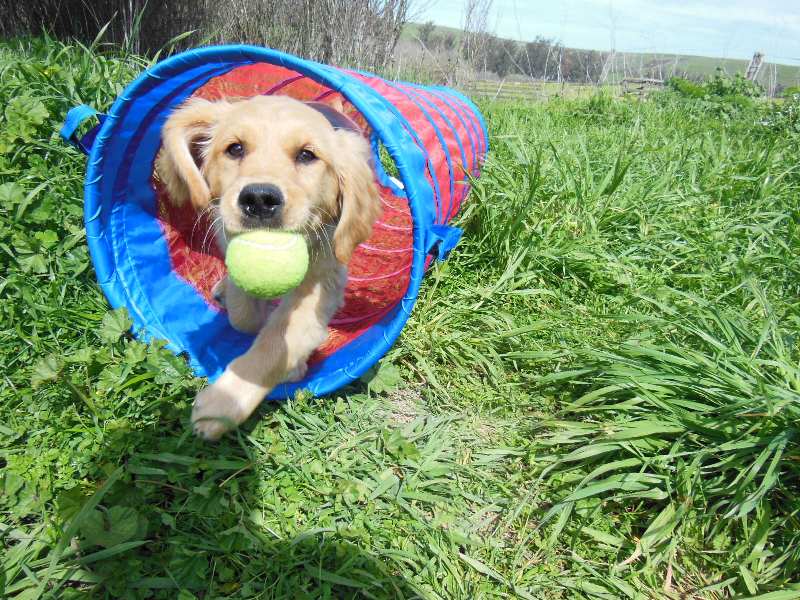
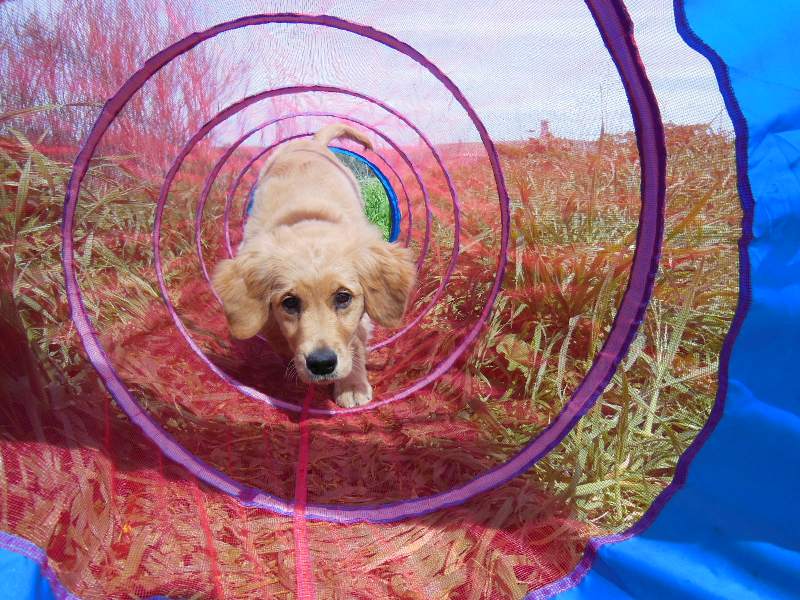
Out of the tunnelNone of our girls has any trouble with tunnels, though Cali did try to circumvent the tunnel once, taking a shortcut to where I was standing. She has always loved tunnels. Cali had a wonderful little play tunnel when she was a puppy, and Jana had plenty of exposure to tunnels before her first agility class. So neither of them hesitates, even when the tunnels are curved or have a piece of fabric covering one end, though many dogs resist entering a tunnel if they cannot see through to the end of it.

I thought about this last week as I was working with a neighbor’s dog, an adolescent golden retriever who is unwilling to use her dog door. The door flap makes her nervous. I rigged up a tunnel using a small table and a towel, and after a couple of sessions, she was willing (though still not exactly eager) to go through it for cookies. She’s uncomfortable with the small space, the towel brushing her back, and her inability to see what is coming. She’s improving, but she reminded me of how important it is to expose dogs to all sorts of tactile experiences, starting at a very young age.

Even that is not foolproof, though; this dog did use the door flap when she was younger, until she had a scary head-to-head confrontation with the cat as she went through the flap. My jerry-rigged tunnel will (I hope) help build her confidence in the same way that agility classes are boosting Cali’s confidence and awareness of where her body is. Classes in agility or other dog sports are a lot of fun — and they improve the dog’s focus on you and your communication with each other. Besides, they provide plenty of mental challenges to your thinking dog!
Older, Wiser … and Far More Painful

Opening birthday presents helps keep Jana young and happy!

We celebrated Jana’s twelfth birthday recently. Her friend Leti (also a golden retriever) just turned 15.  These girls still walk to the park nearly every day and enjoy a vigorous roll in the grass. They make the rounds, saying hello to the other dogs’ people and trying to cadge a cookie or two from each human.

I do everything I can to see that Jana’s quality of life remains high. Despite their good health, both girls are showing signs of their age. Jana has severe arthritis and wakes up feeling stiff and painful many mornings. Though she’s usually very sharp mentally, I’ve noticed a few senior moments, when she seems to be a bit confused.

Hoping to deal with both those issues — without breaking the budget — I’ve put together a regime of supplements and exercises that help Jana a lot. If you have an aging dog, some of this might be helpful. I have no veterinary training, but I do check everything with my vet and vet techs before I try it on Jana, and I recommend that you do the same:

  • Even Cali, age 2, is taking a small amount of glucosamine each morning. It helps ease joint pain. Some people take it, too, particularly for knee pain.
  • New Zealand Green Lipped Mussel. Jana takes one green mussel capsule daily, emptied onto her breakfast. Like glucosamine, it can help people and dogs with joint pain. Jana behaves very differently when she’s talking it — asking to go on walks and soliciting tug games — so I am convinced that it helps.
  • Fish oil. Each girl gets two fish oil capsules a day. The omega-3 is as beneficial for them as it is for humans, and the dogs like the fishy taste. They get sardines once or twice a week as a treat for the same reason.
  • Coconut oil. A spoonful a day is great for their skin and coat. Coconut oil also might help with brain energy and metabolism (Thanks to Tom Morrare for sending me the link to this great article!), and it has anti-inflammatory properties (in lab rats, anyhow).
  • Turmeric, another anti-inflammatory. Jana likes spicy food; for some dogs, turmeric capsules or tablets might work better than the powder. Also, the bright orange powder stains everything it touches. If your dog is prone to tummy issues, you might want to use tablets.
  • Rimadyl or one of the generic equivalents. The active ingredient, carprofen, is an NSAID for dogs. It reduces inflammation and therefore pain. It also can cause liver damage if given in high dosages or for a very long time. Since I have started giving it to Jana regularly, I will make sure to get bloodwork done every six months.
  • Cold laser therapy. Jana goes about once a month. Some dogs get it more often; some less. Figuring out the frequency is a complex formula that factors in cost and distance and time. The treatment really seems to help keep Jana limber and, if not pain-free, certainly far less painful. It stimulates blood flow, healing the tissues and reducing inflammation, thereby reducing pain. I get Jana as many laser therapy sessions as I can so I can reduce the amount of Rimadyl she takes.
  • Jana does daily exercises on an inflated exercise disc, as recommended by her laser therapist. The idea is for Jana to strengthen the muscles that support her arthritic joints. She’s also working her core and having a great time. She’ll “dance” (prance, alternating paws) and turn around on the disc and balance with front or back feet. Cali usually joins in.
  • Treat toys. There are many. Jana’s favorites are Squirrel Dude and Nobbly Nubbly, both from PetSafe, and the Kyjen Cagey Cube. Other dogs will like different toys; these are the ones that hold Jana’s interest, even if I give them to her over and over again.

There are other options that we have not tried (or haven’t tried yet) or haven’t liked: Adequan injections, for example, which is used for arthritis pain; acupuncture, which Jana didn’t react well to; surgery; massages and body work; Chinese herbal treatments … the list is long. If you find something that works for you, let the Thinking Dog know at thinkingdogblog@gmail.com!

The important elements are to keep the dog moving and challenged — physically and mentally — and as pain-free as possible. Jana has jobs as well: She gets the morning paper, brings my shoes when we’re getting ready to go for a walk, and picks up the bowls after each (doggy) meal. She loves interactive toys where food or a tennis ball are hidden or trapped (her favorites are mentioned above); she’ll spend a long time trying to figure them out, whereas Cali gives up much more quickly.

It’s also important to make sure your older dog has a comfortable bed (in Jana’s case, so that she can sleep next to it) and is warm in cold and damp weather. I’ve put down rubber mats so she no longer slips on the bamboo and linoleum floors. I haven’t gotten her a ramp or stairs yet, but I do have to help her into the car.

My goals are to reduce Jana’s pain without heavy use of pharmaceuticals and maintain her quality of life. I started with the supplements and only added a small amount of Rimadyl when Jana was clearly painful. I want to accomplish all of this at what I consider a reasonable cost. Obviously, this means something different to everyone. And I understand that not everyone is willing to spend several minutes measuring out supplements at each meal or hours schlepping a dog to a laser appointment. Every individual dog and family needs to figure out what works best for them.


Get Healthy, Get a Dog

I was excited when I read about Get Healthy, Get a Dog, a new report from the Harvard Medical School that describes the connections between life with a dog (or dogs) and better health. The article I read in Bark magazine was very enthusiastic, and I immediately purchased a copy of the report, a collaboration between Harvard Medical School and Angell Animal Medical Center (in Boston). A few days later, I settled in to read the whole 50-page document … and was deeply disappointed .

It’s not that the report contains anything negative. In fact, the first section is an excellent review of the many studies that have shown physical and emotional benefits of sharing life with a dog. It offers scientific support for what we all know: Dogs are great company, get people to exercise and take better care of themselves, and help people connect socially and feel less isolated. Great!

There’s a big problem with this part of the report, though: It lacks proper citation of the studies, and there is no list of references. The report does not offer enough information for readers to find the original studies. I expected more professional work from Harvard.

As a person with considerable expertise and experience in working with service dogs, I was especially disgusted by the section on service dogs. The definition provided for service dogs is wrong and misleading, and the authors confuse therapy dogs with service dogs, a common, but inexcusable, error.

I was especially looking forward to the section mentioned in the Bark article where dogs get their turn: Half the report is dedicated to describing what responsible dog ownership entails. Sadly, this portion of the report is very superficial. It reads more like the pet column of a newspaper than a carefully researched report. An example: After a thorough description of canine obesity (complete with the ubiquitous diagram), the authors suggest “limiting” treats to 10 percent of food intake, or “about seven medium-size dog biscuits” for a 70-lb. Labrador. Seven biscuits a day? Just for existing? Not in my house!! (To be fair, they do mention the possibility of using carrots or apple slices as treats and suggest putting the treats into a Kong so the dog has to “work” for them.)

There’s a lengthy section on exercising with your dog with heavy emphasis on exercising safely. As many dog owners do, I live in a moderate climate, so I found the inclusion of skijoring on the list of suggested activities a bit odd and the absence of activities like Rally, flyball, dock diving — and other dog sports that people have actually heard of — unfortunate.

The paper concludes with a short and not comprehensive list of dog resources, primarily a disjointed collection of dog-related organizations, and a brief glossary (which defines skijoring but not service dog). While such a list can never be exhaustive, it would be easy to prepare a better, more coherent list, as well as a list of the studies and books cited.

Save your $18 ($20 for a print copy); better yet, spend it on a subscription to Whole Dog Journal  or Bark. One issue of either of these outstanding dog magazines offers more, and more current, information than this second-rate report.

Note: A longer version of this blog post is published on Barks from the Guildthe blog of the Pet Professional Guild, where I am a monthly contributor. 


Anticipation … Is Making Me Worry

Cali worries.

Many people worry. They dream up scenarios that could never happen. Then they worry that those unlikely events can and will happen. And they worry about what would follow … I don’t know if Cali does that, but she does worry about things that she knows are about to happen.

She worries about brushing her teeth. This is odd, because, when she was a puppy, she actually asked to have her teeth brushed, perhaps anticipating the treat to follow. She walked over to where the dog toothbrushes and toothpaste were kept and touched them with her nose. Looked at me. If I failed to notice, she nudged my hand, then walked over and touched the brush again.

Now, when it’s getting close to bedtime, she’ll go out for “last call,” then come in and immediately disappear when I say, “Time to brush your teeth,” or even move toward the bathroom. Disappearing a 60-lb dog is not an easy feat in a tiny one-bedroom apartment, yet Cali is gone. Jana comes right over to the sink, tail wagging, ready for the nightly tooth-brushing routine. I call Cali. She hides behind the bathroom door. Or I find her in the dog bed on the other side of my bed, pretending to be asleep. I’m willing to provide delivery service for the actual tooth-brushing but not for the cookie that follows. That’s only for dogs who line up to get their teeth brushed (she usually shows up for that part). Tooth-brushing doesn’t hurt. She’s never had a toothache or broken tooth or even an abscess. She likes the taste of the (chicken-flavored) toothpaste. But, somehow, when she knows that it is coming, she worries. The anticipation is much worse than the experience.

This is also the case for some other grooming tasks: Ear cleaning is admittedly as bad as she expects it to be, but getting the fur on her feet trimmed doesn’t hurt at all. It might tickle a bit, but then she’s amply rewarded with really special cookies. Nail trimming is even worse to anticipate: Both the Dremel that files her nails and that horrid clipper thingy are clearly medieval torture implements, in her view. In her entire 2 ½ years, no one has ever over-trimmed and cut the quick. Even so, no one can convince Cali that nail trimming is not worth every ounce of dread she can summon.

Cali worries about other things too. When I am working at my home computer, she catches sight of her ball and then looks worriedly at it, as if wondering whether anyone will ever throw it for her again. When we’re at the park and I do throw it, she catches it and then holds it between her paws, lying on the grass and looking worriedly around her at the other dogs who might come by and nab it. When she decides other dogs are too close, she picks up her ball and moves to a different part of the field. When no possible dog threats are near her in the park, she stretches her back legs out, ball loosely held between her teeth, and wags her tail at the activity happening at a safe distance. But she is reluctant to let the ball go for me to throw it — and start up the whole worry sequence again.

Her other big source of worry is the vacuum cleaner. It looks innocent, tucked into its little corner of the kitchen, but it sometimes roars to life. She avoids it, though she had no such fear as a puppy. When it comes out of its corner, Cali is nowhere to be found. What is her concern? She’s been around vacuums her whole life without ever suffering the smallest chance of being sucked up.

Cali’s worried anticipation, much like her eager expectation when we are driving toward a beloved location, dispels the myth that dogs are unable to think about future events. Dogs do appear to extrapolate from past experiences what the future might bring, good or bad. The best I can do when she’s nervous is acknowledge her concerns and insist that she face her fears and move on. While I hope that her anxiety is just a phase, I do wish that I were fluent enough in Dog to figure out why some future events seem so frightening to Cali.

Play By the Rules

Dogs just seem to know how to play by the rules. Ethologist Marc Bekoff makes this argument based on years of observing dogs and their wild relatives — at play. In a 2010 article in Scientific American, “The Ethical Dog,” Bekoff describes four rules that dogs use to govern their social relations: Communicate clearly; mind your manners; admit when you are wrong; be honest.

Social play helps dogs (and humans and other social beings) manage and maintain social connections. Individuals who do not play well with others often suffer in other areas of their lives. Coyotes who don’t play fairly and are ostracized when young tend to leave their family packs more than better-socialized coyotes — and they have a significantly shorter life span.

While the stakes for domestic dogs are lower — they can survive nicely in one-dog homes — there are still consequences, as anyone who has lived with a poorly socialized dog knows well. Some people cannot board their dogs or must avoid any outing where another dog is likely to appear. Some walk their dogs very early in the morning to avoid other dog-walkers.

Some people, unaware or uncaring that their dogs lack social skills, go to the park anyhow. Fortunately for Cali and Alberta, they have a big sister who’s willing to enforce the rules.

Not long ago, Alberta was happily playing with another Lab at our neighborhood park. The Lab was excited and got overly rough. Alberta, in her sweet, polite way, told him that he was being too rough. That didn’t work. She tried to avoid him, but he still didn’t get the hint. Jana had had enough. She got up and, with all of her senior-dog-dignity, approached the other dog — and gave him an earful.

After being told off by his elder, the Lab finally got the message. He apologized, and play continued at a more appropriate energy level. All was immediately forgiven.

A dog I lived with many years ago even applied the principles of fair play to human-human interactions. We were on a walk once when we came upon a group of young boys, around 8 or 9 years old. Two or three of the boys were hassling a smaller boy. Timo, all 12 pounds of him, was incensed. Though leashed, he lunged, barked, and snarled at them. Startled, the bullies ran away. Timo shook himself off and strutted home.

Most dogs learn the “rules” from their littermates, which is one key reason that puppies should stay with their siblings until they are eight weeks old. Good puppy classes are another place for puppies to acquire these all-important social skills.

Wherever your pup learns, make sure to play, and play often with him. As I’ve written, it is the best way to maintain a close bond.

Play Ball!

Wanna play?
Wanna play?

“She’s such a mama’s girl,” Deni said of Cali the other day. “If we get too far ahead, she looks back and wants to stop and wait for you.”

“Nah,” I said. “She knows that I have her precious tennis ball, and she’s worried that she won’t have it when she gets to the park.”

I may be a bit too cynical, and I do know that Cali and I have a close bond, but … when it comes to morning play, I really am just the tennis-ball carrier and tennis-ball thrower.

We tested our competing theories the next morning. As Deni, Cali and Alberta set off at a brisk pace, leaving Jana and me plodding at 12-year-old-golden speed, Cali glanced back once, then marched off, tail wagging. A key difference from the previous morning: Deni was wearing the all-important black backpack with Cali’s filthy, spit-coated, utterly disgusting tennis ball — the only one that Cali wants to play with.

Soon they were out of sight. When I got to the park with Jana, I asked Deni what had happened.

“Well,” she said. “Cali did look back twice, but she did not want to stop or even slow down.”

I knew it. Tennis-ball carrier status confirmed.

As I have mentioned before, play is very important to Cali and a huge part of our daily routine. She’s a very fair and friendly dog, and makes every effort to include all the humans present in whatever game is going on. When we’re not playing, she thinks that we should be.

In fact, Cali is my best balanced-life coach, nudging me at regular intervals to gently point out that it is time to take a break from this horrid computer, go outside, and play with her. And that darned tennis ball.

Cali knows what dogs have known for thousands of years and what has contributed significantly to the human-canine partnership: People and dogs play well together. Play makes all of our lives better. And playing with ours dogs makes our relationships with them better. According to a recent study by dog expert John Bradshaw, dogs who have frequent, positive play sessions with their owners (no scolding!) are more obedient and more engaged with their humans.

So, what are you waiting for? Get out there and throw that (disgusting) tennis ball!

Makes Scents

Follow your nose … wherever it takes you!

In a recent conversation, a friend described her memories of her grandparents’ house — each room had, obviously, a visual memory, but also a unique scent memory. Many people have experienced being transported back to a meaningful childhood moment upon smelling a familiar scent — Grandma’s perfume, cinnamon rolls, Thanksgiving turkey roasting … But until I read Dr. Gregory Berns’s study “Scent of the Familiar,” I hadn’t really thought of memories, scents, and dogs in the same context. This study, published in the journal Behavioural Processes in 2015, shows that dogs have a pleasurable association with some scents. Berns’s team analyzed MRI scans of several dogs, comparing their brain response to sniffing the scents of familiar and unfamiliar people and dogs. The dogs were all trained, using only positive methods, to lie still in MRI machines, as described in Berns’s book, How Dogs Love Us.

What the team found was that, while the scent-processing areas of the dogs’ brains responded similarly to all the scents, only the scent of a familiar human triggered a strong reaction in the “pleasure center” of their brains. The study was carefully controlled — the scents were from people in the dogs’ households but not the dogs’ primary caregivers and not individuals who were present in the lab for the testing.

Berns compares the dogs’ ability to recognize and happily respond to the scent of a loved but distant human to the response humans show when viewing photos of loved ones who are not present.
In simple English, this study confirms that dogs, like my friend, can experience pleasant memories via scent. It makes perfect sense, since dogs’ ability to detect and identify scents is so powerful. Humans tend to rely more on visual cues to identify and remember places, people and, maybe, dogs. But dogs are far less visually oriented, and their eyesight works differently from ours — fewer colors, more emphasis on shadows and movement, for example.

It also most likely explains how dogs remember people they have not seen in a very long time. As a student at Bergin University (then called the Assistance Dog Institute), I trained a young puppy, from her birth to about 13 weeks of age. Cassie was a brilliant puppy, and we spent time together every day. Then, the semester ended, and I left for my home. I did not visit the school again until a year and a half later. I knew that Cassie was still there, but there was no way that I could pick out this now-grown golden retriever from a sea of beautiful, but very similar-looking, goldens. I’m sure I looked different too, but she had no trouble recognizing me. I quickly guessed that the enthusiastic, whole-body-wagging-with-joy girl who was leaping into my arms was Cassie. The nose knows!

Dog Parks: The New Spectator Sport

Cali loves going to the park, just as many sports fans love going to the stadium. McNear Park, about eight blocks from our apartment, is an off-leash dog run for a few hours every morning. A group of very nice, well-mannered dogs are regulars, and I have only very rarely seen any inappropriate play. It’s a wonderful place for Cali to get some off-leash ball play, since our yard is very small.

Cali loves going to the park, just as many sports fans love going to the stadium. McNear Park, about eight blocks from our apartment, is an off-leash dog run for a few hours every morning. A group of very nice, well-mannered dogs are regulars, and I have only very rarely seen any inappropriate play. It’s a wonderful place for Cali to get some off-leash ball play, since our yard is very small.

Every morning, she bugs me to get going. Hurry up! She brings my shoes and nudges me to get out the door faster. She noses her favorite ball to remind me to take it along. When we get there, she demands that I throw the ball immediately. She eagerly chases it.

Then she lies down in the grass and surveys the park. She’ll occasionally bring the ball back and let me throw it again. Once. She moves from sunny patch to shade, carrying her ball with her and carefully placing it between her paws as she resumes her reclining position on the grass. Watching other dogs play.

A few dogs try to engage her, bowing and bouncing. Once in a great while, Cali will play for a couple of minutes, then, worry furrowing her brow, search out her ball, sigh in relief, and lie down, the precious ball resting safely between her paws once again.

Sometimes, I go over and get the ball to throw it for her. She’s happy to chase it, tail rotating like a helicopter blade … and then, again, lie down and watch the action. Or not, in which case, she’ll hold tightly onto the ball, not letting me take it and throw it.

Cali sees the park as a sports arena where she gets to watch other dogs play ball, Frisbee, and tag. She’d be happy to stay there all day, observing, but I usually get annoyed and threaten, “Play — or we’re going home.”

Meanwhile, Jana is doing her thing. She grazes a bit, then rolls in the grass. Stretches out, does a bit of yoga, sunbathes. The walk there and back is enough exercise for her. But Cali really needs to run and burn off energy.

When I finally give up and snap leashes back on, Cali usually digs in her heels, refusing to leave. She might, grudgingly, let me take the ball and throw it a few times then, before we leave.

When we get home, what does Cali want me to do? Throw the ball for her, of course.

Duck-Induced Deafness

cali and ducksI’m a whole lot less interesting than three mallards. I’m trying not to take it personally.
I took the girls swimming the other day at the Russian River. We were having a nice time splashing around, and Cali was happily swimming after a ball. Jana was searching for rocks. Russian RIver April 2015She likes to find heart-shaped rocks, as I have described in an earlier post. She added this one (right) to our collection on this particular river excursion. In short, all was well.
Until those darn ducks swam by. There were about 10 ducks, enjoying a sunny day. Jana noticed them first. She’d swim in their general direction, and they’d fly up a few feet into the air, and she’d lose interest.

Then Cali got in on the game. She just followed them around, never getting too close. She was no threat. She was holding a tennis ball in her mouth the whole time, and she never got closer than about 10 feet. Three of the ducks decided to play a little game with her. They did not fly away. They stayed just far enough in front of her that they (apparently) felt safe but close enough that she stayed interested. And they swam around in big circles. They swam across the river, around a big island, back to our side. Upriver. Downriver. Big circles.

Cali paddled doggedly after them.

At first, it was funny. She never let go of her tennis ball. She’s a strong swimmer, but after a few minutes, I started worrying that she’d get tired. My friend and I waded farther into the river, determined to head them off if they headed downriver. They didn’t.

We called Cali and waved. But she was suffering a bout of duck-induced deafness and never heard a thing. Jana had long since given up on following the ducks and was nosing around for sticks on the beach. The other golden in our group had gone back to tennis balls. But not Cali. Back and forth, around and around. Finally, my friend couldn’t stand it any longer. She crossed the river and grabbed Cali, getting soaked in the process. Cali still had her tennis ball. She was not even winded.

Jana used to do the same thing. She once followed a leaping fish pretty far out into the Gulf at a Florida dog beach. But Jana has more sense than Cali. After a while, she looked back, saw how far she was, got a very worried look on her face — and turned and paddled for shore as quickly as she could. I don’t worry about Jana disappearing into the wild. She never wants to lose sight of me.

But Cali is more impulsive and less aware of her surroundings. Was Cali even a tiny bit aware that she had worried us? Nothing doing. Within minutes, she was bugging us to throw the ball some more.

Does this mean that Cali has a poor recall? Not necessarily; even the best-trained dog is likely to go temporarily deaf when confronted with a really interesting distraction. It does teach me to keep a closer eye (and shorter leash) on Cali when I see ducks on future water adventures, though. And it’s a good reminder that I need to practice recalls with Cali in more places with lots of interesting things going on. I may never be able to cure duck-induced deafness, but I can probably relieve some of the symptoms.

Chaser: Unlocking the Genius of the Dog Who Knows a Thousand Words

CHaserAmazing dog. Amazing and super-friendly author. I got in touch w/Dr. Pilley after reading the book (and his research papers) and he did a Skype conversation with a class I was teaching on dog-human communication. He is one in a million, as is Chaser. He is such a great example of positive training that respects a dog and her abilities… and he is a fantastic teacher as well.
No one is surprised to hear that a border collie is intelligent and learns easily. But Chaser has gone far beyond what any other dog has been documented to learn in terms of human language comprehension. Dr. Pilley set out to teach her as many words as he could — names of objects — after reading the dismissive comments that greeted publications describing the accomplishments of Rico, a border collie in Germany who learned several hundred words. Dr. Pilley analyzed the linguists’ and other academics’ critiques of the training and testing of Rico — and set out to train his dog in a way that addressed all of their objections. And he accomplished his goal. (An interesting chapter in the book describes the resistance he faced when attempting to publish his initial results.) The opposition to admitting that any creature but humans can use language is still deeply entrenched.
But it’s also dead wrong. Chaser truly does understand human language. She learned and retains the names of more than a thousand items. She has demonstrated her ability to categorize them, grouping round bouncy things into the “ball” category and flat flying things into the “Frisbee” category, for example. And, like most dogs, she clearly distinguishes the category of “my toys” from “things in the house that I’d like to chew but am not allowed to chew.”
But Dr. Pilley realized that he had not pushed the boundaries of Chaser’s abilities. So, they tackled grammar next. Chaser understands the concepts of subject, verb, object — and indirect object. As an editor and college instructor, I have to point out that many writers and college students do not reach Chaser’s level of grammatical knowledge.
Toward the end of the book, Dr. Pilley describes his initial attempts to teach Chaser to imitate long, complex strings of behaviors. His description inspired me to try simple imitation games with my dogs, which have been fun and very funny.
The best part about this book though, is its constant message: Keep training fun and rewarding for the dog; make it a game; play to your dog’s strengths and preferences and, most important, make sure she has time do play and engage in her favorite activities. For Chaser, that means regular opportunities to herd sheep at a near