Ready to Rally?

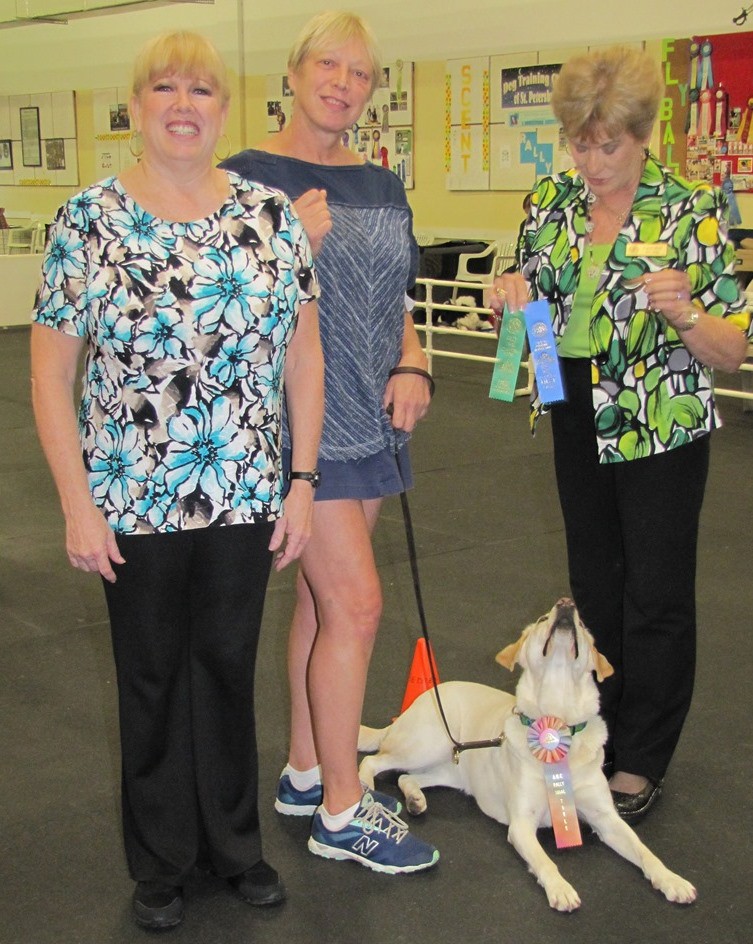
Alberta accepts her ribbons after earning her Rally Excellent title
Alberta accepts her ribbons after earning her Rally Excellent title. Deni and Alberta are the first guide dog team to earn an Excellent title. They have already two of ten needed “legs” toward their Rally Advanced Excellent title. 

I’ve watched both formal Obedience competitions and Rally-O (or Rally Obedience) competitions, and the difference is as stark as the difference between traditional training and cognitive education.
Both have the same goal: demonstrating a dog’s ability and willingness to follow specific commands when cued by the handler. They use similar sets of commands. Competitors are scored based on the preciseness of the dog’s response, the accuracy in completing the set of commands presented, and the time it takes to accomplish each task. Above the novice level, dogs compete off-lead. Dog-and-handler teams can earn titles in both kinds of competition.
That’s about where the similarity ends.
Rally is variable. The course is different in every round. The judge sets up the course within an hour of the competition; which exercises are included and in what order is a surprise for handlers and dogs. Formal obedience competitions, on the other hand, follow a set pattern of exercises at every level of competition. Experienced dogs and handlers could run the pattern in their sleep.
While competing, Rally handlers talk to, praise, and encourage their dogs. In the lower levels, the handler can use targeting and clapping or even touch the dog! Formal Obedience handlers cannot interact with their dogs other than to issue each cue, verbally or through hand signal, once.
To my (very biased) way of thinking, Obedience competition is all about showing the dog who’s boss (hint: it’s not the dog). Rally is about relationship and having fun. I strongly favor anything that builds relationship between dogs and their humans. Rally acknowledges the uniqueness of how each handler and dog interact as a team. Rally allows each team to excel in its own way.
The differences between Rally and Obedience underscore the differences in traditional vs. cognitive approaches to teaching dogs. If all you care about is getting an instant, precise response to a command, traditional obedience will do it for you. But that approach limits what you can accomplish with your dog and defines your relationship inside very narrow parameters.
Expecting precise, predetermined, responses to every cue essentially forbids your dog from thinking. There is a single correct response to each cue. Any other response results in punishment or lack of reward. The dog is not allowed to think about how to respond. Nor can the dog think of a better way to respond. When a dog schooled in this way confronts a situation that is slightly different from the training scenario, that dog will not know what to do. If the precise, rehearsed response is not possible or ineffective, the dog faces certain failure.
On the other hand, a dog who is taught with a cognitive approach will be able to figure out how to apply his or her learning in a variety of situations.
Here’s an example. Let’s say there are two dogs who have been taught to retrieve as part of their education. The obedience trainer, focused on the next competition, polishes his dog’s retrieve. The dog can flawlessly follow instructions to watch where the dumbbell was thrown over a jump, go out over the jump (even if a bad throw makes this the least efficient way of reaching the dumbbell), and bring it back, jumping over an obstacle on the way back. Perfect every time.
The cognitive trainer also teaches retrieve, but in a more jumbled way. Sometimes the dog retrieves a dumbbell. Sometimes it is the newspaper on the front porch. As training progresses, a set of keys, a cellphone, a pair of glasses, a spoon, a pen, a bottle of water are added. Sometimes the dog can see the item; sometimes the dog must search for it. Sometimes, it is an item that the handler has dropped. Sometimes it is the pair of slippers in the other room. The dog trained cognitively to retrieve has learned to follow her handler’s point, gaze or verbal cue for the item that needs to be retrieved.
Which of these dogs is more likely to fetch your keys if you drop them and they bounce, landing under your car? Which will find your cellphone when you fall and need help?
The dog who is trained only to produce a rote response will freeze when the dumbbell is not where he expects it to be or the judge produces a leather dumbbell when he has only practiced with a wooden one. This dog knows the retrieve as a patterned set of responses: sit, stay, go out, come back, sit in front holding the dumbbell, release, finish to a heel position.
This is different from understanding the reason behind a retrieve.
The dog who is trained to think about the retrieve as a practical skill, figure out the goal, and find a solution — the cognitive dog — will size up the situation and, chances are, do what needs to be done, even when it is not expected. I know more than one dog who has taught himself an “automatic retrieve,” picking up anything the handler drops, as a result of this style of retrieve training. Dogs who are allowed to freelance by adding variations to the task based on understanding the goal, will do so. This can come in handy when the handler unknowingly drops important material — like money.
Cognitive education enhances communication between dog and humans.

The Daily News

A very young Jana fetches The Jerusalem Post

Jana spends considerable time on every walk catching up on the local news. She sniffs out the usual trees and bushes on our daily route. When we take a different route or an extra walk, I know to leave extra sniff time.
But that’s not enough for my newshound. Jana does her best to ensure that I, too, have a steady stream of news and information. Knowing how sadly lacking my sense of smell is — and sensing my inability to understand the dog news, should I somehow manage to gather it — she wants me to read the daily paper.
Since our recent move, we’ve had Sunday-only delivery of The New York Times. But every morning, Jana has headed to the gate with an eager expression and a spring in her step. Bringing in the paper has been her job. Forever. She fetched The Jerusalem Post as a puppy. As a secular dog, she resented the lack of a Saturday edition.
As a young adult, she fetched the Boston Globe, carrying it the length of a very long driveway. (At one point, she suffered the humiliation of having to fetch it wearing a long leash, the result of an unfortunate decision one morning to take off after a jogger, rather than bring the paper home.)
She has fetched the Santa Rosa Press Democrat, the St. Petersburg Times (and, more recently, the Tampa Bay Times) and, last year, the San Francisco Chronicle. For the Chronicle, she was forced to fend off a job-stealing challenge from puppy Cali; having held on to her position, she proudly, carefully, carried her prize a great distance to our little rural cottage each morning.
So, when we moved to Petaluma, Jana simply could not understand — or accept — my decision to take Sunday-only delivery. Online news access, it seems, is an even more foreign concept to dogs than to us over-40 humans. I am fumbling along with it, but she refuses to accept this transformational technology and the havoc it wrought in her world.
I simply could not face the daily sad face, the disappointment. She’d head happily to the gate, and I would open it and show her: no paper. Her head would hang, and she’d slowly walk back to the house. Unemployment. Downsized. Made redundant by a computer. Unneeded. The worst fate for a smart, educated adult. Jana could relate. It was a terrible thing to watch.
So, I upgraded my newspaper subscription.
Now, our paper appears at the gate daily. Not rain, nor sleet, nor snow … even better than the mail, since we get seven-day-a-week service. Every morning, even before the sun comes up, Jana has a paper to retrieve. Full employment has returned. Jana’s sense of self-worth is restored.
Life is good for this thinking dog.

The Inclusive Dog

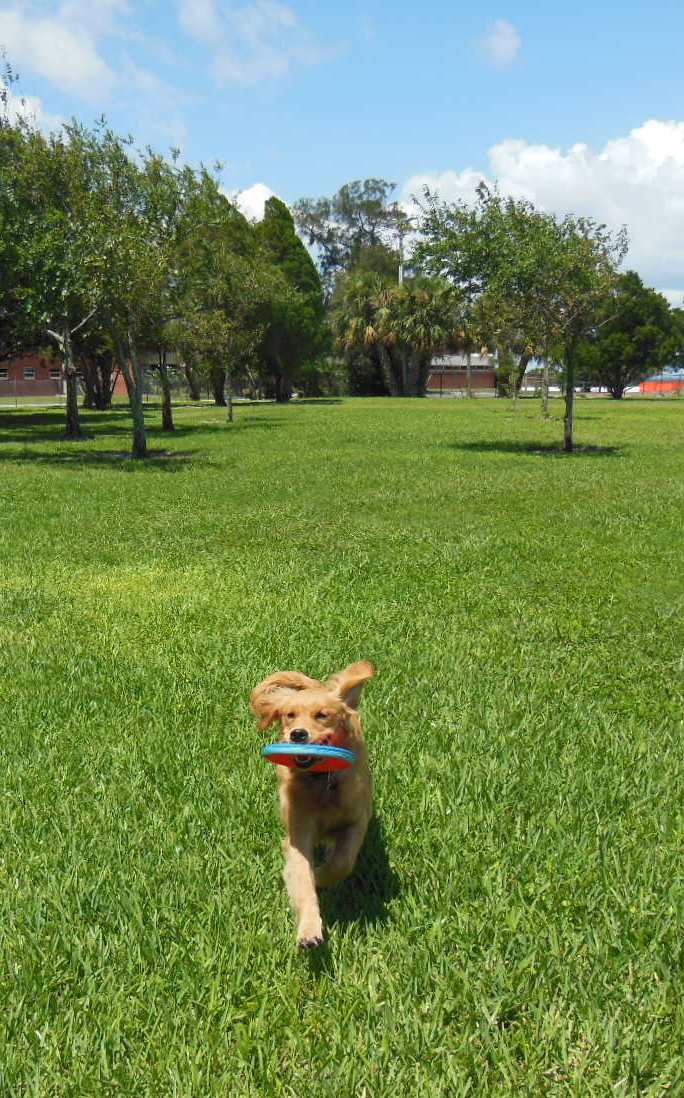
Cali zipflight2Cali, Albee, and Deni are playing fetch with a Zipflight (a Frisbee-like toy for dogs that Cali is crazy about). I wander over with Jana. Deni throws the disc. Cali catches it. Cali then brings it over and offers it to me for a throw.

If more than one person is in the area where Cali is playing fetch, she always does this. I find it charming. She takes the toy to one person, and then to the other, as if to include everyone in the game. She’ll include people she doesn’t know well, too, if they happen to be standing near and watching.

Oriel did this too. Cali and Oriel are closely related, but since Albee occasionally does it too, I don’t think genetics fully explains this behavior.

A professor I had in graduate school, ethologist Marc Bekoff, has hypothesized that play behavior forms the foundation of social ethics for a species. That is, youngsters learn how to get along in the group — what is “good” and “bad” behavior in their society, what the rules are for acceptable social interactions — at least partly through their games. They learn to play by the rules, not hurt each other, not to cheat or deceive, and to self-handicap when playing with younger or smaller friends. We observe all of this as our well-bred and well-socialized canines play with one another and with other dog friends. This might be a partial explanation, but Cali’s behavior seems to go a step farther.

I’ve seen dogs take turns in other situations — at the school where I teach, it’s not unusual to see three or four dogs lined up, waiting for a turn at the water bowl! And of course, when we play with our three dogs they must take turns chasing the ball when we throw it. Our dogs wait their turn to get their treats, to get brushed, even to get their dinners. Taking turns is nothing new in multi-dog homes. But dogs ensuring that all of the people and dogs get to join the game is unusual and shows an even higher level of social awareness. Cali’s not waiting for her own turn to do something fun or trying to get extra turns. She’s going out of her way, sometimes across a large lawn, to invite someone else to take a turn, to join the game.

Cali zipflightIt’s impossible to know exactly what motivates her to offer me a chance to throw the ball when she’s playing with Deni, but it does bring the family together. She even takes the ball over to Jana to offer her oldest sister the chance to chase the ball!  Cali’s desire to include everyone reflects something that matters to her. Empathy, or possibly inclusiveness.

An inclusive organization is defined as one that values the contributions of all people (human and canine!); one that incorporates different members’ needs, assets, and perspectives. That sounds like the kind of dog-human family I want. And, from her actions, it appears to be the kind of dog-human family that Cali wants too.


Do Dogs Have a Funny Bone?

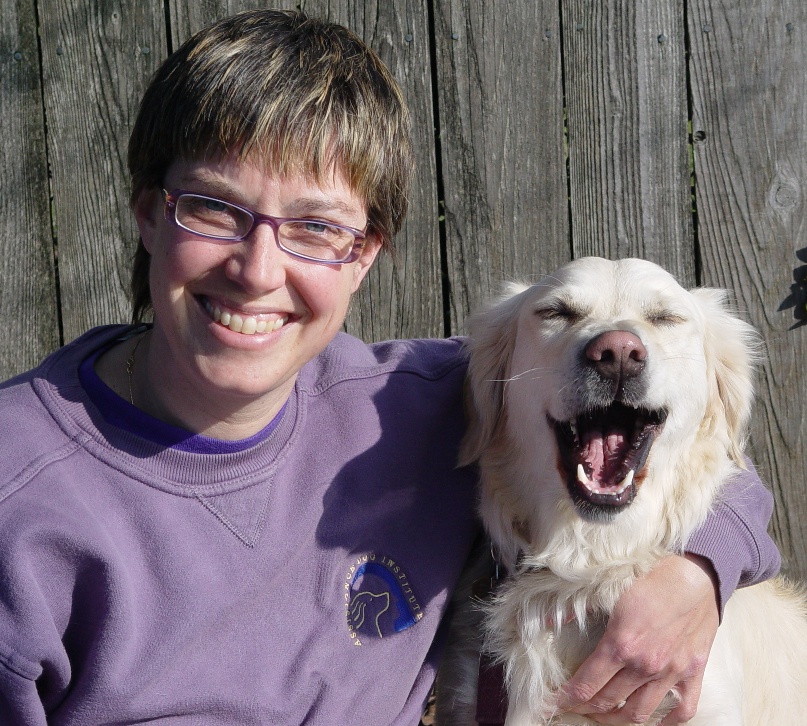
Dogs smile and even laugh. Dog magazines understand this — both The Bark and Modern Dog regularly reprint readers’ photos of their “smiling” dogs. But do these facial and vocal expressions prove that dogs have a sense of humor? This is debatable. I would argue that some dogs do, thought this varies by breed. Golden retrievers and Labradors definitely enjoy a good laugh with their people or at their people’s expense.

Jana enjoys a good joke!

On our recent drive from California to Montana, Jana (a golden retriever), Deni, and I stayed at a cute little guest cottage in Oregon. I took Jana for a walk around the grounds. The cottage had two small rooms, one with a patio. Jana and I left through the main door but returned to the cottage and entered through the “back” patio door. I told Jana to “find Deni.” She ran into the cottage, then into the main room, wagging and smiling, and greeted Deni. Deni reacted with happy surprise at Jana’s sudden appearance, since the main door, a few feet from where Deni sat, remained closed. Jana danced around wagging and smiling. Since she is a reserved dog, this was an unusual display.

Jana was pleased with herself. But more than that, she appeared to enjoy the joke she had played on Deni. Is this possible? Or am I reading too much into the situation, being too anthropomorphic?

What does it mean to have a sense of humor? Most living organisms — human, canine, or other — seek pleasure and avoid pain. This basic principle guides behavioral science (and dog training). Humor — laughing, and the ability to be amused — feels good and is good for us. So it is biologically sound to assume that other creatures have senses of humor. And, as creatures that have evolved, through heavy human influence, to be our best friends and companions, it would be far stranger if dogs did not understand and participate in intentionally humorous antics.

One of dogs’ most appealing characteristics is their love of play. But dog play often resembles dog aggression. Thus dogs have a detailed repertoire of communication that signals to other dogs — and dog-savvy humans — that “this is only play.” In other words, “I’m just kidding; I am not really going to bite/hunt/hurt you.” Another sign that dogs understand humor and “fun” is that they make up games. They also change the rules of games we, or other dogs, make up and self-handicap so that another, smaller, dog or puppy can also have fun.

Lots of dog owners and trainers have stories of things their dogs do that make them laugh. Like small children, some dogs intentionally repeat whatever action elicited the laughter. This is a sign that dogs get it. They understand that our laughter is a good thing. They love to play tricks on each other and on us. Does your dog have a sense of humor? Share your stories!


Give That Dog a Job!

This slideshow requires JavaScript.

Getting the paper each morning is the classic dog’s job. My friend Sally continued her newspaper subscription long after she’d lost interest in reading it — just because it gave Mav, her Lab, such pleasure to get the paper. Jana started fetching the Jerusalem Post each morning when she was just a few months old. She’s graduated to the New York Times, which is considerably weightier, especially on Sundays. Every so often, Wylie tries to nose in on her morning chore, but she’s not giving up easily.

Our dogs have also learned to pick up their bowls after they eat. Some people have expressed surprise at this, understanding why a dog might bring an empty bowl in hopes that we’ll fill it but not why a full dog would bring an empty bowl. We explain that we try to encourage our dogs to behave responsibly. The dogs give us their empty bowls rather than actually washing them, but it’s a start. Jana can be persuaded to put her toys in the toy basket as well.

Dogs like to have jobs. This is a frequent topic of discussion with my dog-training students. These students are training future service dogs, but they are also preparing to train pet dogs — and their owners. We’ve talked about the many roles and careers available to dogs these days, and the consensus among my students is that, even if the job is a dangerous one (think military and police dogs), most dogs seem happier when they have work to do.

Most pet dogs are bored most of the time. Giving underemployed dogs some small tasks to do throughout the day can relieve that boredom and challenge them a bit.

Most people’s lives are filled with tasks that dogs can learn to handle, if only given the chance. When we miss the recycle box when tossing balled-up paper from our desks, a dog (or two) is always ready to bring the trash back or put it in the box for us. Fetching slippers or shoes is a natural. Dogs who learn to fetch the leash or their owners’ walking shoes when it is time for an outing might take the initiative and bring the items when they figure that they’ve waited long enough. Our beloved Oriel decided on her own to bring the water dish to one of us for a refill when it was empty, and she often brought discarded papers from the recycle box in hopes of exchanging the trash for a cookie.

If you can’t think of tasks, challenge your dog’s mind with games or a treat toy; dogs don’t seem to differentiate between  thinking tasks that are just for fun and those that are dog jobs. Interactive dog games abound these days — these ask dogs to use their noses, paws, and sometimes teeth to open compartments, slide little doors, and nudge puzzle pieces aside to reveal hidden treats. Playing “tug” can lay the foundation for teaching dogs to open doors, cabinets, and drawers. Hiding a favorite toy or treat (or person) somewhere in the house encourages the dog to think, problem solve, and use her nose to find it. Some dogs’ desire to talk can be channeled into for alerting the humans to mail and package deliveries with just one bark. Other dogs, who like to carry things, can be taught to place plastic bottles in the recycle bin or clothes in the laundry basket.

The possibilities are endless. What are you waiting for? Give your dog a job!

Dog Happiness!

I’ve been thinking (and writing) a lot about dogs and their emotions lately. I love the way Dr. Marc Bekoff describes animal emotions and says that dog joy or fox grief might not be like our experience of joy or grief but that doesn’t make it any less real. (Check out his book, The Emotional Lives of Animals).
Jana and Wylie certainly exhibit what can only be joy — pure delirious happiness — every time we let them loose in “their new front yard” — Lassing Park, on Tampa Bay.

Wylie runs in delighted circles in the water, kicking up splashes, flying toward flocks of birds, racing, racing, racing until his tongue is hanging to his knees and all he can do is stand, panting and grinning giddily.
Jana is a bit more restrained, usually seeking out the deepest pool of water and lying down in it. Then, she exuberantly rolls in the sand, the grass, any dead thing she can find. And repeats the cycle as many times as I let her. She, too, runs along the waterfront with a big smile on her face.

This undeniable dog happiness is tempered somewhat by what comes next. Bathtime. Rinsing them, we laugh at their disgusted and annoyed expressions, at Wylie’s snapping at the water spray, at Jana’s dance to avoid having all that nice smelly stuff washed off.

Some may call me anthropomorphic, but no one who has observed these — or any other — dogs closely can deny that they are happy.

Dog Happiness!

I’ve been thinking (and writing) a lot about dogs and their emotions lately. I love the way Dr. Marc Bekoff describes animal emotions and says that dog joy or fox grief might not be like our experience of joy or grief but that doesn’t make it any less real. (Check out his book, The Emotional Lives of Animals).
Jana and Wylie certainly exhibit what can only be joy — pure delirious happiness — every time we let them loose in “their new front yard” — Lassing Park, on Tampa Bay.

Wylie runs in delighted circles in the water, kicking up splashes, flying toward flocks of birds, racing, racing, racing until his tongue is hanging to his knees and all he can do is stand, panting and grinning giddily.
Jana is a bit more restrained, usually seeking out the deepest pool of water and lying down in it. Then, she exuberantly rolls in the sand, the grass, any dead thing she can find. And repeats the cycle as many times as I let her. She, too, runs along the waterfront with a big smile on her face.

This undeniable dog happiness is tempered somewhat by what comes next. Bathtime. Rinsing them, we laugh at their disgusted and annoyed expressions, at Wylie’s snapping at the water spray, at Jana’s dance to avoid having all that nice smelly stuff washed off.

Some may call me anthropomorphic, but no one who has observed these — or any other — dogs closely can deny that they are happy.

Dog Happiness!

I’ve been thinking (and writing) a lot about dogs and their emotions lately. I love the way Dr. Marc Bekoff describes animal emotions and says that dog joy or fox grief might not be like our experience of joy or grief but that doesn’t make it any less real. (Check out his book, The Emotional Lives of Animals).
Jana and Wylie certainly exhibit what can only be joy — pure delirious happiness — every time we let them loose in “their new front yard” — Lassing Park, on Tampa Bay.

Wylie runs in delighted circles in the water, kicking up splashes, flying toward flocks of birds, racing, racing, racing until his tongue is hanging to his knees and all he can do is stand, panting and grinning giddily.
Jana is a bit more restrained, usually seeking out the deepest pool of water and lying down in it. Then, she exuberantly rolls in the sand, the grass, any dead thing she can find. And repeats the cycle as many times as I let her. She, too, runs along the waterfront with a big smile on her face.

This undeniable dog happiness is tempered somewhat by what comes next. Bathtime. Rinsing them, we laugh at their disgusted and annoyed expressions, at Wylie’s snapping at the water spray, at Jana’s dance to avoid having all that nice smelly stuff washed off.

Some may call me anthropomorphic, but no one who has observed these — or any other — dogs closely can deny that they are happy.