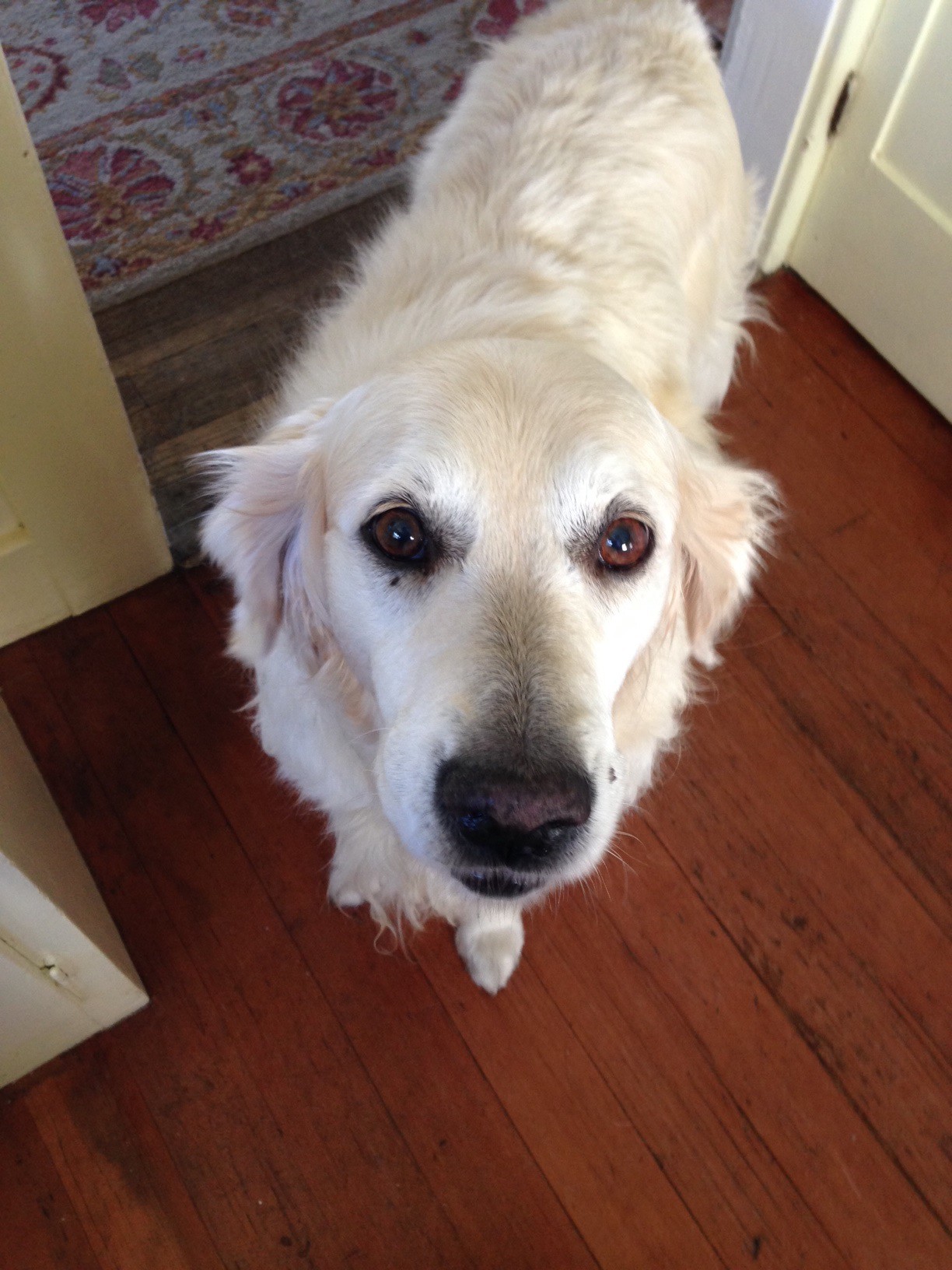
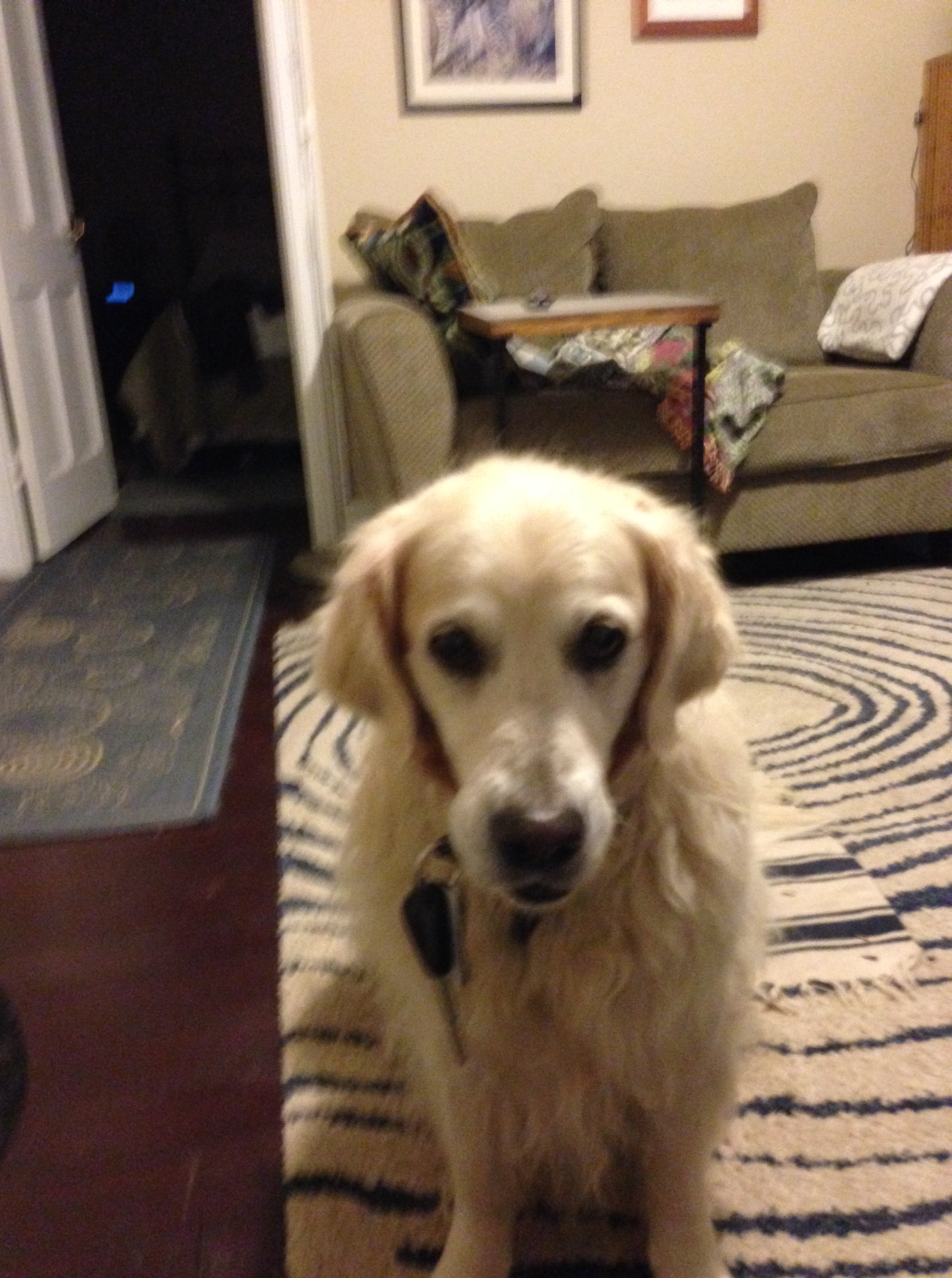
Jana and Cali have vastly different understandings of our morning walks. Each girl’s interpretation also describes her approach to life.
For Cali, the point of the walk is the destination. She wants to be at the park with every cell in her body. The closer we get, the harder it is for her to contain her excitement. She does her little skip-walk dance, where she bounces ahead, remembers, bounces back, walks nicely for two steps, can no longer contain her excitement, bounces ahead, remembers … I think she burns more calories doing this dance than she does at the park. Mostly because she spends too much time at the park jealously guarding her ball rather than running around chasing it.
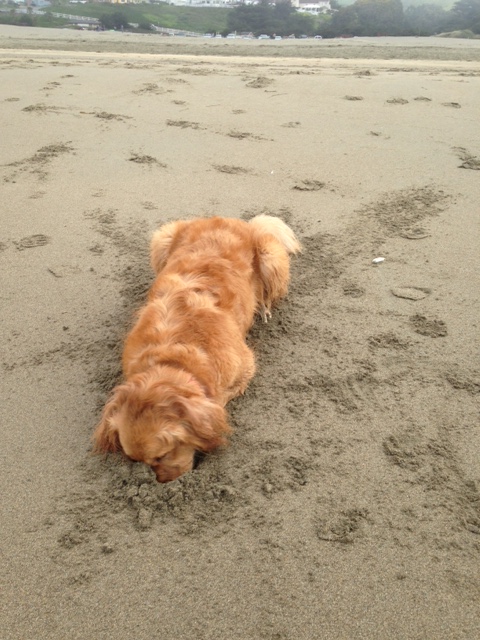
Jana, on the other hand, is all about the journey. Even at the park, she’s on her journey. She investigates everything along the way with her full attention. Everything. Clumps of grass. Leaves, wood chips, tendrils of ivy trailing on the sidewalk, fence posts, trees … She looks and sniffs from every angle, breathing deeply and considering the nuances of the scent. Only then is she ready to move on … to the next leaf.
At the park, she sniffs and samples the grass, which is very fresh, green, and wet these days. She then rolls in it. Her favorite thing happened the other day: The mower was just finishing up, which meant that she got to roll in the freshly cut grass, turning herself light green in the process. I think “freshly cut grass” is her favorite scent. If I had shampoo that smelled like that, she’d willingly bathe every day.
Since walking the two of them presents certain logistical challenges, with one full steam ahead and the other moseying along … I tried taking them for individual walks. Jana was having none of it. She wanted to go with us. She’d bring me my boots, stand by the door, push her way out the door if I was leashing Cali, use all of her considerable expressive talent to communicate: Take me too! So maybe her walks are a little bit about the destination too.
Which is great, because Cali also has that bit of balance. Her delight in the journey is evident when we meet other people along the way. Her excitement is channeled at them as she beelines for this new best friend. Tail wagging, huge smile on her face, she eagerly waits for the person to greet her. Most do. To her credit, Cali brushes off the rare crushing rejection with aplomb. We’re on our way to the park, after all!
I’ve read a lot of academic studies of dogs and other non-humans that seemed silly, but I somehow missed this one, described by Carl Safina in Beyond Words. Safina pokes fun at a researcher who gathered and analyzed video of dogs playing for two years before reaching the somewhat obvious conclusion that when a dog wants to invite another dog to play, he behaves differently if the other dog is facing away from him: He tries to get that dog’s attention before offering a play bow. The dog either barks or uses his paw to attract the other dog’s attention. Dogs don’t play bow to other dogs’ rear ends. Amazing. (For more on this and what it can teach us, see Learning from Real Dogs.)
In ridiculing this and other studies, Safina makes the point that researchers should get out of the lab and watch how real animals interact with members of their own and other species. There is much to love in Beyond Words: The sections on elephants, wolves, and orcas are chock-full of detail, stories, and heartbreaking information about how badly humans screw things up when we don’t understand other species. I’ve written about his discussion of self-awareness and the mirror test. But my favorite section, naturally, had to do with dogs. He writes engagingly about his own dog when he takes on the controversial issue of whether dogs (or any non-humans) have “theory of mind.”
Safina offers several definitions for theory of mind drawn from real studies. My favorite is the one that claims that theory of mind is the ability “to read the minds of others.” Based on the divorce statistics and the number of wars and conflicts of all sorts, it seems that all humans would fail that test. A better definition is “knowing that another can have thoughts that differ from yours.”
Safina provides many, many examples of non-humans, including dogs, showing that they meet this definition; he calls the evidence “blinding” (his emphasis). Any time your dog anticipates your behavior — putting on those shoes means a walk — or asks for anything, like a belly rub, treat, or dinner, your dog is showing that he understands, or at least can make a plausible guess at, what you are thinking or planning and might even be able to influence your decision. Any time a dog fakes you out (or another dog) by playing keep-away with a toy or takes advantage of your inattention — barking while you are on the phone, for example — your dog is demonstrating his mastery of theory of mind.
Safina also takes on the definition of self-awareness, as well as other traits or abilities that some scientists, absurdly, continue to insist that only humans possess, skewering the human-centered irrelevance of the “tests” that purport to demonstrate other species’ lack of these abilities. A thorough discussion of humans’ penchant for believing things that we know not to be true versus non-humans’ evidence-based actions and beliefs leads to his conclusion that “maybe more than anything, what ‘makes us human’ is our ability to generate wacky ideas.”
I recently read a study that compared wolves’ and dogs’ ability to solve a “puzzle” — opening a plastic box with a piece of sausage inside. The wolves did much better than the dogs, and, from the articles I read about the study, it seems that many researchers are interpreting that to mean that the dogs are dumber than the wolves, at least when it comes to problem-solving. The comments were rather unkind to dogs, and, I think, wrong.
One comment, in the New York Times, came closest to “getting it.” This person suggested that perhaps the dogs had been taught not to take human food or open food containers. Paired with the fact that most dogs’ food is handed to them by humans, while most wolves must find their own food, I’d say the dogs were set up to fail.
The study was published in a British journal by an Oregon State University researcher, Monique Udell. In her own analysis, she paid more attention to the fact that the dogs spent more time looking at the familiar human (who was present for some trials of the test and who provided encouragement in some trials) than at the box. Various commenters’ interpretations of the dogs’ looks ranged from “seeking assistance” to “slavish.”
Half the dogs tested were pets; the other half were shelter dogs, but no information was provided about how many of those had spent part or most of their lives in homes before landing at the shelter. The wolves had been socialized to humans, but even a tame wolf is still a wolf, not a domestic pet.
It makes sense that the dogs would have been taught not to take food or been punished for taking food. It also makes sense that, if a familiar human were present, they would seek help, information, or even permission before helping themselves. When I give my dogs a particularly spectacular treat (a 2-inch piece of sausage would certainly qualify), they often look at me, look at it, look at me — going back and forth a few times, seemingly questioning whether this bounty is truly meant for them. They are polite. They know the rules. They are also quite happy to indulge in exceptions to those rules, once they’re sure they won’t get reprimanded for doing so.
I would have been much more surprised if the dogs didn’t look to the human for permission or help. After all, thousands of years of living together has resulted in close partnerships and, at least on the dogs’ part, exquisite ability to read human’s communication. We humans are less successful at reading the dogs, sadly. Their survival depends on reading humans’ cues and behaving accordingly. Wolves have no such hangups (nor should they).
Some comments on the study went so far as to suggest that training dogs has made them dumber and less able to solve problems, that their social connection to humans puts them at a cognitive disadvantage. I disagree. While some training approaches do discourage dogs from thinking, modern approaches to training that use motivation and reward actually encourage problem-solving. Far from dumbing dogs down, their enhanced social sensitivity to humans enables them to thrive in our world and, in many cases, enjoy comfortable lives and strong connections with their adopted families.
And if those strong connections compel dogs to ask before eating your food, what’s wrong with that? Many people wish their roommates were as considerate.
The study, “When dogs look back: Inhibition of independent problem-solving behavior in domestic dogs,” by Monique Udell, was published in the British journal Biology Letters on Sept. 16, 2015.
I originally wrote this post for PPG Barks, the blog of a professional positive trainers networking organization. The post was rejected; I think the reason is that I am asserting that dogs deceive each other and humans. I am very interested in this topic, and I plan to revise the post further (or write an entirely new post) about dogs and deception. Meanwhile, I’d love some feedback from you. Please comment on the post or to me privately if you feel inclined. I am interested in what other dog people think about the question of doggy honesty and deception.
How much is a dog willing to bend the truth or improvise in order to get a reward?
That’s not a crazy question. Dogs routinely exhibit all of the cognitive behaviors needed to form an idea, plan, and execute deceptive or manipulative behavior. Consider:
Cookie, please
Dogs deceive each other or fake each other out to get what they want. One dog will pretend to hear someone at the door and bark the warning bark — anticipating that his doggy sibling will run to the door. The conniving canine then steals the dupe’s rawhide, toy, bed, choice spot by the TV, etc.
Dogs who have been taught to ring a bell or bark when they need to go out tend to go through at least a short period of ringing that bell constantly … or at least testing out how often they can get Mom and Dad to “hop to it” and let them out, even when all they want to do is roll in the grass or bark at the neighbor.
Is there any dog who hasn’t tried to convince her owners that they have “forgotten” to feed her?
Many dogs will retrieve items that have not been requested in hopes of getting a reward. My dogs routinely bring me extra shoes in the morning, after they’ve been asked to bring my dog-walking shoes (and have been rewarded for doing so). This is probably optimism more than dishonesty, though. I routinely reward them for bringing me things that I have dropped, whether I was aware of dropping the item or not.
It gets even more sophisticated. For example, our German shepherd used to pretend not to know where the ball had landed when we threw it and he was busy sniffing something or chasing a squirrel. A request or two to get the ball would be completely ignored. Or, to humor the annoying humans, he’d search half-heartedly for a few seconds before doing the dog equivalent of shrugging and going back to something more interesting. “OK,” we’d say. “If we’ve lost the ball, it’s time to go home.” In under 10 seconds, he’d have found and delivered that “lost” ball.
Then there’s the golden who used the bells on the door to get Mom to open the door, knowing that her annoying puppy-sister would go charging out the door … while she stood there, smiling, as Mom closed the door with puppy outside and her inside.
So. While I will concede that not all of the above examples necessarily show deceptive behavior, some do, some might, and others at least indicate an ability to manipulate humans to obtain a desired end. I believe that dogs do lie and that they sometimes deceive each other and us. And they do it for a variety of reasons, including the possibility of getting a reward.
I’ve been thinking about this since I read What the Dog Knows by Cat Warren. It’s a great book; I posted a short review here on the Thinking Dog Blog not long ago. It’s about scent-dog training, specifically, cadaver dogs. The author raises an interesting topic: False alerts. She’s brave to do this, partly because many dog people ran into what I think I am running into: Many people cling to decades-old and thoroughly debunked ideas about how limited dogs’ cognitive abilities are. But mostly she’s brave for another reason: Many handlers proclaim that their dogs are never wrong and become incensed if anyone suggests otherwise.
Some false alerts are the handler’s fault. Particularly when the handler is a beginner, and the team is at an early stage of training, the handler’s body language or other unintentional cuing might hint to the dog that “this is where” he should alert. In this case, the dog is not lying; he is trying to follow the cues he’s just learning, and thinks he’s doing what the handler wants.
Training and working in situations, like cadaver searches, where the handler is not always able to tell whether the alert is false further complicates the discussion. Some false alerts, as Warren explains, might not actually be false. She says that if they are training in a vehicle junkyard, for example, and her dog alerts on the seat of a smashed car with a shattered windshield, while that is not the target she’s searching for, she rewards the alert anyhow. The scents linger for a long time, and the dog probably did detect the scent of human decay (parts of the book do require a strong stomach!).
I’m not talking about those instances though. I wonder if — and at what stages of training — dogs intentionally, knowingly lie about detecting the target scent. There are certainly working situations where the handler might not know if the scent is present and therefore is likely to trust the dog and reward an alert. False alerts occasionally do cause problems in law enforcement.
She draws a distinction between false alerts that are outright lies and those that are more nuanced and, she says, even more insidious (though not always because of misbehavior from the dog). The dog is detecting something but is not entirely sure it’s the correct scent; or the dog has detected the scent but not found the precise location and alerts anyhow; whatever the case, in these instances, she explains, the dog isn’t consciously deciding to lie. As with human behavior, not all situations are easily explained, black or white.
Warren says she will never know whether her dog’s false alerts are inadvertent or are deliberate lies — but she does not rule out the possibility of a dog lying. She also says that her dog’s body language is so clear that she thinks she could tell if her were lying. Many humans betray their dishonesty through body language. Sometimes those “tells” are very subtle. A close study of our dogs’ body language might be our best chance at knowing when they are — and are not — trying to con us.
What do you think? Have you ever worked with a pathological doggy liar? An occasionally dishonest dog?
Cali and Alberta both have great social skills, and their play together is cooperative and fun. They never fight and are good at reading each other’s signals. When one wants a break, the other complies.
Bringing a third dog into play always changes the dynamic, and when it’s a puppy or adolescent who’s still learning the rules of social interaction, everything changes. So, when Scarlett joins Cali and Alberta in play, the energy level goes up — and sometimes the tension level escalates as well.
Often, the three girls have a ball chasing each other around Scarlett’s huge yard, tugging on Alberta’s ears, sneaking veggies from the garden, and generally being silly together. Sometimes, though, one dog — most often Cali — seems to be trying to calm things down. When she’s not able to do this, I know that I have to get involved.
How do dog owners know when play is going well and when they need to intervene? This question is especially important at dog parks, where the playing dogs might not know each other well and where, unfortunately, many owners don’t pay enough attention to what their dogs are doing.
As our dogs’ protectors and advocates, it’s important that we are aware of what’s going on whenever our dogs are playing with other dogs (or with children). I suspect that, even among friends and family, most dogs don’t play much when their people aren’t around. I think that our presence helps them feel safe and confident that things won’t spiral out of control. It’s our job to understand that responsibility — and to step in when our dogs need our help.
So, back to Cali, Alberta, and Scarlett. The photos at the top of this blog post show healthy play. The dogs’ tails are held high. Their faces are animated, and their mouths are open in relaxed (not stressed) smiles. They are not holding their ears back tightly or tucking their tails.
The way they are playing is also important: There is not one dog who is always being chased — or doing all of the chasing. When they are wrestling, again, there is not one dog who always seems to be the target (or aggressor). They change roles, change games, go from chase to wrestle to tug to chase with a fluidity that comes from reading each other’s body language and paying attention to each other’s signals.
What does it look like when it goes wrong?
I step in if I see Cali’s tail go down or I see her trying to walk away. If she’s trying to leave the group and one of the others (usually Scarlett, an energetic eight-month-old) jumps on her or runs after her, I know that Cali needs a little help. Sometimes, she just stands there with her head and tail down, looking overwhelmed. Calling her to me or gently redirecting Scarlett to a toy works. Scarlett is a smart girl and wants to play — she’s not bullying Cali. She simply is not always ready to stop playing or quick enough to read the signal that Cali has had enough. I know these dogs and can read their body language pretty well. I can step in and ask everyone to calm down — and get them all to cooperate.
In more public spaces, like dog parks, owners might need to intervene more forcefully to help their dogs if play with unfamiliar dogs starts to deteriorate into something too wild or rough. Also, if there are a lot of dogs around, “dogs getting carried away playing” can turn into bullying or even a fight in seconds, with more dogs piling on.
Owners of relatively soft dogs (like Cali) who won’t stand up for themselves should be prepared to extricate their dogs if a situation becomes overwhelming — and this can happen any time a softer dog is playing with other dogs. Body language to watch for includes repeated looks to you, as if seeking help; lowered ears or head; a tucked tail; or any baring of teeth.
If you’re not sure of the other dogs, it’s best to avoid the situation. We’re fortunate to have a play area where we live that attracts a regular crowd of very nice dogs. Cali has become comfortable with most of these dogs. Even so, she usually prefers to play ball with me and rarely engages with another dog. It’s not that she doesn’t enjoy lively play; when she’s with her sisters or a good friend, she lets her guard down completely.
If you don’t have a “regular” play group, look for a few well-matched (size and energy level) dogs and try to set up regular play dates. Or find ways to exercise your dog without other dogs. Plenty of dogs would rather play with their humans anyhow!
In a recent conversation, a friend described her memories of her grandparents’ house — each room had, obviously, a visual memory, but also a unique scent memory. Many people have experienced being transported back to a meaningful childhood moment upon smelling a familiar scent — Grandma’s perfume, cinnamon rolls, Thanksgiving turkey roasting … But until I read Dr. Gregory Berns’s study “Scent of the Familiar,” I hadn’t really thought of memories, scents, and dogs in the same context. This study, published in the journal Behavioural Processes in 2015, shows that dogs have a pleasurable association with some scents. Berns’s team analyzed MRI scans of several dogs, comparing their brain response to sniffing the scents of familiar and unfamiliar people and dogs. The dogs were all trained, using only positive methods, to lie still in MRI machines, as described in Berns’s book, How Dogs Love Us.
What the team found was that, while the scent-processing areas of the dogs’ brains responded similarly to all the scents, only the scent of a familiar human triggered a strong reaction in the “pleasure center” of their brains. The study was carefully controlled — the scents were from people in the dogs’ households but not the dogs’ primary caregivers and not individuals who were present in the lab for the testing.
Berns compares the dogs’ ability to recognize and happily respond to the scent of a loved but distant human to the response humans show when viewing photos of loved ones who are not present.
In simple English, this study confirms that dogs, like my friend, can experience pleasant memories via scent. It makes perfect sense, since dogs’ ability to detect and identify scents is so powerful. Humans tend to rely more on visual cues to identify and remember places, people and, maybe, dogs. But dogs are far less visually oriented, and their eyesight works differently from ours — fewer colors, more emphasis on shadows and movement, for example.
It also most likely explains how dogs remember people they have not seen in a very long time. As a student at Bergin University (then called the Assistance Dog Institute), I trained a young puppy, from her birth to about 13 weeks of age. Cassie was a brilliant puppy, and we spent time together every day. Then, the semester ended, and I left for my home. I did not visit the school again until a year and a half later. I knew that Cassie was still there, but there was no way that I could pick out this now-grown golden retriever from a sea of beautiful, but very similar-looking, goldens. I’m sure I looked different too, but she had no trouble recognizing me. I quickly guessed that the enthusiastic, whole-body-wagging-with-joy girl who was leaping into my arms was Cassie. The nose knows!
Amazing dog. Amazing and super-friendly author. I got in touch w/Dr. Pilley after reading the book (and his research papers) and he did a Skype conversation with a class I was teaching on dog-human communication. He is one in a million, as is Chaser. He is such a great example of positive training that respects a dog and her abilities… and he is a fantastic teacher as well.
No one is surprised to hear that a border collie is intelligent and learns easily. But Chaser has gone far beyond what any other dog has been documented to learn in terms of human language comprehension. Dr. Pilley set out to teach her as many words as he could — names of objects — after reading the dismissive comments that greeted publications describing the accomplishments of Rico, a border collie in Germany who learned several hundred words. Dr. Pilley analyzed the linguists’ and other academics’ critiques of the training and testing of Rico — and set out to train his dog in a way that addressed all of their objections. And he accomplished his goal. (An interesting chapter in the book describes the resistance he faced when attempting to publish his initial results.) The opposition to admitting that any creature but humans can use language is still deeply entrenched.
But it’s also dead wrong. Chaser truly does understand human language. She learned and retains the names of more than a thousand items. She has demonstrated her ability to categorize them, grouping round bouncy things into the “ball” category and flat flying things into the “Frisbee” category, for example. And, like most dogs, she clearly distinguishes the category of “my toys” from “things in the house that I’d like to chew but am not allowed to chew.”
But Dr. Pilley realized that he had not pushed the boundaries of Chaser’s abilities. So, they tackled grammar next. Chaser understands the concepts of subject, verb, object — and indirect object. As an editor and college instructor, I have to point out that many writers and college students do not reach Chaser’s level of grammatical knowledge.
Toward the end of the book, Dr. Pilley describes his initial attempts to teach Chaser to imitate long, complex strings of behaviors. His description inspired me to try simple imitation games with my dogs, which have been fun and very funny.
The best part about this book though, is its constant message: Keep training fun and rewarding for the dog; make it a game; play to your dog’s strengths and preferences and, most important, make sure she has time do play and engage in her favorite activities. For Chaser, that means regular opportunities to herd sheep at a near
I recently attended a two-day workshop with TTouch practitioner Lori Stevens. Of the many tips and techniques that stuck with me, this stands out: We tend to label dogs’ behavior rather than describe it.
What is an anxious dog? What is an aggressive dog? A well-behaved dog? Turns out that each dog owner — and dog professional — means something different when she uses those terms.
I sometimes describe Jana as “anxious” because, many evenings, she seems unsettled, distracted, and uncomfortable. She whines or paces, but I can usually settle her down in a few minutes. The technique I learned from Lori, using a body wrap, seems to help a little. Jana also shows what I call anxiety on walks if a vehicle (mostly loud, big trucks, though she seems to harbor a deep-seated hatred of minivans, too) approaches from behind us and startles us. I attribute some of this “anxiety” to the possibility that she’s not hearing things as well as she used to and she gets surprised more often — perhaps she’s also losing some vision. Whatever the cause, things seem to come out of nowhere and startle her more often. Fine, so, she’s a bit anxious and I deal with it.
But I have friends whose “anxious” dogs have done hundreds of dollars in damage to their possessions, their floors and walls, their furniture … other “anxious” dogs bark nonstop or are unable to sleep through the night (pacing, whining or barking, and ensuring that no one in the household gets any sleep. Ever.). Compared with that, Jana is calm and placid, well-adjusted even.
Then there’s the “aggressive” dog. I’ve seen dogs who have been labeled as aggressive who are the sweetest, friendliest dogs … but who really dislike cats and want to chase them (or worse). Or who have maybe bitten a person, once, under what turns out (if I get the whole story) to be extreme provocation. Or who are simply terrified, stressed by being put in a situation that they cannot handle. Not all of these dogs are aggressive; they are scared and overwhelmed.
Scared and overwhelmed can be fixed; prey drive can be managed. But some dyed-in-the-wool, born-with-it aggression is not fixable and can be very hard to manage. It is important to know the difference.
Being able to describe our dogs’ behavior accurately and in detail is important for so many reasons. We can do a better job of figuring out how to manage or change that behavior if we know what it is and why it’s happening. As dog professionals, or as dog owners who want to call in a professional, a clear, detailed description of behavior is an essential starting point — does this dog need training? Medication? Treatment for some underlying, painful condition that is causing her to snap at people? Sometimes the cause is simple, even if it’s not immediately obvious.
A couple of summers ago, one evening, Jana snapped at Cali for playing roughly near her. Jana is usually amazingly patient with Cali. I reprimanded Jana for her “aggressive” act. Fortunately, within a few days, Jana was scheduled to have her annual physical. At her vet exam, the doctor found that Jana had a very painful cracked molar. A long surgery and several hundred dollars later, Jana was no longer in pain. She has never snapped at Cali again.
So, trash the catch-all labels. Instead, look at the behavior. When does it happen? Is there a trigger? Did it just start? Has behavior changed recently? Has the dog’s environment changed? Is the dog getting enough exercise, a balanced diet, regular medical checkups? If you can’t figure out the cause, call in help: doggy friends, the vet, a trainer. Post a question on the Thinking Dog Blog!
It’s usually possible to figure out what’s going on — and lots of expert help is available!
When Jana gets angry at me, she takes one thing (usually a tissue) out of the wastebasket, shreds it, and leaves the pieces next to the wastebasket.
A quick Google search will turn up dozens of articles on why dogs eat trash or how to get them to stop, and many will suggest that they’re attracted to the food or your scent on items, or that they are obeying an irresistible impulse. Some will suggest that training can solve the problem; some will suggest management (trash cans with lids). Many dogs get into the trash; why do I think it is a reflection of her anger with me? I know my dog.
When Jana was a puppy, she nearly always shredded the trash when I left her home. As a dog newbie, I once followed the advice of a trainer to put hot sauce on the trash to discourage this behavior. Instead, I discovered that Jana loves spicy food. And spicy “food.” (Her definition of food is much, much broader and more inclusive than mine.) After she had enthusiastically thanked me for adding condiments to her snack, I asked her to help me pick up the remnants and put them (back) in the trash can. She did. I never put sauce on her snack again.
As Jana matured, she became a responsible dog who follows the rules and respects boundaries. She’s very helpful and thoughtful. I could leave a steak dinner on the counter and go out for the day (unlikely; I keep a vegetarian home) and it would still be there when I got home. She is 100 percent trustworthy around guests and snacks, even if the snacks smell really good and are at dog-nose level on a coffee table. She has mostly stopped the trash-shredding behavior.
But.
When I leave her at home at a time that is just wrong — it’s close to mealtime, or I have already been gone much of the day and I come in and leave again soon after, or it looks like I am going to do something fun that should include dogs — I will come home to a single shredded tissue on the floor next to the trash can.
I know that serious dog scientists (most of whom seem to never have actually lived with a real dog) will howl over my interpretation of this behavior, but here it is anyhow. I think that Jana is expressing her hurt feelings and anger in a way that is uniquely her own. She could be very destructive; thankfully, she’s not that kind of girl. She could ignore me when I returned, but she’s not the type to hold grudges, either. I believe that she has thought this through and decided that shredding one piece of trash makes a statement.
As Cali does with hiding before brushing her teeth, Jana is telling me how she feels. Both girls do this articulately and in their own way — and then move on. Wouldn’t it be nice if everyone were so mature and as effective and clear in their communications?
Dogs’ memories — how well they remember things over time, whether they remember people, other dogs, or their mothers and siblings years after they last met — are the topic of much speculation and, lately, of serious research.
As Jana gets older and begins to show her age in some ways, I sometimes wonder whether she’s becoming forgetful or confused in the ways that many humans do as we age. She sometimes will stand and look at me and bark (and bark and bark), for example, and I cannot figure out what she wants or needs.
But then there are the encounters with smelly things on walks. She’ll find something — scraps of food, something dead, sometimes even worse things — that she wants to eat and that I do not want her to eat (or roll in). I’ll give her a stern, “Leave it,” and encourage her past the Thing. I’ll make a mental note to remember this Thing on our way home. A half hour or 45 minutes later, we’ll be walking home. The Thing will, of course, have completely slipped my sieve-like mind. Not Jana’s though. She beelines for it.
Sure, she could be smelling it as we approach. While that’s a reasonable explanation for Thing encounters on daily walks, the same thing can happen with encounters that are weeks or even months apart. At the dog beach we used to visit in Florida, she’d remember where a really good dead Thing had been — months later. It was never still there, and the tides, the wind, the cleanup crews, the other dogs and other animals would have obliterated any remaining scent. On hikes, she’ll dash off to pick up a rock she noticed on the way in — sometimes a couple hours later, as we head to the car. She seeks out remembered toys and beds at friends’ houses, too.
While generations of scientists and dog lovers have accepted the idea that dogs live fully in the moment — and they really seem to — that does not mean they don’t also remember and plan. Dogs clearly make “mental notes” of significant things, as we do. They appear to be far better than many of us at actually remembering to seek those things out (and remembering where to look for them).
We should all enlist this talent to keep track of our eyeglasses, car keys, and cellphones!
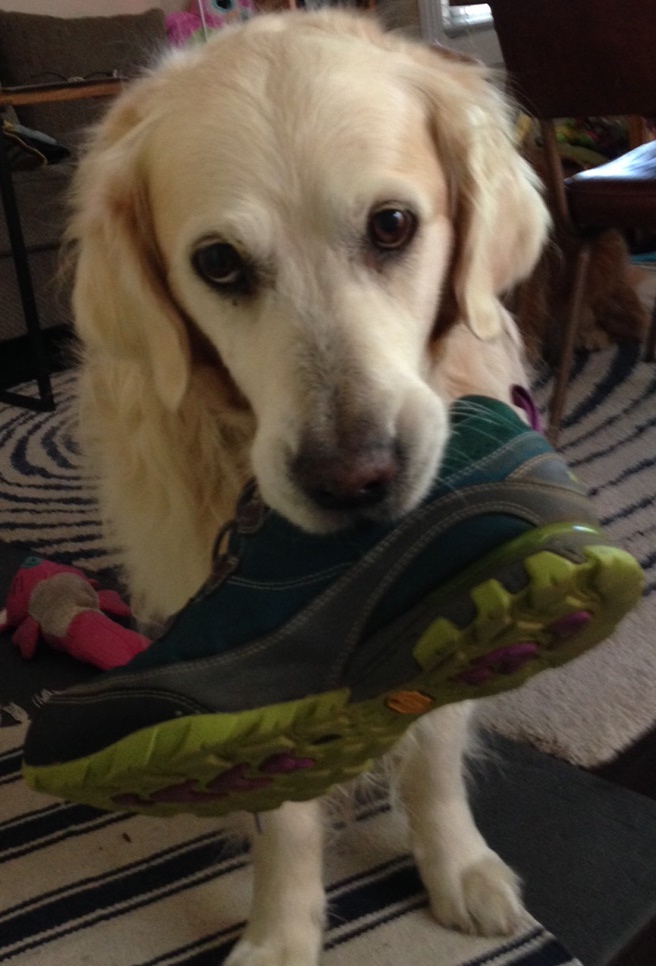

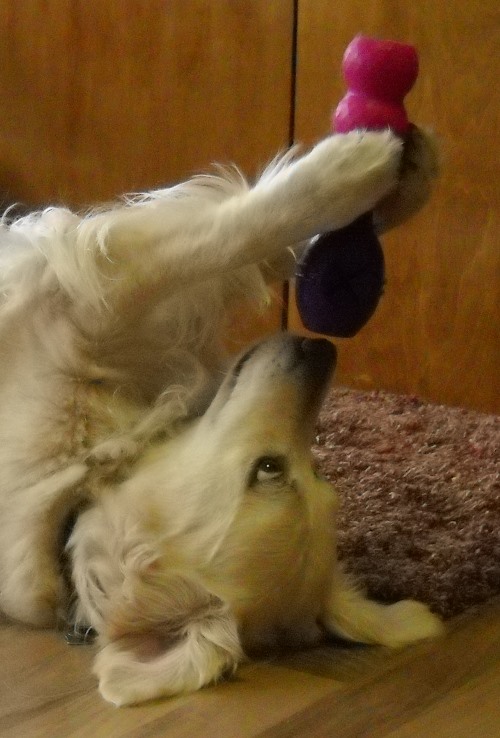


 I sometimes describe Jana as “anxious” because, many evenings, she seems unsettled, distracted, and uncomfortable. She whines or paces, but I can usually settle her down in a few minutes. The technique I learned from Lori, using a body wrap, seems to help a little. Jana also shows what I call anxiety on walks if a vehicle (mostly loud, big trucks, though she seems to harbor a deep-seated hatred of minivans, too) approaches from behind us and startles us. I attribute some of this “anxiety” to the possibility that she’s not hearing things as well as she used to and she gets surprised more often — perhaps she’s also losing some vision. Whatever the cause, things seem to come out of nowhere and startle her more often. Fine, so, she’s a bit anxious and I deal with it.