Communication Goes Two Ways

An entire industry, dog training, is dedicated to teaching dogs to understand what we want. Even dog owners who don’t go to training classes or hire private trainers spend a lot of time trying to communicate to their dogs (and often being frustrated at their apparent failures). Literally hundreds of books offer tips for teaching dogs to understand what we tell them.
What about helping us understand what our dogs are saying?
Our dogs are excellent communicators. Even the ones who don’t seem all that smart because they never do what their moms and dads ask probably are reading Mom, Dad, and all other humans better than any human ever could. Those dogs are also, most likely, using their whole bodies, putting heart and soul into trying to tell those very humans what they need, want, and feel.
We’re just very poor listeners.
Dogs use their tails, their ears, their hackles, their voices to communicate. A slight lift of a lip tells a story, as do exposed teeth, a lowered head, a low, slow tail wag. Each bark, yip, and growl has a different meaning. All dog owners should strive for a general understanding of what dogs in general say with their bodies.
The most important place to start, I think, is recognizing when a dog is uncomfortable, stressed, or afraid. Since some of the body language can look similar to friendly or happy dog body language, many people miss important signs.
For example, that wagging tail. It means a happy dog, right? Not always. Dogs’ tail wags are very nuanced. A tail held high and wagged fast generally means an excited or happy dog, but a lower, slower wag can be a sign of apprehension or discomfort. If the tail is stiff, or the tail is moving slowly and the rest of the dog’s body is stiff, you are not looking at a happy dog.
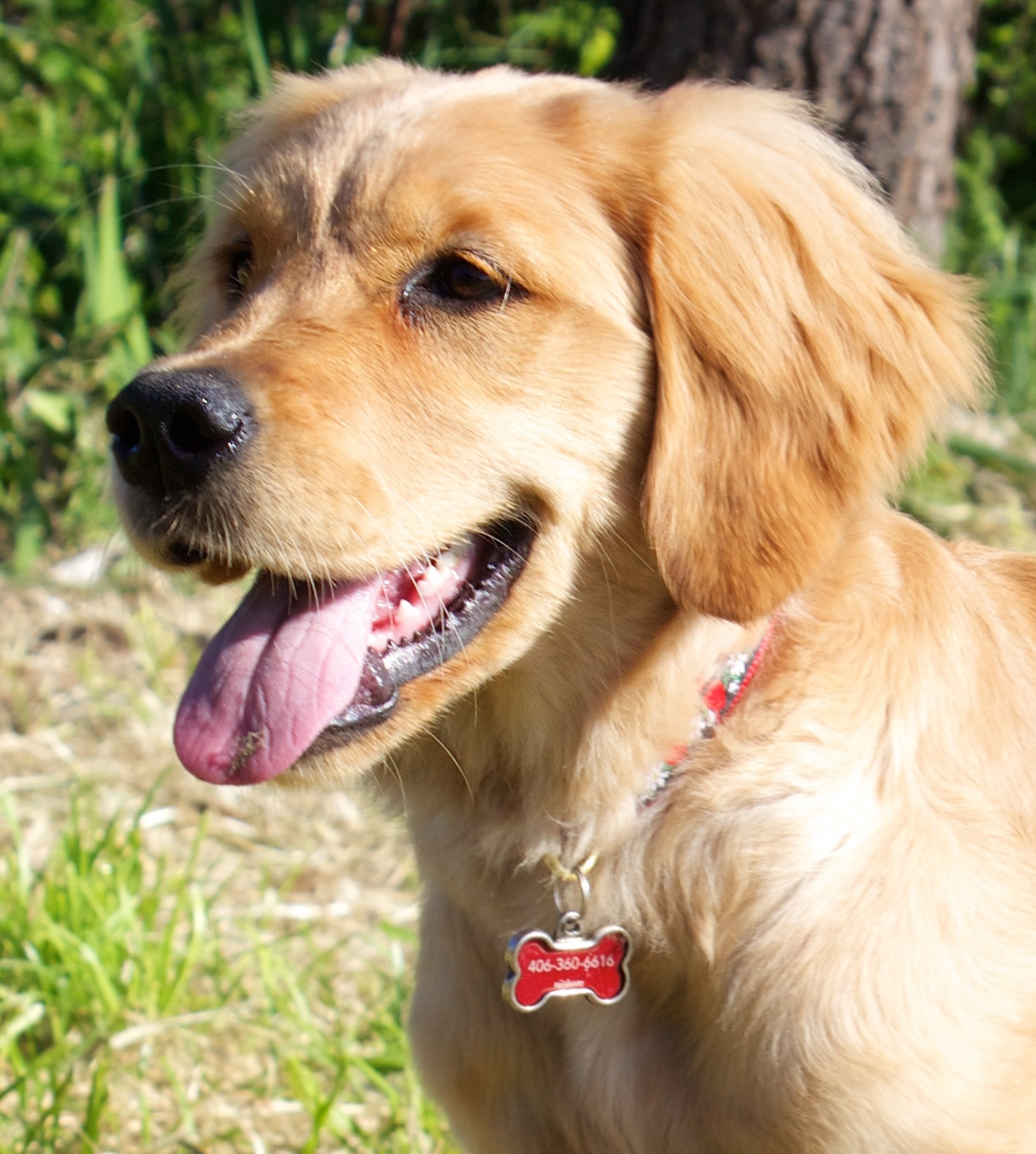
Cali relaxed

“Smiling dogs” are another area of confusion. If the dog’s lips are pulled back in what looks like a smile, and her eyes are soft and her tail is wagging loosely, she’s happy. But if the eyes are hard or are darting between you and someone or something else or the hackles are up, you are more likely looking at a stress smile. That dog is scared or stressed.
Take a look at these photos of Cali (when she was a much younger puppy). The right-hand photo shows her with soft eyes, and her mouth is relaxed. She looks soft. Happy. But the photo on the left (below) shows stress. Her eyes are hard and scared. Her mouth is more rigid.

Cali stress

Other signs of stress? Sweaty paws, furrowed brow, ears plastered back against the head, repeated lip licking or yawning, tail low or tucked, stiff posture, and panting. Many dogs will refuse treats in a stressful situation. Watch for avoidance behaviors: Some will sniff the ground when faced with a strange dog or even try to walk away.
A general understanding of what dogs’ body language means is important for anyone who spends time around dogs. But it’s even more valuable to invest some effort in learning your own dog’s body language and vocal vocabulary. What are her stress signs? How does she show you affection, share joy, express empathy? Learning her cues will strengthen your relationship.
Then, you can take the next step and start giving your dog ways to ask for what she needs!

Body Slams and Touch-Free Cuddling

Look, but don’t touch!

Not all dogs like to be petted. Certainly not all dogs like to be petted the same way.

The thinking dog owner might ask, “Huh? Isn’t petting a big part of why we have dogs around in the first place? Isn’t being petted pretty much an integral part of their job description as pets?” Maybe, but so what? I think that all of us, human and canine, get to decide how, when, and by whom we are touched.

With that in mind, and being admittedly slower than our dogs on the uptake, I recently made a realization about an ongoing battle I have with our German shepherd, Wylie. It’s likely, though, that only I see it as a battle; he might see it as a series of very small victories. Here’s the story.

Wylie can be pushy. He wants attention. Lots of it. He likes roughhousing and hard body contact. He body slams other dogs when he’s playing, he crashes into people and dogs, he steps on our feet and tails (well, the tails of those who have tails). He also, whenever I am petting golden retriever Jana, comes over and pushes his nose, head, or entire body between my hand and Jana. I push him away. He comes back. I put up an arm to block him. He crashes into it.

I could, of course correct him by telling him to sit or lie down. But what often happens is that, when he butts in, I get annoyed. And, I want to spend some time with Jana. So, instead of asking him to sit and then petting him in turn, I block him and usually order him to “go settle — somewhere else.”

But it doesn’t work. He keeps coming back.

I was musing about this ongoing conflict one evening recently and suddenly realized that Wylie is, in fact, getting exactly the kind of “petting” that he likes. Maybe not much of it — a few seconds at most — but he is getting what he wants. When I do focus on him and pet him, I don’t massage him and use the gentle strokes Jana likes; I thump his side, and we roughhouse a bit. He likes that.

While I am sure he would prefer that I stop petting Jana and focus my full attention — and both hands — on him when he interrupts my Jana time, he might believe that some attention is better than no attention. So my shoving him back isn’t a correction but more of a reward. And Wylie might not see the encounters as an ongoing battle but more as a challenge to see how much of my attention he can claim.

This realization ties nicely in with my strong belief that we (humans who live with dogs) should try to see things from the dog’s point of view sometimes and figure out what matters to the dog — more specifically, to each individual dog. When we understand a dog’s motivation, a lot more of that dog’s behavior makes sense.

Which brings me to Jana and touch-free cuddling.

It sounds like an oxymoron, but touch-free cuddling is actually Jana’s favorite way to spend time with her people. She’ll join one of us on the bed or the sofa, curling up comfortably — close but  not touching. If we overstep our bounds and reach out to stroke her, we’ll often be “rewarded” with a dirty look and a disappearing dog. Occasionally, she will tolerate a few minutes of petting before inching away, out of reach.

It’s not that Jana  doesn’t want company; she does. She’s quite content to hang out near us and will often follow me from room to room, settling nearby. And sometimes, on her terms, she wants to be petted, stroked, massaged, or belly-rubbed. She’ll even ask for it on (rare) occasion. When she’s enjoying it, she thumps her tail happily and offers lots of body language cues that tell me to continue, primary among them the fact that she has not walked away! But it is always, very much, on her terms.

Jana has always been more aloof than most golden retrievers, and I recognize and appreciate that about her. I am not one of those people who enjoys an attention-seeking dog (or person); Jana and I understand and complement each other well. But she is often misunderstood by people who assume that all dogs (or at least all goldens) live for the touch of human hands and who feel rejected by Jana’s refusal to be petted.

Not only do our dogs deserve to be petted (or not petted) in the ways that feels good to them, each needs to be understood and appreciated for who he or she is. In doing so, we humans have a better chance of understanding our dogs’ behavior — and perhaps avoiding or resolving conflicts.