Hide and Seek

hiding

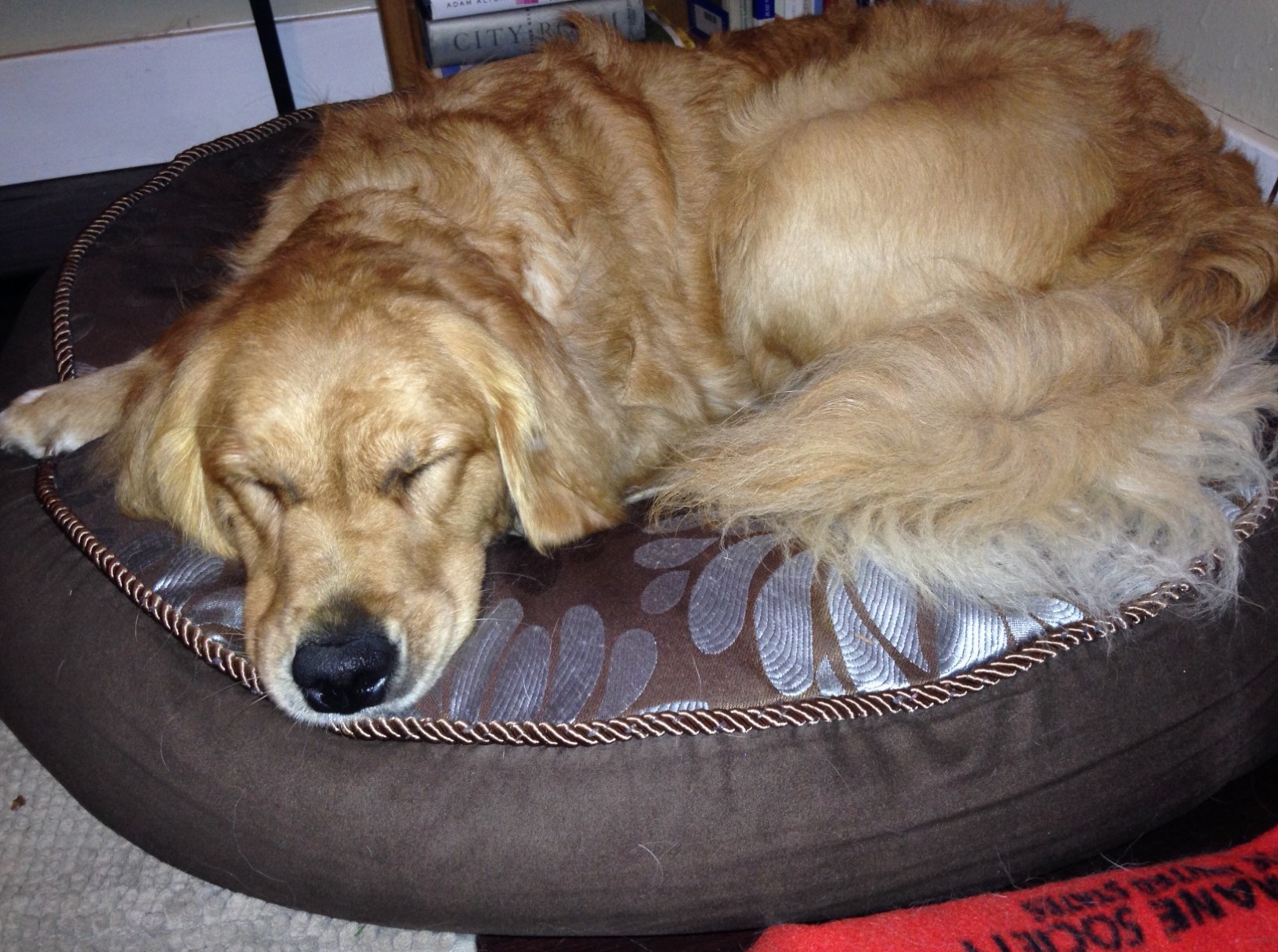
Every evening, as we get ready for bed, I call the dogs to brush their teeth. Jana runs right over, ever the good dog (and ever the dog who can sense a cookie opportunity). Cali used to run over. In fact, as a small puppy, she would often ask to have her teeth brushed, going over to the shelf where the dog toothbrush was kept and nosing it, touching my hand and then walking back over to it.
Those days are gone.
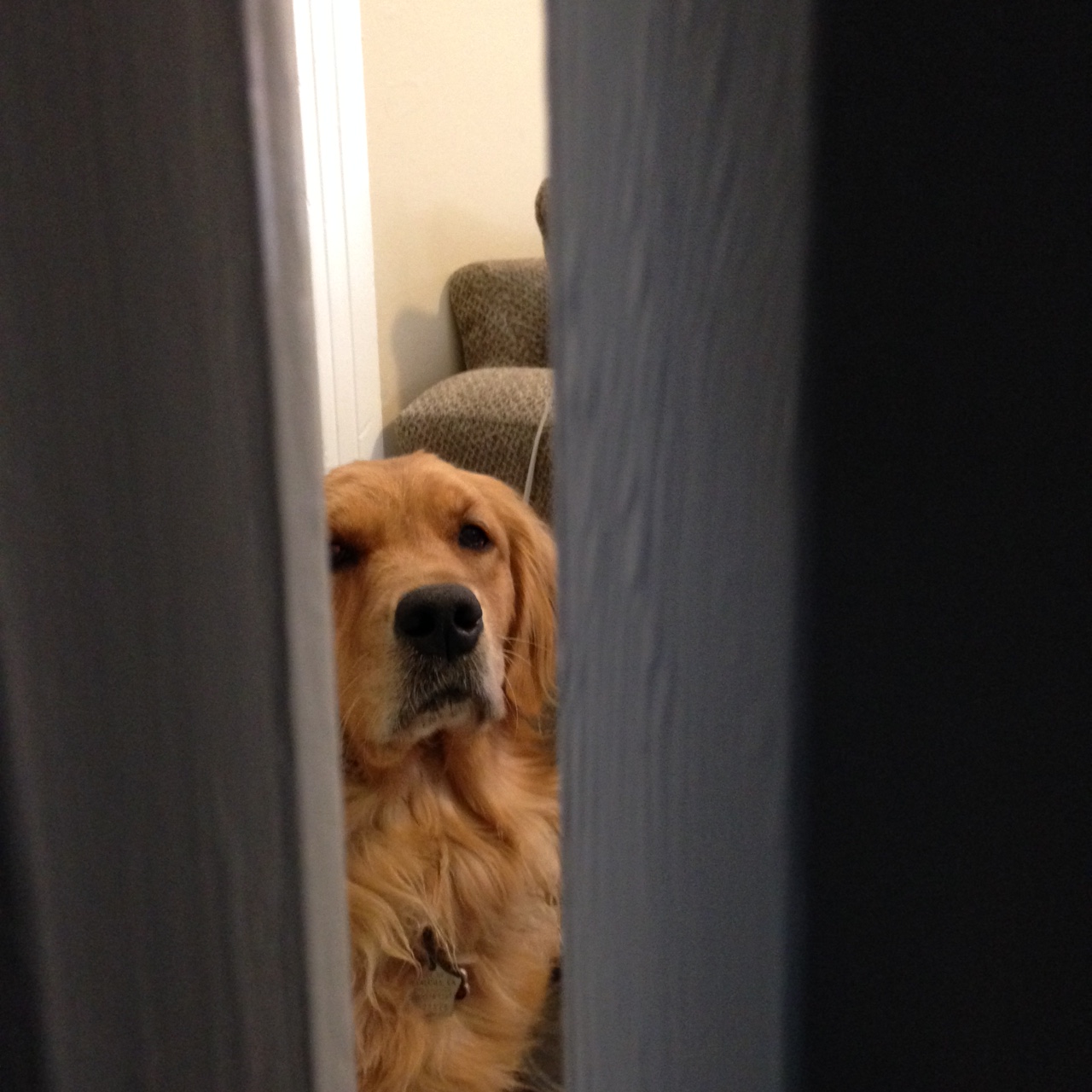
Now, her ritual is to hide. First, she heads into the bedroom. When I finish Jana’s teeth and call Cali, she walks toward me, but then she hides behind the bathroom door. She’s less than a foot away from me, and when I call her again, she comes over. But she always goes through this hiding routine. She does it when I need to clean her ears or trim her nails, too.
She could really hide. She could squeeze under the bed or hide in the closet. She doesn’t. She knows (I think) that I can see her. She’s not trying very hard to avoid the inevitable. She’s not refusing to cooperate. She’s simply registering her discontent. I don’t want to do this, she’s telling me, but I will, if I have to. And I will eagerly accept a cookie afterward.
What does all of this mean? I think it shows a pretty high level of communication. Cali is sure of what she wants, and does not want, to do. She knows, too, that we follow a routine and that she has to undergo some grooming, like it or not. She has figured out that hiding lets me know how she feels.
But it also shows her cognitive development in another way. Hiding, and understanding that she and I both know to look for something hidden (rather than assume it is gone forever) is part of understanding object permanence. It’s part of developing consciousness of the world around you and your place in it and in relation to others.
I have seen very young puppies show a grasp of object permanence: I once watched 8-week-old puppies playing with an agility tunnel. One ran in, and another ran to the other end of the tunnel to wait for her sister. That showed that the puppy knew that the “missing” puppy was simply temporarily out of sight and would reappear. She even knew where the puppy would reappear.
By the way, babies begin to grasp this concept at about 8 months, and, at about a year, can retrieve an item if they see it being hidden. Those 8-week-old puppies are leap years ahead of the typical baby.
So it’s no surprise that Cali understands object permanence. What I find fascinating, though, is how she uses it to communicate with me.

Growing Up

9 Weeks

Janas Bed age 2


Cali turned two recently, so by some definitions, she is an adult. I had this fantasy that, at age two, she’d “click in,” showing maturity and leaving behind the seemingly endless adolescent phase.
Hasn’t happened.
But all is not lost. She is showing signs of growing up.
For a couple of weeks now, she’s been trying very hard not to pull on the leash when we are walking to the park where we play every morning. She has excellent leash manners on most regular walks, but she’s so excited about the park that our morning walk there has been a constant struggle.
I repeatedly stop and ask her to stop pulling. She bounces into position next to me, then, within a few seconds, is out in front, pulling hard. As we walked, my patience would wear thin and my requests would grow sharper.
Then, a couple of weeks ago, I noticed that she wasn’t pulling so much as … well, vibrating. When Deni was here for a Thanksgiving visit, she asked why Cali was” bouncing like that.” Cali now walks out in front of me, but the leash is a bit slack and she bounces and quivers, and, every so often, moves back and walks next to me for a few steps. She is trying so hard not to pull.
Another sign of impending adultness is that she actually tried on her own, without being asked, to pick up her bowl after dinner this week. I’ve been trying to get her to do this, as Jana does, for months. The best she’s managed is to sort of lift it by one edge and drag it to my waiting hand. And that only happens if I have a really good treat in the other hand. But there she was — and, because of raging hotspots, she was wearing her cone — trying mightily to lift her bowl.
Finally, the best sign yet of maturity came yesterday. For a few months, every time our neighbors walk their dog, Ernie, Cali has barked madly at him. She does not bark when the people go by without Ernie. She is fine meeting Ernie in the parking lot or at the play yard, where they occasionally show up when we are there. But they walk Ernie a lot. Several times a day. And Cali has always done her crazy dog impression, barking her loudest, fiercest bark.
Until yesterday. Earlier, the other neighbors had returned from a walk with their two dogs, and both Cali and Jana let them know whose territory this was. I let them know how unacceptable their barking was.
About 15 minutes later, I saw Ernie and his people walking by. Dead silence from both dogs. Until I threw them a party. Good GIRLS! Lots of cookies!! Woo-hoo! When the trio came back from their walk, again, silence. This morning, again. Can it be that she has finally learned??
It’s easy to get frustrated at our dogs. And to assume that they know what we want them to do (or not do) and are disobeying out of spite. Or general badness. How many times have I told Cali that she’s the “baddest dog in the whole #$&^ town”?
But she’s not. And chances are, your dog isn’t either. They are trying. But it takes a lot of maturity and self-restraint to follow human rules that make no sense in a doggy world.

Alberta’s Marshmallow Test

This slideshow requires JavaScript.

In the 1970s, a psychologist tested the self-restraint of preschool children. Each child was offered a marshmallow. The children were told that they would get two marshmallows if they could delay eating the treat, and then left alone in a room for fifteen minutes. The researcher recorded what happened. The efforts of some children to stare down the treat or to distract themselves from it are both comical and painful to watch. Of course, some children inhaled the treat as soon as the researcher left the room. A recent book (The Marshmallow Test) describes this experiment and the follow-up studies of those children. The marshmallow test and other research on the ability to delay gratification shows that those who can exercise self-control in the face of temptation have better “life outcomes,” as measured by a variety of criteria, including SAT scores, social and cognitive functioning, long-term health, and retirement planning.

What does all of this have to do with thinking dogs?
Alberta experienced her own version of the marshmallow test recently. To say that Alberta loves treats is a bit like saying that I love chocolate. Alberta not only loves treats, she is not terribly fussy about which treats she gets. For sure, there are better treats, for example this bison and beef jerky concoction that I get at Costco and that, for some reason, Jana, Cali, and Alberta will do anything for. But ordinary, boring biscuits are fine too, and they are happily accepted as rewards for a job well done.

In her guide dog work, Alberta comes across many items that fit this dog’s definition of “treat,” and she works very hard to resist bits of food that just happen to be lying on the floor.
Alberta is justifiably proud of her hard-earned restraint, but more importantly, she wants Deni to know. So, in the course of a day’s work, if Alberta sees food on the floor and gives it a wide berth, she also nudges Deni to make sure that Deni knows just how good she is being. She pushes Deni hard with her nose, hoping that Deni will notice the ignored object. She often nudges Deni right near the pocket where Deni keeps the dog treats, just in case Deni might want to reward this extraordinary show of restraint. A girl can hope, can’t she?

Alberta knows the rule that she can’t grab food off the ground when she’s working. She wants to believe that that rule does not apply when she’s off-duty (her harness is off). She also knows that, even while working, she’s allowed to take treats that Deni hands her for particularly notable service. But she recently encountered a situation that blurred these lines a bit, a marshmallow test for dogs. Her reaction was remarkable.
Guiding Deni down a street in Saugatuck, Michigan, Alberta (along with her entourage of two other human family members) passed by a store that not only had a full doggy water bowl sitting by the sidewalk, but also a full bowl of doggy cookies. Just sitting there for the taking. An open invitation. Irresistible.
Or not.
Alberta headed for the water, took a drink, noticed the cookie bowl and … stopped dead. Confused. She looked at the biscuits. Looked at Deni. Furrowed her brow. Looked longingly at the treats. But she did not touch the treats.
We’d all stopped to watch the unfolding marshmallow-like drama. Alberta really wanted to gobble up as many of those dog cookies as she could. But she did not take one. She did, however, look at every one of us to make sure that we all knew how good she was being. Deni rewarded her by picking up a few biscuits from the bowl and handing them to Alberta.
Watching the interaction, I got to thinking. Most dogs who walk by this shop are not trained service dogs. Though many, like Jana and Cali, have had some training and certainly know that they are not supposed to just devour everything in sight, they don’t always have the restraint to follow through. Having more than once found myself alone with a new box of Trader Joe’s dark chocolate peanut butter cups, I can relate.
I wondered how often a doggy passerby just digs in and eats all the cookies in the bowl. How many battles between hungry hounds and their hapless handlers has the shop owner witnessed? Does the handler ever win? And really, what was that shop owner thinking?

But back to Alberta. In need of photos for this blog post, I asked Deni to re-create Alberta’s marshmallow test. The photo gallery (presented in order) at the top of this blog post shows that, like the successful children in the original marshmallow test, Alberta devised a series of ways to distract herself. Some of the children looked away, as Alberta did. Some sang songs or recited the alphabet. Alberta did neither of these. Some children closed their eyes. Upon realizing that, even after she had turned away, the bowl of biscuits was still there, Alberta closed her eyes.

Alberta has not only learned to resist random bits of food on cafeteria floors, sidewalks, and the like, but there she was, on that Michigan sidewalk and again in Deni’s office, passing up food that was obviously meant for dogs, placed there for her enjoyment. This shows us that dogs are able to do some high-level thinking and processing.

If Alberta were purely instinct-driven, that bowl would have been emptied in seconds flat. If she were operating only out of fear of punishment or hope of reward, she might have surreptitiously sneaked a mouthful of biscuits before Deni noticed, just to see if she could get away with it — and been rewarded by the treat, even if she got scolded after. But she went beyond a gut-instinct response and even beyond the basic (low) level of moral development that governs much of human and animal behavior. She paused, checked in with Deni, and did the right thing — even though she really wanted those cookies. We’re eagerly looking forward to seeing Alberta’s SAT scores and are consulting her for retirement advice. But in my next post, I will describe more practical ways we can apply the doggy marshmallow test to our relationships with our dogs.
What Is Motivation?

When we are trying to understand why individuals — canine or human — behave in a certain way, we are trying to understand what motivates them. When trying to convince someone to do something he or she is not especially eager to do, we need to come up with a strong enough motivation to overcome that resistance.
For many dog trainers, food rewards are the only “motivator” they employ. Other trainers refuse to use food rewards in training, scornfully saying that dogs trained that way will work throughout their lives only for the food. In some cases, this might be true; skilled trainers, though, fade out the food rewards once a dog has learned a cue. Which leads to the interesting question of motivation: If the dogs are not working only for the food, what are they working for?
What do you work for? The satisfaction of a job well done? Money? The chance for a guilt-free rest or vacation? The admiration of your boss, colleagues, or friends? To impress your family? The pleasure you get from your work?
People work for many things. Some are tangible (money or food); some are external (popularity, praise, satisfaction) and some are internal (feeling proud of accomplishment, understanding the importance of the goal). The same is true of dogs (except maybe the money part).
What motivates you is as individual as you are. It is as variable as the situation or task at hand, your mood or energy level, where you are (in life or at a given moment), who’s nearby … any number of things can affect your motivation. What remains true is this: You decide what motivates you at any given moment or to perform any particular task. If you don’t care about money, no amount will drive you to do a task you loathe. If you are not hungry, the promise of a snack is unlikely to propel you to quickly complete your homework.
Next time you are having a hard time getting your dog to do something that you want her to do, think about motivation. Try a different motivator. Maybe you are asking her to do something that is very important to you but irrelevant or even unpleasant to her. Examples range from calling your dog to you when she is playing at the dog park or chasing a squirrel to asking her to pick up an object that is heavy, awkward, or just plain inconvenient to hold. In many cases, she’ll be willing to do as you ask — given the right motivation.
I know that it’s hard to be more interesting and appealing than a fleeing squirrel. But waiting a moment, until the squirrel reaches a nearby tree, perhaps, then calling the dog and offering a really tasty treat … well, now you might be getting somewhere. If your dog loves to play tug, use a few rounds as a reward when she does something that is really important to you — like picking up her heavy, awkward food bowl after dinner. Improve your tennis-ball-obsessed pup’s recall by rewarding her for a quick response with a few throws.
Finding the right motivation sometimes requires creative thinking on your part. It also requires looking at your dog as an individual. To figure out what motivates your dog, pay attention to what your dog pays attention to. What turns that light on in her eyes or gets her running over to you? Dogs whose owners say they are “not interested” in food might discover a culinary bent in their pooch when they offer freeze-dried liver or bison jerky or bits of roast beef. Maybe you haven’t hit on the right toy to turn on your dog’s inner retriever or you haven’t found the scratch spot that’ll have him not only picking up but washing and drying the dishes — just to get a little more of what you are offering.
We all will work for something. We will often do even unpleasant chores for the right reward. The trick, in every relationship, is figuring out which rewards work. You’ll know when you find the ones that work — but remember, make sure that the dog knows that it’s always her decision.

Doggy Enforcers and Tattle-tails

Gracie, left, and Willow (Photo by James Cramer)

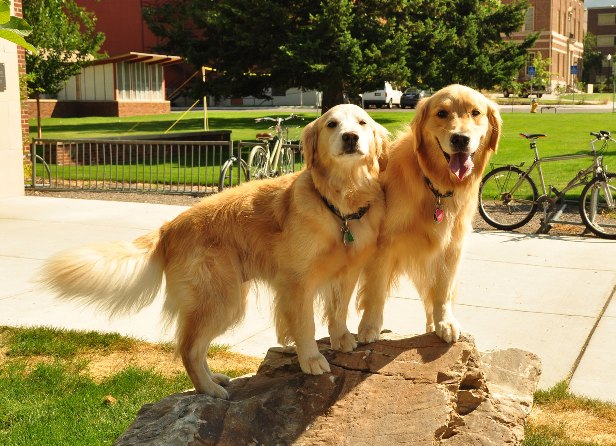
Some time ago, in a post published on the Creative Loafing website, I described an incident where Jana “told on” Wylie and Oriel when they broke the house rules. A brief recap: The dogs, wet and sandy following a swim in the bay, had been gated into our office, which is at the back of the house. A few minutes later, Jana started barking. I told her to stop, then yelled at her, then, finally, went back to see what was up. She was alone. Wylie had knocked over a barrier, gone out the dog door, and walked around the house to open a French door that leads into the master bedroom. He let himself (and Oriel, who had followed) into the main part of the house.

The funny part, so revealing of their different personalities, was that, just as I was chastising Jana, Wylie marched triumphantly out of the bedroom to proclaim his jail-breaking prowess to the world. Oriel had quietly curled up on a dog bed in the bedroom, wisely not advertising her rule-breaking to anyone.

So. Is Jana the only rule-bound dog I know? Not by a long shot!

Not long ago, Willow, a family friend (also a golden retriever), was visiting a favorite plant nursery with her newly adopted sister, Gracie. Willow is an exuberant dog who has never met a stranger. The entire world is her stage and all of us, her admirers. This particular nursery is a favorite because the staff adore her — and because whenever she’s there, she gets a treat if she greets the cashier and sits nicely.

This visit progressed much like all others, Willow’s dad reports, until the nice cashier asked the dogs to sit. Willow sat. Gracie, new to this routine and a little nervous about new things, did not sit. Willow wanted her cookie. The nice lady asked Gracie to sit. Willow grew impatient. When Gracie did not sit, Willow stood up, lifted a paw, and whacked Gracie on the head. Gracie sat. When the humans stopped laughing, both dogs got treats.

Was Willow really enforcing the rules? Was Jana? Can dogs tell “right” from “wrong”? If so, to what extent can we hold them accountable for their actions?

These are big questions that dog world is increasingly willing to discuss — though dog lovers and researchers are nowhere near reaching agreement. Whole Dog Journal editor Nancy Kerns discussed this very question in a recent blog post, and I plan to teach a course that centers around this very issue next spring at the Bergin University of Canine Studies.

As we examine dog behavior more deeply and consider interpretations beyond categorizing every action as a mechanical or instinctive response, and as biologists and ethologists explore the behavior of an enormous range of non-human animals, we see growing evidence that many animals besides humans think about their actions and weigh potential consequences. The TED talks website has a fascinating presentation on animals and morality by Frans de Waal that shows empathy and cooperation in the animal world.

For now, I am considering these questions about dog behavior — and collecting stories. Has your dog ever tried to get another dog to do something? “Told on” a sibling dog who broke the rules? Or done anything that suggests that he or she thought about rules or consequences before acting? Please share your stories here or by email to: thinkingdogblog@gmail.com