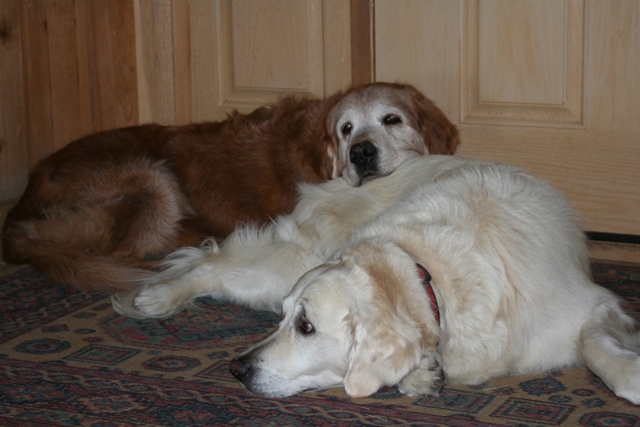
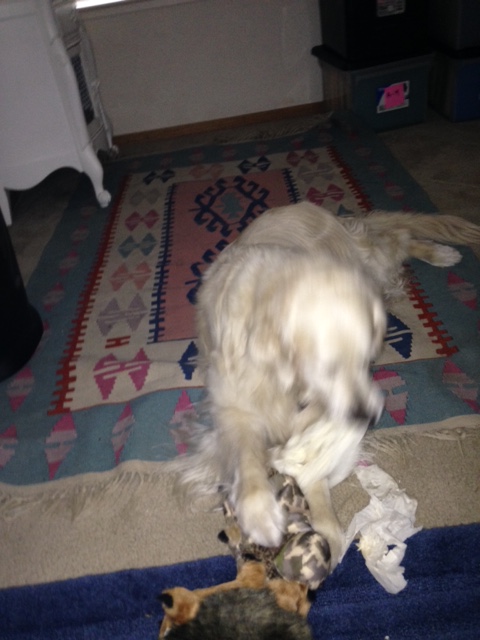
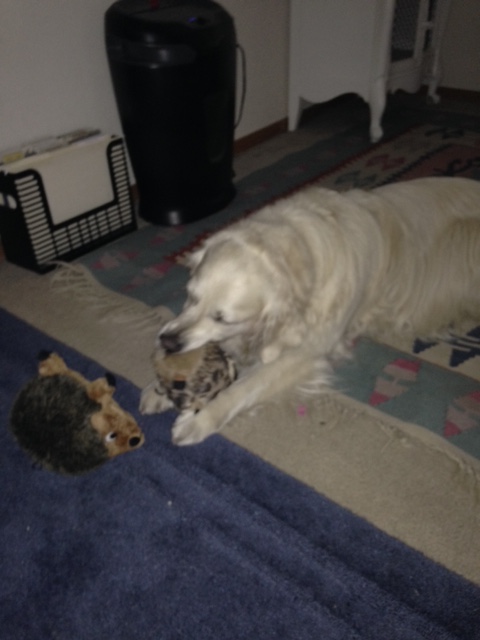
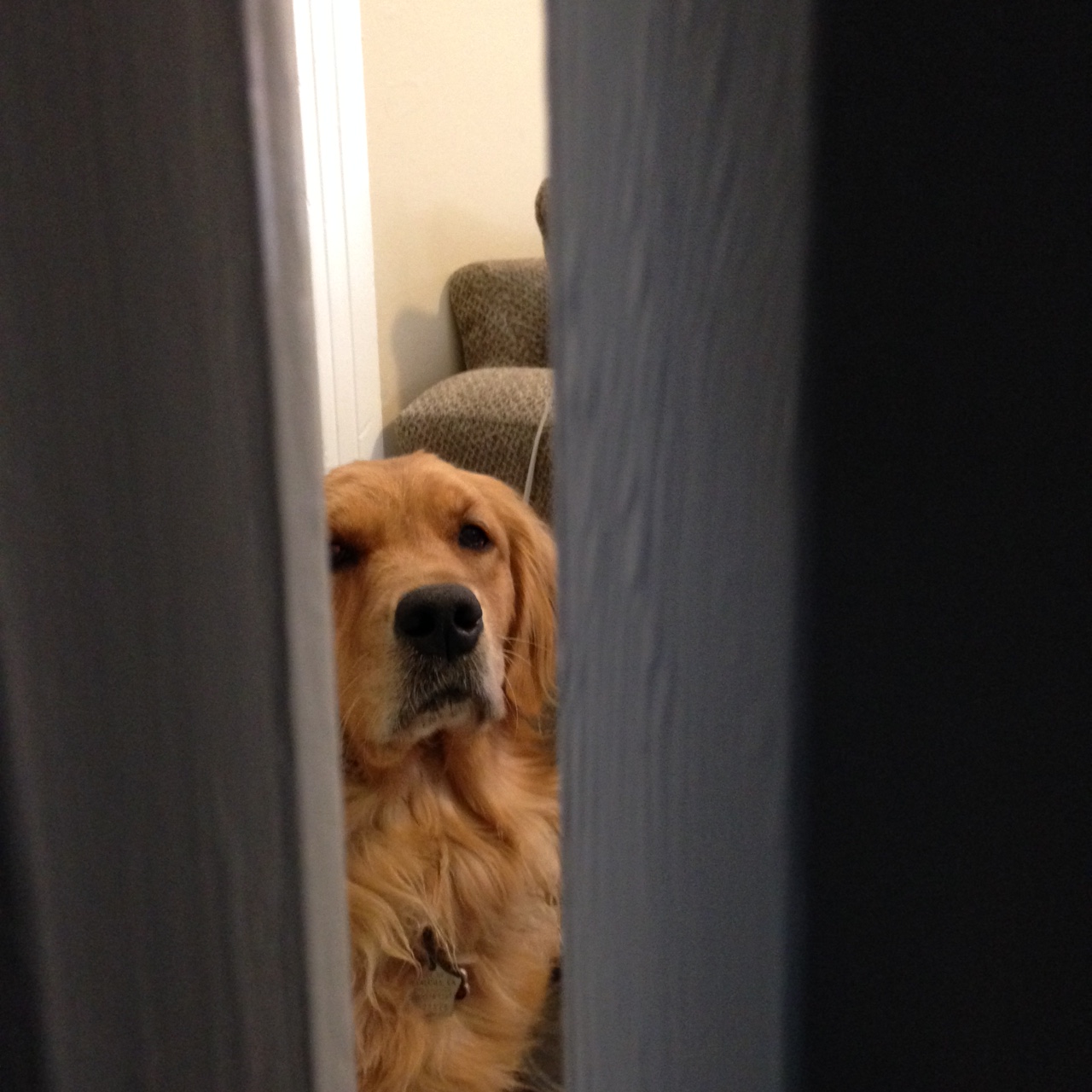
I don’t know if the cooler weather has anything to do with it, or a recent visit from one of the girls’ favorite aunties, but Jana and Cali have been very playful lately.
Each is playful in her own way.
As a younger dog (uh, princess), Jana played hard and liked playing with the big boys. Labrador boys. Or golden retrievers. Occasional other breeds but her reaction on seeing a Lab or golden, even from a block away, was joyful excitement; other breeds were generally greeted more warily. She’d get to know individuals and decide that certain of them could have her attentions. She’s like that with people, too.
Now, as she ages, she prefers gentle play. Tug with me or a (very few) special friends, whom she will approach, tug toy in mouth, and invite to play. Catch, if the again, specially selected, person gently throws the ball to her, she will either catch it or nose bump it back in the person’s direction. The person’s job is to get it from her or catch it and toss it again. She especially likes playing this game in the water.
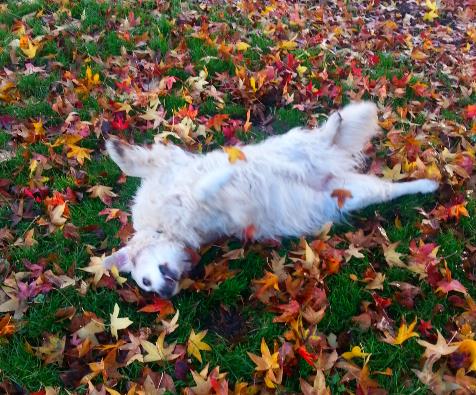
But Jana’s all-time favorite recreation is rolling: Rolling in grass, especially if it is so freshly cut that the mower is still working. Best of all if it turns her green. Rolling in sand is also excellent, mostly because that means we must be at the beach. Mud is pretty great, too. Jana has has a lifelong goal of becoming a black golden retriever.
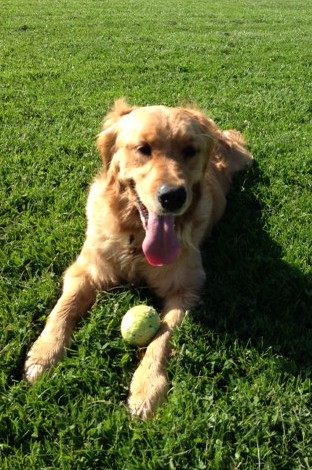
For Cali, of course, the only game in the world that matters is tennis ball. Frisbee will do in a pinch. I don’t call it fetch, since that is rarely what happens. (The bringing it back part, I mean … there is something about the “retriever” part of their name that eludes both girls).
Photo by Christina Phelps
Cali rarely plays with other dogs, except her sisters, Dora and Alberta. She will occasionally play with a smaller dog. Like Jana, her reaction to large dogs of other breeds is wary avoidance. Also like Jana, she’s more interested in meeting other golden retrievers and some Labradors, usually the smaller, calmer ones. Unlike Jana, Cali rarely warms up enough to play with them.
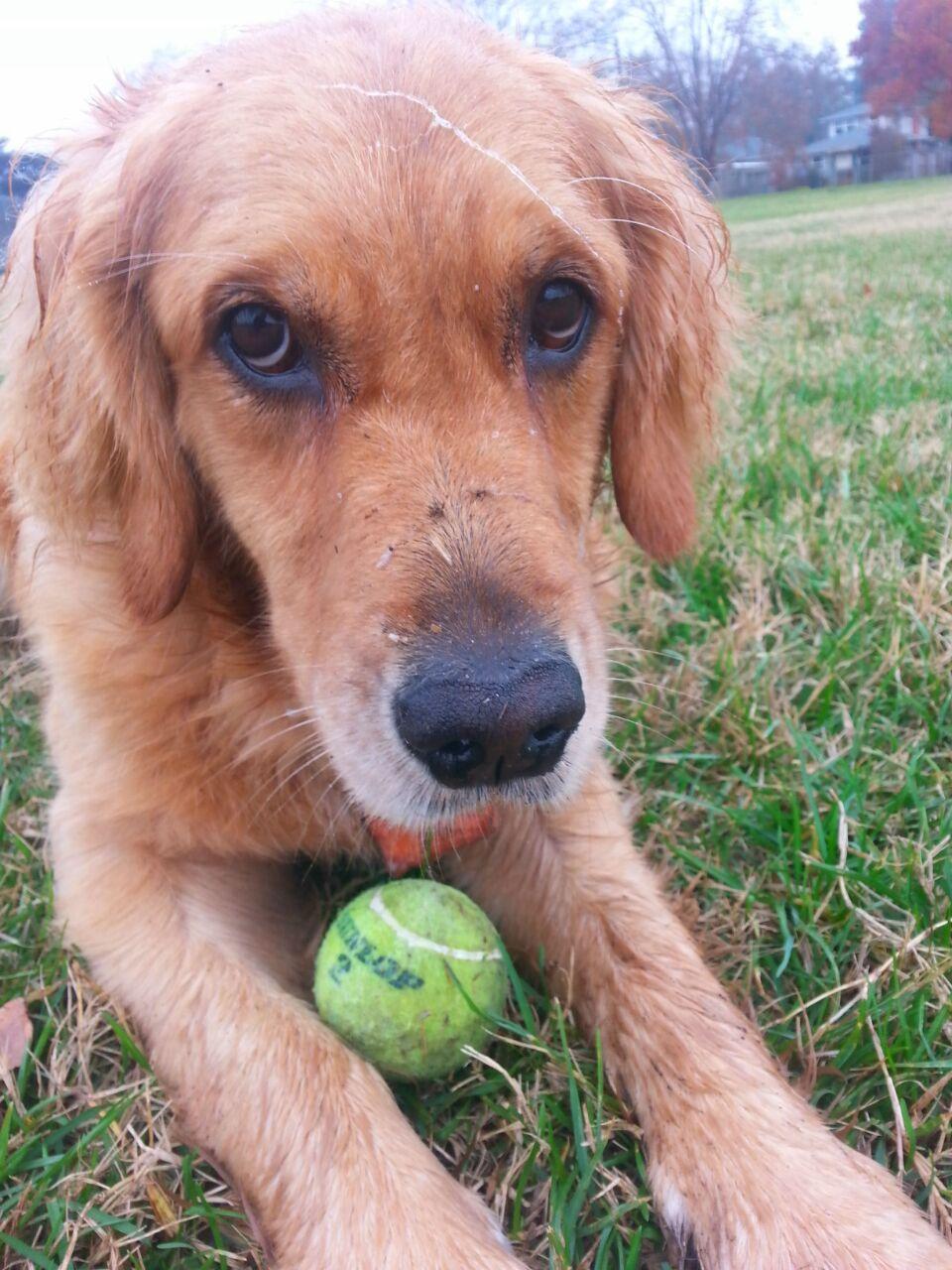
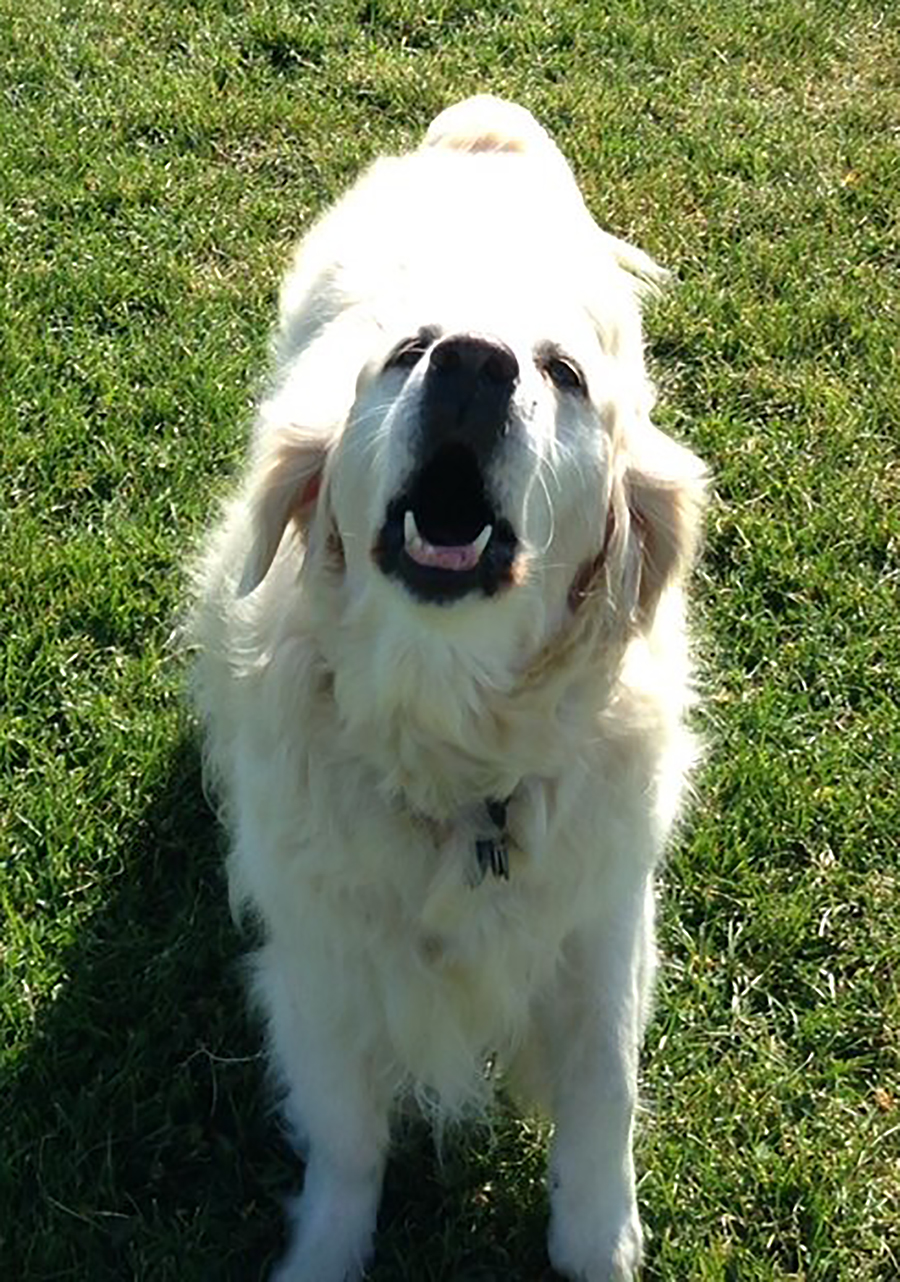
When she gets into a good game of running after her ball and sometimes bringing it back but usually just hanging out with it in the middle of the park, she gets a good drool worked up. She’s developed the unusual talent of drooling onto her own head, as the photo shows. She usually soaks her feet, too. The tennis ball gets a pretty thick coating too, mixed in with dirt and who knows what else. I know that dogs don’t sweat, but Cali also seems sweaty when she’s been running. And of course her feet and legs and tummy get covered in mud (as well as drool). Her messiness is a reliable measure of how much fun a play session has been.
I watched Cali run to and fro one morning, searching for her ball at the field where we play. She was so busy anticipating my throw that she ran full-on in the wrong direction and therefore had no idea where the ball landed.
She does not use the logical grid search technique that Wylie, the German shepherd who once shared my life, used. She often runs right past the ball without seeing it. She usually seems to follow her nose, and she always does manage to find her ball, eventually. It’s a large field and sometimes the search takes a while. She wants only her ball; she sniffs and rejects any other ball that happens to be in her path.
But her nose seemed to be broken on this particular morning. Or maybe she just had a bad cold. She ran past the ball several times, almost touching it, without noticing it.
Cali also does not appear to have read those studies that say that dogs, even very young puppies, can and do follow human pointing gestures. Or the training manuals that assure us that our body language looms large in our dogs’ minds, and they will go in the direction that our body, eyes, and feet are pointing, no matter what verbal cues we’re giving them.
Nope. My voice, arms, feet, and body were all telling her the same thing. I even walked toward the ball, stood two feet away, and pointed. No response from Cali, who glanced briefly at me before continuing her random search.
She did, ultimately, strike gold. She then watched me throw the ball once, brought it back — and lost it again on the next throw.
Another thing. Those studies about how dogs know what people can see and therefore tend to deliver the ball to a person’s front rather than her back? Cali hasn’t read those either. Or maybe she thinks that, because I am her mom, I have eyes in the back of my head (my mom did!). I tell her that doesn’t work for adopted kids. I pretend not to know where the ball is. I beg her to bring it to me. I demand that she bring it. I walk away. No luck. She loves dropping the ball behind me. Maybe she just has an odd sense of humor.
I enjoy reading all these studies about dogs’ cognitive abilities, and I really believe that (most) dogs do have great potential for problem solving, interspecies communication, and other feats of intellectual greatness. But playing with actual dogs like Cali is a good reality check sometimes.
I originally wrote this post for PPG Barks, the blog of a professional positive trainers networking organization. The post was rejected; I think the reason is that I am asserting that dogs deceive each other and humans. I am very interested in this topic, and I plan to revise the post further (or write an entirely new post) about dogs and deception. Meanwhile, I’d love some feedback from you. Please comment on the post or to me privately if you feel inclined. I am interested in what other dog people think about the question of doggy honesty and deception.
How much is a dog willing to bend the truth or improvise in order to get a reward?
That’s not a crazy question. Dogs routinely exhibit all of the cognitive behaviors needed to form an idea, plan, and execute deceptive or manipulative behavior. Consider:
Cookie, please
Dogs deceive each other or fake each other out to get what they want. One dog will pretend to hear someone at the door and bark the warning bark — anticipating that his doggy sibling will run to the door. The conniving canine then steals the dupe’s rawhide, toy, bed, choice spot by the TV, etc.
Dogs who have been taught to ring a bell or bark when they need to go out tend to go through at least a short period of ringing that bell constantly … or at least testing out how often they can get Mom and Dad to “hop to it” and let them out, even when all they want to do is roll in the grass or bark at the neighbor.
Is there any dog who hasn’t tried to convince her owners that they have “forgotten” to feed her?
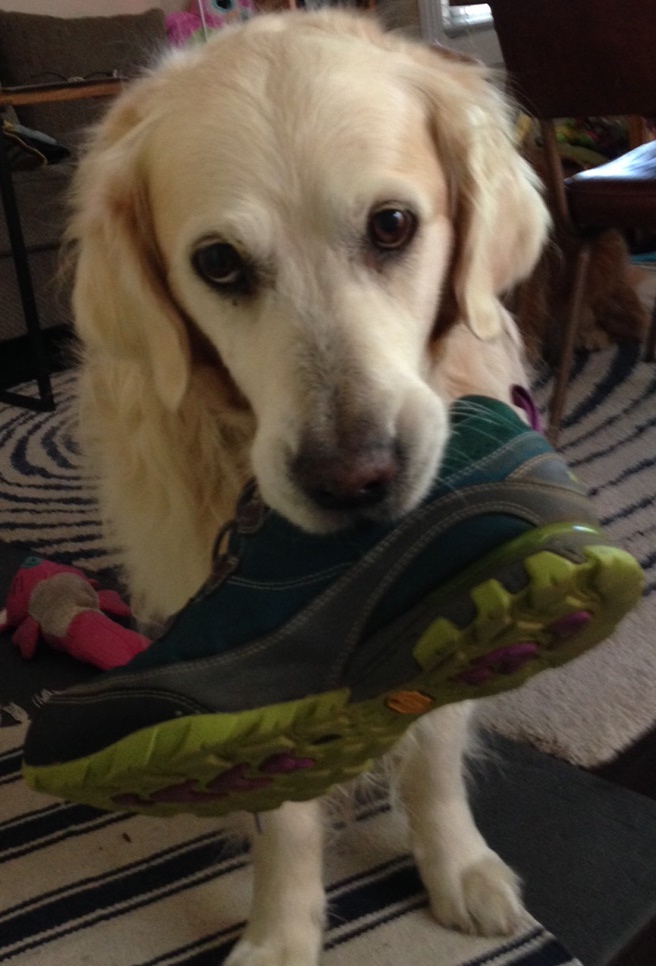
Many dogs will retrieve items that have not been requested in hopes of getting a reward. My dogs routinely bring me extra shoes in the morning, after they’ve been asked to bring my dog-walking shoes (and have been rewarded for doing so). This is probably optimism more than dishonesty, though. I routinely reward them for bringing me things that I have dropped, whether I was aware of dropping the item or not.
It gets even more sophisticated. For example, our German shepherd used to pretend not to know where the ball had landed when we threw it and he was busy sniffing something or chasing a squirrel. A request or two to get the ball would be completely ignored. Or, to humor the annoying humans, he’d search half-heartedly for a few seconds before doing the dog equivalent of shrugging and going back to something more interesting. “OK,” we’d say. “If we’ve lost the ball, it’s time to go home.” In under 10 seconds, he’d have found and delivered that “lost” ball.
Then there’s the golden who used the bells on the door to get Mom to open the door, knowing that her annoying puppy-sister would go charging out the door … while she stood there, smiling, as Mom closed the door with puppy outside and her inside.
So. While I will concede that not all of the above examples necessarily show deceptive behavior, some do, some might, and others at least indicate an ability to manipulate humans to obtain a desired end. I believe that dogs do lie and that they sometimes deceive each other and us. And they do it for a variety of reasons, including the possibility of getting a reward.
I’ve been thinking about this since I read What the Dog Knows by Cat Warren. It’s a great book; I posted a short review here on the Thinking Dog Blog not long ago. It’s about scent-dog training, specifically, cadaver dogs. The author raises an interesting topic: False alerts. She’s brave to do this, partly because many dog people ran into what I think I am running into: Many people cling to decades-old and thoroughly debunked ideas about how limited dogs’ cognitive abilities are. But mostly she’s brave for another reason: Many handlers proclaim that their dogs are never wrong and become incensed if anyone suggests otherwise.
Some false alerts are the handler’s fault. Particularly when the handler is a beginner, and the team is at an early stage of training, the handler’s body language or other unintentional cuing might hint to the dog that “this is where” he should alert. In this case, the dog is not lying; he is trying to follow the cues he’s just learning, and thinks he’s doing what the handler wants.
Training and working in situations, like cadaver searches, where the handler is not always able to tell whether the alert is false further complicates the discussion. Some false alerts, as Warren explains, might not actually be false. She says that if they are training in a vehicle junkyard, for example, and her dog alerts on the seat of a smashed car with a shattered windshield, while that is not the target she’s searching for, she rewards the alert anyhow. The scents linger for a long time, and the dog probably did detect the scent of human decay (parts of the book do require a strong stomach!).
I’m not talking about those instances though. I wonder if — and at what stages of training — dogs intentionally, knowingly lie about detecting the target scent. There are certainly working situations where the handler might not know if the scent is present and therefore is likely to trust the dog and reward an alert. False alerts occasionally do cause problems in law enforcement.
She draws a distinction between false alerts that are outright lies and those that are more nuanced and, she says, even more insidious (though not always because of misbehavior from the dog). The dog is detecting something but is not entirely sure it’s the correct scent; or the dog has detected the scent but not found the precise location and alerts anyhow; whatever the case, in these instances, she explains, the dog isn’t consciously deciding to lie. As with human behavior, not all situations are easily explained, black or white.
Warren says she will never know whether her dog’s false alerts are inadvertent or are deliberate lies — but she does not rule out the possibility of a dog lying. She also says that her dog’s body language is so clear that she thinks she could tell if her were lying. Many humans betray their dishonesty through body language. Sometimes those “tells” are very subtle. A close study of our dogs’ body language might be our best chance at knowing when they are — and are not — trying to con us.
What do you think? Have you ever worked with a pathological doggy liar? An occasionally dishonest dog?
Of our three girls, only Cali is truly secure and comfortable in her dogness. Alberta and Jana are quite sure that they are not dogs.
How do I know this?
Cali happily goes in and out the dog door, delighted with her independence and freedom to enjoy a large yard, from which she can survey the surrounding hills and valleys. Jana and Alberta go to the people door and bark. If their staff fails to appear in a timely fashion and let them in, they bark louder. They both will, if forced, use their keys to open the dog door and step disdainfully inside. But they really shouldn’t have to resort to that.
Cali is fine being left home, particularly if she can let herself out. She calmly accepts being banished to the porch with a visiting puppy to play. She’s perfectly content hanging out with other dogs, so long as she knows and likes these dogs. Alberta, rightly, assumes that Deni should take her along everywhere she goes. Jana just plain does not want to be left with the dogs. She does not want to be excluded from adult company, relegated to the puppies’ table (or porch), or treated like a dog. If left at a dog place — she has, on rare and very stressful occasions, been left at a groomer’s or a boarding facility — her facial expression, resistance, and loud protests all say: PLEASE don’t leave me with all these dogs!
I would say that Jana and Alberta are anomalies, shaped by our treatment of them to believe that they are somehow not quite dogs — but I have met so many other dogs who seem to be equally certain that they are not dogs. Molly, for example, whom I mentioned in a recent post. Of course, she’s a standard poodle, and I for one do not think that poodles are dogs. They are so close to being human. Molly clearly agrees.
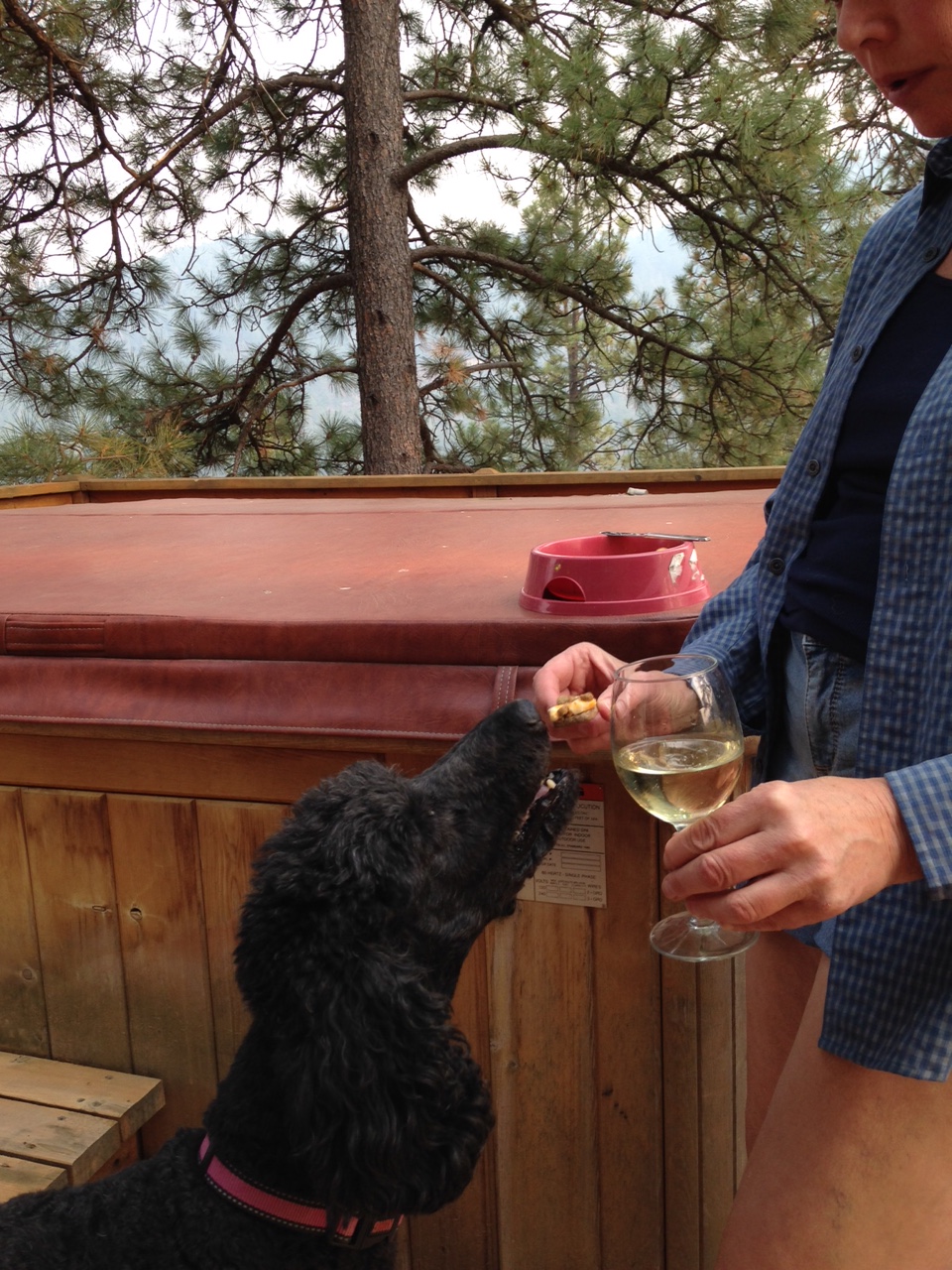
When Molly was visiting, she would not — could not — eat in the laundry room with the other dogs. Excuse me. With the dogs. She dined solo, al fresco, with a white-jacketed server in attendance. OK, so maybe Deni wasn’t wearing a white jacket, but the rest is true. Not only did she dine in solitary patio splendor, she had special meals. Chunks of cheese, biscuit crackers, slices of deli meat … the only way that Molly would eat kibble was on a cracker (biscuit) or in a turkey roll-up. She prefers white wine, not too dry and not bubbly. (OK, OK, she didn’t actually get any wine, either. But the rest is true. Really.)
But back to Cali. It is nice to have at least one dog who actually is comfortable being a dog and is happy to fulfill her role as the family dog. She’s very cuddly, for example, and loves to be petted. She’s always enthusiastic about going for a walk or out to play. She enjoys doggy things, like chasing after a tennis ball and refusing to bring it back, barking at deer, licking all the hand lotion off of my fingers, and begging for treats. She wants to be near me most of the time, even when I am doing boring (to her) things, like writing a blog post (she’s at my feet) or grading papers. Like her ancestor Oriel, Cali embodies everything people love about dogs. She’s sweet, affectionate, playful and goofy sometimes. She’s great company and very friendly. And secure in her dogness.
Do dogs miss us when we’re away? Do they miss places they’ve been or items they’ve loved?
It’s clear that dogs remember people and places — and often, the landmarks or scents on the way to places that they either love or hate. Dogs can recognize a person whom they haven’t seen in years. Or a place that they haven’t visited in years: Oriel, our late and much-missed golden retriever once ran joyfully to the site of a small pond that had been dry for about a decade. The former pond was a short walk from her former home in Montana, and she hadn’t been there for at least 3 years. She became very excited as we approached the road to the house, too. And of course all of our dogs know the way to fun places and begin to show excitement ridiculously early in any journey in the general direction of the dog beach, Cali’s sister Dora’s house, the park where we play ball …
It’s also clear that dogs use these memories to anticipate, with pleasure or dread, future experiences. Dogs generalize and can become fearful of people or situations that remind them of unpleasant experiences in the past. A dog who fears going to the vet, for example, can recognize a vet’s office, any vet’s office, from several blocks away. Happy experiences have the same effect. Thus a dog who loves to run and play will decide that any open green space you happen to drive past would be a really fun place to stop and play ball. He might helpfully point out all the nice play opportunities say, between Northern California and Missoula, Montana, as you are driving. Believe me, there are hundreds of open green spaces in the American Northwest.
But do they miss us? Do they miss places?
This question becomes more relevant each day, as our departure from Montana gets closer and closer. Does Cali miss her play park and friends in Petaluma? More to the point: Will she miss her private play yard in Montana? Will she ever forgive me for taking her away from this idyllic place where she is so happy?
It’s also a question that many dog owners ponder if / when they leave their dogs with a dog sitter or boarding kennel when they travel. Does the dog pine for them? Wonder where they are? Or, as dogs do so well, does the dog simply live in the present moment, enjoying the attention of the dog sitter?
I’ve heard enough stories about how dogs behave after the death of a loved human or canine playmate or family member to believe that dogs grieve. Isn’t that an indication that dogs miss people or dogs who aren’t present?
I don’t have a definitive answer to any of these questions. I suspect that some individual dogs form closer ties to people, dogs, places, and other beings or objects and do, indeed, miss them. Other dogs appear to be — and may truly be — happy in the present moment, loving the ones they’re with.
So the answer might be similar to my answer to so many questions about dogs: It depends. Dogs are individuals. Your individual dog might miss you very much when you are gone. Or she might happily hang out with whomever is nearby. Cali might miss Montana. But Cali’s such a sunny optimist that I am betting she’ll be happy to be back in Petaluma and enjoy picking up our old routine and reconnecting with her playmates there.
Opening birthday presents helps keep Jana young and happy!
We celebrated Jana’s twelfth birthday recently. Her friend Leti (also a golden retriever) just turned 15. These girls still walk to the park nearly every day and enjoy a vigorous roll in the grass. They make the rounds, saying hello to the other dogs’ people and trying to cadge a cookie or two from each human.
I do everything I can to see that Jana’s quality of life remains high. Despite their good health, both girls are showing signs of their age. Jana has severe arthritis and wakes up feeling stiff and painful many mornings. Though she’s usually very sharp mentally, I’ve noticed a few senior moments, when she seems to be a bit confused.
Hoping to deal with both those issues — without breaking the budget — I’ve put together a regime of supplements and exercises that help Jana a lot. If you have an aging dog, some of this might be helpful. I have no veterinary training, but I do check everything with my vet and vet techs before I try it on Jana, and I recommend that you do the same:
Even Cali, age 2, is taking a small amount of glucosamine each morning. It helps ease joint pain. Some people take it, too, particularly for knee pain.
New Zealand Green Lipped Mussel. Jana takes one green mussel capsule daily, emptied onto her breakfast. Like glucosamine, it can help people and dogs with joint pain. Jana behaves very differently when she’s talking it — asking to go on walks and soliciting tug games — so I am convinced that it helps.
Fish oil. Each girl gets two fish oil capsules a day. The omega-3 is as beneficial for them as it is for humans, and the dogs like the fishy taste. They get sardines once or twice a week as a treat for the same reason.
Coconut oil. A spoonful a day is great for their skin and coat. Coconut oil also might help with brain energy and metabolism (Thanks to Tom Morrare for sending me the link to this great article!), and it has anti-inflammatory properties (in lab rats, anyhow).
Turmeric, another anti-inflammatory. Jana likes spicy food; for some dogs, turmeric capsules or tablets might work better than the powder. Also, the bright orange powder stains everything it touches. If your dog is prone to tummy issues, you might want to use tablets.
Rimadyl or one of the generic equivalents. The active ingredient, carprofen, is an NSAID for dogs. It reduces inflammation and therefore pain. It also can cause liver damage if given in high dosages or for a very long time. Since I have started giving it to Jana regularly, I will make sure to get bloodwork done every six months.
Cold laser therapy. Jana goes about once a month. Some dogs get it more often; some less. Figuring out the frequency is a complex formula that factors in cost and distance and time. The treatment really seems to help keep Jana limber and, if not pain-free, certainly far less painful. It stimulates blood flow, healing the tissues and reducing inflammation, thereby reducing pain. I get Jana as many laser therapy sessions as I can so I can reduce the amount of Rimadyl she takes.
Jana does daily exercises on an inflated exercise disc, as recommended by her laser therapist. The idea is for Jana to strengthen the muscles that support her arthritic joints. She’s also working her core and having a great time. She’ll “dance” (prance, alternating paws) and turn around on the disc and balance with front or back feet. Cali usually joins in.
Treat toys. There are many. Jana’s favorites are Squirrel Dude and Nobbly Nubbly, both from PetSafe, and the Kyjen Cagey Cube. Other dogs will like different toys; these are the ones that hold Jana’s interest, even if I give them to her over and over again.
There are other options that we have not tried (or haven’t tried yet) or haven’t liked: Adequan injections, for example, which is used for arthritis pain; acupuncture, which Jana didn’t react well to; surgery; massages and body work; Chinese herbal treatments … the list is long. If you find something that works for you, let the Thinking Dog know at thinkingdogblog@gmail.com!
The important elements are to keep the dog moving and challenged — physically and mentally — and as pain-free as possible. Jana has jobs as well: She gets the morning paper, brings my shoes when we’re getting ready to go for a walk, and picks up the bowls after each (doggy) meal. She loves interactive toys where food or a tennis ball are hidden or trapped (her favorites are mentioned above); she’ll spend a long time trying to figure them out, whereas Cali gives up much more quickly.
It’s also important to make sure your older dog has a comfortable bed (in Jana’s case, so that she can sleep next to it) and is warm in cold and damp weather. I’ve put down rubber mats so she no longer slips on the bamboo and linoleum floors. I haven’t gotten her a ramp or stairs yet, but I do have to help her into the car.
My goals are to reduce Jana’s pain without heavy use of pharmaceuticals and maintain her quality of life. I started with the supplements and only added a small amount of Rimadyl when Jana was clearly painful. I want to accomplish all of this at what I consider a reasonable cost. Obviously, this means something different to everyone. And I understand that not everyone is willing to spend several minutes measuring out supplements at each meal or hours schlepping a dog to a laser appointment. Every individual dog and family needs to figure out what works best for them.
Many people worry. They dream up scenarios that could never happen. Then they worry that those unlikely events can and will happen. And they worry about what would follow … I don’t know if Cali does that, but she does worry about things that she knows are about to happen.
She worries about brushing her teeth. This is odd, because, when she was a puppy, she actually asked to have her teeth brushed, perhaps anticipating the treat to follow. She walked over to where the dog toothbrushes and toothpaste were kept and touched them with her nose. Looked at me. If I failed to notice, she nudged my hand, then walked over and touched the brush again.
Now, when it’s getting close to bedtime, she’ll go out for “last call,” then come in and immediately disappear when I say, “Time to brush your teeth,” or even move toward the bathroom. Disappearing a 60-lb dog is not an easy feat in a tiny one-bedroom apartment, yet Cali is gone. Jana comes right over to the sink, tail wagging, ready for the nightly tooth-brushing routine. I call Cali. She hides behind the bathroom door. Or I find her in the dog bed on the other side of my bed, pretending to be asleep. I’m willing to provide delivery service for the actual tooth-brushing but not for the cookie that follows. That’s only for dogs who line up to get their teeth brushed (she usually shows up for that part). Tooth-brushing doesn’t hurt. She’s never had a toothache or broken tooth or even an abscess. She likes the taste of the (chicken-flavored) toothpaste. But, somehow, when she knows that it is coming, she worries. The anticipation is much worse than the experience.
This is also the case for some other grooming tasks: Ear cleaning is admittedly as bad as she expects it to be, but getting the fur on her feet trimmed doesn’t hurt at all. It might tickle a bit, but then she’s amply rewarded with really special cookies. Nail trimming is even worse to anticipate: Both the Dremel that files her nails and that horrid clipper thingy are clearly medieval torture implements, in her view. In her entire 2 ½ years, no one has ever over-trimmed and cut the quick. Even so, no one can convince Cali that nail trimming is not worth every ounce of dread she can summon.
Cali worries about other things too. When I am working at my home computer, she catches sight of her ball and then looks worriedly at it, as if wondering whether anyone will ever throw it for her again. When we’re at the park and I do throw it, she catches it and then holds it between her paws, lying on the grass and looking worriedly around her at the other dogs who might come by and nab it. When she decides other dogs are too close, she picks up her ball and moves to a different part of the field. When no possible dog threats are near her in the park, she stretches her back legs out, ball loosely held between her teeth, and wags her tail at the activity happening at a safe distance. But she is reluctant to let the ball go for me to throw it — and start up the whole worry sequence again.
Her other big source of worry is the vacuum cleaner. It looks innocent, tucked into its little corner of the kitchen, but it sometimes roars to life. She avoids it, though she had no such fear as a puppy. When it comes out of its corner, Cali is nowhere to be found. What is her concern? She’s been around vacuums her whole life without ever suffering the smallest chance of being sucked up.
Cali’s worried anticipation, much like her eager expectation when we are driving toward a beloved location, dispels the myth that dogs are unable to think about future events. Dogs do appear to extrapolate from past experiences what the future might bring, good or bad. The best I can do when she’s nervous is acknowledge her concerns and insist that she face her fears and move on. While I hope that her anxiety is just a phase, I do wish that I were fluent enough in Dog to figure out why some future events seem so frightening to Cali.
Dogs just seem to know how to play by the rules. Ethologist Marc Bekoff makes this argument based on years of observing dogs and their wild relatives — at play. In a 2010 article in Scientific American, “The Ethical Dog,” Bekoff describes four rules that dogs use to govern their social relations: Communicate clearly; mind your manners; admit when you are wrong; be honest.
Social play helps dogs (and humans and other social beings) manage and maintain social connections. Individuals who do not play well with others often suffer in other areas of their lives. Coyotes who don’t play fairly and are ostracized when young tend to leave their family packs more than better-socialized coyotes — and they have a significantly shorter life span.
While the stakes for domestic dogs are lower — they can survive nicely in one-dog homes — there are still consequences, as anyone who has lived with a poorly socialized dog knows well. Some people cannot board their dogs or must avoid any outing where another dog is likely to appear. Some walk their dogs very early in the morning to avoid other dog-walkers.
Some people, unaware or uncaring that their dogs lack social skills, go to the park anyhow. Fortunately for Cali and Alberta, they have a big sister who’s willing to enforce the rules.
Not long ago, Alberta was happily playing with another Lab at our neighborhood park. The Lab was excited and got overly rough. Alberta, in her sweet, polite way, told him that he was being too rough. That didn’t work. She tried to avoid him, but he still didn’t get the hint. Jana had had enough. She got up and, with all of her senior-dog-dignity, approached the other dog — and gave him an earful.
After being told off by his elder, the Lab finally got the message. He apologized, and play continued at a more appropriate energy level. All was immediately forgiven.
A dog I lived with many years ago even applied the principles of fair play to human-human interactions. We were on a walk once when we came upon a group of young boys, around 8 or 9 years old. Two or three of the boys were hassling a smaller boy. Timo, all 12 pounds of him, was incensed. Though leashed, he lunged, barked, and snarled at them. Startled, the bullies ran away. Timo shook himself off and strutted home.
Most dogs learn the “rules” from their littermates, which is one key reason that puppies should stay with their siblings until they are eight weeks old. Good puppy classes are another place for puppies to acquire these all-important social skills.
Wherever your pup learns, make sure to play, and play often with him. As I’ve written, it is the best way to maintain a close bond.
“She’s such a mama’s girl,” Deni said of Cali the other day. “If we get too far ahead, she looks back and wants to stop and wait for you.”
“Nah,” I said. “She knows that I have her precious tennis ball, and she’s worried that she won’t have it when she gets to the park.”
I may be a bit too cynical, and I do know that Cali and I have a close bond, but … when it comes to morning play, I really am just the tennis-ball carrier and tennis-ball thrower.
We tested our competing theories the next morning. As Deni, Cali and Alberta set off at a brisk pace, leaving Jana and me plodding at 12-year-old-golden speed, Cali glanced back once, then marched off, tail wagging. A key difference from the previous morning: Deni was wearing the all-important black backpack with Cali’s filthy, spit-coated, utterly disgusting tennis ball — the only one that Cali wants to play with.
Soon they were out of sight. When I got to the park with Jana, I asked Deni what had happened.
“Well,” she said. “Cali did look back twice, but she did not want to stop or even slow down.”
In fact, Cali is my best balanced-life coach, nudging me at regular intervals to gently point out that it is time to take a break from this horrid computer, go outside, and play with her. And that darned tennis ball.
Cali knows what dogs have known for thousands of years and what has contributed significantly to the human-canine partnership: People and dogs play well together. Play makes all of our lives better. And playing with ours dogs makes our relationships with them better. According to a recent study by dog expert John Bradshaw, dogs who have frequent, positive play sessions with their owners (no scolding!) are more obedient and more engaged with their humans.
So, what are you waiting for? Get out there and throw that (disgusting) tennis ball!
Poor Ziggy. Summer in Kansas is a never-ending cycle of thunderstorms and frenetic lawn-mowing. To make matters worse, his neighbors seem to tag-team each other. No sooner does one mower stop its terrifying buzz than another starts up. When all the lawns are neatly groomed … the thunder clouds roll in.
Ziggy cannot click his heels together, murmur “there’s no place like home,” and wind up back in thundercloud-free Southern California, where he grew up. He wouldn’t even need to worry about lawnmowers there; lawns are practically illegal in California these days. There’s no place like home indeed.
So what’s a poor thunder- and mower-phobic dog to do?
Rescue Remedy did not live up to its name; hiding under the sofa failed to quell his fears, and even the trusty closet let him down, seeing as it has an external wall. His mom’s planning to turn his kennel into a man-cave in the hall, the only place without windows or outside walls, but meanwhile, well, it’s raining. Again. And rain means thunder. When the rain stops, the neighbors fire up their mowers. Again. The cycle continues.
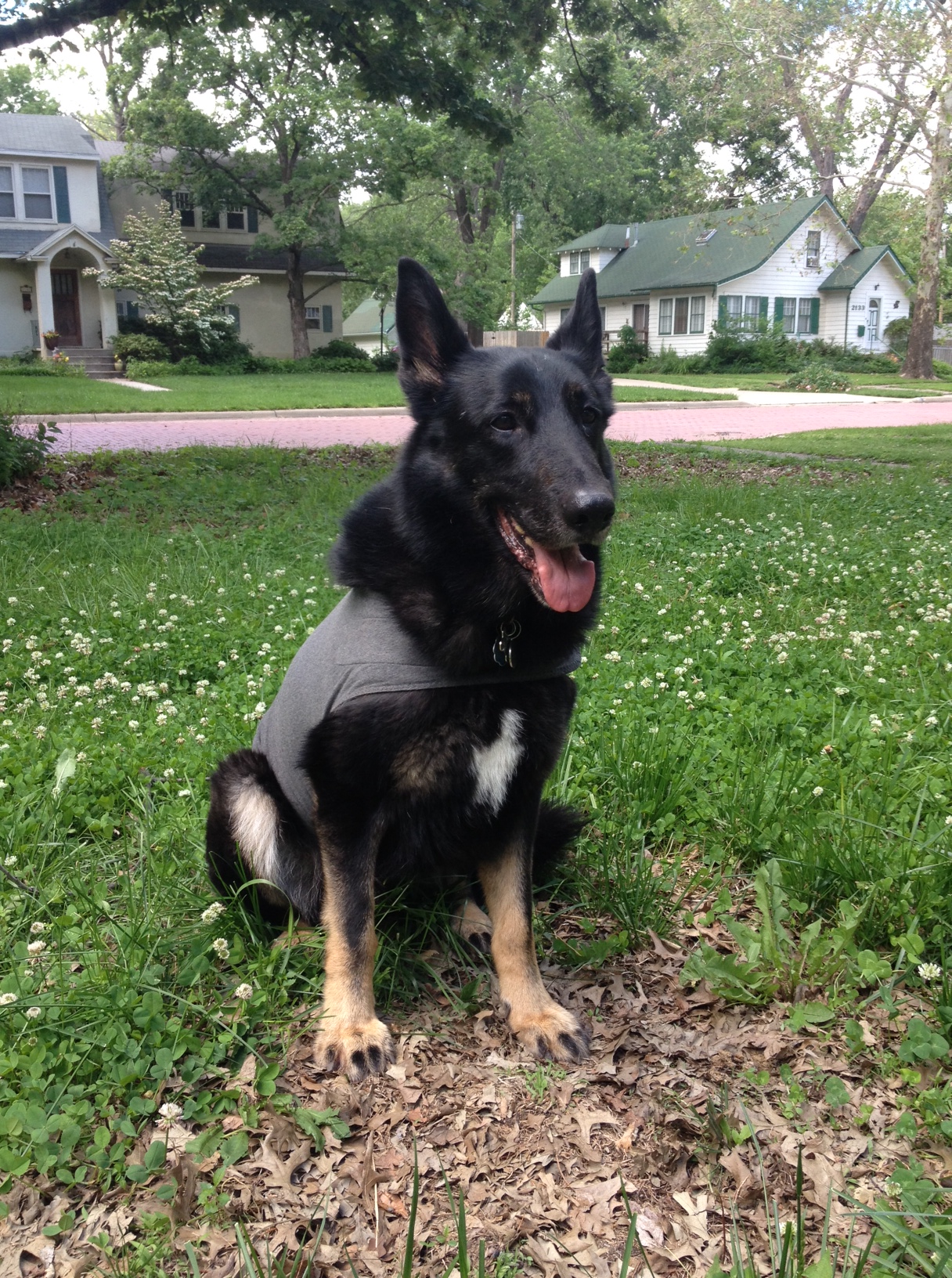
In Ziggy’s case, the ThunderShirt™ does the trick. Donning his trusty gray garment, Ziggy, a.k.a. Thunderboy®, acquires the superpower he needs to survive the back-to-back threats of local lawnmowers and ubiquitous thunderstorms.
Ziggy’s hardly alone in his quandary. And thunder and lawnmowers are not the only anxiety triggers of summer. The suggestions here can help dogs deal with Fourth of July fireworks as well.
Not all dogs are lucky enough to gain superpowers by putting on a ThunderShirt. Other forms of wraps work for some anxious dogs — Jana favors hot pink elastic bandages, for example, when her nerves are on edge. Some dogs opt for a ThunderCap™, but Ziggy prefers to confront his fears with eyes wide open.
Some dogs just need a cuddle. Or a lot of cuddles. In the bed with you. Or on top of you. Others dogs are happier in their own secure fortresses — under or behind furniture or in a secure crate. Closed-sided crates or wire crates draped with towels or blankets work best. Pheromone sprays, collars, and plug-in diffusers work for some anxious dogs, while others can be distracted by music (or TV, for the couch potatoes) or games. A food toy (who doesn’t feel better with a nosh at hand — er, paw?), such as a stuffed Kong, inside the crate could work wonders for your pup’s nerves, if not his waistline.
A warning — dogs with extreme noise phobias might bolt during especially loud thunderstorms or fireworks. Make sure your dog is secured inside your home; a dog who escapes could cover a large distance trying to outrun his fear.
For many dogs, the issues is not the noise, it’s the air pressure and other changes they can feel when a thunderstorm is approaching. Some dogs’ anxiety can kick into high gear well before the first raindrops fall or thunder rumbles. If there’s no escape and no distracting him, medication might be necessary. In extreme cases, a Valium can pacify your perturbed pooch.
If even that fails? Dip into his Valium yourself … one little tablet (or a nice glass of Cabernet) and those anxieties will soon slide into the background.
 Now, as she ages, she prefers gentle play. Tug with me or a (very few) special friends, whom she will approach, tug toy in mouth, and invite to play. Catch, if the again, specially selected, person gently throws the ball to her, she will either catch it or nose bump it back in the person’s direction. The person’s job is to get it from her or catch it and toss it again. She especially likes playing this game in the water.