Ready to Rally?

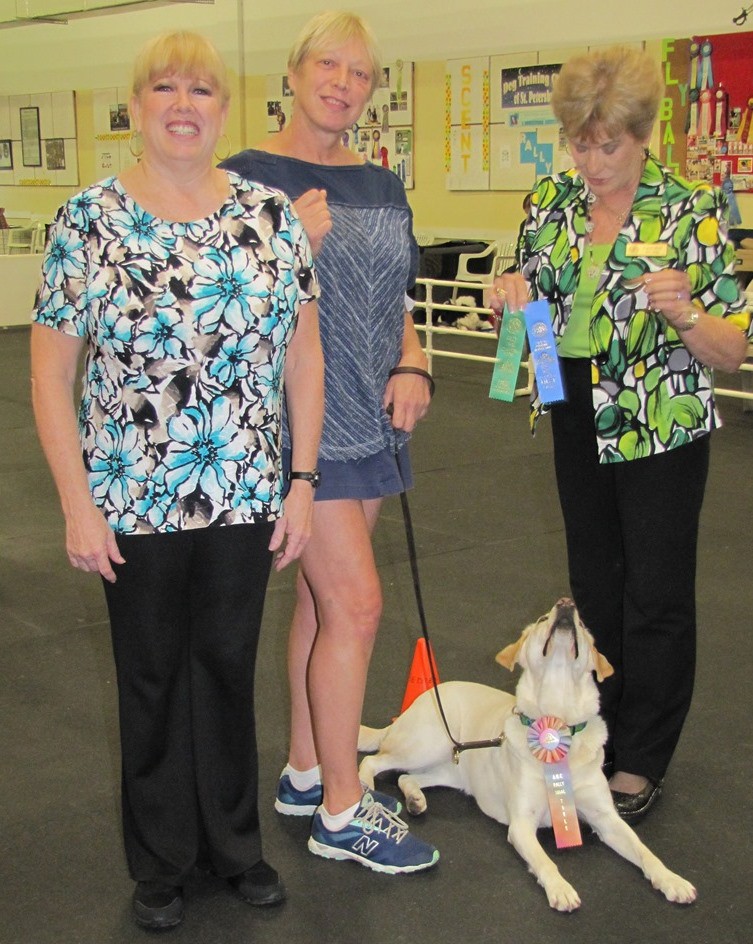
Alberta accepts her ribbons after earning her Rally Excellent title
Alberta accepts her ribbons after earning her Rally Excellent title. Deni and Alberta are the first guide dog team to earn an Excellent title. They have already two of ten needed “legs” toward their Rally Advanced Excellent title. 

I’ve watched both formal Obedience competitions and Rally-O (or Rally Obedience) competitions, and the difference is as stark as the difference between traditional training and cognitive education.
Both have the same goal: demonstrating a dog’s ability and willingness to follow specific commands when cued by the handler. They use similar sets of commands. Competitors are scored based on the preciseness of the dog’s response, the accuracy in completing the set of commands presented, and the time it takes to accomplish each task. Above the novice level, dogs compete off-lead. Dog-and-handler teams can earn titles in both kinds of competition.
That’s about where the similarity ends.
Rally is variable. The course is different in every round. The judge sets up the course within an hour of the competition; which exercises are included and in what order is a surprise for handlers and dogs. Formal obedience competitions, on the other hand, follow a set pattern of exercises at every level of competition. Experienced dogs and handlers could run the pattern in their sleep.
While competing, Rally handlers talk to, praise, and encourage their dogs. In the lower levels, the handler can use targeting and clapping or even touch the dog! Formal Obedience handlers cannot interact with their dogs other than to issue each cue, verbally or through hand signal, once.
To my (very biased) way of thinking, Obedience competition is all about showing the dog who’s boss (hint: it’s not the dog). Rally is about relationship and having fun. I strongly favor anything that builds relationship between dogs and their humans. Rally acknowledges the uniqueness of how each handler and dog interact as a team. Rally allows each team to excel in its own way.
The differences between Rally and Obedience underscore the differences in traditional vs. cognitive approaches to teaching dogs. If all you care about is getting an instant, precise response to a command, traditional obedience will do it for you. But that approach limits what you can accomplish with your dog and defines your relationship inside very narrow parameters.
Expecting precise, predetermined, responses to every cue essentially forbids your dog from thinking. There is a single correct response to each cue. Any other response results in punishment or lack of reward. The dog is not allowed to think about how to respond. Nor can the dog think of a better way to respond. When a dog schooled in this way confronts a situation that is slightly different from the training scenario, that dog will not know what to do. If the precise, rehearsed response is not possible or ineffective, the dog faces certain failure.
On the other hand, a dog who is taught with a cognitive approach will be able to figure out how to apply his or her learning in a variety of situations.
Here’s an example. Let’s say there are two dogs who have been taught to retrieve as part of their education. The obedience trainer, focused on the next competition, polishes his dog’s retrieve. The dog can flawlessly follow instructions to watch where the dumbbell was thrown over a jump, go out over the jump (even if a bad throw makes this the least efficient way of reaching the dumbbell), and bring it back, jumping over an obstacle on the way back. Perfect every time.
The cognitive trainer also teaches retrieve, but in a more jumbled way. Sometimes the dog retrieves a dumbbell. Sometimes it is the newspaper on the front porch. As training progresses, a set of keys, a cellphone, a pair of glasses, a spoon, a pen, a bottle of water are added. Sometimes the dog can see the item; sometimes the dog must search for it. Sometimes, it is an item that the handler has dropped. Sometimes it is the pair of slippers in the other room. The dog trained cognitively to retrieve has learned to follow her handler’s point, gaze or verbal cue for the item that needs to be retrieved.
Which of these dogs is more likely to fetch your keys if you drop them and they bounce, landing under your car? Which will find your cellphone when you fall and need help?
The dog who is trained only to produce a rote response will freeze when the dumbbell is not where he expects it to be or the judge produces a leather dumbbell when he has only practiced with a wooden one. This dog knows the retrieve as a patterned set of responses: sit, stay, go out, come back, sit in front holding the dumbbell, release, finish to a heel position.
This is different from understanding the reason behind a retrieve.
The dog who is trained to think about the retrieve as a practical skill, figure out the goal, and find a solution — the cognitive dog — will size up the situation and, chances are, do what needs to be done, even when it is not expected. I know more than one dog who has taught himself an “automatic retrieve,” picking up anything the handler drops, as a result of this style of retrieve training. Dogs who are allowed to freelance by adding variations to the task based on understanding the goal, will do so. This can come in handy when the handler unknowingly drops important material — like money.
Cognitive education enhances communication between dog and humans.

The Daily News

A very young Jana fetches The Jerusalem Post

Jana spends considerable time on every walk catching up on the local news. She sniffs out the usual trees and bushes on our daily route. When we take a different route or an extra walk, I know to leave extra sniff time.
But that’s not enough for my newshound. Jana does her best to ensure that I, too, have a steady stream of news and information. Knowing how sadly lacking my sense of smell is — and sensing my inability to understand the dog news, should I somehow manage to gather it — she wants me to read the daily paper.
Since our recent move, we’ve had Sunday-only delivery of The New York Times. But every morning, Jana has headed to the gate with an eager expression and a spring in her step. Bringing in the paper has been her job. Forever. She fetched The Jerusalem Post as a puppy. As a secular dog, she resented the lack of a Saturday edition.
As a young adult, she fetched the Boston Globe, carrying it the length of a very long driveway. (At one point, she suffered the humiliation of having to fetch it wearing a long leash, the result of an unfortunate decision one morning to take off after a jogger, rather than bring the paper home.)
She has fetched the Santa Rosa Press Democrat, the St. Petersburg Times (and, more recently, the Tampa Bay Times) and, last year, the San Francisco Chronicle. For the Chronicle, she was forced to fend off a job-stealing challenge from puppy Cali; having held on to her position, she proudly, carefully, carried her prize a great distance to our little rural cottage each morning.
So, when we moved to Petaluma, Jana simply could not understand — or accept — my decision to take Sunday-only delivery. Online news access, it seems, is an even more foreign concept to dogs than to us over-40 humans. I am fumbling along with it, but she refuses to accept this transformational technology and the havoc it wrought in her world.
I simply could not face the daily sad face, the disappointment. She’d head happily to the gate, and I would open it and show her: no paper. Her head would hang, and she’d slowly walk back to the house. Unemployment. Downsized. Made redundant by a computer. Unneeded. The worst fate for a smart, educated adult. Jana could relate. It was a terrible thing to watch.
So, I upgraded my newspaper subscription.
Now, our paper appears at the gate daily. Not rain, nor sleet, nor snow … even better than the mail, since we get seven-day-a-week service. Every morning, even before the sun comes up, Jana has a paper to retrieve. Full employment has returned. Jana’s sense of self-worth is restored.
Life is good for this thinking dog.

You Need a Large Toolbox

I met a wonderful family recently. They are puppy raisers for a guide dog school in the Northeast (one of the best assistance dog organizations that I am familiar with, Guiding Eyes for the Blind, in Yorktown Heights, NY). They told me a story that perfectly illustrates the importance of knowing and treating each dog as an individual.
The ability to lie still and just hang out is a crucial skill for service and guide dogs in particular, but, really, all dogs need to learn to do this. After all, we humans can rarely provide 24/7 entertainment and fun. Even if we could, this would be over-stimulating for the dog. Dogs need to learn how to calm themselves and just chill out.
These puppy raisers said that the way they had originally learned to teach dogs the importance of just being still (often using a cue like “settle”) was to give the dog food treats as rewards for lying quietly near them. For many dogs, this works well — the dog can initially be rewarded simply for lying down (when working on a strong “down”), and, very gradually, the rewards can be delayed until the dog has remained quiet for a few seconds, then 10 seconds, 15, etc. When the dog is able to relax in place for longer times, intermittent treats, with the interval getting longer, can reinforce this behavior and convince the dog that just lying there really isn’t so bad.
What was wrong with this approach? For many dogs, nothing. Then there were those extremely food-focused dogs. Funny how many of those are Labs and goldens — the very dogs that service and guide organizations use the most. Some of these dogs, it seems, would take to asking for food. The more independent ones would cut out the middleman entirely and start looking for dropped crumbs on the ground. These behaviors are annoying in any dog, but particularly unacceptable in a dog who works in public. These dogs need to learn to ignore tempting morsels in restaurants, supermarkets, and other places where there could be food on the floor.
So, the trainers came up with a solution: Reward the dog for lying quietly with a very gentle stroke along the dog’s back. Not active petting or interaction; simply a single, gentle, calming stroke. Again, for many dogs, this is indeed a desirable reward and something that will even deepen the calm, relaxed state the dog is in.
Then there are all of those other dogs. The ones that get wildly excited at the slightest stimulation. Even reaching toward these pups to stroke them is likely to be read as an invitation — and is more likely to elicit a play bow than a calm, relaxed dog. Or the dogs who regard touch as an invitation to cuddle or the ones who roll on their backs to solicit a belly-rub at the slightest hint that a hand is near. And don’t forget our analytical canines — the ones for whom touch is not rewarding, those whose social styles tend more toward more reserved contemplation of humans than actual up-close-and-physical contact.
You get the picture. This method of rewarding lying still is not going to work for all dogs — any more than food rewards would work for all dogs. That is exactly the point of using a cognitive approach to teaching dogs: Treat each dog as an individual. Starting with that essential principle, we can figure out which dogs to reward with food, which to reward with stroking — and which need something else entirely.
There is no one correct way to teach or reward any particular behavior, as my new friends learned. And individual dogs may respond to different rewards at different times. Applying this knowledge has made them better puppy raisers — and, I am sure, better people.
The methods and rewards are as varied as the dogs (and trainers) are. Be on the lookout for new ideas and ways of teaching or rewarding a dog. Every trainer needs a constantly expanding toolbox of techniques.

What Is Motivation?

When we are trying to understand why individuals — canine or human — behave in a certain way, we are trying to understand what motivates them. When trying to convince someone to do something he or she is not especially eager to do, we need to come up with a strong enough motivation to overcome that resistance.
For many dog trainers, food rewards are the only “motivator” they employ. Other trainers refuse to use food rewards in training, scornfully saying that dogs trained that way will work throughout their lives only for the food. In some cases, this might be true; skilled trainers, though, fade out the food rewards once a dog has learned a cue. Which leads to the interesting question of motivation: If the dogs are not working only for the food, what are they working for?
What do you work for? The satisfaction of a job well done? Money? The chance for a guilt-free rest or vacation? The admiration of your boss, colleagues, or friends? To impress your family? The pleasure you get from your work?
People work for many things. Some are tangible (money or food); some are external (popularity, praise, satisfaction) and some are internal (feeling proud of accomplishment, understanding the importance of the goal). The same is true of dogs (except maybe the money part).
What motivates you is as individual as you are. It is as variable as the situation or task at hand, your mood or energy level, where you are (in life or at a given moment), who’s nearby … any number of things can affect your motivation. What remains true is this: You decide what motivates you at any given moment or to perform any particular task. If you don’t care about money, no amount will drive you to do a task you loathe. If you are not hungry, the promise of a snack is unlikely to propel you to quickly complete your homework.
Next time you are having a hard time getting your dog to do something that you want her to do, think about motivation. Try a different motivator. Maybe you are asking her to do something that is very important to you but irrelevant or even unpleasant to her. Examples range from calling your dog to you when she is playing at the dog park or chasing a squirrel to asking her to pick up an object that is heavy, awkward, or just plain inconvenient to hold. In many cases, she’ll be willing to do as you ask — given the right motivation.
I know that it’s hard to be more interesting and appealing than a fleeing squirrel. But waiting a moment, until the squirrel reaches a nearby tree, perhaps, then calling the dog and offering a really tasty treat … well, now you might be getting somewhere. If your dog loves to play tug, use a few rounds as a reward when she does something that is really important to you — like picking up her heavy, awkward food bowl after dinner. Improve your tennis-ball-obsessed pup’s recall by rewarding her for a quick response with a few throws.
Finding the right motivation sometimes requires creative thinking on your part. It also requires looking at your dog as an individual. To figure out what motivates your dog, pay attention to what your dog pays attention to. What turns that light on in her eyes or gets her running over to you? Dogs whose owners say they are “not interested” in food might discover a culinary bent in their pooch when they offer freeze-dried liver or bison jerky or bits of roast beef. Maybe you haven’t hit on the right toy to turn on your dog’s inner retriever or you haven’t found the scratch spot that’ll have him not only picking up but washing and drying the dishes — just to get a little more of what you are offering.
We all will work for something. We will often do even unpleasant chores for the right reward. The trick, in every relationship, is figuring out which rewards work. You’ll know when you find the ones that work — but remember, make sure that the dog knows that it’s always her decision.

Rethinking Obedience

IMG_1725“The walls and grids that restrain your animals restrain also your own knowledge.”
— Vicki Hearne
What I call “old-school” dog trainers — those who operate from the assumption that the human has “to be the alpha” in his or her relationship with a dog — don’t, in my opinion, credit dogs with much in the way of cognitive ability.
Some, like the 1920-era European trainer Konrad Most, bluntly state an approach to education that many of us would recoil from today: “In the absence of compulsion, neither human education nor canine training is possible.” Others, like William Koehler (circa 1960s), give rational-sounding advice: “Lay down a set of rules, and see that your dog lives by them.” But the means used to accomplish that goal are harsh and authoritarian.
What these trainers share is an emphasis on punishment over motivation or reward and an expectation that a dog should offer instant, precise obedience to any command given by a human. The expected response is almost robotic in its uniformity and immediacy.
Trainers with these expectations do not believe that dogs can — or should — think or be part of a decision-making process. No, the dog should know who’s boss and, according to Most, “do what we find convenient or useful and refrain from doing what is inconvenient or harmful to us.”
While both Most and Koehler were both enormously influential in the development of dog training, much about their approach is antithetical to the goal of raising a thinking dog.
Demanding instant, precise obedience to all commands in all situations does not allow for the dog to think or process the command in any way. When you expect instant, unquestioning obedience from your dog, you are essentially prohibiting him from thinking. In human relationships, we talk about such expectations this way: “When I say jump; you may ask only, ‘how high?’ ”
To raise a thinking dog, that is, to use a cognitive approach to your dog’s education, you must have expectations that not only allow for but encourage the dog to think and solve problems. The cognitive dog needs to learn, understand, and, ultimately, buy into a shared goal. Expecting unquestioning obedience at every request, mapping out not only the end result but every step the dog must perform to get there does not — cannot — allow dogs to think conceptually about what you are trying to accomplish, learn to solve problems, or offer a different (maybe better!) solution.
Granted, there are situations where an instant response is necessary — if your dog is unthinkingly following a bouncing tennis ball into a street, for example. But developing your dog’s cognitive abilities does not prevent you from also teaching your dog a strong recall and an “emergency recall” cue that, when taught and practiced with the highest-value treats possible, will ensure an automatic response in a true emergency.
There are many ways to lead or manage (or parent). Those of us who want to share our lives with thinking dogs should be wary of dog professionals who talk a lot about alpha roles and hierarchical relationships. Instead, we should look for ways to develop our dogs’ considerable cognitive abilities. Start by figuring out what motivates your dog. Read future blogs for tips on how to do that and more.

Teaching or Training?

A young Kong addict
A very young Jana figures out how to get food out of a Kong

Puppies, like babies, are born with the potential to learn and problem solve and think. They are innately curious and begin investigating their world even before they open their eyes.
Our job is to develop these skills in our puppies and dogs by providing opportunities for them to learn and develop their conceptual thinking abilities. We can expose them to lots of novel items and situations and provide encouragement and motivation. We can also be on the lookout — especially with puppies — for opportunities to turn potential problem behaviors into desirable, adorable, and even helpful skills!
Dogs who are taught, especially by handlers who use methods that encourage problem-solving, become better problem-solvers. A study called “Does training make you smarter?” compared dogs who had received training with dogs who had not. Dogs who had received training solved a problem — opening a box that had a pad that could be pressed by the dog’s paw — spent more time trying to open the box (and were less likely to seek help from their owners) than dogs who had no formal education. The study’s authors speculate that trained dogs have “learned to learn” in a way that unschooled dogs have not.
But, and this is a big but — not all education is equal. There are many approaches to teaching or training, and the methods you choose will affect more than just how fast your dog learns — it can affect the bond between you and your dog, and it can shape or reflect your attitudes toward dogs. And it’s not just the method. The words matter, too.
I make a distinction between training dogs and teaching them because I think the word choice reflects a difference in attitude and goals.
Training dogs is what I call educational approaches that are narrowly focused on eliciting specific reactions to cues or commands. The trainer has a clear end result in mind for each command. The trainer says, “sit;” the dog sits. Practice emphasizes precision of the dog’s response, speed of the response, and the dog’s ability to respond quickly and precisely even when distractions are present.
When I refer to teaching, on the other hand, I am referring to a process that develops the dog’s thinking and problem-solving abilities. The teacher’s goal is to give his or her students the tools and the confidence to figure out what to do in a variety of situations. Sometimes, a teacher might seek a precise response, like the sit; other times, the teacher makes a request that requires the dog to figure out what to do. “Find a pen” gives the dog a goal but no precise instructions for reaching that goal.
Teaching brings the dog to a level of independent thought and problem solving that enables him to respond to a command or cue that is as vaguely defined as “find a pen;” training does not.
Any approach to training or teaching is based on an underlying mindset or set of assumptions: assumptions about what dogs are capable of learning; assumptions about how dogs learn and how much of what we say and do they actually understand; and assumptions about what the dog-person relationship should be.
Trainers who do not believe that dogs are capable or reasoning or problem-solving are unlikely to put any effort into developing these skills in the dogs they train. Trainers or handlers who believe the dog’s “job” is to be obedient and submissive are unlikely to tolerate a free-thinking dog. Some trainers talk about “getting dominance” or “being the alpha” as ways to ensure that dogs remain obedient and submissive.
Methods of dog “training” or education can be placed on a continuum that ranges from those that do not encourage the dog to think at all to those that practically make the dog do all of the thinking. The Thinking Dog blog will teach you to recognize various approaches and their goals — and encourage and equip you to explore methods that help your dog become the best thinking dog he or she can be.

What Is Cognitive Education for Dogs?


Jana and Turbo toy_crop
Welcome to an all-new, improved Thinking Dog blog! It is re-launching with a new focus — cognitive approaches to educating dogs.

What does that mean? Think of it as a contrast to the more traditional approaches, many of which use force, to train dogs.

Cognitive-based dog education means teaching dogs to think their way to becoming their best selves.

Their best what, you ask? Well, that answer is different for every dog — just as it is for every person.

It’s not a new idea: In 1963, Clarence Pfaffenberger wrote a book called The New Knowledge of Dog Behavior. A line in that book beautifully captures the essence of cognitive education.  Pfaffenberger writes that the first time a puppy to removed from his or her littermates for training, the puppy is given “the dignity of being an individual.” All dogs deserve this. It is this understanding that forms the basis of cognitive education for dogs.

In 1995, Vicki Hearne published a classic piece, “A Taxonomy of Knowing: Animals Captive, Free-Ranging, and at Liberty.”  In it, she describes the ideal relationship between a human and a non-human partner (most of her examples are dogs): the team shares a goal, recognizing and respecting the unique abilities that each member of the team brings to the joint pursuit of that goal.

An animal working at liberty, Hearne writes, is one “whose condition frees her to make the fullest use of some or all of her powers.” A great example is a search-and-rescue team. The dog brings amazing powers of scent detection and tracking to the partnership; the human brings logistical planning abilities and much more. The point is, neither partner, alone, could be as successful in the goal of finding a lost child as they are as a team.

Dogs in at-liberty partnerships are being the best that they can be. Cognitive education can get you and your dog there.

Remember Maslow’s hierarchy of needs (Psych 101)? Basic stuff like food and shelter are at the bottom. More esoteric needs, like social acceptance and aesthetic enjoyment, are higher up. The highest level is self-actualization — being the best you that you can be. That is what cognitive educators want for each and every dog.

As Pfaffenberger acknowledged, each dog is a unique individual with likes, dislikes, strengths, weaknesses — and an idea of what he or she wants (and does not want) to do. Cognitive educators understand this and teach each dog as an individual. There is no one-size-fits-all approach to training.

This approach enables each dog to be the best (fill in the blank) that he or she can. Some dogs can become fantastic service dogs; others are destined to work as scent detection or search and rescue dogs, serve in the military, or provide loving companionship to their humans. Some pets are great athletes who enjoy dock diving; others prefer Rally, flyball, agility, or freestyle dancing. Whatever your pet’s skills and preferences, you, as a cognitive educator, friend, and companion to that dog, can help your dog explore and develop and grow.

If this sounds like something you believe in or want to learn more about, stick with The Thinking Dog blog. We’ll be exploring cognitive education from every angle — who does it and how; what it looks like in daily life; how to think like a cognitive educator; what dogs are telling you about their likes and dislikes and how to better understand them … and so much more.

Check back often, subscribe to the blog, and be sure to share it with all of your dog-loving friends.