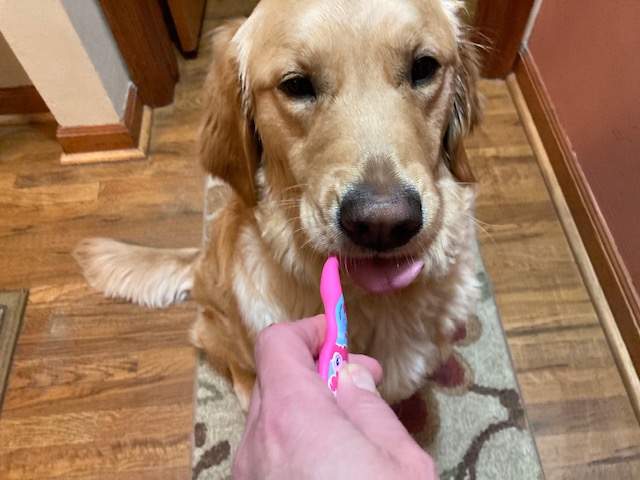
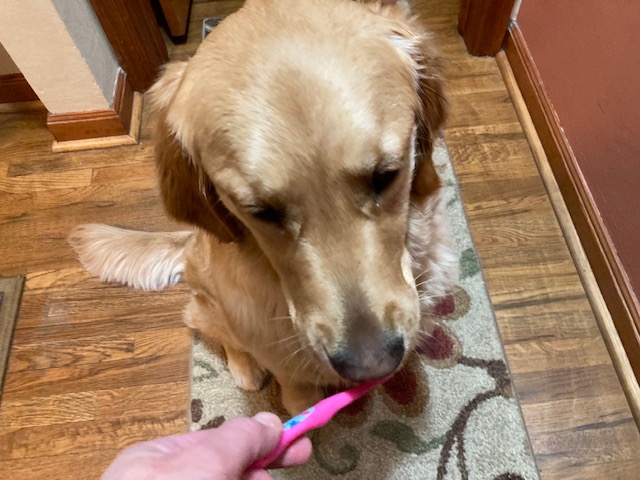
I took Dotty to see a friend recently. The friend hadn’t seen Dotty in quite a while and after commenting on her pony-like stature, she exclaimed, “I can smell her puppy breath!”
Dotty is 16+months old. How is it that she has “puppy breath,” a sweetish scent usually associated with puppies up to about 6-8 months of age? Is puppy breath simply the absence of typically stinky “dog breath”?
It really might be that simple: Dogs’ puppy teeth aren’t around for long enough to get dirty and cause bad breath. Their adult teeth are usually in by the time they are 5-6 months old. Without brushing, those permanent teeth immediately begin to develop a coating of plaque and tartar, and… dog breath occurs.
If this is the cause, then, the secret to extending “puppy breath” throughout your dog’s lifetime is (you know what I am going to say …) brushing your dog’s teeth.
 Dotty and Orly (and Cali and Jana before them) have excellent oral hygiene. That is, they brush their teeth daily. Well, most days. When I leave them with a sitter, I think the daily brushing goes on hiatus.
Cali never had a professional teeth cleaning in her life, and she had beautiful white teeth and good breath. Orly and Dotty are still young, and so far, both have gorgeous teeth.
Their doggy toothpaste claims to taste like chicken (really!). I haven’t verified that claim personally, but the girls like it. I’ve tried other brands over the years, but return to Petrodex because it’s easy to find in a large-ish tube that lasts several months. I also use small, soft kids’ toothbrushes because a lot of the ones sold as dog toothbrushes are stiff and awkwardly large.
Looking through the comments on a recent Whole Dog Journal blog post about brushing dogs’ teeth, I discovered another ally in the battle against dog breath: Kelp powder. The commenter recommended a specific (pricey) brand, but I started looking at other powdered supplements for dogs’ oral health, fell deep into a rabbit hole, and emerged with the conclusion that powdered seaweed sprinkled on the dogs’ food could help keep their teeth clean and breath fresh, as well as providing other potential benefits.
I’m giving them each a small sprinkle once a day of “Raw Paws organic kelp” — about half the amount that the package recommends. They seem to like it (not that golden retrievers are fussy eaters).
This completely unscientific experiment has brought what I consider to be excellent results: After a few months at a training kennel without her toothbrush (or her devoted tooth-brusher), Dotty returned home with some icky brown tartar on her back teeth. Brushing and kelping has completely eliminated that buildup and put her squarely on the path of permanent* puppy breath (*for as long as she lives with me…).