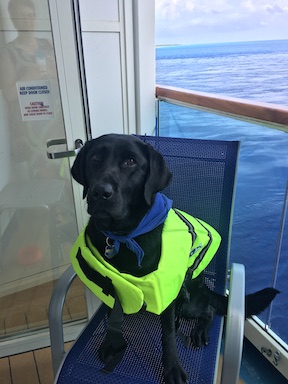
A guest post by Guiding Eyes Hildy and her scribe, Deni Elliott
Here’s what to do when your new guide dog hunches over and poops in harness while she is guiding you on a moving walkway at the Minneapolis-St. Paul airport:
- Be grateful she started at the beginning of the walkway to give you time to react;
- Pull out the poop bag you always keep in your front left front pocket;
- Find the poop with your bag-mittened hand, glad she got over last week’s diarrhea;
- Keep smiling as the bag dangles from your right hand in the final seconds of your ride;
- Be glad this dog has learned to find a trashcan when asked and is right on target;
- Fight the urge to deposit the dog in the trashcan along with the poop bag;
- In a soft voice tinged with horror and embarrassment, ask her “What were you thinking?” hoping the dog remembers that you have stopped in three different Service Animal Relief Areas (SARAs) in the previous 45 minutes where, each time, she insisted that the artificial turf and concrete floor alternatives were just too icky to use.
What she was thinking is that she could wait for me to find her a better bathroom.
I could see Hildy’s point. That day in January was just two months after she left Guiding Eyes for the Blind to become my fifth guide dog. In seven flight days at four different airports, she had already become my best-ever travel guide dog: She slept through every flight, not minding if I got up to use the restroom. Faster than any guide before her, she learned to steer me through the Tampa airport to first check my suitcase at the Delta ticket counter and then lead me without additional direction up the escalator to the E gates where Delta flights depart. She wagged her tail and offered kisses during the TSA pat down. She dutifully turned to go to the SARA for a final chance to potty and then led me to the other end of the terminal where we could find our departure gate.
Clearly, the problem was with the inside-security relief areas. Airport people bathrooms are almost always better maintained than service animal facilities, even in the middle of a holiday rush. Some service animal potties are tolerable; most are not; others are nowhere to be found.
The investigation begins
After the moving walkway incident, Hildy agreed that she had made a colossal miscalculation; I promised to give her more practice.
Together, we decided to do the field experiment as co-researchers: We would visit a doggy potty in every airport. We came up with an objective ranking scale: 1-3 pts for smell; 1-3 pts for clean-up supplies and working sink; 1-3 pts for aesthetics; and an extra point if the accommodation was within eight gates of our arrival or departure.
Hildy and I field tested the SARAs doggedly, anonymously, like restaurant critics but at the tail end. We visited 45 relief areas in 12 airports on 18 flight days. Hildy stoically squatted in each with an improvised SARA stance, balancing with her nether parts in the air. Whether she was posing for my photos or actually peeing, I’ll never know.
The results are in
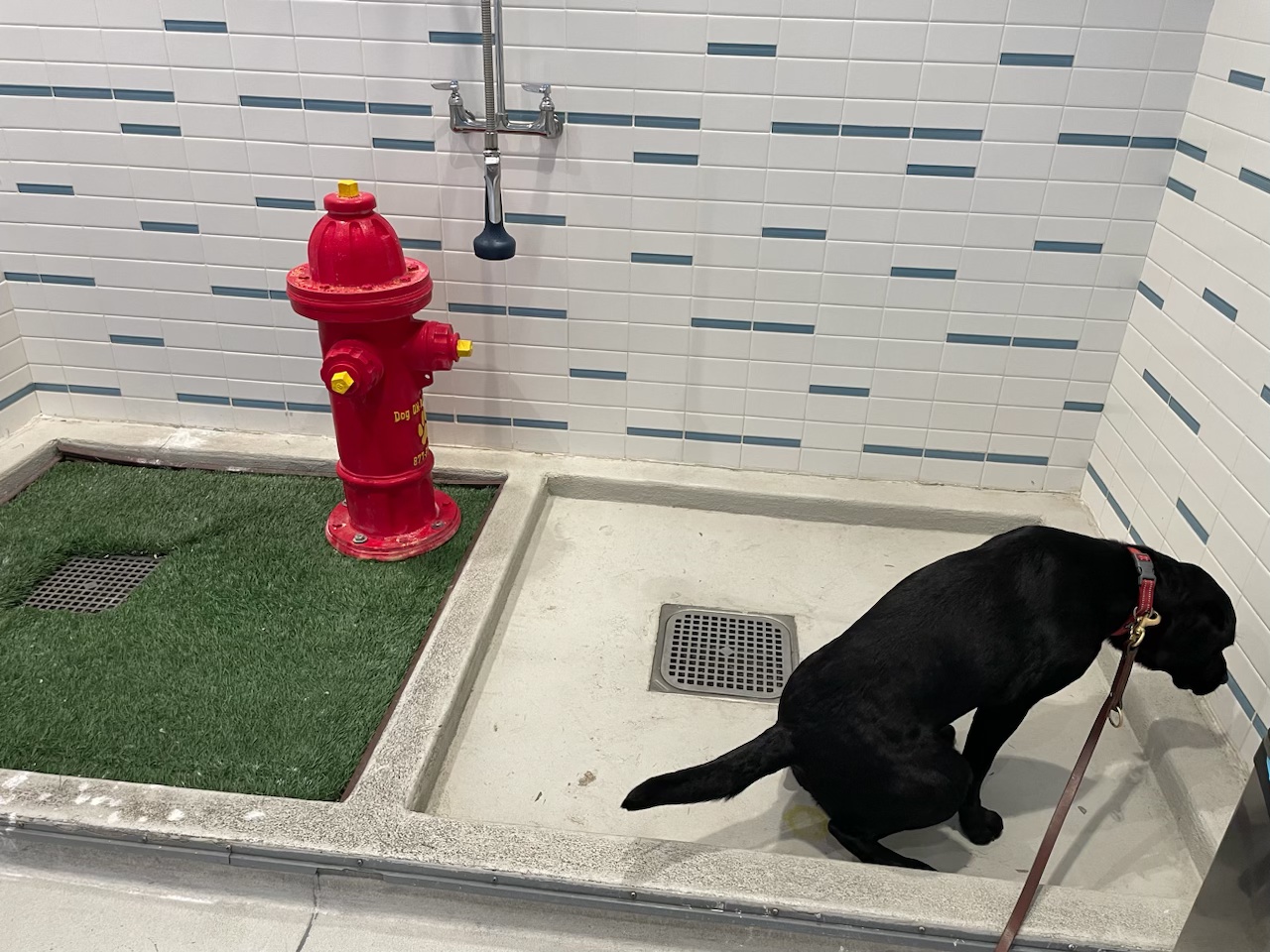 After five months, we sat down to analyze the data together and agreed that only one doggy potty earned a perfect score.
Despite Hildy’s clear preference for outdoor accommodations, we ultimately agreed that “inside-security” provisions were necessary whenever we had connecting flights.
That required us to eliminate four outlier airports — Rapid City, Raleigh-Durham, Savannah, Rhinelander-Oneida County — that did not have relief areas behind security. This despite the fact that for almost a decade, federal law has required commercial airports with 10,000+ annual flights to have SARAs inside security.

Relief areas at Atlanta, Cincinnati, Minneapolis-St. Paul, NYC-LaGuardia, NYC-Kennedy, and Salt Lake City all ranked in the middle of the pack, with scores of 5-6 points.
- Most failed the sniff test, even by human standards, not deserving the minimum 1 point we gave them. As I held my breath and blinked my stinging eyes in the sealed rooms, I wondered how dogs, who detect scent 200x better than humans, could stand it.
- Many rooms were out of paper towels or poop bags or the sink didn’t work.
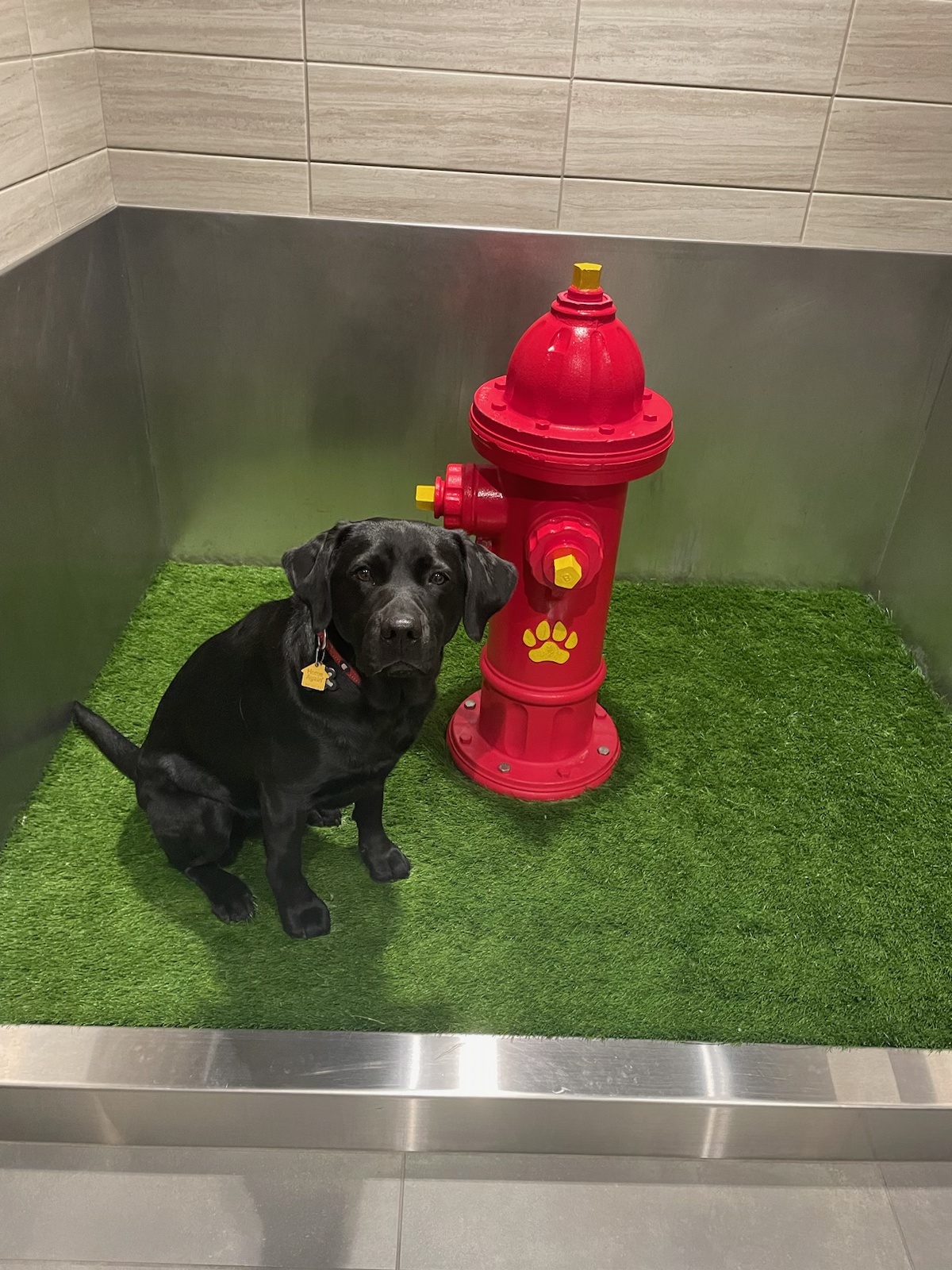
- I added the aesthetics criterion once I realized that a red plastic fire hydrant served as the unimaginative focal point for every SARA. Then I learned that federal law requires this type of furnishing, even if airports are allowed to forego ventilation. Apparently, someone at the Federal Aviation Administration convinced his colleagues that requiring a fire hydrant or fake rock in SARAs would encourage male dogs to urinate. Hildy and I, amused by this reasoning, wondered if he needed encouragement as well.
As I couldn’t ethically ding the SARAs for their ubiquitous red fire hydrants, we gave full aesthetic points only when there was art on the wall, a view, seemingly clean tile walls, or some other thoughtful and distinctive feature.
And the winners are …
Second place
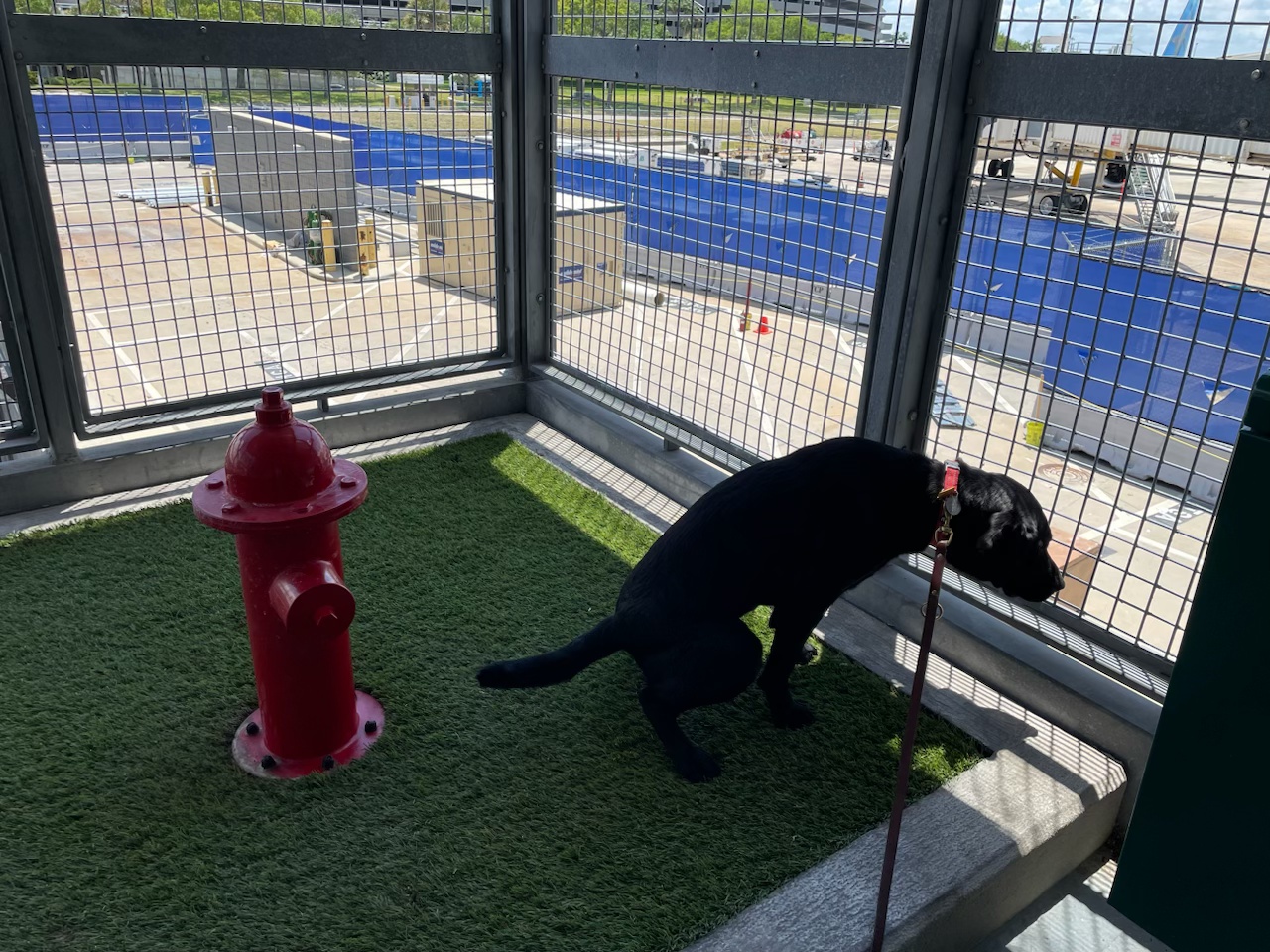
TPA, Tampa International Airport, came in second.
The caged, outdoor, well-ventilated SARA on the gate level in Airside E is at the far south end of that terminal. The whiff of jet fuel in that enclosure is a breath of fresh air when compared to SARAs that smell like you stepped into the basement of a porta-potty.
However, this SARA lost a point because Hildy and I nearly always fly from the far north end of that terminal, more than 10 gates away from the doggy potty. It nearly lost an additional point for uneven availability of paper towels and poop bags. Since TPA is our home airport, we certainly did some over-sampling here, so, upon reconsideration, we gave TPA a 9.
Drum roll …
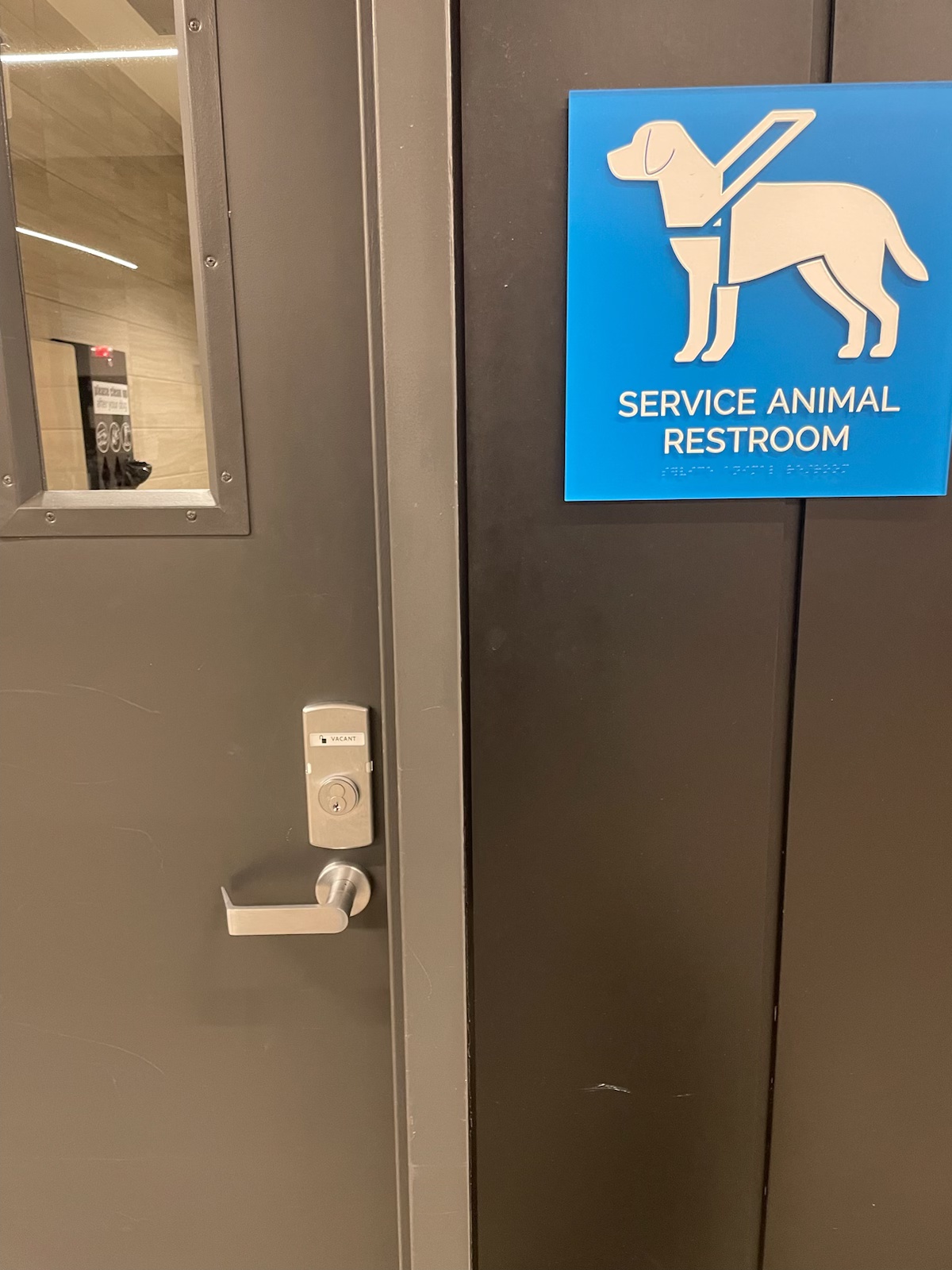
The best in-security service animal relief area in the US, based on our field study, is at MSO, the airport in Missoula, Montana.
This private, one-dog bathroom has self-draining turf and a large window. There was no offensive odor that I could detect or that appeared to offend Hildy. Ample cleaning supplies were on hand for every visit. It is an easy stroll to all four of the airport’s gates.
MSO wins paws down aesthetically for calling their accommodation the Service Animal Restroom instead of animal relief area, and for tucking it between the men’s and women’s restrooms. The vacant/occupied lock system, consistent with those on the human bathroom stalls, is a nice additional touch.
MSO earned the only perfect score: 10/10.
Hildy and I will continue our study of airport service animal accommodations across America and hope to find more that deserve recognition. But for now, thank you to Missoula Airport Board members who appreciate that, indeed, dogs are people too.