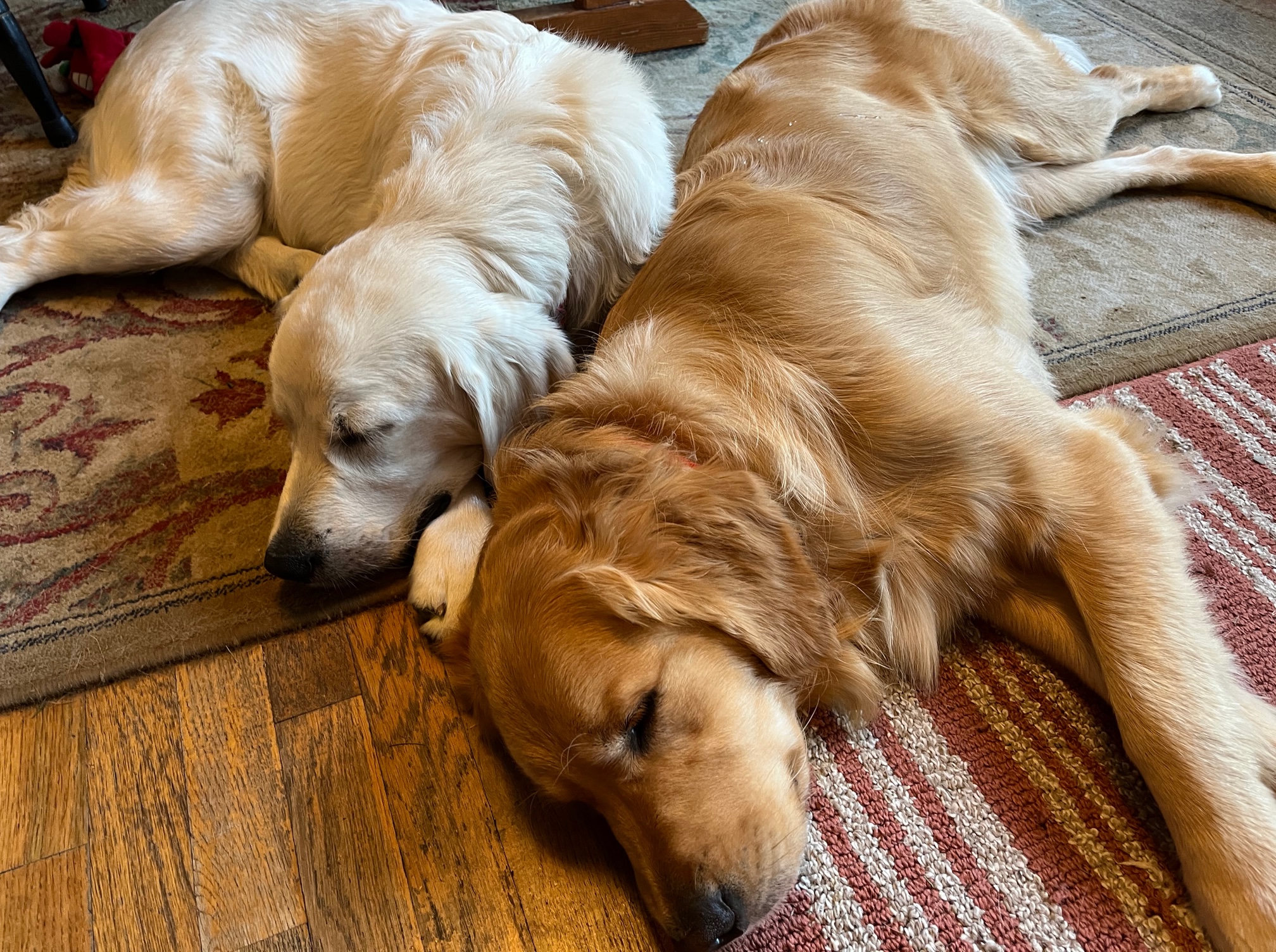
I was dog-sitting for two wonderful pups, one of whom insisted that he absolutely had to go out at 3 am. We all went out. Dogs did what dogs do, and we stood there for a few minutes marveling at the stars. I did, at least. My friends live well outside of Missoula and can actually see stars. It was a beautiful clear night, if a bit cold.
I was settling back into bed when Orly asked to come up for a cuddle. I leaned over to pet her and said she could come up. Usually, she needs to be told a few times and I need to move over and show her her spot, convincing her that I really want to cuddle with her.
Not this time.
I don’t think the word “yes” was out of my mouth before she leapt. Full speed ahead, just inches from my nose.
There was quite a bit of blood.
While I was dealing with that, Orly settled in on the bed — nice of me to warm it for her — and went to sleep. My friends’ dogs settled on their beds and returned to sleep as well. Only sweet Dotty came to check on me and keep me company while I iced my nose.
Orly doesn’t actually take boxing lessons. Turns out she does not need them, either. And I’m pondering the benefits of a dogless bed …
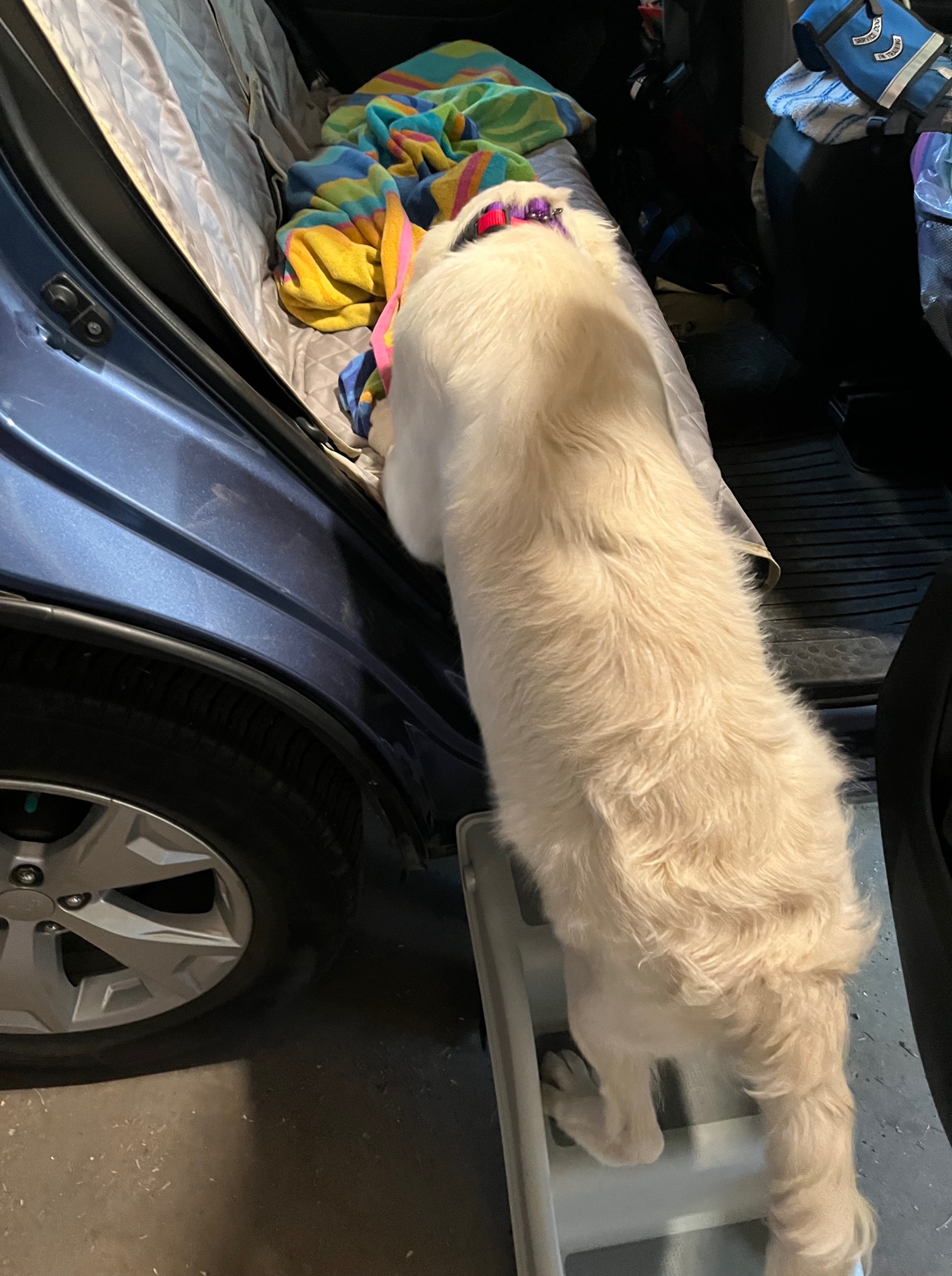
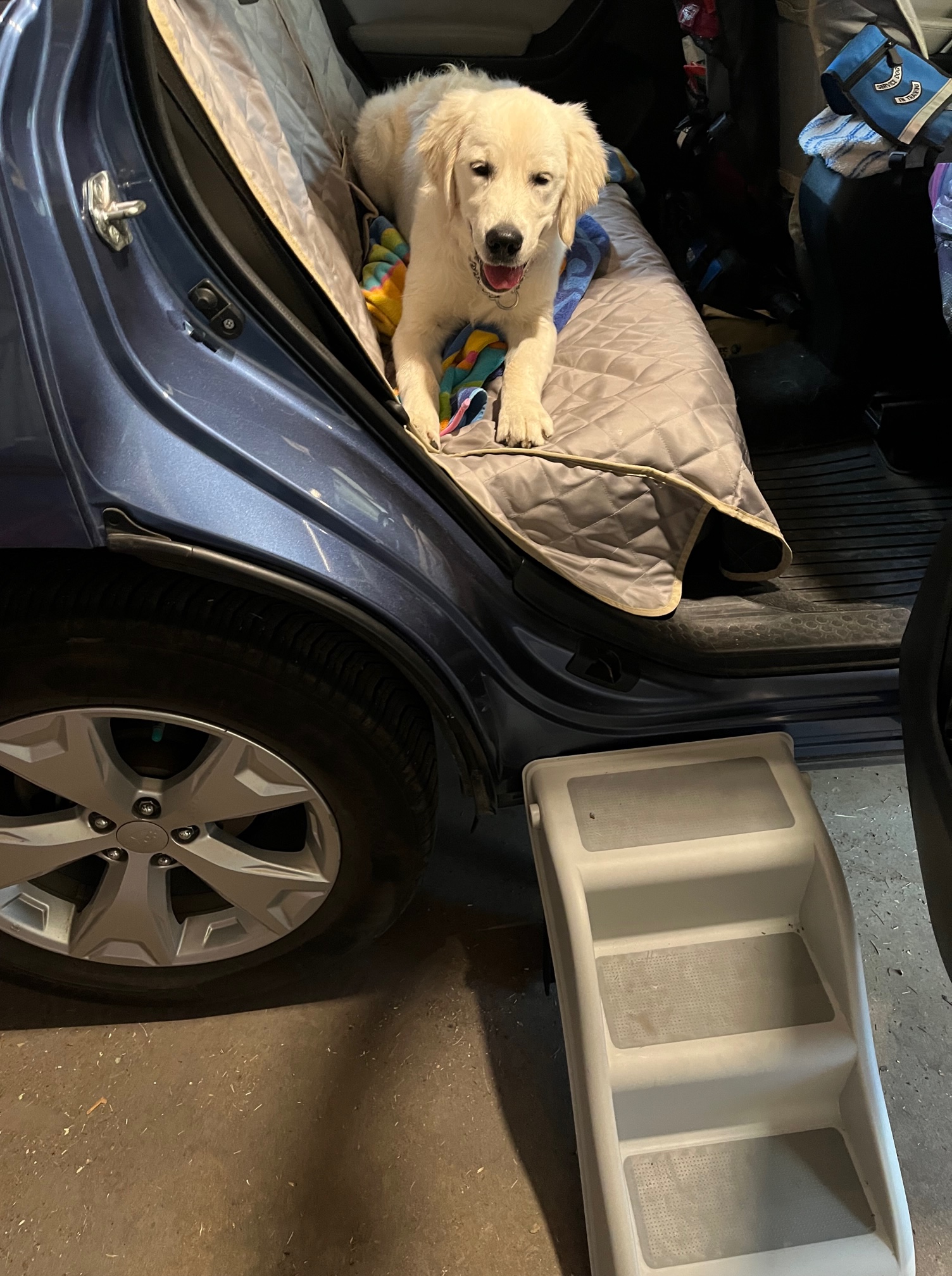
I was working on getting her out of the car, practicing with the little stairs, safely inside our garage, and making no progress. Orly was happily demonstrating what to do and how to eat the cookies she got as a reward. Dotty was pacing on the seat, unwilling to get down into the foot space or to jump down to the little stairs from the seat.
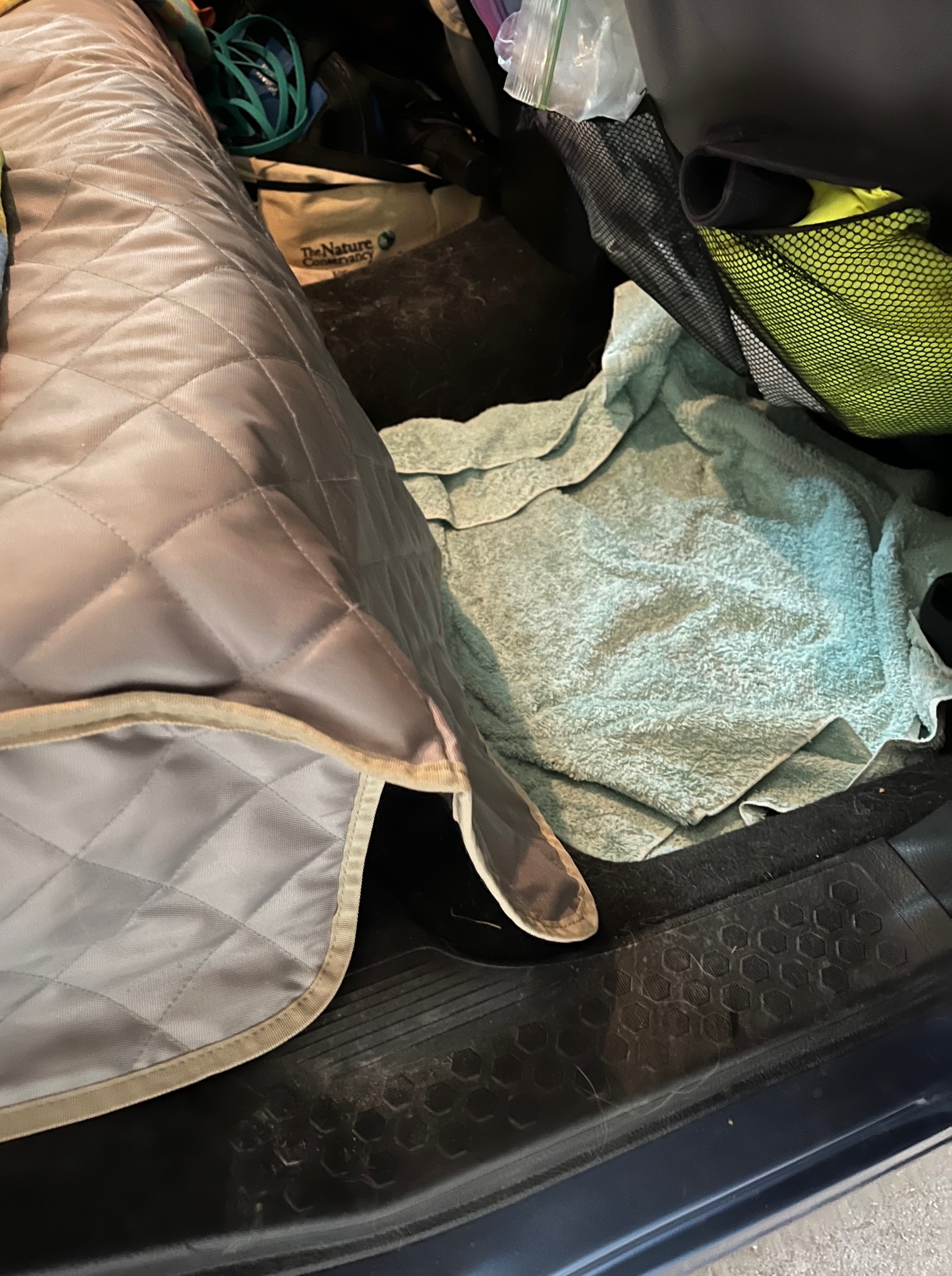
I sat next to her, looking at the foot space. Even with the front seat moved all the way forward, the space is small. And dark. I wasn’t all that surprised that Dotty didn’t want to jump down there.
I thought about what Glenn, our trainer, says when a puppy is resisting something: Change the picture.
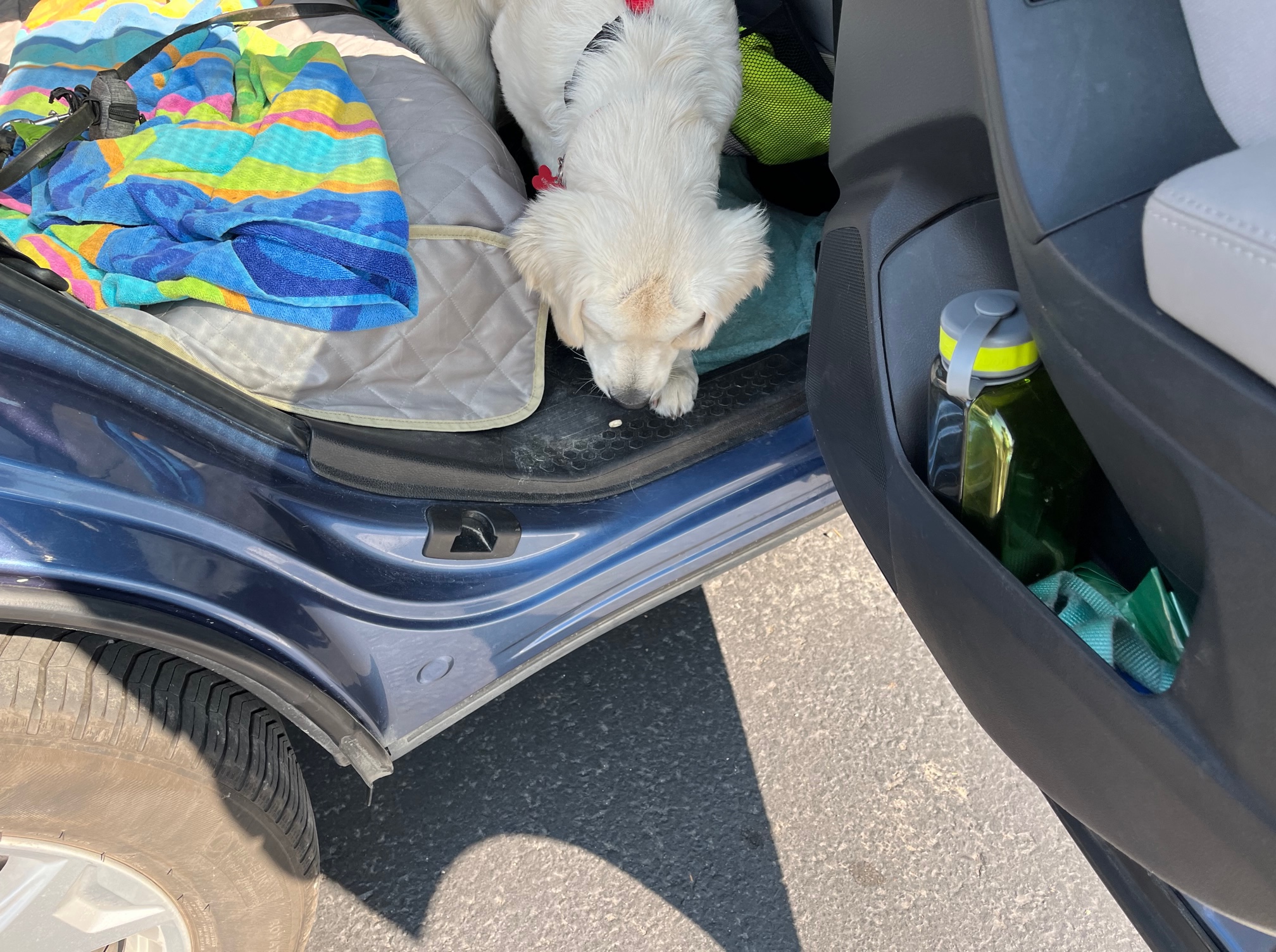
I reached behind the back seat and grabbed a light green towel from the handy dog stuff box that lives in the car. I placed it invitingly on the floor in the foot space, and got out of the car.
I sweetened the deal with a bribe: A small, but delicious (to Dotty) treat on the floor. Orly showed immediate interest. I banished her to the back yard.
I replaced the pilfered treat and added one on the steps for good measure.
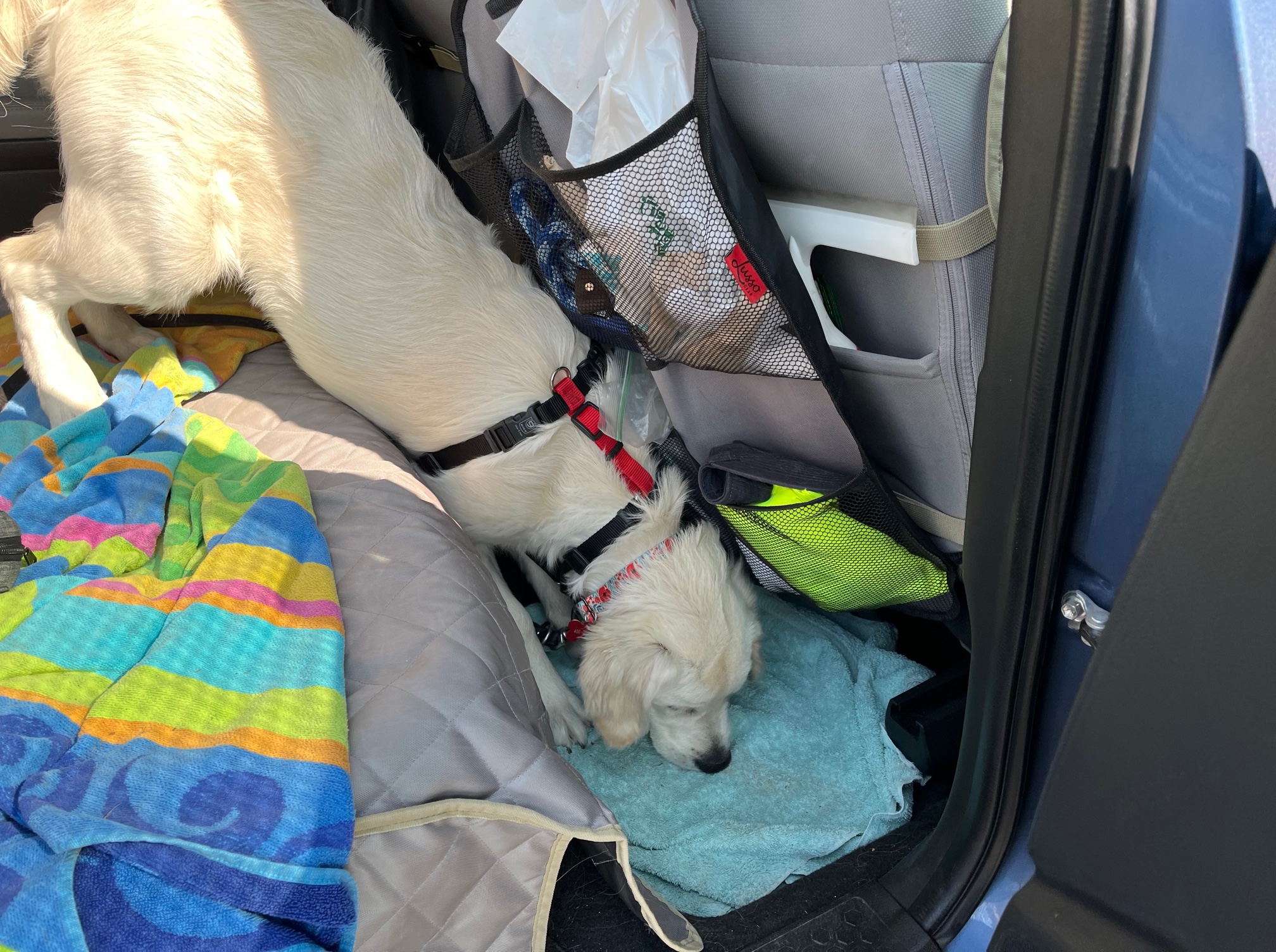
Dotty very cautiously reached a paw down, leaned wayyyy over, and managed to get the treat. Encouraged, the brought another paw down then her back end. Yay Dotty!
She stuck her nose out the door, decided, ‘nope,’ and hopped back onto the seat.
The second time, she jumped down pretty quickly, though, and then put her nose out … followed by a tentative paw. And another paw. Then, all at once, she was out of the car! And devouring a jackpot of treats.
The next day, she tried again — at a park this time. She got out, back in, and even got out again at home. She’s done it several times since, and is less reliant on the edible encouragement each time — but she still gets a treat at the end. She’s definitely getting more confident. All thanks to the magic of a light-green towel … and a willingness to change the picture.
Dotty does not like getting into the car. She hates (and strongly resists) getting out of the car.
This is a problem when, say, we need to go to the vet or to training class, as it would be with any pup. But as a service-dog-in-training, Dotty simply goes more places than most dogs — and she needs to get used to getting in and out of all kinds of vehicles.
When I trained young service dog puppies, long ago, we took them on field trips in a minivan. We had a folding ramp that they walked up and down to get in and out of the van, where they rode in sturdy crates.
I have a Forester, and the dogs ride in the back seat. Getting in and out requires either a big jump onto the seat 0r, preferably, two smaller jumps — one into the passenger foot space, and then from there onto the seat.
Orly learned quickly (from Cali) how to do all of this, and we never had an issue getting her in or out of the car.
Dotty has learned a lot from Orly … but not this. Despite watching Orly get in and out of the car dozens (maybe hundreds) of times. Treats aren’t helping either.
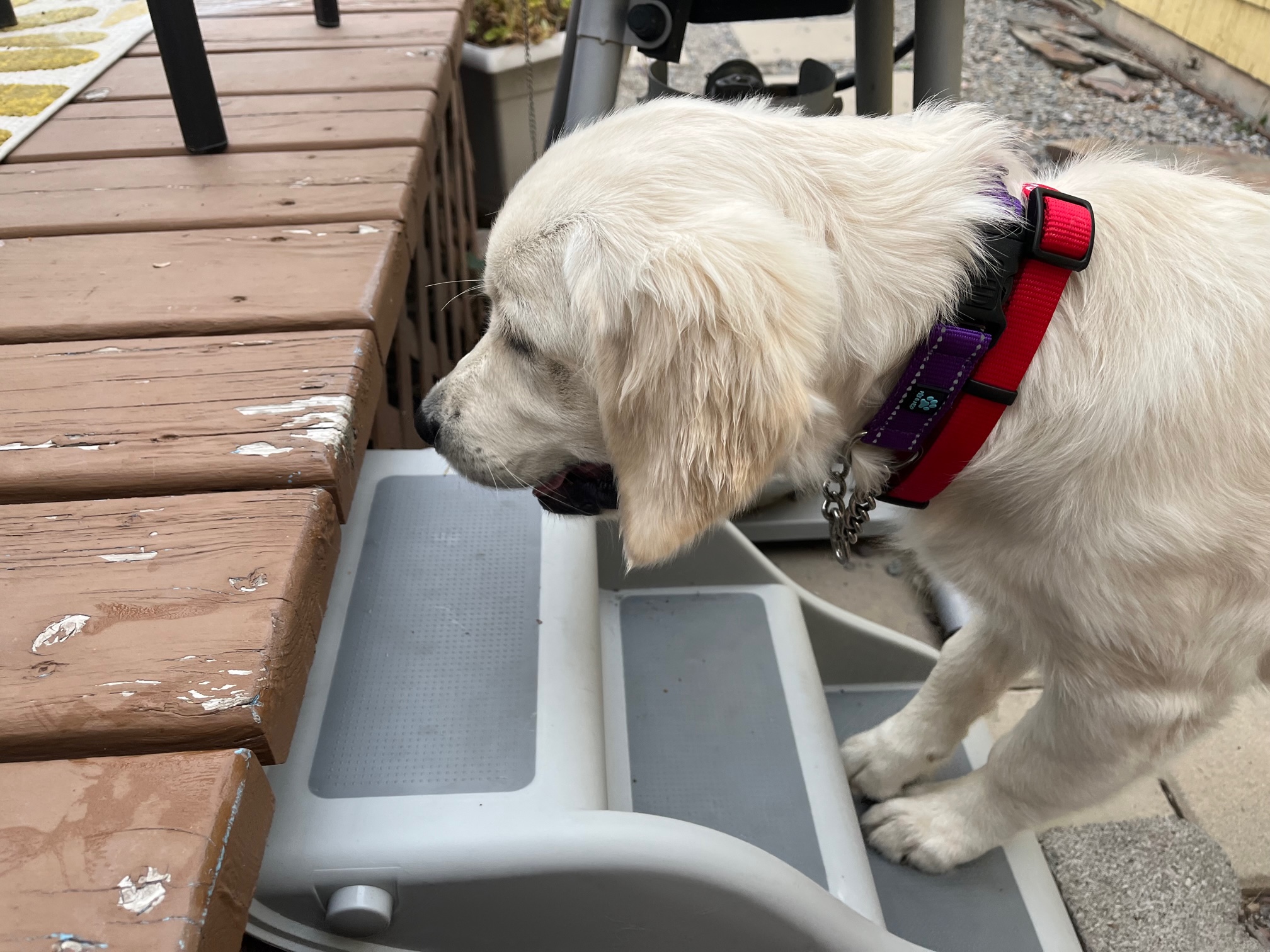
So I bought her some steps. The ramps I saw for sale were too long to be usable either in my narrow driveway or when parking in a parking lot with only a foot or two between cars. They are also often too wide to use at a passenger side door. But these little steps fit.
They’re plastic and sturdy enough to support a much larger dog than Dotty is (at the moment), but they can move if the dog jumps too enthusiastically. I hold them in place with a foot. Orly doesn’t mind the movement. Dotty… does.
(You may remember, though, that Dotty was not eager to use regular steps … the solid kind that are inside the house … especially the ones going down.)
Orly figured it out immediately and eagerly showed Dotty how to bound up and down, in and out. Dotty wanted nothing to do with these steps, not even with our top-rated treats.
We moved to the basement and practiced going up and down the steps to get on and off the TV sofa, the only furniture Dotty is allowed on. She caught on pretty fast, with the help of some yummy treats.
We moved to the deck. Orly again demoed quite enthusiastically.
Dotty grudgingly tried (treats definitely helped here)… survived … tried a few more times. Seemed comfortable enough.
Back to the car. She went in. Progress!
But that was it. Dotty did her usual lie down refusal to even consider getting out.
Orly bounded in and out a few more times, showing off her ability and confidence — and making a big deal out of gobbling her treat rewards.
Unmoved, Dotty turned her back on us and lay down even harder, if that’s even possible.
We went to training class, where Glenn, our trainer, helped all the dogs go in and out of his minivan using stairs very similar to ours. And a ramp. Dotty did both. She even seemed to like the ramp.
Back to the Forester. She got in, no problem. I coaxed her off the back seat and she — miracle — climbed down the steps and out of the car!
Once.
Climbed back in and did the hard lie-down. Dared me to try to get her out.
We drove home and … that was it. She was done. Not gonna get out.
I did my usual — picked her up and lifted her out. All almost-40-pounds of her. I cannot keep doing this.
We’ll see who wins this battle. My money is on Dotty, which will present quite a conundrum if she gets any bigger.
Even at the tender age of not-quite-2, Orly is taking her role as the steward of family culture seriously.
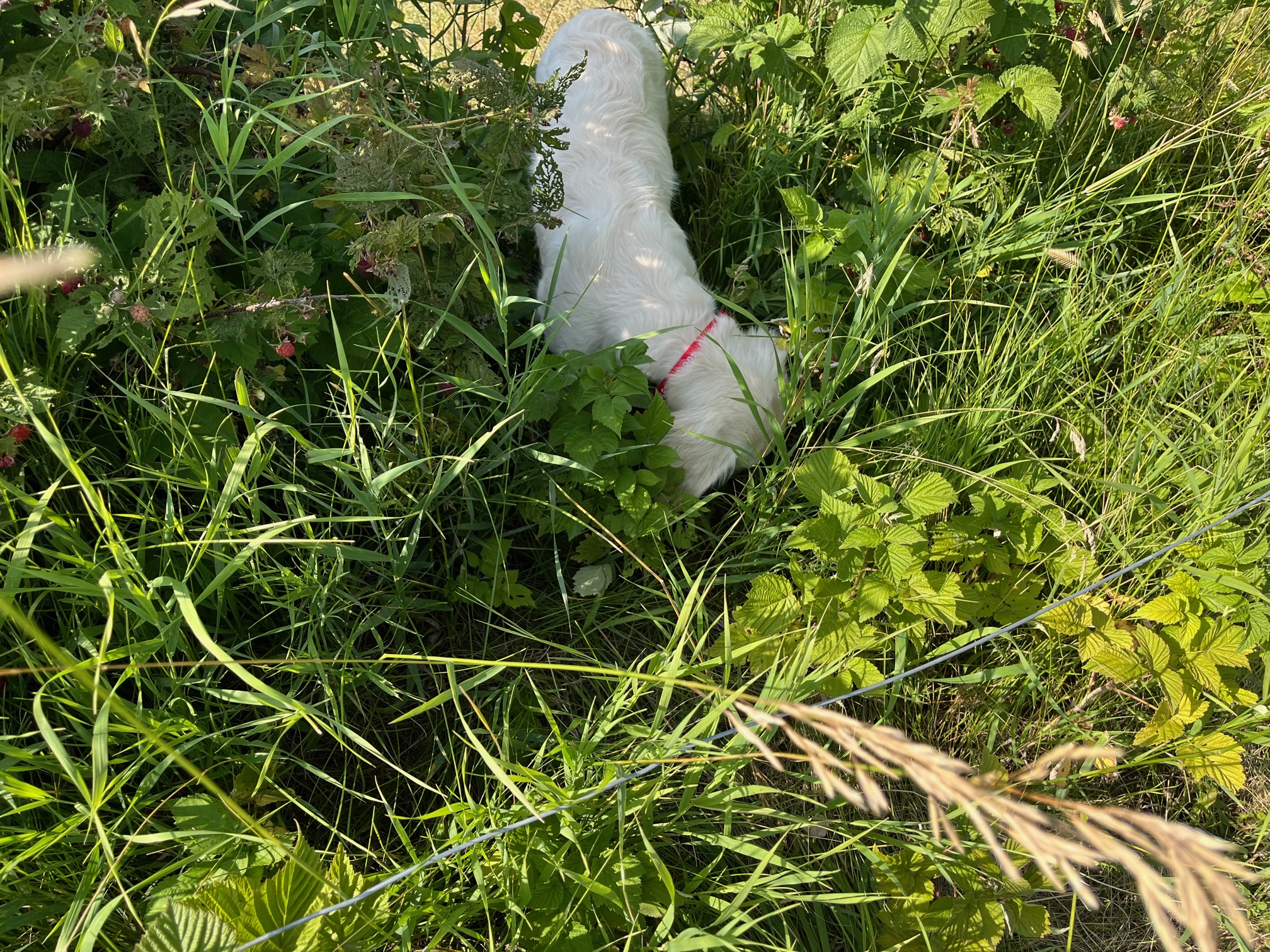
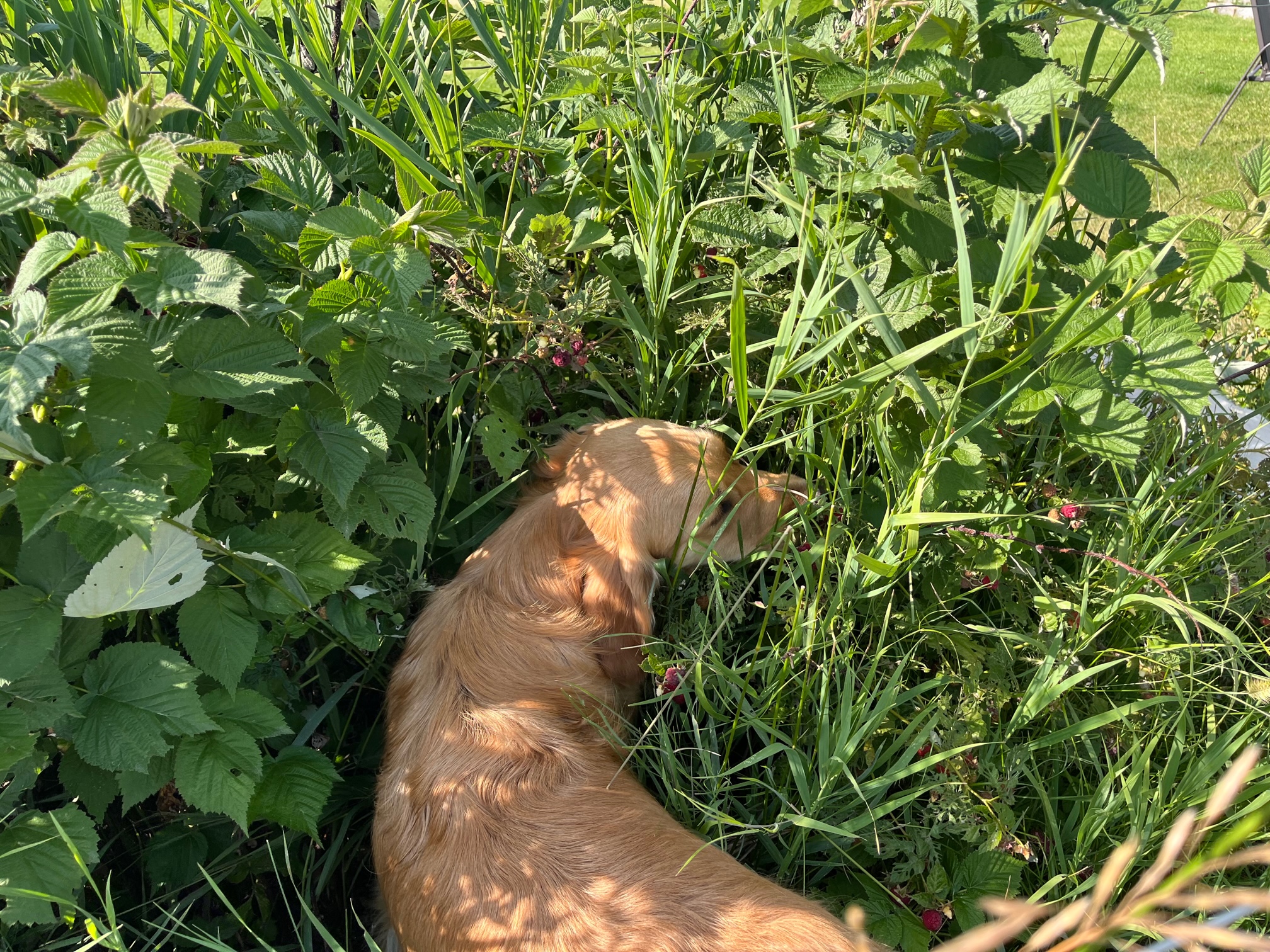
Last week, while we were dog-sitting for Orly and Dotty’s new best friends (Stella and Cruiser), Orly thought to leverage an opportunity to hand down Hogle Golden Retriever Culture and Wisdom: She taught Dotty how to pick raspberries.
Berry picking is a revered part of the culture of all Hogle goldens. Jana created this family talent as a young puppy in Israel. She started with strawberries, very quickly learning that the red, sweet-smelling ones tasted better than the green, hard ones. Thus began a daily competition for the finest berries. I usually lost.
Strawberry season in the Israeli garden fed into blackberry season. Jana perfected the art of plucking the ripest, sweetest berries — while avoiding the thorns. We made a deal: Anything above her nose height belonged to me. Anything lower belonged to her.
That deal survived a move to the US, and endured through blueberry picking in Massachusetts. Jana conveyed the cultural knowledge to Cali in California, ensuring it would continue through the next generation — now with raspberries.
Cali perfected raspberry picking over several summers in Montana, teaching the art to young Orly. In one glorious summer, just a year ago, Cali and Orly gorged on raspberries and blackberries. They got a little carried away, though, and might have … destroyed the raspberry bushes in the process.
Never mind. Following some landscaping work, new berry bushes will be ready to fill dog tummies by summer 2024.
Imagine Orly’s delight, then, to discover raspberry bushes at Stella and Cruiser’s house!
Not being goldens, Stella and Cruiser had no idea of their good fortune.
Orly took Dotty firmly in paw, led her to the patch, and … Dotty was a star student, picking up on the technique right away, thus ensuring that the cultural tradition would extend to a fourth generation.
Dotty even remembered and was able to apply her new skill in a different environment: Several days after we got home, Dotty remembered that there were raspberry bushes next to the river trail, and immediately headed to them, nosed around, picked and devoured the few remaining berries.
While it used to be controversial to say that non-humans shared culture in their social groups, Jane Goodall identified dozens of shared and taught behaviors among chimpanzees that, she pointed out, constituted culture. Now, many researchers agree that agree that culture “involves a collective adoption and transmission of one or more behaviors among a group” or a pattern of “knowledge, belief, and behavior that depends upon the capacity for learning and transmitting knowledge to succeeding generations” — and that multiple animal species demonstrate cultural knowledge and sharing.
After a cold, wet spring, summer has arrived with a furnace blast of 90-plus days.
Dotty and Orly know just how to keep cool!
They have a pool! And a splash pad! (Thanks, Aunties Maren and Christina!)
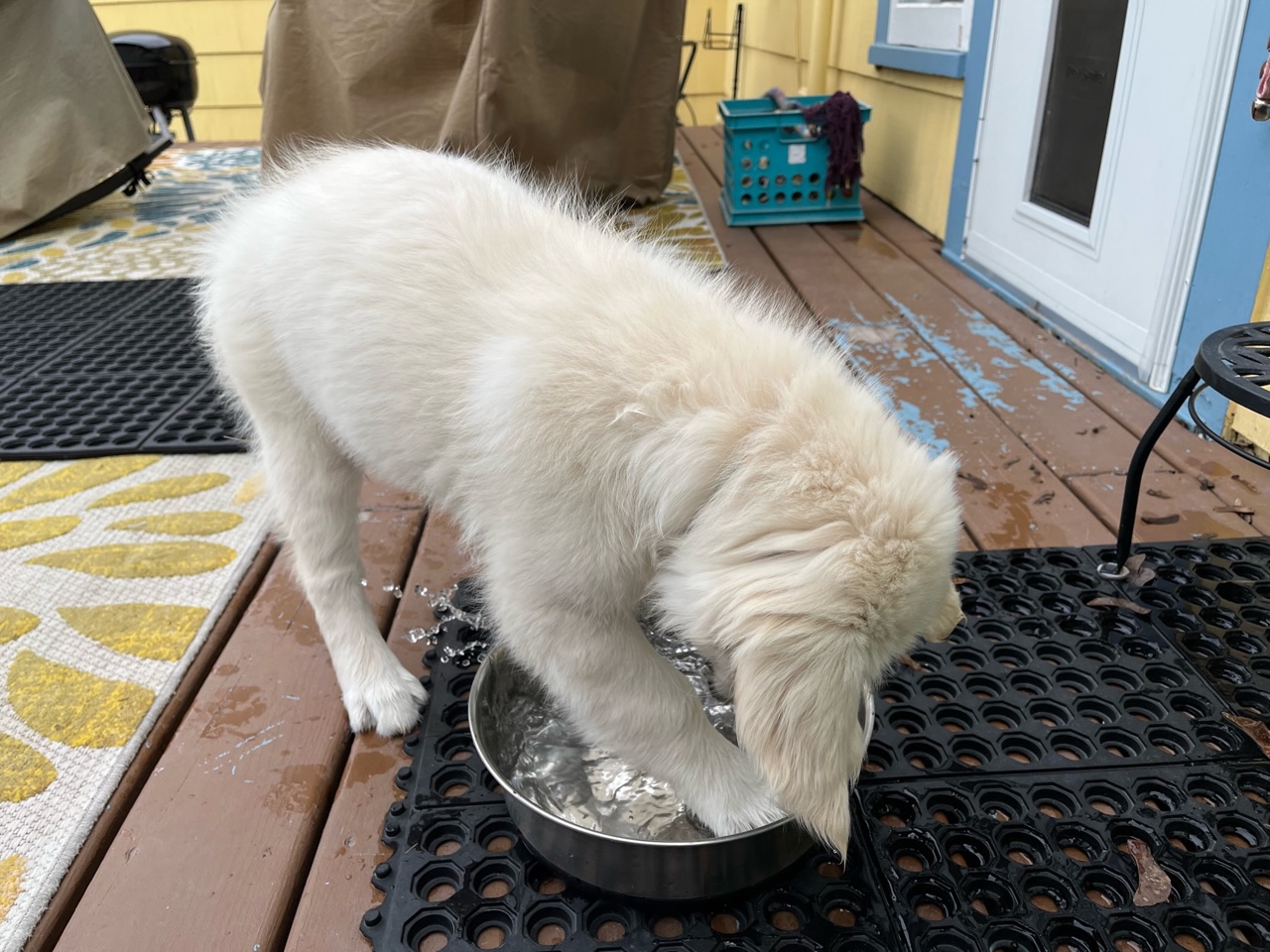
As a pup who loves to paddle in her water bowl, Dotty took to her water toys like, well, a golden retriever to water.
Her favorite activity is rolling around to get thoroughly soaked, then finding a nice patch of backyard to dig up. Mmmmm, that dirt-and-wet-dog combination. Mom loves that … not at all.
They’re very eager to swim in the river, but we haven’t tried that yet. Maybe next week!
Dotty is growing up! She no longer has to sleep in a crate.
When she was reliably sleeping through the night and asking clearly to go out, I decided that she was ready. I waited for a long weekend. I set up a second dog bed in the bedroom.
Finally, it was time: We did our evening routine of last call and tooth-brushing. But, instead of calling her to “kennel,” I propped open the crate door and placed a pet gate at the bedroom entrance.
Dotty watched with great interest from her perch on Orly’s dog bed (or, more accurately, on Orly). When I settled in to read — also part of the going-to-bed routine — she knew things were Different.
And she celebrated. Loudly and enthusiastically.
She leapt up and began racing around the room, looping under the bed in a way only she can (and probably only for a few more weeks). Puppy zoomies on sterioids! With barking! And the squeaking of toys!
On and on it went.
After a couple of minutes of this celebration, I looked at her sternly and in my best Mom Voice, said, “If you don’t settle down by the time I finish this chapter, I am putting you into your crate.”
Well.
Her English comprehension clearly rivals that of Chaser (and a new favorite fictional dog, Six-Thirty from Lessons in Chemistry). She looked at me, dropped to the floor, and instantly fell fast asleep. Under the bed.
Subsequent nights were less celebratory. She has asked to go out a couple of times, but she mostly just sleeps, on the floor or on one of the dog beds. Just like the big, grown-up girl that she is … not. Yet.
I’ve created a monster. Think ‘Cookie Monster’ — not ‘JAWS.’
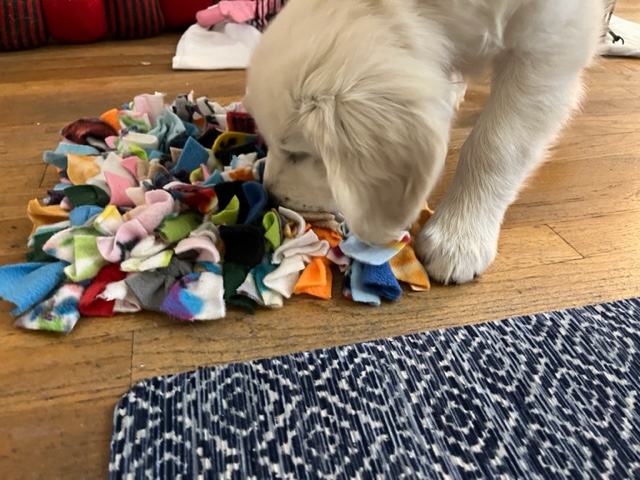
I introduced little Dotty to our little snuffle mat. Adorable in every possible way. She figured it out pretty much instantly. There is nothing wrong with her nose, and, true to her breed, she loves a good snack.
[A snuffle mat is a nest of fleece strips. The human servant hides yummy treats among these strips, and the dog sniffs them out and devours them. It’s a chance to let dogs use their noses and enjoy some mental stimulation. And a snack.)
I generally give Orly a snuffle mat after she hikes, and sometimes we do it after (my) lunch even on days that Orly doesn’t hike. She sometimes asks for it, but is generally happy to get the offer but not insistent.
Dotty is different.
After two — two — snuffle mat sessions, she started walking over to the shelf and trying to pull hers down. She resorted to barking at it when she couldn’t free it from the shelf.
She goes over to the snuffle mats and demands (often quite loudly) that I prepare one for her.
I ignore that, but when I am preparing the snuffle mats, she barks instructions, wriggles, tugs at the corner, pops up to watch where I am putting the treats (or is she counting to be sure that she gets as many as, or more than, Orly?!). She dives for Orly’s as I move to set it down. She impatiently sits, wriggling and sometimes barking, as I give Orly her mat and turn to give Dotty hers.
Once she’s finished clearing the treats from hers — and has thoroughly examined Orly’s mat to ensure that nothing was left behind (as if!) — she has taken to dragging one — usually Orly’s larger mat — around the room.
The partnership that develops between a well-bred and trained guide dog and a visually impaired human looks and feels like magic. However, as was the case with Ida and me, sometimes things just don’t work out.
Alberta, my first Guiding Eyes dog, and her successor, Koala, matched me perfectly in very different ways. I wasn’t surprised that Ida was not like the others; I thought of her as my sensitive girl.
However, after three weeks with me, Ida made it clear to my Guiding Eyes home trainer and me that she really didn’t want to be a guide dog. I am grateful that Ida made her choice before we set out together on a trip in which she would have needed be comfortable at my side while I gave a professional presentation in Chicago, attended some meetings in Salt Lake City, and then got to know her golden retriever sister and life in Montana, with many hours in airports and flights on Delta in between.
Ida got the life that I suspect she wanted all along — being a pampered pet with the family who raised her from the age of 8 weeks to 16 months. My previous two guides are happy too: when Koala retired after more than 6 years of guiding, she happily returned to her puppy raiser. Alberta, who retired early due to an eye tumor, is now 12 years old. She lovingly watches over my toddler grandniece, who has shared food with the dog since she was old enough to fling it from her high chair.
I will be fine, even though I miss having a dog at my side and am temporarily using a white cane to help with navigation. Guiding Eyes training staff and placement specialists have come to know me well over the past 10 years; They are working hard to find my next perfect match.
My first two Guiding Eyes partners taught me that dogs with different temperaments can be equally good guides:
Alberta exuded confidence. Give her a challenge, and she’d rise up on her toes to say, “Bring it on!” More than once she responded to my uncertainty by nuzzling me to say, “We can do this.”
Koala was my introvert, analytical and thoughtful about new environments, but five weeks into our relationship, she flew with Pam and me to Israel without complaint and happily worked trains and open air markets in Jerusalem, as well as guiding me safely up and down the centuries-old stairs that traverse Tzefat.
Ida was brisk, responsive, and responsible when in harness and loved being praised and rewarded for her good work. That’s why she was matched with me in the first place! But, when off duty, she increasingly startled at unexpected sounds and sights, including wind in the trees and birds flying overhead. Within a few weeks, she could no longer shake off whatever surprised her and became more intensely anxious more of the time. Ida taught me that a smart, creative dog can hide her true feelings in her eagerness to please — at least for a while.
A successful guide partnership is a tapestry of collaboration, cooperation, communication, and trust. My dog trusts me to know our ultimate destination and give her clear directions about where we are heading. I trust the dog to alert me so that I can navigate curbs and stairs and locate door handles and empty chairs. She steers us safely around obstacles that I would run into or trip over. Most importantly, she quickly gets us out of the way of vehicles that might run us down. The partnership works only when dog and person agree that the dog has final say in all guiding decisions. We live by the Guiding Eyes mantra: Trust your dog.
Sometimes puppies decide as early as 8 weeks that they are not cut out for the intensity of guide work; others make their reluctance clear as adolescents when learning guiding skills. Dogs past their prime slow down when they are in harness, signaling to their partners that they are ready to retire. Unfortunately, as with Ida, sometimes the dog’s decision comes at a sad time for all of the humans involved: When placed in a real life partnership, they decide that a guide dog’s life is not for them.
Dora, Cali’s sister and playmate, passed away on March 23, likely of same hemangiosarcoma that claimed so many of their siblings and other relatives.
Dora had the even, sociable, sweet, and loving temperament so many of their family shared. She was more analytical than Cali, often more serious, and an excellent dog’s dog. By which I mean that she could connect with and understand any dog, whether excitable or calm, young or old, anxious or confident.
Dora spent many years helping her mom walk a pack of dogs each day and made many dog and human friends through that dog pack and in her neighborhood. As her health declined, she more often chose to stay home, often hanging out with her adored dad (Cali adored him too … ).
From their first night away from their mom, which they spent snuggled together in a tiny crate, Cali and Dora shared a special sister bond. Until Cali and I moved to Montana, Cali and Dora had frequent play dates. Though both had many other friends and playmates, there was an intensity and intimacy about their play together that Cali never experienced with any other dog.
Looking through old photos of the girls, I found that many are just a blur of fur and motion; when they were together, Dora and Cali played and played (stopping for occasional snack breaks of course).
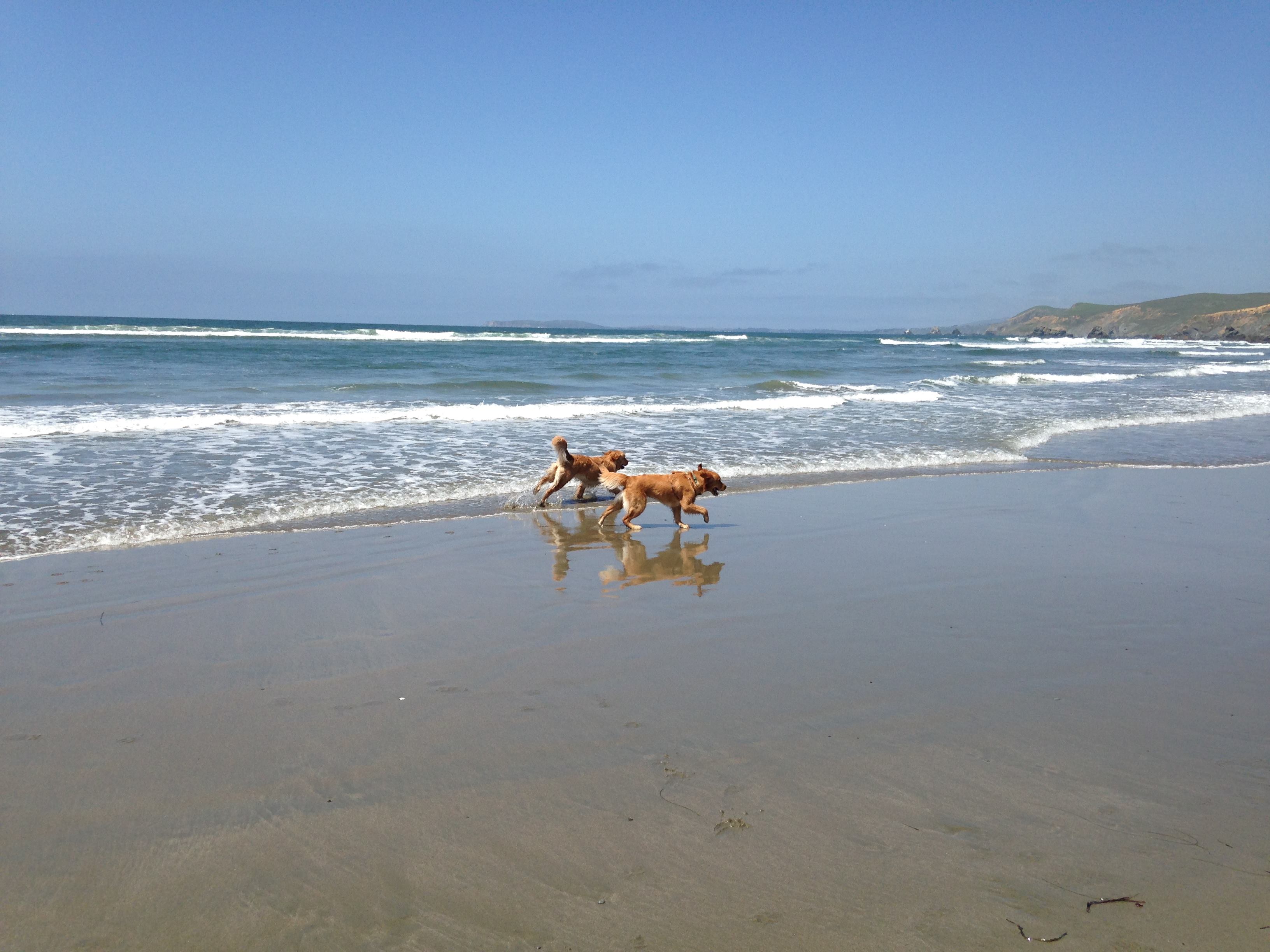
It’s the end of a wonderful era, and it came way too soon. I know it’s a silly, but I like to imagine them running together on an endless eternal dog beach.
Ever since Orly hit early adolescence, I have been looking for a playmate for her who matches her play style. (Secretly hoping that if someone played with her as roughly as she goes after Cali, that might convince her to tone it down a bit …)
I have found her!
Spirit is our house guest while her dad deals with some health challenges. Spirit is four and a half years old, but otherwise could be Orly’s clone (Orly just turned one). They look astonishingly alike, down to the identical worry lines around their same-shaped eyes. Sprit’s coloring is a shade lighter than Orly’s, and she’s a little wider in the body, but that might just be because she lacks a built-in playmate and regular hiking group.
The similarity extends beyond their looks. Their play style is identically obnoxious — basically lots of jumping, crashing into one another, wrestling, tugging on ears and neck fur, and chasing one another around the yard. Spirit particularly likes to grab the fold of fur/skin at the back of Orly’s neck and spin her around … not so different from how Orly used to try to spin Cali around by her ear, tail, or anything else she could latch on to.
They can both get deep into chewing on a bone, though, and love to play ‘tug’ with soft toys (gently so far …) while ignoring the actual tug toys. They are both very oral, grabbing things, including human hands, as a primary way of communicating. And they both have to work really hard to remember not to jump on people.
Alas, my secret hopes have been dashed. Rather than realize how off-putting her play style is, having her moves returned with interest has apparently reinforced Orly’s approach. The two of them tumble out the door in the morning and start playing, often forgetting their key mission. After they come back inside, I have to let each of them out separately so they can pee… Then breakfast: a highlight in everyone’s morning.
More play follows, ceaselessly, until they collapse for power naps. That cycle repeats throughout the day.
Cali, who was not at all welcoming to Spirit, has come around, realizing that two nutty dogs who tire each other out translates to more peace and quiet for her. Though she sometimes tires of their antics and barks at them to calm down. Or maybe she’s worried that Spirit might actually pull Orly’s ears off?