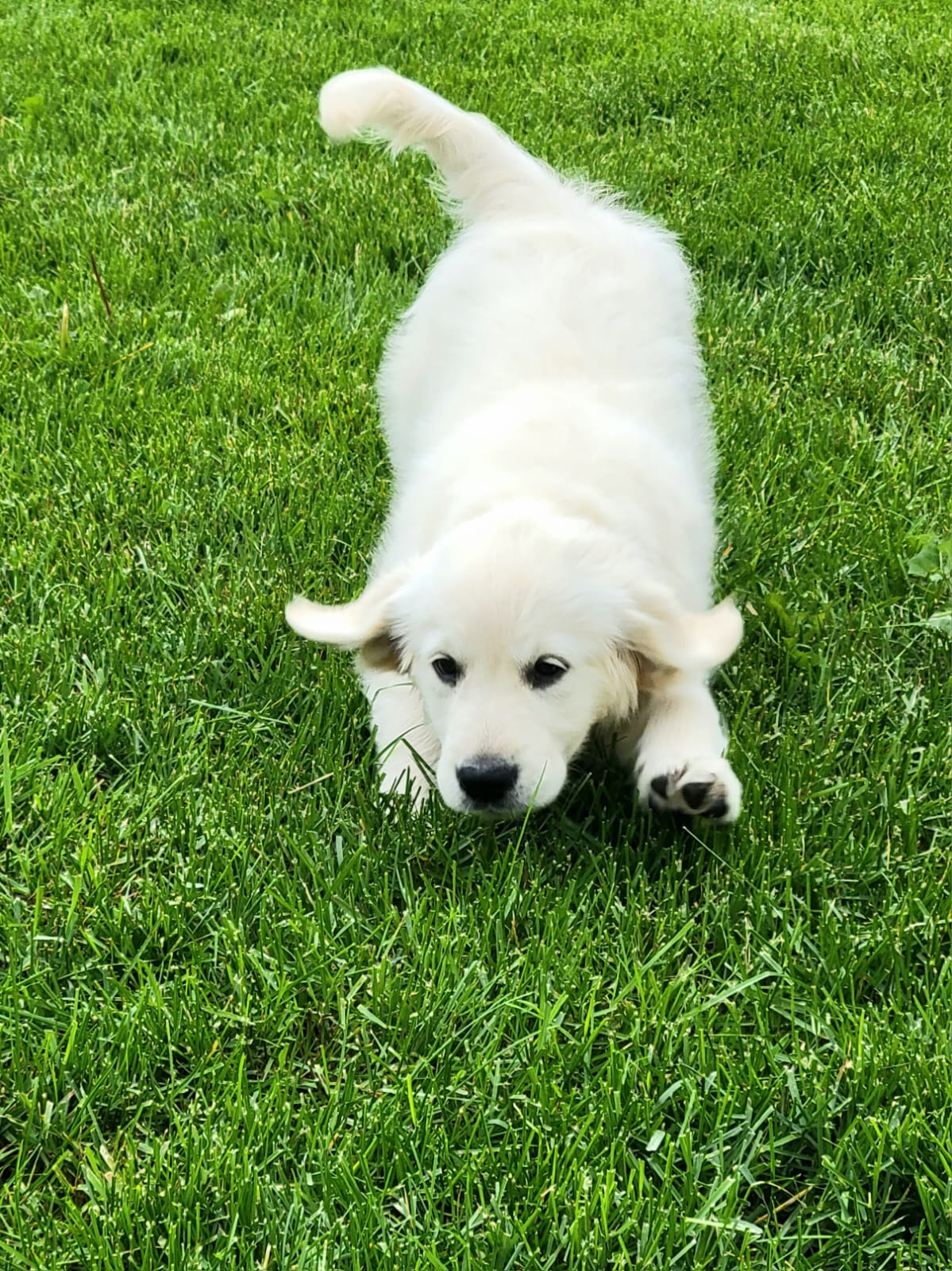
Early-Onset Adolescence

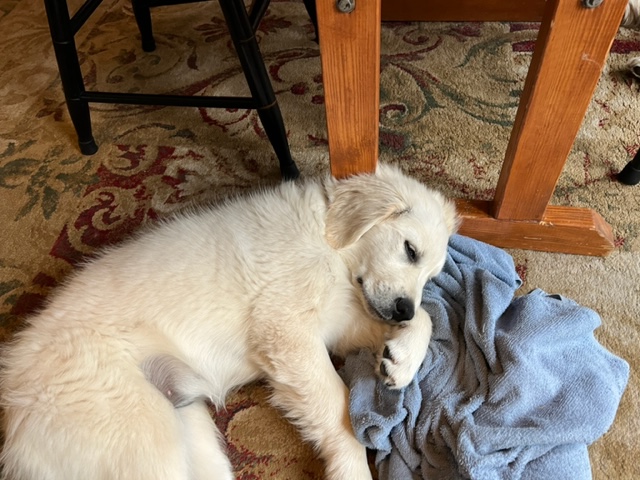
23-pound white golden retriever puppy Dotty uses a blue towel as a pillow for her napDotty is just over three months old as I write this. Yet she seems to have become an adolescent, a pleasure that I should not be forced to endure until she’s at least six months old.
Where’s my sweet little puppy?

She’s still got her baby fuzz and a very puppyish, sweet face. (She’s not little, though; she topped 23 pounds at her 12-week checkup!)

But her attitude! Her attitude is 100% teenager!

She demands her “rights” in a loud, entitled voice. She protests the unfairness of, well, pretty much everything. She grabs at treats and gobbles her food, never saying “Thanks.”

She sleeps a lot.

She’s also adventurous and curious. Eager to meet every new person. Jaded and so over spending time with Mom, though.

She still adores her big sister Orly and wants to do, see, feel, taste everything that Orly does.

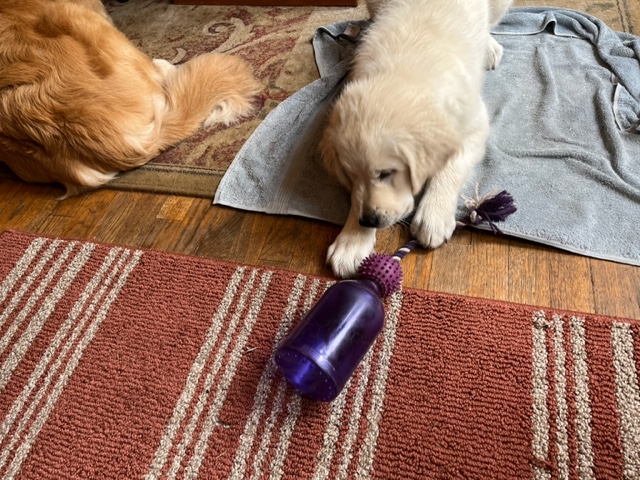
White golden retriever puppy Dotty paws at a purple, bottle shaped toy, trying to get the food out
This treat toy has Dotty stumped (for now)

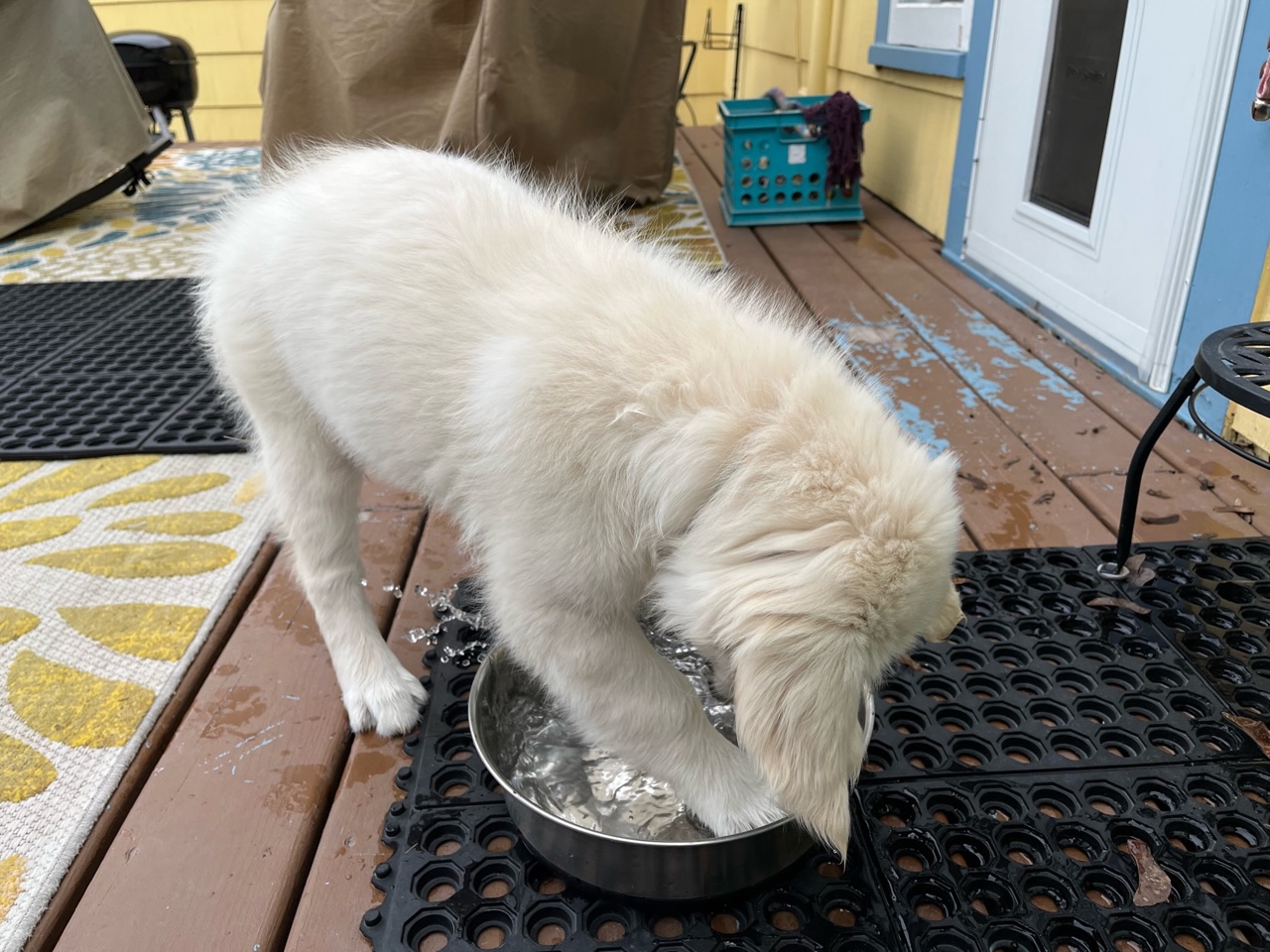
She’s learning new things every day: Leash manners; retrieving all sorts of things; digging and using her nose to find buried treasures; taking treats politely; figuring out a wide variety of treat toys; deconstructing soft toys and rugs; digging and making huge holes in the yard; extracting the water from her water bowl using all of the tools at her disposal (mouth and front paws); pouncing on the spray in her splash pad; soaking up all the muddy water from a puddle … the challenges are endless, varied, and all, in Dotty’s opinion, fabulous.

But the teenageriness. The not wanting to come when called. The hiding stuff and sneaking off behind the garden shed to engage in forbidden activities (digging, mostly). The “too busy/important to pay attention to you” dismissals…

They grow up so fast.

Golden retriever puppies Dotty and Orly dig in a sand pit designed as a dog digging pit
Looking for buried treasure!

A BIG GIRL Bed

Dotty is growing up! She no longer has to sleep in a crate.

When she was reliably sleeping through the night and asking clearly to go out, I decided that she was ready. I waited for a long weekend. I set up a second dog bed in the bedroom.

White golden retriever pup Dotty lies under a wooden bed with a beige cover. Golden Orly lies nearby. Both are on their sides.Finally, it was time: We did our evening routine of last call and tooth-brushing. But, instead of calling her to “kennel,” I propped open the crate door and placed a pet gate at the bedroom entrance.

Dotty watched with great interest from her perch on Orly’s dog bed (or, more accurately, on Orly). When I settled in to read — also part of the going-to-bed routine — she knew things were Different.

And she celebrated. Loudly and enthusiastically.

She leapt up and began racing around the room, looping under the bed in a way only she can (and probably only for a few more weeks). Puppy zoomies on sterioids! With barking! And the squeaking of toys!

On and on it went.

After a couple of minutes of this celebration, I looked at her sternly and in my best Mom Voice, said, “If you don’t settle down by the time I finish this chapter, I am putting you into  your crate.”

Well.

Her English comprehension clearly rivals that of Chaser (and a new favorite fictional dog, Six-Thirty from Lessons in Chemistry). She looked at me, dropped to the floor, and instantly fell fast asleep. Under the bed.

Subsequent nights were less celebratory. She has asked to go out a couple of times, but she mostly just sleeps, on the floor or on one of the dog beds. Just like the big, grown-up girl that she is … not. Yet.

Snuffle Monster

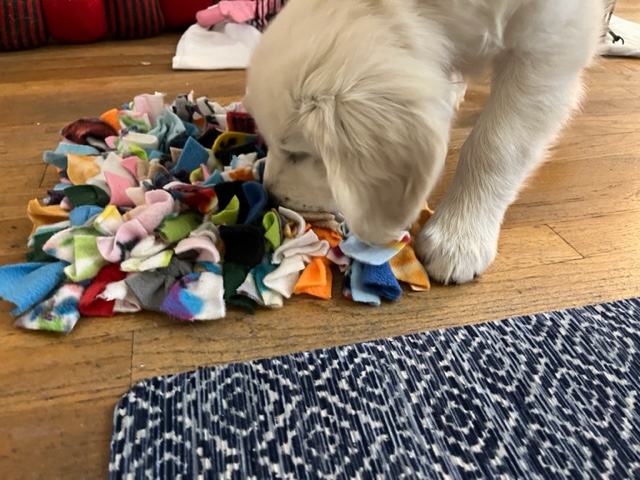
10-week-old white golden puppy sniffs a snuffle mat made of strips of fleeceI’ve created a monster. Think ‘Cookie Monster’ — not ‘JAWS.’

I introduced little Dotty to our little snuffle mat. Adorable in every possible way. She figured it out pretty much instantly. There is nothing wrong with her nose, and, true to her breed, she loves a good snack.

[A snuffle mat is a nest of fleece strips. The human servant hides yummy treats among these strips, and the dog sniffs them out and devours them. It’s a chance to let dogs use their noses and enjoy some mental stimulation. And a snack.)

I generally give Orly a snuffle mat after she hikes, and sometimes we do it after (my) lunch even on days that Orly doesn’t hike. She sometimes asks for it, but is generally happy to get the offer but not insistent.

Dotty is different.

After two — two — snuffle mat sessions, she started walking over to the shelf and trying to pull hers down. She resorted to barking at it when she couldn’t free it from the shelf.

She goes over to the snuffle mats and demands (often quite loudly) that I prepare one for her.

I ignore that, but when I am preparing the snuffle mats, she barks instructions, wriggles, tugs at the corner, pops up to watch where I am putting the treats (or is she counting to be sure that she gets as many as, or more than, Orly?!). She dives for Orly’s as I move to set it down. She impatiently sits, wriggling and sometimes barking, as I give Orly her mat and turn to give Dotty hers.

Once she’s finished clearing the treats from hers — and has thoroughly examined Orly’s mat to ensure that nothing was left behind (as if!) — she has taken to dragging one — usually Orly’s larger mat — around the room.

Snuffle Monster.

Never Too Young for Good Dental Habits!

This slideshow requires JavaScript.

Dotty wants to be just like big sister Orly. Which is (sometimes) great!

For instance, Orly loves to brush her teeth!

So, a few days after Dotty came home, I introduced her to the toothbrush. The first time, she got to sniff and lick it, Honestly, she wasn’t that interested.

She did watch closely as Orly got her teeth brushed — and got rewarded with a cookie.

The next day, Dotty was eager to try out the toothbrush, and she licked it a little.

Over the next few days, I slowly started to put the brush in her mouth, very gently touching her teeth.

Now she’s a pro. She sits calmly, little tail wagging, while I gently brush her tiny, needle-sharp puppy teeth.

And of course she eagerly accepts her cookie when I am done.

What Goes Up …

What, or who, goes up … doesn’t always come down.

Stairs.

Orly learned how to go up and down stairs well before I met her, and never had any issue with the (many) stairs in our house.

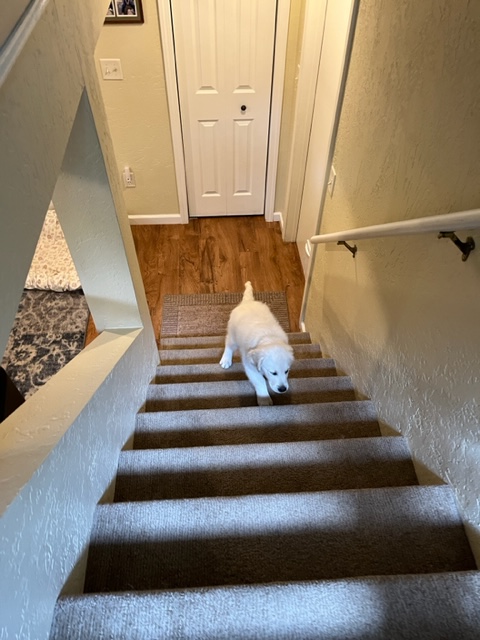
Dotty had not encountered a tall staircase, and found the steep mountains in front of her a little scary.

She did quickly master the short 2-3 steps to the back, and then the front yards. Down first. Up took a little longer, but she got that too.

Next up — the house stairs.

My old-school attempts to lure her, one or two stairs at a time failed. I started with the stairs to the office, thinking the rubber runners would give her a good grip and ease her fears. She was willing to stretch enough to reach the treats on the edge of one step … but not move her paws so she could reach farther.

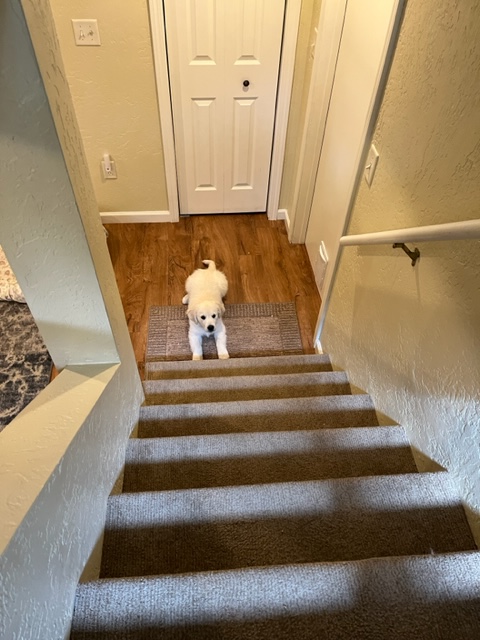
We tried the carpeted basement stairs, with a non-slip mat at the bottom. No luck.

Hm.

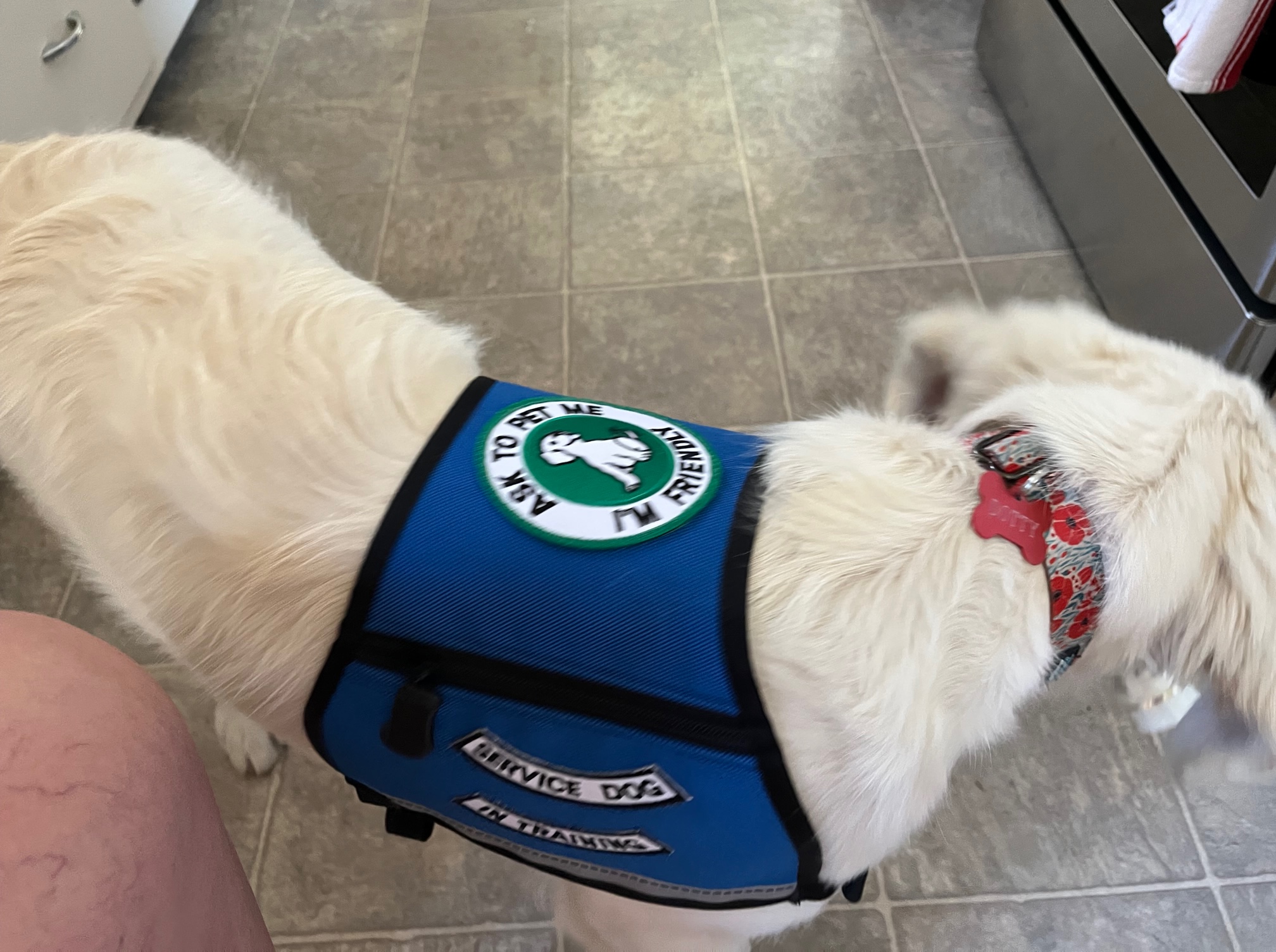
Stumped, I asked the expert (Glenn, who runs Dotty’s service dog school).

He said that going down would be less scary than up. Dotty is clearly not related to me. My (mild … ish) fear of heights makes going down far more uncomfortable.

Anyhow. He suggested sitting with her a few steps up from the bottom and letting her think about it for a while. We did that, then I let her walk down 3 steps. Success.

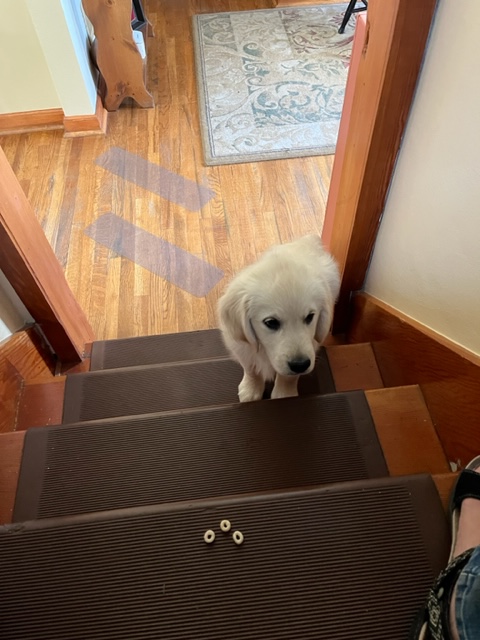
Golden pup Dotty looks up a tall flight of carpeted stairsWe did that a bunch of times, slowly adding a step or two.

I also worked in the other direction, carrying her most of the way up, then letting her tackle the top 2-3 steps.

We practiced all of this over a couple of days, also working on what Glenn calls the “follow me” routine. This encourages the puppy to go wherever I go, which she is naturally inclined to do anyhow.


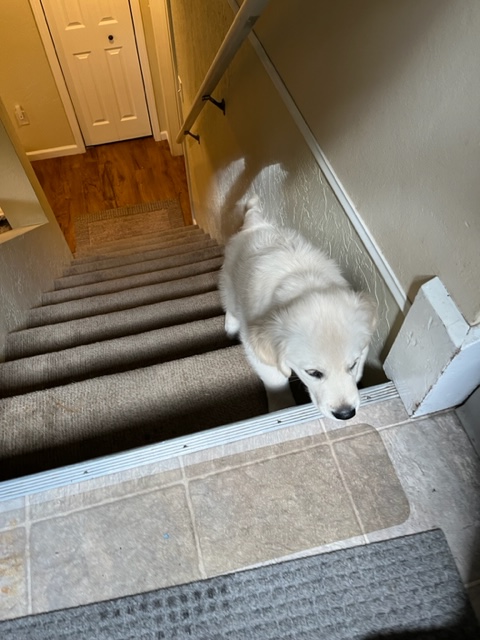
Dotty progresses up the carpeted stairsAfter a few days of steady success with small numbers of stairs, I took a leap of faith. She seemed more confident on “up,” so I headed up the stairs with my hands full of stuff, and called out “Come on girls, follow me.”

Not surprisingly, Orly trotted up the stairs. Dotty hesitated. Whimpered once. Then she got a determined look on her fluffy little face and … followed me all the way up!

Dotty reaches the top of the stairsProud of herself, she did a little dance at the top. And eagerly accepted her reward — lots of praise and petting as well as a cookie.

She also soon figured out that she could get herself up the stairs any time she wanted. Only problem is … we’re still working on down the stairs. She’s gotten herself upstairs several times now, realized she was alone, and, yep, next thing you know, I’m running up the stairs to rescue 18 pounds of wriggly puppy who has instantly transformed from despairing to delighted.

A “Little Sponge” Indeed

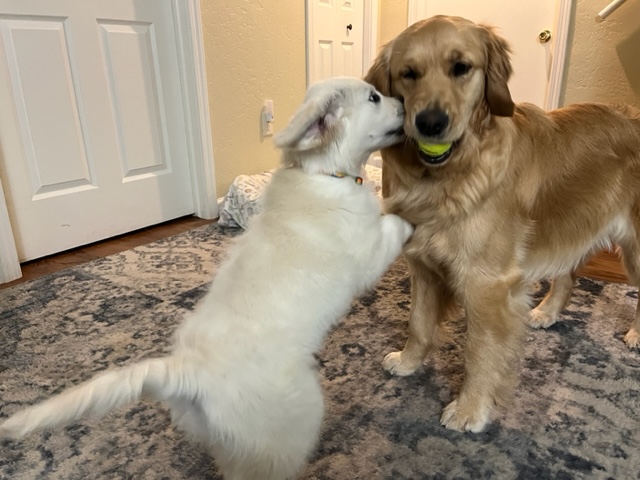
White golden puppy Dotty jumps on big sister Orly, a blond golden retriever As I said in the little news story on Dotty’s service dog program, Dotty is a “little sponge” soaking up, well, everything. (That includes what Orly is teaching her …)

However, on the positive side, she:

  • Learned how to go down the 3 steps from the deck into the back yard
  • Learned how to go back up those 3 stairs
  • Discovered the wonders of string cheese as a training treat
  • Figured out how to get food out of multiple types of food toys
  • Encountered & conquered an ice cube
  • Mastered the snuffle mat
  • “Paddled” in her water dish
  • 10-week-old white golden puppy sniffs a snuffle mat made of strips of fleeceTaught Orly to snuggle with her
  • Helped me mow the lawn and pull dandelions
  • Had a bath and pawdicure
  • Stole the hearts of dozens of Missoulians and countless email and text friends

… All in her first two days.

She’s learning how to go up and down larger flights of stairs, brush her teeth, walk on a leash, and more. In between her many short training, learning, and exploring sessions, she sleeps. A lot. She settles down nicely in a large crate or pen, but prefers to lounge in the grass or on a huge dog bed. She loves toys, especially ducks and the small chirpy chick that was one of Orly’s baby toys. And anything that makes a crinkly sound.

Orly is teaching her to eat grass, try to break into the newly reinforced raspberry patch, stare down squirrels, chase her tail, wrestle, and collect her fair share of the egg tax.


WHAT Have I Gotten Myself Into?!

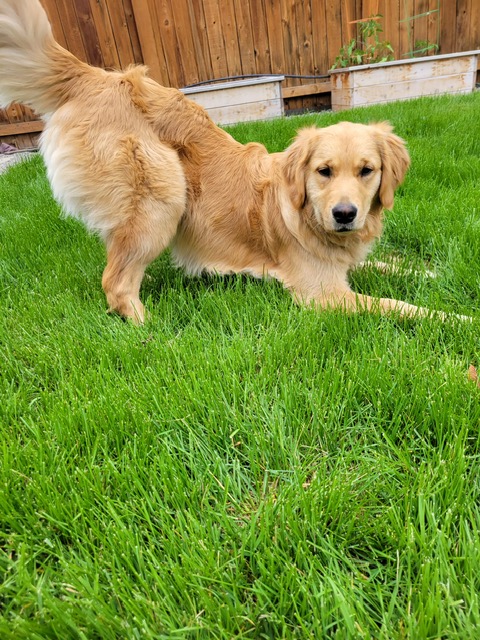
Golden retriever Orly, standing on grass, play bowsSeveral years ago, I trained service dog puppies. I also taught at a school for service dog trainers. I worked with dozens of volunteers, including many puppy raisers. But, until now, I had never been a puppy raiser.

Missoula used to have a mobility service dog program called Pawsibilities, run by Glenn Martyn. Glenn also was one of my teachers; he’s an outstanding dog trainer with deep and varied experience. And he’s working on re-establishing his service dog organization.

Through a series of events that could only happen in a place like Missoula, where all the dog people know each other, Orly’s dog hiker met Glenn because Glenn was training my friend/neighbor’s puppy (who hikes with her because I made the match …). They seemingly cooked up this idea during a training session. Orly was on board too.

So, by the time Glenn asked whether I would be interested in puppy raising … well … I am not sure that “no” was an option.

9-week-old golden pup Dotty runs with hears flying out to the sides
Photo by Christina Phelps

So here we are.

Dotty, named for my late grandmother, came home last night. Orly immediately invited her to play. Despite tumbling Dotty over a couple of times, Orly showed exceptional manners and is already a great big sister.

Dotty has learned to use the steps from the back deck to the grass — she went down last night and figured out “up” this morning. She’s also been introduced to food-filled chew toys, string cheese, and a water bowl (almost) big enough to swim in. She is learning to sit for meal prep. She already knows to ask to go outside and has not (yet) had an accident in the house. She seems to know about the magic sit, in fact, and takes treats very gently. She had a bath and had her very sharp little nails trimmed this morning, and behaved perfectly throughout.

We’ll follow her adventures over the next several months, as she learns all the skills she needs to be a great service dog!

This slideshow requires JavaScript.


Orly LOVES Sleepovers

3 dogs sleep in dog beds, while golden Orly looks around to see if one wants to play
Wanna play?!

Orly loved her first sleepover.

Her human hostess, the Missoula Dog Mom who takes her hiking a few times a week, was ready. Some of Orly’s buddies were waiting.

When I left, Orly followed me to the gate. She looked a little worried when I left her inside after I went outside. Dog Mom called her over and cuddled her, and as I drove off, Orly’s tail was wagging.

A short time later a looonnnngggg video popped up on my phone. In it, Orly was racing madly around the huge fenced yard and trying hard to entice a doodle pup to chase her. The doodle chased, then wandered off. Orly resorted to more solo laps. She was prancing and leaping and dancing. Her tail never stopped wagging.

Orly loved sleepaway camp.

In the photo, she’s the one falling out of her bed, probably trying to get one of her sleeping pals to wake up and play some more.

She pretended to be happy to see me when I picked her up. She was pretty tired and went right to sleep after dinner.

By the next day, though, she was bored. In true teenager fashion, she sighed loudly as she slumped down, bored. Bored. BORED. The only thing missing was a phone for her to fiddle with.

She’ll be getting a surprise soon, though. One that (who?) will banish the boredom. You’ll all read about it in next week’s post.

Orly’s First Sleepover

Golden retriever puppy Orly lies in a muddy river, coated in mudWe’ve packed her food and put clean sheets on her dog bed. We’re taking Orly for her first sleepover as we head out to spend a long weekend at Yellowstone.

She watched the prep with interest. The only time she has slept away from home was last summer when we went camping, and she loved that. She’s also had fun aunties stay with her at home while I traveled for work.

This time, though, she’s going away, alone.

The dog sitter is the same amazing fun person who takes Orly hiking a few times a week, and who always has a carful of friends for Orly to run around with.

She has visited her dog sitter’s home, and she was delighted to find her buddy Henry there (he lives there) as well as some of friends from her hiking group.

I was with her, though, and we only stayed for about an hour. When I drop her off tomorrow, with bed and breakfasts (and dinners), she’ll be off on her first solo overnight adventure.

She’ll go on hikes with her buddies, play in the huge fenced yard, and have slumber parties with the other dogs. She’ll probably eat too much junk food and stay up too late.

I’m sure she’ll have a great time. And that I will miss her far more than she misses me.

Not All Dogs Are Career Dogs

Koala, a black Labrador, wears her guide harness.The post about Ida last week and some conversations with a local service dog trainer got me thinking about the many reasons that dogs don’t succeed in a career as a service or guide dog.

For Ida, the issue was anxiety; she was uncomfortable with unpredictable sounds, with airplane travel, and possibly with other unavoidable features of life as a working dog.

Why else might a dog bred or selected for training as a guide or service dog be released?

For many puppies, and even adults or working dogs, leaving the field is the result of a health issue. Alberta retired 7 years ago after losing an eye to a benign tumor.

For others, it’s temperament. They are too nervous to work safely in public spaces, for example. I’ve known dogs with top-notch skills who simply couldn’t function in a busy public place where pets aren’t expected to be, like a grocery store or a restaurant, or even a busy park.

They may be uncomfortable around unfamiliar dogs; Deni has encountered untrained “service” or “support” dogs in airports and other public spaces who growled or lunged at her working dog. These dogs are too scared and reactive to be safe working in public.

Some dogs have specific fears, like dogs who are afraid of thunder, that mean they cannot focus on their work.

Sometimes, the problem is behavioral: A dog who is so obsessed with food or distracted by squirrels or tennis balls, for example, that she cannot focus on her work will be released.

Working dogs need to be calm under all circumstances, keep working even when they are tired, and not react to other dogs, cats, small (or adult) humans who invade their space and touch them or repeatedly call their names. They need to be flexible and resilient and able to regroup, change direction, and keep their handlers safe.

Working as a guide or service dog asks a lot of a dog and exposes the dog to many things pet dogs never have to worry about. It’s not surprising that many dogs who begin the training don’t complete it. Or, like Ida, once they see what the job is like, they quickly realize that they are overwhelmed.

I am glad I met Ida. She’s a sweet, smart girl. I’m also happy for her that she will have the kind of life she needs and deserves.