Dog-O-Ween No Ordinary Dogs’ Night Out

Wednesday’s Dog-O-Ween outing was no ordinary night out with our three dogs. On arrival at Dominic’s Pizzeria, host of the costume ball, we saw many participants hiding under the tables. Or dancing on top of them.
Dominic’s staff  took it all in stride; they’re used to dogs. The Gulfport restaurant’s patio is always dog-friendly and Dominic’s hosts Yappy Hour every Wednesday. Servers carried trays piled high with bags of doggy treats and nimbly balanced food, drinks, and treats without treading on any tails.

We’d started preparing well ahead of time, seeking the perfect costumes on a weekend shopping trip. Wednesday afternoon, we pulled it all together.

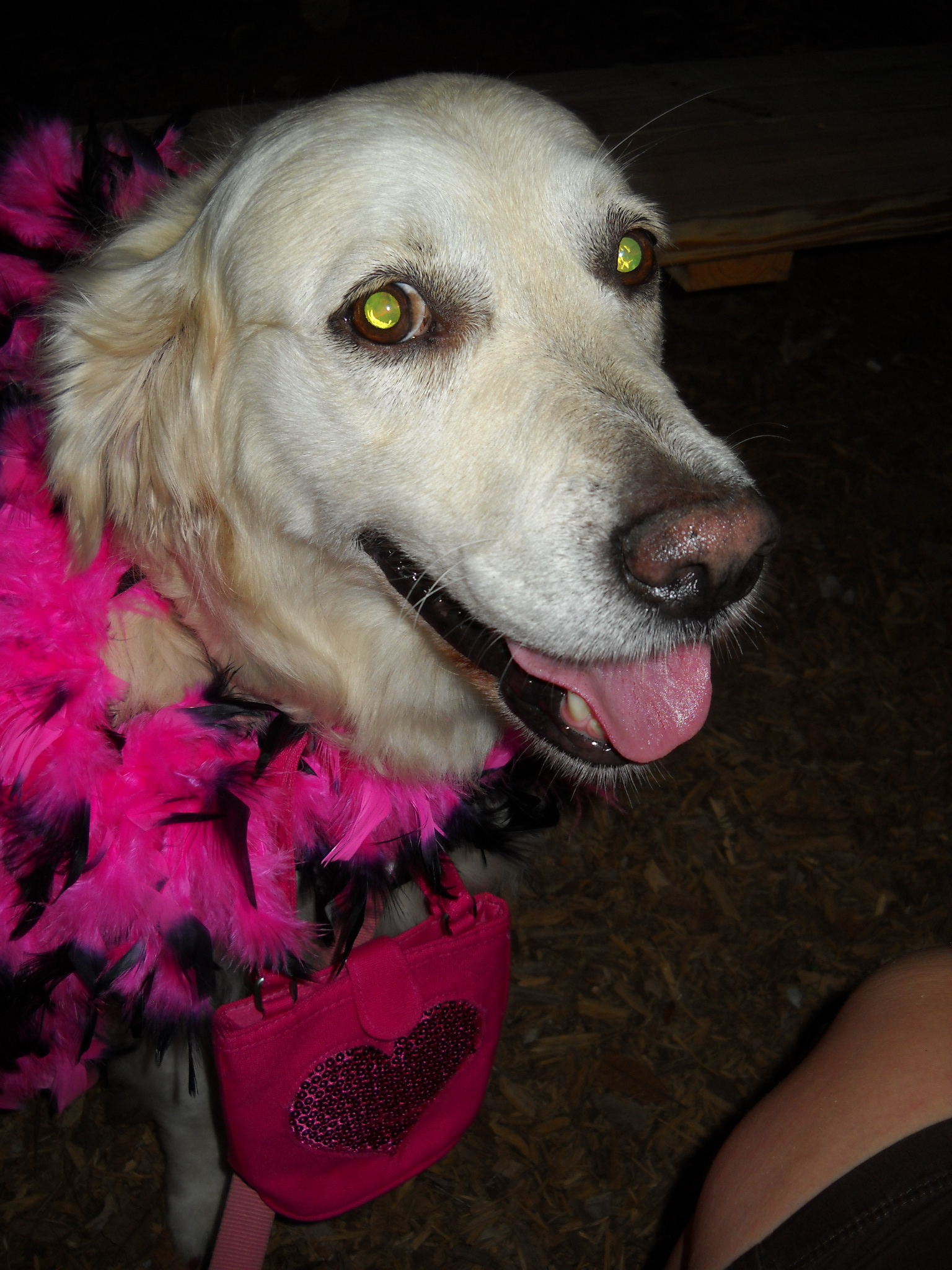
Jana, the white golden retriever, was easy. She watched approvingly as I applied her magenta nail lacquer and wagged happily at the sight of the bright pink feather boa and bling-y purse that completed her Femme Fatale costume.

Ever-patient and cooperative, Oriel, our red golden retriever, initially tripped over her Little Red Riding Hood cape. The hood covered her eyes. Adjustments were clearly needed. Holes cut in the hood for her ears held it in place, and rainbow shoelaces reined in the cape’s flapping sides. At last, she could walk without tripping on her costume.
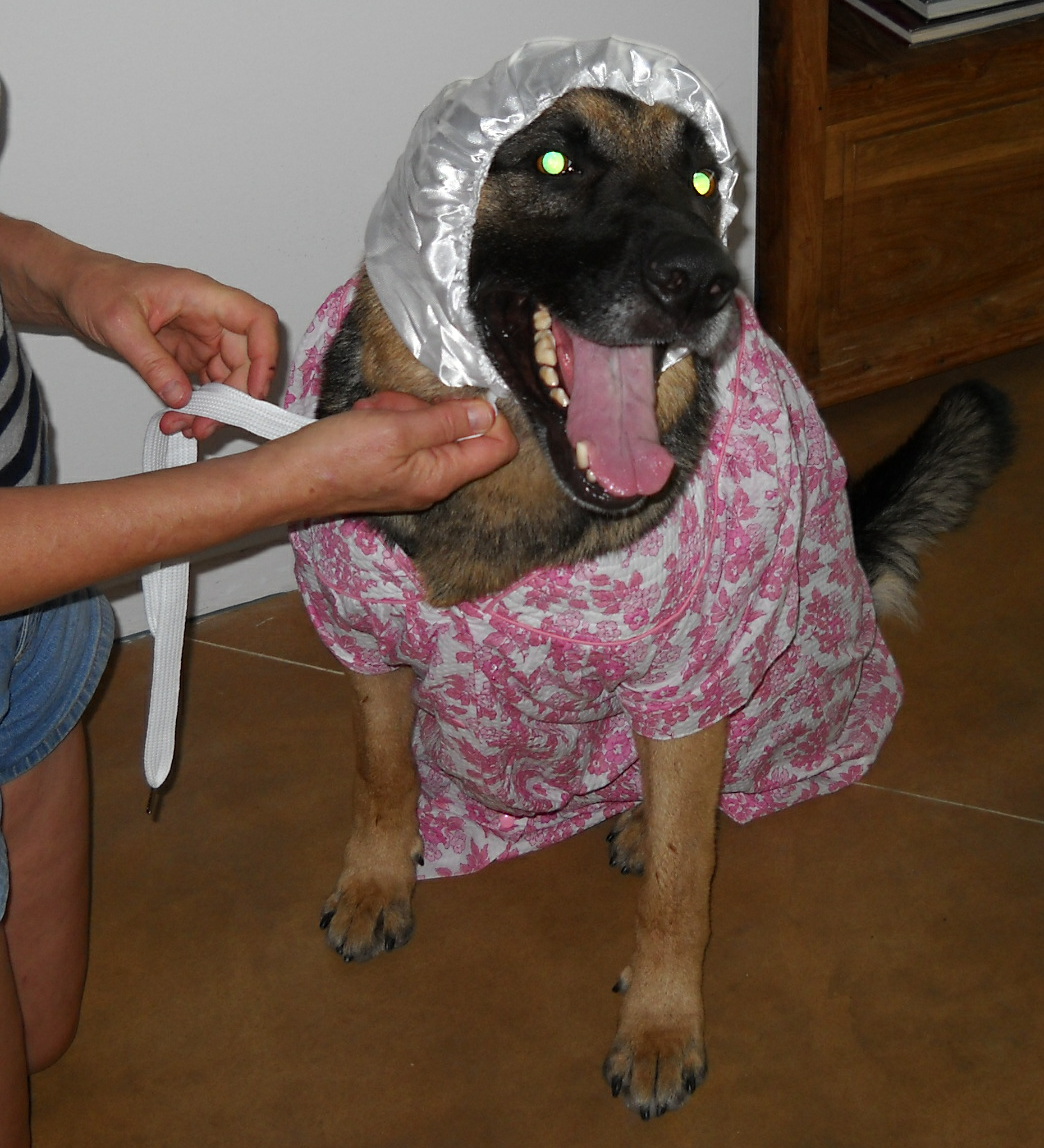
Grandma, what BIG teeth you have!

Wylie was the challenge. A tall, athletic German shepherd, Wylie was attending Dog-O-Ween as Ory’s foil: the Big Bad Wolf. His Grandma nightgown needed considerable nipping, snipping, and tucking to be wearable. Ear-holes added to his nightcap enhanced his wolf-like appearance. His expression seemed to signify resigned acceptance of human foibles.

We drove to Gulfport. With a few last-minute costume adjustments, we were ready.
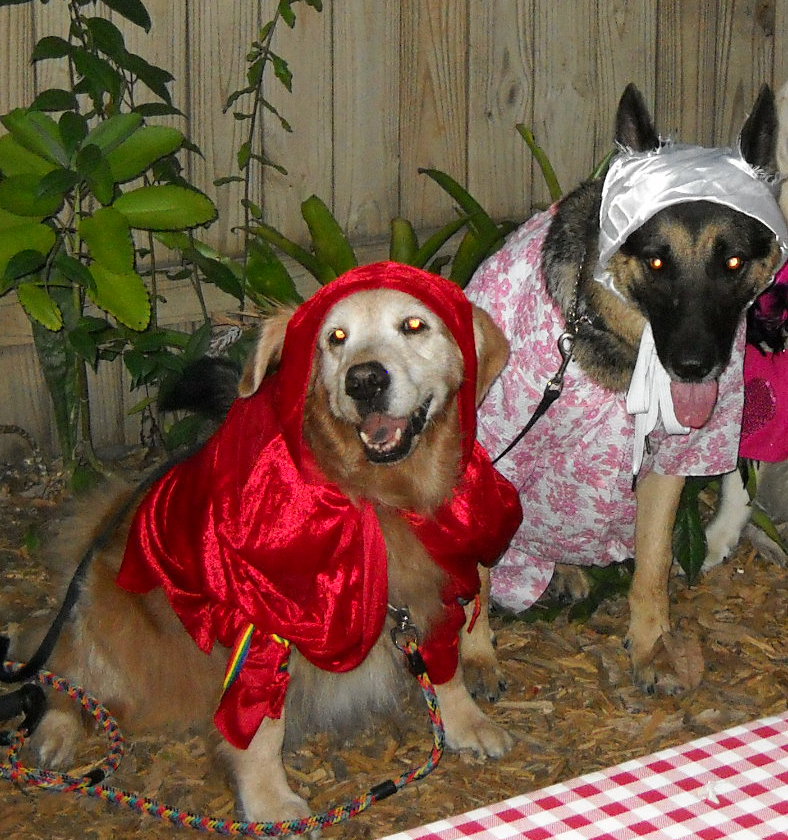
Riding Hood and the Big Bad Wolf

Other guests’ attire ranged from simple T-shirts to elaborate affairs. One large dog was dressed as a doggy bag. A medium-sized dog wore a rooster suit; another was dressed as a cow (his owner wore a matching costume). The Queen of Hearts was in attendance, carried by her gentleman-in-waiting who sported an “Off with their heads” sign. Small dogs came dressed as a  hot dog, a police officer, a princess. A Southern Belle wore a ruffled skirt and gauzy hat.

The Mistress of Ceremonies, Auntie Lynda of Pet Pal Rescue, organized the two dozen or so dogs into a parade. Small dogs first, then medium-sized, and, finally, large dogs. We took our places at the end of the line and watched the contestants stroll past the judges. Many dogs, especially Jana, vamped their way through the spotlight.

Quickly dubbed “the cross-dressing shepherd” by the judges, Wylie was a runaway hit. In fact, our family swept the Large Dogs category: Jana came in third, Little Red Riding Hood took second, and the cross-dresser sashayed off with first prize.

They’ve pooled their prize money to purchase a stash of Halloween treats. Our special order will be waiting at our favorite stand at the Saturday Morning MarketFred’s Finest Pet Treats. Here’s hoping the treats will keep them quiet as we pass out candy Sunday evening!
The Bowl Really IS Half-empty

One of the things I have always loved about dogs is their unbridled optimism. Many dogs, and certainly most golden retrievers, greet every stranger as a new best friend. And car-savvy dogs seem to just know that a car ride always leads to fun for dogs!

And then there’s Jana, my golden. She’s sure that getting in the car means that she is going to be stuck there for days and probably won’t even get dinner on time. She definitely struck me as a bowl-half-empty sort of gal early on. Are dogs like people in that regard — some optimistic, others not?

I was clearly not the only person wondering that. Now, a scientific study has determined that, indeed, dogs can be pessimists.

With Jana, I am sure it began the day she reached adulthood, or late adolescence — whatever age it was that I decided  that she no longer needed three puppy meals a day. Nope, like a true grown-up dog, Jana would have two meals a day. She was crushed when, despite several reminders from her, I failed to serve puppy lunch. I tried telling her that many, many dogs eat only once a day, but she wasn’t buying that. From her perspective, it’s been pretty much all downhill since then.

The pinnacle, or should I say, the nadir, of her existence might have occurred on a cross-country trip a couple of summers ago, when we spent what seemed like a week just crossing Texas. She heaved an I-might-as-well-be-dead sigh and threw herself across the console in between the two front seats — and refused to be consoled. Nothing budged her. Not the promise of walks and playtime, not even a snack. Getting into the console for  sunglasses or a pen required using two hands and a hefty push to lift the lid, dog and all, to gain access.

Jana’s travel companion, Wylie, a German shepherd, is a born optimist if there ever was one. But even his frequent expressions of excitement which could only be translated as  “There’s a place we could stop and play!” “Look, some grass! Let’s go play!” failed to rouse her. Jana refused to so much as lift her head to look out the window. When we got stuck staying at a none-too-clean La Quinta one night, she realized that there was something worse than 12 hours in the car. Even the people were reduced to foraging for dinner at Denny’s. Life was truly not worth living. (Not to worry — our stay at a wonderful French Quarter hotel in New Orleans a couple of days later revived her. She has been plodding along, finding half-empty bowls, ever since.)

Not surprisingly, the intrepid team of researchers who determined that dogs could be pessimists was British. If dogs anywhere would be doom-and-gloomy, stiff upper lip and all that, it would be British dogs, wouldn’t it? The team’s thesis was that separation anxiety behaviors, commonly seen in pet dogs — they estimate that as many as half of Britain’s pets dogs show these behaviors during their lives — could indicate a pessimistic outlook on life.

The dogs studied were first evaluated for their response to being left alone, specifically to determine whether they showed anxiety. Anxiety might be exhibited as vocalization, destructive behavior such as chewing, or inappropriate toileting in dogs who are known to be housebroken. Next, the dogs were taught that bowls on one side of a room always contained rewards, while bowls on the other side of the room never contained rewards.

The optimist/pessimist test, or, if you prefer, the happy dog test, came next. The bowls were placed in one of three ambiguous positions, between the reward and no-reward locations the dogs had been taught to recognize. Dogs who approached the bowl quickly were judged to be anticipating a food reward and thus optimistic; dogs who did not approach the bowls or approached slowly were judged to be pessimistic, i.e., not expecting a reward. Several tests were run for each dog, with the bowls in the reward, no-reward, and ambiguous locations. Each dog’s times for the three locations were charted and compared so that speedy dogs didn’t get higher marks for optimism simply because they had longer legs than other test subjects.

Wouldn’t you know it? Dogs who had demonstrated anxiety at being left alone also had lower happy-dog scores than the calmer dogs. The researchers concluded that separation anxiety might indicate a negative underlying mood. For dog owners and therapists, looking at it the other way around might be helpful — dogs with a naturally bleak outlook might be more likely to exhibit separation anxiety.

While the idea that dogs’ behavior is influenced by their emotions or mood is certainly not news to anyone who has lived with and closely observed dogs, it’s nice to have official confirmation. And for the families of dogs who show classic separation anxiety — I know of one dog who jumped out of a second-story window to get to her departing humans, and have seen astonishing feats of destruction wrought by other distraught paws (and teeth) — understanding the dog’s emotional state and feelings might be calming in those moments when the humans really want to throttle the dog.

The logical question is, though, what are you supposed to do with this information? I am not an advocate of doggy Prozac, and punishing a frightened or anxious dog is counterproductive. Anxious dogs need a tremendous amount of patience from their families, and, sadly, there is no quick fix. One happy effect of the current economic downturn, at least from the dogs’ perspective, is that so many more of us are available, at home, for several more hours each day; we’re also taking fewer dog-less vacations and enjoying less-frequent people’s nights out.

Behavior modification with a qualified trainer who uses positive methods is the best approach to resolving anxiety related behavior in your dog. Find a trainer in your area through the APDT or a local animal-friendly trainers group, such as Tampa Bay Animal Friendly Trainers.

Thinking Dog Blog now on Creative Loafing

Check out the new home of the Thinking Dog Blog — BellaDOG!

View previous posts at Creative Loafing Tampa Bay’s Daily Loaf:

http://blogs.creativeloafing.com/dailyloaf/author/pamhogle/

Dog Happiness!

I’ve been thinking (and writing) a lot about dogs and their emotions lately. I love the way Dr. Marc Bekoff describes animal emotions and says that dog joy or fox grief might not be like our experience of joy or grief but that doesn’t make it any less real. (Check out his book, The Emotional Lives of Animals).
Jana and Wylie certainly exhibit what can only be joy — pure delirious happiness — every time we let them loose in “their new front yard” — Lassing Park, on Tampa Bay.

Wylie runs in delighted circles in the water, kicking up splashes, flying toward flocks of birds, racing, racing, racing until his tongue is hanging to his knees and all he can do is stand, panting and grinning giddily.
Jana is a bit more restrained, usually seeking out the deepest pool of water and lying down in it. Then, she exuberantly rolls in the sand, the grass, any dead thing she can find. And repeats the cycle as many times as I let her. She, too, runs along the waterfront with a big smile on her face.

This undeniable dog happiness is tempered somewhat by what comes next. Bathtime. Rinsing them, we laugh at their disgusted and annoyed expressions, at Wylie’s snapping at the water spray, at Jana’s dance to avoid having all that nice smelly stuff washed off.

Some may call me anthropomorphic, but no one who has observed these — or any other — dogs closely can deny that they are happy.

Dog Happiness!

I’ve been thinking (and writing) a lot about dogs and their emotions lately. I love the way Dr. Marc Bekoff describes animal emotions and says that dog joy or fox grief might not be like our experience of joy or grief but that doesn’t make it any less real. (Check out his book, The Emotional Lives of Animals).
Jana and Wylie certainly exhibit what can only be joy — pure delirious happiness — every time we let them loose in “their new front yard” — Lassing Park, on Tampa Bay.

Wylie runs in delighted circles in the water, kicking up splashes, flying toward flocks of birds, racing, racing, racing until his tongue is hanging to his knees and all he can do is stand, panting and grinning giddily.
Jana is a bit more restrained, usually seeking out the deepest pool of water and lying down in it. Then, she exuberantly rolls in the sand, the grass, any dead thing she can find. And repeats the cycle as many times as I let her. She, too, runs along the waterfront with a big smile on her face.

This undeniable dog happiness is tempered somewhat by what comes next. Bathtime. Rinsing them, we laugh at their disgusted and annoyed expressions, at Wylie’s snapping at the water spray, at Jana’s dance to avoid having all that nice smelly stuff washed off.

Some may call me anthropomorphic, but no one who has observed these — or any other — dogs closely can deny that they are happy.

Dog Happiness!

I’ve been thinking (and writing) a lot about dogs and their emotions lately. I love the way Dr. Marc Bekoff describes animal emotions and says that dog joy or fox grief might not be like our experience of joy or grief but that doesn’t make it any less real. (Check out his book, The Emotional Lives of Animals).
Jana and Wylie certainly exhibit what can only be joy — pure delirious happiness — every time we let them loose in “their new front yard” — Lassing Park, on Tampa Bay.

Wylie runs in delighted circles in the water, kicking up splashes, flying toward flocks of birds, racing, racing, racing until his tongue is hanging to his knees and all he can do is stand, panting and grinning giddily.
Jana is a bit more restrained, usually seeking out the deepest pool of water and lying down in it. Then, she exuberantly rolls in the sand, the grass, any dead thing she can find. And repeats the cycle as many times as I let her. She, too, runs along the waterfront with a big smile on her face.

This undeniable dog happiness is tempered somewhat by what comes next. Bathtime. Rinsing them, we laugh at their disgusted and annoyed expressions, at Wylie’s snapping at the water spray, at Jana’s dance to avoid having all that nice smelly stuff washed off.

Some may call me anthropomorphic, but no one who has observed these — or any other — dogs closely can deny that they are happy.

What IS Dog Intelligence

There’s a lot of talk lately about dogs’ intelligence. Some researchers compare dogs’ intelligence to that of a 2-year-old child. I don’t think that makes sense. First of all, an intelligent 2-year-old grows up to be an intelligent adult, a less-intelligent 2-year-old grows up to be a less intelligent adult so, really, what IS the intelligence of a 2-year old? It varies as widely as the intelligence of people at any age.
But the real problem with the comparison is, I think, that human intelligence and dog intelligence are very different. A 2-year-old child is human and is learning to function in a human world. Human children are born preprogrammed for language and other things that equip them for life among humans.
A dog is, well, a dog (please, somebody, explain this to Jana — I have not been able to convince her of this fact yet!). Dogs are born preprogrammed to exist in a dog world. And the world of a domestic dog is weird — it is, of necessity, intertwined with the human world. We’ve played with their genetics so much that the domestic dog cannot function as a wild animal. Yet dogs retain some behaviors that are directly traceable to their wild ancestors. Their communication system — chiefly body language — mimics that of wild canines. Their vocalizations, their play style, their prey drive, and so much more. But in designing breeds and through the long process of domestication, much of this behavior has changed. Dogs have adapted to our world.
I think intelligence is figuring out how to not merely survive but to thrive in one’s environment. For a human 2-year-old, that is a human environment. For a dog, that is also a human environment — so not only must the dog learn dog stuff, the dog also has to learn to understand and make himself understood by members of another species. Much more difficult.
Think of it another way. People who use guide dogs put their lives and safety into the dog’s paws. How many of you would trust a 2-year-old, even a very bright one, to decide when it is safe for you to cross the street? How many 2-year-olds can understand sheep herding or search-and-rescue?
Dogs have mastered our world and learned to manipulate us (OK, many 2-year-olds are great manipulators too) and they’ve learned to partner us in dozens of ways that go far, far beyond the capabilities of any 2-year-old. It’s a very different sort of intelligence and, I argue, can’t be described or defined by comparison with humans’ intelligence at any age.
What do you think?

Smarter Than You Think

I often tell people whose dogs I am training that their dogs are smarter than they think and are capable of a lot more than we give them credit for. I am well aware that most people vastly underestimate their dogs. I guess I am “most people” since Jana kindly keeps proving to me that she’s far brighter than I recognize. Wylie, too. In just the last couple of days they each gave us an example that had us shaking our heads and chiding ourselves for, yet again, underestimating them.

Jana first. When she’s done eating, she picks up her bowl and hands it to me. If I am not in the room with her, she comes to find me, carrying the bowl in her mouth. She’ll happily pick up Wylie’s bowl too, and the bowls of any guest-dog-diners as well. She has learned well the lesson that “she who picks up the bowls, gets the cookies.” Well, a few days ago, she and Wylie had finished eating and Deni and I were in another room. Deni heard some banging and looked over to see what was going on. She called me over and said, “You’ve got to see this! Jana’s stacking the bowls!”
Sure enough, Jana was trying to put one bowl inside the other. Unfortunately, she had the bigger bowl on top so it wasn’t working too well, but she certainly had the right idea! Now, when she brings me the bowls, I ask her to get the “bigger” one first (remember that lesson?) and then I ask her to put the smaller one inside the bigger one. She does it precisely and neatly every time. With some practice, I am sure she’ll figure out how to stack them and then bring me both together.

Now Wylie. We have several soft wool balls that we put in the dryer with our laundry. They are supposed to prevent static cling. To dogs, they look like really great toys. Yesterday, as Deni was folding laundry, a wool ball fell to the floor. Wylie picked it up. Deni asked him to “bring the ball back.” He looked at her for a moment, then walked over to the toy basket. He dropped the new, very desirable wool ball into the toy basket and picked up a less desirable alternative — a small basketball that is losing air due to an unfortunate encounter with a Wylie-tooth. Wylie carried the basketball to Deni and offered it to her. He knew he had taken a ball and had to give Deni a ball; he did not offer any of the dozens of non-ball toys that are in the basket. He clearly understood that a ball was needed but he wasn’t quite ready to part with the new, nice ball so he offered a different one in exchange, figuring, I think, that since we humans don’t appreciate balls nearly as much as he does, Deni wouldn’t mind. Nice try, Wylie!

Dogs Need Jobs

I went to see a herding dog trial this week. My friend Tom had his dogs entered in the trial and it sounded like fun. It WAS fun. We saw Tom’s dog Ki work with cattle and ducks. I’ve seen him herd sheep as well. Watching Ki and the other dogs was interesting for many reasons.
First of all, herding uncooperative livestock demands coordination and strategizing. When dog and human work on herding together, they have to share not only the ultimate goal but the plan for how to achieve it. This tells me that not only is the dog thinking, but the dog and human are clearly communicating. Some scientists (and others) believe that thinking is not possible without spoken language and that true communication only occurs when spoken language is possible. This is a convenient way to form a foundation for the claim that only humans can think and communicate on a high level. How absurd.
Watching working dogs also reinforces my deeply held belief that dogs need jobs. I am sure that there are some individuals, just as there are individual humans, who are content to lie around all day on a soft bed and do nothing, but most dogs — as most people — are bright and curious and want to be more engaged with the world than that. A dog’s job can be simple — bringing in the morning paper and cleaning up his toys at night, for example. It can be complex — guide dogs come to mind, or search and rescue dogs, or the many working dogs on farms all over the world. As with people, dogs have different aptitudes and preferences. And their circumstances might dictate their job. A dog living in a city is unlikely to have much chance to herd cattle, but he could easily be kept busy — and mentally challenged — in other ways.
Some of the dogs at the trial are herding dogs only for fun — that is, it’s their hobby, a way for them to work and think and spend high quality time with their humans. Others are real working dogs. All of them seemed happy to be there and looked like they were enjoying their work.
Finally, I am convinced that “bad” dogs (anyone see “Marley and Me” ??) are only trying to find ways to put their considerable intelligence, their problem solving skills, and their excess energy to work. Wouldn’t you rather decide how your dog expends his excess energy than let him come up with his own ideas?
Jana and I recently started attending agility classes after a (too) long break. Agility is mentally and physically stimulating for Jana (and for me) and really tires her out. It is also a lot of fun. She is bright, alert, engaged and very happy to be there. It’s not the same as a “job” but it certainly offers her the chance to think things though and offers us a chance to improve our communication and have fun together. Wylie loves it too, but his mom plans to try him out on Flyball since he’s so ball-obsessed. Whatever your dog’s passion, there might be a job or “hobby” out there that is perfect for him or her. Remember, a tired dog is a good dog!

What have I done for you lately?

Today is Jana’s 6th birthday. I decided to take a few hours off work and do some fun things with her.

Last night we went to an agility class. She’s taken beginning agility classes and has learned most of the equipment, but she has fun with it. We’re nowhere near ready to run full courses but she really enjoys the classes. She was alert, engaged, and really loved all the treats.

Today, I took her to the river for a swim. I threw sticks in for her to swim after. She doesn’t really retrieve them, not fully believing that she’s a retriever (or even a dog, for that matter). She swam, rolled in the grass, swam some more.

Then we went to the Dairy Queen for a treat. I got ice cream. Then I asked for a plain hot dog, no bun. “Nothing, no bun?” the Dairy Queen lady asked. “Well, it’s for my dog. It’s her birthday and I promised her a treat,” I answered. “Oh, for your dog. Does she want it in a little baggie?” The woman smiled at me, then frowned at the cash register, wondering how much to charge. She only charged me 50 cents. Then she asked, “Does she want a doggy cone for dessert?” “You DO that?” I asked. Yes they do. Dairy Queen lady pulled out a tiny little cone — maybe 2 inches tall — and filled it with Dairy Queen ice cream, a little glob on top, just like a grown-up cone. Only tiny.
I got into the car and told Jana she was the luckiest dog in the world. I showed her the hot dog. Her eyes got really big. I gave her bites of hot dog. Then, I offered the cone. Her eyes lit up and got even bigger. She bit off the top glob of ice cream and then — very daintily — licked the ice cream down to the cone and nibbled at the cone. Finally, she gobbled the cone. Then she started eyeing mine…
Now she’s sunbathing in the yard.

A couple of years ago, on Jana’s birthday, we were driving from Richmond, VA to Jefferson, MA, where we lived at the time. It was a very long day in the car. At one of our stops, I got myself some ice cream, then got Jana a small bowl of vanilla. When I got her out of the car and offered it to her, she was absolutely incredulous. She looked at it, then looked at me, back at it, and back at me, as if to ask, “For ME?? Really??!!” I said, yes, for you, and she eagerly and happily started slurping away.

So. When’s the last time you did something nice for your dog? For many people, living with a dog is all about what the dog does for them. We should all take a look at the world from our dog’s point of view sometimes. Figure out what her favorite activity is, her favorite toy or food or color (Jana’s is pink). Our relationships with our dogs add so much to our lives. I like thinking of ways to make Jana really happy so she knows how much I appreciate having her in my life. Happy Birthday, Jana!