Wily Wylie

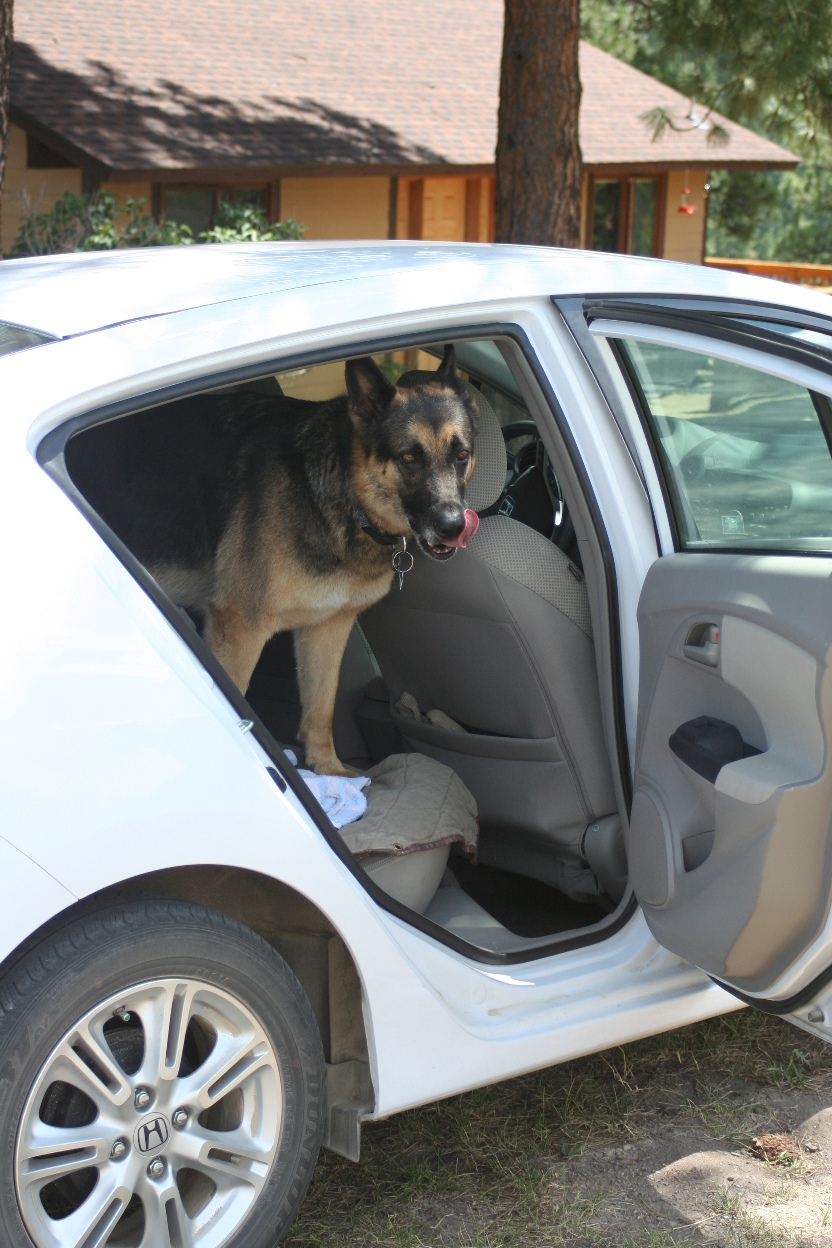
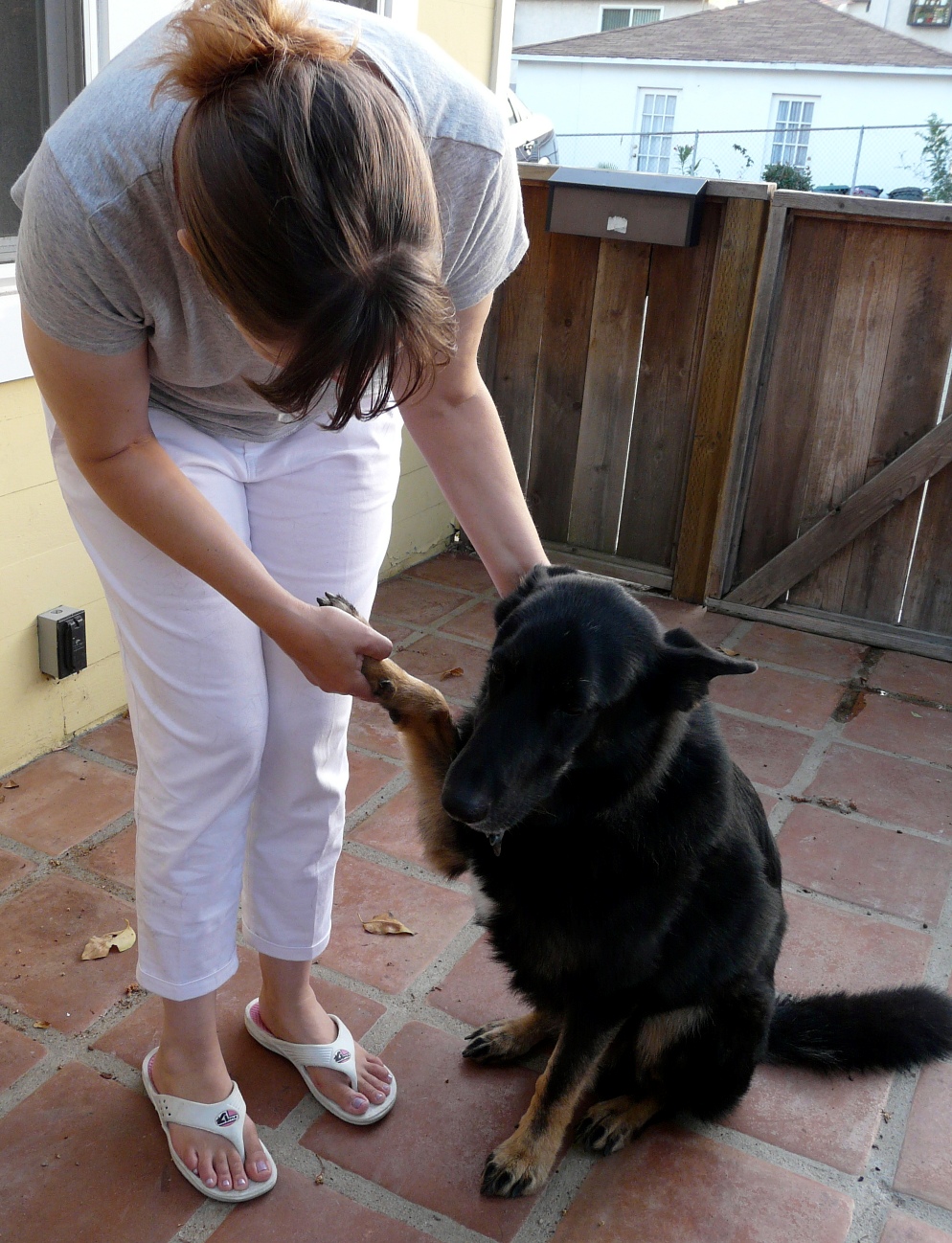
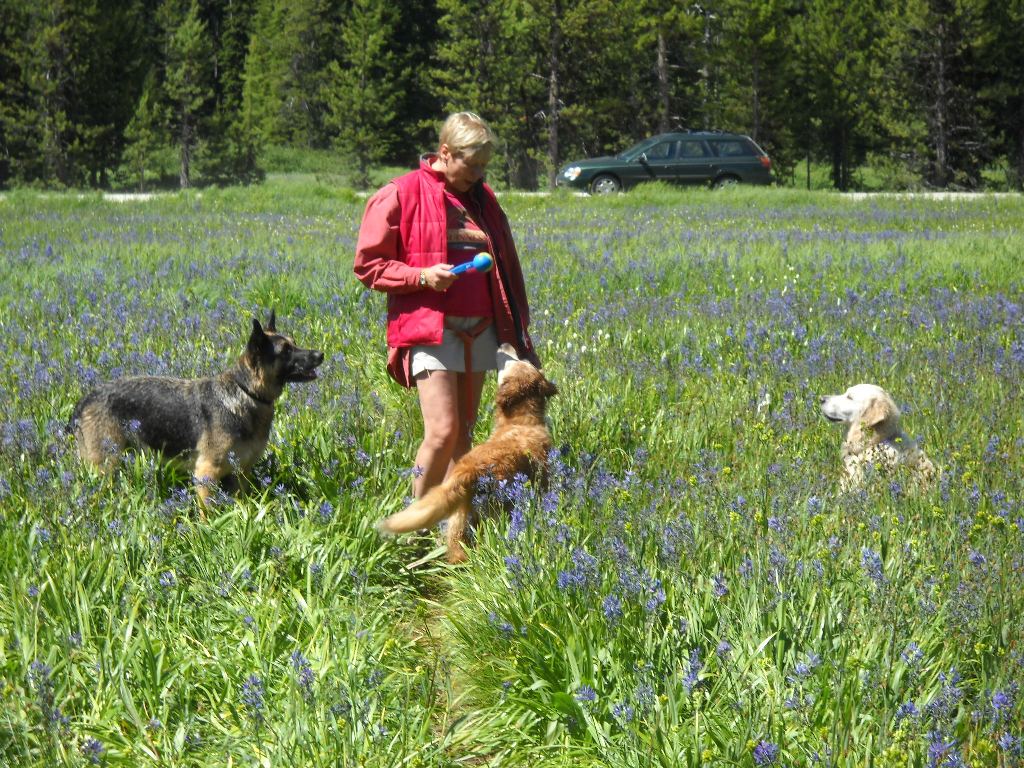
The chipmunk was driving Wylie crazy while Deni put the car’s backseats down in preparation for transporting some boxes. Taunting him, chattering nonstop, and darting around the yard. It ran under the car. Wylie ran around and around the car, fixated on the annoying rodent. Deni stepped around the dog, adjusting the seats through the car’s open doors. The crafty chipmunk stayed under the car, just out of paw’s reach. Then Wylie had an idea. Jumping into the backseat of the car, Wylie paced, peering intently out each door. He had figured out that, if that darned racing-striped rat didn’t see him, it would feel safe enough to leave the shelter of the car — and Wylie would be ready when it did!

Wylie’s idea of outsmarting the chipmunk (foiled only when Deni called Wylie back to the house and closed the car doors) shows his ability to strategize. Wylie uses his canine wiliness and planning skills in other ways as well. He’s not the only one.

Anyone who lives in multi-dog families has surely seen a gambit popular with Jana, Wylie’s doggy sister. Noticing that Wylie has a bed, bone, or toy that she might like, she suddenly looks intently out the sliding glass door or runs to the dog door, madly barking her “Look! What’s that in our yard?!” bark. Ever the dutiful watchdog, Wylie immediately goes to investigate and use his authoritarian German Shepherd voice to scare off any dangerous intruder. While Wylie’s scanning the horizon, hackles raised, Jana saunters over to the bed, bone, or toy he had been enjoying … and takes possession.

These stories and many more indicate that dogs have what is called “theory of mind.” Theory of mind means that they are aware of points of view other than their own and use that awareness to guess what another creature might do in a particular situation. It’s a necessary element for empathy and plays a role in much higher-level thought and social interaction.

For many scientists, though, theory of mind is a crucial component of what makes humans, well, human — and unique. As in, smarter-more sophisticated-better than non-human animals. Human children begin to demonstrate theory of mind by about age four. So attributing theory of mind to dogs can be controversial. Some psychologists and dog researchers who are reluctant to attribute theory of mind to dogs ascribe dogs’ ability to “read” us humans to group consciousness or instinct.

Increasingly, though, some are willing to at least take a tentative step out on that limb.

Psychologist and dog cognition researcher Alexandra Horowitz, for example, proposes what she calls a “rudimentary theory of mind” that might exist in dogs. She defines this as “more than acting instinctively, or as a behaviorist, but less than acting with the theoretical understanding characteristic of humans.”

I’ll take that; I am not (yet) ready to argue that dogs’ cognitive abilities are on a par with those of the average human. But there are too many examples of dogs anticipating and manipulating others’ behavior and empathizing with others’ emotions to ignore the evidence that suggests that dogs show theory of mind. And it is important to consider that we, with our human limitations, are measuring dogs’ theory of mind based on how it works for humans. It’s a good bet that we haven’t come up with a relevant-to-dogs way of testing it yet.

It’s cool enough that dogs show theory of mind about their own species, even if they tend to use it, as Jana does, for nefarious purposes. But it’s even more amazing that dogs use theory of mind in their interactions with humans, often anticipating what we’ll do — and coming up with endless ways of manipulating us to walk, play with, and feed them. Any dog who has ever brought his or her human a leash, an empty bowl, or a ball is showing theory of mind (as well as creative communications skills and great optimism!). Wylie was even using theory of mind to try to imagine how the chipmunk might change its behavior if the dog was out of sight. Better luck next time, Wylie!

Jana Rocks

What’s the best present your dog ever brought you? Mine is the rock pictured here. Jana pulled it out of Lolo Creek at Fort Fizzle, one of our favorite spots to spend a hot summer afternoon. It joins this one:

Jana pulled it out of the same swimming hole last summer.

Does Jana know that hearts have a special meaning to humans? Do dogs use symbols to communicate the way humans do?

Those questions are not as farfetched as they might sound.

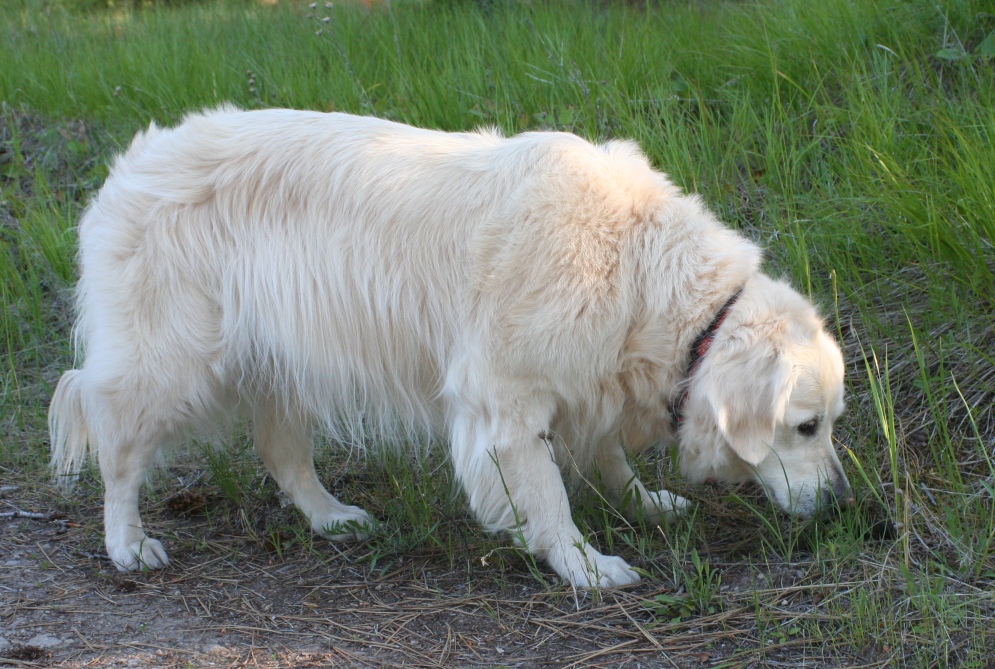
Jana loves hunting for rocks in the water, and she often pulls them out to collect onshore or to hand to me for safekeeping. She’s pretty selective about the ones she picks up.

She pokes her head under water, holding her breath as she looks for the perfect rock. Once she’s selected a rock, she lifts her head out and works the rock loose with her paws, then puts her head under water and grabs it. Some of them are huge for a 60-pound dog to carry, weighing a two  pounds or more. Sometimes, I throw one back. And she pulls it out again, often giving me a disgusted look in the process.

They are not all heart-shaped, of course. This stretch of river offers her a large selection of rocks in many sizes, shapes, and weights. Yet many of the rocks Jana chooses are triangular or have an elongated shape and rounded corners.

I can’t help wondering why Jana seems to prefer heart-shaped rocks. Is she sending an intentional message?

Dogs, like humans, regularly  use symbols to communicate with their human and canine friends. Many dogs, for example, bring a leash or guide their human to where the leash hangs to ask for a walk. A human donning a certain pair of shoes can trigger a wild dance of delight in other dogs. Play, aggression, and calming signals are part of universal canine-to-canine body language.

Dogs quickly learn to associate specific actions, such as sitting, coming, or lying down with humans’ spoken words, hand signals — and even printed words or pictures.

But dogs’ abilities go far beyond understanding simple concepts and associations. Studies in canine cognition labs around the world constantly expand our knowledge of how dogs understand high-level concepts.

Dogs have shown that they recognize people in photos and can differentiate between photos of dogs and other creatures. They even associate the sound of a growl with a photo of an  appropriate-sized dog who might make such a sound, looking at a photo of a large dog upon hearing a deep, big-dog growl, for example.

Dogs also learn to associate pictures with concepts. I’ve taught dogs to respond to flashcards printed with words or stick figure dogs showing specific behaviors  (sit, down, speak, etc.). And a researcher in Florida, Dr. Lauren Highfill, recently did a study where dogs learned to ask for their preferred reward by choosing the corresponding picture. They first learned to associate a food reward with one picture, a toy with another, etc. Dr. Highfill even had a “surprise” reward category that allowed dogs to ask for an unknown reward. Some dogs consistently chose to be surprised, while others always asked for their favorite.

So, back to the heart-shaped rocks. I haven’t intentionally taught Jana any specific association with hearts, but she has seen me collecting (much smaller) heart-shaped rocks on our walks together on many different beaches. Maybe she just knows that the symbol is, for whatever reason, meaningful to me.

Jana is very bright and perceptive. Even so, it’s a bit of a stretch to think that she has somehow picked up on the idea that, in human culture, the heart shape stands for an expression of love. It’s not as much of a stretch to think that a watchful dog knows what pleases her human partner and enjoys finding ways to do that. Whatever her reasons, the heart-shaped rocks are gifts from Jana that I will always treasure.

So Sorry About That Skirt … Or Not?

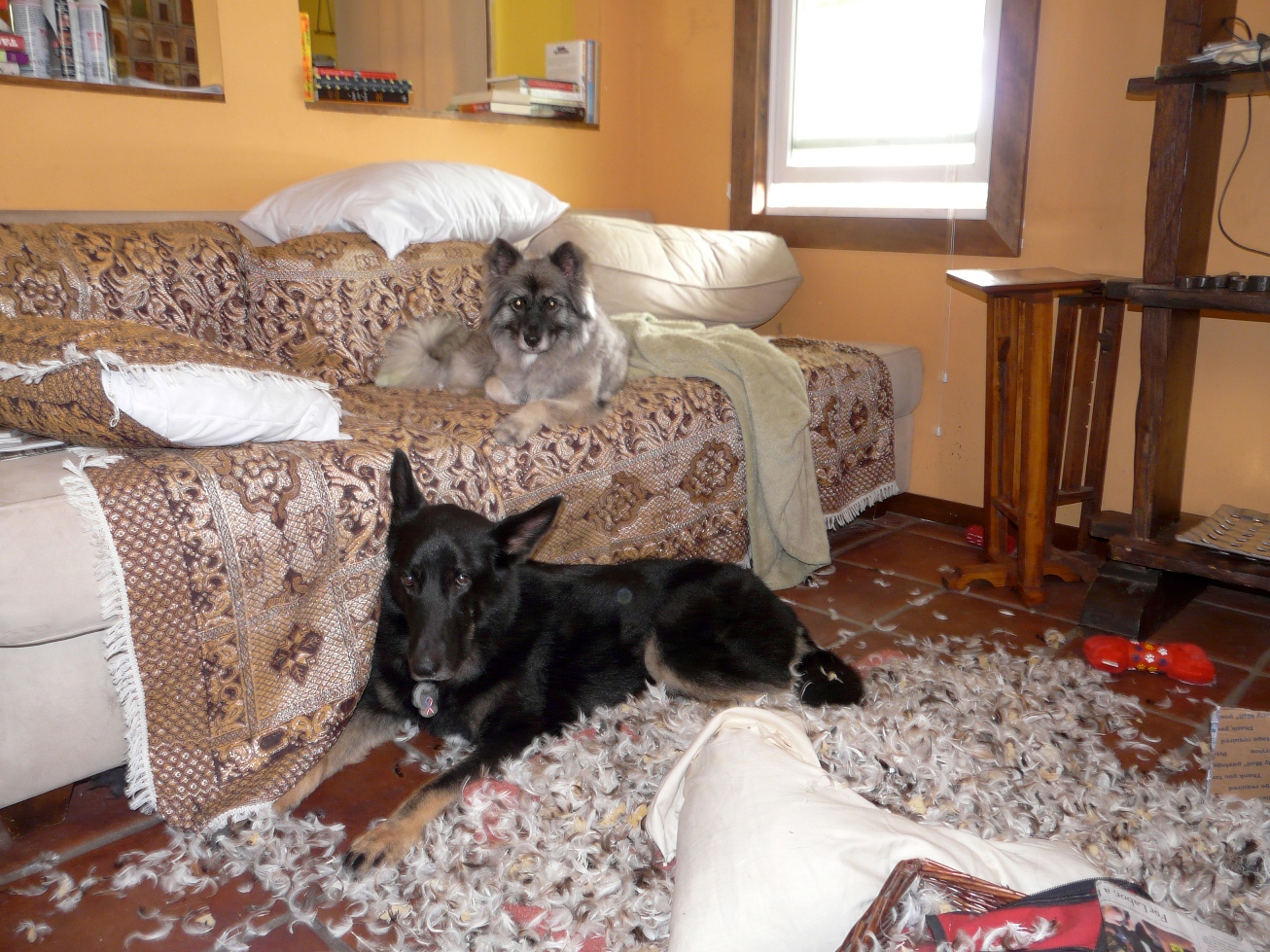
My sister was clearly annoyed. “Ziggy ate my new silk skirt,” she reported.

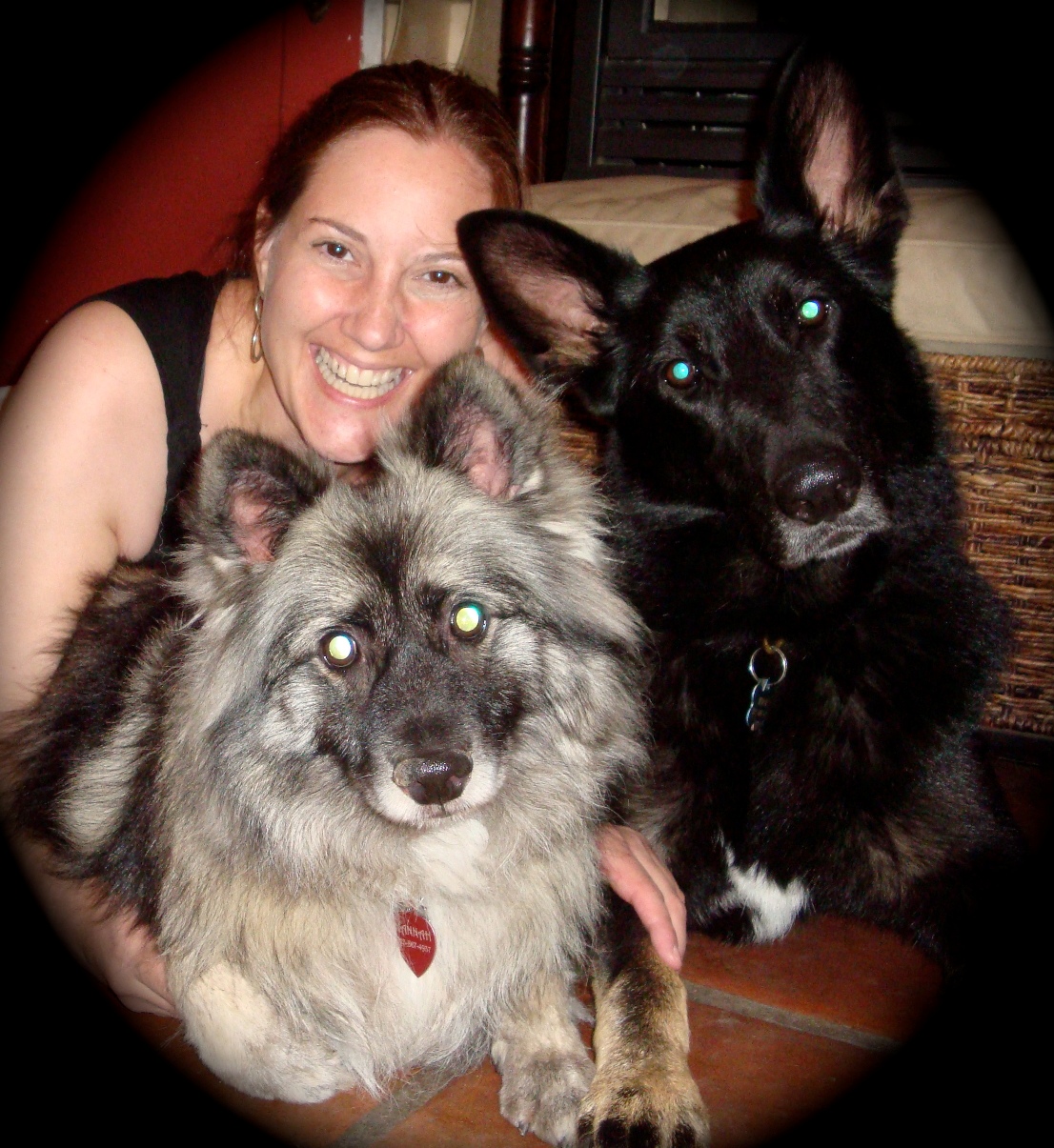
Ziggy is a German shepherd with a penchant for illicit snacks. A gentle soul, he’s been led astray by his big sister, a keeshond named Hannah. Their usual modus operandi, though, is raiding the refrigerator — now only possible when Cyndi forgets to close the child-and-dog-proof latch she bought for it.

Cyndi then ventured into common, but contentious, territory. “He’s sorry,” she said. “He keeps apologizing and acting guilty.”

She’s not alone in believing that this is possible. According to Scientific American blogger Jason Goldman, 74 percent of dog owners believe that their dogs show guilt. But, like many scientists, Goldman argues that evidence for dogs’ ability to show “secondary emotions,” which include guilt, pride, and jealousy, is rare. The argument, Goldman says, is that guilt is too complicated an emotion for non-human animals.

Bah, I say. I’m with the 74 percent.

"I'm sorry."

After a lifetime of living with, working with, and studying dogs, I am convinced that they feel the entire range of complex emotions, including guilt, pride, and jealousy. Charles Darwin believed that social primates exhibited these emotions. Behavior patterns that resemble guilt — keeping the head down, averting the gaze — have been observed in wolves, too.

Social animals, including dogs and wolves, need to get along with the others in their group. Secondary emotions, which also include anxiety, worry, contentedness, and affection, are social lubricants. They reinforce social bonds, elicit tolerance, reduce conflict — all things essential to anyone living in a group. Dogs are highly social, and dogs are highly dependent on humans. It makes perfect sense that dogs would understand and feel these emotions.

But.

Feeling them and showing them are two different things. A while back, a series of You Tube videos starring Denver, the “Guilty Dog” was popular. Other dog parents jumped on the bandwagon, posting their own “guilty dog” videos. Problem was, most of the videos showed scared dogs or appeasing dogs or very stressed-out dogs. Not necessarily guilty dogs.

What many dogs learn is that certain behaviors on their humans’ part mean that the humans are unhappy. Angry, even. Angry with them, perhaps. They might have no idea why the human is angry, but they want to make the tension go away. Dogs are very good at figuring out how to placate, neutralize anger, make their humans laugh, or otherwise reduce the possibility of hostile actions directed at them by their humans.

Not that Cyndi is mean to her dogs. She’s a great dog mom. And that explanation only makes sense if Ziggy was anticipating a scolding (or worse) — which is extremely unlikely. So we’re back at square one: Was Ziggy feeling guilty and apologizing for eating her skirt?

My long-distance reading of the situation is that Ziggy knew that Cyndi was unhappy with him. They have a close bond and can read each other well. He’s a very sensitive dog. I think it is likely that he not only understood that she was upset but also that it was connected with the skirt.

So, yes, he could have been apologizing. Or he simply could have been trying to calm her down. It actually doesn’t matter which is the case. From a broad social-science perspective, the two aren’t that different; the goal of both is to defuse tension and reduce strife between group members. And, it worked.

She’s So Vain … She Probably Thinks This Blog Is About Her!

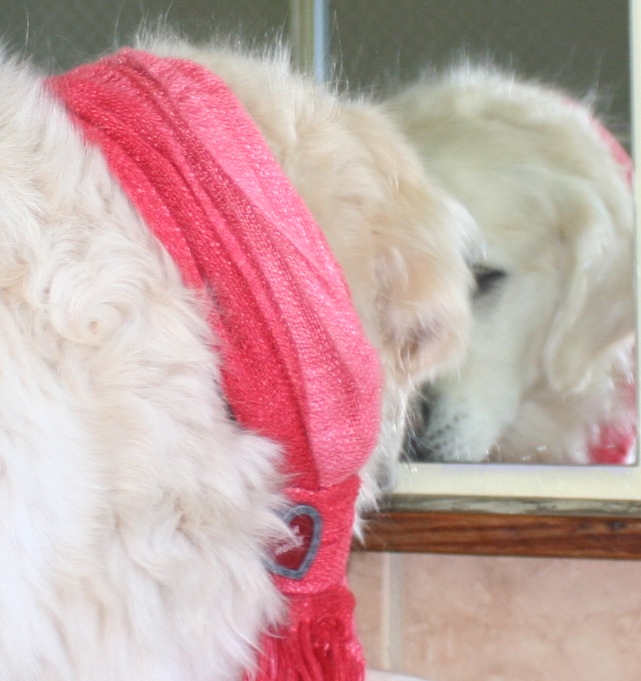
I find it hard to believe that there are still people who dismiss the fact that dogs are self-aware. Self-awareness is simply the ability to recognize oneself as separate from other individuals and from your environment. Not only do I believe that dogs are self-aware, I go a step further and say that some dogs (yes, I mean you, Jana) are not only self-aware but self-absorbed.

Psychologists and other scientists point to dogs’ disappointing performance on the “mirror test” as “evidence” that dogs are not self-aware. This test, which humans and many primates (and dolphins) pass, basically involves putting a mark on the face of the test subject. If the test subject, when looking in a mirror, reaches up to touch or try to remove the spot — on himself or herself, not on the mirror image — this shows self-awareness. The test subject recognizes himself or herself as different from the mirror image.

Some dogs do pass the mirror test. Before I even knew about the mirror test, as a newbie trainer back in 2002, I was training a service-dog puppy named Yasu. Yasu, a petite platinum blonde, seized every possible opportunity to look in a mirror. She would have aced the mirror test. And her interest in mirrors went beyond mere recognition of herself. She gazed adoringly at her reflection. She sought out mirrors. In the supermarket, she would “up” on the lettuce bin to gaze admiringly at her image in the mirror that was angled above the produce. It was funny — and embarrassing.

But, Yasu aside, many dogs don’t do so well on the mirror test. So what? The test looks at something that is irrelevant to most dogs. For most dogs, self-awareness is not primarily about appearance. Scent is what matters in a dog world.

Ethologist Marc Bekoff demonstrated dogs’ self-awareness with his yellow snow experiments. He moved patches of snow that the dogs he was studying had marked (thus turning it yellow … use your imagination) and studied their reactions. They spent far more time sniffing and investigating yellow snow patches that had been created by other dogs than sniffing their own. Bekoff had moved all of the patches of yellow snow from where the dogs had initially marked, so the “sniffer” dogs were not responding to specific locations. Bekoff’s reading of the study was that the dogs knew their own scent, quickly determined that they would not learn anything interesting about other dogs by sniffing their own marks, and moved on.

So, dogs do show self-awareness, if tested using criteria that actually matter to dogs.

Several years after I worked with Yasu, I took a seminar with Bekoff while doing my master’s degree at Bergin U. I learned about the self-awareness debate and the yellow snow. I never asked Bekoff about it, but I’ve wondered what Yasu’s love of her own image meant.

Who's the fairest dog of all?

Then, along came Jana and the question of self-absorption. Jana turns the yellow snow experiment on its head.

On walks, she seeks out and spends considerably more time sniffing her own, um, leavings. Before anyone starts yelling about what a horrible person I am for not picking up her poop, I would like to point out that we walk in wilderness, in Montana, where hundreds of animals, including deer, elk, moose, fox, coyote, wolf, bear and mountain lion, wild turkeys, and an unknown number of local dogs all walk regularly. No one picks up anything, and there is a smorgasbord of scents for the dogs to investigate.

Jana and I frequently walk the same loop. Despite the markings of all the other animals, on every walk, she stops at the same spots — her spots. The more we walk the loop, the more Jana deposits in the woods along the way — and the more stops we make. She is still sniffing at spots she marked a couple of weeks ago. There is nothing visible left, but she checks out her spots anyhow.

It’s not simply that she’s enjoying the scent. If so, she’d roll in it, as she does with many things, such as dead wildlife, that, to her, have delectable scents. Nor does she (thank goodness!) grab a snack, as she often does with horse droppings. She sniffs. Long and thoroughly. From every angle.

I’ve decided that she thinks her scent is so hot that she’s convinced that other dogs must also think so — and that, therefore, they will leave messages for her. Her own little local Facebook. Extreme doggy self-absorption.

While Jana does admire herself in mirrors occasionally, her self-awareness — and self-absorption — is all about her own heavenly scent.

Pups Need Time With Mom, Siblings

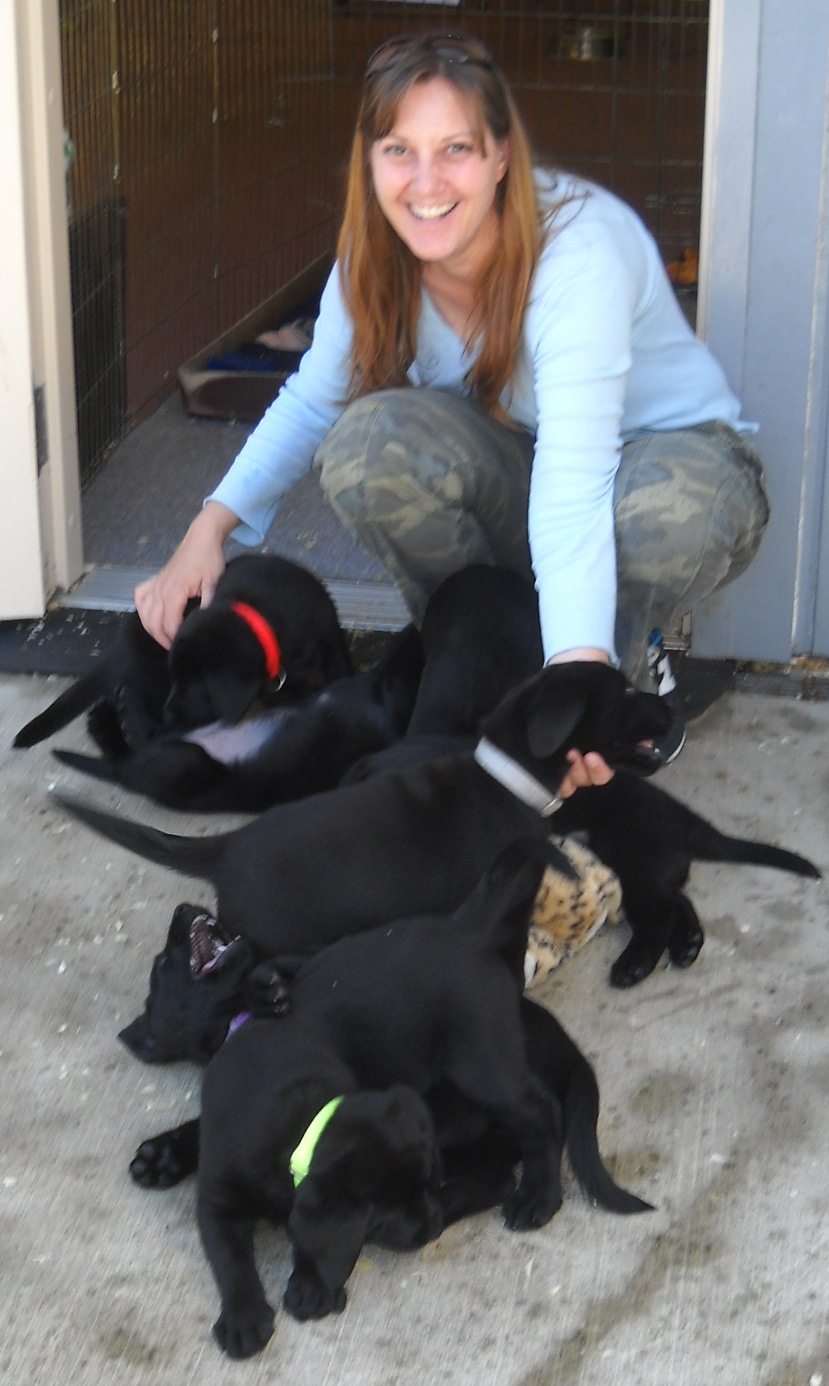
As one puppy tugged her shoelace, another went for her long hair, and yet another tugged on her pants leg, I watched my sister’s reaction. It suddenly occurred to me. “You’ve never played with an entire litter at once, have you?” I asked.

She hadn’t. In fact, her dogs were rescued as adolescents, so she’s never lived with a young puppy either. These Labs were seven weeks old, the perfect age: cute, cuddly, and playful, but still too small to be pushy or overwhelming en masse (there were seven of them, after all).

Seven weeks is also about the age that most litters are split up, each puppy being sent off to his or her new home. Some breeders (and puppy mills) try to place puppies even younger than seven weeks; responsible, caring breeders will wait at least eight weeks — maybe longer.

The puppies need that time together.

A study published in the Veterinary Record in October 2011 shows that puppies who were removed from their litters too early were far more likely to exhibit problem behaviors later in life than puppies who stayed with their sibs for 60 days or longer. The behaviors included destructiveness, excessive barking, fearfulness on walks, reactivity to noises, toy possessiveness, food possessiveness, and attention-seeking. A much larger proportion of early-separated dogs demonstrated those behaviors.

The study was based on survey responses of 140 dog owners in Italy. Their dogs were between 18 months and seven years old. Half had been adopted at age 30–40 days and half at 60 days. Half came from pet stores and the rest from friends or relatives of the owner or from a breeder; none had been adopted from shelters or had been obviously traumatized.

Dogs who had been separated early from their litters and purchased from a pet store showed the greatest tendency toward toy possessiveness, fearfulness on walks, attention-seeking, stranger aversion, excessive barking, destructiveness, and play biting. Thus, the authors concluded, the combination of early separation and temporary housing at a pet store is particularly inhibiting to a puppy’s social development.

Dog experts have long known about sensitive periods in puppy development and the importance of puppies learning, through play with their littermates, to interact appropriately with other dogs. A puppy’s experiences during this sensitive period, that starts at about 2.5-3 weeks of age and ends at 12 to 14 weeks, a puppy’s experiences can actually modify his brain, leaving lasting effects on his temperament and behavior.

In plain English, this study suggests that taking a puppy away from Mom and sibs too early could affect his ability to adjust to new environments and social relationships — for the rest of his life. It also suggests that early separation makes the puppy more likely to develop behavior problems.

Read more about this study here.


Do Dogs Have a Funny Bone?

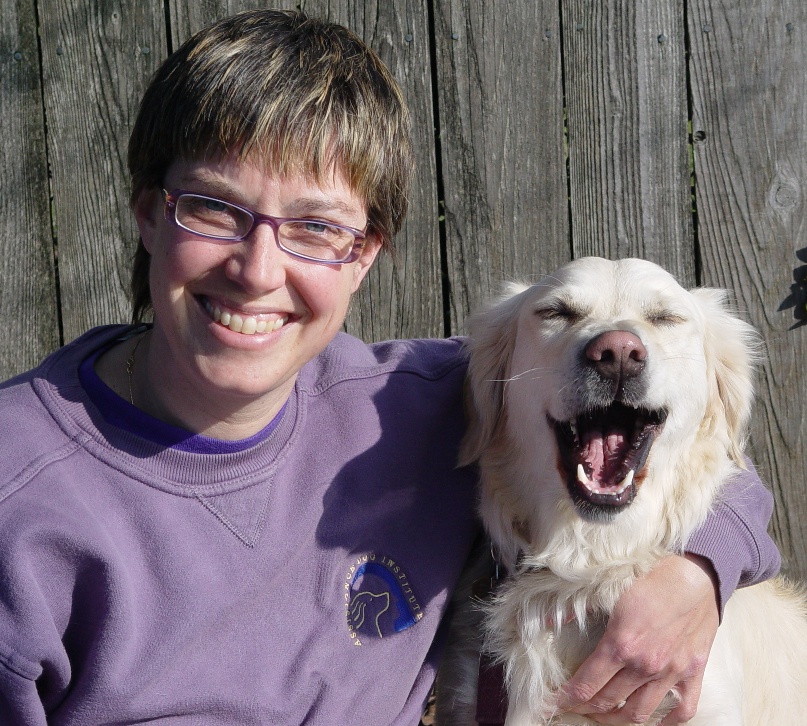
Dogs smile and even laugh. Dog magazines understand this — both The Bark and Modern Dog regularly reprint readers’ photos of their “smiling” dogs. But do these facial and vocal expressions prove that dogs have a sense of humor? This is debatable. I would argue that some dogs do, thought this varies by breed. Golden retrievers and Labradors definitely enjoy a good laugh with their people or at their people’s expense.

Jana enjoys a good joke!

On our recent drive from California to Montana, Jana (a golden retriever), Deni, and I stayed at a cute little guest cottage in Oregon. I took Jana for a walk around the grounds. The cottage had two small rooms, one with a patio. Jana and I left through the main door but returned to the cottage and entered through the “back” patio door. I told Jana to “find Deni.” She ran into the cottage, then into the main room, wagging and smiling, and greeted Deni. Deni reacted with happy surprise at Jana’s sudden appearance, since the main door, a few feet from where Deni sat, remained closed. Jana danced around wagging and smiling. Since she is a reserved dog, this was an unusual display.

Jana was pleased with herself. But more than that, she appeared to enjoy the joke she had played on Deni. Is this possible? Or am I reading too much into the situation, being too anthropomorphic?

What does it mean to have a sense of humor? Most living organisms — human, canine, or other — seek pleasure and avoid pain. This basic principle guides behavioral science (and dog training). Humor — laughing, and the ability to be amused — feels good and is good for us. So it is biologically sound to assume that other creatures have senses of humor. And, as creatures that have evolved, through heavy human influence, to be our best friends and companions, it would be far stranger if dogs did not understand and participate in intentionally humorous antics.

One of dogs’ most appealing characteristics is their love of play. But dog play often resembles dog aggression. Thus dogs have a detailed repertoire of communication that signals to other dogs — and dog-savvy humans — that “this is only play.” In other words, “I’m just kidding; I am not really going to bite/hunt/hurt you.” Another sign that dogs understand humor and “fun” is that they make up games. They also change the rules of games we, or other dogs, make up and self-handicap so that another, smaller, dog or puppy can also have fun.

Lots of dog owners and trainers have stories of things their dogs do that make them laugh. Like small children, some dogs intentionally repeat whatever action elicited the laughter. This is a sign that dogs get it. They understand that our laughter is a good thing. They love to play tricks on each other and on us. Does your dog have a sense of humor? Share your stories!


Is Your Pooch a Couch Potato?

No couch potatoes here!

I remember coming home one evening long ago to find not only my dog, Timo, on the sofa watching TV but Buddy and Daisy, my mom’s two dogs, up there as well. Even better — whoever had pawed the remote to turn on the TV had somehow hit the right button to bring up Animal Planet — a favorite of the humans in the household as well.

The people at DogTV think those three were onto something. Developed in Israel (where the three dogs described above lived), this first cable channel directed at dogs, rather than just being about them, says it offers “the right company” for dogs who are home alone. Or, presumably, those having a dogs’ night in with their buddies.

DogTV’s website promises that, with its 24-hour-a-day programming, our furry friends “should never again feel alone.” According to the website, the content was developed to meet specific attributes of canine vision and it “supports their natural behavior patterns.”

Since most dogs who are left home all day while their humans are at work or school snooze the hours away on the sofa, I suppose it is not a huge leap to claim that providing TV for them does support that natural behavior pattern …

Setting my skepticism aside and remembering how Timo, Buddy, and Daisy enjoyed their Animal Planet viewing, I decided to test out the sample content on Jana. The results of my statistically insignificant survey (sample size of one) are not terribly promising. Jana does not appear to aspire to couch potato-hood; she watched the “Stimulation” sample for about 3 seconds before her eyes and attention wandered. She ignored the “Relaxation” sample completely.

And it’s not that she’s simply more of an intellectual. Jana’s most strident reaction — indignant, vocal rejection — came in response to the “Exposure” sample, essentially doggy PBS. Described by DogTV as “using the most advanced veterinary science, special sounds and visuals help comfort and habituate dogs by exposing them to different day-to-day stimuli,” the sample on the website features a person telling her dog to sit as she answers the door (this made-for-TV dog is not only willing to sit, he doesn’t even bark at the doorbell or the guy at the door), people and traffic on a busy street, a baby in a car with a siren audible outside the car, small children playing. Jana, of course, barked at all of these as she turned tail and flounced away.

Tuning in a dog-centered channel when you leave your furry friends at home might do little more than make you feel better. A young, healthy dog would  much prefer a game of Frisbee or a run in a park to watching some other dog on TV have all the fun. And even an older or less energetic dog would prefer to get out and sniff the grass herself. And any dog would rather spend quality time with her humans than sit around on the sofa — TV or no TV.

On the other hand, dogs have been shown to be more relaxed in kennels and shelters if there is background music playing. The only problem is getting them all to agree on a radio station!

Play Dates for Your Dog

Does your dog have friends or do you just assume that all dogs like each other?

I met my (human) friend at the dog beach last week, and her cheerful, playful golden bounded over, wearing a huge smile as she ran up to say hi to Jana. They’ve played together many times at dog beaches around the Bay Area (tough life, I know) and they are clearly friends.

But, while 9-year-old Christina and 8-year-old Jana are BFFs, there are other dogs we see regularly with whom Jana is cordial, but distant. Remember being forced to play with your mom’s friends’ kids? It’s the same with canines — our dogs and our friends’ dogs don’t always hit it off.

It might seem obvious. Not all dogs like each other or enjoy hanging out together. We certainly don’t instantly bond with every human we meet. Some become friends. Many do not.

But when some people take their dogs to dog parks or dog beaches, they somehow assume that everyone there will play nicely together. Similarly, they get irked when their dog seems to take an instant dislike to another dog they meet on a walk or in a training class.

Just like our parents, we want our dogs to be polite and friendly all the time. Unfortunately, it doesn’t always work out that way. When some dogs take an instant dislike to another, they lunge, bark, or even attack the other dog, for no reason that we hapless humans can see.

I’ve spent a lot of time in dog parks lately doing observation research with my students. What we’ve noticed is that most of the dogs there don’t play with each other. They run, play with their humans, chase balls, roll in the grass, and sniff things. Often, they are sniffed or given a play bow from another, more social dog, and politely and appropriately decline the invitation to play. Sometimes, dogs chase each other a few times, and sometimes the “play” chase turns into something closer to bullying.

Those of us who take our dogs to dog parks for exercise need to be involved. It is no more acceptable to spend dog-park time involved in a long cellphone conversation than it would be for the mother of a 2-year-old human child to do that while her child ran unobserved at the playground. A dog park, fenced or not, is not an opportunity to take a break from your dog.

We can go to dog parks with friends whose dogs are really our dogs’ friends — or set up play dates at our homes. Or, we can go to the dog park with the plan of engaging with our dog while we’re there — to walk with the dog, or maybe toss a ball. What we need to avoid is just assuming that all the dogs will play together and get enough exercise while we ignore them. As many dog experts will tell you, the more engaged the humans are at the dog park, the fewer unpleasant incidents you’ll see.

The same goes for walks. Even on-leash dogs can hurt each other. If your dog is reactive to other dogs, consider working with a trainer to improve his socialization and help him learn to behave more calmly. If your dog seems to attract hostility from other dogs, ask their owners not to let their dogs approach. Meanwhile, work at building up your dog’s confidence and social skills with dogs you know are friendly.

But the bottom line is, we’re our dogs’ protectors and advocates. Don’t throw your dog to the (domesticated) wolves at dog parks or in the neighborhood, and don’t let your dog become the bully, either.

Check out these doggy buddies: Dog Guides Blind Dog

Clothes Make the Dog

For as long as I have worked with service dogs in training, I have known that putting a service dog cape or harness on a dog sends a clear signal: “ Now, you are working!” With many dogs, the working dog and the off-duty dog behave so differently they could be two different dogs. Wylie is an extreme example — on harness, he will work past distractions. He still notices cats, for example, but his strong work ethic keeps him focused on the job at paw. But take off his harness and he is all-dog — party dog. We call him the frat boy. All he wants to do is play. And, maybe, if we’d let him, drink beer.

Wearing his harness, Wylie is all business

Last week, The New York Times gave me an explanation for this phenomenon: enclothed cognition. The study’s authors say that we think not only with our brains but also with our bodies. It’s long been known that our clothing affects other people’s perceptions of us; now researchers are learning that how people dress affects the way that they see themselves and the way that they think and behave.

The study cited by the NYT found that people who put on a “doctor’s” lab coat were better able to notice subtle incongruities or differences in images they saw. For example, they noticed that the word “red” was colored green, or they found more differences in very similar photos. Those wearing the “doctor’s” coat did better than test subjects who merely saw the coat, better than subjects who wore the coat but were told it belonged to an artist, and better than a control group who had no white coat presented in any way.

“Enclothed” cognition is an extension of embodied cognition. Just as washing hands has been shown to be associated with ideas of moral purity and people who carry large clipboards feel important, dressing in certain clothing awakens specific associations in our minds — and these associations affect our behavior.

It’s not much of a leap to recognize that dogs are affected in a similar way.

Off duty and ready to party

Putting on a cape signals to a Pet Partner dog that it’s time to go on a therapy dog visit, and putting a cape on a service dog says that playtime is over. Some dogs even have better leash manners with their capes on. When two working service dogs, who also happen to be pals, meet while on duty, they might greet each other warmly and with a wag of the tail, but they will quickly settle back into their calm, unobtrusive working roles. Take those same two dogs on a walk together, or watch them at one of their homes when neither is on duty, and you will see very different dogs and a much higher level of energy!

Just as some people quickly exchange work clothes — and professional persona — for comfy yoga pants and an informal attitude as soon as they get home, some dogs, like Wylie, demonstrate a wide gap between “all business” and “let’s get this party started.” And there are dogs (and people) who clearly know that something special is expected of them when they are dressed for work but who maintain a consistent personality, on duty or off. Each dog’s different degree of “enclothed” cognition helps us respect the truth that all who live with and love working dogs quickly learn: a service dog partner is not a robot, but an individual who makes voluntary choices to do her job. The study’s authors wonder whether the effects of a person’s daily work uniform eventually wear off — or become habit. Do the clothes, in the end, define the dog?

Never Too Young to Learn

ImageBergin University has a litter of adorable black Lab puppies. (I know, puppies are all adorable, but I’ve always been a sucker for black Lab puppies.) The puppies started school last week. The puppies also turned four weeks old last week. That’s right. Four weeks. They’d had their eyes open for a full week before training started, so, honestly, I don’t know why the student trainers waited so long.

Sadly, there are still people who think that you can’t start formal training until a dog is a year old. Some more liberal people say that puppies can start training at six months. Then there are those smart puppy owners who get their pups into puppy kindergarten as soon as they can — usually once the pups are vaccinated. But even that is late. Puppies start learning the day they are born, if not before.

So why do people traditionally wait so long to begin teaching their puppies? In the history of dog training class that I am teaching this semester, the students have finally emerged from the cruel, punishment-focused training years of the early to mid-1900s. By the ’50s, people were starting to understand that so much emphasis on punishment actually got in the way of learning. A few trainers — Blanche Saunders, Winifred Strickland, and others — began incorporating praise and even rewards into their training! But the prevailing methods, up until the 1970s, were pretty harsh. Only older, stronger dogs could stand up to the punishment and the trainer’s lack of communication — and actually “learn” anything. Lots of dogs were deemed untrainable because they shut down or defended themselves by snarling or biting when treated harshly.

Learning "Sit" ...

Fortunately for puppies and people who love them, trainers like Milo Pearsall and Ian Dunbar began teaching that, like young children, puppies are eager and quick learners. Furthermore, the younger they start learning how to learn, the better they get at it. In a sense, your puppy will be “smarter” if you train her early. These trainers introduced a now-popular and ubiquitous concept:  puppy classes.

... and "Shake"

Human parents of a new puppy can reduce the number of bad habits and undesirable behaviors the puppy learns by enrolling the youngster in puppy kindergarten. Here puppies learn what to do — and what not to do — and develop good manners early on, all without harsh punishment. Good puppy classes emphasize socialization — ensuring that puppies are exposed to lots of different kinds of dogs, people, sounds, sights, smells, and experiences — all in a controlled, positive way. This helps puppies learn that new things are not always scary, that their human families will keep them safe, and that the world is an interesting and fun place to explore.

So, back to my students. These special Lab puppies are future service dogs. Thanks to Bonnie Bergin’s enlightened early training, fewer puppies need to be “released” from the program, and more will become grown-up dogs capable of doing the work needed by their owners, who have disabilities. What these puppies are learning now will pay off: The tiny bits of mushy puppy food offered as a reward for sitting or coming when called are helping the puppies build two-way communication with humans. The puppies are learning to think and problem solve, which will enable them to become full partners to the people who will rely on their assistance. Training sessions are short — only a few minutes at a time for the little pups  — and fun.

The good news is that, nowadays, training that is fun is not just for puppies. Family dogs of any age can benefit from modern training approaches that emphasize positive reinforcement, rewards, and keeping training fun. Breeders can start working with puppies at four weeks; those “adopting” a new puppy at the ripe old age of eight weeks — or an older dog — can start as soon as the dog comes home. Your dog can start today. What are you waiting for?

Special thanks to Dearing English for the puppy training photos captured from her video of the first day of training. Puppies were four weeks and one day old.