Honoring Those Who Serve

I know this is a little late for Veterans Day, but bear with me. It’s worthwhile. Anyhow, we should honor those who serve our country every day.

In January, military dogs will finally get some recognition. The U.S. Military Working Dog Teams National Monument, honoring every dog who has served in the U.S. military since WW II, will be unveiled in California. A replica of the memorial will be featured on a float in the Tournament of Roses Parade in Pasadena on Jan. 1.

The real monument, featuring a 9-foot bronze dog handler and four 550-pound “hero sized” dogs — a Doberman, a German shepherd, a Labrador retriever, and a Malinois  — will go on tour, ending up at Lackland Air Force Base in San Antonio, Texas, where many military dogs are trained.

John Burnam, a veteran military dog handler and the man whose passion and tireless efforts have made this monument a reality, is an inspiration and a true friend to military dogs. In addition to spearheading the effort to create the monument, Burnam designed the monument.

Dogs have served in the military since the times of the Roman Empire. Many dogs have died in service. Many dogs serve in roles that pretty much guarantee they will die in service, with the goal that, in doing so, human lives will be saved.

As a dog lover, I wrestle with the ethics of this. In a class discussion of military dogs last spring, students pointed out that we send our children to serve in dangerous roles; why is sending dogs any worse? Others argued that the humans have choices and a greater understanding of the risks and benefits.

I do believe that dogs understand the concept of danger — and that some dogs freely choose to risk their own lives or safety to assist humans. Stories abound from dogs who took on snakes, challenged bulls or bears to protect humans to those who’ve saved people from fires, drowning, snowstorms, and even dogs who pull people from burning car wreckage after an accident.

The training of a military dog is intense and, in many cases these days, not based on the use of force or punishment. The dogs who just aren’t into it are unlikely to make the grade. So, in a sense, one could argue that the dogs have some choice in whether they accept their military mission. Still, the idea of dogs marching off to war is a painful one for me.

Since it’s likely, though, that humans will continue to go to war, and continue to take dogs along with them, it’s well past time to acknowledge the contributions and sacrifices of our canines in uniform.  Other countries, including  Italy, France, Russia, Belgium, Germany, Japan, the Netherlands, and Great Britain, have national monuments to their military dogs. Several U.S. cities, cemeteries, and military bases also have memorials. But a national monument, joining the ranks of Mount Rushmore, the Statue of Liberty, and other national monuments, is a tremendous — well-deserved — honor.

A Dog’s Life

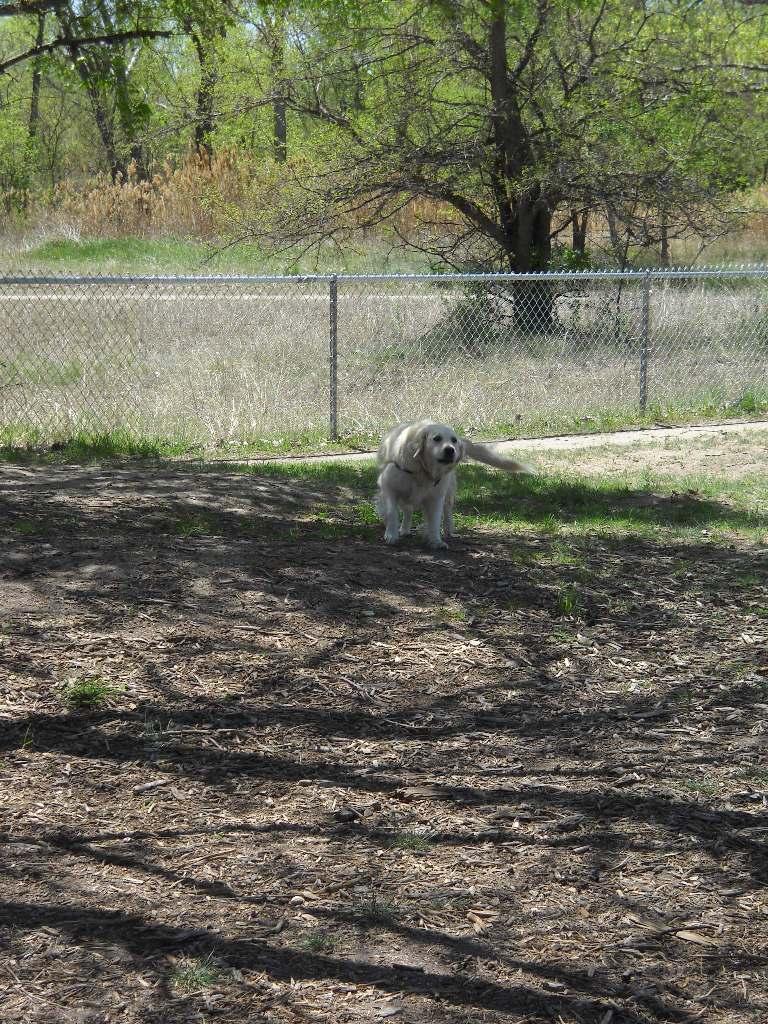
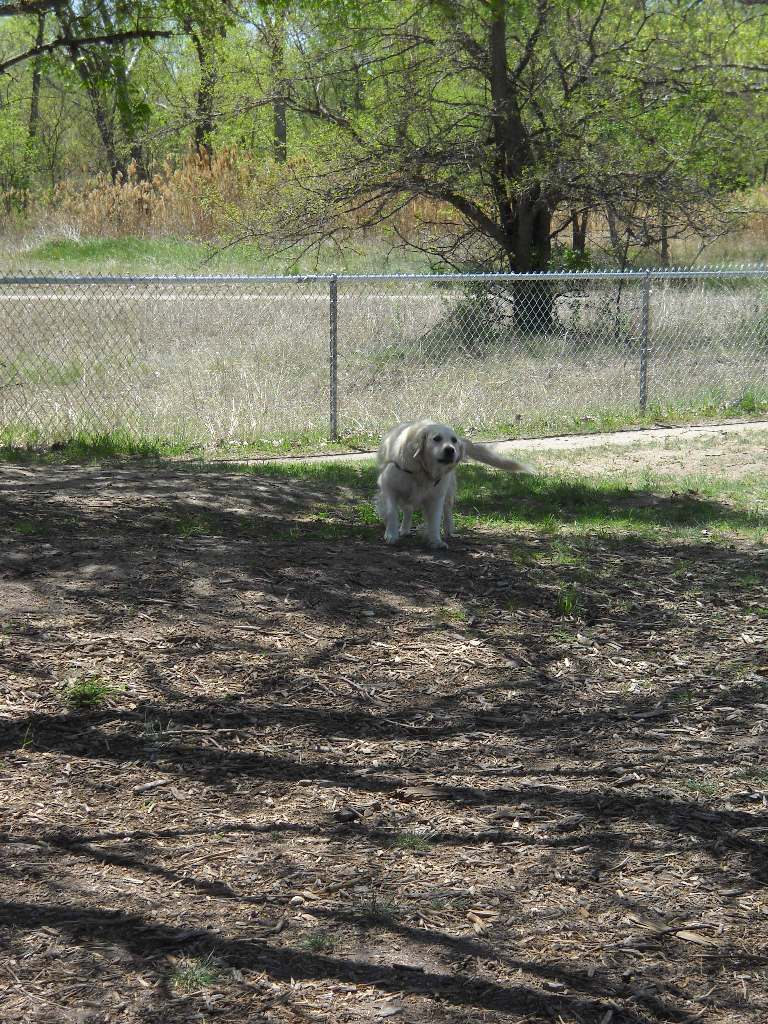
Jana has visited many dog parks around the U.S. and in Israel; this one is in North Platte, NE

I have just returned from a too-short visit to Israel, where I lived for nearly 15 years and where Jana, my golden retriever, was born. An exciting discovery was a new dog park just a few blocks from my mom’s apartment. Even nicer was a long article in the HaAretz newspaper’s weekend magazine about the social networks that are springing up at dog parks around the country. I also noticed a lot more people out walking dogs, water bowls outside shops, and people dining with their dogs at outdoor tables at restaurants in Tel Aviv and Jerusalem.

All of this, I believe, signifies wonderful changes in the status of dogs and dog-loving humans in Israel. When I moved there (in 1990), it was a challenge to find dog food. By the time I left, a few premium brands were being imported. Now, boutique pet stores are common, and they feature a full range of high quality foods, toys, and accessories. According to the HaAretz article, Israel now has more than 60 dog parks, most of them in Tel Aviv. I remember when Jerusalem’s first dog park opened in a park near Israel’s parliament building, the Knesset. When Jana was a puppy, we occasionally went there to play — and usually had the place to ourselves. Since Jana is only 9, it seems that the growth in dog park numbers and use has happened fairly quickly!

The HaAretz article describes groups of dog-park regulars who coordinate their visits to the park; many have formed friendships that extend beyond the dog park gate. The friends have helped each other out in times of economic stress, attended each other’s weddings, and formed open, honest relationships with a broader range of individuals than they otherwise would have been likely to befriend. The descriptions of these dog-centric social circles underscore the growing role that dogs are playing in people’s lives in Israel — a role that American dogs also fill — as friends and social icebreakers. “The dog makes it more likely that strangers will start talking to each other,” one interviewee says.

It also indicates, I believe, that dog owners are taking better care of their dogs and attending to the dogs’ needs for exercise and social interaction with their own doggy peers. When I worked as a dog trainer in Israel, I was often called to work with dogs who had “behavior problems” — problems that stemmed from lack of any attention at all. Not too many years ago, a lot of Israeli dogs spent their lives alone in a yard, often tied up. That still may be far too common, but this visit gives me hope that, for many Israeli dogs, things are looking up.


Body Slams and Touch-Free Cuddling

Look, but don’t touch!

Not all dogs like to be petted. Certainly not all dogs like to be petted the same way.

The thinking dog owner might ask, “Huh? Isn’t petting a big part of why we have dogs around in the first place? Isn’t being petted pretty much an integral part of their job description as pets?” Maybe, but so what? I think that all of us, human and canine, get to decide how, when, and by whom we are touched.

With that in mind, and being admittedly slower than our dogs on the uptake, I recently made a realization about an ongoing battle I have with our German shepherd, Wylie. It’s likely, though, that only I see it as a battle; he might see it as a series of very small victories. Here’s the story.

Wylie can be pushy. He wants attention. Lots of it. He likes roughhousing and hard body contact. He body slams other dogs when he’s playing, he crashes into people and dogs, he steps on our feet and tails (well, the tails of those who have tails). He also, whenever I am petting golden retriever Jana, comes over and pushes his nose, head, or entire body between my hand and Jana. I push him away. He comes back. I put up an arm to block him. He crashes into it.

I could, of course correct him by telling him to sit or lie down. But what often happens is that, when he butts in, I get annoyed. And, I want to spend some time with Jana. So, instead of asking him to sit and then petting him in turn, I block him and usually order him to “go settle — somewhere else.”

But it doesn’t work. He keeps coming back.

I was musing about this ongoing conflict one evening recently and suddenly realized that Wylie is, in fact, getting exactly the kind of “petting” that he likes. Maybe not much of it — a few seconds at most — but he is getting what he wants. When I do focus on him and pet him, I don’t massage him and use the gentle strokes Jana likes; I thump his side, and we roughhouse a bit. He likes that.

While I am sure he would prefer that I stop petting Jana and focus my full attention — and both hands — on him when he interrupts my Jana time, he might believe that some attention is better than no attention. So my shoving him back isn’t a correction but more of a reward. And Wylie might not see the encounters as an ongoing battle but more as a challenge to see how much of my attention he can claim.

This realization ties nicely in with my strong belief that we (humans who live with dogs) should try to see things from the dog’s point of view sometimes and figure out what matters to the dog — more specifically, to each individual dog. When we understand a dog’s motivation, a lot more of that dog’s behavior makes sense.

Which brings me to Jana and touch-free cuddling.

It sounds like an oxymoron, but touch-free cuddling is actually Jana’s favorite way to spend time with her people. She’ll join one of us on the bed or the sofa, curling up comfortably — close but  not touching. If we overstep our bounds and reach out to stroke her, we’ll often be “rewarded” with a dirty look and a disappearing dog. Occasionally, she will tolerate a few minutes of petting before inching away, out of reach.

It’s not that Jana  doesn’t want company; she does. She’s quite content to hang out near us and will often follow me from room to room, settling nearby. And sometimes, on her terms, she wants to be petted, stroked, massaged, or belly-rubbed. She’ll even ask for it on (rare) occasion. When she’s enjoying it, she thumps her tail happily and offers lots of body language cues that tell me to continue, primary among them the fact that she has not walked away! But it is always, very much, on her terms.

Jana has always been more aloof than most golden retrievers, and I recognize and appreciate that about her. I am not one of those people who enjoys an attention-seeking dog (or person); Jana and I understand and complement each other well. But she is often misunderstood by people who assume that all dogs (or at least all goldens) live for the touch of human hands and who feel rejected by Jana’s refusal to be petted.

Not only do our dogs deserve to be petted (or not petted) in the ways that feels good to them, each needs to be understood and appreciated for who he or she is. In doing so, we humans have a better chance of understanding our dogs’ behavior — and perhaps avoiding or resolving conflicts.

Good Owners Make Good Dog Parks

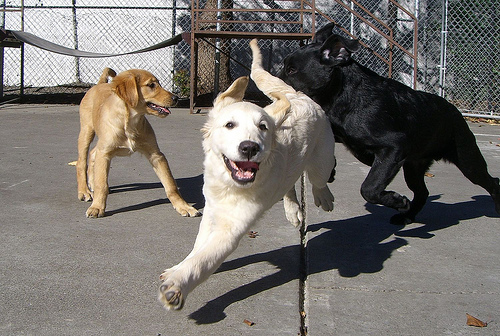
Happy dogs at play (photo by Sae Hokoyama)

In Take Me Out to the Dog Park, I described some features that contribute to a successful — fun, safe — dog park. But a perfectly designed and maintained park can be a nightmare if the dogs and humans who hang out there create a bad dog park culture. How can you tell?

Before letting your dog off leash in an unfamiliar dog park, check it out. If you can, observe the park during busy after-work or weekend hours. If not, observe for a few minutes before letting your darling out of the car.

Inattentive dog owners are a key contributor to unsafe and unpleasant dog park experiences. If the people are all clustered around the edge, chatting in small groups, or sitting on benches sipping coffee and ignoring the dogs, walk away. Some dog parks have a “let dogs be dogs” culture that encourages bullying. In Sue Sternberg’s excellent APDT Webinar[1], she showed video footage from a small urban dog park where dogs bullied and ganged up on other dogs while the oblivious humans sat on the sidelines.

You are your dog’s advocate and protector — if your dog is being bullied, get him out of there! You are also the responsible grown-up, frightening as that may be. If your dog is being a bully, get him out of there! Not all dog play is appropriate, and dog owners need to be aware of what’s happening so they can stop unsafe play.

What does dog bullying look like? If a dog keeps bugging another dog to play, even though the other dog has looked away, walked away, or barked, bared teeth, or otherwise told the first dog that he’s not interested, that dog is being a bully. If a dog pursues another dog, and nothing the other dog does can shake him, that dog is being a bully. If one dog body slams or plays roughly and the other dog is trying to get away or is not equally engaged in the roughhousing, it’s time to step in.

Watch those high-speed doggy chases, too. Sometimes it is all in good fun. The dogs chase each other, stop and restart, and look relaxed and happy, with tails up and ears back. But if the “chasee” has his ears forward and his tail tucked and looks scared, or if several dogs are chasing one dog, the dog being chased needs help. If a chase never changes directions — the same dog is always being chased — the chaser(s) might be bullying the other dog.

Entry gates at dog parks are prime spots for scary interactions. If several dogs are milling around the gate — or approach as you and your dog enter the double gate — be very careful. Walking into a mob of strange dogs is a stressful experience for your dog. The dogs might be friendly; they might also harass or attack an entering dog, especially if he seems nervous or defensive. Do your dog a favor and wait until the entryway is clear.

Not all dogs automatically learn the social graces. If your dog needs to learn some manners, try to set up one-on-one play dates with well-socialized dogs who can teach him the boundaries of appropriate dog play. And if you do take him to the dog park, remove him the instant you see him picking on another dog. He will learn that the fun stops when he acts like a bully, and the other dogs and people at the park will appreciate your conscientiousness.

Dog parks can be wonderful places for dogs to socialize and burn off energy. But some dogs are shy or timid; a dog park is too stressful for these dogs. And there are too many stories of dogs being injured or attacked to assume that all dog park experiences will be good ones. Think carefully about whether your dog will enjoy the rough-and-tumble of multi-dog play, and take the time to check out a dog park’s culture before you go.


[1] “A Look at Interactions Between Dogs in Public Dog Parks”

Take Me Out to the Dog Park …

This dog park in North Platte, NE offered lots of shade, even on a 90-degree day.

Friends of ours are planning and building a dog park in their community. I am in awe of their energy and commitment; they’ve got the entire dog-owning community involved. Talking with them about their plans got me thinking about dog parks and some of the research I did with a college class I taught last spring. Dog parks can be a wonderful asset to city-dwelling dog lovers — or they can be rough-and-tumble, scary places. What makes the difference?

Planning is one of the keys to successful dog parks. The dog park culture is another. This post will talk about the physical features that contribute to making great dog parks succeed. My next post, Good Owners Make Good Dog Parks, will delve into dog park culture.[1]

As anyone with a large, fenced back yard knows, just having enclosed green space is not enough to get dogs to exercise; many dogs will just pick a sunny spot and take a nap. But add more dogs and you have a potential problem: in a plain, flat grassy area, dogs are more likely to chase other dogs. Often, once one dog starts a chase, other dogs eagerly join in.

Dog parks with natural or planned “breaks” in the open space are safer for dogs. They force running dogs to change direction or slow down, and give the “chasee” opportunities to escape. “Breaks” can be hills, paths, stands of trees or bushes, a pond or a beach. Benches can also break up open space, but benches encourage the humans to sit, chat with others, and not pay attention to their dogs — which contributes to bad dog park culture.

Besides breaks, dog parks — especially in warm climates — need shade. Plans should include lots of shade trees or even a shelter with a roof.

Water is a wonderful “break” and adds to the fun for the dogs. People tend to keep a closer eye on their dogs around water, too. If the space for a planned dog park is not on the edge of a natural body of water, consider a manmade pond! And of course, if there is a place to swim, a rinsing station is a great idea. At absolute minimum, a dog park should have a hose or fountain for drinking water.

In dog park planning — and visiting — size matters! In a smaller dog park, particularly if it is crowded, dogs are more likely to feel stressed — which leads to defensive behaviors or could make them targets for dog bullies.  In larger spaces, dogs who don’t want to play with the other dogs simply have more room to move away. Many urban areas have dog parks that are a half-acre (or less); for a large, high-energy dog, this is not enough room to really stretch those legs and burn off energy (I know; I live with a dog like that!).

In smaller parks, it is essential to have a separate small dog area. Parks that are several acres and include walking paths or a beach can be safe for dogs of all sizes (so long as the humans are paying attention), but in smaller parks, it is far too easy for small dogs to be injured, even if all of the dogs are behaving appropriately. Dogs in full play mode don’t always pay attention to what’s in their path, and they can’t (or won’t stop on a dime.

If you are choosing a dog park to visit, scope it out before releasing your dog. If it is small and crowded, you might be better off taking the dog for a leashed walk. On the other hand, if you are lucky enough to live near a large, well designed park, do what you can to ensure that the dog park culture will ensure a safe, fun experience for dogs of all sizes!


[1] Thanks to the APDT and Sue Sternberg for their wonderful Webinar, “A Look at Interactions Between Dogs in Public Dog Parks” for information referenced here.

Jana and Wylie Go to College

Jana and Wylie got accepted to Eckerd College and, last week, attended their first class, a math class. They were students in the Dog Behavior Project, a cognition study run by the psychology department. Your dog can participate too, if you live in the Tampa Bay area! The application is simple.

The dogs were excited when we got there. A human class was just letting out, and some of the students said hello. The dogs got to explore the psych lab for a few minutes, and they could tell that other dogs had been there.

Then it was time for class. Jana got to go first, so we went into the testing room. There was a chair for me, two bowls on the floor at the other end of the room, with one student serving as tester and a student who recorded what Jana did.

The current study is hoping to determine whether dogs can count or judge quantities. The tester drops treats into bowls, and the dogs get to choose one of the bowls. For each trial, she drops a different number of treats into each of the two bowls, with the dog watching. Jana got Charlee Bears, which she loves.

We went in and sat down. I told Jana to wait and held her collar loosely. She sat facing the tester. Once the treats were in both bowls, Jana was allowed to choose which bowl she wanted, run to the bowl, and eat the treats. The researcher is supposed to grab the treats in the other bowl while the dog is eating. Some “control” trials have treats in only one bowl.

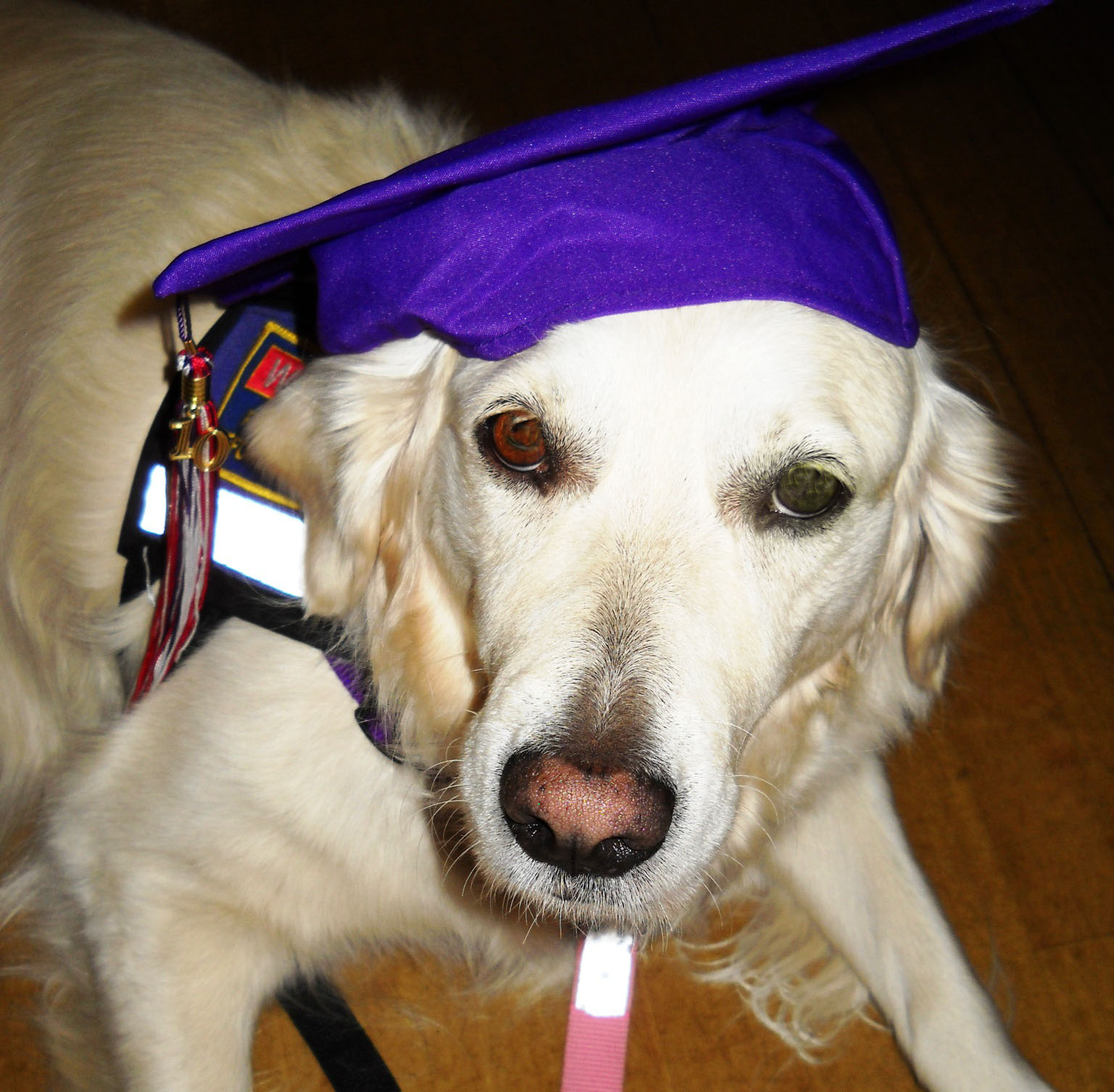
No one looks good in these graduation hats!

Jana watched intently each time treats were being dropped into the bowls. When I said OK and let go, she ran to a bowl. She chose the larger number of treats eight out of 10 times; I have no idea what happened those other two times. She was definitely paying attention. She also, not surprisingly, ran to the second bowl each time she finished eating her treats and barked at the researcher when she found it empty. What tells me that she was really paying attention is that, in the “control” trials, when the researcher had not placed treats in the second bowl, Jana did not bother going there.

When Jana finished the last trial, she brought me the empty bowl. I am sure Jana thought this was the best class ever! She would happily have done 20 or even 50 trials.

Then it was Wylie’s turn. Unfortunately,  in his first two trials, the researcher forgot to pick  up the treats from the second bowl, and he was able to get both sets of treats. From then on, he showed a clear “side bias,” always choosing the same bowl. He only got the larger number of treats six out of 10 times, but in his defense, I think he was misled about the nature of the task. My guess is that he figured that it didn’t matter which bowl he went to first. Also, he’s just not that excited about Charlee Bears. If she had put tennis balls in the bowls …

Both humans and dogs enjoyed participating in this study, and we’d do it again. Some of the studies are longer-term, with the same dogs coming back for several sessions. It’s a fun way to spend time with your dog and learn more about how her mind works.

It also shows how far dogs have come. Even as recently as 15 years ago, you’d be hard-pressed to find published academic research that focused on dogs. Now, researchers all over the world are exploring dogs’ thinking and problem solving abilities. Some of the best work is being done in Hungary, at the “Family Dog Project” at Eötvös Loránd University.

But it’s not necessary to go that far afield. Eckerd is just one of several U.S. colleges and universities where dog cognition labs recruit local canine “students.” Others are the University of Florida, Duke University, Barnard College, and the University of Kentucky. Researchers are looking at a variety of topics ranging from canine facial expressions, such as the “guilty” look to dogs’ responses to human gestures to how dogs form trusting relationships.

I get excited about anything that gives me a window into my dog’s mind. I often wonder what she’s thinking. These studies might help us better understand of our doggy best friends and improve our relationships with them. Then again, the researchers might confirm something that I have long suspected about Wylie — that he regards humans as bumbling, inept, and not very smart, and he knows that, if only dogs had opposable thumbs, the world would be a very different place.

Teach “Incompatible” Behaviors for a Well-Mannered Pup


New puppy parents are often advised to keep a supply of puppy chew toys handy in every room. If the puppy starts to chew on something inappropriate, such as the sofa leg or a shoe, the humans can easily reach for a puppy toy and offer a trade. This is good advice and a good introduction to teaching an “incompatible behavior” to replace an undesired behavior: If the puppy is chewing on her own teething bone, she’s not destroying the furniture.

In my last blog post, The Best Alarm Clocks Ever, I mentioned procedural memory in a description of how and why dogs remind us that it is time to get up, feed them, or even take our medication. Procedural memory is even more significant in the way it affects other routines and behaviors.

Some psychologists say that procedural memories form aspects of character or habits. That means that a behavioral or emotional response to a particular situation could become an automatic or ingrained response. This is a valuable piece of knowledge in educating dogs (or humans). Old habits are hard to break, but understanding where a behavior comes from might mean that you can work to change it — replacing the “bad”  habit with an incompatible good habit. An incompatible behavior is simply any different behavior that cannot be done at the same time as the undesired behavior. Learning the new “routine” will replace the old, undesired one.

A common example is doggy greetings. Jumping up to greet people (or adult dogs) is a very common puppy behavior. This probably hearkens back to dogs’ wolf ancestors. When young wolf pups jump up and lick adults’ muzzles, it stimulates regurgitation feeding. Ick. (It’s also a submissive behavior.) When our cute puppies jump on us to greet us, we might not feed them in the style of wolves, but we do tend to reach down and pet and cuddle them. We might laugh and tell them how wonderful they are. This is fun and rewarding for puppies, and it encourages puppies to continue to jump on returning human family members and guests. Many small puppies grow, though, and become large, gangly adolescents, then 60- or 100-pound adult dogs. Jumping is not cute anymore, but the puppy has never learned not to do it; in fact, the puppy has been rewarded for jumping.

Some old-fashioned trainers might suggest stepping on the dog’s toes or kneeing the dog in the chest to stop the jumping behavior. This is cruel and does not teach the dog anything other than that his human can’t be trusted. From the dog’s perspective, his human has suddenly started hurting him for no reason. After all, the human allowed and even encouraged the jumping when the puppy was small.

A more fair and humane approach is to teach an incompatible behavior, for example teaching the puppy or dog to sit to greet people. If the puppy is sitting, she can’t jump, right? (Another option for overly enthusiastic canine greeters is to teach the puppy to fetch a toy and bring it to the visitor.)

Not exactly cocktails, but it’s a start (photo by Sae Hokoyama)

When Jana was a puppy, I wanted to teach her to sit to greet visitors. I put the “incompatible behaviors” principle to work successfully — both on puppy Jana and on our guests. First, I taught Jana to sit when I crossed my arms over my chest. Then I asked entering guests to cross their arms. This action was “incompatible” with petting the jumping puppy. It also gave Jana the cue to sit (incompatible with jumping). Viola! Jana sat and was rewarded with praise, petting, and, often, treats; I could happily greet visitors without fretting that they were teaching Jana bad habits.

In The Best Alarm Clocks Ever, I also mentioned Jana’s propensity to remind me of mealtimes — well ahead of time. Doggy dinner is at 6 p.m., but Jana often starts hinting, nudging, trying to lead me to the kitchen, pointing out her empty bowl, etc. long before 5 p.m. Do you suppose that, if I taught Jana to make cocktails at 5 p.m., she would stop bugging me for her dinner? It’s worth a try …


The Best Alarm Clocks Ever

I’d always heard that dogs have no sense of time; that the concepts of present, past, and future were unique to human beings; and that our canine friends lived only in the present. I accepted that as “common knowledge” until I really began to pay attention to dogs.

When I was in service dog trainer school ten years ago at Bergin U (then called the Assistance Dog Institute), I learned that we could train dogs to remind their human partners to take medication at a particular time each day. That really got me thinking. Most dogs know when dinnertime arrives. In fact, punctual critters that they are, they tend to remind us humans of approaching mealtimes, well in advance, lest we delay. (Goldens and Labs tend to remind us hours and hours in advance …)

Dogs get to know what time the family wakes up, even adjusting to weekends. Our dogs are the best alarm clocks ever. I get good morning kisses from Wylie (whether I want them or not) at 5:30 each morning, well before my radio alarm comes on. Any visitor to our house can request a “wake-up dog,” similar to a wake-up call but warmer, fuzzier, and sometimes wetter. Wylie loves this job.

Jana even knows the concept of “weekends.” While Jana, like Wylie, stirs a little before the alarm clock on weekday mornings, she, like her humans, enjoys a couple of extra hours of sleep on Saturday and Sunday. She’s made that distinction for years. Never failed. Nothing fazes her, not power failures or holiday weekends (darn!).

Neither dog takes more than a day or so to adjust to Daylight Saving Time changes, and Wylie, who commuted cross-country on a regular basis, was quickly able to adjust his “internal” clock to local time and update his expectations for when meals and exercise might happen.

It’s not always perfect; Jana might suggest that it is dinnertime a little early, in reasonable golden retriever fashion, and Wylie is sure to remind us if we run late when he believes that it is time for afternoon exercise.

Wylie’s human, Deni, teaches college classes. Sometimes, she teaches a 3-hour evening class that includes a break after about an hour and a quarter. If Deni starts a new section or says something like, “Before we take our break, I just want to …” Wylie quickly lets her know that that is not acceptable by groaning, sighing, and moaning. That gets the students laughing, which quickly convinces Deni that, no, she won’t “just do” anything else before the break.

Our dogs are not unique in learning our routines and schedules. Dogs are attuned to when their people usually return home in the afternoon, pacing or looking out the window in anticipation. Research by Rupert Sheldrake and others hints that some dogs seem to be tuning in to something more than the clock as they anticipate a family member’s return even when unexpected, but that is more correctly termed “pack awareness” than time sense.

But, overall, dogs’ capabilities are far greater than what most traditional dog behaviorists and trainers claim. This is important because learning and remembering routines, time-bound or not, is a function of procedural memory — a type of long-term memory that is an essential component of learning motor skills and cognitive activities. It’s the reason you never forget how to ride a bike, for example.

People use procedural memory to teach dogs some tricks and service dog skills, such as turning on a light or getting something out of the refrigerator; dogs also use procedural memory to train us to do what they want and when. Humans and canines would not be so close if it weren’t for that shared training and learning ability.


Doggy Enforcers and Tattle-tails

Gracie, left, and Willow (Photo by James Cramer)

Some time ago, in a post published on the Creative Loafing website, I described an incident where Jana “told on” Wylie and Oriel when they broke the house rules. A brief recap: The dogs, wet and sandy following a swim in the bay, had been gated into our office, which is at the back of the house. A few minutes later, Jana started barking. I told her to stop, then yelled at her, then, finally, went back to see what was up. She was alone. Wylie had knocked over a barrier, gone out the dog door, and walked around the house to open a French door that leads into the master bedroom. He let himself (and Oriel, who had followed) into the main part of the house.

The funny part, so revealing of their different personalities, was that, just as I was chastising Jana, Wylie marched triumphantly out of the bedroom to proclaim his jail-breaking prowess to the world. Oriel had quietly curled up on a dog bed in the bedroom, wisely not advertising her rule-breaking to anyone.

So. Is Jana the only rule-bound dog I know? Not by a long shot!

Not long ago, Willow, a family friend (also a golden retriever), was visiting a favorite plant nursery with her newly adopted sister, Gracie. Willow is an exuberant dog who has never met a stranger. The entire world is her stage and all of us, her admirers. This particular nursery is a favorite because the staff adore her — and because whenever she’s there, she gets a treat if she greets the cashier and sits nicely.

This visit progressed much like all others, Willow’s dad reports, until the nice cashier asked the dogs to sit. Willow sat. Gracie, new to this routine and a little nervous about new things, did not sit. Willow wanted her cookie. The nice lady asked Gracie to sit. Willow grew impatient. When Gracie did not sit, Willow stood up, lifted a paw, and whacked Gracie on the head. Gracie sat. When the humans stopped laughing, both dogs got treats.

Was Willow really enforcing the rules? Was Jana? Can dogs tell “right” from “wrong”? If so, to what extent can we hold them accountable for their actions?

These are big questions that dog world is increasingly willing to discuss — though dog lovers and researchers are nowhere near reaching agreement. Whole Dog Journal editor Nancy Kerns discussed this very question in a recent blog post, and I plan to teach a course that centers around this very issue next spring at the Bergin University of Canine Studies.

As we examine dog behavior more deeply and consider interpretations beyond categorizing every action as a mechanical or instinctive response, and as biologists and ethologists explore the behavior of an enormous range of non-human animals, we see growing evidence that many animals besides humans think about their actions and weigh potential consequences. The TED talks website has a fascinating presentation on animals and morality by Frans de Waal that shows empathy and cooperation in the animal world.

For now, I am considering these questions about dog behavior — and collecting stories. Has your dog ever tried to get another dog to do something? “Told on” a sibling dog who broke the rules? Or done anything that suggests that he or she thought about rules or consequences before acting? Please share your stories here or by email to: thinkingdogblog@gmail.com


Dog Days of Summer

Most of the country has experienced record heat this summer. A common response among dog owners is to get the dog shaved, thinking the dog will be cooler. Is giving your dog a buzz cut really the best choice? How can you help your dog cope with the heat?

Regular grooming, especially for non-shedding breeds such as poodles, is a good idea for any dog. However, a close shave is not recommended. Some dogs dislike short haircuts, even going into hiding after a too-close shave. But your dog’s self-image isn’t the only concern when going for extreme summer grooming. The dog’s coat provides protection against sun and heat — and against sunburn.

Regular bathing with a moisturizing shampoo and frequent brushing to remove mats, debris, and loose fur will keep your dog’s coat clean and beautiful. A shampoo with aloe and oatmeal is a good choice in hot or dry weather or for itchy dogs. A trim might be in order for long-haired or thick-coated dogs, but many groomers advise clipping the top coat and leaving the undercoat for protection. The fur provides natural protection from the sun. Dogs can not only get sunburned, they can get melanomas, just like we humans can.

Canine melanoma usually appears in dogs’ mouths and on their skin and toes — areas that might be exposed to the sun. Skin melanomas occur more on dogs with dark skin, and they look like large, flat, wrinkled masses or small, dark lumps. These tend not to spread or be malignant.

However, melanomas occurring in the mouth, behind the eyes, or on dogs’ toes can be malignant. Despite the similarity in name, these melanomas are not connected with sun exposure and are thought to have a genetic link. Early signs of an oral melanoma include bad breath, bleeding around the mouth, coughing, excessive drooling, trouble swallowing, and excessive weight loss.

Other forms of skin cancer, such as squamous cell carcinomas, are often caused by sun exposure. These can be aggressive cancers. Short-haired (or shaved) dogs are at greater risk for squamous cell carcinomas, and they often occur on the feet, abdomen, and around the genitals — areas with thin or no hair. Squamous cell tumors look like warts and are firm and raised from the skin surface.

Finally, mast cell tumors, the most common form of canine skin cancer, are usually slow-growing but can also be aggressive and can cause inflamed ulcers on the dog’s body. These might be genetically linked, but they have also been linked to irritants or inflammation of the skin.

Monitor your dog carefully — daily brushing and petting will help you notice changes in skin color or texture. Have a veterinarian check any growth or tumor immediately. Many skin cancers can be treated successfully if caught early.

But skin cancer is not the only heat-related summer problem.

Dogs can overheat and even get sunstroke from spending too much time in the summer sun — or in a hot car. On a warm day, never leave a dog inside a closed car! Even with windows open, the interior of the car heats up fast and is much hotter than even the outdoor temperature. Sunlight streaming through the glass windows is turned into heat. Too many pets die each summer because their owners left them in the car “just for a minute.” Don’t risk it.

It is possible to enjoy outdoor play with your dog in the summer, though. Dark-haired dogs can wear white T-shirts to stay cooler (wet the shirt to keep the dog even cooler). Or let your dog wear a cold, wet bandanna or neck wrap to cool off. Other dogs take matters into their own paws, finding a pool or puddle to lie down in. If there’s a dog-friendly beach nearby, spend a day at the dog beach.

Enjoy the summer — but make sure that your dogs have shade when outdoors, can come indoors in hot weather, and always have access to fresh water.