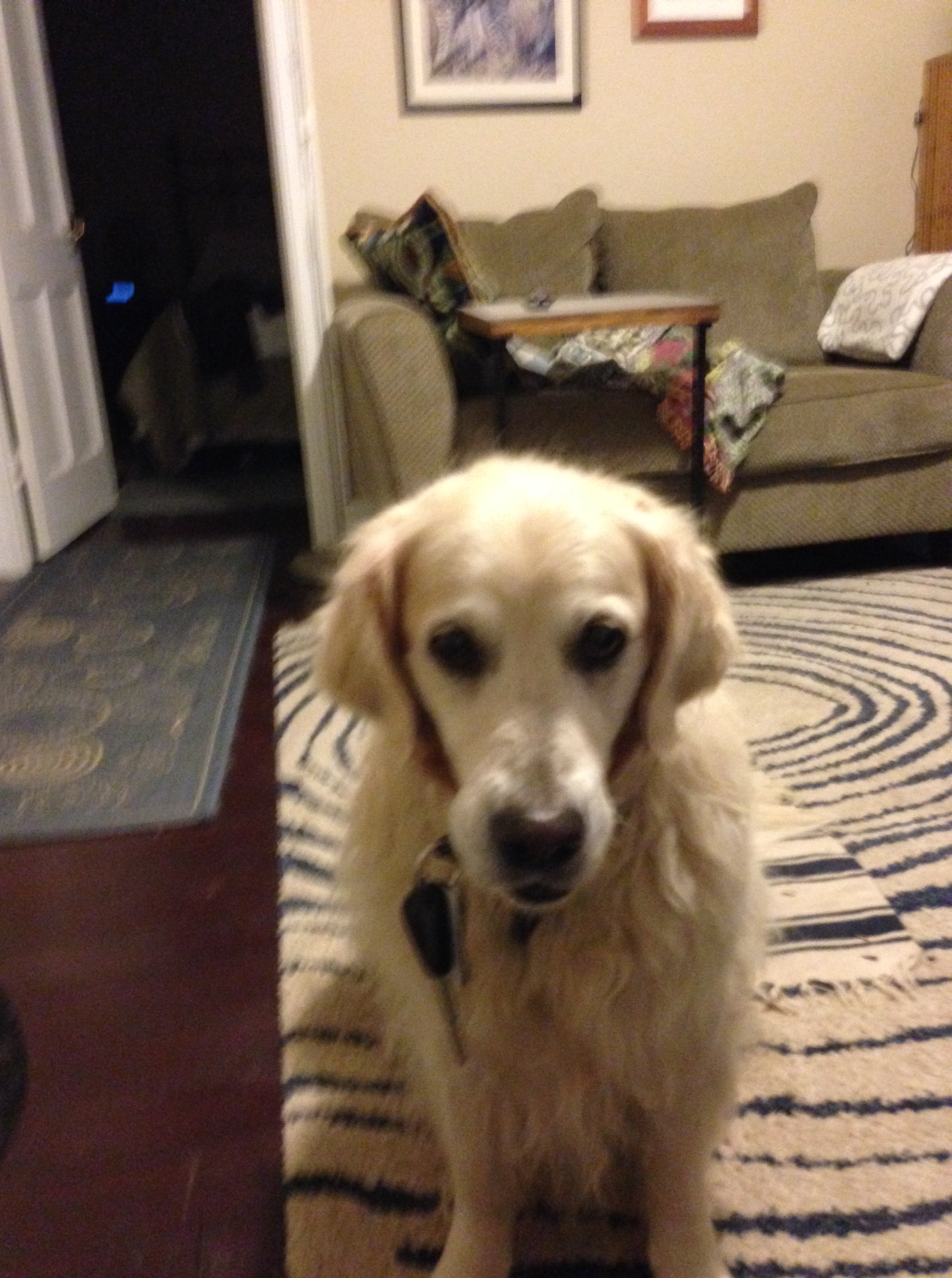
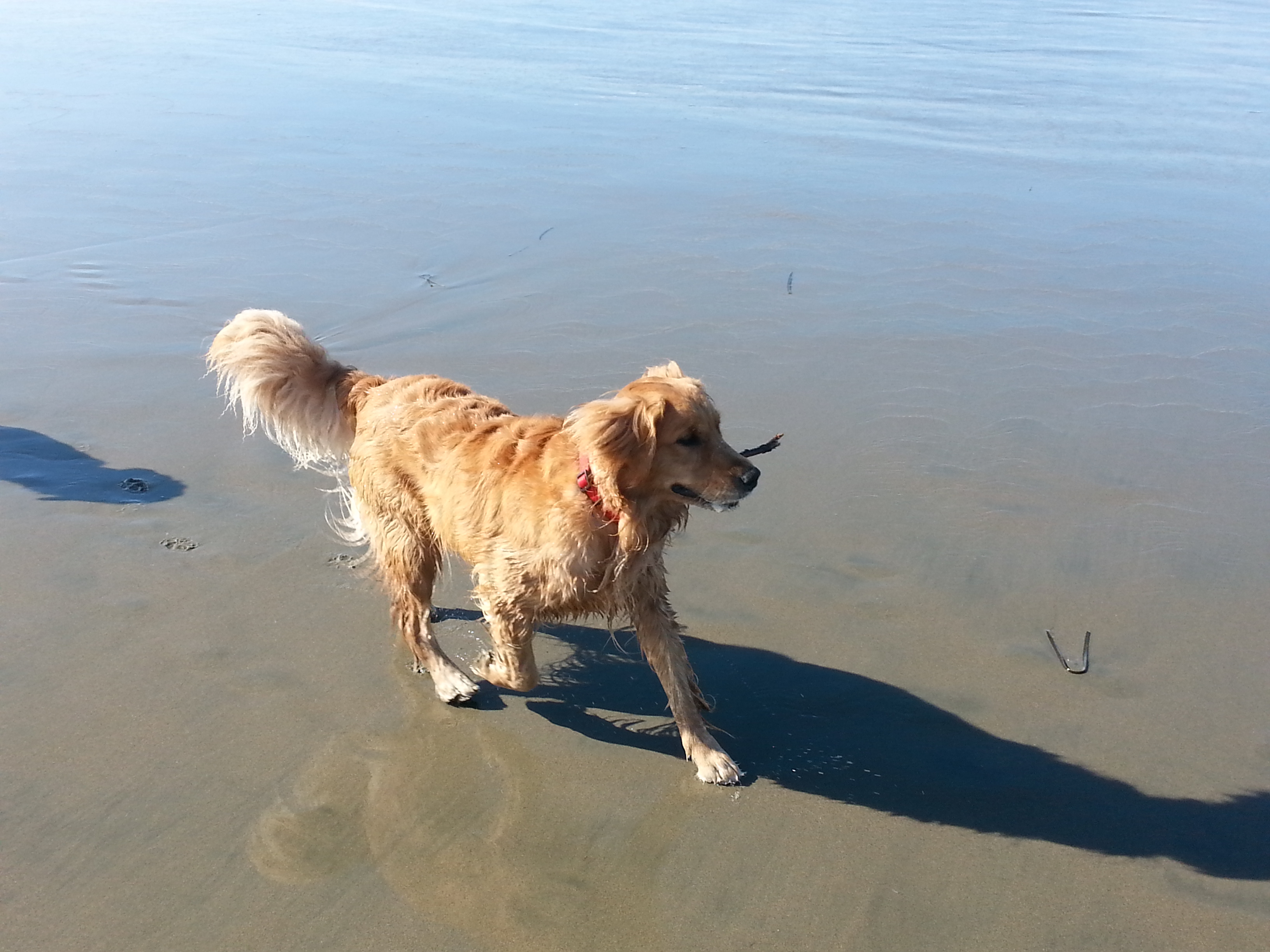
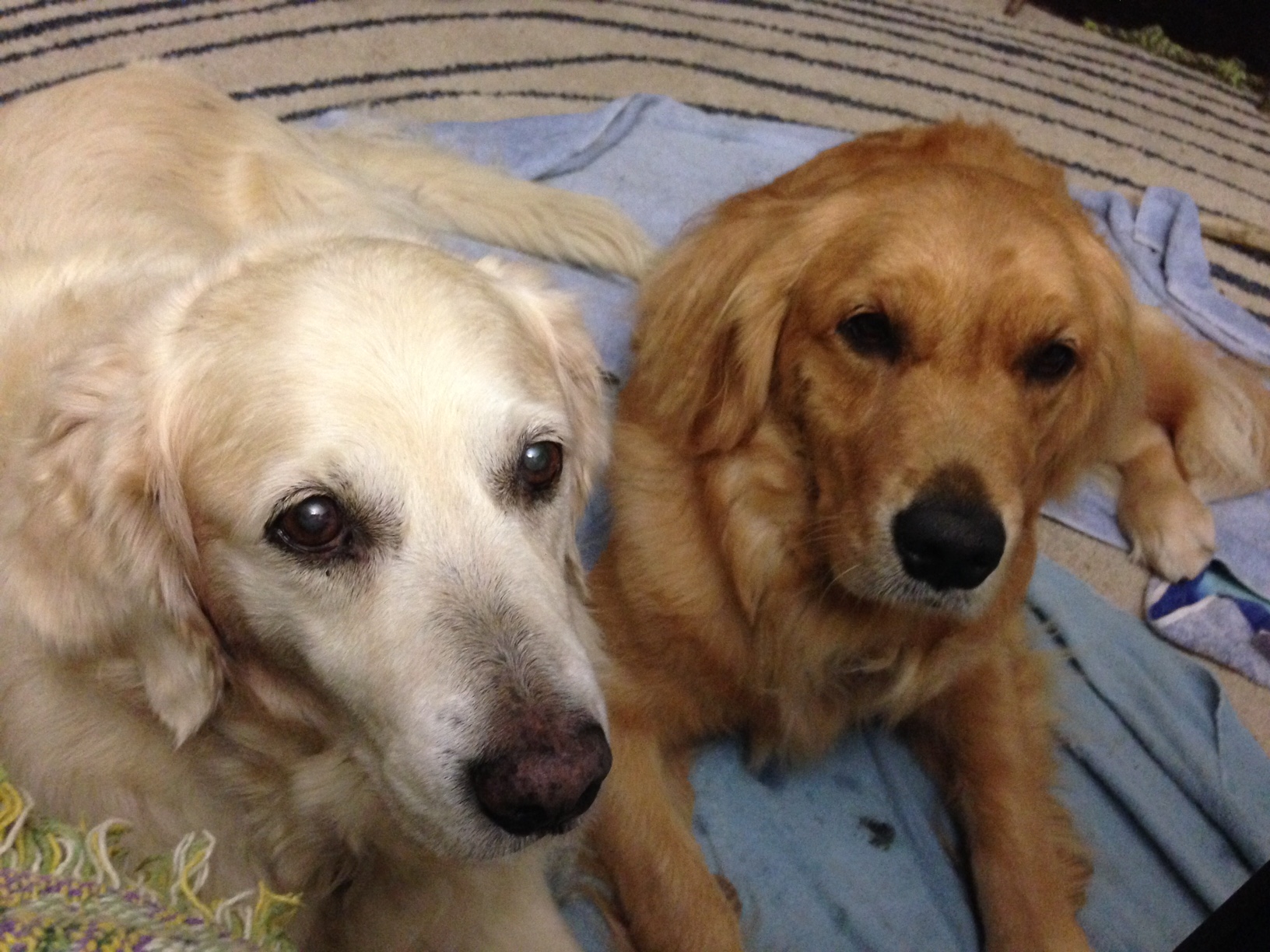
Following Our Dogs’ Example

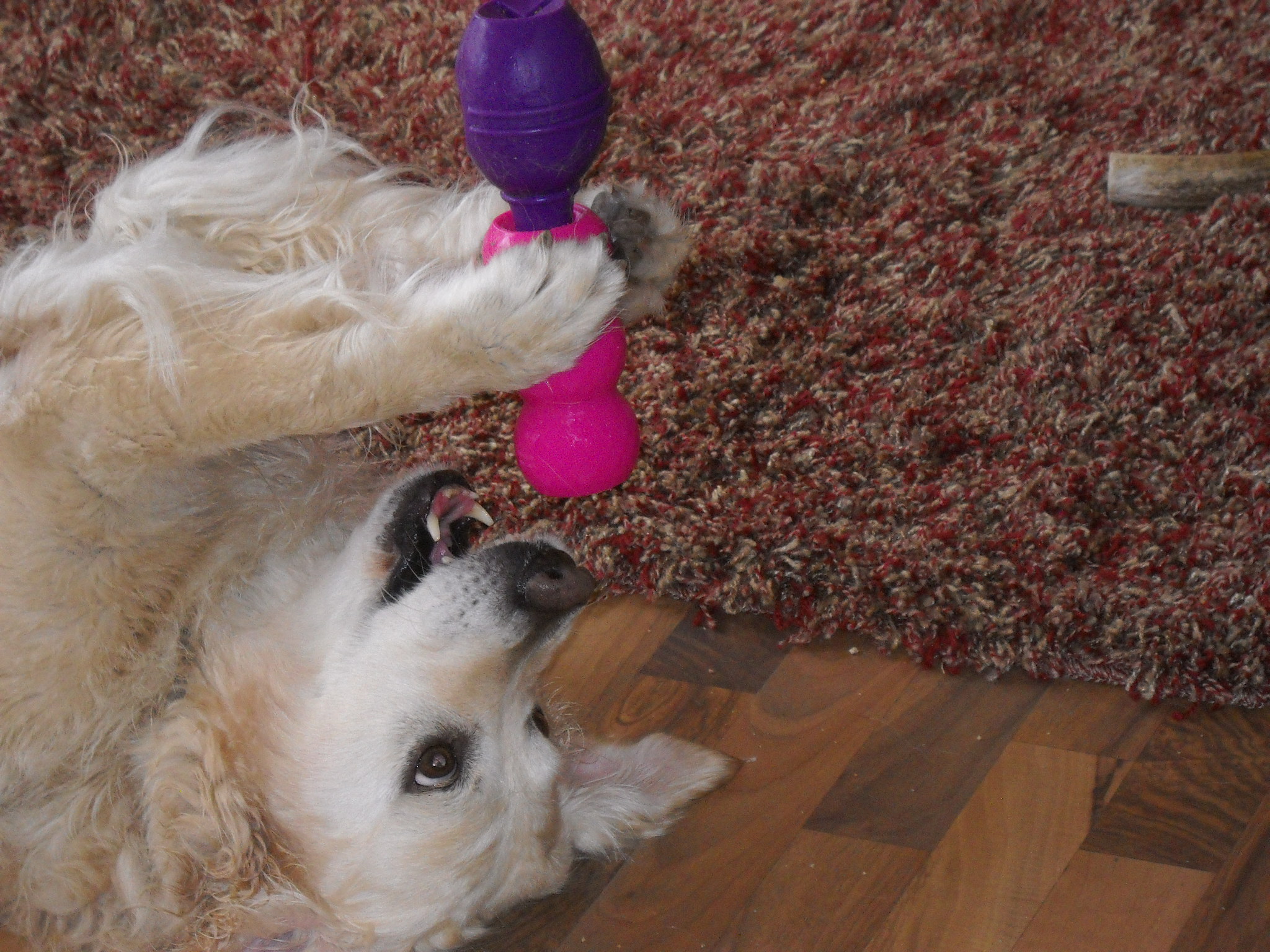
Jana does yoga. No, really.

I took a yoga workshop a couple of weeks ago that focused on stretches for the back, neck, and shoulders. The instructor showed us a couple of ways that she uses a tennis ball to apply pressure to tight muscles. Watching her, I got an immediate image of Jana, who does something very similar. You can watch her here: Jana Works Out. She has always done this. She wriggles so that the tennis ball moves down her back, massaging every inch.

We can learn a lot about how to live well and take care of ourselves by watching our dogs. Think about how consistently they demand exercise. And fun. Breaks. I can get sucked into work and sit in front of the computer for several hours. Except Cali won’t let me. Play time is supposed to happen at 3:30. Dinner must happen at 5. Breaks happen every couple of hours, tops. That is such a healthy, balanced approach to life — enforced by my dogs.

Also recently, I was talking to an acupuncturist. She was lecturing me on how important it is to take probiotics. I looked at her for a moment, then said. You know, I actually know that — I do it for my dogs. I just never applied that knowledge to my own diet.

IMG_1540How many of us worry more about what our pets eat than what we eat, and how many spend more time (and money) ensuring that their food is nutritious, balanced, tasty … while we eat junk food? Jana and Cali have no weight problem to contend with. They take their vitamins and supplements and exercise daily. They get better medical care than I do. And, once something becomes routine, even something like brushing their teeth, they expect it — and expect me to provide it. They remind me. (Though they have never asked me to clean their ears …)

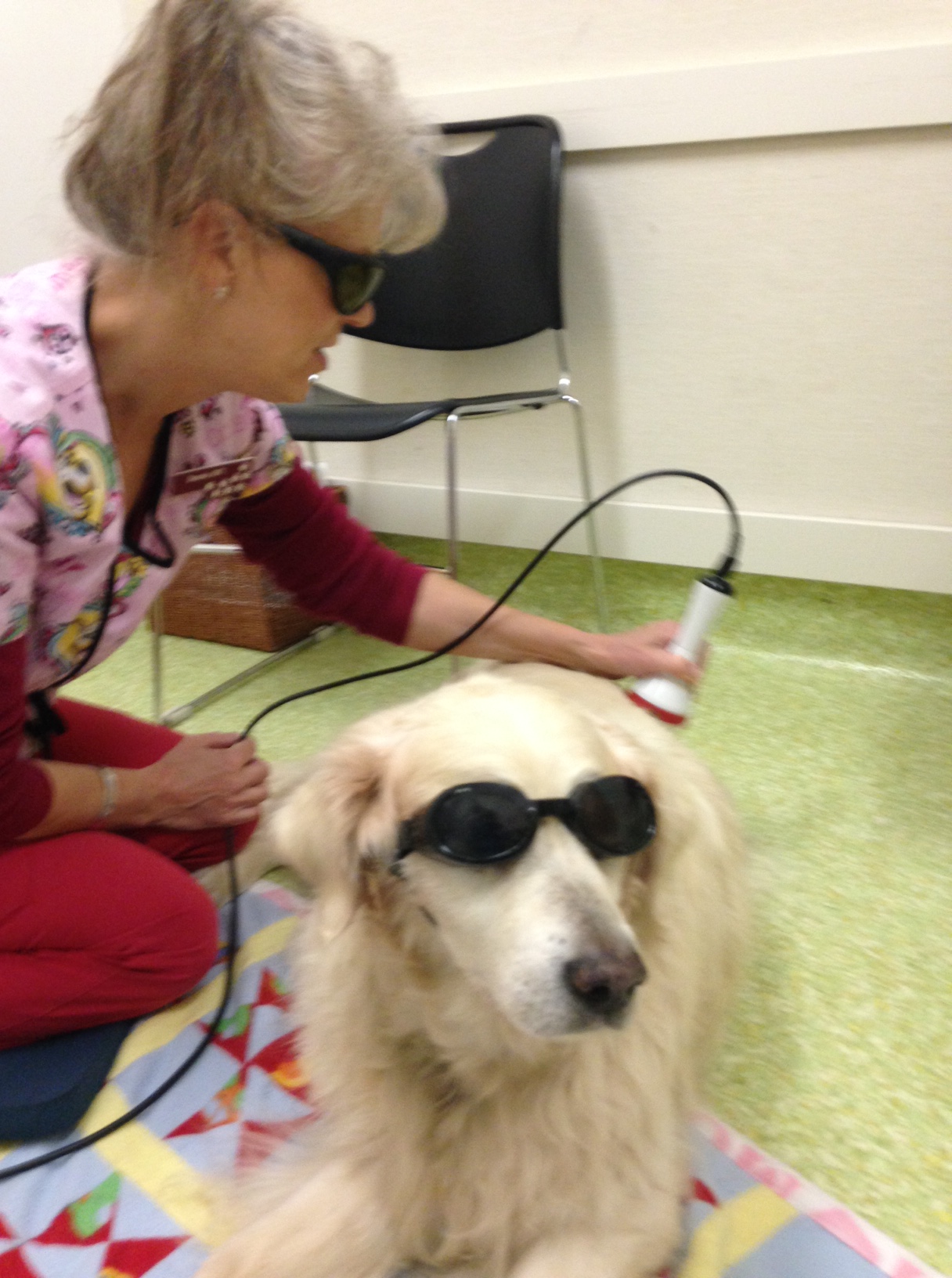
We do exercises daily to build up Jana’s shoulder muscles (which, incidentally, help me improve my balance), and Jana also gets regular laser therapy treatments for her arthritis (see photo). It keeps her (mostly) pain-free, so she can continue to wriggle and roll and do her yoga-tennis-ball exercises. For many more years, I hope!

“I’m So Angry I Could Eat a Tissue”

Jana01
Photo by Cathy Condon

When Jana gets angry at me, she takes one thing (usually a tissue) out of the wastebasket, shreds it, and leaves the pieces next to the wastebasket.

A quick Google search will turn up dozens of articles on why dogs eat trash or how to get them to stop, and many will suggest that they’re attracted to the food or your scent on items, or that they are obeying an irresistible impulse. Some will suggest that training can solve the problem; some will suggest management (trash cans with lids). Many dogs get into the trash; why do I think it is a reflection of her anger with me? I know my dog.

When Jana was a puppy, she nearly always shredded the trash when I left her home. As a dog newbie, I once followed the advice of a trainer to put hot sauce on the trash to discourage this behavior. Instead, I discovered that Jana loves spicy food. And spicy “food.” (Her definition of food is much, much broader and more inclusive than mine.) After she had enthusiastically thanked me for adding condiments to her snack, I asked her to help me pick up the remnants and put them (back) in the trash can. She did. I never put sauce on her snack again.

As Jana matured, she became a responsible dog who follows the rules and respects boundaries. She’s very helpful and thoughtful. I could leave a steak dinner on the counter and go out for the day (unlikely; I keep a vegetarian home) and it would still be there when I got home. She is 100 percent trustworthy around guests and snacks, even if the snacks smell really good and are at dog-nose level on a coffee table. She has mostly stopped the trash-shredding behavior.

But.

When I leave her at home at a time that is just wrong — it’s close to mealtime, or I have already been gone much of the day and I come in and leave again soon after, or it looks like I am going to do something fun that should include dogs — I will come home to a single shredded tissue on the floor next to the trash can.

I know that serious dog scientists (most of whom seem to never have actually lived with a real dog) will howl over my interpretation of this behavior, but here it is anyhow. I think that Jana is expressing her hurt feelings and anger in a way that is uniquely her own. She could be very destructive; thankfully, she’s not that kind of girl. She could ignore me when I returned, but she’s not the type to hold grudges, either. I believe that she has thought this through and decided that shredding one piece of trash makes a statement.

As Cali does with hiding before brushing her teeth, Jana is telling me how she feels. Both girls do this articulately and in their own way — and then move on. Wouldn’t it be nice if everyone were so mature and as effective and clear in their communications?

What Do Dogs Want?

I am teaching a class where students attempt to analyze dog-human relationships from the dog’s perspective. I asked them to think about what dogs would want the world to look like — what dogs dream of, what the future would look like if dogs’ perspectives were given equal weight to humans’. We also looked at what several writers and editors have published as their versions of dogs’ dreams, hopes, and aspirations.
Looking at the work was informative. Much of the published work that claims to represent a canine viewpoint is undeniably anthropomorphic. Products, too — though designed for dogs, they are things that no dog would ever want. Shampoo with an overpowering, sweet fruity scent, for example.
Or Dog TV, a channel created for your dog to watch while he’s at home all day. It’s carried by several cable companies. Several of the examples we looked at described dogs’ desire to have thumbs so that they could control the remote or their desire to lie around dreaming all day. Dog TV was created for people who see dogs as furry little couch potatoes.
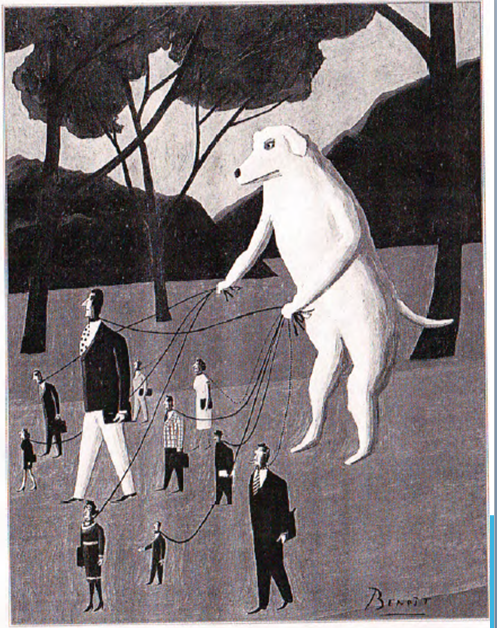
Another common theme is taking charge. One image from 21st Century Dog, a collection of dog-centered prophesies, appears below.
21st century dog
In a similar vein, several students channeled dogs who lived in a leash-free world where humans addressed their every whim or in homes where the dogs ate at the table while the humans curled up underneath. But, benefitting from an in-depth understanding of dog behavior, relative expertise on dogs’ health, well-being and psychology, and lives immersed in all things dog, several students’ views of dogs’ desires seem to get closer to what dos might, actually want.
In a book that illustrates dogs’ dreams, dogs dream of large, ornate houses, trips to Paris, and huge collections of shoes. Not likely, unless those shoes were for chewing.
Yet all is not lost to the hapless dreaming dog. Several students’ dogs dreamed of more doggy things — endless balls, growing on plants in their yard; freely available and dog-appropriate food (they are also studying canine nutrition); being free to dig, roll in the mud, and drink from a bottomless water bowl; enjoying a private stream where they could catch fresh fish.
Others envisioned a world where, rather than one species ruling another, the partnership was more even. Humans would understand their language and they’d get as much attention and company as they wanted. Dogs would not have to wear clothes; could go out to pee whenever they chose; would not be forced to interact with dogs whom they disliked; and bed-sharing would be negotiated.
One student nailed it by focusing on scent … another imagined dogs having the right to work in fulfilling jobs.
While we’ll never know for sure whether dogs dream of taking over or simply of a more equitable partnership with us, we can be sure that most dogs — like most people — want to use their intelligence and be challenged physically and mentally. Then, tired and muddy, we can all stretch out on the couch and fight over the remote.

The Happiest Dog on Earth

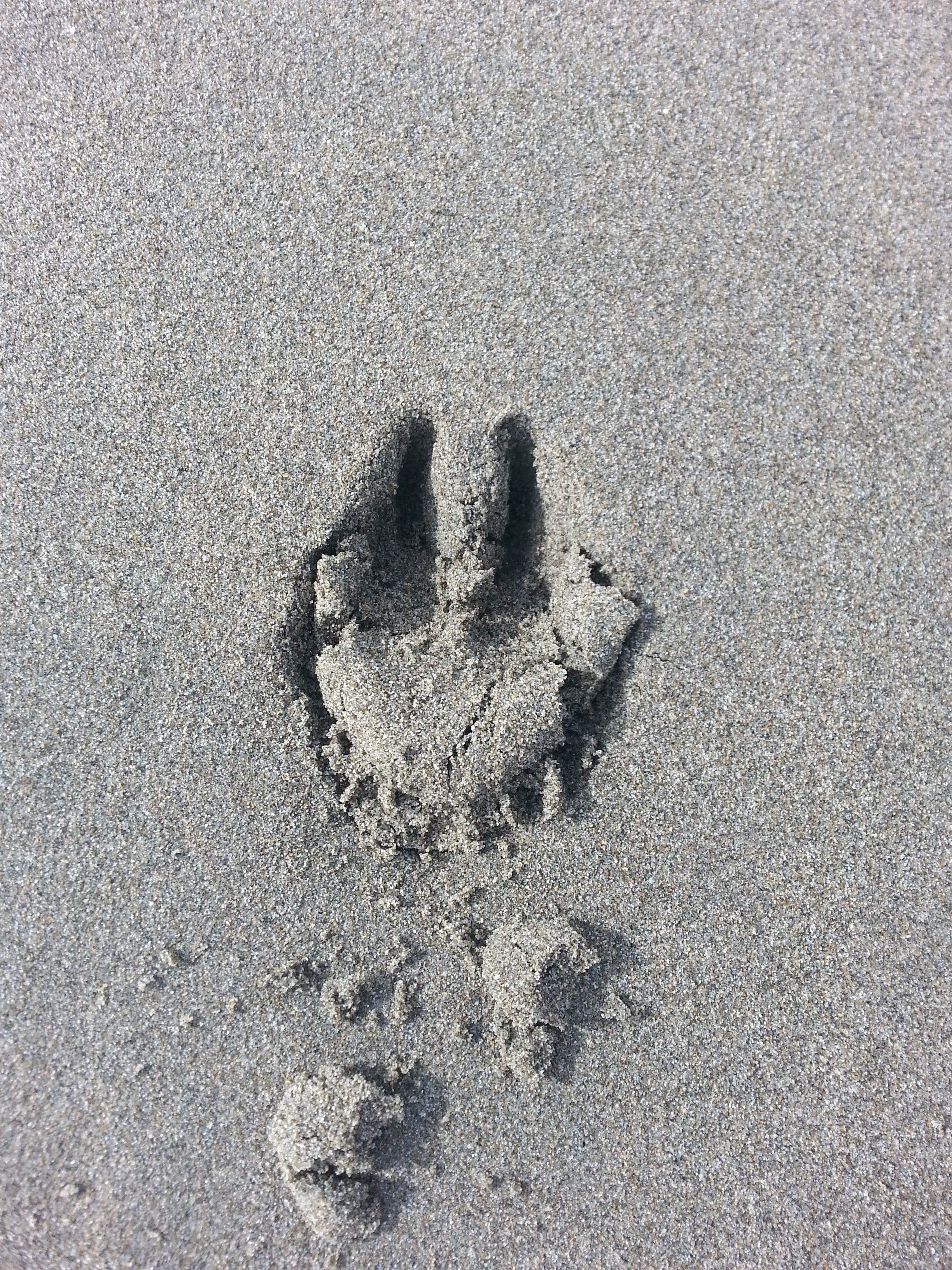
Calis signatiure Feb3 2015
Cali Was Here (Photo by Christina Phelps)

Cali’s pawprint from a recent beach day. It’s so fitting that her pawprint looks like a smiley face. Cali really is the happiest dog I have even known. She greets each morning (actually, since she gets up well before the sun, I could say that she anticipates each morning) with pure joy. She grabs a toy and waves it in my face or jumps on the bed to give me kisses or just wags her whole rear half — whatever works to get me out of bed. Lazy Mom.

She then grabs a favorite toy and runs outside where she runs around, wagging and smiling. (Yes, I can tell she’s smiling, even if she has a large toy in her mouth.) A few hugs and cuddles, more wags, and she’s off to take care of morning business.
Sometimes, in the afternoon, when she’s bored and I am working too much, she loses the smile and gives me the bored teenager sigh. But she perks up immediately when I say a magic word (“park” or “play” or “walk”).
Anticipation kicks in again sometimes. I apparently have a habit of saying, “OK,” when I am about to get up from the computer. It triggers a wild frenzy of dancing and tail wagging. Same thing happens — this is a bit embarrassing — when the end music to my latest Netflix TV series comes on each night. Cali might be comfortably napping on the huge memory foam dog bed (having kicked Jana off, no doubt), but at the first bars of music, she’s up and dancing toward the door.
Am I really that predictable (yes). More to the point, what does this tell us about dogs?
The ability to remember experiences, learn from them, and anticipate new ones based partly on those memories is a huge element of what makes humans conscious and engaged in society. Same thing is true for dogs. While I doubt that Cali lies around wondering what we’re doing next weekend or worrying about how we’ll pay for her next bag of SoJo’s (she leaves that to me), she often appears to anticipate good things happening in her future.
She seems to expect that, at 4 p.m., I will stop working and Play With the Dogs. At 5 p.m., dinner had better be in the bowl. While following a routine does not, in itself, mean that dogs are thinking, planning, or anticipating, it’s clear to me that she anticipates these events. And that her clock runs a bit fast.
Even more interesting is her certainty, whenever we get on 101 South, that fun things are in store for dogs. Not all car trips end up being fun for the dogs. She’s been on car trips that started with getting on 101 South … and ended in Florida, many long, dull days later. Sometimes, I just run errands. Mostly, though, we are heading to Berkeley, to visit Cali’s sister Dora or hang out with her friend Virgil. Sometimes we end up in San Francisco with Jana’s longtime pal Christine at the beach. So the odds of fun are strongly in Cali’s favor.
That’s enough for her. Cali’s sunny personality reflects her natural optimism. And what is optimism if not a belief that good things are bound to happen in the future?

Just Where I Left It …

Looking for these?
Looking for these?

Dogs’ memories — how well they remember things over time, whether they remember people, other dogs, or their mothers and siblings years after they last met — are the topic of much speculation and, lately, of serious research.
As Jana gets older and begins to show her age in some ways, I sometimes wonder whether she’s becoming forgetful or confused in the ways that many humans do as we age. She sometimes will stand and look at me and bark (and bark and bark), for example, and I cannot figure out what she wants or needs.
But then there are the encounters with smelly things on walks. She’ll find something — scraps of food, something dead, sometimes even worse things — that she wants to eat and that I do not want her to eat (or roll in). I’ll give her a stern, “Leave it,” and encourage her past the Thing. I’ll make a mental note to remember this Thing on our way home. A half hour or 45 minutes later, we’ll be walking home. The Thing will, of course, have completely slipped my sieve-like mind. Not Jana’s though. She beelines for it.
Sure, she could be smelling it as we approach. While that’s a reasonable explanation for Thing encounters on daily walks, the same thing can happen with encounters that are weeks or even months apart. At the dog beach we used to visit in Florida, she’d remember where a really good dead Thing had been — months later. It was never still there, and the tides, the wind, the cleanup crews, the other dogs and other animals would have obliterated any remaining scent. On hikes, she’ll dash off to pick up a rock she noticed on the way in — sometimes a couple hours later, as we head to the car. She seeks out remembered toys and beds at friends’ houses, too.
While generations of scientists and dog lovers have accepted the idea that dogs live fully in the moment — and they really seem to — that does not mean they don’t also remember and plan. Dogs clearly make “mental notes” of significant things, as we do. They appear to be far better than many of us at actually remembering to seek those things out (and remembering where to look for them).
We should all enlist this talent to keep track of our eyeglasses, car keys, and cellphones!

What Are Dogs Responding To?

Photo by Christina Phelps

A tall, elderly gray mixed-breed is the oldest Cali. Two young Labs, a Border Collie mix, a spaniel, another mix. Any of at least a alf-dozen dogs could come running when I call Cali at our neighborhood dog run. I never would have named her Cali if I had known how trendy the name was; it seems to be especially popular in our Petaluma, Calif., neighborhood.
But they don’t come. Each Cali (or Callie or Kali) responds to her own mom — including (usually) my Cali. And they ignore the calls of the other Cali moms. So, what are they responding to?
Some dog trainers argue that dogs do not understand words at all. They respond to a mixture of sounds and body language cues that we send them, sometimes intentionally and sometimes unconsciously. Others, including the apparently wise and wonderful Guiding Eyes for the Blind puppy raiser whose dog is the TODAY Show’s newest star, know that dogs can and do recognize their own names and “understand” lots of words. On one of his first appearances, Wrangler, the TODAY Show puppy, walked over to Saxon, the trainer and sat when she called him. He had learned his name in less than a day.
Dogs do learn their names, and they learn associations with other words as well. Some, like “sit” and “down,” are associations we teach them; others, like “cookie” and “walk,” they often manage to learn on their own.
Dogs are not as focused on words as people. They notice our tone and pick up on the emotion behind our words. They are very tuned in to our body language, too. I’m sure that all those Calis hear me calling — and know that it’s perfectly fine to ignore me. “Not my mom,” they might think as they decide to ignore the sound of their name being called.
If your words are not getting the desired response from your dog, don’t just repeat the words. Think about the whole message you are sending and see if changing your posture, adding a gesture, or adding some happiness and enthusiasm to your tone of voice helps you get a better response.
And at the dog park, while your dog is most likely keeping track of where you are, his responses might not be as speedy as you might like. There is also a lot going on there, and you’re not likely to be more compelling than his buddies, the birds, the balls, and the squirrels. It’s a good idea to practice recalls in less distracting environments until you’re sure he’s got it, then let your dog have fun with his buddies, calling him to you only when really necessary.

Finding the Right Sitter

Will you take care of us?
As I planned travel for the holidays and again in the spring, I faced a familiar problem. Whom do I trust to take care of my girls?
I am fortunate to have many dog-loving friends who often help out. But recently, I left my dogs in the care of a dog-sitter who stayed at my apartment. Searching for a dog-sitter and then leaving the girls in her hands was an interesting (and nerve-wracking) experience.
Kennels are out for many reasons. The environment is stressful, especially at Christmas, when kennels are packed to capacity. I truly believe that very few dogs really do well in a kennel environment. Cali is overwhelmed by so many dogs and is usually intimidated by large dogs. Jana simply cannot abide being treated like a dog. So kennels would not work for my girls. Besides, kennels in my area cost as much as (or more than) a dog-sitter who will provide much more individualized attention.
I checked into some dog-sitters who take dogs into their homes, but I worried that the stress of being in a strange home and surrounded by unfamiliar dogs would be too much for Jana. She gets anxious easily, and can be, let’s say, defensive of her food when she’s stressed. Since many sitters care for multiple dogs over the holidays, visions of Jana biting another dog were too vivid to ignore.
In the end, I interviewed about a half-dozen potential sitters. There are many wonderful people out there who really love dogs, and it’s possible to find a variety of environments and approaches to dog care. While selecting the right person and environment can take a while, I was encouraged to see that, even for dogs who need extra attention or care, there seem to be sitters who can provide what is needed.
I was happy to find a capable, dog-savvy sitter who would stay with the girls. They’d be in their own home, and no unfamiliar dogs would be in the picture. They’d (supposedly) have company much of the time and get to follow their usual routines. Seemed like a great solution.
When I got home, Jana and Cali were excited and affectionate, but also happy, well-fed, and perfectly cared-for. I would do this again.
But I wasn’t entirely thrilled with the experience. I’ve never thought of myself as a helicopter parent, but, while I was gone, I wanted to know what my girls were up to. I don’t have any way to know how much time the sitter spent here and how much time the dogs were home alone. I don’t know whether she took them to the park where we usually play ball every morning, or even if they went for walks. I wanted pictures occasionally, and I wanted updates by email or text. If I contacted the sitter, she responded, but I didn’t get a single photo the entire time. I realized how important and reassuring this type of contact is. I have found a wonderful dog walker and — even when she takes the dogs for a half-hour walk — she sends pictures.
So, to all of you dedicated (and tech-savvy, communicative) dog-sitters — thank you for the work you do (and keep those photos coming!). And to dog parents — it’s worth doing your homework and finding the best person to care for your dogs. It might take some experimentation to figure out what works best. Next time, I will know to ask for photos and updates!

Nice to Meet You

Wanna play?
Wanna play?

Dogs are as individual as people; therefore, getting to know them takes time and happens on different levels. There’s a big difference in “knowing” someone you’ve met at a party or been introduced to over coffee by a mutual friend, and “knowing” a friend who’s been part of your life for years, right? The same is true with dogs.
It takes time to get to know a dog and identify his or her personality and behavior patterns, just as it would with a person. But what about when you meet a dog briefly, say, walking down the street or hanging out at a coffee shop?
When you meet a person with a dog, greeting the dog probably won’t get much more intimate than saying hello and maybe giving the dog a pat or a hug. You might note the breed or notice whether the dog seems friendly — but even at this level, you can look for cues from the dog about his or her personality.
Cali and Jana perfectly illustrate the polar opposites in terms of their reaction to new people.
Cali was put on this planet to greet every single human being and become his or her new best friend. She rushes toward strangers with her whole rear half wagging and a huge smile on her face. If we’re on the way back from the park, she’s also got a slobbery tennis ball in her mouth, ropes of drool dangling, a wet “bib” (from the drool), muddy paws and legs, and she feels sweaty to the touch. On really energetic play days, she’s also given herself a good all-over shake and has, in the process, managed to drool on top of her own head. Never mind. She doesn’t notice any of that, and neither should you. She greets each and every person we meet with enthusiastic joy, secure in the certainty that every single human will love her back. Of course you can pet this girl, hug her, take her home and play ball with her. She’s your new best friend, after all.
Jana stands back and watches this all with horrified disapproval. Sometimes she barks. Usually she stands behind me, ensuring that there is a large, solid barrier between the stranger and the nut-job puppy greeting the stranger — and herself. This is not a dog who is inviting or would welcome a getting-to-know-you pat. This is the dog who invented “no-touch cuddling”: when she’s feeling affectionate, she will agree to lie upon a corner of my bed, so long as we’re not touching. After a few minutes, never more than five, she, with great dignity, descends from the bed and gets on with her life. This is what counts as “cuddling” in Jana’s world.
OK, so when you’re encountering a new dog, the first thing to notice is whether the dog is approaching you or standing back? That’s easy. But most dogs just kind of stand or sit next to their owners. They are not as clear about where they are on the Jana‒Cali continuum as, well, Jana and Cali are. What then?
Most dogs, even the friendly ones, dislike being patted on the head and being hugged. Sadly for them, most humans do one or both of those things when meeting a dog. According to Turid Rugaas, a dog communication expert who has identified what she calls “calming signals” — subtle body language cues dogs use with each other — the best way to introduce yourself to a dog is to approach slowly and from the side.
If the dog is sitting next to the person, you can just pet the dog on the side — stroke his shoulder, say — or reach around (not over the head) to scratch his ears. Making direct eye contact, leaning over a dog’s head, or reaching for the top of his head can be perceived as threatening by a dog, so it’s better to use the sideways approach. You can always crouch down to be more at the dog’s level; you’ll be less threatening and the dog will probably see it as a friendly gesture. If you are face to face, rather than reach for the top of the dog’s head, it’s better to scratch his chest. In any case, a slow approach lets the dog get your scent before you actually touch him.
Most people aren’t very observant around dogs, and dogs’ body language cues can be very subtle. A dog that is constantly looking back and forth, between the owner and you, for example, is showing nervousness, as is a dog who constantly licks her lips. A nervous dog might yawn or show a “stress smile.” (See “Communication Goes Two Ways” for examples.) These dogs will be happier if you don’t try to pat them when you first meet them.
If your dog is particularly sensitive or will meet a lot of people, it’s a good idea to play a pat-the-puppy game — pat the dog on the head, then immediately praise him and offer a treat. This can revise his thinking about this unpleasant encounter and may even turn it into something he likes. It’s also a good idea to teach your dog to look at you when people approach. You can reward this focus with a treat. The dog may develop better associations with meeting people. The dog will also be learning to look to you when she is stressed, which is a good “default” behavior. Because the bottom line is, whether your dog is Cali-style friendly, Jana-style reserved, or somewhere in between, your job is to keep him safe — and that means running interference with strangers, whether human or canine.

Let Your Dog Choose


Jana choosesIn “Communication Goes Two Ways,” I wrote about learning to read your dog’s body language, especially to recognize when she’s stressed or afraid. You can take your communication to the next level by teaching your dog new ways to communicate with you. Some ideas?

    • Hang a bell on the door your dog uses to go out in the yard for potty breaks. Encourage the dog to nudge the bell each time you let her out. She will soon connect the bell with getting you to open the door, and ring it when she needs to go out. A word of caution: Some smarty-pants dogs will use this system to train you, demanding to be let out every time you sit down or stop paying attention to them.
      One clever dog of Deni’s used this system to get rid of a pesky young puppy sibling. She’d ring the bell; puppy (and Deni) would come running; Deni would open the door; puppy would run out — and clever older dog would not. She’d stay inside to enjoy the calm, now puppyless, house.

IMG_1258

  • Offer your dog choices: Do you want to play with the tennis ball or the Frisbee? Which treat do you want? Do you want a walk or should I toss the ball? This can be as simple as offering two items for the dog to choose. But you can, with training, teach the dog to answer simple (two-option) questions. A student in my canine-human communication class taught her dog to choose between two options (sometimes yes and no) by nosing one hand or the other. A researcher in Florida taught dogs to choose a reward for a task they had completed by nosing a card with a picture of the desired reward — a ball, a food treat, a tug game, etc. She found that each dog had definite preferences!
  • Let your dog decide which direction you head on your afternoon walk. Jana and I have an informal agreement. The morning walk, which always includes Cali, is to the park where Cali plays ball. Afternoon walks, which are often just the two of us, are Jana’s choice. She likes to head toward the river and walk past her beloved dog training school, stopping along the way to visit her friend in the office on the corner (a very kind woman who always offers Jana a cookie).
  • Many people use hand signals to communicate with their dogs. These can substitute for (or work in tandem with) verbal cues — a raised hand for stay, for example, is widely used. Some trainers have made the leap to teaching dogs signals that they can use to communicate back to us, similar to the Baby Sign Language some parents use with pre-verbal babies. This takes more planning and teaching than some of the other ideas.


There are many more options, requiring various amounts of preparation and teaching, but you get the idea. Encouraging your dog to express her preferences and communicate her needs will increase her independence. It is empowering for her, and it shows that you respect her as an individual, which will enrich your relationship by making it a tiny bit more reciprocal.

Communication Goes Two Ways

An entire industry, dog training, is dedicated to teaching dogs to understand what we want. Even dog owners who don’t go to training classes or hire private trainers spend a lot of time trying to communicate to their dogs (and often being frustrated at their apparent failures). Literally hundreds of books offer tips for teaching dogs to understand what we tell them.
What about helping us understand what our dogs are saying?
Our dogs are excellent communicators. Even the ones who don’t seem all that smart because they never do what their moms and dads ask probably are reading Mom, Dad, and all other humans better than any human ever could. Those dogs are also, most likely, using their whole bodies, putting heart and soul into trying to tell those very humans what they need, want, and feel.
We’re just very poor listeners.
Dogs use their tails, their ears, their hackles, their voices to communicate. A slight lift of a lip tells a story, as do exposed teeth, a lowered head, a low, slow tail wag. Each bark, yip, and growl has a different meaning. All dog owners should strive for a general understanding of what dogs in general say with their bodies.
The most important place to start, I think, is recognizing when a dog is uncomfortable, stressed, or afraid. Since some of the body language can look similar to friendly or happy dog body language, many people miss important signs.
For example, that wagging tail. It means a happy dog, right? Not always. Dogs’ tail wags are very nuanced. A tail held high and wagged fast generally means an excited or happy dog, but a lower, slower wag can be a sign of apprehension or discomfort. If the tail is stiff, or the tail is moving slowly and the rest of the dog’s body is stiff, you are not looking at a happy dog.

Cali relaxed

“Smiling dogs” are another area of confusion. If the dog’s lips are pulled back in what looks like a smile, and her eyes are soft and her tail is wagging loosely, she’s happy. But if the eyes are hard or are darting between you and someone or something else or the hackles are up, you are more likely looking at a stress smile. That dog is scared or stressed.
Take a look at these photos of Cali (when she was a much younger puppy). The right-hand photo shows her with soft eyes, and her mouth is relaxed. She looks soft. Happy. But the photo on the left (below) shows stress. Her eyes are hard and scared. Her mouth is more rigid.

Cali stress

Other signs of stress? Sweaty paws, furrowed brow, ears plastered back against the head, repeated lip licking or yawning, tail low or tucked, stiff posture, and panting. Many dogs will refuse treats in a stressful situation. Watch for avoidance behaviors: Some will sniff the ground when faced with a strange dog or even try to walk away.
A general understanding of what dogs’ body language means is important for anyone who spends time around dogs. But it’s even more valuable to invest some effort in learning your own dog’s body language and vocal vocabulary. What are her stress signs? How does she show you affection, share joy, express empathy? Learning her cues will strengthen your relationship.
Then, you can take the next step and start giving your dog ways to ask for what she needs!