Thinking Dogs ♥ New York

Alberta and Deni trainingService dogs in New York got a great Christmas present from Governor Andrew Cuomo: official recognition as the state dog.

While some states choose a breed as the official state dog, and many states (gasp!) have no official dog, New York took a novel and wonderful approach. This article from Syracuse.com points out that breed doesn’t matter; only education and ability.

The original legislation designated service dogs as the official state dog. The governor expanded the law to include working dogs like police K9s and search-and-rescue dogs, and the lawmakers have agreed to officially expand the definition.

Four paws up to New York legislators for recognizing the contributions of service dogs. Other working dogs are also heroic and deserving of recognition, but a tiny, possibly very cynical, part of me wishes the honor had been kept, as originally intended, for service dogs only.

Unlike this recognition, the “me too”-ism that wants to lump a whole bunch of dogs in with service dogs for special attention or privileges usually is negative, as described in this New York Times column: When Dog Owners Are Off the Leash.

Maybe my grumpiness stems from having read the two stories only moments apart.

While the writer of the Times column admits to schadenfreude at the news of a celebrity couple getting caught and penalized for smuggling their two dogs into Australia, breaking several laws, including avoiding the required quarantine — he also freely and unabashedly admits to committing similar misdeeds. Stating that “half the people” he knows do it, he relates stories of many other people smuggling dogs into no-pets venues, lying to get them on airplanes, and smuggling pets across borders. He even acknowledges having a fake letter attesting to his dog’s status as an emotional support dog, commenting that the law is so vague that it’s easy to cheat. The motivation ranges from simply wanting to avoid paying pet fees on airlines to feeling entitled to have your pet with you wherever you want. Even if that requires that you lie about having a disability and pretend that an untrained pet is a trained service dog.

While the author of the column briefly mentions that this fakery “makes life difficult for those who really need” service dogs, he seems not to care. He sounds much more irate about the high fees that airlines charge to transport small dogs, and approvingly cites a few recent changes, including posh hotels that now allow dogs and the news that Amtrak has started allowing small pets to ride on some trains.

The thing is, though, that faking it is not OK — and is not trivial. So many people are doing it that it really does interfere with legitimate working dogs’ ability to do their jobs. And their safety. I’ve seen so-called service dogs come tearing out of airport shops, snarling and dragging their people, reacting to people or working service dogs.

And, as my students who train service dogs have pointed out, allowing untrained pets into more and more public spaces might not be the best solution. As a pet owner, I love discovering new places that I can take my dogs. But as a person who understands the ins and outs of training and working with service dogs, I also understand the problem.

If pet dogs are very well trained and socialized and the owners are skilled handlers who are aware of what’s going on around them, then no harm is likely to be caused; unfortunately, that’s rarely the case. Most dogs are poorly prepared for the stresses of public spaces, and many dog owners are poorly equipped to handle their dogs safely and appropriately — or they are simply oblivious. As is often the case, a good remedy is more education. Education of dog owners — and of business owners, about how to spot and deal with fakers.

Kudos to New York for recognizing and increasing awareness of the incredible work that service dogs do. Let’s hope it will help more people understand how vital service dogs are to people who truly need them — and how harmful it is to fake it.


She’s Very Patient; or Is She Stubborn?

A few weeks ago, Cali showed protective behavior when another dog at the park seemed to be interested in her ball. I wrote about it in a post that was published on Dec. 14, No More Toys.

I did stop taking the ball. We’d walk to the park, and Cali would get more and more excited as we got closer. I’d turn her loose and tell her to go play. And she’d sit and stare at me.

Stubborn CaliDay one. Fixed stare. Day two. Fixed stare. Days three, four, five … this went on for more than a week.
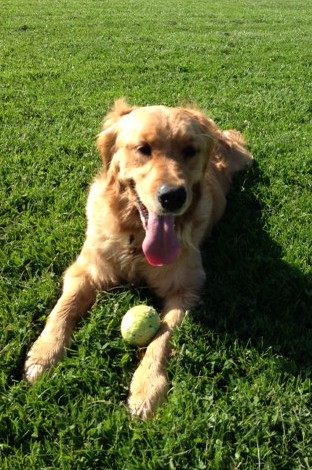
Cali did not play with another dog. She did walk around the park, following me, stopping every few feet to sit in front of me and stare.

Deni suggested that I bring a non-ball toy and try to get Cali to play with Ronen, Alberta’s Labrador friend. Cali watched Ronen run off with the tug toy. Then Cali sat. And stared at me.

A couple of times, there were no other dogs at the park when we got there. Cali sat and stared at me. Just the two of us, alone in a huge meadow, perfect for ball playing. I decided to bring a ball and only let Cali play with it if no other dogs were around.

Who was I kidding?

Now, Cali’s sit-and-stare-at-mes were punctuated by brief pop-ups. Up onto her hind feet, quick poke with her nose to my backpack (or pocket), where the ball was. Then pop back into her sit. And stare at me.

I was trying to out-stubborn Cali? I was delusional. Cali is very stubborn. Or, from her perspective, extremely patient.

My firm resolution softened. I decided to let her play ball if there were only a couple of other dogs there. Well, maybe if there were only four or five dogs. Or more, but not big ones. Or if they were far down the field … You can see where this is going.

So, once again, we play ball at the park.

I do stay far from the other dogs, and I put the ball away if the more rambunctious ball stealers are there. For her part, Cali is (a little) better about bringing the ball back to me. Sometimes. And she hasn’t so much as given another dog a dirty look.

I’m calling it a compromise.

Just Relax …

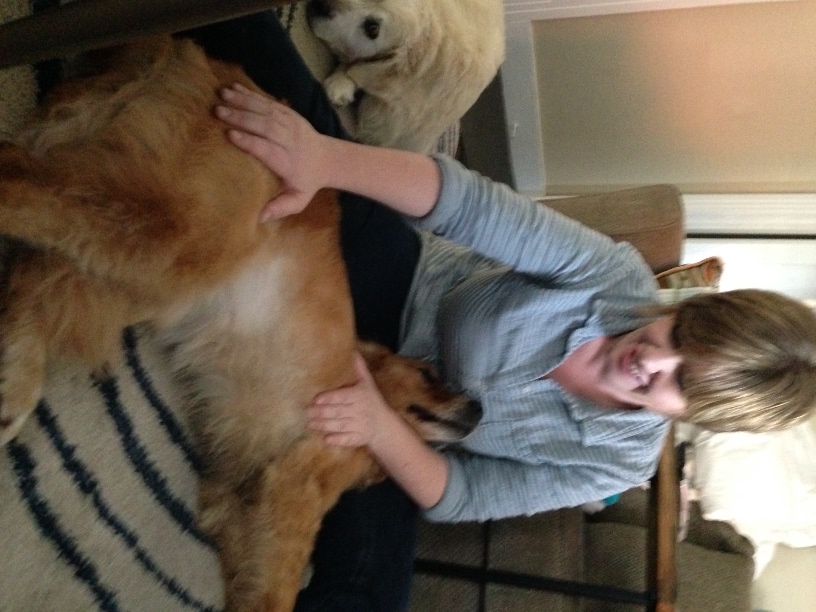
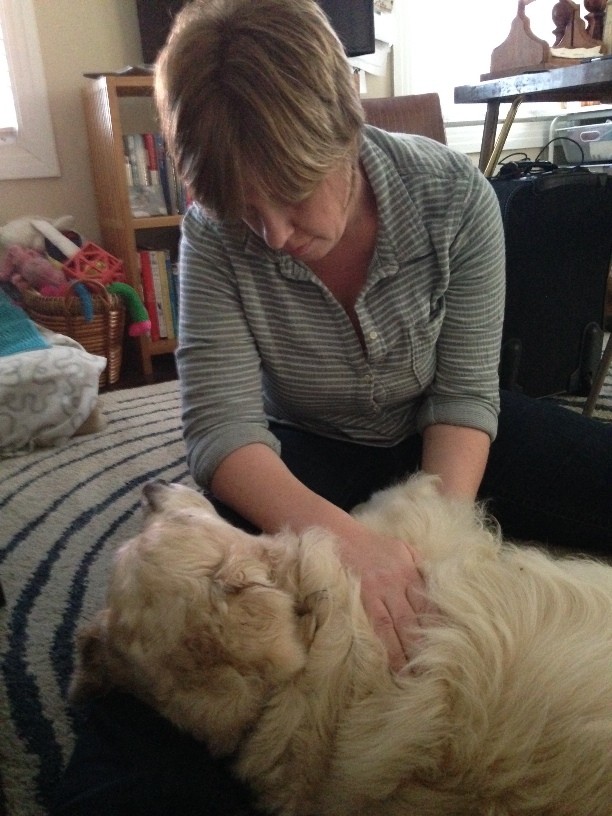
Reiki Cali2 A new practitioner of Reiki, Christina was eager to try her hand at it. Cali eagerly volunteered. Jana was more doubtful, but she agreed to try as well.

I was perhaps the most skeptical, but I watched, mesmerized, as Christina worked her magic on Cali. And Cali, excited, bouncy, always-in-motion Cali, lay still. Peaceful and relaxed, Cali lay nestled against Christina, sighing occasionally, and enjoyed the 20-minute treatment.

Reiki JanaI was less surprised that Jana lay still; she tends to stay put. But I was impressed when she allowed the treatment to continue for several minutes and expressed what seemed like enjoyment through her loud sighs and snorts.

What is Reiki? Reiki means “universal life force energy.” An ancient Japanese healing art, it is a technique that purports to channel energy through the recipient by means of touch (hands-on) or by hovering the hands over certain points in the recipient’s body. The energy comes both from the person giving and the person receiving the treatment. This website, Reiki for Pets, has a good explanation.

In people and dogs both, Reiki can promote healing, reduce stress, promote relaxation, and encourage feelings of balance and well-being. Some say it can boost the immune system or reduce pain. It might help with dogs’ behavior issues by reducing stress and calming the dog, so that the dog either does less of a stress- or fear-based behavior or is calm enough for other behavior modification training to actually work. It is used to complement conventional medical treatment, behavior modification and training, and other therapeutic treatments, such as laser, acupuncture, and Chinese herbal medicine.

Most of all, a hands-on Reiki treatment is a soothing and bonding experience — for both the person and the dog!

Christina lives in Southern California. If you are interested in Reiki for your dog, call her at 909-705-7596.

No More Toys

It’s so obvious that even the young girl at the park knew it: Taking toys to the dog park is a bad idea because the dogs might fight over them. So spoke the wise sage, who couldn’t have been older than eight.

And yet, for months (years?), I’ve been taking Cali to the park to play ball. She’s obsessed with her ball. Only her ball; she won’t touch any other ball. And when she’s there, she gets nervous if too many other dogs are playing nearby. They might take her ball. It has happened; and, with some dogs, it’s a challenge to get her precious ball back.

With all that I know about dogs, you’d think I would see the writing on the wall. Smell the coffee. Choose your cliché. I didn’t, until this morning, when Cali actually lunged at another dog.

Yes. Sweet, gentle Cali, who loves all humans and nearly all non-humans. Who wants to befriend the cats and birds and squirrels that Jana is trying so hard to chase. Cali, who comically crouches and grovels, trying to convince tiny Chihuahuas and toy poodles that she’s eager to play with or submit to — not harm — them.

Barley, who owns the above-mentioned wise child and their mom, is a goofy, energetic, one-year-old golden doodle. He’s at that precarious stage where he’s lost his “puppy license” but doesn’t yet understand all the rules of civilized dog play. When he gets out of bounds, the grown-up dogs at the park reprimand him rather than tolerating the puppyish misbehavior. Most are very appropriate; he usually reacts well, and the play continues. We are very lucky to have an extremely nice group of regular dogs and dog parents, and the dog play is nearly always healthy and energetic; I’ve rarely seen dogs behave aggressively.

Barley was inviting Cali to play. His energy might well have been too much for her; she’s pretty sensitive. But she usually just hunkers protectively over her ball and ignores the other dogs. Or picks up her ball and walks away.

At least, she did. Until today.

Barley ran by, seemingly trying to take her ball, and she jumped up and barked. She might have even growled a little. Cali!

I scolded her and was on my way over to leash her up and go when … she did it again! Barley’s mom was very nice about it, but I was mortified. Cali usually has better manners than that. And I should know better.

The truth is, I had been thinking about leaving the ball at home. I was not expecting Cali to lash out at another dog, but I was hoping to encourage her to play with the other dogs. When Alberta is here, Alberta plays with other dogs and tries to get Cali involved. It seems like such a great way for Cali to get exercise. A lot better than lying in the grass clutching her ball, anyhow.

So that’s it. No more toys at the dog park for Cali. And a big bonk on the head with a rolled-up newspaper for me.

Maybe She Had a Cold

I watched Cali run to and fro one morning, searching for her ball at the field where we play. She was so busy anticipating my throw that she ran full-on in the wrong direction and therefore had no idea where the ball landed.

She does not use the logical grid search technique that Wylie, the German shepherd who once shared my life, used. She often runs right past the ball without seeing it. She usually seems to follow her nose, and she always does manage to find her ball, eventually. It’s a large field and sometimes the search takes a while. She wants only her ball; she sniffs and rejects any other ball that happens to be in her path.

But her nose seemed to be broken on this particular morning. Or maybe she just had a bad cold. She ran past the ball several times, almost touching it, without noticing it.

Cali also does not appear to have read those studies that say that dogs, even very young puppies, can and do follow human pointing gestures. Or the training manuals that assure us that our body language looms large in our dogs’ minds, and they will go in the direction that our body, eyes, and feet are pointing, no matter what verbal cues we’re giving them.

Nope. My voice, arms, feet, and body were all telling her the same thing. I even walked toward the ball, stood two feet away, and pointed. No response from Cali, who glanced briefly at me before continuing her random search.

She did, ultimately, strike gold. She then watched me throw the ball once, brought it back — and lost it again on the next throw.

Another thing. Those studies about how dogs know what people can see and therefore tend to deliver the ball to a person’s front rather than her back? Cali hasn’t read those either. Or maybe she thinks that, because I am her mom, I have eyes in the back of my head (my mom did!). I tell her that doesn’t work for adopted kids. I pretend not to know where the ball is. I beg her to bring it to me. I demand that she bring it. I walk away. No luck. She loves dropping the ball behind me. Maybe she just has an odd sense of humor.

I enjoy reading all these studies about dogs’ cognitive abilities, and I really believe that (most) dogs do have great potential for problem solving, interspecies communication, and other feats of intellectual greatness. But playing with actual dogs like Cali is a good reality check sometimes.

Born to Ride

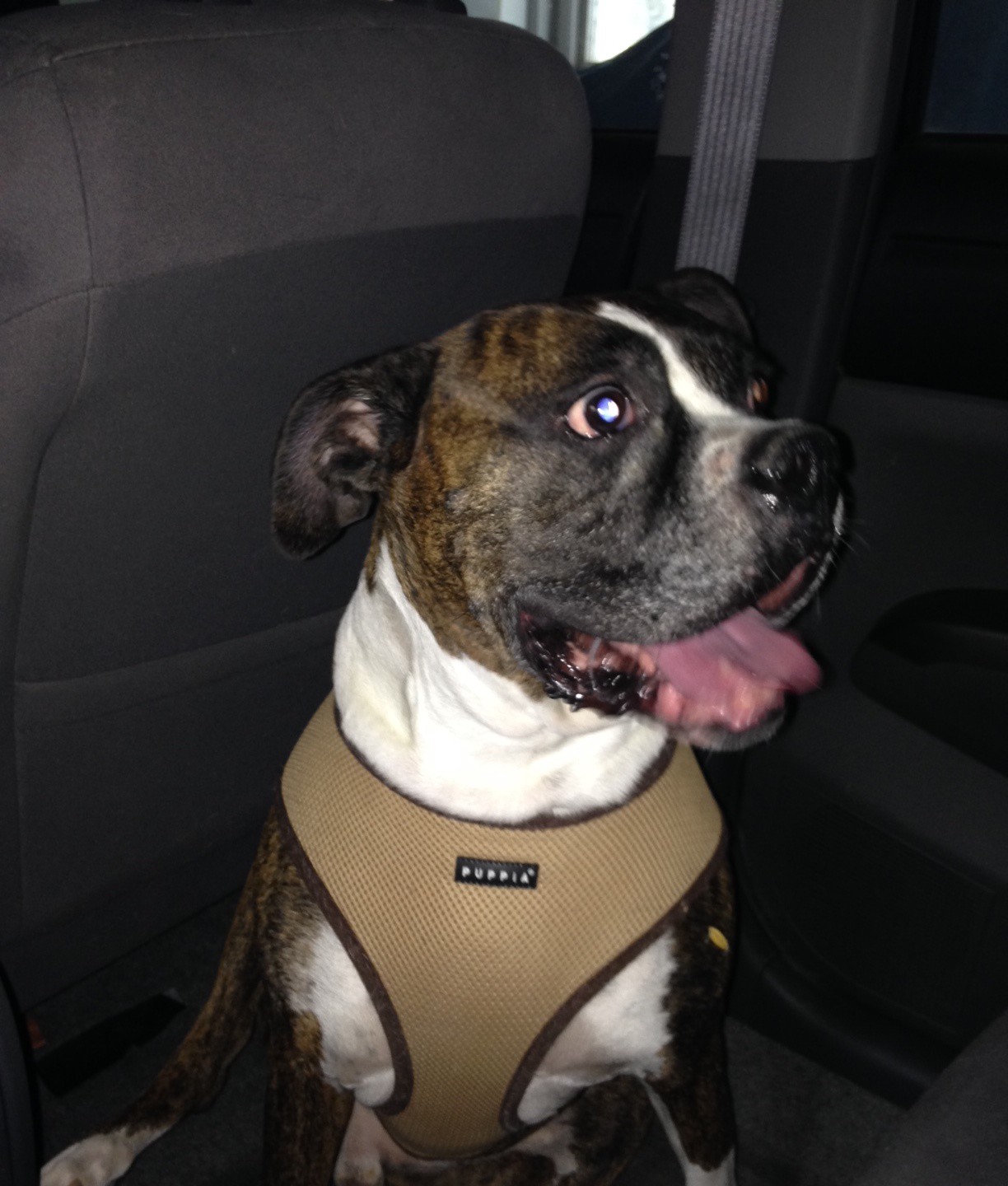
The happy person driving down the road while his buddy rides along, head hanging out the window, ears flapping in the wind, is an iconic image for dog lovers. That’s why it was so exciting when Beau, my aunt’s new dog, jumped into the car with no help — and with great enthusiasm — recently. He had surgery on both knees before my aunt adopted him from a boxer rescue group, and his hind legs are still shaky.

We were even more thrilled when he jumped onto the back seat from the foot space. He wanted to sit next to me, which was gratifying. But I’m no longer visiting, and he’s still getting up onto the seat. He seems enthusiastic about going for rides and is equally thrilled with the adventures in store when the car arrives at its destination. He’s been on walks in different places and helped drop off the recycling once. Now that Beau is willing to get onto the seat, we’re wondering what kind of rider Beau will be. Is he the head-hanging-out-the-window type? Not all dogs are.

Cali’s riding style is to sit up and look out the window, watching everything that goes by. When she realizes we’re going someplace familiar and fun — her sister’s house, for example, or the dog beach — she gets really excited and starts pacing and sometimes squealing. For this reason as well as for general safety, I usually seatbelt her (and the other dogs) when we’re off on a car adventure. Cali gets the window seat on the passenger side of the car; if she were sitting behind me, I’d have to contend with more than her vocalizations: She likes to lean over the shoulder of whoever is sitting in front and nuzzle that person’s neck — and drool on her shoulder.

Ory and Jana in carAlberta gets the middle because she likes to poke her head between the front seats and say hi to the driver and passenger. For a petite Lab, Alberta has a surprisingly heavy head. It can be hard to get into the storage console when she’s in the car, using it as a pillow. And forget about using that console as an arm rest.

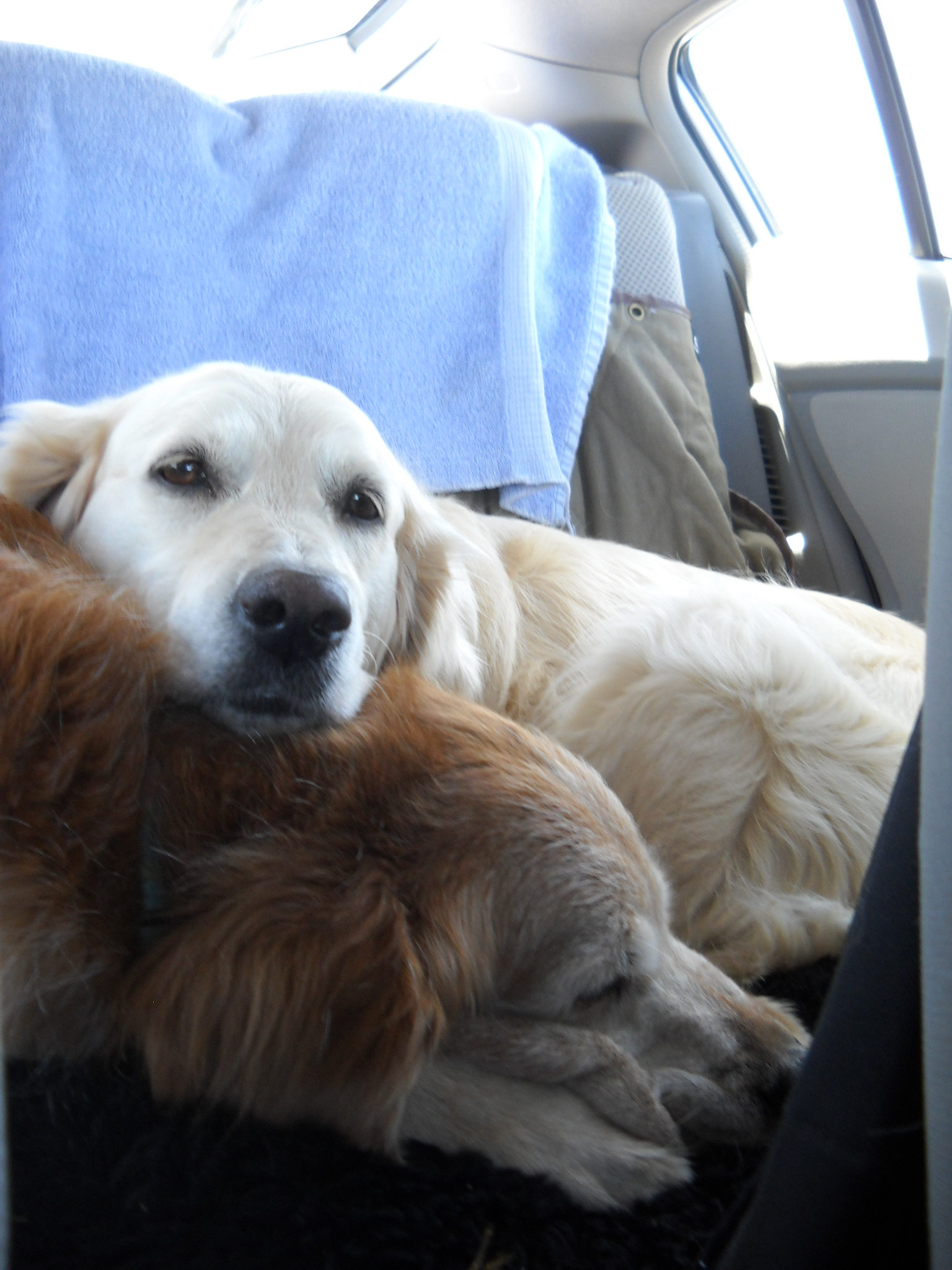
Jana is the most mellow rider in the family. She curls up and snoozes. Sometimes she cuddles with Alberta. Several years ago, when Oriel was still with us, Jana and Ory spent most of a cross-country drive snuggled up together in the back seat.  On a recent trip to Yellowstone, we did get Jana to sit up and take notice, but only when the bison came right up to the car.

Fortunately, all of our dogs love car rides. But some poor dogs are scared or get carsick. For them, a car ride is worse than a nail trim! Whether Beau hangs his head out the window, drools on his driver, or just sits there and smiles, I wish him many miles of enjoyment in the car.

A Conscious Struggle

This slideshow requires JavaScript.


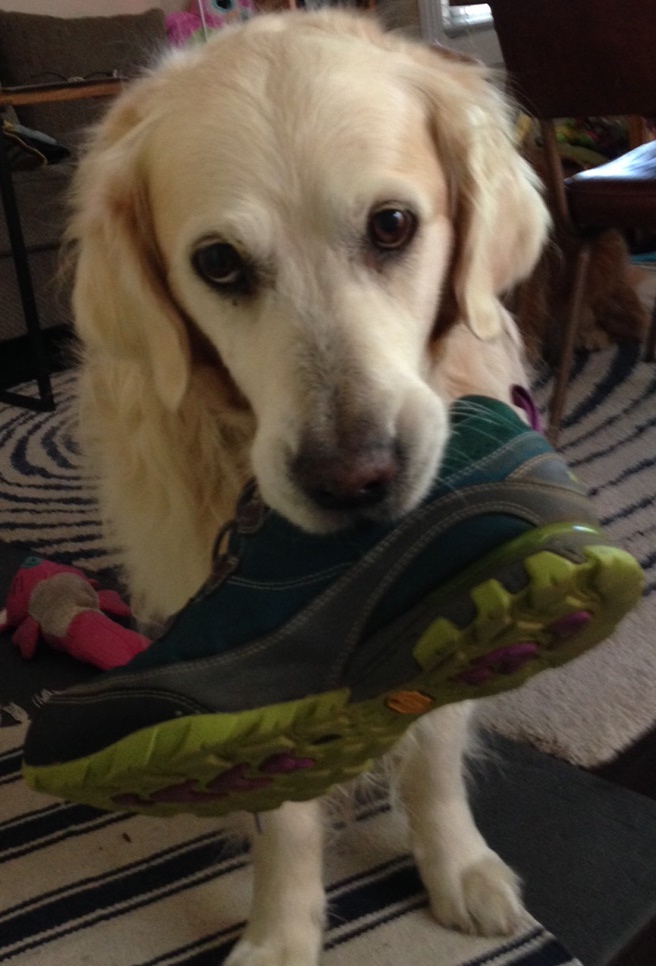
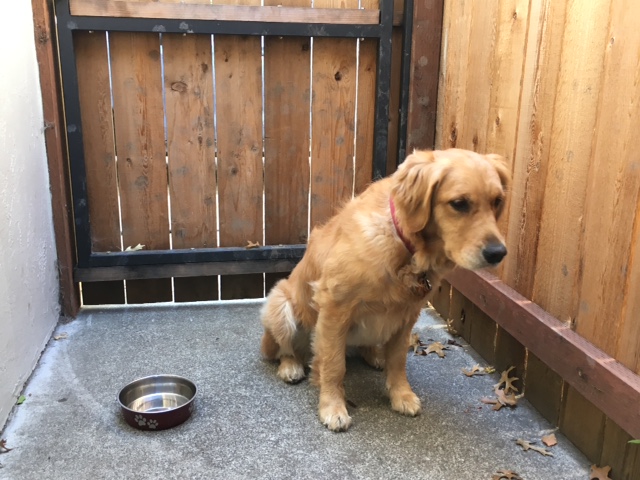
Our dogs have jobs that they are expected to do, similar to assigning household chores to a child. Jana brings in the morning paper. Jana and Cali each bring me a shoe when we’re getting ready for a walk. And each dog is expected to bring me her food bowl when she’s done eating.

Jana learned this task very quickly. She does it eagerly, always happy to receive her dessert in exchange (a small cookie). Alberta is also an eager participant, usually the first to finish her meal and deliver her bowl. If I am not paying attention, she’ll push it into my leg, hard, in a not-at-all-subtle demand for her pay. Past dogs have learned the task too, though Wylie made it quite clear that he saw this task as beneath him — girls’ work — and he would immediately depart for more masculine pursuits upon finishing his meals. Jana was happy to pick up the slack (and the extra cookie).

Then there’s Cali. For months, she’d pretend to try, lifting the bowl by one edge before dropping it with a loud clang. Putting on her saddest golden retriever face, she look at me as if to say, “I tried, Mom, but I just can’t lift it. It’s a very large bowl, and I am a very small puppy.” As the very small puppy became 56 lbs. of solid muscle, this excuse held less and less water, but the sad eyes … well, let’s just say that she does a very good “sad golden” face.

Along came Deni. Not only did we switch Cali to a smaller bowl this summer, but Deni took over much of the feeding supervision. Deni wasn’t moved by the sad face. Weeks of cajoling and praise and cookies paid off. Cali started bringing her bowl, but reluctantly and only with much encouragement. Once we knew that Cali understood what was expected and that she was fully capable of doing it, the coddling was phased out.

Now, as Deni explains, Cali broods over the looming task or “stands there and glowers at her bowl.” She knows she’s supposed to pick it up; she simply does not want to. It’s similar to her reluctant acquiescence to brushing her teeth. But, more and more, Cali talks herself into bringing the bowl with no prompting from either of us. Deni reports that if Cali sees that extra-special treats are being offered for dessert, she is able to convince herself to pick up the bowl much more quickly, and she does so with far more energy and enthusiasm.

The battle of the bowl shows Cali’s increasing maturity and offers a window on her personality and intelligence. We all sometimes choose to do things that we do not want to do. Sometimes we do them for rewards (a paycheck, working extra hours to earn a vacation …) or to avoid worse consequences (dental checkups) or because we don’t want to disappoint someone we care about. Whatever the reason, we all face large and small decisions every day. Cali is no different.

Beyond WordsIn his wonderful book Beyond Words, which I have mentioned before, Dr. Carl Safina talks about sentience, cognition, and thought as the “overlapping processes of conscious minds.” He defines sentience as “the ability to feel sensations”; cognition as “the capacity to perceive and acquire knowledge and understanding”; and thought as “the process of considering something that has been perceived” (page 21).

We see all of these at work in Cali’s struggle. She understands what she needs to do and how to do it; she feels stress, anxiety or discomfort of some kind when she thinks about this expectation, and she considers how to resolve it. Sometimes the feeling of anticipation or desire for a treat wins; sometimes, probably, the desire not to disappoint Deni or me tips the balance; sometimes she needs some prodding. But she is very definitely making a choice. Whether she decides to go for the cookie or she’s concerned about our reaction or she walks away and lets Alberta or Jana pick up her bowl, she is in control; she weighs the options and makes her choice. She is not instinctively or automatically responding to a stimulus in a conditioned way, as some behaviorists would argue. Every day, every meal, Cali shows what it means to be a thinking dog.


Minding Their Manners

I recently read a study that compared wolves’ and dogs’ ability to solve a “puzzle” — opening a plastic box with a piece of sausage inside. The wolves did much better than the dogs, and, from the articles I read about the study, it seems that many researchers are interpreting that to mean that the dogs are dumber than the wolves, at least when it comes to problem-solving. The comments were rather unkind to dogs, and, I think, wrong.

One comment, in the New York Times, came closest to “getting it.” This person suggested that perhaps the dogs had been taught not to take human food or open food containers. Paired with the fact that most dogs’ food is handed to them by humans, while most wolves must find their own food, I’d say the dogs were set up to fail.

The study was published in a British journal by an Oregon State University researcher, Monique Udell. In her own analysis, she paid more attention to the fact that the dogs spent more time looking at the familiar human (who was present for some trials of the test and who provided encouragement in some trials) than at the box. Various commenters’ interpretations of the dogs’ looks ranged from “seeking assistance” to “slavish.”

Half the dogs tested were pets; the other half were shelter dogs, but no information was provided about how many of those had spent part or most of their lives in homes before landing at the shelter. The wolves had been socialized to humans, but even a tame wolf is still a wolf, not a domestic pet.

It makes sense that the dogs would have been taught not to take food or been punished for taking food. It also makes sense that, if a familiar human were present, they would seek help, information, or even permission before helping themselves. When I give my dogs a particularly spectacular treat (a 2-inch piece of sausage would certainly qualify), they often look at me, look at it, look at me — going back and forth a few times, seemingly questioning whether this bounty is truly meant for them. They are polite. They know the rules. They are also quite happy to indulge in exceptions to those rules, once they’re sure they won’t get reprimanded for doing so.

I would have been much more surprised if the dogs didn’t look to the human for permission or help. After all, thousands of years of living together has resulted in close partnerships and, at least on the dogs’ part, exquisite ability to read human’s communication. We humans are less successful at reading the dogs, sadly. Their survival depends on reading humans’ cues and behaving accordingly. Wolves have no such hangups (nor should they).

Some comments on the study went so far as to suggest that training dogs has made them dumber and less able to solve problems, that their social connection to humans puts them at a cognitive disadvantage. I disagree. While some training approaches do discourage dogs from thinking, modern approaches to training that use motivation and reward actually encourage problem-solving. Far from dumbing dogs down, their enhanced social sensitivity to humans enables them to thrive in our world and, in many cases, enjoy comfortable lives and strong connections with their adopted families.

And if those strong connections compel dogs to ask before eating your food, what’s wrong with that? Many people wish their roommates were as considerate.

For more about the study, see these articles:

OSU study: Have we made dogs lazier or dumber than their ancestor wolves?, the Register-Guard, Oct. 2, 2015

Why Is That Dog Looking at Me?, The New York Times, Sept. 15, 2015

The study, “When dogs look back: Inhibition of independent problem-solving behavior in domestic dogs,” by Monique Udell, was published in the British journal Biology Letters on Sept. 16, 2015.

See also my related post on the PPG Barks blog.

Apologies to Jana

I owe Jana an apology.

I’m reading a wonderful book (go get it right now!), Beyond Words by Carl Safina. A review will be posted … once I finish the book. I’ve finished the sections on elephants, wolves, and, best of all, dogs. Orcas are up next.

He takes great delight in lampooning several ludicrous studies that purport to prove humans’ superiority in matters of self-awareness and “theory of mind.” In reading Safina’s analysis of the mirror test, I realized that I got it all wrong. His explanation is brilliant — and so obvious.

The mirror test has been used for decades to establish, so some researchers say, whether an animal has self-awareness. This is variously defined as recognizing that you exist as an individual separate from other individuals (and your environment) to, more absurdly, the definition put forth by the creator of the test and quoted in Safina’s book: “Self-awareness provides the ability to contemplate the past, to project into the future, and to speculate on what others are thinking.” Other definitions include the “capacity for introspection.” I’m not sure how recognizing yourself in the mirror reveals a capacity for introspection or an ability to project into the future, but the folks who wrote those definitions did not explain that detail.

The test involves surreptitiously putting some sort of mark on the test subject’s forehead. When the person (whether human, ape, dolphin, dog, etc.) looks in the mirror, if the person touches or tries to remove the mark, he or she is recognizing that the reflection is not some other creature but an image of himself or herself. I understand that. What Safina points out, though, is that that says nothing at all about self-awareness. What it reveals is an understanding of how reflection works. Seems pretty obvious, no?

He goes on to talk about what self-awareness really means — being aware that you, yourself, are separate from other “selves” and from the environment. He says that a creature that does not recognize this would assume that the reflection was itself since it would not differentiate its own “self” from anything else, but that would also make it impossible to move, eat, find a mate, or do much of anything, like survive. He provides wonderful examples of all kinds of non-humans showing exquisite understanding of their environments and other beings that populate those environments.

I’ll leave his discussion of theory of mind for another post.

So, what does all of this have to do with Jana? In a long-ago post, I described Jana’s experience with the mirror test, and I described her as not only self-aware but also as self-absorbed. While this might be true, I did not give her enough credit. You see, Safina points out that what some non-humans (and who knows, maybe some toddlers as well) do when they first encounter mirrors and do not (yet) understand reflection is that they try to engage with or attack the other being in the mirror. While many psychologists will say that this means that they are not self-aware, Safina makes the (again obvious) point that it absolutely shows self-awareness. Trying to play with or attack another being requires that understanding that you and he are not the same creature!

So. Jana. When Jana was a puppy, we had an older dog, Timo, who resented the puppy and did not play with her. My mom had two adult dogs, Buddy and Daisy, who also were not keen on playing with this relatively large, high-energy puppy. But at my mom’s apartment, Jana made a wonderful discovery: a puppy who kept play-bowing and acting friendly and excited to see her. Jana could not understand why this other puppy never moved beyond the play bow, however. Within a few weeks, Jana did recognize that the puppy in the mirror was actually her, and she stopped trying to get the puppy to play. I used to tell this story and say it meant that little Jana didn’t yet have self-awareness. How wrong I was!

Thanks, Dr. Safina, for pointing out that of course my brilliant puppy knew that she was a distinct individual — an individual who simply wanted a playmate.


Canine Con Artists?

I originally wrote this post for PPG Barks, the blog of a professional positive trainers networking organization. The post was rejected; I think the reason is that I am asserting that dogs deceive each other and humans. I am  very interested in this topic, and I plan to revise the post further (or write an entirely new post) about dogs and deception. Meanwhile, I’d love some feedback from you. Please comment on the post or to me privately if you feel inclined. I am interested in what other dog people think about the question of doggy honesty and deception.

How much is a dog willing to bend the truth or improvise in order to get a reward?

That’s not a crazy question. Dogs routinely exhibit all of the cognitive behaviors needed to form an idea, plan, and execute deceptive or manipulative behavior. Consider:

Cookie, please
Cookie, please
  • Dogs deceive each other or fake each other out to get what they want. One dog will pretend to hear someone at the door and bark the warning bark — anticipating that his doggy sibling will run to the door. The conniving canine then steals the dupe’s rawhide, toy, bed, choice spot by the TV, etc.
  • Dogs who have been taught to ring a bell or bark when they need to go out tend to go through at least a short period of ringing that bell constantly … or at least testing out how often they can get Mom and Dad to “hop to it” and let them out, even when all they want to do is roll in the grass or bark at the neighbor.
  • Is there any dog who hasn’t tried to convince her owners that they have “forgotten” to feed her?
  • Many dogs will retrieve items that have not been requested in hopes of getting a reward. My dogs routinely bring me extra shoes in the morning, after they’ve been asked to bring my dog-walking shoes (and have been rewarded for doing so). This is probably optimism more than dishonesty, though. I routinely reward them for bringing me things that I have dropped, whether I was aware of dropping the item or not.

It gets even more sophisticated. For example, our German shepherd used to pretend not to know where the ball had landed when we threw it and he was busy sniffing something or chasing a squirrel. A request or two to get the ball would be completely ignored. Or, to humor the annoying humans, he’d search half-heartedly for a few seconds before doing the dog equivalent of shrugging and going back to something more interesting. “OK,” we’d say. “If we’ve lost the ball, it’s time to go home.” In under 10 seconds, he’d have found and delivered that “lost” ball.

Then there’s the golden who used the bells on the door to get Mom to open the door, knowing that her annoying puppy-sister would go charging out the door … while she stood there, smiling, as Mom closed the door with puppy outside and her inside.

So. While I will concede that not all of the above examples necessarily show deceptive behavior, some do, some might, and others at least indicate an ability to manipulate humans to obtain a desired end. I believe that dogs do lie and that they sometimes deceive each other and us. And they do it for a variety of reasons, including the possibility of getting a reward.

what the dog knowsI’ve been thinking about this since I read What the Dog Knows by Cat Warren. It’s a great book; I posted a short review here on the Thinking Dog Blog not long ago. It’s about scent-dog training, specifically, cadaver dogs. The author raises an interesting topic: False alerts. She’s brave to do this, partly because many dog people ran into what I think I am running into: Many people cling to decades-old and thoroughly debunked ideas about how limited dogs’ cognitive abilities are. But mostly she’s brave for another reason: Many handlers proclaim that their dogs are never wrong and become incensed if anyone suggests otherwise.

Some false alerts are the handler’s fault. Particularly when the handler is a beginner, and the team is at an early stage of training, the handler’s body language or other unintentional cuing might hint to the dog that “this is where” he should alert. In this case, the dog is not lying; he is trying to follow the cues he’s just learning, and thinks he’s doing what the handler wants.

Training and working in situations, like cadaver searches, where the handler is not always able to tell whether the alert is false further complicates the discussion. Some false alerts, as Warren explains, might not actually be false. She says that if they are training in a vehicle junkyard, for example, and her dog alerts on the seat of a smashed car with a shattered windshield, while that is not the target she’s searching for, she rewards the alert anyhow. The scents linger for a long time, and the dog probably did detect the scent of human decay (parts of the book do require a strong stomach!).

I’m not talking about those instances though. I wonder if — and at what stages of training — dogs intentionally, knowingly lie about detecting the target scent. There are certainly working situations where the handler might not know if the scent is present and therefore is likely to trust the dog and reward an alert. False alerts occasionally do cause problems in law enforcement.

She draws a distinction between false alerts that are outright lies and those that are more nuanced and, she says, even more insidious (though not always because of misbehavior from the dog). The dog is detecting something but is not entirely sure it’s the correct scent; or the dog has detected the scent but not found the precise location and alerts anyhow; whatever the case, in these instances, she explains, the dog isn’t consciously deciding to lie. As with human behavior, not all situations are easily explained, black or white.

Warren says she will never know whether her dog’s false alerts are inadvertent or are deliberate lies — but she does not rule out the possibility of a dog lying. She also says that her dog’s body language is so clear that she thinks she could tell if her were lying. Many humans betray their dishonesty through body language. Sometimes those “tells” are very subtle. A close study of our dogs’ body language might be our best chance at knowing when they are — and are not — trying to con us.

What do you think? Have you ever worked with a pathological doggy liar? An occasionally dishonest dog?