Just Hangin’ Out

Jana_aging

We all know that our dogs love us, right? It’s not enough to know that, though; researchers have to prove it. Fine. First we had the wonderful Dr. Gregory Berns and his MRI studies that showed that the pleasure center in dogs’ brains lights up when they catch a whiff of a familiar human. Then we had oxytocin studies that showed that a meaningful gaze is also therapeutic — for dogs (more about that in a future post). Now, my favorite: A study showing that dogs will actually learn and perform a task for what reward? A chance to spend a minute with their person.

The study was published in the fall issue of the Journal of Applied Behavior Analysis. Titled “Application of Functional Analysis Methods to Assess Human-Dog Interactions,” the study itself if a tough read. Do yourself a favor and read Dr. Stanley Coren’s “translation” in his column for Psychology Today.

The study only looked at three dogs, so it is not exactly definitive. But these dogs were tested on several different scenarios. First, they learned to perform a task that would open a door and allow them access to a room where their human was sitting. They actually figured out — taught themselves —a task, then performed it over and over again, just to get to be with their humans. They could hang out with (and be petted by) their person for one minute, then they were taken back to the room.

Initially the room was bare and boring. But then the researchers upped the ante. They gave the dogs some toys. Later, they added the dog’s favorite bed. In each case, performing the same task would let them out and give them access to their person. Yes, they chose to leave a relatively comfortable room and their toys to be with their humans. One dog had a harder time leaving the toys than the empty room, and one of the dogs chose not to leave the comfy bed.

The next level test put the people and dogs in the same room. Now, the dogs had no bed, no toys, and a human who was working on a computer. The door was open; the dogs were free to head to their toys, their beds, out. Yet, even though the person wasn’t paying paying any attention to them, the dogs showed a preference for being with their person. They stayed, rather than head to a more stimulating place.

Remember, this is a very small study. But it tracks with my experience of living with many dogs over many years, and spending time with dozens (hundreds?) of dogs whom I knew well but did not live with. It also lines up with our understanding of dogs as great therapy visitors, empathetic creatures, and just plain good friends.

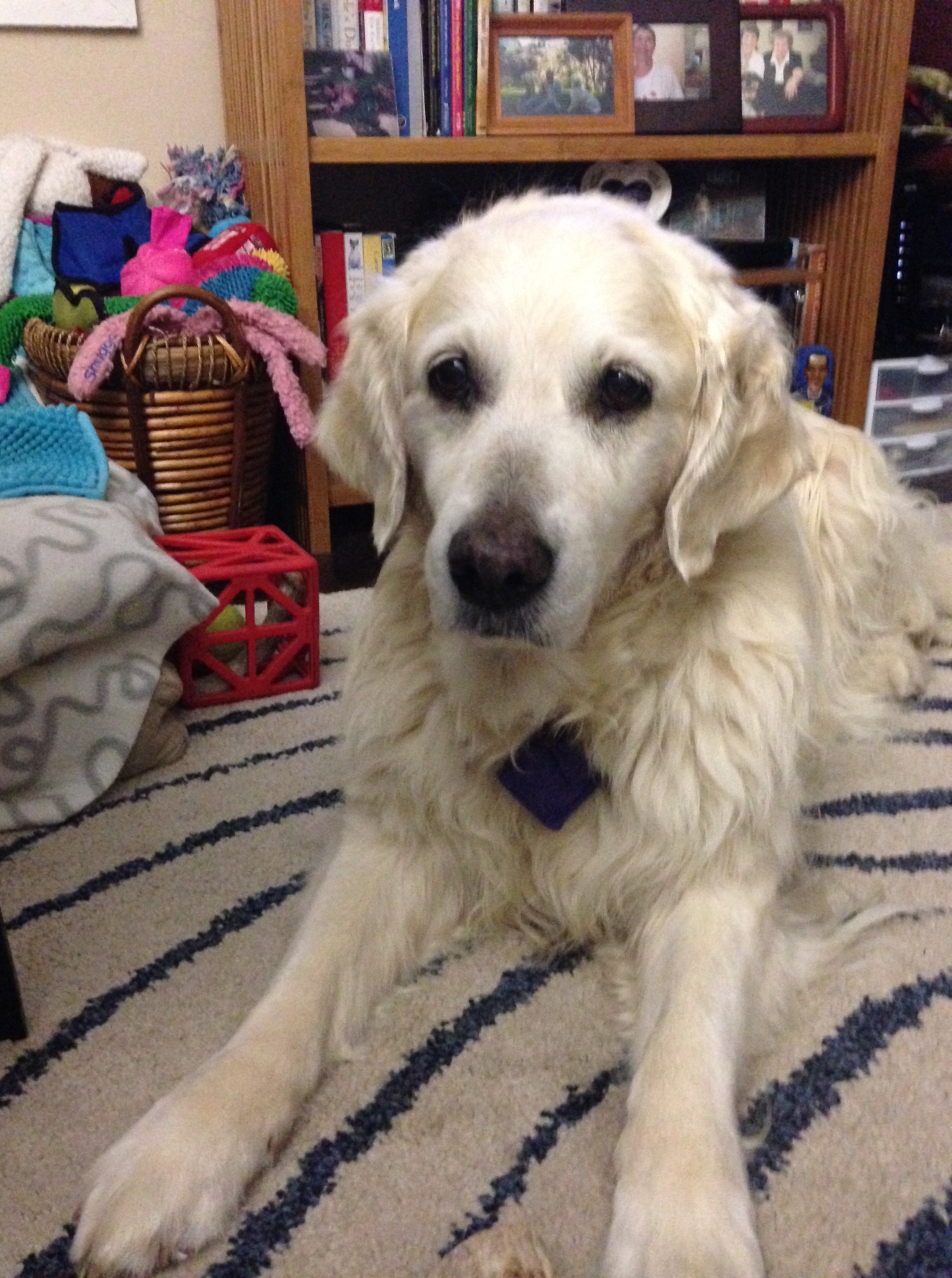
I live in a tiny apartment, but, in addition to the living room where I spend much of my time, the dogs have access to the yard most of the time, a bedroom (with very comfy dog beds), and the kitchen and bathroom,which offer a cool floor in hot weather. The vast majority of the time, Jana chooses to be in whatever room I am in. She gets up and moves if I do. Even if I tell her, “Don’t move; I am coming right back,” she goes with me. In fact, ages ago, tiny 7-week-old Jana attempted a huge flight of stairs when I ran upstairs to get something and she just didn’t want to be left alone for even a minute.Janas Bed age 2
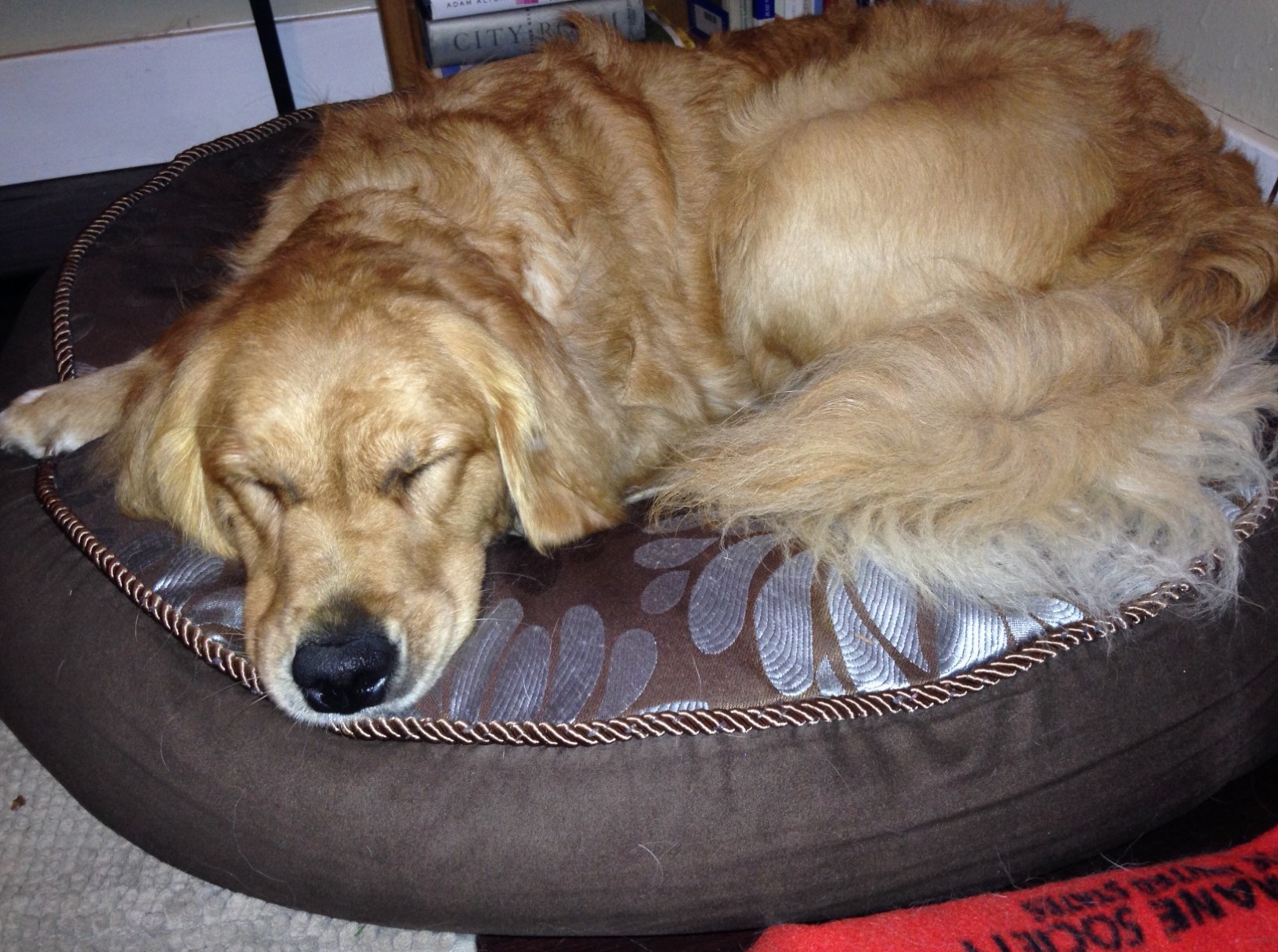
Cali is less consistent. If I move, she always comes to see if something fun is about to happen. But she often likes to nap on my bed or hang out outside when I am working in the living room. Even then, though, she comes and checks in very frequently.

This study seems to say that dogs enjoy just hanging out with their people. I am happy to know that. The more time I spend with dogs, the more I appreciate the true friendship between us; it’s nice (though not necessary) to see research studies confirming that this bond is valued by dogs as well.


 

Funny Girls

What's so funny, Cali?
What’s so funny, Cali?

Cali’s sister Dora recently spent several days with us, and I enjoyed watching them play, wrestle, and hang out together. It is fun and interesting to see how they are similar and how they are different. One similarity is that they both have a silly side and a goofy sense of humor.

All the dogs I’ve known, with the possible exception of a German shepherd, have had some concept of humor. They play tricks on each other and on us — keep away, hide and seek. They act silly. Cali lies on her back and wriggles around the living room, bicycling her legs. This never fails to get a laugh (and usually a belly rub and a play session). She especially likes to do this when I am on the phone.

Jana used to have a “geflite fish” stuffed toy that said, “Oy, vey …” and burbled when she squeezed it. This also was always good for a laugh. She’d dig it out and “oy vey” it whenever she thought I needed to lighten up. Sometimes, she’d stand and do it over and over, just to keep me laughing. She always watched me very carefully as she did this, as if gauging my reaction.

They don’t only enjoy getting me to laugh; they seem to like it even better when I do something silly and they get to laugh at me!

Jana LaughingCali and Dora lucked out. I had lunch with some friends while Dora was here, and we talked about different stretches and exercises we do at home. Someone talked about how important it is to do the “plank” pose from yoga, so I decided to try it. Well, that was about the funniest thing that Dora had ever seen. Cali wanted to play too, so she lay down and squeezed her head under one of my arms. Then she flipped over and wriggled until she was, belly-up, between my arms. Dora was — I swear — laughing. Literally ROTFL. I’ve never actually seen anyone do that!

The next trick was even better. I have a foam roller, and I use it to stretch my back. Fair enough. Hilarious, said Dora. She buried her head in my shoulder, laughing. I am sure she was laughing. Cali got in the act too, and within seconds, I had a fuzzy golden head peering at me from either side. Two big black noses in my face. Two girls nosing my shoulders, neck, face. Nudging. Occasionally, one or both could stand it no longer and buried her head in my shoulder. Laughing. Silly humans!

All those studies about how humans benefit from living with dogs? If laughter is the best medicine, I think it goes both ways.

Chow Hounds

How many of you have dogs who steal food from the table or countertop? How about dogs who beg? On the flip side, how many have to cajole and hand-feed dainty treats to a fussy dog?

Taking available food is a natural behavior for dogs, so puppies generally have to be taught to respect some boundaries and not “steal” human food. They don’t necessarily accept our characterization of “helping myself to a snack” as “stealing.” We also tend to disagree on what items belong in the “food” category, but that is a whole separate issue. Some trainers claim that dogs can’t be taught not to steal food, but that is absurd. Of course they can. But if they keep getting rewarded by tasty snacks left out on the counter, well, that’s not their fault, is it? If you have a food thief, management is necessary. Great temptation plus no chance of getting caught is a tough test for even well-trained dogs, especially once they’ve formed the habit.

I recently spent the weekend with family, including my “cousin” Beau, a boxer. He loves to do the dishes, and his humans allow him the pleasure of this “chore.” Despite knowing that he’ll get some, or maybe because he knows, he doesn’t beg. He’s totally chill while we’re eating, even when we eat sitting on the sofa, just inches from him (reclining on his dog bed).

Jana would never steal food from the table or counter. She generally respects boundaries. But, when she was a puppy, she was invited to a 2-year-old’s birthday party. She was unable to resist the temptation of dozen of cupcakes walking around at exactly her nose level. Never mind that each cupcake was being held by a toddler … She wasn’t invited to the 3-year-old party.

She did learn her manners, but, a girl has to give in to temptation once in a while. I came home with her once and my roommate was sitting on a low chair on the patio, eating a turkey sandwich. She leaned forward to get up, sandwich in hand … at nose level. Gone in one gulp. Well, Jana thought she was offering her the sandwich. An honest mistake. And the now-former roommate is still a good friend. Though I haven’t seen her eating a turkey sandwich when Jana’s been over, come to think of it.

Then there’s Cali. Cali begs. To be brutally honest, Jana sometimes begs. She does so by resting her chin on my lap while I am eating. Or staring me down. If I tell her to stop, though, she seems a bit embarrassed and stops. Not Cali. Shameless beggar. She’s never actually stolen anything, though I wouldn’t put it past her. Besides, she has a family history of food theft. Her great-aunt Oriel, an otherwise perfect dog, would steal food given the tiniest opening. Ory even stole sandwiches from picnic blankets in the park near our house.

Scarlett-Eating-Peas-07-01-16
Scarlett makes sure to eat several servings of veggies a day (Photo by James Cramer)

Cali feels entitled to some (all?) of whatever I am eating. She employs a combination of the stare-down, the nudge, the head on the knee, the LOOK … plus whatever pops into her head at the time. She’s relentless. And I have never fed her from the table, though I occasionally let her lick out a dish, it’s rare, and not at the table either. She will stop when I firmly tell her to settle and stop begging, but she never seems the least bit embarrassed. Hey, a girl’s got to try, she shrugs. She also checks out any snack I put on the little TV table. She’s never taken anything, and she leaves it when I tell her to, but she definitely pushes the boundaries. I wouldn’t trust her alone with a tasty dinner.

And then there’s Scarlett. She has Cali beat, paws down, for shameless begging and food theft. She steals vegetables right out of the garden! Her dad has to scheme and trick her just to get a few peaches off of his own tree!

IMG_2090But these dogs are all “normal” for retrievers. Retrievers are chow  hounds. You can’t leave food out when they’re around. I get that. What I don’t understand, what none of us understand is the fussy dogs. What kind of dog turns her nose up at chicken?

I’m not sure I’d know what to do with one. Deni hand-fed cheese and crackers to a fussy house guest last summer, who enjoyed her visit immensely and did not waste away from starvation while she was with us. But getting her to eat required some creative thinking.

It’s really a question of management: Managing expectations (ours and the dogs’) and managing opportunities, as in, not providing opportunities for the dogs to steal food.


She’ll Have It HER Way

Who else is old enough to remember the Burger King jingle about having it your way?

I’m sure Jana’s never heard it, but she’s completely on board with the idea. Jana is very particular about how she wants things done.

The other day, we set out for our usual morning walk. Except that she did not want to walk a block up Petaluma Blvd. to the crosswalk. Or a block the other way to the light and crosswalk. Nope. She wanted to cross on the corner of our street and head right to the little park a block in on the other side of the street. I could not convince her to walk to the crosswalk.

When she digs her heels in, nothing I can do will budge her. And I am not about to drag 61 pounds of elderly golden retriever down the street.

So we did it her way. She got to the park, rolled in the grass, smiled broadly, sniffed and rolled some more. Happy Jana. Then we went on our usual route to the big park.

On a Saturday morning, early, there’s not much traffic on Petaluma Blvd. so it doesn’t matter if we cross at our corner or at a crosswalk. On a weekday morning, I wouldn’t chance it. Other than traffic, does it really matter which way we go? Of course not. But to Jana, being able to express a preference and make a choice, even a trivial one, matters.

To Cali, too. When we play ball, if I take the “wrong” ball from the basket, she won’t return it to me. She’ll run over, sniff it, then give me a  reproachful look. That’s not my ball. I’ve learned. I pick two balls from the basket, any two, and let her choose. Then she plays happily with her ball.

Some afternoons, if Jana seems tired, I let her choose between a walk (I offer the leash) and her favorite toy (I also offer Squirrel Dude). Contrary to my expectation, she does not always choose Squirrel Dude, who comes with a bellyful of Charlee Bear treats. She often wants a walk. She always appreciates having the choice.

The choices are not monumental. It’s probably similar to letting your two-year-old child choose between two T-shirts when getting dressed. I’m not letting the dogs take over (I keep telling myself that, but even I don’t really believe it …); I’m just letting them have some control over their environment. There’s so much that I can’t give them a choice about that I am always happy to find things that they can decide for themselves.


Don’t Fake It …

I spent much of the day prepping for two short classes I am teaching on service dog access law. I’ve done this before, but most recently, I had an entire semester to teach students about access law and other dog-related laws. We spent seven weeks on the crazy quilt of federal laws that govern public access for people who have service dogs. Paring the vast amount of information down to two one-hour presentations is tough.

I decided that the most important things that the students, future service dog trainers need to know are:

  • The ADA might be the most important law to study, but it is far from the only law that touches on people with disabilities and service dog access
  • The right to be accompanied by a service dog is far from absolute
  • Not all dogs can be or should be service dogs

Beyond that, I hope to give this group of students an overview of the applicable laws and plenty of info on where to get more in-depth information.

The biggest problem with the number of laws and variations in how and where they apply is how easy it is for people to break the law — sometimes intentionally, sometimes not.

What do I mean?

People often confuse service dogs, therapy dogs, and emotional support animals.

Service dogs, individually trained to assist a specific person by performing tasks that mitigate that person’s disability, are often seen in malls, restaurants, supermarkets — almost anywhere that members of the public can go. The ADA, the Americans with Disabilities Act, gives people with an ADA-recognized disability the right to take their service dogs into these places. But dogs that merely provide comfort or “emotional support” are not considered service dogs. Animals other than dogs (with limited exceptions for miniature horses) are not covered by the ADA.

However, people can get permission to live with an emotional support dog or other animal in housing that doesn’t allow pets. Other people get their dogs certified as “therapy dogs” and visit hospitals, schools, and other places that normally do not allow pets. What gives?

Different laws govern access to housing, air travel, Veterans Administration facilities … the laws are confusing. There is no requirement for any kind of public access test or identification. Emotional support animals that accompany people in no-pets housing or on airplanes are not required to have any training.

Many people honestly believe that they have the right to take their pet along to the coffee shop because they have a letter, a “prescription” that turns their pet into a service animal, or because they’ve passed a test given by Pet Partners or another therapeutic pet organization. Other people know that they are breaking the law when they purchase a vest online and head off to the coffee shop with Fido in tow; they just don’t care.

They also might not think they are harming anyone, but that’s often untrue. Most pets are not temperamentally suited for the stress of being in public. Stressed-out dogs might pant, drool, pull toward an exit, hide behind the handler  — or become aggressive. It’s not fair to subject a pet to this level of stress. A dog that is reactive to other dogs, has high prey drive, or any tendency at all to behave aggressively should not be in public. These dogs pose a threat to other people and to people with legitimate, well-trained service dogs.

What’s important for everyone to know, whether members of the public, pet owners, or managers and employees of businesses, is that the right to access is not an absolute right. A person can be asked to remove a dog who is misbehaving, is showing aggression, or is not under the handler’s control — even if the person does have a disability and even if the dog is a trained service dog. Asking a person to remove a dog under those circumstances is not a violation of access laws.

Ethical service dog trainers are careful about which dogs they place as service dogs, both to ensure that the person’s needs are met and to ensure that the dogs they place are comfortable and safe working in the public eye. Service dogs get lots of attention, including petting and hugging from random children (and adults) who run up to them out of nowhere. They endure a barrage of noises, smells, and sights that most pets cannot even imagine. Not all dogs can (or want to) do this work. It’s unfair to expect an unprepared, untrained dog (or other animal) to behave perfectly and calmly in public, even if he is wearing a really nice vest. And it is unfair and unethical to endanger properly trained working dogs and members of the public by taking a poorly prepared, frightened dog into situations that he or she cannot handle.


Miscommunication

IMG_3201I was on deadline, struggling to communicate with my computer (and failing). Cali came over and ever-so-gently nudged me. I patted her and kept working. Another nudge. I had taken a ball-throwing break about 10 minutes earlier, so I distractedly said, “Not now,” and kept working.

Another nudge. I ignored her. More nudges. Insistent, but so, so gentle and sweet. I patted her, told her to wait a few minutes, told her she was cute. Not what she wanted. This went on for about 10 minutes, I’m embarrassed to admit.

Finally, deciding that rebooting my computer was the only possible step, I shut everything down, rebooted, and got up. “OK, Cali, where’s your ball?” I asked, wandering outside.

Cali wasn’t outside. Neither was her ball. I called her again and looked around the yard. No Cali, no ball.

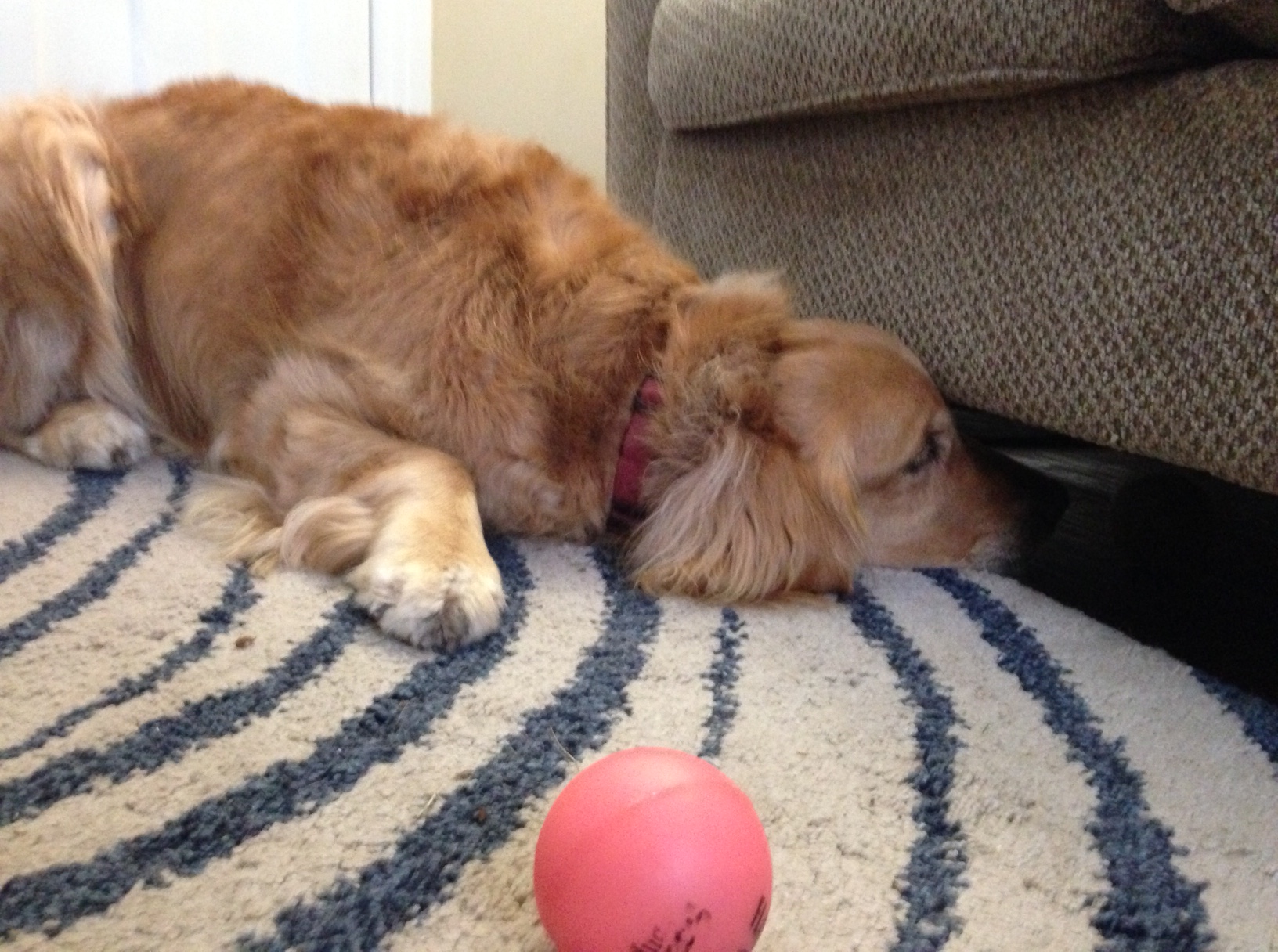
IMG_3195I went inside. Cali was standing in front of the sofa. She came to me, then walked back to the sofa. Touched it gently. Looked under it. Touched it. Looked at me.

The ball was under the sofa. Actually two balls were under the sofa, one dry, dusty, covered with tufts of fur. So much for my housekeeping skills. And my communication skills.

I gave her back the ball. She graciously allowed me to throw it twice, but really, all she wanted was her ball. And her long-lost second ball. She happily stretched out in the yard nuzzling the balls as I went back to work.

I’m constantly amazed by how clearly our dogs communicate — if we’re paying attention. And of course, this clear and detailed exchange reveals how little actual words matter to human-dog conversations. No, our communication does not suffer from dogs’ inability to speak human language. It suffers from our inability to pay attention, to focus on what they are saying — without words, but with eloquence nonetheless.

Because You’re a Golden Retriever

“Come with me,” the vet said to Jana. “I want to take a look around with the ultrasound. Because you are a 13-year-old golden retriever.”

Jana’s having surgery. By the time this gets posted, she’ll be well into her recovery, demanding that treats be brought to her in bed, thumping her tail imperiously as her army waits on her.

As a dog of a certain age who takes Rimadyl, Jana needs regular checkups. Her very thorough vet likes to get that “look around,” and has been tracking what turned out to be a small mass on Jana’s spleen. Luckily, Jana can live just fine without her spleen. Even more fortunate — additional tests show no sign of cancer anywhere else.

You see, because she’s a golden retriever, the most likely kind of cancer is hemangiosarcoma, which can spread quickly to the lungs, the heart, throughout the body. If the mass is cancer and if the had spread, the prognosis is very poor. So, no sign of spreading is very good news. The mass could also be benign. The problem with spleens, I am told, is that they are very delicate. Rupture can be fatal. A mass, an attempt to biopsy a mass, or an attempt to remove part of the spleen can all cause massive internal bleeding. So out it came in its entirety.

If it’s not cancer, or it is cancer that hasn’t spread, Jana will be just fine. She’s enjoying the pampering that comes after the surgery; she enjoyed the beach day that came before the surgery even more!

Jana’s recovery has been surprisingly smooth. She’s taking some pretty good pain drugs, but she’s not taking that many pills. She has been leaving her stitches alone, and was eager to go for a (very short) walk a couple of days post-op. She’s one tough cookie!


Pets and the Environment: A Partial Review of and Response to Run, Spot, Run

Run Spot RunIn Run, Spot, Run, author Jessica Pierce devotes a chapter to “Pet and Planet;” the environmental impacts of owning pets. This chapter considers a few areas: the effects of environmental toxins on our pets, the environmental impacts of pet-food production, and the effects our pets themselves have on the environment. In just a few pages, she really had me thinking hard.

The first one’s relatively easy. I filter our tap water, don’t use horrible chemicals to clean my tiny apartment, don’t buy Jana and Cali those vinyl toys that last about 5 minutes and leach terrible phthalates (whatever they are; all I know is that they’re bad) into our pets’ bodies. Basically, I protect Jana and Cali from environmental pollution as well as I can — and at least as well as I protect myself.

The third one is a bit tougher: how pets affect the environment. I often think that future civilizations, having unearthed millions of those knotted plastic poop baggies, will think that dogs were in charge (they’ll be right …). Pierce also mentions all the stuff we buy our pets. Yep, three cushy dog beds in my minuscule two-dog home. Big basket of toys. At least six leashes. Cali’s cowgirl hat. Stuff galore. I can rationalize the environmental impact of my pets: I don’t go overboard; I don’t generally buy a lot of stuff. All of our life choices have some impact on the environment — and they’re not always bad. I walk a lot more because I have dogs, spend more time outside. I pick up trash so my dogs won’t eat it; I pick up other dogs’ poop at the park. People have children despite their impact on the environment (and they require a lot more stuff than dogs). Getting the typical American child from birth through potty training results in a pretty big pile of plastic diapers. While I think that pet owners and petless people alike should do what’s feasible to minimize the damage they cause to the environment, I am not convinced that it’s a convincing argument against having dogs.

It’s that middle one, the pet-food production argument, where I have the most trouble. I don’t eat meat, mostly because I dislike everything about the food-animal industry. I think that being vegan is the best choice, though I am not there yet.

Cali and Jana are not vegetarians.

I buy high-quality dog foods for them and make sure that all their food is sourced and produced in the USA (or, at minimum, from trustworthy sources that are not in China). But … meat and seafood consumption are key contributors to global warming, pollution, and over-fishing. Ironically, those of us who seek top-quality ingredients for our pets exacerbate the problem. Cheap pet foods use a lot of the waste material from the food industry. The standards for what can be used in animal feed are distressingly and disgustingly low. But by insisting on good quality ingredients, I fuel the same factory farming industry that I have opted (mostly) out of for myself. One suggestion Pierce offers is that people buy sustainable meat and fish for their pets and decrease their own consumption proportionally. That argument has some merit, and I’ve made great progress … on the “reducing own consumption” part.

If the goal of an ethics book is to get people thinking about tough questions, Pierce’s book is already a huge success, and I am only halfway through it. I doubt that anything she says will convince me not to have dogs. But I don’t think that’s her goal. Getting readers thinking will lead to changes in their behavior. Cali and Jana are already looking forward to lovingly home-cooked meals of organic, pasture-raised meat, sustainable seafood, and local organic veggies … in their dreams.

What Have I Done?

Relaxed Jana_cropIn a couple of weeks, I will start a new job. It’s a full-time job at an actual office. I haven’t done that in a while, and I have enjoyed a lot of aspects of freelancing, especially the amount of time I get to hang out with Cali and Jana.

I’m already planning early-morning walks and looking for local dog walkers. I’m trying to figure out how other people manage to work full-time and have dogs — and even kids and spouses. Wow. I used to be able to get everything done while working a demanding high-tech job. I was a lot younger then … but I know it’s possible. The dirty secret of freelancing is that I waste a lot of time. I know I can do things more efficiently.

Sad Cali

Still … the quality of life issue is not trivial. Our pets pay the price for our decisions. I’m  reading Jessica Pierce’s book, Run, Spot, Run, mentioned in a recent post, about the ethics of having pets. She raises a lot of good questions — and she offers no easy answers. I also keep seeing commentary on the tragic killing of Harambe the gorilla and its implications for keeping nonhuman animals captive.

I do look at dogs differently from the way I consider captive wild animals. Dogs are so much a creation of their relationship with people that I cannot argue that living in human homes is unnatural for them. But their need for social contact, their tremendous cognitive and emotional intelligence, and their dependence on us to meet all of their needs all mean that we can’t just interact with them a few minutes a day, when it suits us, and tell ourselves that they’ll be fine on their own for the other 23 hours-plus of every single day.

It’s a question of balance. I will still give Cali and Jana two walks a day, most days, when I start working. I will find a dog walker for some days. I’ll try to think of other ways to make their environment more interesting. I will tell myself that, even when I am home, they spend plenty of time sleeping or just ignoring me. And I will do fun things with them on weekends.

But I will still feel guilty. Especially when Cali gives me that look.

The Experts Finally Noticed

That dogs have feelings, emotions, and thoughts probably seems obvious to readers of this blog, as well as to most people who share their lives with pets. But, as I tell my students at Bergin U, sometimes things need the stamp of approval of science, via peer-reviewed research, to be fully accepted as Truth. Many, many studies of dogs’ behavior and cognitive abilities do not, actually, reveal anything that we didn’t already “know.” But these studies solidify that knowledge and induct it into the Body of Knowledge that gets academic credit, credibility, proof.

That’s why the establishment of a new scientific journal dedicated to the study of animal sentience is significant. Acknowledgement and study of animals’ thoughts and emotions has grown tremendously over the past twenty years or so. Now, those studies have their own journal. Animal Sentience: An Interdisciplinary Journal on Animal Feeling is a publication of the Humane Society Institute for Science and Policy (HSISP), based in Washington D.C.

Alva Noë, a philosopher, says in an NPR article that “A new scientific journal is not merely a new venue for publishing research, it can encourage new science, create a new community of investigators and, to some degree, contribute to the establishing of new fields.”

That’s an exciting thought for people who care about nonhuman animals — and dogs in particular. For centuries, dogs were not considered worthy of academic study. Now, several universities host canine cognition labs; at Bergin U and elsewhere, students study the canine mind, along with canine behavior and communication, as they explore ways to expand the human-canine partnership.

The journal embraces a broad definition of sentience or “feeling”: “Feeling can be any sensation, such as seeing, hearing, touching, tasting, smelling, moving, wanting, pain, pleasure, emotion, mood, anticipation or intention.” Intention. Anticipation. I know that my dogs experience these higher-level “feelings.” I also know that generations of researchers have been ridiculed for asserting that dogs (or any nonhumans) could.

It matters that people recognize dogs’ sentience so that the we can improve how we, as individuals and as a society, treat dogs. Before we had anticruelty laws, we had to know that animals could suffer, could feel pain. Now, as we consider how dogs fit into our lives and our society, it is equally important to recognize that they feel more than pain. They think, wonder, plan, feel happy or sad, they grieve — and they empathize when we feel sadness or grief. How do we need to change our laws and our treatment of dogs to accommodate this new understanding?