Is Cali a Wagg’n Dog?

Cali plays with a new friend at Wagg'n indoor dog park

Last week, I wrote about dog parks in general. Here, I want to share Cali’s experience with an indoor dog park, Wagg’n, in Missoula. I think the concept is great. Missoula, Montana, has a lot of winter. Cold, gray winter. Plenty of fluffy snowy winter, too, the kind of days we want to play outside. But when it was 7 degrees, I was really happy to have an indoor play space available.

The park is set up nicely. It’s a huge warehouse-type space with a high ceiling — including several skylights, so it’s bright — and it is bright and clean. The floor is matted with recycled rubber mats, and there’s a potty area with fake grass, an efficient enzymatic cleaning system, and drinking fountains. It does not smell doggy or kennel-ey at all. There’s a double gate at the entrance, and there are always at least two staffers, usually three, on hand.

On the rare occasions that a dog has gotten out of hand while I’ve been there, the staff are calm and professional in how they de-escalate. I have never seen any dog show aggression while I’ve been there. The worst I’ve seen is overly exuberant play or a dog that keeps trying to engage another dog who is clearly saying he’s not interested, is overwhelmed, or is stressed out.

I have seen several dogs show signs of stress, however. Including Cali. Some dogs there for daycare spend their time under a sofa or on the lap of any available human, for example. Others hang out at the gate, trying to escape. Not good.

Cali is a bit of an enigma. She gets excited when we drive there, and she clearly knows where we’re going (it’s out by the Missoula airport in the middle of nowhere … we never drive that way when we’re going anywhere but Wagg’n). She’s excited when we get out of the car and happily — excitedly — greets the owner and staff. Then … she hangs back a bit when we head into the play area. She likes to be on the sofa or a bench, often with me, at first. Within a few minutes, though, she jumps into the fray and chooses a dog to play with. She can be a little bratty and pushy if the chosen dog doesn’t reciprocate … leading to intervention from me, Cali getting back on the sofa, etc.

She enjoys the playtime. She also spends a lot of time with me on the chairs there, drooling (a sign that she’s excited and/or stressed). She wants to go there, but while we’re there, I watch her pretty closely. When she’s had enough, which can be after 15 minutes or after an hour and a half, she wants to go. Now.

I wouldn’t leave Cali there all day for daycare or board her there. She’d be overwhelmed by that much stimulation and social time. Other dogs are fine with it; many of the regulars are happy and cheerful whenever I see them. But as a place to take a break, stretch her legs, and play, it’s great. And very necessary during a long, cold winter!
Are Dog Parks Worth the Risk?

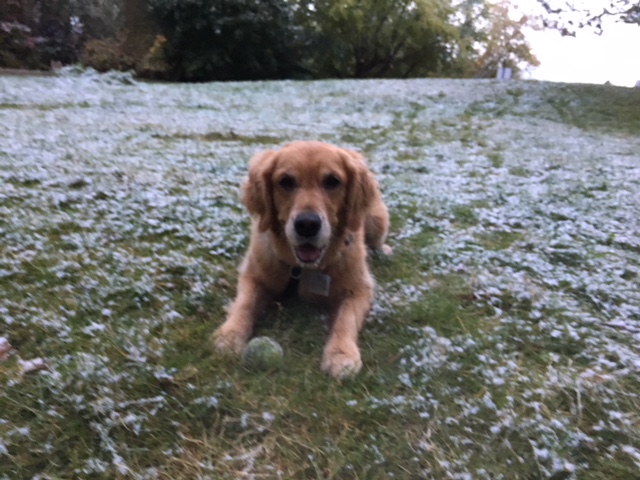
Cali holds her tennis ball at Jacob's Island dog park, early on a cold morning. A light dusting of snow covers the grass.

The current issue of the Whole Dog Journal has a section on dog parks. Though the article itself offers solid commentary and advice (of course it does; Pat Miller wrote it!), the sidebar with comments from several trainers is pretty negative. I’ve been to a lot of dog parks, so I figured this was a good chance to weigh in.

If you are thinking about heading out to the dog park, start with Miller’s seven things to consider, but don’t neglect an honest look at your dog(s), the dog’s needs, and your own circumstances.

My best dog park experience was in Petaluma, where Jana, Cali, and I walked to a local park every day (sometimes twice!). The park has posted off-leash dog run hours and is mostly fenced. When we discovered it shortly after moving to Petaluma, a regular group of dogs and their people could be found there. We soon became part of the 8 am crowd. Jana greeted each human and inspected their pockets and hands for treats, Cali occasionally played with suitable dogs but mostly bugged me to throw her ball, and I got to hang out with some fun and interesting dog-loving people. Over the three and a half years we lived in Petaluma, dogs passed away, new puppies joined the crowd, and the human group changed. Toward the end of our time there, Jana was gone, and Cali found the group of mainly young, high-energy dogs less to her liking. I was working in an office, so we went much earlier in the morning on weekdays and had the place mostly to ourselves. Weekends were more challenging.

Now, in our first Missoula, Montana, winter, we’ve joined Wagg’n, an indoor dog park. It’s also a daycare and boarding business, so the mix of dogs varies. We’re getting to know some of the daycare regulars, and Cali and I each have our favorites. Like the Petaluma park, it’s not divided into small- and large-dog areas, which would worry me more if I had a small dog. Cali’s not that interested in boisterous group play, but she usually finds one or two smaller dogs, goldens, or Labs to play with (she’s kind of a doggy racist and likes only retrievers and little dogs). Being inside changes the nature of the space considerably; it’s echo-ey in a way that an outdoor park is not, and dogs do play differently on the rubber-matted floor (with a nicely designed astroturf potty area) than they would on grass or dirt.

Before the weather turned cold and mornings became dark, we went to Jacob’s Island, Missoula’s downtown dog park, several times a week. We went early, though, on purpose, so Cali and I could play ball without her having to worry that some other dog would “steal” her ball.

These are my primary experiences of having a “regular” park, but I’ve been a drop-in visitor at dozens of dog parks. I’ve driven cross country multiple times with multiple dogs. And when traveling with dogs anywhere that’s more than about 4 hours, I generally look for a place to let the dog run and stretch her legs. Visiting dog parks “on the way” does not allow for the type of research that Miller advises, but I approach these visits as I would any new place I take my dogs. I watch for a few minutes to get a sense of the energy level, see what kinds of play the dogs are engaged in, and I look at whether the people are paying attention to their dogs or just looking at phones or talking to each other and “letting dogs be dogs.”

Like the trainers quoted in the WDJ article, I’ve heard lots of dog park horror stories, and I know that a bad experience can lead to serious injury (or worse); at minimum, it can set back your training and socialization goals considerable, shake your dog’s confidence, or lead him to fear other dogs. Though I have never personally had a bad dog park experience, I am not unaware of the risks.

I won’t take a dog into a park where I see lots of wild or rough play or people who are not paying attention to the dogs. If I cannot tell which people go with which dogs, I take that as a bad sign. The people need to be obviously watching what is going on with their dogs; otherwise, how can they intervene if needed? The person has to be the dog’s advocate and protector in any social situation, whether with other dogs or with humans (especially if children are around). I’ve leashed up my dogs and left parks where the dynamic changes, a particularly troublesome dog enters, or I feel that things are getting too wild.

At the same time, looking for dog parks is as much a part of my road-trip planning as looking for pet-friendly hotels. I can’t imagine asking my dog to spend 8-10 hours in the car without giving her a chance to run and play. Often, just wanting to throw the ball for a few minutes, I look for a corner or end of the park with fewer dogs and head there. If another dog seems overly interested in Cali’s ball, rather than subject her to the stress of worrying about it, I’ll pick up the ball and instead lead Cali on a brisk walk around the perimeter of the park.

The bottom line is that, while aware of potential problems with dog parks, I am usually willing to try out a park and find a way to make it work for my dog and our needs at the moment. I’d never leave Cali unsupervised, and that means no phone either — eyes on the dog at all times (I do sometimes take photos). It also means watching other dogs and intervening if they are rough, pushy, or overwhelming to Cali. Finally, it means being ready to pick up and leave quickly if necessary.

Getting to Know You …

Cali’s tail never stops wagging as she follows her nose.

A recent column in the Whole Dog Journal had these two sentences, part of a longer description of a coonhound learning to trust humans (the column is well worth a read; in fact, nearly everything in WDJ is worth reading):

The only clue we had that she actually did like attention was that if you sat in her presence, she would come and stand very close to you; she liked to put her face very near your face – a quite uncomfortable sensation with a dog who has no expression, and isn’t wagging her tail or trying to lick you. She would just approach, stand very close, and hold very still – odd.

This caught my attention because Cali does the same thing. Well, Cali has a very expressive face and is nearly always wagging her tail, sometimes even in her sleep. But the ‘putting her nose right next to people’s mouths’ part is the same.

I think that dogs do this to learn about people. They pick up a lot of information from smells, far more than whether we’re overdue for a dose of mouthwash. They learn about other dogs that way, both in person and by sniffing the ground.

Cali often does this breathing exercise while also giving the person a hug (she gives great hugs), possibly begging for a treat (or sniffing the person’s plate), or nuzzling the person. But often, she just inhales … soaking in the essence of her friend. And almost everyone is her friend — or would be if she could only meet them!

I’m not sure whether Cali is doing this more, as well as sniffing the ground more carefully and thoroughly since we started doing scent work classes or I am just noticing it more. But she does seem to be very attuned to her nose lately. When we played ball in the snow this morning, though, I noticed that she doesn’t seem to be able to detect the scent as easily. She ran right past her ball several times, sniffing the air, and did not seem to know it was there. She’s generally very good at finding it with her nose.

Of course, it could just be that she loves running around in the snow


Smarter Than Cats

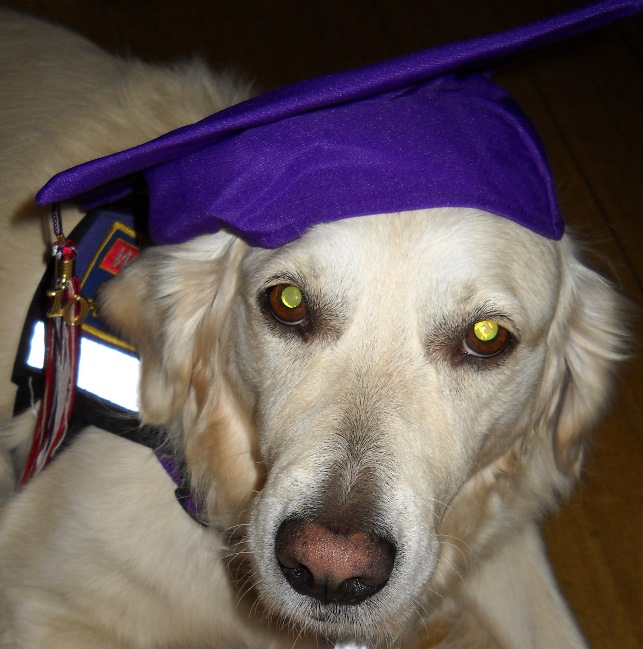
A white golden retriever wears a mortarboard. Dogs are indeed smarter than cats!

Finally, science backs up what we all know: Dogs are smarter than cats.

The study looked at the number of neurons in the cerebral cortex of carnivores, including dogs and cats. According to “Research News @Vanderbilt” writer David Salisbury, these are associated with thinking, planning, and complex behavior — “hallmarks of intelligence.” He quotes the study’s author as stating that the findings mean that dogs  “have the biological capability of doing much more complex and flexible things with their lives than cats can.”

My favorite line in the study‘s abstract: “We find that the golden retriever dog has more cortical neurons than the striped hyena, African lion and even brown bear, even though the latter species have up to 3 times larger cortices than dogs.” Cali, Jana, and I have always known that golden retrievers are superior beings; still, it’s nice to have evidence.

The study also found no apparent effect on neuron number from domestication. The researchers found that the domesticated dogs and cats did not have smaller brains for their body size than their wild relatives. It also found that larger carnivores, such as bears, have fewer cortical neurons relative to their brain size and that carnivores do not pack greater brain power than their prey.

I like this study because it doesn’t take something irrelevant to one or all species tested and attempt to make a comparison. Dogs’ brains are different in lots of ways from wolves’ brains because dogs’ lives and needs are different in so many ways. For instance, another recent study looked at the ways dogs and wolves collaborate. Wolves were better able to solve a problem that required cooperation to get food. That makes sense. Wolf packs hunt together — or starve. Dogs train their humans to dump food into the bowl at the same time every day and, with varying degrees of success, to hand out snacks at other times of the day. Other studies try to compare the intelligence of dogs and wolves, dogs and chimps, different breeds of dogs … you name it. But too often, they use yardsticks that don’t reflect the ways dogs use their considerable intelligence.

Knowing that dogs have more of the thinking and planning cells than cats makes sense if you look at the different ways dogs relate to people. Thinking, planning, problem solving, and other complex behaviors are the basis of the many ways that dogs and humans work together. While cats may be equally adept at getting humans to take care of them, most cat-person partnerships begin and end there. Canines are more social than felines, and domestic dogs have turned their focus from pack hunting and social living to myriad other tasks, to the great delight of humans everywhere.

You (and your dog) might want to be careful, though, if you live near any raccoons. Raccoons were the brainiest carnivores studied, having the same number of cortical neurons as a dog —packed into a cat-sized brain. Who knows what they are planning! 

SNOW!

On the fourth night of Hanukkah, Cali got her wish: Snow. Fluffy, white, untouched-by-dog-paws snow.

It started snowing in the afternoon, and she got a little taste of it on our afternoon walk, but not much had accumulated. I went out to a dinner party and got home a little after 9. I put on my boots, put Cali on her leash, and gave her the best present of her life. We walked a bit, then I just dropped the leash and let her run. There was no one else out, no cars moving in the parking lot, and the space between two apartment buildings was so inviting. All that new snow!

As she has on encountering open spaces before, Cali ran crazy circles and figure eights around the picnic tables. She did something a little different this time, though: Every couple of circuits, she’d bound over to me, play bow, dance a little, then take off again. I scooped up snow and threw it in the air. It was so dry and powdery that I couldn’t make a snow ball to throw, but Cali caught the flying snow and licked it from her nose. She plowed into the snow on the ground with both nose and paws. She ran more laps around the picnic tables.

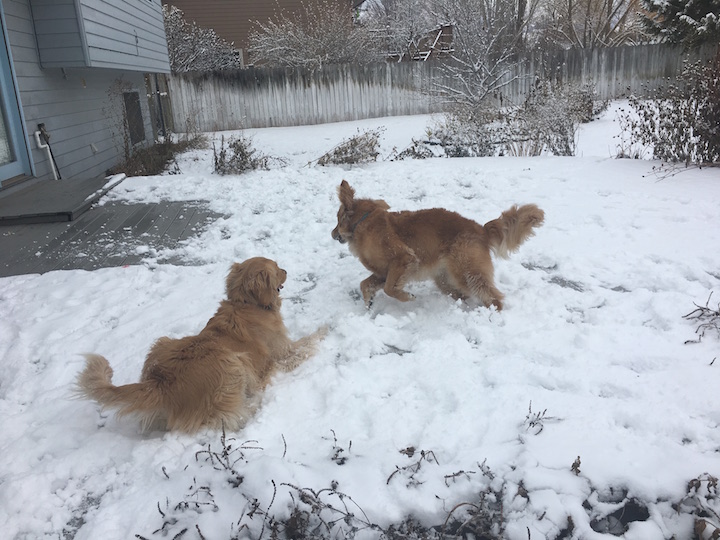
The next morning, we visited our friend Scarlett (who has a back yard!) and both girls ran around and around in the snow. We played ball in the snow, too. The snow is still here (Cali doesn’t know it yet, but the snow is likely to still be here weeks and months from now…) and she still thinks it is wonderful.


Cali and the Magic Box


This slideshow requires JavaScript.


Cali’s head whips around. Her body follows her nose. She’s on the scent.

She started doing this at her second or third “nosework” class — as she ambled around, haphazardly looking for the target. Suddenly, she’d catch the scent and be off, following that now-beloved birch scent to the magic box. All she had to do was touch this box and her devoted servant (me) would start showering her with praise and treats. Really good treats. Yum.

Cali “got it” very quickly. When practicing, I have to put her in the bedroom and close the door so I can hide the magic box. She trots out eagerly, nose in the air. Within seconds, that nose whips around and she’s dancing beside the box.

The road to nosework expertise is not without bumps. At one point, Cali started bashing the box with a large, soft paw. When we switched to cardboard boxes, she thought they might make a nice snack.

Despite the minor hiccups, Cali continues to progress in her scent-detection abilities. She’s putting them to work daily. Though Jana enjoyed the concept of smell walks throughout her life, Cali had never been interested in sniffing her way through town. Now she thoroughly investigates the many (many, many, many …) places along our daily walks that other dogs have marked. I never knew it could take so long to walk around a parking lot!

She’s suddenly developed a deep interest in squirrels, too. Montana squirrels are a lot more interesting than California squirrels, apparently. Especially the one that hangs out near the veterans’ apartment building next to our apartment complex. Oh, and the one that raids our bird feeder any chance it gets, whom Cali seems to enjoy watching.

Back in “nosework” class, we’ve moved from hiding the scent in boxes to moving it around. Cali quickly grasps each new step — at least, in class. Watching her try to understand the new “rules” at home is interesting. She is a living illustration that content and context both affect learning. In plain English — don’t change everything at once. She did find the scent hidden in a plastic container this morning, as well as under the sofa and on a shelf. She’s is following her nose for sure; she can’t see where I have hidden the tin with the scent stick. She’s not very methodical in her search, but she is thorough. And she gets very excited when she finds it.

What’s great about the scent game is that we can play it all winter, indoors, with little changes, and – so far — Cali’s enthusiasm hasn’t faded a bit.


Freedom!

Cali lost her head over Thanksgiving. We spent the week at her Favorite Place in the World, also known as Deni’s Lolo, Mont., house. We were sharing the holiday with Alberta and Mack, two lovely dogs who live there.

Well, the most important thing to know about Deni’s Lolo house is that it has a lot of land and is surrounded by even more open, unfenced land and national forest.

The first day, we set out for a walk around the property and, well, Cali lost her head. She took off running and she ran and ran in giant loops around the meadow, up and down hills, in and out between trees, around and around and around, for several minutes.

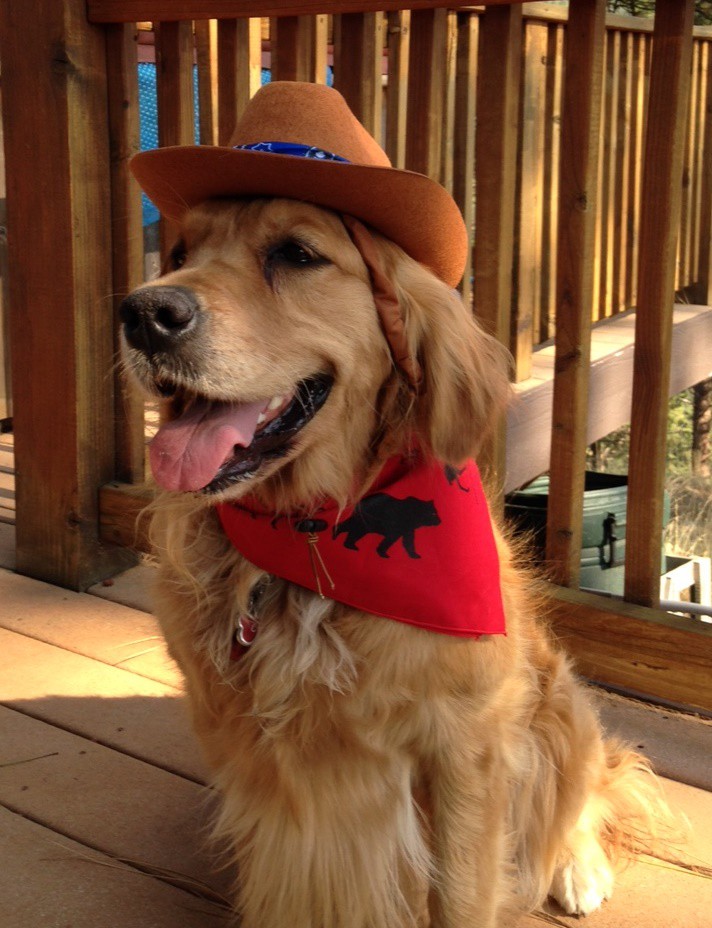
Cali, wearing a cowboy hat, smiles broadlyThe first time Cali spent a summer in Montana, I decided that “Don’t Fence Me In” should be her theme song. When we returned last summer, we stopped at Packer Meadow, which is at Lolo Pass, right on the Idaho — Montana border, about a 30-minute drive from Lolo. Koala was with us, and the two dogs did the same sort of “lost-our-heads, can’t-stop-running” exuberant celebration (see the video for a tiny sliver of their romp).

There is nothing more joyful than watching a dog run free. And dogs seem to know when they are truly free, versus in a large, open, off-leash, but fenced area.

Cali has a good life. Every day, wherever we’ve lived, I’ve taken her someplace that she can play ball and run around off leash. But it’s nearly always a yard or park that is a contained, fenced play area. She loves it, but she knows the difference.

A Cognitive Moment

Koala is learning to open doors.

This is actually tougher than it sounds. Teaching Jana this very task, 13 years ago, led to the moment that I first realized how smart Jana was — and how phenomenal dogs’ cognitive abilities are.

The task is opening a closet door. Doors with lever handles, rather than round doorknobs, are easier. The dog can easily be taught to push a door open (or closed) when the door is ajar. It’s also pretty simple to teach a dog to press the lever to release a latch and push open a door that opens inward. (Koala’s got that; see the video.)

The challenge is opening a door that needs to be released, then pulled outward.

Jana had a solid understanding of “open” and “close” the door and was easily opening the inward opening doors when we turned to this challenge. To open a latched door, she’d do an “up,” putting her front paws on the door. She’d release the latch by pressing the lever with one paw, and her weight would push the door open. This worked great for doors that could be pushed open, but presented a physics problem for doors that opened outward. The very weight needed to release the latch also pushed the door shut again.

As a new trainer, I could not figure out how to tell Jana what to do. (Honestly, I still don’t know how I’d communicate it.) I put her favorite toy behind the door and encouraged her to keep trying. Watching her repeated attempts was frustrating. But then …

Jana had an epiphany.

She put her paws on the door, as she had so many times before. She paused, looked at the door, then, slowly and deliberately, moved her right paw a couple of inches to the right. She placed her paw firmly on the doorframe. Then she triumphantly pushed the lever and pulled toward herself in a fluid motion. The door opened.

I was astonished.

That one moment was enough. Jana had solved the challenge.

Koala needs to make that same cognitive leap. She’s older (Jana was several months old at the time) and has had far more training. And Koala is a top-notch problem solver. I’m betting that she’ll get it after only a few tries. I’ll let you know when she does.

Tips for Keeping Older Dogs Safe and Comfortable


A beloved friend, Molly, turns 14 today (November 13). Happy Birthday, Molly!

In her honor, I wanted to share some tips for helping older dogs stay safe and comfortable.

When Jana started having trouble getting up because she slipped on the smooth floors, I followed a tip from my aunt and got rubber mats. They are not the most attractive addition to household decor, but they work. Yoga mats can be used as well. The most important place to put them is near the dog’s bed(s). We lived in a tiny apartment, and I put them all along the hall and in the bedroom, giving Jana a non-slip path from bed to door. Oh, and the bed? A really nice, big, memory foam dog bed from Costco. Jana sure loved to sleep on the floor next to that bed …

Keep the dog as active as is feasible. Even a slow walk is important. It gives the dog a chance to stretch her legs, move around, sniff and catch up on the neighborhood news. Even when she was well past even pretending to want to play ball, Jana wanted to walk with Cali and me to the park, where she greeted friends, begged for cookies, and rolled in the grass.

Keep nails trimmed. Long nails can hurt when the dog walks. They also exacerbate any balance or joint issues, which are common in older dogs. Many dog owners neglect their dogs’ nails. Even if long walks on sidewalks kept the nails to a reasonable length when the dog was young, an older dog who walks less (and experiences poor balance and possible joint pain) is likely to need more attention to the nails.

Make it a priority to do activities that you know your dog loves doing. A huge regret I have is not taking Jana to the dog beach more often. Other activities she enjoyed included hanging out at the corner cafe (sans Cali), solo walks, sunning herself in the yard, visiting her friend in a nearby office, and any activity that involved cookies.

If there are younger pets or kids in the family, teach them to treat the senior with gentleness and respect, and intervene if necessary to ensure that the youngster doesn’t push the older dog around or treat her roughly.

Make sure that her food and water bowls are in a place that’s easier for her to reach, or elevate them so a large dog doesn’t have to lean (that balance again …) down to eat and drink. Jana seemed to really appreciate her elevated bowls.

Take a look around your house. Are there stairs that the dog has trouble navigating? Does she have trouble getting into or out of the car? We had no stairs, so that wasn’t an issue for Jana. I kept the passenger seat in the car moved up so she could easily step into the foot space and then onto the seat. She needed help sometimes, but preferred to get in and out alone. When she was weak, though, I used a sling to help lift her into the car. A towel works in a pinch. If you do have stairs, and your dog is prone to stumbling or becoming confused, consider blocking the stairs with a baby gate for safety. When we were in a house with lots of stairs, I would block the stairs to discourage Jana from following me if I ran up to get something. She always wanted to follow me, but if I was coming right back, I wanted to spare her the effort and pain of extra trips. She disagreed, so I used the baby gates.

Look into supplements, medications, and alternative treatments than can help with chronic issues, especially pain. I limited the amount of Rimadyl that Jana needed by taking her for regular laser therapy treatments, which reduced her arthritis pain and stiffness. Not all dogs respond to the same treatments, so you might need to try a few different things. But once you hit on something that helps, you will know; the dog will be more playful and happy. Some of the lying around and sleeping is a response to pain, not an inevitable part of aging.

Get regular vet checkups. I took Jana in for checkups and blood work twice a year after about age 8. Watch for behavior changes and discuss them with your vet. Some older dogs get a form of dementia. Learn more about what that looks like on this blog: Dog Dementia: Help and Support. Regular vet visits are a great place to learn about supplements and treatments; I also recommend the Whole Dog Journal and Dogs, Naturally; both are great resources. Also, consider a home visit from a palliative care vet. A veterinarian with expertise on aging issues can look around your house and recommend steps to make it safer and more comfortable for your aging dog. She might pick up on behaviors or problems that you hadn’t noticed or had gotten used to.

Older dogs are great company, and, like any longtime friend, you want them to be with you forever. Keep your senior dog safe and comfortable, and treasure every day you get to share.


Acing the Physics Final, but …


What is it with dogs and physics?

Many dogs, including Cali, can calculate the exact place to jump into a river to intersect the tennis ball or stick that is floating along with the current. They do this while racing at top speed along the riverbank. Those same dogs can perform gorgeous acrobatics as they run and leap high into the air to catch a flying Frisbee. Cali executes stunning leaps over hills and turns gracefully in the air to catch her beloved tennis ball. Most dogs can catch a tiny piece of popcorn as it sails through the air, artfully dodging the other dog or dogs angling to snatch the same treat.

These calculations require a complex combination of skills that I, personally, have never mastered. They need to understand geometry, trigonometry, calculus, and, yes, physics. They can perform these feats while running at top speed and rarely, if ever, crashing into anything. Miraculous. They are better multitaskers than any human. These dogs could easily ace a college physics final exam.

Why, then, is gravity so hard for those same dogs to comprehend?

I play ball with Cali on the grass outside our apartment. There’s a fairly steep hill, and I often throw the ball up the hill. Cali races after it, catches it or picks it up, and sometimes, brings it back to me.

This is where we run into the gravity problem. She often drops the ball next to me, on the hill. The ball rolls down the hill. Cali gives it a perplexed look … and sits there, waiting for me to throw the ball again.

But I don’t have the ball. It’s several feet away, at the foot of the hill.

No matter how often this happens, Cali just doesn’t seem to understand.

I ask her to put the ball in my hand. She drops it. It rolls. I ask her to get it again. She looks at me as if I am crazy. I get the ball and throw it.

We repeat this cycle several times a day.

How is it that she understands calculus and trajectories but not gravity? Did she skip the first weeks of class, snooze through the midterm — and only show up for the more advanced stuff?

There is, of course, another possible explanation.

It could be that Cali finds it more entertaining to watch me fetch the ball than to get it herself. Nah, that couldn’t be it …