It’s About Time

A miniature Schnauzer with uncropped ears.
Keep your paws off my ears!

A breeder in Pennsylvania could face prison time and large fines if she’s convicted of the eight counts of felony animal cruelty she’s been charged with. This a year after earlier charges resulted in her being placed under “supervision.” The supervision was not sufficient to stop her from continuing her cruel practice — cropping the ears of puppies without any anesthesia or even antibiotics.

I find ear cropping and tail docking reprehensible. I know all the devotees of breeds where this is standard practice are going to howl in protest. Go ahead. It’s a vile, cruel practice. But if you insist on doing it, the very minimum you must do is have a veterinarian perform the procedure on puppies who have been anesthetized and who will receive proper follow-up care, including antibiotics and analgesics. To force puppies to endure this barbaric procedure without pain meds is unspeakably cruel.

Four of the counts against this monster are for torture. Torture. I’m pleasantly surprised that the state of Pennsylvania has such strong laws to protect these puppies — and that the laws are being enforced, at least in this case. I wish the rest of the country would follow suit. (According to the Animal Legal Defense Fund, Pennsylvania updated its cruelty laws in 2017.)

What’s even more nauseating is the outcry among breeders and “dog fancy” folks in support of the breeder — including the American Kennel Club.

Breed standards can change to eliminate requirements for cosmetic surgery. Allowing show dogs to retain their ears and tails does not interfere with their so-called genetic purity; it merely requires the humans who torture and profit from them to alter their ideas on what the dogs should look like. Many breeds’ appearance has changed drastically over the years due to selective breeding, and people have accepted and even embraced the changes. There’s no reason a show poodle can’t have a tail or a Schnauzer shouldn’t have ears. Whatever the historic justification for cropping and docking, it’s not relevant in the show ring or typical pet home. Owners and breeders of working dogs who may feel that the alterations serve a useful purpose can make that argument — and have a vet do the procedures. Nothing justifies the cruelty of unnecessary surgery on puppies who are “’crying and screaming’ without anesthesia while their ears were cut,” as described in a Washington Post article.

I hope this woman spends the rest of her miserable, cruel life in prison where she cannot hurt any more puppies.

Best Binge Buddies

Infographic shows Netflix survey results

Not without a bit of self-interest, Netflix recently published a “study” on viewers’ habits.

Not surprisingly, many people prefer watching Netflix with their pets to watching with other humans. Pets rarely hog the remote, they don’t give away the plotline, and they always let you choose the program. Pets might gobble all the binge snacks, but you still get to decide what and how much junk food to serve.

Surprises in the results? The US is only third, after India and Thailand, in terms of how many people watch with their pets. And 30 percent reported having separate profiles for solo watching vs. watching with their pets. That’s only surprising because people are actually making that distinction. Cali and I head downstairs together to watch TV. She might head off to bed before I am done watching, but it’s never the case that I say, “Oh, tonight I want to watch alone” or specifically have to invite her to join me. She’s my buddy. Evening activities are by default together… unless I am a terrible, horrible person and go out without her. Hmm, I wonder if she has a profile for watching without me

Some respondents change the show if their pets don’t seem to be enjoying it, so maybe I am wrong (or just selfish) about always getting to choose. Cali does prefer shows that have dogs in them, as long as the dogs seem happy. I’m with her on changing the channel if the dog gets hurt. She’s willing to indulge my Grey’s Anatomy addiction, though, and we both like the British baking show. She likes nature shows too.

Many viewers reconfigure their seating arrangements to accommodate their pets’ comfort, which is pretty much the story of my entire life, in front of the TV or not. Bird owners are the most attentive to their friends’ wishes, with more of them reporting that they choose shows specifically based on their pets’ preferences. I’m wondering whether that’s true of all bird owners or only those whose birds talk. Netflix does not say.

The saddest statistic is the 20 percent (!) who have to bribe their pets to watch with them … they must have really horrendous taste in TV or really uncomfortable couches. But I do relate to the 22 percent who talk to their pets about what they’re watching. As well as the one-in-three who “turn to” their pets for comfort during scary parts. If by “turn to” you mean “bury your face in the fur of,” that is!

Is your dog your TV binge buddy? Is the number of respondents who watch with their pets only 74 percent because the other 26 percent don’t have pets? How lonely …

Doggy Environmentalists

Working Dogs for Conservation logo features a dog standing in the grass

“Our conservation detection dogs are agile, portable, and endlessly trainable. They are an efficient, highly sensitive, and non-invasive way to gather high-quality data.”

The above quotation is from the website of Working Dogs for Conservation (WD4C), a Montana-based organization whose dog teams literally travel the globe helping to save endangered species, find and route out invasive species, and intercept contraband cargo that includes products from endangered animals.

The coolest … okay, one of many, many cool aspects of their work is that the dogs they train are the “bad” dogs who wind up in shelters because no one can handle them. No regular family or ordinary adopter, that is. The high-energy, obsessive dogs who will do anything, anything at all, for the chance to play one more game of tug or get that silly human to throw the ball. Even better, the organization reaches out to shelters and teaches staff how to recognize these high-drive dogs and connect them with organizations, like Working Dogs for Conservation — or police, military, search and rescue, or other organizations that train and work detection dogs.

WD4C offers living proof that dogs can master more than one job. The dogs — endlessly trainable, remember — are taught to detect multiple, maybe dozens, of scents. That makes them versatile partners and enables teams to work in all kinds of places. The dogs learn to detect scents underwater as well as on land. In the water, they can detect pollutants like metals or pharmaceuticals, and they can distinguish between species of fish and aquatic plants, to identify invaders. At a talk I recently attended, the research director, Megan Parker, said that the dogs could distinguish between rainbow trout and brown trout, a feat that many Montanans would find impossible. They’re currently teaching dogs to detect brucellosis, a highly bacterial infection that affects, among others, cattle, bison, and elk in Montana.

In the service dog world, I’ve heard people claim that a single dog couldn’t be trained to, say, guide a person with impaired vision and retrieve dropped items; that person would need two service dogs. I’ve heard pet owners (and, sadly, pet trainers) claim that dogs can’t learn different rules for different situations or understand tasks that are too similar. This is absurd, of course.

So maybe the best thing about WD4C is that it believes in dogs: It believes in dogs’ ability to constantly learn — the demo dog at the talk is a 12-year-old Malinois who has been working for 11+ years. He’s still learning new tasks. It believes in the hard-to-handle dogs that others write off — and saves many of them from certain death in shelters. It even believes in humans’ ability to learn about dogs, sharing training methods and research with organizations and individuals who are eager to understand how incredibly capable dogs are — and to teach them to use their noses in countless ways.


If You Use Oral Flea Control — Read This

Red circle with a slash through it over image of a flea and a tick, indicating No Fleas or Ticks.As many readers know, I trust the Whole Dog Journal as a key source of information on dog health and welfare. So when the WDJ issues a warning, I pay attention.

A few days ago, they published this: Hold Off on Those Oral Flea-Killing Medications. This came up just after Dora’s mom sent me a link to the FDA warning. Cali and Dora have both been taking Nexguard.

Cali is lucky to live in Montana, where she does not need heartworm preventive and only needs flea control a couple months of the year (we won’t get into the reasons for WHY that is true, but think cold weather …). That significantly reduces the amount of these nasty chemicals that I have administered to Cali over the year+ that we’ve been in Montana. But not everyone is lucky enough to live in a place that has winter for 8 months a year, so …

Flea control is important, and I am not recommending stopping it completely. I do not have an “answer” — a single recommendation for all dogs. I do have some suggestions, with emphasis on this: What you choose depends on the climate where you live, the prevalence of fleas and ticks, your dog’s reaction to both flea bites and to the different treatments and preventives, and on how much time and effort you are willing and able to invest in keeping your dogs and home flea-free. If your dog is extremely sensitive to flea bites and fleas are abundant where you live, you might opt for stronger methods than if you live in a climate where fleas are less of a problem, for example.

Newer oral flea control products like Nexguard, Bravecto, Credelio, and Simparica are the subjects of the warning. If you are using these, stop doing so until more is known. By “neurologic adverse events,” the warning mostly means seizures, but can also refer to tremors or loss of muscle control, which can mean stumbling or falling. These products are relatively new, and the FDA has received reports of such reactions. Most dogs do not have an adverse reaction, but … there are enough other options for parasite control that why risk it?

Other oral flea preventives, like Trifexis, have their own histories of causing seizures in some breeds of dogs or individuals with a history of epilepsy or other seizures. Comfortis, AcuGuard, and ComboGuard use the same medication as Trifexis. I’ve used Trifexis and Comfortis; I am not thrilled with using strong chemicals on my dogs, but for people who live in, say, Florida, where fleas are a huge problem and many remedies simply don’t work, these are an option.

Prescription topical preventives (Advantage, Advantix, FrontLine) are an option. In many parts of the world, mostly the warm, humid regions, the fleas are resistant to these and the topicals simply do not work. Where they are effective, and if you do not have to use them year-round, they might offer a solution. They have their own problems; they are potent neurotoxins, after all. You need to be careful when you apply them and when disposing of the containers. They are nasty, toxic chemicals. But if relatively easy, spring and summer flea or flea and tick control is needed, at least look into these. Some dogs react badly to these but, unlike with an oral medication, immediate and repeated bathing can reduce this reaction. I don’t recommend the over-the-counter topicals based on bad personal experience (severe reaction in a dog).

A more holistic approach is also a possibility, but this is far more labor-intensive and might not be sufficient in places where fleas and ticks are more prevalent and hardy. This includes regular (1-2 times a week) washing of rugs, pet beds, etc. as well as some combination of natural repellents. Dogs Naturally has some suggestions and warnings in this article: 9 Tips for Safe and Natural Flea Control. Comments at the bottom of the WDJ article mention Neem oil, beneficial nematodes, food-grade diatomaceous earth, and more. I have not tried these and cannot vouch for their effectiveness. Other comments mention amber collars, Only Natural Pet’s flea repellent tags, and Arava natural pet products. Again, no experience with these, though, having looked at the websites, I’d be most inclined to try the Arava products or the Only Natural Pet topical.

I wish there were an easy answer. Think carefully about your dog’s needs and the options for where you live. Please share your experience in comments, especially if you have tried any of the more natural approaches.


Finding Shortcuts

When she’s done eating, Koala picks up her bowl and takes it to Deni. But she’s come up with a new approach. If Deni is not in the kitchen, Koala first goes to find her. She then takes the bowl to Deni. This saves her having to wander around the house carrying her bowl, which is not really her favorite thing to do. It’s a shortcut.

Each of Deni’s guide dogs has found shortcuts on walking routes they do often (by which I mean, more than once). Some dogs’ shortcuts are kind of offensive to human sensibilities. (Think: drinking from the commode when the water bowl is empty.) Others, like figuring out new routes home or ways to carry multiple toys at once, are clever.

But whether you like the shortcut or not, the idea that a dog can do that is pretty amazing. Well, it would be amazing to people who don’t believe that dogs can think and problem-solve.

Koala is smart in so many ways. I love watching her roll a treat toy around. She has an orange treat ball where Deni puts her “puppy lunch,” a little bit of kibble. Koala rolls it around to get the food out. She’s strategic about how she rolls it, carefully avoiding edges it could roll off or furniture it could roll under. It’s an intelligent approach to problem solving that could be seen as a shortcut; after all, it saves her having to go find a human if the ball gets stuck under a bed.

Many people interfere with dogs’ attempts to solve problems, maybe worried that the dog will pick up something he shouldn’t (a shoe?) or just spoiling the dog by doing things for him. But that can limit the dogs’ opportunities to creatively solve a problem. If you catch yourself stepping in to help the dog, hold off for a moment. Maybe your dog will do something brilliant!

Are Doggy DNA Tests Worthwhile?

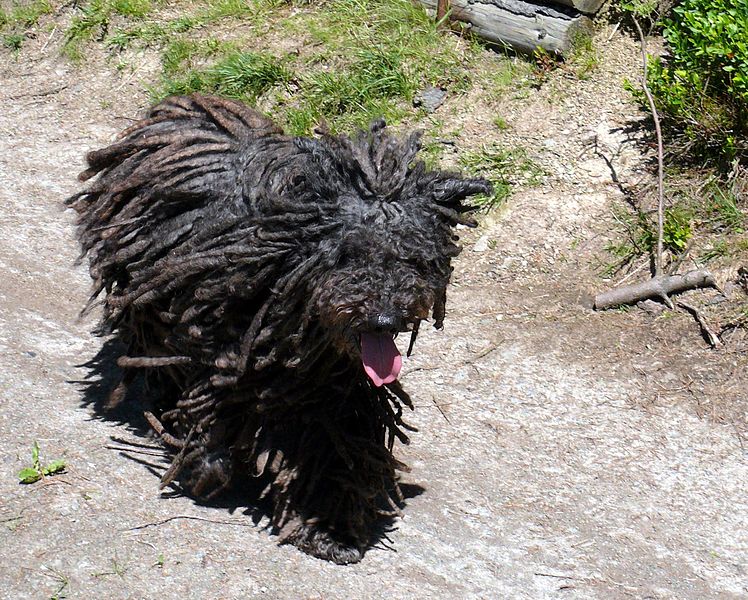
A Puli dog walks on a dirt road.
Is your dog part Puli? Probably not, no matter what the DNA panel says. Creative Commons photo by Rennender

DNA tests started out as a fun way to try to figure out a mixed-breed dog’s genetic makeup. Many people I know who’ve done them have gotten results that made me a little skeptical — high percentages of extremely rare breeds. I am not a geneticist, though, and it all seemed harmless enough.

But.

People are using — and the testing companies are marketing — these tests in two ways that could be very, very bad for dogs: to attempt to predict dogs’ future health problems and to “tailor” behavioral training. And, according to an excellent column in Nature, the tests are extremely inaccurate.

Let’s start with the problem of trying to tailor behavioral training to the supposed mix of breeds in your dog. Your dog is a unique individual. Whether purebred or mixed, each dog’s behavior is affected to some extent by genetic drives — some dogs want to herd everything; some want to chase whatever moves. It’s also enormously affected by personality and experience. Within a breed, within a litter, even, the personalities and drives can be very different.

A good trainer tailors her teaching to the individual dog, of course, but she bases her work on the dog in front of her — not on some possibly wildly inaccurate list of breed percentages. If a dog is half Lab and half German shepherd, do you reward with food half the time, since the shepherd half might not be food focused? Do you use harsher methods half the time if your dog’s ancestry might lie in a military dog line? It’s silly when you start to parse out what it might mean in day-to-day training and life. A smart dog owner will choose a trainer who uses motivational methods tailored to the dog based on her hands-on experience working with that dog.

But a far more dangerous use of these tests is in attempting to predict future illnesses. The Nature article, and these related articles in the Washington Post and the Undark website explain the problems with this in great detail. In sum:

  • The mapping of a single gene mutation to a specific disease is far from foolproof. Genes express themselves differently in different breeds, so a gene that is linked to a condition in one breed might not behave the same way in another breed. And no one really knows what happens in mixed-breed dogs.
  • Having a specific gene mutation might (or might not) increase the risk of a particular disease. Basing a decision to euthanize your dog on very imprecise data, rather than on the actual dog’s health and symptoms, is cruel.
  • People unnecessarily panic when they get the results that show gene mutations — which might be completely meaningless. They pay for — and subject their dogs to — unnecessary, stressful, and expensive tests, which generally don’t tell them anything conclusive anyhow.

The truth is, genetic testing in humans works much the same way … results are often highly inaccurate; they are not predictive; and they could cause people to panic and get unnecessary “treatment” for a disease they think they might get some day. But as an adult, you get to make that choice for yourself. Subjecting your dog to it — or killing him out of fear of what might happen — is horrible!

The testing companies are businesses. They make money by selling you the tests. They also make money by selling the huge amounts of data they collect on test subjects. Veterinary clinics are also businesses, which many people lose sight of. Some vets are ethical and don’t push expensive tests. Others … not so much. Vets can make money by suggesting further testing, special diets that they sell, treatment … there is a definite conflict of interest that can exploit loving pet owners’ worst fears.

So, if you’re curious about whether your pup has some Puli or Xoloitzcuintli in his past (unlikely), go ahead and do the test. Just don’t base decisions about his medical care on the results. Train, and care for, the dog in front of you — his behaviors, his quirks, and his medical symptoms.

Choosing a Dog Food

I’ve gotten some questions about choosing dog foods, particularly since this post was published: Should Your Dog Go Grain-Free? Here are some guidelines (and opinions) I recently provided to people who asked:

  • I’ve seen wonderful results with dogs eating mostly or entirely raw diets. These can be fresh, frozen, dehydrated, or homemade. I personally would not do homemade; it’s a lot of work, I don’t want all that meat in my vegetarian kitchen, and it’s challenging to ensure you are meeting all of the dog’s nutritional needs.
  • For dehydrated, Honest Kitchen is a good brand that is easy to find in good pet stores and online. If you buy directly from the company, you get free treats and other rewards (well, your dog does …).
  • For frozen, Primal and Instinct are nationally available; check in high-end pet stores for local or regional brands. Cali eats Steve’s Real Food, which is not available everywhere. Getting frozen food delivered is really expensive. Learn more here: Dog Food Advisor.
  • For kibble, I can’t say it enough: Choose a food from the Whole Dog Journal’s list. They look into ingredient quality and sourcing and manufacturing practices. They really do their homework.
  • Never buy dog food or treats at the supermarket. Health food stores and natural grocers are a possible exception. If you live in a less urban area, feed stores might stock a wide variety of pet foods and treats; watch quality and check ingredients, but these places might be less expensive than high-end pet stores.
  • That said, shop around. I’m considering switching Cali’s kibble to a brand that uses higher quality ingredients than her current Canidae. It actually costs less — and the real attraction is that I can get it at the high end store where I get her frozen food.
  • For dog treats, look for things that are simple: dried meat or fish, locally baked, few-ingredient biscuits. Avoid anything with artificial colors, preservatives, or ingredients you can’t pronounce. (That’s good advice for choosing your own treats, too!)
  • There’s no need to specifically seek grain-free foods, but many of the top brands have little or no grain. I do avoid wheat and especially corn, a common filler in cheap dog foods. Most of that filler ends up on your lawn. And, corn is a common allergen in dogs.
  • If your dog is gassy or has digestive issues, try a diet change. The protein could be wrong, or there might just be some ingredient or combination that doesn’t work well with your dog’s digestive system.
  • Food sensitivities are a common cause of itchy dogs. And ear problems. If your dog seems itchy and you don’t think it’s a seasonal allergy, take a look at her food. Eliminate corn and wheat. And chicken. If that doesn’t help, consult someone knowledgeable about canine nutrition (NOT necessarily your vet!).

Choosing a Protein

  • Some people prefer to feed a diet with multiple protein sources. When Cali had digestive issues as an adolescent, I decided that that made it too hard to know what was causing the problem.
  • I tend to avoid chicken-based kibbles, since many dogs are sensitive to it and since a lot of the larger dog food manufacturers aren’t using the highest quality chicken. I don’t want my dog eating meat from animals that were loaded with hormones and steroids, for example.
  • Very few dogs need exotic proteins. Don’t spend the money unless you know your dog is allergic to the more common, and more affordable, meats.
  • Pay attention to your dog. If she’s always hot, seeks the cool spot in the house, or gets hotspots or other inflammatory problems, avoid lamb and other “warm” proteins. Beef and turkey are neutral. Duck and most fish are “cool” proteins. On the other hand, if your dog loves the sun and wants to sleep under the covers and suffers even in a Florida winter, do look for lamb-based foods. You might think the idea of warming and cooling foods is mumbo-jumbo, but it has definitely helped both Cali and her sister Dora resolve recurrent hotspot issues. I’m a believer.

A Helping Hand Could Keep Some Pets at Home

A golden retriever carries a box of dog biscuits
Delivering pet food could keep some dogs out of shelters (photo by Sae Hokoyama)

Not all dogs and cats who end up at shelters are unwanted. Some families abandon their pets because they cannot afford to feed them or house them or provide needed veterinary care.

An article I read recently in the New York Times suggests that the “no-kill” shelter movement might unintentionally contribute to the problem. By focusing on getting dogs and cats into new homes, the shelters might be neglecting the reasons many of those animals are in the shelter in the first place.

It might be time for some creative thinking and number-crunching. I’d guess that it costs less to feed a dog than to house him in a shelter until he can be placed in a new home. It certainly has less of an emotional cost for the dog and all the humans involved.

Whether they never should have gotten a pet in the first place, or they were doing fine until a health crisis, job loss, or other financial disaster hit, many people who love their pets find themselves short of cash at one time or another. Finding ways to keep these families intact (pets are family too!) makes more sense than sending the dogs and cats to languish (or die) in shelters.

I don’t for a minute think that that is the only reason animals end up in shelters, but it’s probably possible to make a significant dent in the problem.

Here in Missoula, an organization called Animeals (which also has a cat shelter and cat adoption, foster, and hospice care programs) addresses some of these issues throughout Montana. Animeals runs a pet-food bank and delivers food to homebound, disabled, and senior pet owners, often providing the help that allows them to keep their pets. It feeds homeless animals as well, delivering food to volunteers who feed feral cats and dogs. Animeals also has programs to help families in crisis and to assist impoverished pet owners with vet bills.

Some Meals on Wheels programs across the U.S. deliver donated pet food along with the humans’ meals. And I am sure that other cities or states have local initiatives. Check into what’s happening in your area and consider donating pet food or some of your time. It’s a relatively easy way to make a big difference.


A New Puppy!

No, I am not getting a new puppy! A good friend is getting one though, so I have been thinking about puppy prep lately. In no particular order, here are some things we talked about.

Socialization

We visited my favorite local training school, Sit Happens, so that my friend could meet her puppy-to-be’s kindergarten teacher. We watched several young puppies play in carefully supervised small groups, and talked about drop-in playtime, classes, and, in good time, a more formal manners class. Little Maisy will be very well educated. Best of all, I get to go to puppy class, and I don’t have to get up in the middle of the night with the puppy!

Food

We selected a good quality, reasonably priced food for Maisy, making sure that it was from a brand on the Whole Dog Journal’s approved list. They do all the homework of choosing quality foods, checking on the manufacturing processes, where ingredients are sourced, and whether the foods are nutritionally sound and include high-quality, identified, meat-based proteins.

Toys

I suggested getting lots of chew toys, especially ones that can hide treats. Maisy will spend a few hours at home each morning and afternoon while her family is off at work or school. She’ll need to develop a hobby, preferably one that doesn’t entail thousands of dollars in repairs and remodels to the house. So. Chew toys.

A play pen

Little Cali, age 10 weeks, shares Jana's dog bed
Cali appreciated the comfort of her big sister’s dog bed from her first day home. She never chewed on or ripped it. Not all puppies are as wise.

I lent the doting parents an ex-pen to create a safe space for Maisy when she can’t be supervised. I suggested taping heavy-duty plastic to the floor, as my friends did when our girls (Cali and Dora) were young. Whenever the humans are away or distracted, I advised putting Maisy in her safe space with some chew toys. Of course, when they are home, they will spend lots of time playing with her and cuddling her outside the pen. And rushing her outside!

Maisy also has a large crate to sleep in, complete with cozy crate pad. And a plush bed for when she’s mature enough to sleep on it, not destroy it. Cali was ready for a big-girl bed pretty quickly, and Maisy might well show similar good sense and appreciation for creature comforts.

Grooming

I advised getting the puppy used to having her teeth brushed right away. It’s best to start slowly, letting her lick some tasty chicken-flavored dog toothpaste off the brush (or a finger), then gently starting to brush. Cali loved brushing her teeth as a puppy. Now she’s reluctantly willing to do it, for a cookie.

Same goes for nail trims and brushing. Start right away but introduce it all very gradually and use lots of treats. It’s so much easier to trim a dog’s nails when she’s used to having it done. Cali doesn’t love it, but I can Dremel her nails in a few minutes with minimal fuss. I know several people who cannot touch their dogs’ nails and whose vets or groomers need at least two helpers. It shouldn’t be that traumatic. If you are fortunate enough to get your dog as a youngster, take advantage of the opportunity to introduce grooming early and painlessly.

Sleep

I advised the new puppy parents to rest up, since Maisy will demand a lot of time and energy during the first days as she settles in — and even more throughout her adolescence. I was exhausted for several weeks after getting Cali, and she was a pretty easy puppy.

It’s worth it though; Maisy will no doubt be a great addition to the family.

Not Guilty

Everyone knows that when a dog has done something he knows is wrong, he’ll act guilty, right?

Wrong. Dogs don’t really do guilt.

Dogs do learn not to do things that make their owners act like crazy people. They might, when their favorite human becomes unhinged for no apparent reason, try to soothe or appease the source of dinner and walks.

But chances are that whatever behavior has triggered the human’s meltdown happened in the distant past (more than five minutes ago) and was perfectly normal dog behavior. The dog is unlikely to connect his own past behavior with the human’s antics. And if he did, he’d probably still not see any reason to feel guilty.

The common misconception that they do feel guilty arises from, well, appeasement behavior that looks a lot like what humans interpret as guilty or apologetic behavior.

This image (below) — in fact this entire blog post — explains it all. As social animals, wolves and dogs need relationships. They need to communicate, trust each other, and mend the inevitable rifts. They need to prevent other pack members from harming them, hence the broad range of appeasement behaviors. They don’t need guilt.

It’s important that dog owners understand this. Assuming that a dog feels guilty inherently includes an assumption that he knows he did something wrong (or why would he feel guilty?). This is often not the case, so any anger or punishment from the human is simply baffling (or terrifying) to the dog.

The typical  human response to a “guilty dog” is to punish. An appropriate reaction would be to teach the dog what to do and what not to do. Or to manage the situation so the dog didn’t make the same mistake.

  • Dog ate food that was on the counter? Don’t leave food out. Teach the dog that the counters are off-limits.
  • Dog pooped in the house? Don’t leave the dog home for so many hours. Take him for a good walk first thing in the morning. Make sure he goes before you leave.
  • Young puppy chewed your stuff? Provide him with appropriate chew toys and teach him that your stuff is off limits.

Those are all situations where a dog might show appeasement when confronted by an irrationally angry human. Not one of those is a situation where the dog did something “wrong” (in a dog’s world), though he may have broken a house rule or transgressed a human norm.

Dogs need to learn the rules. It’s possible, but it doesn’t happen by magic. Work at it, go to training classes.

If your dog is showing behaviors that you sill think look like he “acting guilty” — and he’s done something wrong, what’s going on? He might know that you’re angry; if you have a close relationship, he might even know whether you’re angry at him or just generally grumpy. In some cases,  he likely knows that you are angry about something he did.

But don’t assume that his attempts to calm you down mean he knows that what he did was wrong and he’s sorry. He just wants you to stop being scary and mad and crazy. He really just wants you to move on, to throw the ball or get him a cookie.