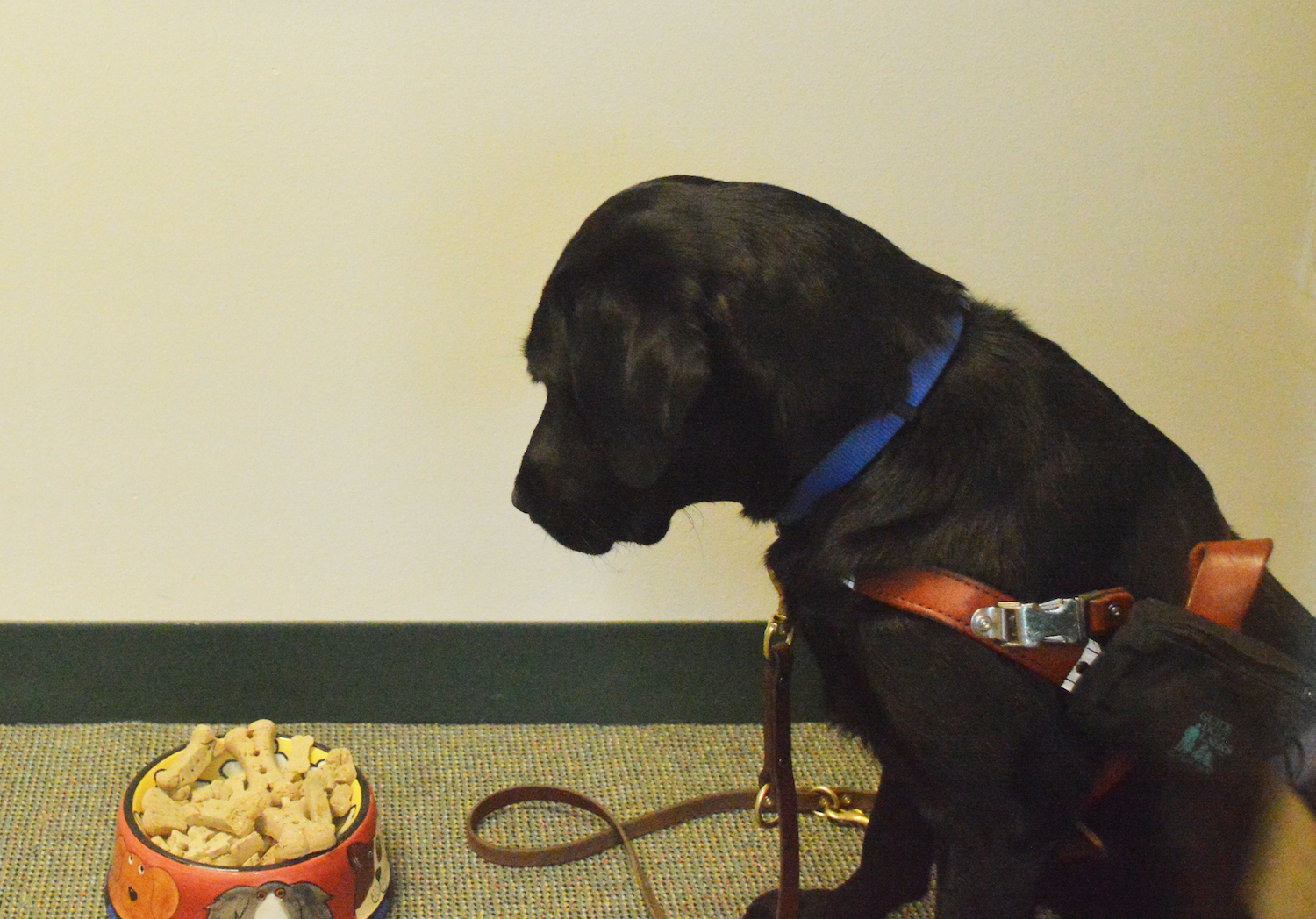
It’s a normal enough question. The kids in my neighborhood ask me that all the time, especially when we’re standing in line at the (world’s best) ice cream stand, just down the street.
When I am out with Cali, whose mission in life is to meet every human on the planet, it’s not really a problem.
But many people who work with service dogs dread the question.
What usually happens after the questioner gets an answer is that he or she then … calls to or greets the dog. For someone who’s working with a service or guide dog, the distraction is problematic.
Yes, most guide and service dogs are very well trained and are generally focused on their work. But they’ve also been taught to be responsive to their names. People calling their names might provide enough of a distraction that the dog misses something important.
Most working dogs are taught to greet people politely when their human partner says they can but not to solicit attention. The repeated cycle of strangers calling the dog’s name and getting excited when the dog looks or approaches them rewards the dogs for paying attention to people other than their partners — while working. This is also problematic, especially since many service and guide dogs are naturally very friendly. Not greeting approaching people already demands self-control. They’ve already got a lot on their plates. Why push it?
The bottom line is that calling to or petting a working dog makes the dog’s task harder. So while it’s natural to want to ask the dog’s name and you’re just being friendly — if you’re chatting with a person who’s working with a service dog, please don’t.
I’ve been asked several times whether I think it’s OK to feed a dog a vegan diet. The short answer is that dogs can survive and even thrive on a vegan diet, but it’s not easy and it’s not the optimal diet. Cats cannot be vegan, by the way.
A recent article in Wired addressed this question from the perspective of dog owners’ conflicting beliefs: They are vegan because they oppose using animals for human benefit but they also want to provide the best lives for their dogs (which means letting the dogs eat meat …). I understand the dilemma.
Premium pet food companies understand the dilemma, too. More and more, they are advertising the humane and sustainable nature of the ingredients they use. Is the advertising accurate? I don’t know; my hunch is that some companies are better than others, as with human food producers. Maybe the Whole Dog Journal will add sustainability to its list of criteria in future dog food evaluations (wouldn’t that be great?).
From a nutritional standpoint, I’d advise choosing this path very carefully. Consult with a canine nutritionist or a vet who has studied pet nutrition extensively. That is not a given; many vets take one or no courses on nutrition in vet school and many vet schools receive a lot of funding from large pet-food companies. That is to say, what many vets “know” about nutrition is heavily influenced by the makers of often not very good kibbles. I’ve gotten truly terrible nutritional advice from many otherwise excellent veterinarians.
If your vet is on board and knows a lot about canine nutrition, you can probably work out a vegan or mostly vegan diet that will work for your dog. But it’s not something to do casually; don’t just switch to a vegan food and forget about it. For example, your dog might need more frequent blood work done to test for key nutritional elements, as the recent scares over taurine levels illustrates.
One hypothesis with the many dogs showing low taurine levels is that foods with high levels of vegetable-based proteins and low or no carbohydrates made it harder for the dogs to get full nutritional benefit from the meat-based proteins in those foods. While I haven’t yet seen a definitive answer to that question, it suggests that boosting the amount of plant-based proteins in a dog’s diet has implications beyond whether she’s getting enough protein … which means going vegan or mostly vegan could have health effects that you’re not anticipating, and that even if the dog is a healthy weight and seems to be fine, serious problems could be developing.
So. The long and short answers get us to the same place, which is this: If you’re serious about moving your dog to a more vegan diet, proceed carefully and make sure you’ve got a knowledgeable vet’s supervision and guidance.
Several weeks ago, Tesla rolled out a software update that introduces “Dog Mode.”
This is a feature that allows car-and-dog owners to set a cabin temperature for their dogs’ comfort while they go off and … do whatever it is people do while leaving their dogs in the car. The car’s heating or cooling system will maintain the appropriate temperature automatically. Here’s the cool part: The Tesla’s screen shows a message meant to reassure worried passers-by that the dogs are OK. It reads “My owner will be back soon” and displays the interior temperature in large numerals.
The main hitch I see is that the screen, which is usually used for the car to communicate with the driver, is positioned between the front seats. People passing by and noticing dogs in a closed car in extreme heat (or cold) may not peek in at the right angle to see the screen. They might still panic, break a window, call the cops, leave a nasty note for the owners, alert the security at the nearest store, etc.
However, this does raise a great possibility: An add-on product that could maintain a reasonable temperature in the car while displaying a prominent notice easily visible from the car’s driver and passenger windows. A solar-powered cooler that hangs inside the window perhaps? Any inventors out there? That’s a Kickstarter I could get on board with.
Seriously. Summer is coming. Don’t overheat your pups. Trade in for a Tesla today! (I wish …)
My mom recently spent a week in Italy, where she noticed dogs everywhere — in restaurants and shops, walking politely down crowded sidewalks — often stylishly clad in jackets. She mentioned multiple times that the sidewalks were spotless.
In chatting with other dog-loving and well-traveled friends, we heard stories of other European countries where well-dressed dogs hobnobbed with humans in restaurants, stores, and even historic homes that the humans were touring.
Obviously, the dog culture is very different in Europe than in the U.S.
I can’t tell you how or why it’s so different, but I can tell you what works: socialization and practice. Dogs who are out and about have to learn manners and be held to high standards of behavior. American pet dogs generally stay home and, too often, are allowed to develop poor manners and habits. It’s a vicious cycle: The dogs are unruly, so we don’t take them in public. Lacking exposure and practice, they don’t learn to behave better. So it’s too much effort to take them to even the few places they are welcome. So they don’t learn …
I’m not criticizing, just observing. I am as guilty as the next dog owner. Many times, I’ve decided not to take Cali into, say, our local dog-friendly Ace Hardware because I just want to get my shopping out of the way. She loves going in, and she’s not horribly behaved — but she puts a lot of effort into looking for employees whom she can hit up for cookies, and I do have to watch her to make sure she doesn’t shoplift those dog treats that are in a nose-level bin. I’d love it if she just calmly walked by my side, ignoring the treats, but I haven’t put in the effort needed to get her to that point.
In my service-dog-training days, I took many, many puppies on many, many trips to stores, restaurants, and every kind of public place. In those instances, I was 100 percent focused on the puppy, not trying to do my own errands, and I taught the puppies to behave properly (I hope). It takes a lot of effort, though it’s well worth it.
I admire the European owners who’ve managed to combine training with living their lives. Obviously, behaving calmly in various situations will come more easily to some dogs than to others, but all puppies need to be taught. Taught to settle down quietly and not demand attention while the humans are eating or talking. Taught not to search for and pick up scraps of food or trash. Taught not to beg at restaurant tables. Taught not to seek attention from strangers. These are, of course, skills that are valuable at home, too, especially when the doorbell rings or a repair person is working in the house.
Everyone’s ideas of what behavior is intolerable and what’s “good enough” are different. Teaching dogs manners is hard work and demands a lot of repetition and consistency. Lots of us are not very good at that, but we really do get out of it what we put in. Maybe it’s time to take Cali to Ace for more practice …
Guiding Eyes Koala and I have few conflicts, but those that we have get tiresome for the person-side of the partnership. Licking. Koala is a licky dog. I don’t like to be licked. I think I have found a solution to the licking conflict and realized something more about canine language comprehension.
I’m not unreasonable. A quick kiss now and again is appreciated and fair exchange for an ear scratch or a snuggle. But, spare me what became a nightly routine: The enthusiastic leap when I invite Koala to come up on the people bed for a cuddle, ending with her upper body on my chest and nose at my chin. “Oh, you let me up on the bed!” her body language says. LICK. LICK. LICK. “I’m so happy to be up here!” Rapid tail wag. LICK. LICK. LICK. “I’m such a lucky dog!” LICK LICK LICK. My plaintive, “Enough!” or commanding, “Off the bed!” ended the licking, but ignored Koala and her intent. This was not how I wanted to end the day with my canine partner.
Recently, I invited her up on the bed and, as she came close to my face, I calmly and nicely said, “If you lick, you’ll need to get off the bed.” Koala stopped. She lay down next to me with more restraint than usual, nose close to my chin. Her tongue slowly reached out to touch my face. Again, I said, “If you lick, you’ll need to get off the bed.”
She stopped. Sighed. Relaxed against my side so that I could stroke her head. Soon she shifted to her back so that I could rub her belly. No licking, just a peaceful, happy dog. A few minutes later, I said that it was time for her to go to her own bed, which she did without protest and without being rejected. I heard Koala settle down on her dog bed next to her Golden Retriever sister and thought about why my warning worked.
Conditional reasoning starts with compound sentences that use “If, then.” Dogs know the “if, then” construction. Sometimes the conditional is time, such as when Pam says, “We’ll go for a walk, and then I’ll give you dinner.” Koala and Cali know the concepts of “walk” and “dinner,” but on hearing this sentence, they head for the door, not the dinner bowls. More often the conditional is action: “If you get the paper, then I’ll give you a cookie,” “If you sit quietly for a few minutes, you’ll get your dinner,” “If you come here, then I’ll rub your ears the way that you like.” The “if, then” condition sets up a trust relationship between dog and human. Dogs that stop coming when called do so because they think that their humans have fallen down on their part of what should happen when they obey.
Koala’s understanding of the “if, then” connection when I said, “If you lick, you’ll need to get off the bed,” was even more complex. This sentence had a condition — If you lick — but a negative consequence. Koala needed to turn the sentence around to reason, “I don’t want to get off the bed, so I better not lick.”
And even more complicated was her realization that she’d have to get off the bed in a few minutes anyway to go to her own bed and that that part of the nighttime routine was not a punishment. The question was whether she could control her licking so that she got a cuddle on the people bed for a few minutes first.
Koala’s success was evidence for her ability to master human language and what is implied by what her people say. Its mastery that all of our dogs are capable of achieving. The limitation is with us humans, who often fail to see how asking our dogs to use their conceptual abilities can make life easier for both humans and canines.
Lots of people who have dogs rarely walk them. A recent UK study found that fewer than half of the respondents walked their dogs daily, and that, when they did, the walks were very short. I read a similar study several years ago on US dog owners.
Some dog owners leave their dogs outside (alone) for several hours a day, assuming that the dog will take care of her own exercise and toileting needs.
That’s not okay. Why bother haveing a dog if you are not going to meet her needs and take care of her?
Dogs are very social and need to be part of a family group. If you have two dogs, they can provide company for one another (if they like each other), but they still need their human family. It’s not enough to put down food twice a day and open the door to send the dog outside.
Walks provide mental stimulation and a chance to bond. They allow dogs to catch up on the news and explore the world beyond their own house and yard. They are also great for the people, providing regular exercise, fresh air, and a chance to relax.
Even better for the dog — a chance to run off leash while the human walks. If you are fortunate enough to live near an open space where it’s safe to hike with your dog off leash, try to build that into your schedule at least a couple times a month.
I know that many people who have dogs work full time and also have families. They don’t have a lot of free time. But the dog is a member of the family and deserves some attention too. Make play and exercise time with the dog a high-priority part of your daily schedule. You’ll all feel better and, guess what? Your restless, high energy dog will be better behaved, because she’ll be getting her needs met for exercise, mental stimulation, and connection with her family.
I wrote about the pitfalls of doggy DNA tests a few months ago — how they might cause people to panic about the potential that their dog is carrying a marker for a genetic disease or lead people to make unhelpful assumptions about the dog’s behavior.
I just saw a review in Wired examining three DNA testing services. So I have to chime in again.
These tests are not very accurate. They basically compare parts of your dog’s genome with all of the other dogs in the database and make guesses based on finding snippets that match. Each service has different dogs in the database, so there will be different matches.
The caveats about deciding what training method to use or panicking about diseases that your dog doesn’t have still hold. Even so, it can be fun to explore your dog’s genetic makeup. But buyer beware.
Like much data collection that exploits human subjects, the fun wrapper is hiding business motives. The parent company of the Wisdom Panel, for example, is a gigantic dog food manufacturer. One that happens to sell overpriced (poor quality) foods targeted at specific breeds. If your dog is found to have a significant proportion of Breed X, guess what? Little ads will start stalking you, trying to get you to buy food tailored to that breed — a concept which is absurd.
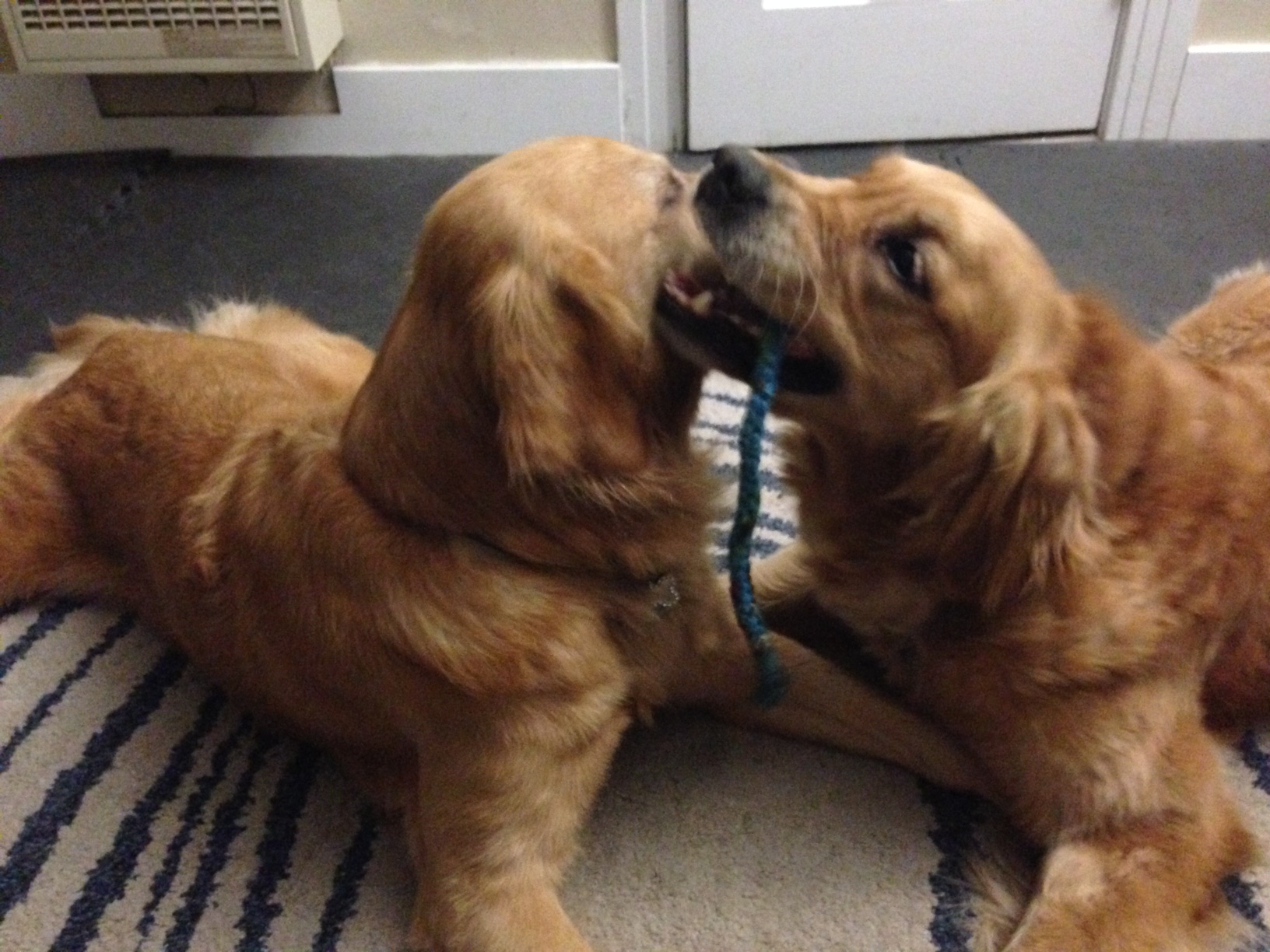
Cali sure loves playing with her sister Dora!
On the other hand, Embark is a spinoff of Cornell’s canine genomics initiative, according to Wired. They look at many more disease markers and are building a database that could someday contribute to research on all sorts of doggy health issues. Cool. It’s also the only one that claims to help you find your dog’s relatives. That’s also the most expensive one, of course.
For me, the bottom line is why you’re doing it. The test itself can be mildly uncomfortable for the dog, and the dog certainly doesn’t care about the results. If it’s all in fun, great. But if you’re trying to discover some deep truth about your dog, you’re better off just hanging out with him and getting to know him better. Instead, donate the $70 — $200 you’d spend on the test to your local shelter.
I’ve accompanied friends with young puppies to puppy play sessions several times over the past few months. (Playing with puppies and then sending them home with someone else is the best …)
Puppies often play in ways that seem rough and scary to their doting parents. Those other puppies might hurt Precious, the new owners fret.
Relax. Puppies are pretty sturdy. They also tend to be quite vocal if another puppy is too rough.
Great puppy play includes:
Lots of chasing. One puppy leads off and others chase her. Within a few seconds, the pair or group change direction and another puppy is in front. When to worry? If only one puppy is chased (same for adult dogs) or if the chasee seems to want to end the chase and the other dogs ignore the signals. If too many puppies or dogs are chasing a single dog and seem intently focused on that dog. Good chase is fluid, not targeted at a single puppy.
Lots of wrestling, mouthing, and tugging. Yes, puppies have nasty, needle-sharp teeth. All the more reason to let them practice biting — and inhibiting their bite — on each other, not on our arms and hands. They let each other know what hurts and when to back off. This is one of the primary reasons why new puppy owners should insist that their puppy stay with his litter until he’s 8 weeks old. Sure, they’re weaned and yeah, the breeder might be pressuring you to take your puppy home. But those few weeks (with teeth) of play with littermates are essential to teaching initial social skills and bite inhibition. Single puppies and those taken from their litters at 6 or 7 weeks, which is way too common, are at a serious disadvantage.
Frequent pauses where puppies check in with their people, get a drink, pee, rest under a bench … puppies who know when they need a break are smart and self-protective. Puppy owners might need to enforce breaks, though, because the little ones don’t always make good choices. Call your puppy over, give him a treat, and send him back to re-engage.
What crosses a line?
Watch puppies for signs of stress. A puppy that is scratching a lot is stressed, as is one who’s constantly seeking to avoid other dogs, clings to a person’s legs, hides under a bench for long periods of time.
Yelps signal distress. Some puppies do vocalize while happily playing, but a distressed-sounding yelp is a call for human intervention. De-escalate the play, let the yelping puppy catch her breath, then let them all play again. Puppies usually recover quickly from a minor scrape and don’t hold grudges.
Too much mounting and other pushy behavior. This is a fine line. Puppies do wrestle and climb on each other, and that’s fine. Puppies of vastly different sizes can play happily together. But if a puppy seems interested only in humping or pinning other puppies and is doing it over and over, or constantly seeks out a specific puppy to mount, that puppy needs a break. And possibly larger, older playmates who will teach and enforce more acceptable play rules.
Puppy play groups are a great way for puppies to work on their social skills while working off a fraction of that endless puppy energy. Don’t avoid them because you are worried that your delicate baby might get hurt — but do pay attention and intervene when needed. In fact, that guidance serves beyond puppyhood and in any situation where dogs of any age are playing together.
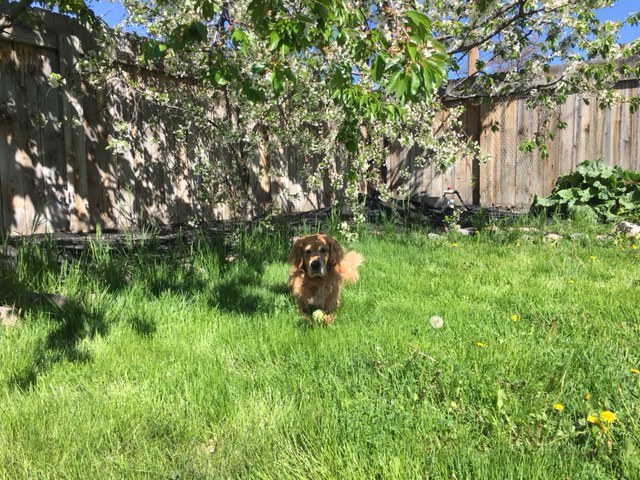
Cali, under the blossoming cherry trees, with her tennis ball.
It’s February in Montana, so reading an article about planning a “sensory garden” for dogs was a nice escape from the cold. Since Cali has staked her claim to the back yard of our house, though, and much landscaping is needed, it’s also great inspiration.
The first piece of advice is to watch how the dog uses the space — where she hangs out, where and what she sniffs. That’s easy. Cali’s favorite spot is under the cherry trees and next to the raspberries. In the summer, her favorite spot is in the raspberries, harvesting and eating as many berries as she can reach. But even in the winter, she’s most likely to be found in that corner of the garden.
Then, plan ways to enrich the garden for her enjoyment and mental stimulation. This means stimulating all of her senses.
Foremost for dogs is, of course, smell. Plant things that she enjoys sniffing. Ideally, plant several plants and flowers that will bloom and grow at different times of the year. Here in Montana, that’s a fairly small part of the year, so other senses will have to dominate in the winter.
For visual stimulation, the author of the article suggests rocks, logs, items of different heights to create variation.
To stimulate hearing, she suggests running water, wind chimes, or rustling plants. Those wouldn’t really work too well in a Montana winter either, but in our somewhat urban neighborhood, there is plenty of aural stimulation.
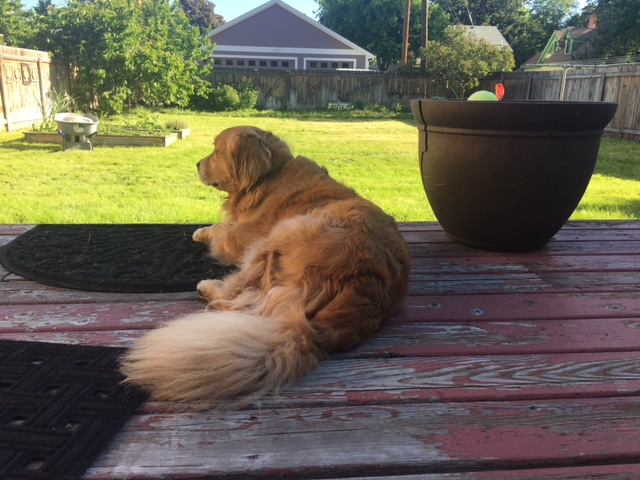
When not under the cherry trees, Cali enjoys her perch on the deck
Taste is a tough one. I have always discouraged my dogs from sampling the garden plants. Timo, my first dog, loved lemon verbena and once ate every single leaf from a small plant. The plant did not survive the assault, but Timo and the larger one coexisted happily for many years. As a puppy, Jana enjoyed harvesting strawberries and blackberries in our garden. Cali enjoys the cherries and raspberries in season, of course. But the suggestions of verbena, thyme, and other safe and appealing plants are worth considering.
Finally, tactile stimulation is essential. Cali loves to dig; I have thought about creating a digging spot for her in the garden. Another suggestion is using a variety of textures — grass, mulch (check and check) and paths made of stones or crushed granite, or even sand. We can definitely work more of that into our landscaping.
A final suggestion is creating opportunities for the dog to run around. When Cali has friends over, they do create a sort of circuit, looping into the cherry-tree corner and under the clotheslines.
Use raised beds, pots, or plant borders to steer dogs away from no-go zones, like the vegetable patch. Interestingly, though Cali dug up all our baby tomato plants the day we planted them, she never bothered the vegetable gardens after that, even though she loves cucumbers, and the cukes were well within her reach. She quickly learned that the raised beds were my turf.
Consider your dog’s age and activity level. For some dogs, simple agility equipment or things they can climb or jump onto are a good addition.
The garden can be very appealing to humans, too. But too many yards are designed only for the people in the family. Since Cali spends exponentially more time in our yard than I do, it’s only fair to create a place she will enjoy fully!
Deni and I were delighted that both Alberta and Koala did well on our cleverly designed doggy version of the marshmallow test — a well-known study of self-control and ability to delay gratification.
Based on hundreds of pages of research papers, magazine and newspaper articles, and books, I was convinced that the test indicated sterling character and hinted at characteristics that led to success in life; after all, follow-up studies showed that the kids in the early marshmallow tests who had showed self-restraint did have better outcomes in life in many areas.
Turns out that’s not what the marshmallow test shows at all. A much larger study, released last spring (an article about it has been buried since then among other things I need to read) shows more nuanced and interesting results. But the bottom line is, Alberta and Koala aced the marshmallow test because they had privileged puppyhoods and superior educations. (Cali’s self-restraint is, of course, due to her excellent breeding and sterling character; she grew up in a converted barn in western Sonoma County and was home-schooled.)
The new study, “Revisiting the Marshmallow Test: A Conceptual Replication Investigating Links Between Early Delay of Gratification and Later Outcomes,” as well as several other recent studies, points to socioeconomic background as a key influence on both ability to delay gratification and successful long-term outcomes like job security and ability to save for retirement. The mom’s education level was a fairly reliable predictor of the kids’ outcomes; kids whose moms had college degrees fared better throughout childhood and beyond, regardless of their marshmallow test results.
Basically, kids from better-off homes have more food security; they know that if they miss out on the marshmallow now, there will be more marshmallows or other treats later, whereas kids from lower-income homes might not get treats — or even meals — as reliably.
Since Guiding Eyes for the Blind has a wonderful puppy raising program, as well as enrichment that begins pretty much at the moment of whelping, neither Alberta nor Koala ever had to worry about a lack of meals and treats. Both of them had excellent educations, as did their parents. They were set up for success.
A dog doesn’t need to be from the elite 1 percent to succeed in life, though. As puppy parents, we ordinary dog-owning humans can set our dogs up for success, too, by offering them a predictable routine and nutritious meals on a regular schedule, training them (with lots of treats), and meeting their needs. Cali aced her pseudo-marshmallow test; your dog could ace the marshmallow test too!