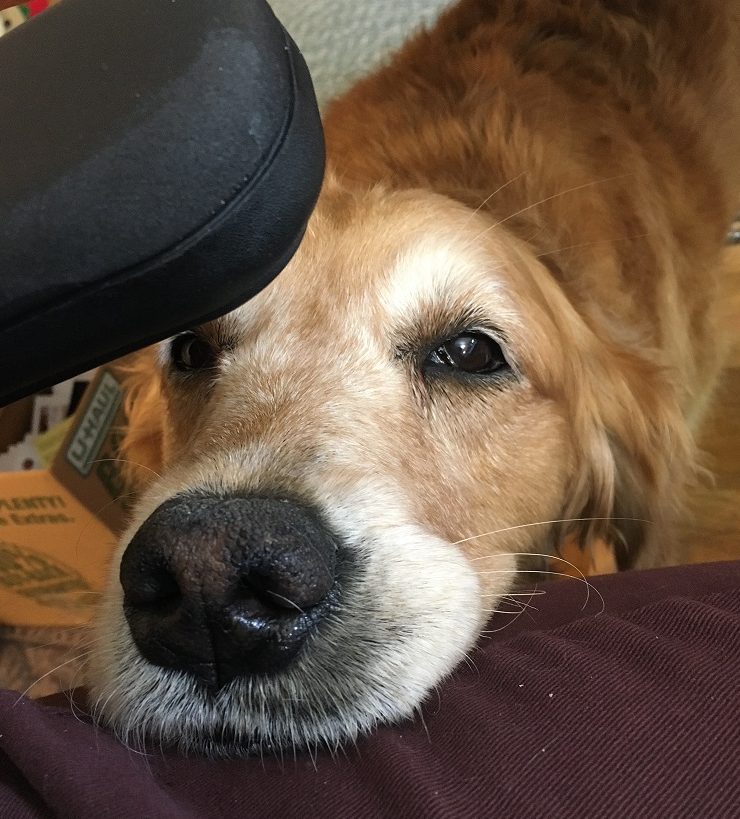
Cali believes in the magic sit. The magic sit is what causes humans to pet puppies — when they stop jumping and sit, magically, a treat and lots of fuss and petting happens. The magic sit is a great way for puppies to get cookies in other situations as well, as little Cali discovered those many years ago … It works when friends visit and she wants them to pet her and admire her toy, for example.
Her faith in the magic sit has never wavered.
Quitting time
When it’s past dinner time and the clueless humans are still staring at their stupid boxes, a magic sit (often paired with some strategically dripped drool) can produce dinner.
When the humans are fixing dinner, the magic sit makes the bowl appear on the floor, full of delicious food.
When deployed at the back door, the magic sit can cause the door to open in a way that jumping and whining rarely do.
When the humans are eating breakfast, a magic sit (or occasionally the magic lie-down variation) can make a small portion of eggs for dogs appear.
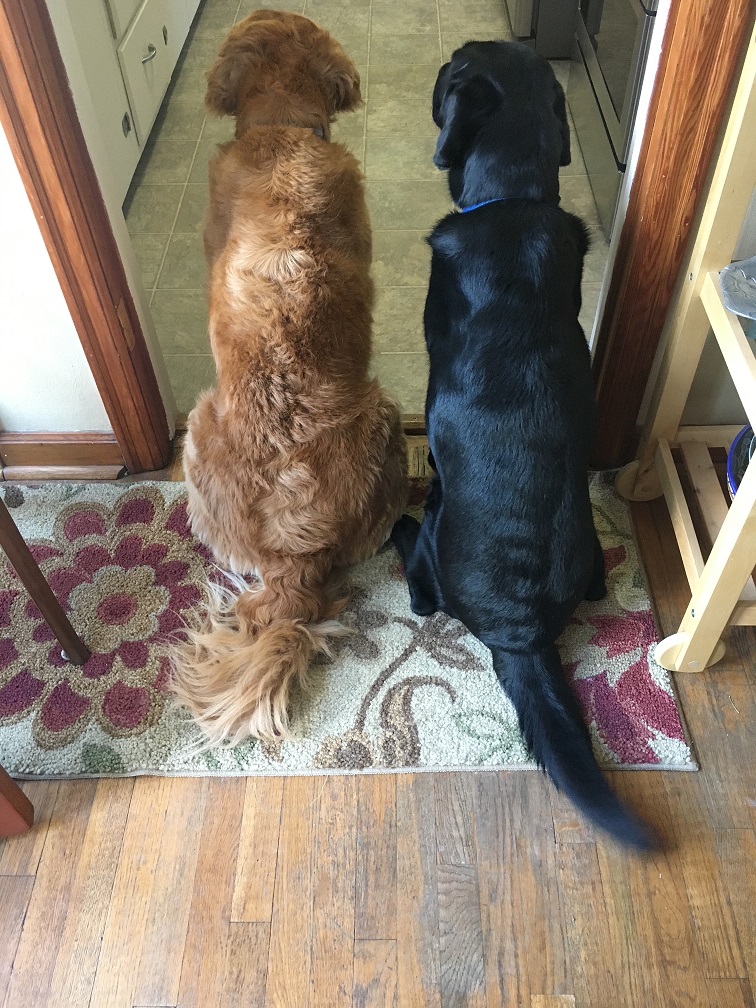
Cali’s faith is so strong that she often deploys the magic sit when it’s not time for dinner or time to go out. She faces into the kitchen, positioned between the dining room and kitchen, as if waiting for dinner. Or she sits by the back door, gazing steadily at her back yard, tantalizingly close. But her humans are not there. They might be behind her in the dining room or in the living room or even upstairs. It doesn’t matter, Cali thinks. The magic sit will work.
So she sits. And hopes. And waits. Believing in the power of the magic sit to get her … what, exactly? We may never know.
Koala faces daily ethical dilemmas, as do many dogs. She’s a highly educated dog who loves to show off her smarts. She also tends to follow rules. But something about the puppy lunch routine is her ethical undoing.
The routine is predictable: Deni gets the girls their puppy lunch each day. Koala brings the treat balls upstairs; Deni fills them; and everyone heads downstairs for PL, as we’ve begun calling it (as if they girls don’t understand …). After PL, Koala puts both treat balls into their little box, and she gets an a cookie as payment for her work.
A daily dilemma
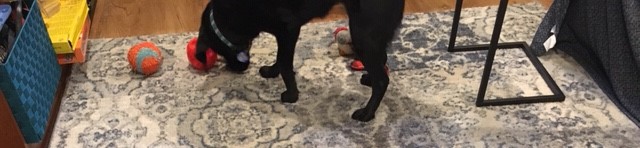
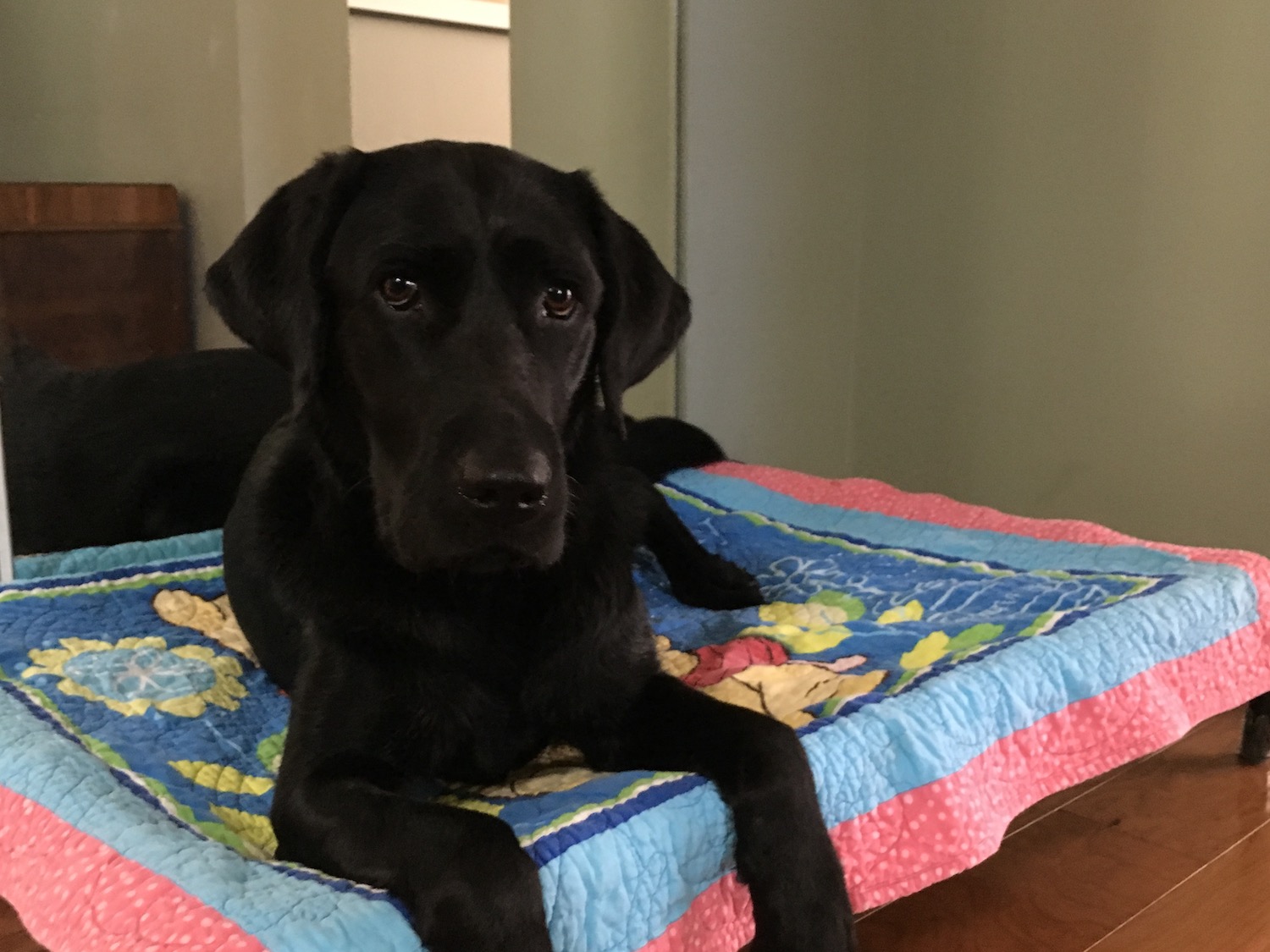
Black Lab Koala nudges her orange treat toy to empty and eat the kibble that’s inside
For a while, Koala did daily battle with her inner bad dog.
She’d quickly finish emptying her treat ball.
But Cali works more slowly. Koala couldn’t stand it. Cali had a treat ball and she didn’t! She began plotting. Each day, she’d try to steal Cali’s. She had to do it without attracting Deni’s attention, of course.
Cali got crafty. She took to batting her treat ball around a very small, sheltered spot. She was on a dog bed, up against a wall, and hemmed in by furniture, so there was only one open access point.
Deni ultimately caught on. She began giving Cali her treat ball inside the office (where Cali continued using the sheltered space) — and banned Koala from the office until Cali finished.
Well. Koala hated that. She’d whine outside the door in frustration.
Cali gets revenge
Cali, however, quickly figured out how to exploit the situation. It takes her longer and longer to slooowwwly empty her treat ball. She then tucks it under a paw, snuggles it gently, and takes a brief nap. All while Koala rages whiningly outside the door.
When Cali has tired of toying with Koala, she gently nudges Deni to let her know that she’s done. Koala then puts the balls away and gets a treat.
Deni has discovered that, even if she’s not there, Koala won’t go into the office to steal Cali’s treat ball. Koala is generally very good about following rules, even rules she hates.
But she will find Deni and badger her until Deni goes downstairs, takes the ball, and lets Koala put the balls away.
I don’t understand …
A related example: Let’s say the girls have finished their treat toys, and Deni is nowhere to be found. So I ask Koala to put the balls away. She knows perfectly well what to do; she does it every day. She puts other things away, too, like toys in the toy box.
Yet, it never fails: She flings the ball down outside of the box. Over and over. And demands a cookie each time. When I don’t give her one, instead repeating, “Please put the ball away, in the box, Koala,” she huffs, puffs, scowls, flings it harder, insists that she has no idea what I want her to do.
I figured out a way to cut this tantrum short. Today, each time she flung the ball anywhere except the box, I calmly handed a cookie to Cali, a willing sidekick in this exercise. I then asked Koala (again) to put the ball away.
Two Cali cookies later, amid disbelieving looks (and many more huff and puffs) from Koala, the ball was in the box. Koala finally got her cookie.
When a good dog behaves badly
Koala is generally a very good dog. So, why does she do bad things when she clearly knows what she’s supposed to do? Who knows? Why does anyone? Maybe it’s just a game the girls play. Or just sisters tormenting each other. When Koala heads back to Florida, she may miss this daily battle. Cali will; she doesn’t even get PL when Deni isn’t here. She does get her snuffle mat, though.
Cali and Koala love Hanukkah, after discovering their Jewish-dog cores this year.
It all started last year. We were on a road trip during Hanukkah. I found a creative solution to celebrating without setting fire to our hotel room and being evicted into the winter night: a little advent box for Hanukkah,
Each night, we’d open the tiny cardboard drawer, eat the treats that were inside, and turn the drawer around to show the lit candle image.
I saved the box, and this year, I filled the drawers with dog treats, offering a different treat each night. This provided something easy and fun for Hanukkah without having to actually buy gifts.
Deni and I called the dogs over each evening and lit the candles. I said the blessings in Hebrew. Then we gave the girls their nightly treat.
By day 4, they’d really caught on.
We did a mid-day app-powered candle-lighting with friends in Israel. As the family in Israel lit their candles and (it was only noon in Montana, so we weren’t actually lighting yet) sang the blessings, Koala woke from her nap, raced upstairs, and sat next to me, wearing an expectant look. Seconds later, Cali emerged from the bedroom, shaking off sleep, and joined Koala.
Blessings finished, I chatted with my friends for a few minutes. The dogs sat. And waited.
I finally caught on — they were waiting for their treats!
They eagerly assembled later in the day for the real lighting, with cookies.
It had taken only 4 repetitions of blessing, then cookie, for the girls to learn that all they had to do was show up while the human was mumbling something unintelligible and they’d get a surprise treat. Why does it take so many more repetitions (like, 100) for them to learn to … say … put a toy in the basket to get a treat?
All good things, even Hanukkah, come to an end. Koala looked devastated as she watched me carry the Hanukkah box down to the basement. Don’t worry, girls; we’ll save the magic treat box for next year. Happy Hanukkah!
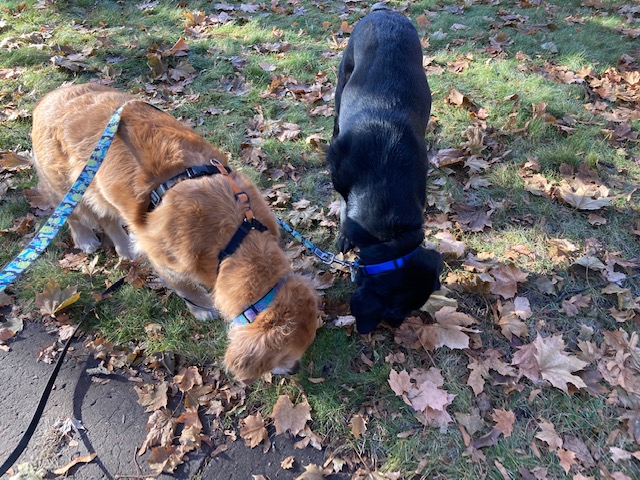
“Smell walks” with Cali and Koala are undergoing an update. It’s going better than I expected, actually.
Smell walks follow a suggestion from Alexandra Horowitz’s book Being a Dog. Basically, they are walks where the human actually lets the dog stop to sniff things. Since in the dog’s world, that is the one and only purpose of a walk, they tend to be mystified and frustrated by the large number of humans who seem to think walks are about walking.
Koala takes the concept beyond the extreme, though, sniffing Every. Single. Tree. And rock, blade of grass, and other, ickier stuff. After realizing that my usual 20-minute morning walk with Cali takes well over 45 minutes when Koala joins us, I knew that changes were needed.
I decided that each dog could choose 3 spots for long, deep sniffing sessions. The rest of the time, we’d walk. There’s one other rule: The deep sniffs do not include other dogs’ droppings.
I explained these rules to them carefully, and off we went. I counted each stop and told them how many they each had remaining in the bank. Even so, on the first modified walk, they seemed surprised and, yes, annoyed when I hustled them along after their 6 deep sniffs.
But they caught on pretty quickly. Soon, they started choosing their spots together, rather than taking turns. I could see one turn to the other, the other give a look — and both dive in. I think this approach provides them both with a greater return from their sniff budget.
They have started to return to the same spots, walk after walk. I’m guessing that those are spots favored by our neighborhood deer friends as well as the numerous other dogs who stroll the sidewalks.
Koala is quickly mastering the “walk-by sniff” — she samples an area with a quick sniff-survey of the air as we approach. Before we’re even there, she’s rejected it as a stop, quickly collecting all the information she needs without even slowing down.
Koala is efficient in another way: She often combines a deep-sniff session with other business needs. I appreciate that she frequently does that near one of the two trash cans on our usual route.
We’ve almost settled into a new routine. I can predict 3 or 4 of their stops already. Maybe they are weighing the others and will make their choices soon. Or perhaps they will always reserve 2 spots for impulse stops. Even dogs need some variety in their routines, after all.
The Department of Transportation released its new rules regarding travel with service dogs. This long-awaited ruling amends the Air Carrier Access Act’s (ACAA) regulations on travel with service animals. The 122-page ruling is available on the DoT website. An FAQ is also available. More than two years(!) have passed since DoT first requested public comment.
The ruling is worthwhile reading. It describes several issues considered and summarizes the comments and arguments presented around each. I’ll summarize some of the key points here, and let you delve into the details on your own.
1. Alignment with ADA on definition of a service dog
The ACAA has adopted similar wording and a similar approach to the ADA (Americans with Disabilities Act) in defining a service animal as “a dog that is individually trained to do work or perform tasks for the benefit of a person with a disability.” More significantly for the traveling public, the ACAA is doing away with any requirement that airlines allow passengers to bring so-called Emotional Support Animals (ESAs) on board without paying a pet fee.
It also requires that airlines treat psychiatric service dogs the same way it treats other service dogs. Many airlines had treated these as ESAs and/or required additional documentation or other “hoops” for passengers traveling with psychiatric service dogs.
The amended ACAA excludes miniature horses from travel in the cabin of an airplane.
2. New paperwork requirements
The new ruling includes a paperwork requirement for all travelers with service dogs. Using the DoT official Air Transportation forms, each traveler who is accompanied by a service dog will be required to attest that the dog has been trained to assist with a disability, the dog behaves safely in public, and the dog is in good health and current on vaccines. If the traveler has any flight segments that are eight hours or longer, they must further attest that the dog “has the ability either not to relieve itself on a long flight or to relieve itself in a sanitary manner” (what counts as sanitary is unspecified).
Airlines can require that the traveler provide the forms up to 48 hours in advance of the flight if they’ve made their flight reservations by then. Airlines cannot, however, require that passengers traveling with service dogs check in earlier than other passengers or check in in-person. If a traveler’s reservation is made within 48 hours of departure, the airline can require the passenger to present the completed forms at the departure gate.
3. About the dog
Airlines may limit a passenger to two service dogs. Whether the passenger has one or two service dogs, though, dog(s) and human must all fit within the space of the handler’s seat and foot space on the aircraft. And they can require that the dog be “harnessed, leashed, or tethered” at all times in the airport and on the aircraft. This is a departure from the ADA, which makes allowance for unrestrained service dogs if that’s necessary for their work. The rationale given in the ruling references the unique environment of an aircraft and situation of being in close quarters, in a stressful environment, with no escape.
If a service animal is too large to fit in the passenger’s space, the airline must offer to move them to another seat with more space, if one is available in the same service class; move them to a different flight; or transport the dog in the cargo hold.
Airlines are not allowed to ban a service dog based on its breed (though some are still trying to do so). But any dog can be excluded from a flight if they exhibit aggressive or unsafe behavior.
A win for pets, too
These new rules aren’t perfect and won’t solve all the problems working dogs face when confronted by fake or poorly trained service animals, but removing ESAs from the picture will certainly reduce the frequency. The numbers are staggering — Airlines for America, an airline trade association Deni found recently while doing research, concluded that more than a million air travelers brought their ESAs aboard in 2018. The number of websites where pet owners could purchase “credentials” transforming their pets into ESAs, while also conveniently purchasing official-looking vests and tags, grew in a trajectory similar to the number of traveling ESAs, while the number of passengers paying pet fees plummeted.
Many of these pets, as I have written before, receive no training and are terrified when taken from their usual safe home life into the bustle of an airport, the stress, along with strange noises and smells, of an airplane, and then, too often, removed from their carriers to be clutched by their anxious owners who are somehow comforted by the presence of their traumatized pets. Not surprisingly, the number of complaints about scared animals doing what scared animals do had climbed as the number of ESAs skyrocketed. The DoT fielded 700 complaints in 2013 — and 3,000 in 2018, according to Deni’s research. These range from animals eliminating on planes to snapping, nipping, and serious bites.
Dogs trained by reputable trainers or guide- or service-dog training schools receive many hours of public-access training and pass rigorous evaluations. But not all service dogs are trained that way. And some dogs are fine in 99% of public settings but are terrified by air travel. So the new law is not a guarantee that the dog in the next seat will be as perfect as Lassie. But, while it doesn’t close every loophole or solve every problem, the new restrictions are likely to make working-while-traveling a lot safer for thousands of guide and service dogs — and their human partners.
Would a Koala-wool blanket keep us warm in a Montana winter?
We all know about sheepdogs — dogs whose job it is (or was) to herd sheep, protect flocks, and herd small children … but what about dogsheep?
A recent New York Times article describes an ancient dog-human relationship: Coast Salish peoples, who lived in the Pacific Northwest, kept large numbers of small dogs … for their fur. The dogs were sheared like sheep (not killed for their fur), and the fur was used, along with fibers from goats and other animals, to make wool for weaving. The dog fur strengthened the yarn.
This is an intriguing possibility. Research indicates that these dogs, like their humans, ate a diet made up primarily of seafood. The dogs ate a lot of salmon, anchovies, and other Pacific fishes — much like Koala’s modern-day diet. Koala has a gorgeous thick, glossy coat. She appears to have far too much of this luxurious fur, as she leaves copious quantities of it … well, everywhere. Perhaps we should be gathering it and knitting it into warm blankets.
There’s another piece of this article that is interesting: The dogs were often buried with their humans or in the same burial grounds, and some graves are as much as 5,000 years old. As researchers dug into the evidence of the dog-human relationships, they realized that Coast Salish raised and bred animals far earlier than many history books reveal.
Unfortunately, the small woolly dog breed no longer seems to exist. As the NYT says, “with colonization” came imported textiles and reduced demand for the local wool. Though who knows? The recent re-discovery of New Guinea singing dogs offers some hope that a “lost” ancient breed could still survive … somewhere.
Cali and Koala have odd habits. For instance, one of them checks in with me if I fail to get up to minister to their needs by 6:30 am. That’s necessary because, although one or both dogs are usually curled up in their dog beds when I go to sleep, they’re not there when I wake. Or at least not both of them. Cali usually strolls in from the living room when my alarm goes off. Koala often makes it upstairs by the time I have let Cali outside.
Similar oddities occur when we are watching TV. Deni and I are on the sofa. Koala is often there as well, instructing us on where to massage her. Then, she’ll get off the sofa. And … moments later, Cali appears. She sometimes even allows us to cuddle her.
The other day, it finally dawned on me: They’re working shifts.
Someone is on duty at nearly all times to keep the needy humans occupied. Occasionally they both manage to creep off somewhere for a nap on a sofa. Either sofa will do, but they rarely share. Shift change can be subtle, but I figured it out when their timing was exact and, as Koala handed us off to Cali, they gave each other a little nod.
Quitting time
Cali is generally responsible for getting me away from the computer as dinner time approaches (or is about to approach in the next hour or two). Koala is in charge of the morning walk.
Koala excels at keeping us to the schedule and ensuring that we don’t forget our daily chores — putting kibble in the balls for puppy lunch, setting up the snuffle mats, walks of course, and meal preparation. Both are at hand to supervise meal prep; it’s far too important a task to risk errors.
They seem to take turns at entertaining the humans, but Cali enjoys the task more and puts her whole heart into it. She especially enjoys running in circles while playing keep-away with her ball, just to see how long it takes to make the human dizzy. Koala, in contrast, is clearly just doing her job when she halfheartedly runs after a tennis ball, counting on the silly human becoming distracted well before Koala has to actually pick the thing up in her mouth and, ugh, return it to the human. Who is only going to throw it again anyhow. Why?
When Koala heads back to Florida in January, Cali will have to work overtime to keep me in line. As will Koala; I am sure that corralling Deni is more than a full-time job. I guess we need to be understanding when they steal an extra nap on the sofa now and again, while they still have the luxury of shift work.
Dogs just want to watch the world go by. And interact with it sometimes. Some dog owners clearly understand that!
Photos by Ken Gagne
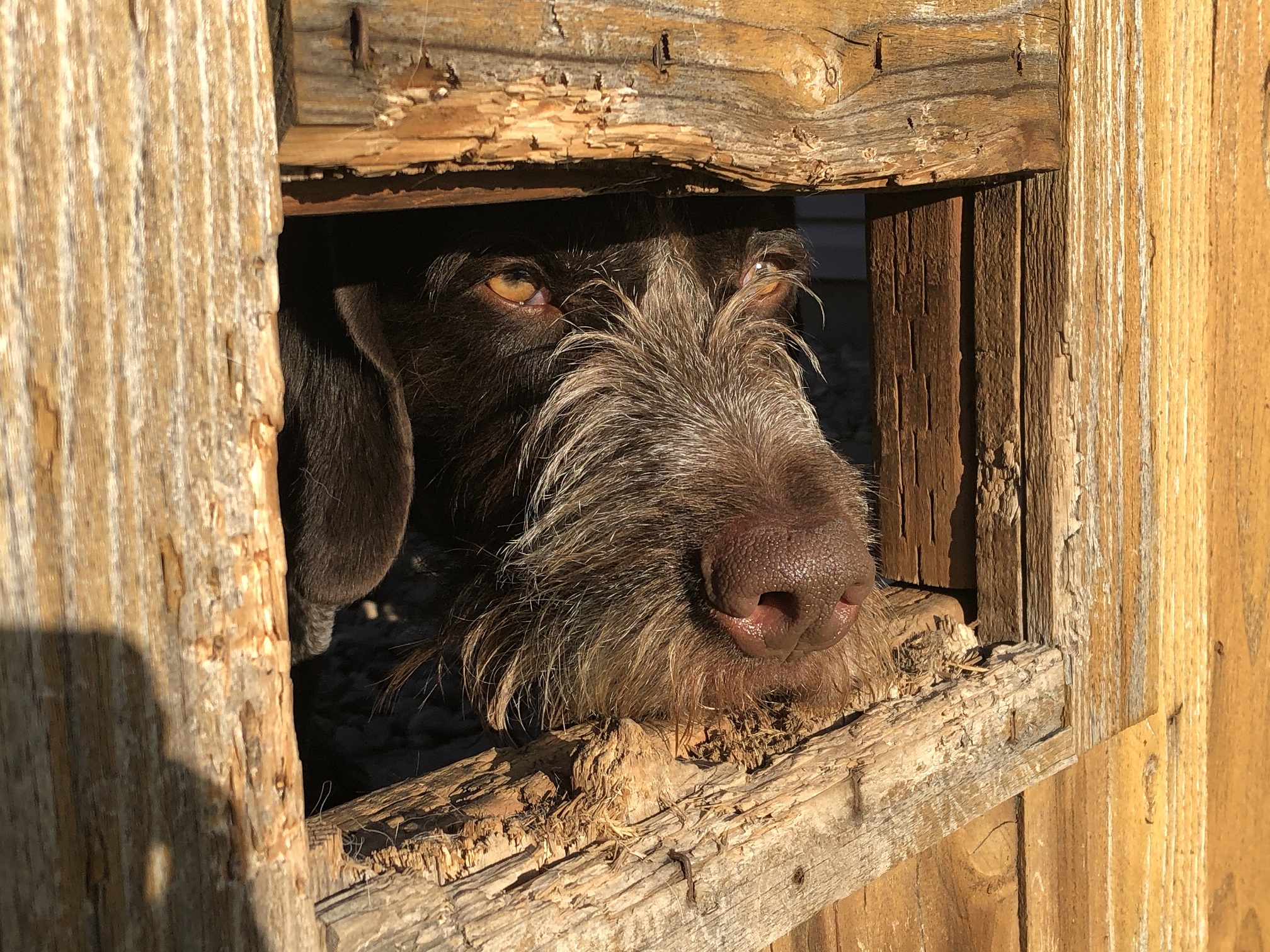
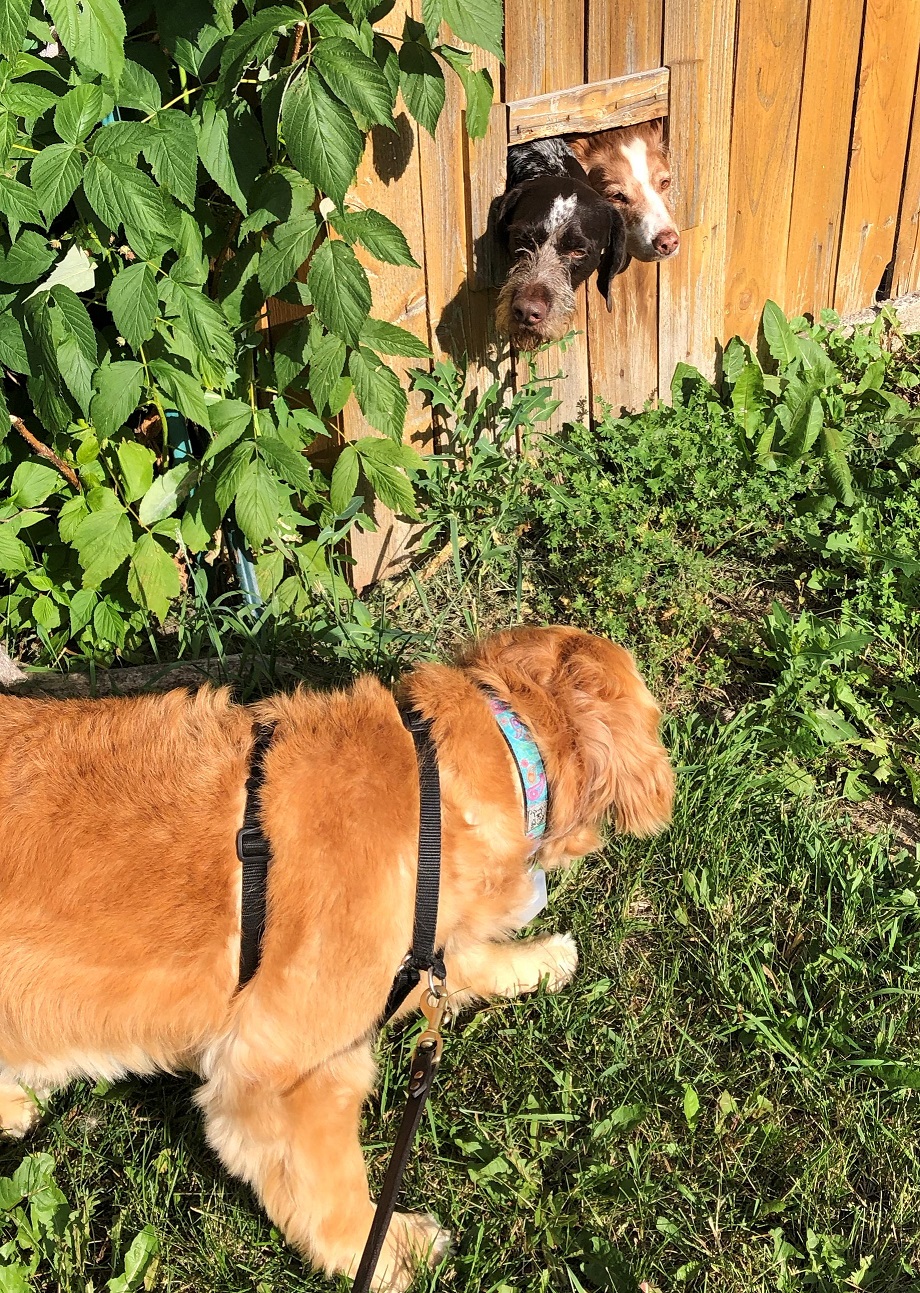
My first encounter with the idea of “fence dogs” came while my friend Ken was spending a few weeks in Missoula this summer. The fence between his AirBnB and the neighboring yard featured an odd window. The purpose of this opening quickly became clear on his first morning there, when a fuzzy canine head appeared.
It turned out that there were three “fence dogs” who liked to visit, supervise the goings-on next door, get nose scratches, and occasionally bring Ken a tennis ball to inspect.
On a visit to Ken, Cali “met” the fence dogs — and probably wondered why her fence does not have such nice windows.
Several weeks after he’d left Missoula, I was reminded of Ken and the fence dogs when I saw an article about a family’s creative approach to letting their dog watch the world go by.
Then, just last week, I saw an even funnier post. These dogs apparently spy primarily on their mom’s comings and goings, and they have to line up just right with their viewing portals.
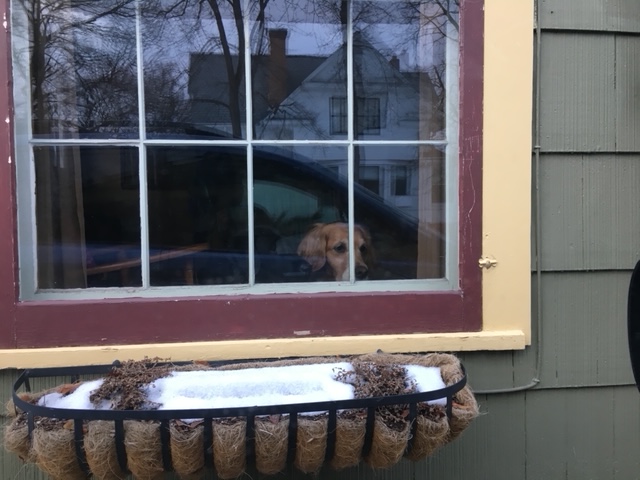
Cali, and occasionally Koala, also enjoy watching the world. They use the large window in my living room that looks out on the driveway — and gives them a great view of the road. Cali grumbles at people walking past, escalating to irate vocalizations when a dog dares to walk on hersidewalk. She looks out sadly, staring me right in the face, whenever I back out of the driveway in a dogless car.
Cali just loves watching what’s going on, and dog-height windows were an appealing feature when I first saw what became our home.
She adopted this space immediately. I briefly put a bench with several plants in “her” window, partially blocking the view, and she let me know that this was unacceptable. Very unhappy, she paced, tried to peer out, gave me dirty looks. I soon moved the bench.
I don’t like walking past yards where dogs fence fight or go ballistic, barking and lunging as I pass, especially if the fence is mostly open. But I think there is a balance. For dogs who can handle the stimulation (and who are supervised and brought indoors when they bark at neighbors), a fence window (or an actual window) is a great idea! Dogs are curious about their world and, for the most part, their lives are contained. Many dogs spend a lot of time at home with no access to see or even smell the outdoors. If we can offer them a way to watch the world, why not?
The Morris Foundation, which runs the lifetime golden retriever study that Cali participates in, has also released new and updated findings about the health impacts of obesity on dogs and cats. First is the shocking statistic that in the US, Europe, Australia, and New Zealand, as many as two-thirds of dogs and cats are obese! Cats are slightly more likely than dogs to be obese.
This contributes to many, many severe health problems and can drastically reduce lifespan. Some are surprising:
Inflammation, which affects many diseases, but is often most noticeable in dogs as osteoarthritis. Arthritis can affect knees and the back in obese dogs, but the inflammation can occur anywhere, causing pain in other joints as well, even those that are not weight-bearing.
The risk of diabetes is significantly higher in obese cats; it’s less of a factor in dogs.
Some types of cancer are more prevalent in overweight and obese dogs and cats.
Overweight dogs have a harder time breathing, which can be life-threatening for brachycephalic breeds — those with short muzzles and flatter faces,such as pugs, Pekingese, and bull mastiffs.
How can you tell?
Pretty much every vet’s office has some version of the dog and cat obesity chart on the wall. Generally, you should be able to see your dog’s waist and feel their ribs.
What do you do?
Taking off excess weight takes time. A crash diet is not healthy for anyone! The safest approach is to work with a nutritionist or a vet with credentials in nutrition, but you can also learn a lot from the Whole Dog Journal or Dogs Naturally, my go-to sites for dog health and wellness information.
Start by logging everything the dog or cat eats. Often, we don’t realize how many calories they consume in treats. Or we consume in treats … Your vet can help you figure out how many calories your dog should consume, based on ideal weight, age, activity level, and overall health. The right amount for your dog might be quite a bit less than the feeding guidelines on the dog-food package indicate!
A severely overweight dog may need a specialized diet; for many dogs, though, cutting back a bit on food, and a lot on treats, can be enough. I’m generally not a fan of prescription diets or weight-loss foods. I think they are often of poor quality and overpriced. With expert guidance, you can generally find a high-quality food and feed amounts that provide balanced nutrition — while also gradually bringing your dog down to a healthy weight.
Before cutting too severely, though, you do need to be sure that your dog will still get the nutrients she needs. That’s why talking to a professional is important. And your vet can advise on whether and what types of exercise are safe, again, considering the amount of excess weight, any issues with joints or spine, and the dog’s age and condition. Best of all, the exercise program gives you new opportunities to walk and play with your dog!
It can take several months for a dog to lose excess weight. Be patient; you’re more likely to have lasting results if you take the time to do it right and make permanent, healthy changes in how your dog eats and exercises.
It’s got 150 acres, with leash-optional play areas including pools and hiking trails, a dog chapel filled with photos and memorials to dogs. It’s marking its 20th anniversary this year.
In non-COVID times, the Mountain hosts events and dog-friendly parties, and more.
Mine is yellow
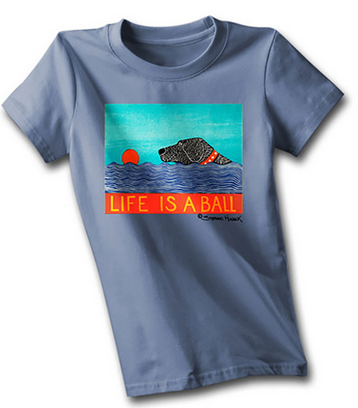
I even have a t-shirt with a print by the guy who founded Dog Mountain.
We need a Dog Mountain out here in Montana. Near Missoula, perhaps.
While we’re dreaming about dog-friendly travel, there’s another place I’ve recently added to my list. I’ve always wanted to visit Best Friends in Kanab, Utah. I recently discovered the Best Friends Roadhouse — which creates a dilemma. Do I visit the Roadhouse with Cali, which would mean I couldn’t volunteer at Best Friends or foster a dog … or do I go to this cool and very dog-friendly hotel without my best friend?
I do not need to answer this question for a while, though, since road trips are on hold until … who knows when. It’s nice to dream, though!
Where’s your favorite dog-friendly place to travel?