First, some very nice people came in and … took away her sofa. The sofa that she loved to lie on so she could look out the windows in comfort, getting up only to bark at people who had the nerve to walk by with a dog.
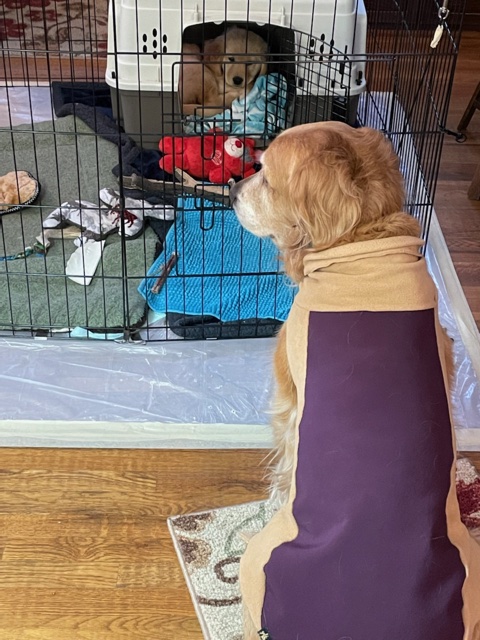
Her mom keeps talking about a new sofa but Cali is beginning to think that her mom is imagining things. There’s no sofa. No, but there is a big puppy pen. Not a good sign. Then her mom left town for almost three weeks! Imagine! OK, well, she got to stay home with a great dog sitter, and Deni showed up after a couple of weeks, but still.
Finally, Cali’s mom came home. Just when things might be looking up, the whole family got into the car and drove all day in very cold weather. They went to a house with a bunch of golden retrievers, including this small puppy. So annoying.
Finally, they went to a hotel and got to sleep.
But.
The next morning guess what happened?!! They went back to that house and took the puppy. That’s right. That little puppy got into the car, into a spiffy little red crate, and settled in as if she belonged there.
Why does Orly get the best bedroom?
(Which she did.)
They all drove home and the puppy took up residence in the living room.
Cali is not delighted to have a new little sister. She does not like the new living room decor. No sofa; instead, a huge ex-pen with a puppy in it. And the puppy has all the best toys.
Even so, she’s starting to come around. She spends a lot of time watching Orly, the puppy. And has even sort of maybe considered playing with her, just a little, but only when she thinks that no one is watching.
Cali has a new little sister, and the Thinking Dog Blog has a new co-star. Orly joined the family on December 29 at almost 10 weeks of age.
She’s one smart cookie, and benefited from an amazingly thorough early-puppyhood enrichment program in her birth home: She is a master of stairs already, is comfortable in a crate, and asks to go out when she needs to go.
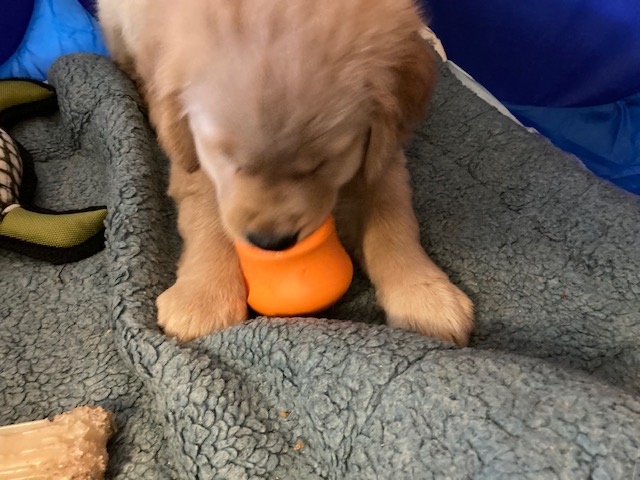
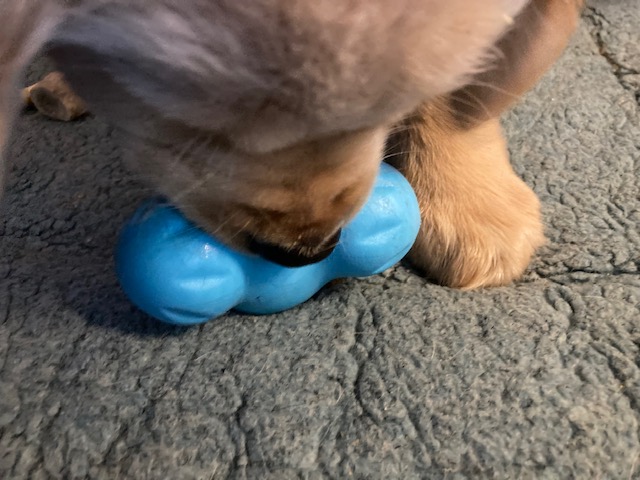
She’s a connoisseur of treat toys and enjoys slow-feeder “puzzle” bowls, snuffle mats, and a wide variety of stuffable and fillable treat toys. (A good little Montana girl, she seems partial to her West Paw Toppl and Tux toys.) She also loves to play tug, chew on just about anything (we call her Baby Shark), and run around in the snow. She enjoys watching TV but has not (yet) asked for a tablet or smartphone. She’s well on her way to mastering the magic sit, and has fabulous recall.
She’s a little analytical and often sits and watches a new thing, seemingly pondering what it is or why it’s there. She notices everything but does not seem to fear anything.
Koala has been sweet and tolerant with Orly; as of Day 2, Cali is still pretending that she’s not here.
Orly is Cali’s niece, the daughter of brother Sailor.
We’re working on some basic training and we’ll start puppy class in a few weeks.
Orly will undoubtedly take some of the pressure off of Cali by providing fodder for many blog posts in the coming months. She’s also the reason that the Thinking Dog may publish less frequently … I’m hoping to post at least every two weeks and will try for every Monday as usual.
When I watch TV in the evenings, Cali will often boycott. She’ll watch the first few minutes, then let me know how dreadful my taste is by simply walking away. She’ll hang out nearby, on a comfy dog bed in the next room, and keep her ears peeled for the sound of snacks, but … she won’t stay in the same room with me, much less let me cuddle her.
It’s distressing. And a bit insulting.
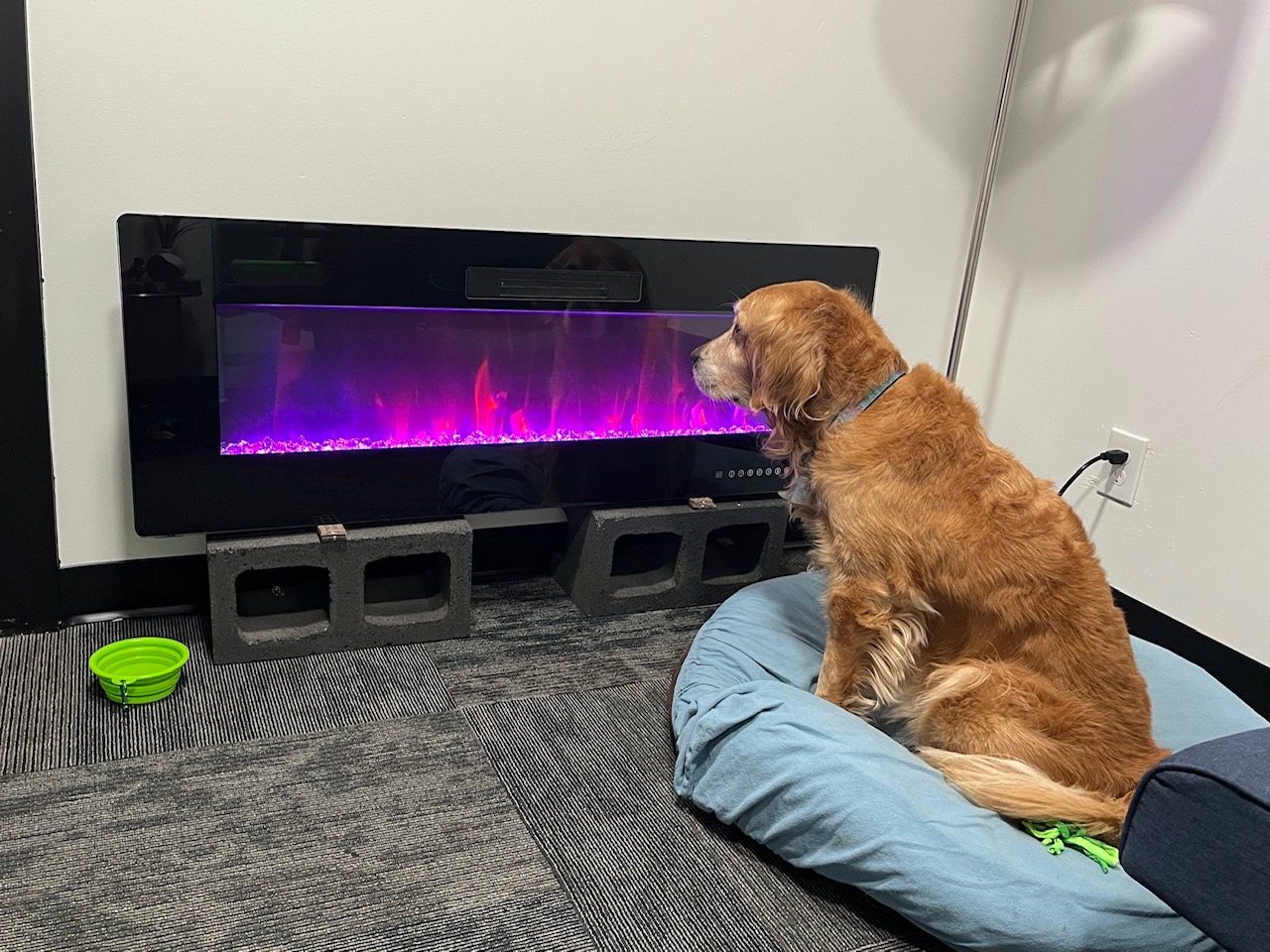
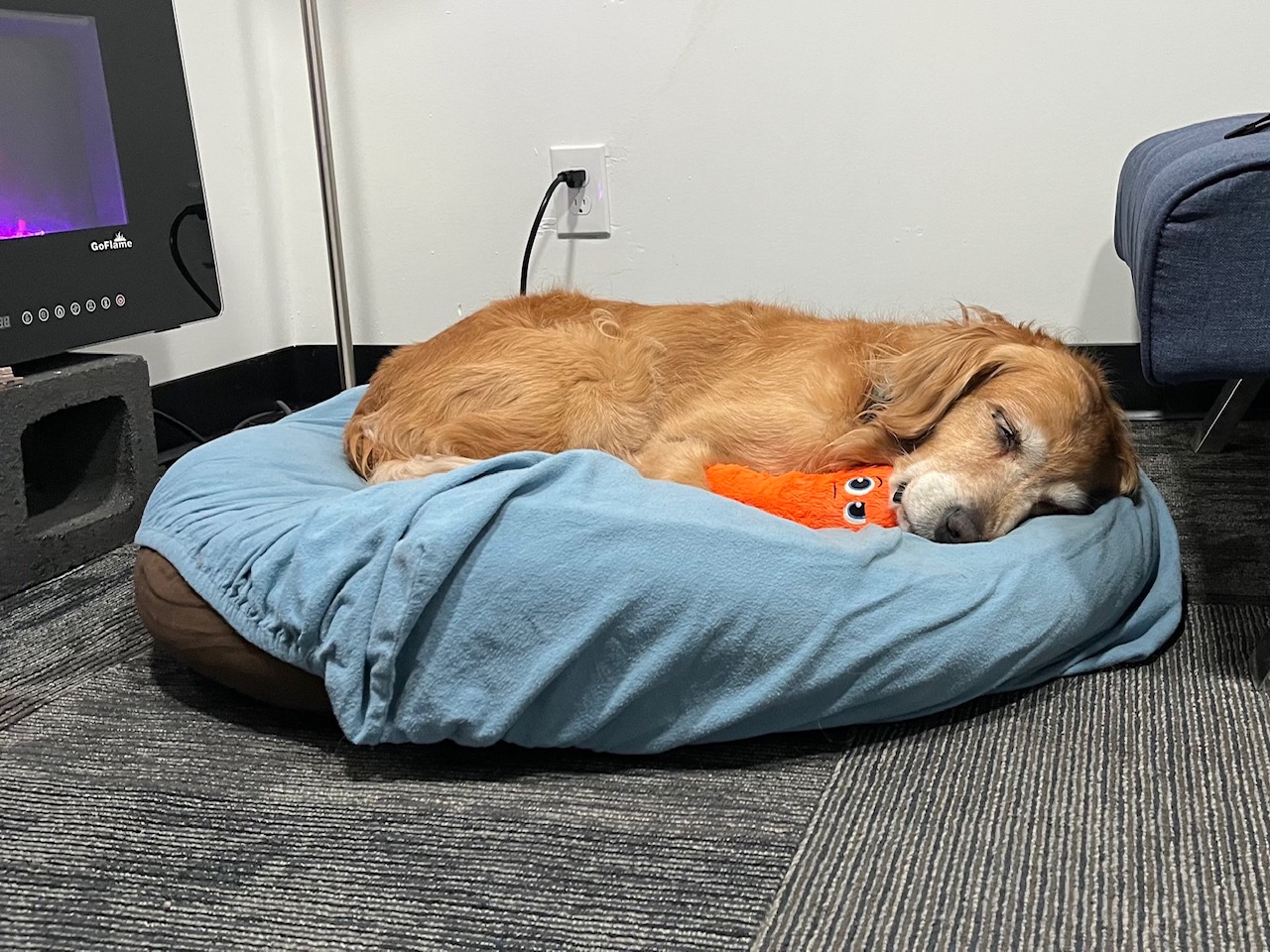
My friend who recently dog-sat for Cali for a couple of weeks has figured out the secret. When they spent time at a co-working space nearby, it became clear that Cali’s favorite show is …
A fake fireplace.
That’s right; she was mesmerized.
When she wasn’t watching the fake flames, she met all the other people in the building and showed them her new carrot toy. Exhausted from the socializing and the exciting viewing, she also napped quite a bit, I hear.
All the people programming Dog TV and figuring out how to teach dogs to make video calls should save their efforts … dog owners can just turn up the heat and watch their dogs tune out.
I read this article in WDJ recently: High Visibility Clothing and Gear For You and Your Dog. Since it’s dark in the morning when I walk Cali, and dark after work when I walk her, this topic has been on my mind, and I’ve been trying out different things to make her — both of us — more visible.
For a few years, I’ve had a light-up collar for her. Jana had one (pink, of course); Koala has one. They recharge with a USB charger, and the charge lasts a long time, maybe a couple of weeks. I use the non-flashing setting because the flashing light is annoying to me, and, I am sure, to the dog. But it’s effective: It makes her visible from quite a distance!
But the WDJ article points out that an approaching car won’t see the light if the dog is right in the path of its headlights, since the bright light of the headlights will sort of cancel out the softer colored light.
They suggest using reflective gear instead. I think we need both.
Since I read the article, I have been watching for cyclists and dog walkers when I walk or drive in the dark. Often, when I am driving, I’ll notice a walker or cyclist approaching from the side — well before I’d be able to pick them up in my headlights. I want to know they’re there before I am heading straight for them as they cross the street! Those (rare few) who have lights are visible, which is very helpful for keeping my blood pressure at its normal level.
Unfortunately, many walkers and cyclists do not have any; some lack reflectors as well. If I notice anything, it’s a dark shape (with a death wish) moving off to the side. Scares the crap out of me sometimes.
I also agree with the point made in the WDJ article that reflectors are useful when you happen upon someone strolling across the street, right in your path!
So, clearly, Cali and I need both; her pretty lighted collar is a good start, but not sufficient.
To that end, I bought some reflective tape and attached it to Cali’s harness. I left for a trip before I got to really test it out, though. Cali also has a spiffy winter coat that has reflective trim. It definitely helps, but she’s only worn the coat a couple of times so far this winter, since the weather hasn’t been very cold yet.
For myself, I have a reflective strap that I can wear over my coat, and I have a headlamp or flashlight with me on most walks. There’s got to be better gear, though, designed for runners or cyclists. I’ll check into that. Cali and I both need to be able to see and be seen on our winter walks!
What do you use? If you have suggestions, write them in comments!
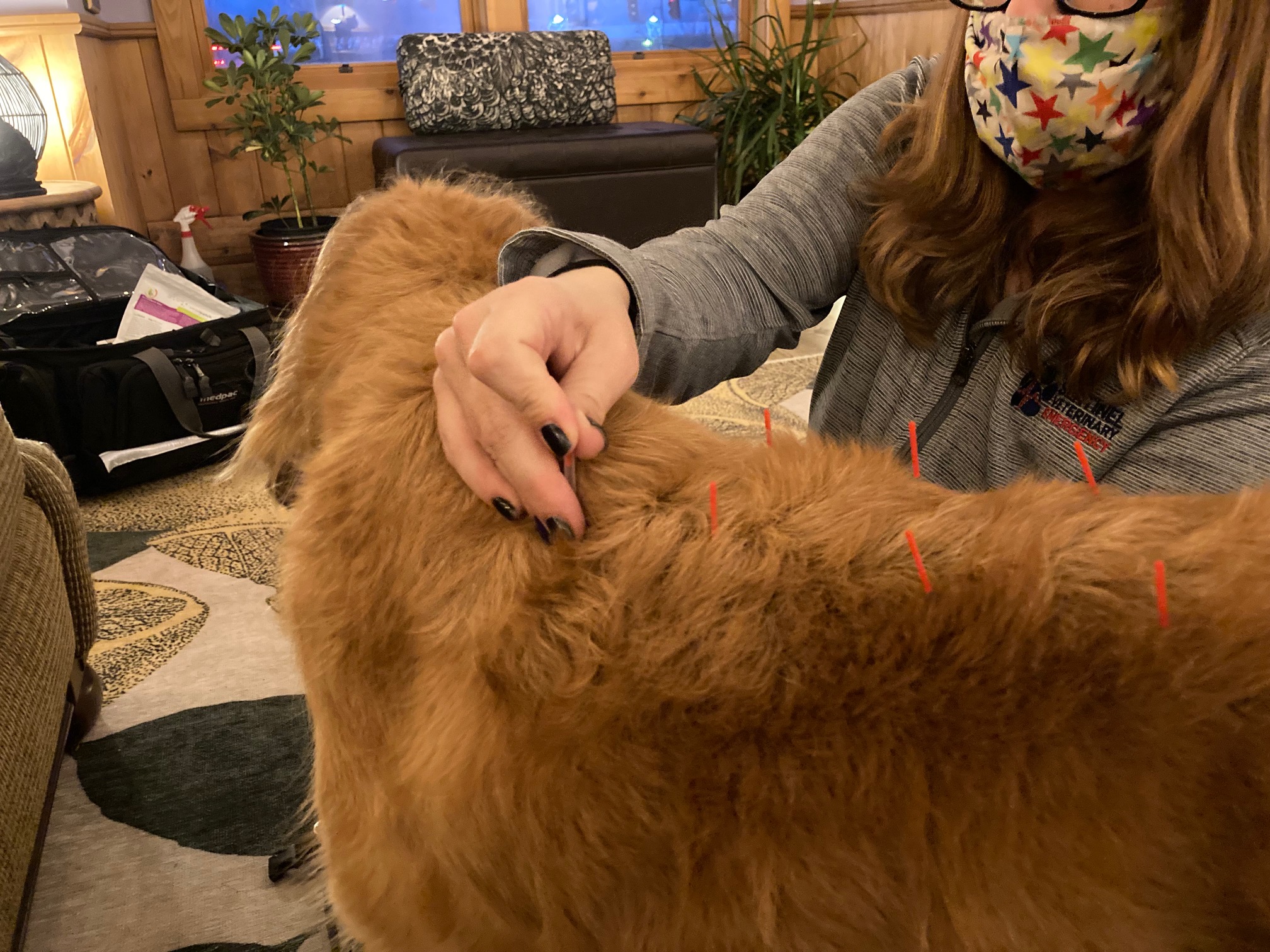
In addition to her swim therapy, Cali has had a few acupuncture treatments. These, along with her new pain meds, are intended to help Cali deal with her painful muscles and readjust her gait.
Fortunately, Cali is not bothered by needles. I’m not sure she even notices when she gets a shot at the vet’s; she’s too focused on the treats.
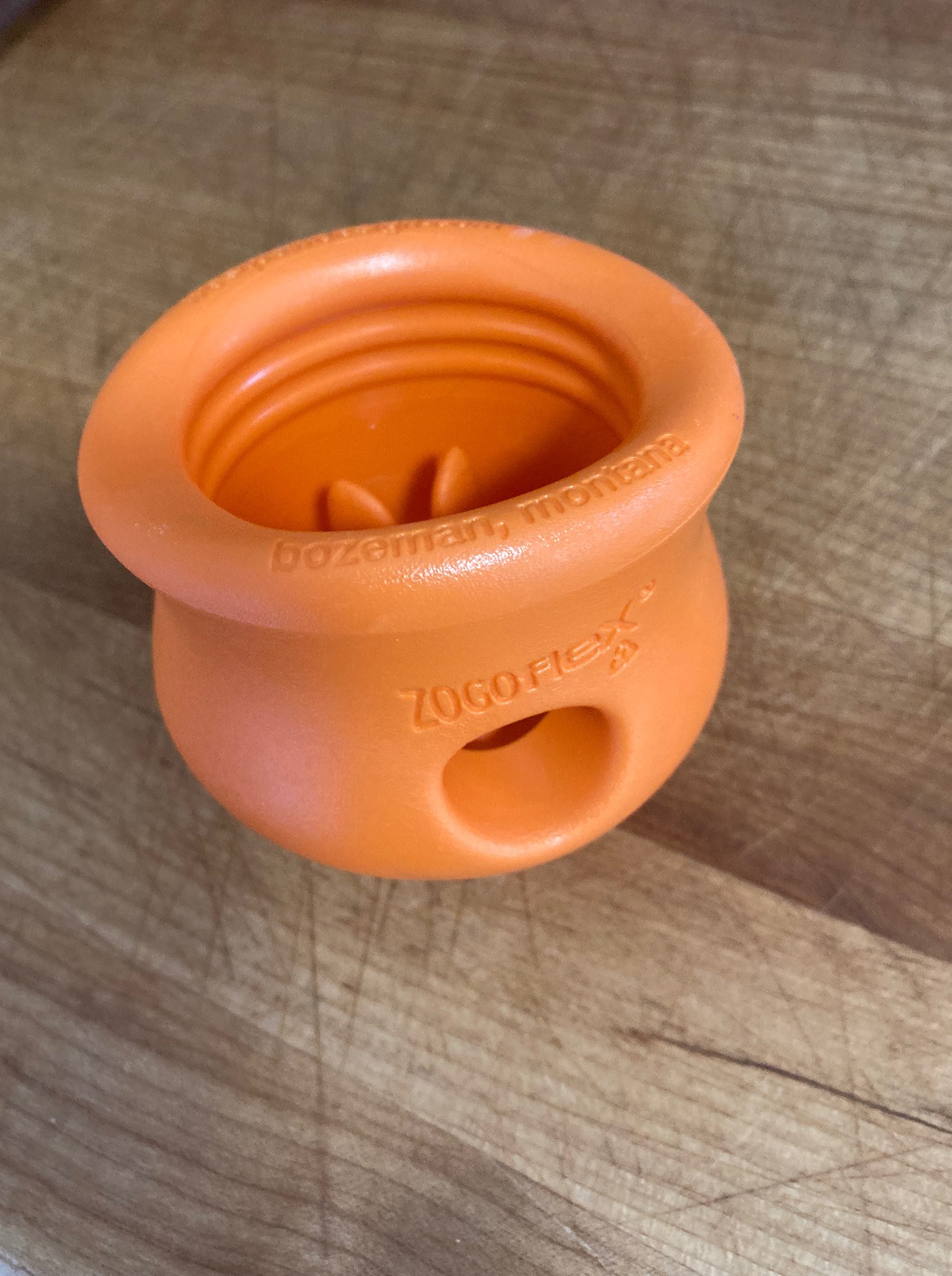
That must be the case at acupuncture, too. The first time we went, Cali got a Toppl toy filled with … I am not sure what, but Cali loved it. I’m not sure she noticed the acupuncture; she was deeply engrossed in licking clean this wonderful new treat toy.
The Toppl is a cup-shaped toy made by West Paw, a Montana company that makes indestructible dog toys. I have since gotten her her own Toppl, which I fill with Greek yogurt and freeze. She gets that after each swim therapy session, since we all know how hungry one gets after swimming.
But I digress.
Acupuncture. Cali gets needled in her back. Both times, one muscle twitched strongly several times when the needles went in. This is apparently a sign that the muscle is releasing tension.
The second time we went, the Toppl toys had all been emptied by some hungry Labs (I wonder if they also swim), so Cali had to make do with regular treats. She was a little more restless and at one point, she stood up and gave a big shake.
Once a muscle relaxes, the needles become loose and can just fall out. So … well. Needles went flying! Fortunately, they have bright red tops, so we quickly found them all.
The combination of swimming, acupuncture, and meds seems to be working. Cali has been energetic and playful to the point of constantly asking me to go outside with her and throw the ball. She even brings it back (sometimes)! And we’re taking longer walks in the neighborhood and along the river, too.
Those of us old enough to have been teenagers before everyone over the age of 4 had smartphones in their pockets may remember how desperately we wanted our own phone. By which I mean a physical telephone that was an extension of the family landline, but one that we could use (for hours) in the privacy of our own bedrooms.
Not only are today’s children more likely to have their own phones, apparently, so are some dogs.
The DogPhone, invented (one must wonder why) by a Scottish professor, is a device that allows a bored, lonely, anxious, or playful dog to call her owner’s cellphone. Actually, the device triggers a video call, which puts the dogs in a technical skills league ahead of many adults …
Showing some insight into dog behavior, the inventor of the DogPhone packaged the phone inside an appealing ball. This nicely sidesteps the problems of dialing without opposable thumbs and an inability to read the numbers on those tiny keys.
Apparently, your dog also needs her own laptop or tablet, as moving the ball triggers a video call which connects the dog’s laptop with the owner’s phone.
The inventor, Dr Ilyena Hirskyj-Douglas, told Gizmodo that the device is intended to enable researchers to “study the way dogs experience technology” and “improve and study the user experience for dogs.”
I wasn’t aware that my dog had a smartphone “user experience” other than leveraging the observation that I am using one as a chance to bark or otherwise demand attention. It had also never occurred to me that Cali might “experience technology” other than as the source of many irritating noises or as competition for my attention. So if you’re mystified by the need for this device, you’re not alone.
Cali has many talents but holding up her end of a conversation is not among them. And I can deliver neither treats nor belly rubs via video phone; I also cannot let her out / back in or throw a tennis ball. Since those are my only useful functions, I am not sure how much use Cali would have for the device.
A short YouTube video about the DogPhone offers some interesting insights. A hint: Despite her statements about the importance of giving dogs agency and control over their use of technology, I am not convinced that this is actually about the dog. For instance, Hirskyj-Douglas mentions feeling anxious if her dog doesn’t phone at his “usual” time.
I’m all for giving dogs agency and choices — but within limits. And within parameters that are meaningful to dogs. I let Cali choose which toy to play with or which direction to go on our walks, for example. But I do not let her order takeout or borrow my credit card to shop at the Holistic Pet Nutrition Center, her local grocery, treat, and toy emporium.
Anyhow, most of us have enough friends and family members calling, texting, Snapchatting, and Slacking us throughout the workday to torpedo our productivity. Do we really need to add a bored dog to the mix? How are we going to resolve her boredom from afar anyhow? Or, consider the other end of the spectrum — the dog who just loves to play with this specific ball… triggering constant chats until the battery dies!
So no, Cali is not getting her own phone for Hanukkah this year (or any other year). And I am adding this to a growing list of dog-focused technologies that just did not need to be invented. Just because we can make a phone for dogs, that does not mean that we should!
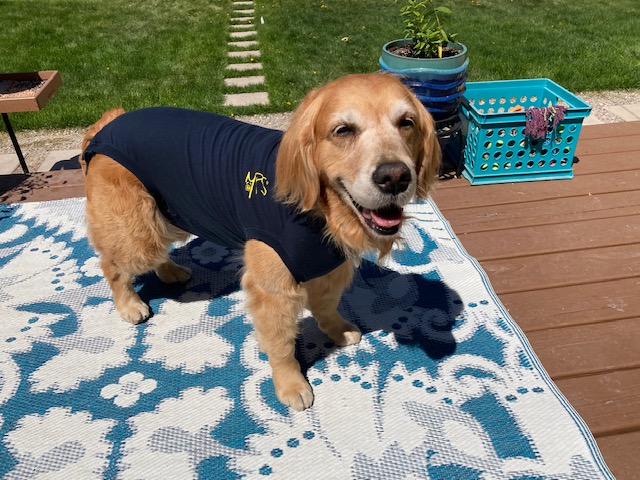
This surgical suit is similar to a “Thundershirt” or other close-fitting anti-anxiety garment for a dog
Many dog people are familiar with dogs who are sensitive to specific noises. Thunder and fireworks are common triggers, and some dogs are so phobic that they hurt themselves in their efforts to escape the noise, cause damage to walls, carpets, or furniture — or run away. (Lost dogs on July 4th are sadly common.)
But what most of us may not realize is that less extreme noises might be feeding our dogs’ anxiety as well. High-pitched, intermittent noises, such as the beeping of a smoke detector that needs a battery change or even the beeping of your microwave could be putting your dog on edge, according to a new study by Emma Grigg, of UC Davis (and Bergin University).
Many dogs fear vacuum cleaners; again it could be the sound. That might be why Cali, who had absolutely no fear of the vacuum I had when she was a puppy shies away from my current dog-hair-collecting tool as if she fears that it’s going to swallow her whole.
“We know that there are a lot of dogs that have noise sensitivities, but we underestimate their fearfulness to noise we consider normal because many dog owners can’t read body language,” Grigg told Science Daily.
It’s bad enough that we humans don’t realize that our dogs are afraid of or anxious about common noises. Unfortunately, many owners actually find their dogs’ reactions amusing! We owe them more than that.
Grigg also said that the anxiety might be related to pain. Because dogs’ hearing is more sensitive than ours, very loud or high-frequency noises might actually hurt their ears. They can even experience a painful reaction to sounds that are outside our range of hearing: When I was teaching at Bergin U many years ago, we (very briefly) set up ultrasonic devices meant to repel mice. We never found out whether they worked on the mice because the dogs immediately started showing signs of distress and anxiety.
If your dog seems anxious, and you haven’t been able to figure out why or how to help, a noise might be the cause. Identifying the cause might be a challenge, but closely watching your dog’s body language and trying to minimize exposure to any loud or high-pitched noises can help.
If you need a refresher on stress signals, revisit Please Back Off. Or, yep, I am going to recommend it again: Take a look at Doggie Language.
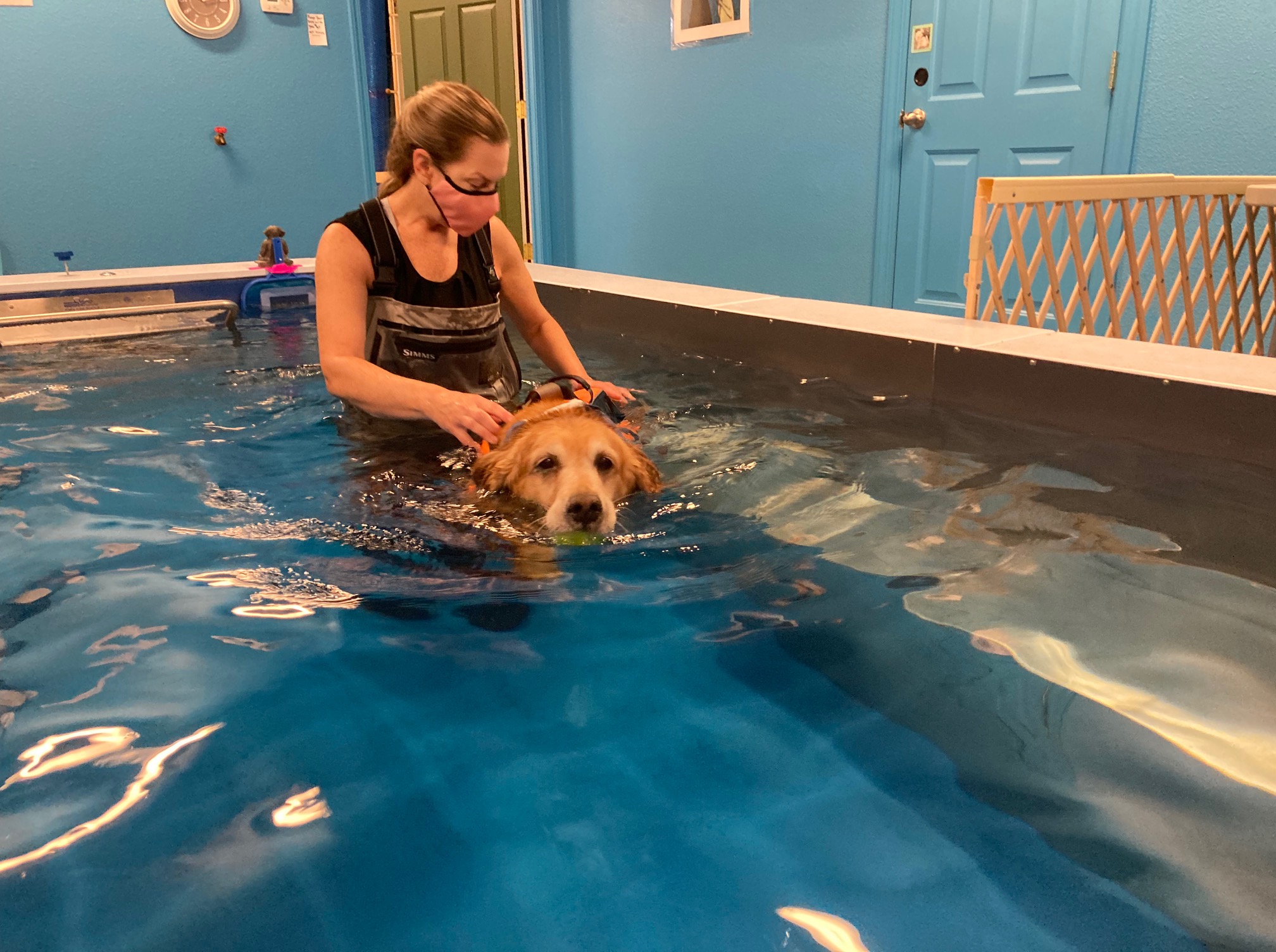
Montana Water Dogs, right here in Missoula, offers swim therapy (hydrotherapy). The owner, Varen, has a really nice setup. She’s got an indoor “infinity pool,” essentially a small, shallow swimming pool. There are steps at one end. The water is about waist deep.
We’ve only had a few sessions, and so far, I get in the water too. But as Cali gets more comfortable, I might not need to do that.
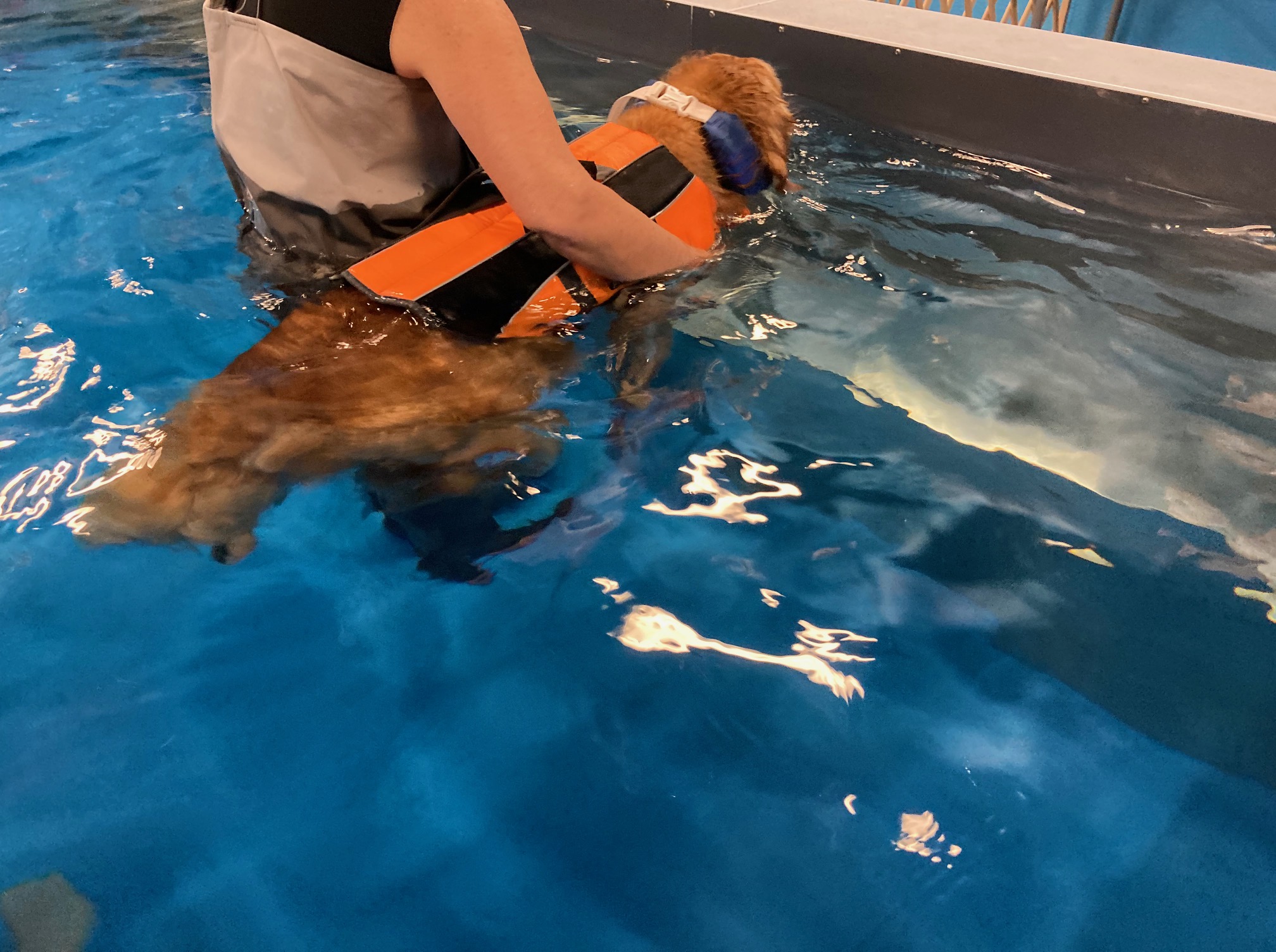
Cali wears a life preserver along with a special collar that helps her keep her head out of the water.
Varen holds onto the handles on the back of Cali’s life vest and guides and supports Cali. She also does exercises with Cali so that Cali uses all four limbs, works her muscles properly, and uses her full range of motion.
During a session, Cali might spend between 9 and 12 minutes actively swimming. But she gets a rest break every 1-2 minutes so she doesn’t get over-tired or overheated.
Cali loves to swim after a tennis ball—or just swim holding her tennis ball—so we use a ball, along with lots of treats, to keep her motivated.
When she’s done, we both rinse off, and I shampoo her so the bromine from the pool water won’t irritate her skin. She doesn’t love the baths, but she’s been very cooperative. The cookies help.
She’s always hungry when we get home (I understand; I’m always hungry after a swim too) but not as tired out as I’d expect. She works pretty hard during her swim sessions!
An article about dogs’ right to food caught my attention recently.
Dogs in the United States lack legal rights, although some (weak and ineffective) laws exist to criminalize some cruel treatment of dogs and other animals. It’s a question that comes up occasionally — in ownership disputes, custody cases, and sometimes in cruelty cases. But for the most part, dogs (and other nonhuman animals) are considered property, not beings with intrinsic value and rights. This question — and the many possible answers — is addressed in Citizen Canine, a book I enthusiastically recommend.
However, courts in other parts of the world are taking different approaches to legal questions concerning animal rights. The article linked above addresses a recent High Court decision in Delhi, India.
The decision concerns whether residents of a town or community have the right to feed and care for street or “community” dogs. India, like many countries, has an enormous stray dog population.
The court could have addressed only the rights and obligations of the humans in either side of the case: pro-feeding people who were opposed by people who believe the dogs are a health and safety threat.
While confirming the rights of the people to feed the dogs, the court went several steps farther: It also stipulated that the dogs have a right to food.
Significantly, the court spelled out that the dogs’ right to food and medical care stems from their existence as sentient beings with intrinsic worth. The decision even states that dogs have the right to engage in normal (for them) behavior!
In going beyond acknowledging that dogs need food and spelling out that humans have a moral obligation to care for — to protect and show compassion toward — all living creatures, the High Court went farther than U.S. courts have (yet) gone to establish something like legal rights for nonhuman animals.
Though there is also progress on the U.S. front, notably in a case involving Columbian hippos, dogs have a ways to go before U.S. law recognizes them as “persons” with intrinsic value and some of what we usually call “human” rights.
Cali says she’d be happy with a ruling that she has a right to (as much) food (as she wants) and that I have an obligation to provide her with food (on demand), just like those dogs in India got.
Choosing a leash for your dog seems like a really simple thing, but, as I have talked to dog owners over the years, I’ve discovered that a poor choice can make walks miserable for you, your dog, or both of you — for years.
Many people buy a leash without giving it much thought. They might get the one that matches the cute collar they’ve selected for their new dog or choose a durable looking chain one. Some people think an extendable or “flexi” leash is a good choice (it’s not; more about that in a moment).
But the wrong leash can be uncomfortable to hold, too heavy for your dog, or actually make walks less safe.
Why I avoid extendable leashes
The idea behind an extendable leash seems sound. You can “lock” it at any length, offering flexibility — or allow your dog more freedom to explore. What could go wrong? How about:
The cord ones can get wrapped around a finger or wrist when the dog pulls and cause serious injury (up to and including loss of a finger). The tape or belt ones are less risky, but they are bulky, so the handles are large and cumbersome.
Most extendable leashes have large plastic handles where the retractable cord or belt winds up for storage. If/when the dog pulls suddenly, you might drop this awkward handle, then this large plastic monster is clanking on the ground, chasing your dog as she runs away in fear. I’ve seen it happen many times, and had it happen to me during the (very brief) period when I thought an extendable leash was a good idea.
Your dog might get tangled around bushes, trees, children, parking meters …
You have little control over the dog and if she’s surprised by another dog, tempted to chase a squirrel or cat, or spooked by something, and bolts, you could get hurt. You could also drop the leash (see above).
Why I like leather leashes
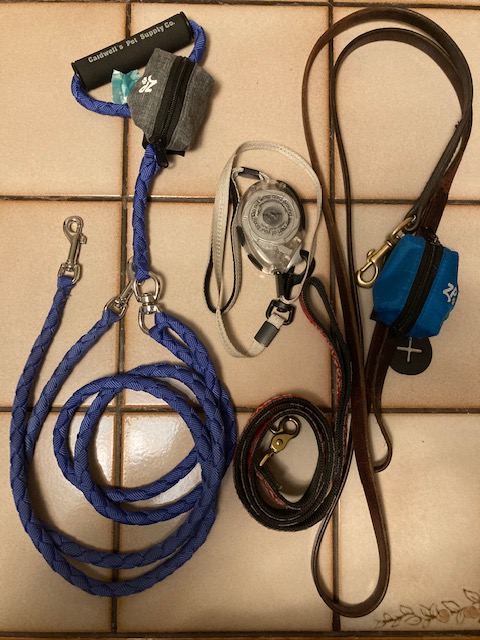
I’m not generally a huge fan of leather. I hate leather furniture and car seats, for example. But I nearly always use a leather leash. The handles are easy on my hands. A leather leash won’t scrape or cut my hands — or arms and legs — like a nylon one will if the dog pulls suddenly or the leash gets wrapped around a limb. Leather leashes last for years — The one I use daily on walks with Cali is more than 25 years old. I saddle soap it occasionally to clean it and keep it soft.
What about chain leashes?
Chain leashes with leather handles might seem appealing for their durability and the advantages of a leather handle. But be careful. They might be too heavy for your dog, especially if you walk the dog using a collar. (I use a chest-fastening harness, so there’s no pressure on Cali’s neck. She also is less likely to pull.)
When I got my first dog, a small mixed-breed dog, I bought a chain leash. the metal clasp alone was too heavy, and the whole setup was just wrong for him. I then got the leather leash I still use …
Consider having more than one
Cali has a shorter leash, also leather, that I use when I want more control. For example, if we’re on a road trip and I have to take her to a dog-friendly restaurant patio, I’ll want to keep her close. If I’m training a young puppy, I will also choose a short (3-4 foot) leash. Cali’s usual leash is a little over 6 feet long. She can wander and sniff, but she will come back if I call her and ask her to heel. She’s not happy about it, but she’ll do it.
I usually have an extra long leash or two around — 20 or 30 feet — for training or swimming when I am nervous about letting dogs off leash. I only buy the cotton ones (the nylon ones are rough on the hands) and I tie a knot every 2-3 feet. This makes it easy to step on the leash and stop a dog who bolts suddenly, perhaps in pursuit of a deer. Or a duck. The knots keep the leash from sliding under your shoe.
Other options
There are many more leash options to consider, and if the cute matching leash has a comfortable handle and is a good length for you and your dog, go for it. I’ve had canvas ones; leashes with soft, fleecy handles; elasticized ones that stretch a little to reduce the impact of a pulling dog; braided nylon ones; and double leashes with a single handle, for walking two dogs at once.
So, although I’ve got several leashes, for regular walks, I almost always turn to my favorite leather leash.
But you’re not me! The reason there are so many options out there is that people (and dogs) have different preferences and needs. I encourage you to do your own research — with lots of dog walks to try out the different options. I am sure that your dog will enjoy helping with that project!
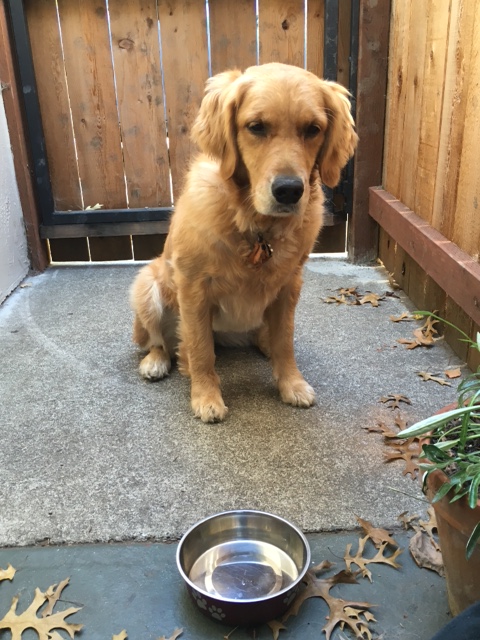
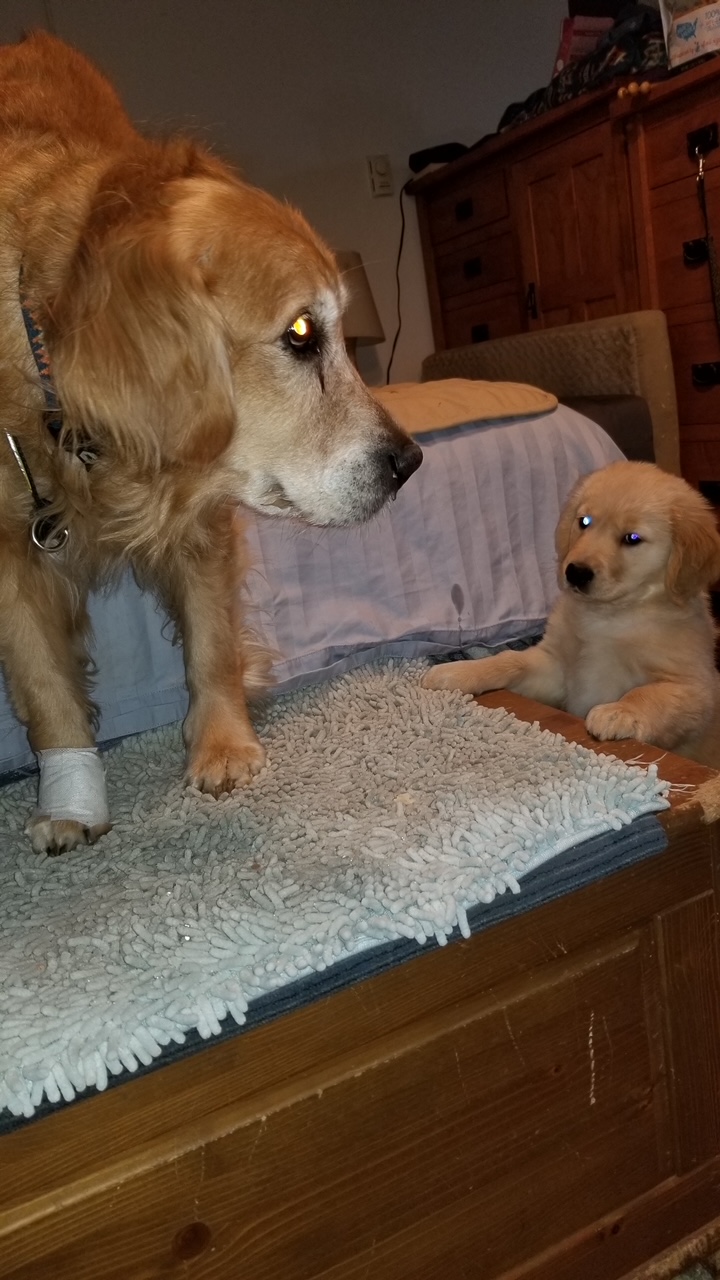 Cali cannot believe her run of bad luck.
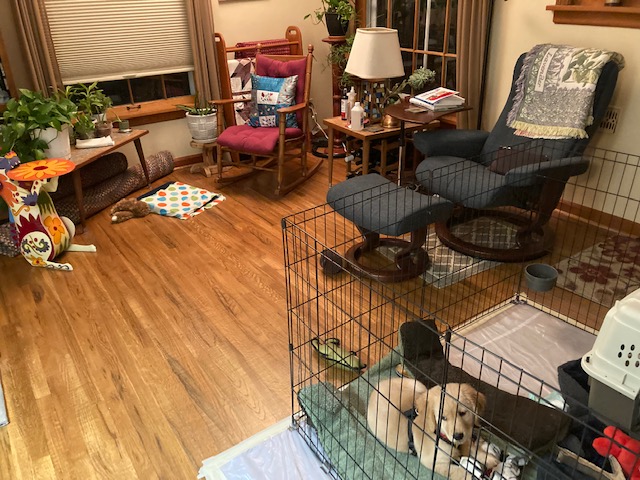 Then her mom left town for almost three weeks! Imagine! OK, well, she got to stay home with a great dog sitter, and Deni showed up after a couple of weeks, but still.