Hiking? Don’t Forget the Doggy Trail Mix!

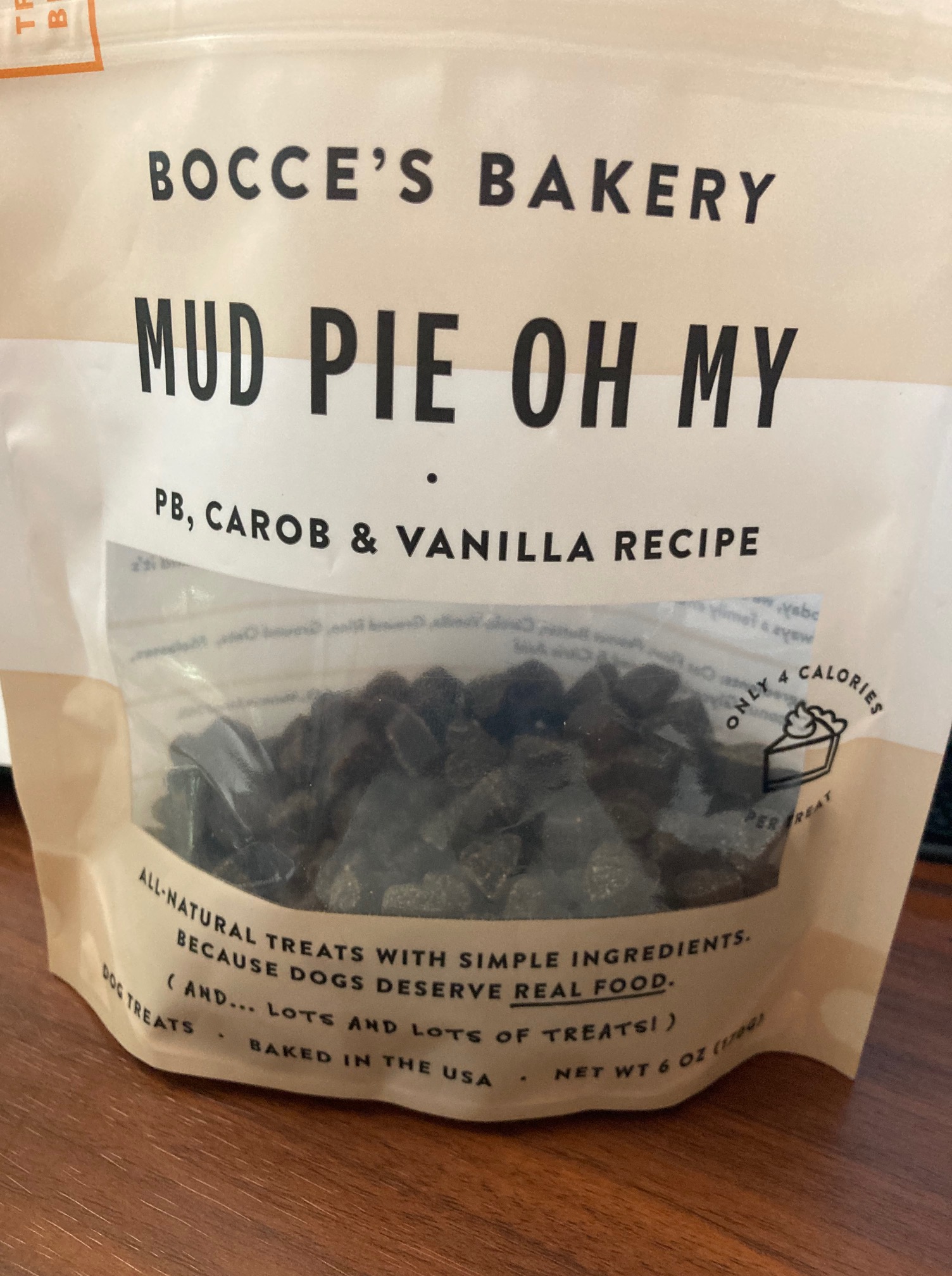
Bag of Mud Pie Oh My dog treats from Bocce's BakeryI have a Dog Hiking Backpack that is always ready for our next adventure. Problem is, it weighs more than Orly does!

So I select essential items for each hike. Number one on that list is doggy trail mix.

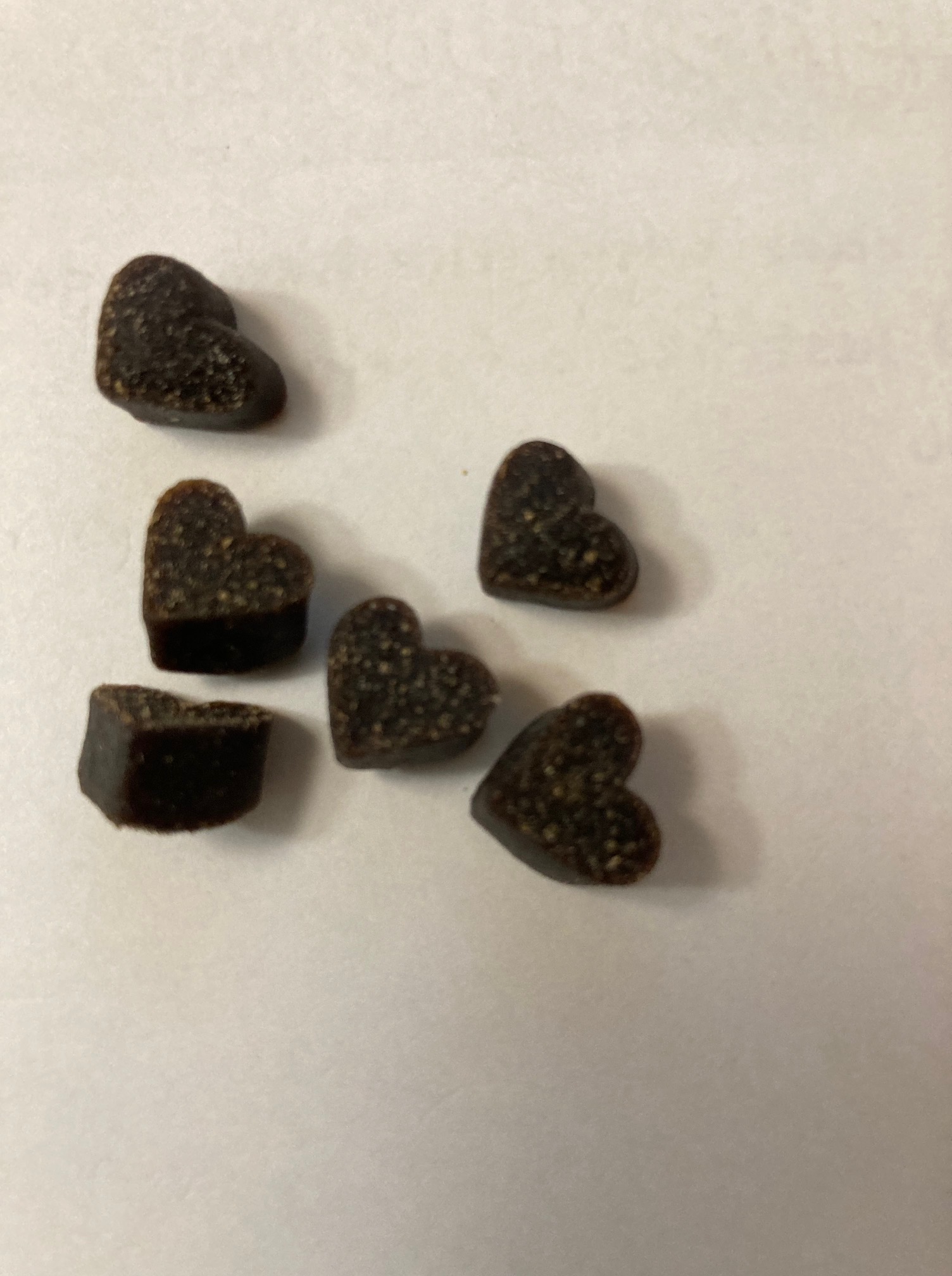
6 small heart-shaped dog treats
The heart shape is a nice bonus

This homemade delight was invented by Deni. And, dare I say, perfected by me, with copious input from Cali. Perfected for our hikes, that is. Your recipe needs to be created and tweaked by your dog(s), of course.

Doggy trail mix is simply a mix of treats. The base, as in any trail mix, is some basic and relatively inexpensive ingredients. I don’t use peanuts (choking hazard) or raisins (dogs can’t eat them); instead, the base mix is about two parts Cheerios (generic are fine) to one part Charlee Bears — any flavor that doesn’t include chicken, for my girls.

To that I add generous amounts of medium-value treats. This mix changes every time. I am partial to the tiny treats from Bocce’s Bakery that my local dog grocer stocks. Cali and Orly love the Mud Pie and Duck flavors. Again, your dogs’ preferences may vary. I have also used many other kinds of dry and semi-soft treats. The key is to use small pieces or treats that are very small.

Topping off the mixture is a few handfuls of high-value treats. I often use freeze-dried liver.

The trick is to have enough good and great treats to

  • Keep the dogs interested and hopeful
  • Provide some variety in their rewards
  • Lend scent and flavor to the other treats as everything jumbles around together

That last point might seem a little deceitful. But come on, who doesn’t eat the bits of chocolate in their trail mix with a bunch of the peanuts or raisins to make it all taste better? If it works for us, why not for the dogs?

Leave out the BEST treats

Our highest-value treat is currently a duck jerky treat that I get in big bags from Costco. It’s soft enough to break into small pieces. But I don’t put it into the trail mix because I save it for the most important use. That’s right: When we’re hiking off leash, I always carry a lot of duck jerky. This ensures that whenever I call the girls, they come running at top speed, screech to a halt, and sit right in front of me, eager for their reward. Duck jerky is truly magic. (Orly’s hiking guide uses the same stuff).

Hiking trail mix, like many human-oriented snack mixes, has crept into daily use. I mix up enormous batches and keep treat jars filled with it on every floor. It’s the default reward for training, cooperation during grooming, and recall practice outside. Each batch is a little different, and no one has complained about (or turned up her nose at) the Cheerios yet.

What else is in the backpack?

The backpack has:

  • A first aid kit
  • Binoculars
  • Dog water bowl
  • Long leashes for swimming, recall practice, or hikes in places I don’t want to let them off leash
  • Insect-repelling dog bandanas
  • Bug spray
  • Sunscreen
  • Wet wipes & sanitizer
  • Strong wire cutters in case we run into traps or snares (I hope NEVER to use them)
  • Bear spray (ditto)
  • Flashlight
  • Extra poop bags
  • Extra leashes
  • Extra sunhat

Often, the pack stays in the car while we hike so the heavier stuff is nearby if needed. But a treat bag stuffed with trail mix and/or duck jerky is always with me. Happy hiking!

When a Bite Is not a BITE

8 month old golden retriever Orly smiles for the camera
Orly loves giving puppy kisses …

Orly loves to connect with people. One way she does this is by holding their hand.

Orly doesn’t have hands, and it’s awkward for her to stand on three legs to hold paws with someone. So she has a more expedient method: She takes the person’s hand in her mouth.

Now, unfortunately, many people see this as a bite. But Orly is not biting them. She’s very, very gently holding their hand.

But, I hear people objecting: Her teeth are touching someone’s skin. And holding on!

True. They have a point …

But it’s not biting. She is using no force. She has not an iota of aggressive intent. She’s simply holding hands.

It’s still not a great idea. Some people — in my friend group, there are many dog-savvy people (go figure!) — get it, even think it’s sweet. Orly really likes those people.

Others freak out a little: “She’s biting me!” Understandable, if inaccurate.

On their account, I am strongly discouraging this method of connecting with new friends. Although I am not sure the non-dog-loving contingent will like what she’s trying instead any better — up close and personal doggy kisses. What’s an aggressively friendly puppy to do?

Wisdom … and Resignation

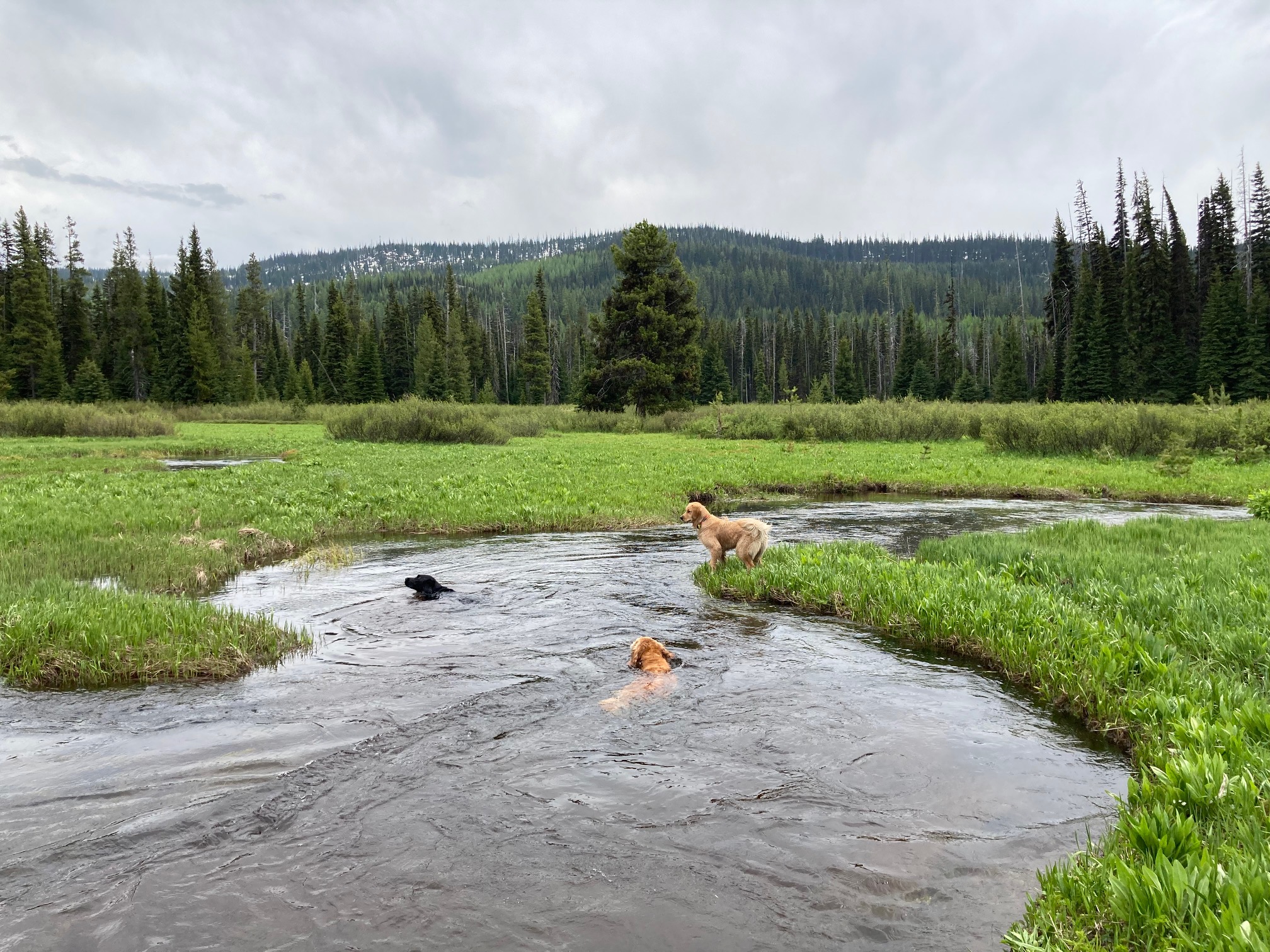
2 golden retrievers and a black Lab swim in a mountain stream
Cali’s Morris study exam is always around the time of our first visit to Packer Meadow and the very cold stream there!

It’s that time of year. Cali always knows. She saw me setting out a small paper plate, ziplock baggie, and a poop bag one evening, and she knew. No breakfast in the morning, and a visit to her pals at the vet clinic who would steadfastly refuse to give her cookies, no matter how good she was.

It was time for her annual Morris Golden Retriever Lifetime Study physical exam. She’s usually pretty resistant to the sample collection, particularly the urine sample.

I think that, with Cali’s advancing age and important new role as the teacher of all good things to Orly (you know, how to thoroughly coat yourself with mud, which plants to chew in the garden while avoiding all the weeds, and the most strategic spots to dig holes in the lawn), she has also learned wisdom and patience. She knows how this day will unfold and, for the first time, she (mostly) cooperated.

I took her out, on leash, first thing. She gave me a disgusted look when I grabbed the plate and baggie, but went willingly. She did not stop peeing when I shoved the plate into place and she did not kick it. Progress! She provided her other sample during our walk.

At the vet’s she briefly objected to going into the back area without a cookie … she was hungry, after all. Once all the samples had been collected and she’d been examined from nose to tail, Cali showed me how well she had trained our vet. As the doc and I talked, all Cali had to do was shift her glance slightly and Dr. Z handed over a cookie or a squeeze of cheese whiz. Cali’s consistent, clear communications were quite impressive!

Best of all, we were out of the vet’s office in well under an hour, and Cali’s breakfast was duly served. Late of course.

As a Golden Ager, Cali — along with other study participants — has been invited to be part of an additional study about aging. Cali doesn’t have to do anything; her mom gets more questionnaires to fill out. With her white face, she increasingly looks like a senior dog, but Cali is aging well. She’s fit and energetic; she loves playing with Orly and going hiking. Let’s hope she has many more annual study exams ahead!

A Wolf Called Romeo

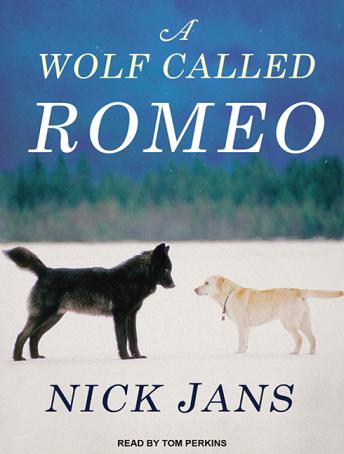
Book cover showing large black wolf nose to nose with a yellow LabradorIn preparation for a recent trip to Alaska, I read A Wolf Called Romeo by Nick Jans. I’ll warn you straight up: It ends predictably. That means that it’s wonderful until about two-thirds of the way through. The last sections are devoted to the inevitable end, a detailed description of the thug who killed Romeo, the many other laws that vile person broke, and the utterly predictable lack of any kind of justice.

However, up to that point … it’s a magical story.

Romeo, a solitary black wolf, appeared one day on a frozen lake near the Mendenhall glacier outside of Juneau, Alaska. The wolf did not flee the humans out walking and skiing. Even more surprising, he seemed interested in meeting those humans’ dogs.

The dogs were equally intrigued, and the first up-close meetings occurred between dogs who slipped their leashes or pulled away from their humans’ to go meet this large new playmate.

Over the next several months and years, Romeo made friends with several dogs and a few humans. He’d watch for them to arrive, follow them, hang out, play with the dogs, and otherwise conduct himself as any walking partner and friend would.

Jans and a few other humans who spent considerable time with the wolf share their stories as the book unfolds — as well as their fears of the wolf becoming too comfortable around humans. An even greater fear: Naive or clueless humans doing something stupid that resulted in a dog or child being harmed.

Despite many somethings stupid, such as parents pushing their toddlers into the wolf’s company to get a photo, the wolf never harmed a human. On a couple of occasions, he did respond to small dogs as he would to prey, grabbing them and running off … and then he released the dogs unharmed.

As the wolf’s fan club grew, so too did the band of wolf haters. One such individual claimed that the wolf ran off with his dog. The dog never did reappear, but there was also no evidence of the wolf’s involvement. Over several years and hundreds or thousands of human and dog encounters, that was the worst harm reported.

I recommend this book with the caveat that it ends badly. If you can take that (or stop reading in time), you’ll enjoy a beautiful story that shows how a wolf in the prime of his life seeks friendship from close relatives and enjoys playing and hanging out with both dogs and humans. It’s a unique perspective on wolf behavior and cross-species friendships.

Orly’s Pedicures

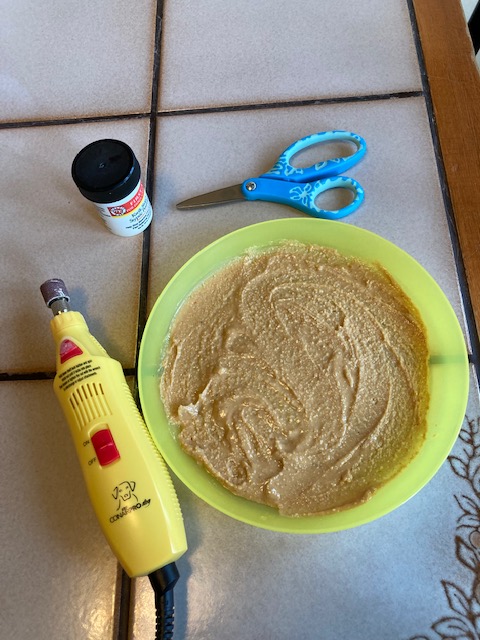
a yellow nail grinder, a plastic plate smeared with peanut butter, blunt scissors and styptic powder are gathered for the pedicure
Prepare your tools before you start the dog pedicure

What’s the best way to trim a dog’s nails? That’s a common question, since most dogs have experienced painful or unpleasant nail trims and loathe the entire process. I have had to find an answer; the secret is peanut butter.

Orly’s nails grow so fast! Cali’s need attention occasionally, but if I let Orly’s go for a couple of weeks, they get unbelievably long. So, it has been important to get her cooperation for frequent pedicures.

I’ve never liked using dog nail clippers. First of all, they all seem to be designed for right-handed people, and I don’t feel like I can get a good grip on the nail and clip it. Second, all of my dogs have either had entirely or mostly black nails.

With black nails, it is really hard to tell where the “quick” is. This is the tip of the blood vessels that feed the nail. In dogs with white nails, you can see the quick (it’s pink). If you cut it, the dog bleeds. A lot. And squeals in pain. It’s horrible.

That leaves a dremel-type tool to file down the nails. It’s pretty easy to do … if the dog cooperates.

With Jana, Cali, and, most recently, Orly, I started dremel training early. Turn it on, let them hear it while getting great treats. Let them sniff it thoroughly when it’s off. If possible, let them watch other dogs get pedicures (and treats, always lots of treats). Things like that.

Jana spoiled me. She loved pedicures. She loved anything that made her feel like a pampered princess. She’d sit still, hold up her paw, and accept my attention (and treats!), looking bored by the whole thing.

Cali is good, but she doesn’t like the nail trims. She cooperates, but pulls her paw away if I spend too much time on it. I rarely do hers, so it hasn’t been an issue.

Orly … needs her nails done nearly every week.

Fortunately, she’s very cooperative. Even better, she loves peanut butter. I mean really loves peanut butter. So I have come up with the perfect pedicure process:

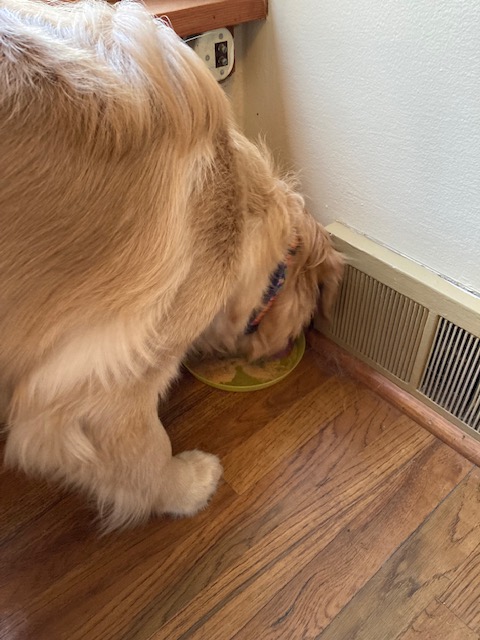
  1. Get dremel, styptic powder (in case of bleeding), and scissors from the grooming kit.Golden puppy Orly licks peanut butter off of a plate
  2. Smear a small plate liberally with peanut butter.
  3. Find a comfortable corner where the plate can be pushed up against a wall and not escape.
  4. Put the plate down and let Orly start licking the peanut butter.
  5. Push Cali’s nose out of the peanut-butter dish.
  6. Turn on the dremel and pick up first paw. File each nail.
  7. Put down the paw.
  8. Turn off the dremel, and push Cali’s head out of the peanut-butter dish.
  9. Move the plate back into place.
  10. Turn demel back on and pick up the next paw.
  11. Repeat steps 7, 8, 9, and 10.
  12. If 4th paw is finished before the peanut butter is gone, use scissors to trim the fur between Orly’s paws.
  13. Give Cali some peanut butter as a reward for being (relatively) patient while Orly had her pedicure.

She doesn’t seem to mind this at all. I’ve never had any accidents (no blood and no pain), and she seems happy to participate in this activity every time I get the dremel (and the peanut-butter plate) out. It actually only takes about 10-15 minutes.

The trick is figuring out how much peanut butter is needed to keep Orly busy long enough to do all four paws. As she gets bigger, her peanut-butter-licking skills are improving rapidly, so the layer of peanut butter gets thicker and thicker. I might need a bigger plate soon. She’s pretty active, so I don’t worry (yet) about the large amount of peanut butter she’s eating. If we get up to half a jar at a time … well, let’s hope that doesn’t happen!

Golden retrievers Orly and Cali lick the last bits of peanut butter off of a yellow plastic plate
Cali is happy to help with post-pedicure cleanup


New Podcast: Off Leash

The Off Leash podcast logo shows a drawing of a dog's head and the title in red lettersAlexandra Horowitz has a new podcast called “Off Leash.”

In each episode, she goes for a walk with a person and dog. Together, they explore a question about life with dogs. Or life as a dog.

The first episode is about, what else, smell. That is, after all, the primary way that dogs experience the world!

The episode delves into interesting dog jobs that involve scent, such as tracking rare animals using their scat. It also spends more time than I thought strictly necessary talking about how humans use smell and the interplay of smell and memory. It’s a lot like Horowitz’s book on dogs and smell, Being a Dog, but in podcast format. I’m looking forward to future episodes, and I recommend you check it out!

Orly Is a “Tween”

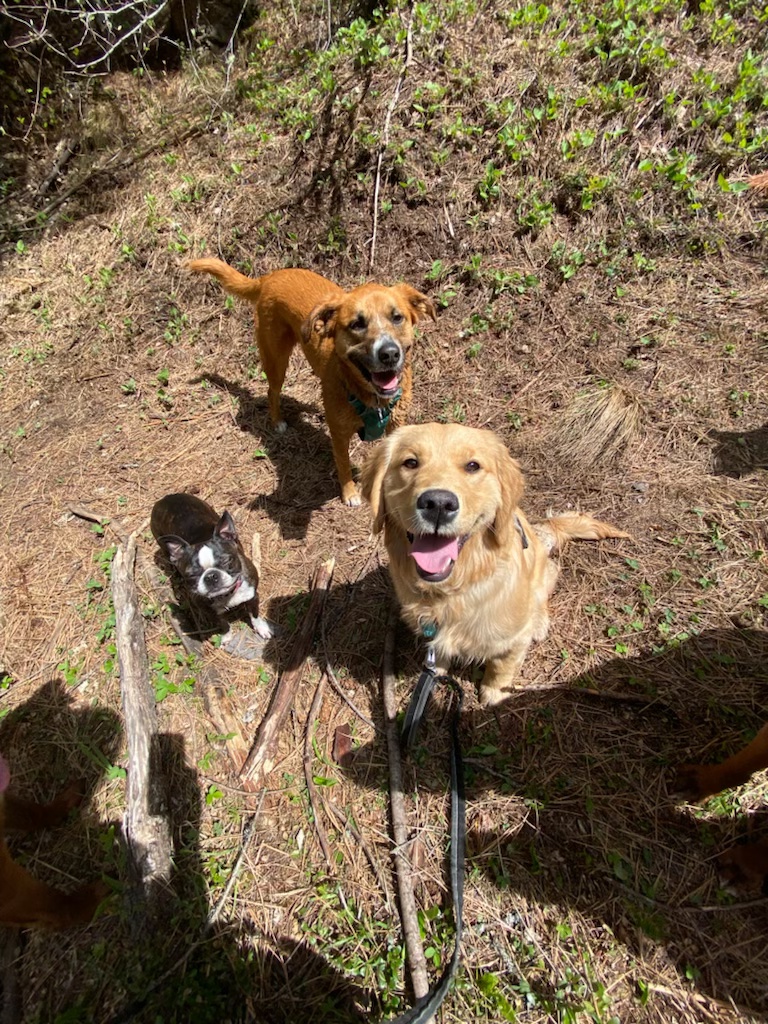
7-month-old golden retriever Orly sits with 2 other dogs
Orly was on-leash and well-behaved during her first group hike (Photo by Missoula Dog Mom)

Humans aged about 9 to 12 are often called “tweens.” Not quite teenagers, they are also no longer little kids.

In puppies, this period seems to start at about 6 months. Orly is very definitely a tween.

She is impulsive, curious, and has no common sense. She can be very toddler-like, pouting when she doesn’t get what she wants — and sulking when pouting doesn’t produce results.

She also has little toddler tantrums, getting bursts of mischievous energy when she’s over-tired. During these phases, she’s most likely to needle Cali relentlessly, badgering her to play, tugging on ears, tail, collar until I intervene.

She’ll continue these outbursts, acting up and acting out, until she finally collapses and falls asleep. Often very sweetly snuggled partway onto my lap.

Then there’s the early adolescent behavior: She seems compelled to investigate everything, meet everyone. She pulls in every direction, following any sound or scent, chafing at the leash, wanting the freedom to explore.

She’s also started hanging out with the cute boy (dog) next door, mooning over him and chasing around the yard, whether ours or theirs. But she also barks grumpily at any other dog who comes near her fence or her yard.

Adolescence for golden retrievers (and many other dogs) means a dog with enormous energy and curiosity who still makes poor decisions. Unfortunately, it can last until age 3 … or beyond.

I’ve been working hard on her recall and make sure to have lots of treats with me whenever we’re outside. She’s still pretty good, but I know that adolescence often brings a temporary hearing loss and lack of comprehension of names, recall cues, and other requests and demands from nearby humans.

With all this in mind, I have started letting Orly go on “real” hikes, the kind where dogs get to be off leash sometimes.

Her first group hike (on leash) was a huge success: She got a good report from the hiking guide and came home tired and happy. Over the next few hikes, she’ll get to know her fellow hiker-dogs and begin to taste off-leash freedom with the group.

I’ve also started taking her to “safe” places to hike off-leash with Cali, me, and, sometimes a friend or two. Our first foray was hugely successful. She instantly came back every time I called her, didn’t dash off to say hi to any of the “new best friends” ahead of us on the hiking trail, and didn’t annoy Cali (much).

The hikes are fun for all of us, and a great way to burn off a tiny fraction of her excessive energy. I’m looking forward to a summer filled with on- and off-leash hikes. I hope that Orly remembers her name, the meaning of “Come here!” and the taste of top-quality treats throughout, so we can all safely enjoy the summer.

Leave Me Alone!

This slideshow requires JavaScript.

Orly has hit adolescence.

She’s full of energy, eager to explore the world and try out everything … and has very little common sense. She is also fearless and a little too eager to test boundaries and live on the edge.

I work from home, so I am not always available to play. I’m working on some arrangements to get her tired out — regular dog walks or hikes with a lucky someone else, play dates with the neighbors’ dogs, things like that. And I frequently offer treat toys, snuffle mats, and games of “find it,” where I hide little boxes with smelly, yummy treats inside and she and Cali use their noses to find the treats. It’s not enough.

All that adds up to a dog who bugs Cali.

The most egregious behavior occurs when we’re playing outside. Orly will launch herself off the deck and run, full-speed, toward Cali … and tackle her. Or race after Cali when Cali is racing after a tennis ball … and grab Cali’s tail or her leg and tug. Hard.

I step in each time this happens and put Orly back inside, but the lesson is not sinking in. I also let Cali out without Orly and throw the ball, while Orly looks on, sadly, from behind the screen door. Again, she’s not making the connection.

What would make the connection is a correction from Cali. A well-placed, sincere warning. But Cali is too nice. She just rolls her eyes and looks to me for help.

I could just keep them separate, but that’s not what either of them wants. They do love to play together, and Cali often initiates play, whether it’s a game of tug, wrestling, or racing around the yard together.

I’m going to call in reinforcements. The young male dog next door. The puppy who lives behind us. Koala, who is coming for a visit soon. Dogs who, like Cali, want to play with Orly but who, unlike Cali, are likely to set and enforce boundaries.

The combination of playmates who establish ground rules and additional activities to tire Orly out just might be the magic we all need. I’ll let you know!

Dogs at Work

Puppy Orly and big sister Cali, both golden retrievers, relax on a dog bed
Relaxing on the extra-large dog bed is a favorite office pastime

Should you be able to take your pet dog to work?

My office is as dog-friendly a place as you’ll find anywhere: A huge, overflowing toy box and two comfy dog beds are standard features. The window seat boasts a cozy dog rug. In addition to the chew toys and stuffed toys, two snuffle mats are at the ready, alongside a large container of treats. You get the picture.

Cali, a golden retriever, searches for treats in a blue snuffle matBut my office is the upper floor of my home. I’m the only one who has to like the idea of dogs, dog hair, dog toys underfoot, and the occasional vocal interruption. Well, my teammates are all dog lovers, so when the dogs chime in on a Zoom meeting, no one gets too upset. (And their dogs also participate occasionally.)

Post-pandemic, people are reluctant to return to their offices. Pandemic pets who’ve never been left home alone are part of the reason for many workers.

Since we’re also in the midst of a huge reshuffle of workers, offices that want to be the destination rather than the company everyone’s leaving are considering allowing employees to bring their dogs to work. What could go wrong?

Well, for openers, not all dogs are as easygoing as Cali, who enjoyed the amenities while visiting a friend’s co-working space. Some dogs will bark or whine, or even growl at people who walk by. Others are too energetic. Or attention seeking. Or food seeking (& stealing). The truth is, not all dogs are well-behaved or temperamentally suited to be out in public spaces with strangers and unpredictable sounds, sights, and smells.

Then there are the other workers. I love dogs. A lot. But I also get it that not everyone does (their loss …). And that work is stressful enough without worrying about an unfamiliar dog (or even a familiar one) poking her head under the stall door when you’re enjoying a private moment … or rifling through your trash or shedding on your new wool sweater.

Then there’s the question of which dogs get to come to the office and how many at a time and how often and … the areas of contention multiply rapidly.

I’m definitely not opposed to dog-friendly workplaces, but I think it requires a considerable amount of planning. I have heard too many stories of dog-friendliness gone very wrong when the decision to allow “a dog” in the office was made casually.

Anyhow, appealing as the dog-friendly office may be, I am even more strongly in favor of allowing people to work from home. Many of the types of jobs that enable people to have a dog in their office are the exact jobs that can easily be done remotely. Rather than bribe some people to come back using a reward that will drive other workers away … why not just give everyone more flexibility?

No Breakfast?!

Golden retriever puppy Orly cuddles a black-and-white panda toy
What do you mean I don’t get breakfast?!

Orly had her first real vet experience this week. Not the run-of-the-mill go in, get cookies, get poked with something sharp, get more cookies vet experience. Nope. She was spayed.

Surgery means no breakfast. And it means being left at the vet clinic.

It was not her favorite day.

First, I put her outside and gave Cali breakfast. Orly couldn’t believe it. She rang her bell, asking nicely to be let in. She escalated to batting the door with a paw. Harder and harder. Then whining.

By then, Cali was done eating. Rather than reward the whining, I let Cali go out, then let both girls in a few minutes later.

Orly wasn’t speaking to me at this point, but she agreed to get into the car.

She was happy to be at the vet’s, where she met a very friendly (and very large) Great Pyrenees dog in for a dental cleaning, and weighed in at 43 pounds.

She was a little mystified that no one offered her a cookie, though.

Then, the vet tech took her … and I left. She was very surprised by that, but didn’t have the chance to ask me about it.

When I arrived to pick her up, the vet said that Orly was in the back, cuddling with all the techs. Yes … and interviewing potential moms, I am guessing.

Golden puppy orly wears a dark blue onesieShe got home, had breakfast (and dinner not long after). And put on her surgical suit. No cone for Orly!

She was pretty mellow and cuddly Tuesday — the food was all it took to get back into her good graces — but by Wednesday …

Despite the medications that were supposed to keep her a little lethargic, she wanted to play. I kept her busy with treat toys.

Orly chases an orange treat ballThat worked for a while. Then, luckily, our new sofa cover arrived, and I was able to let dogs into the living room. Orly happily tried out the new sofa cover. Then Cali offered the first lesson on how to keep other dogs off of our sidewalks.

Cali’s method doesn’t really work, but it does involve quite a bit of muttering and grumbling at people walking by …

Several days post-op, Orly is full of energy, in no pain, and really wants to play. I am supposed to keep her quiet and calm for another week. Yeah, right.

Cali and Orly, both golden retrievers, stand at a large window