Did Tool-Using Dogs Learn from Their Ancestors?

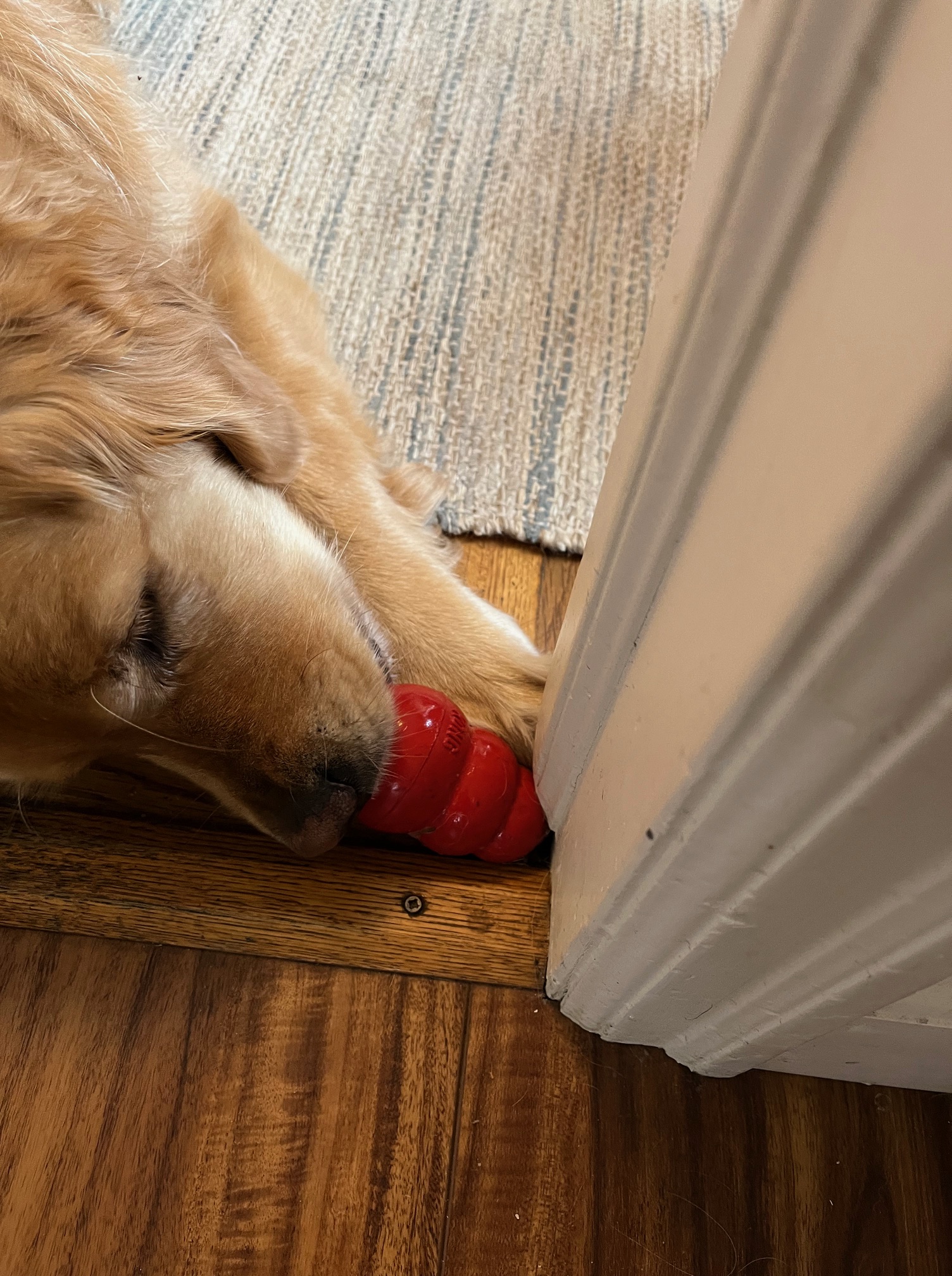
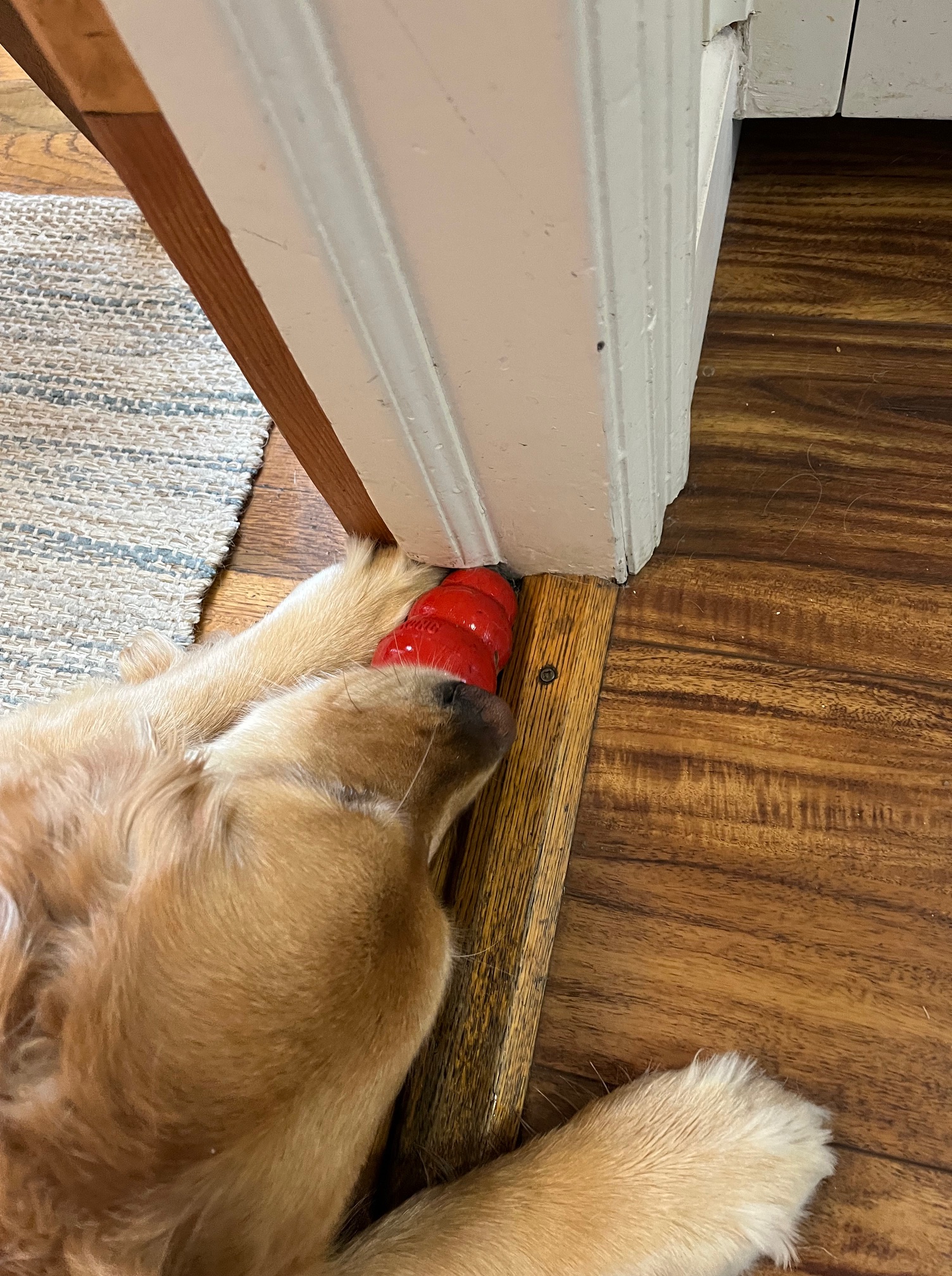
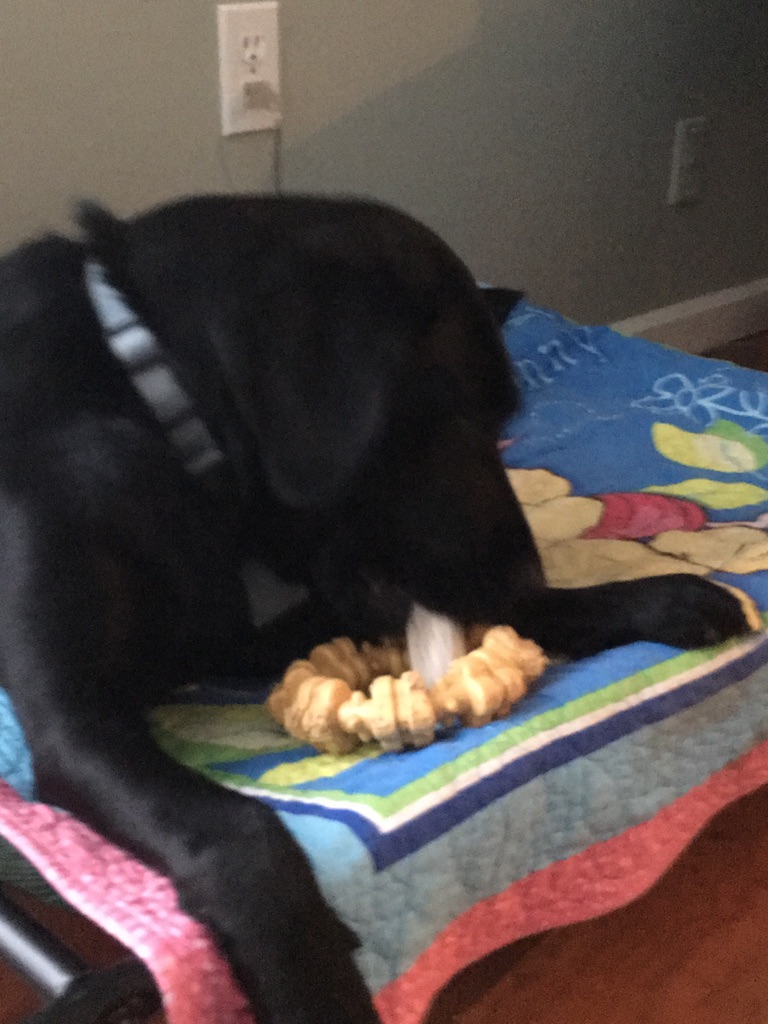
Koala, a black Labrador, uses a ring toy to hold an antler steady for chewing.
Photo by Deni Elliott

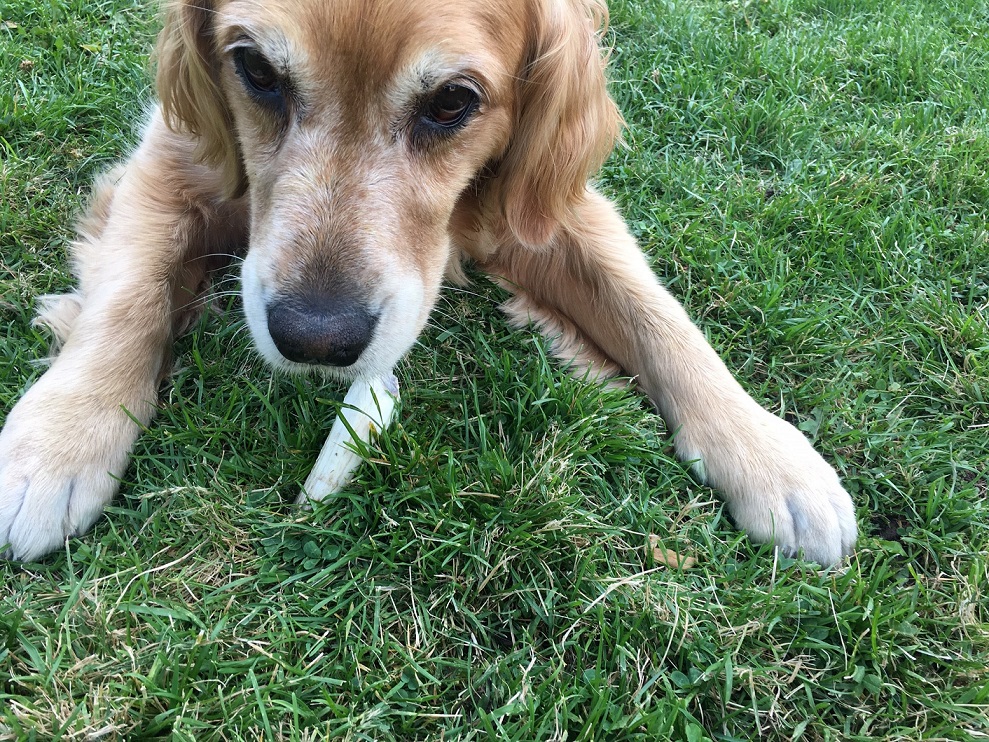
I have written about the ways various family dogs have learned to use tools: Orly ringing a bell, not only to prod me to let her in and out, but as a way to help her sister. (Never mind that as an adult, she refuses to use the bell…). Going even farther back in history, Koala devised a tool to hold her antler still for chewing, while Cali used the backyard to hold her antler.

I was excited about these examples of dogs’ creativity, smarts, and problem-solving skill. And I wondered whether all dogs — and their ancestors, wolves — could use tools.

I now have an answer!

A study published in November shows wolves using tools: They have been captured on camera intentionally and repeatedly tugging a rope to pull up a crab trap, then breaking into the traps to steal and eat the bait. So far, two different wolves have been captured (on camera) raiding the traps.

Cali pokes the antler into the soft ground

Since Jane Goodall first wrote about Chimpanzees using tools in 1960, other non-humans have been found to use tools, including elephants, crows, dolphins, octopuses, and even ants!

So far, the animals’ tool use tends to be self-serving, but I am hoping to convince Orly to pitch in around the house at some point. She thinks the vacuum is scary, but maybe she’s willing to try her paw at shoveling snow?

Social Butterfly

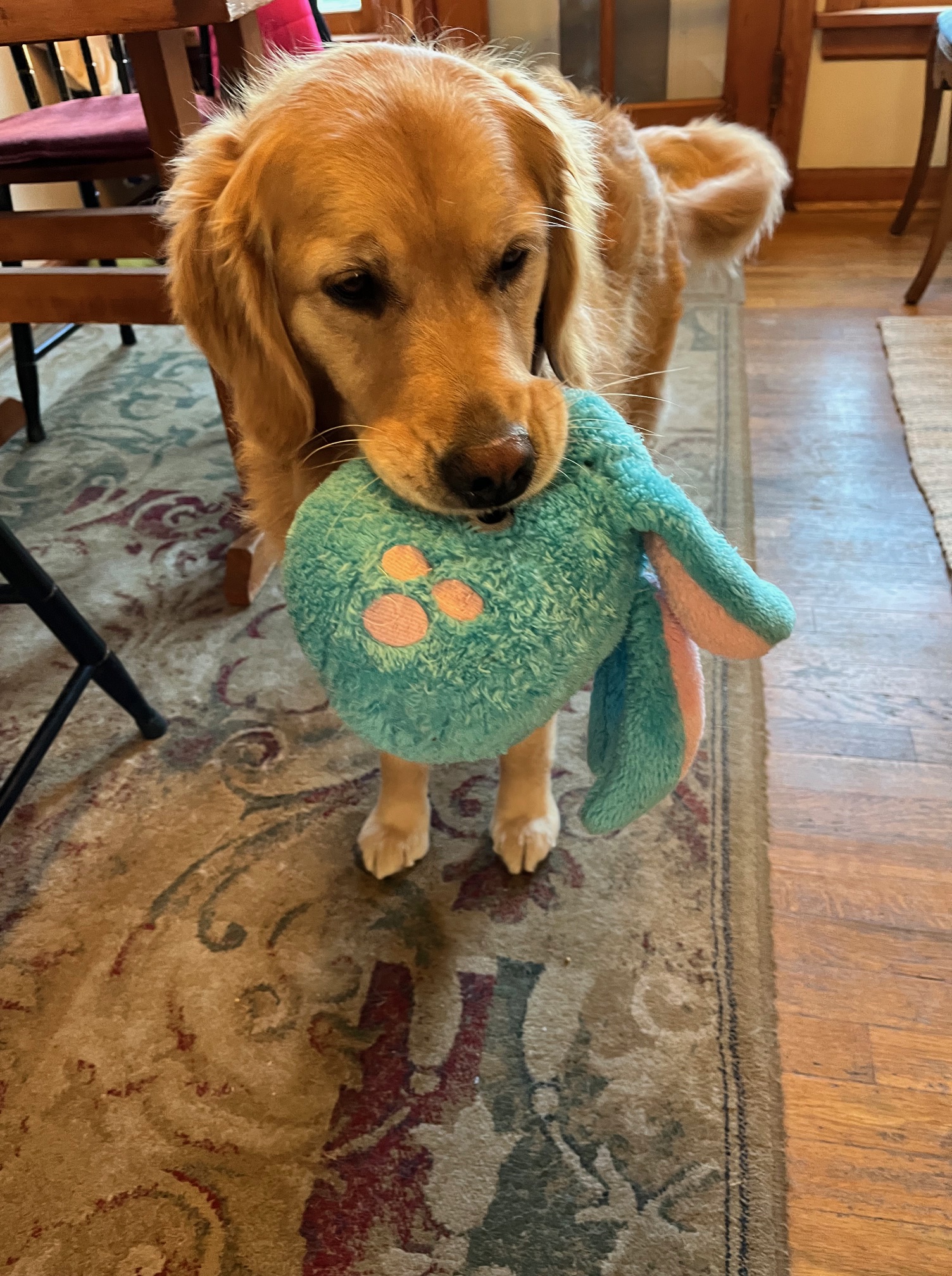
Golden retriever Orly holds a blue stuffed octopus toy and wags her tail

Driving home from my synagogue on an early fall holiday, I debated driving right to the riverside park where members of the community were meeting. I decided to stop at home first, though, to see whether Orly was home and wanted to come along.

As I am sure you know, Orly is a dog. If she wasn’t with me, why wouldn’t she be home?

But she wasn’t; Orly was still out hiking with her friends.

Orly has a more active social life than I do, yet she’s always looking for new friends. Like many goldens, she has no concept of a ‘stranger.’ All new humans, dogs, cats, deer, and birds are unmet friends.

That’s why I wasn’t worried about her recent ‘orientation’ at a nearby dog boarding, training, and daycare facility where she might need to spend a few nights soon. Part of the mandatory half-day session is spent introducing her to different potential playmates to see how well she interacts with other dogs.

Orly, it turns out, plays very nicely with others. She also excelled at using the dog door, taking treats (do dogs really flunk that?), walking on a leash (THAT was a nice surprise), and not fence-fighting or barking.

My little social butterfly, transformed from a fuzzy golden ball of fur into a dripping ball of mud, seemed to have enjoyed her morning at camp. She was less happy about the bath that followed … but returned home a tired dog indeed.

By the next morning, she was wide awake and ready for her next adventure.

Where Dogs Eat Free on Their Birthdays

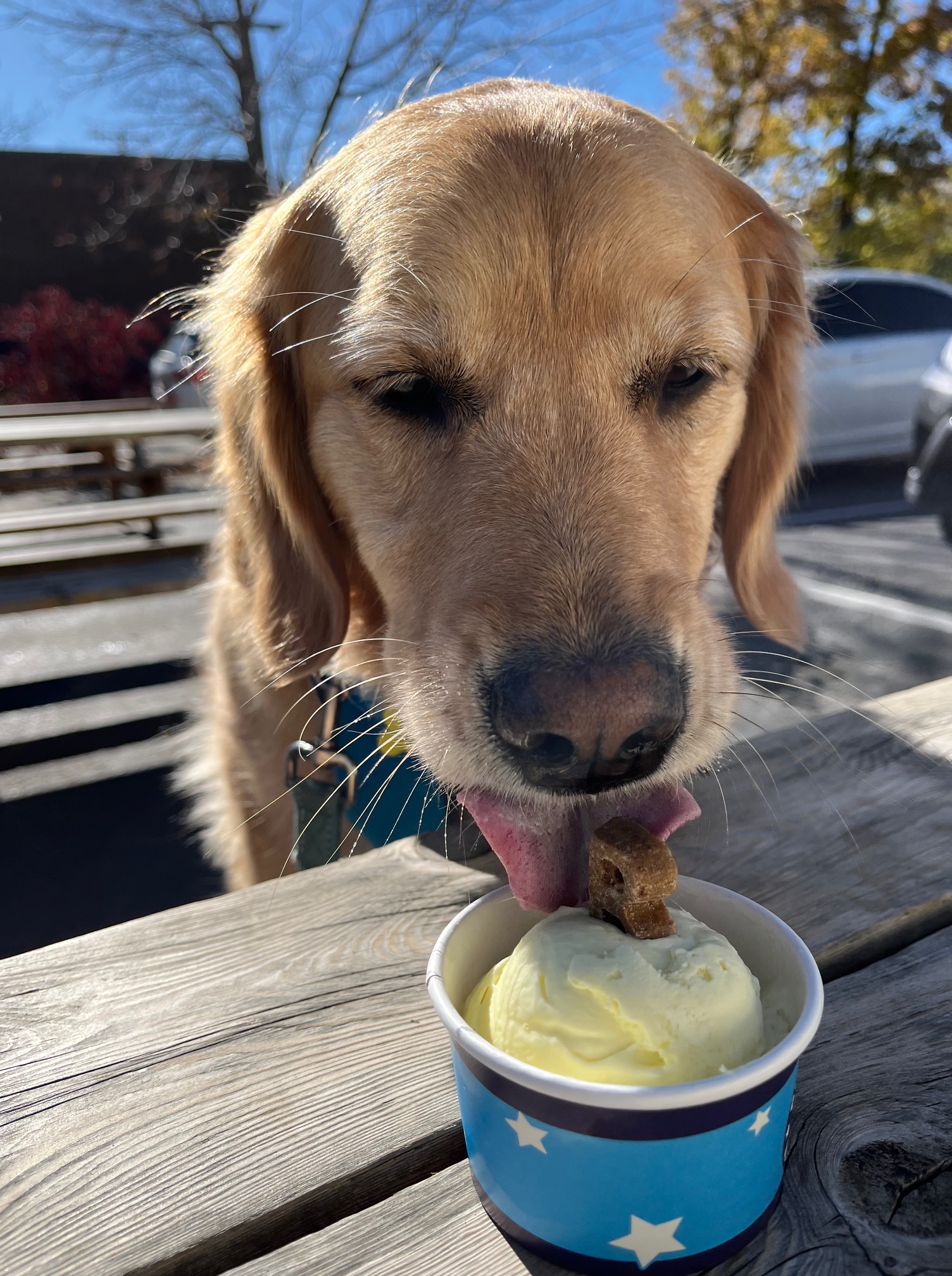
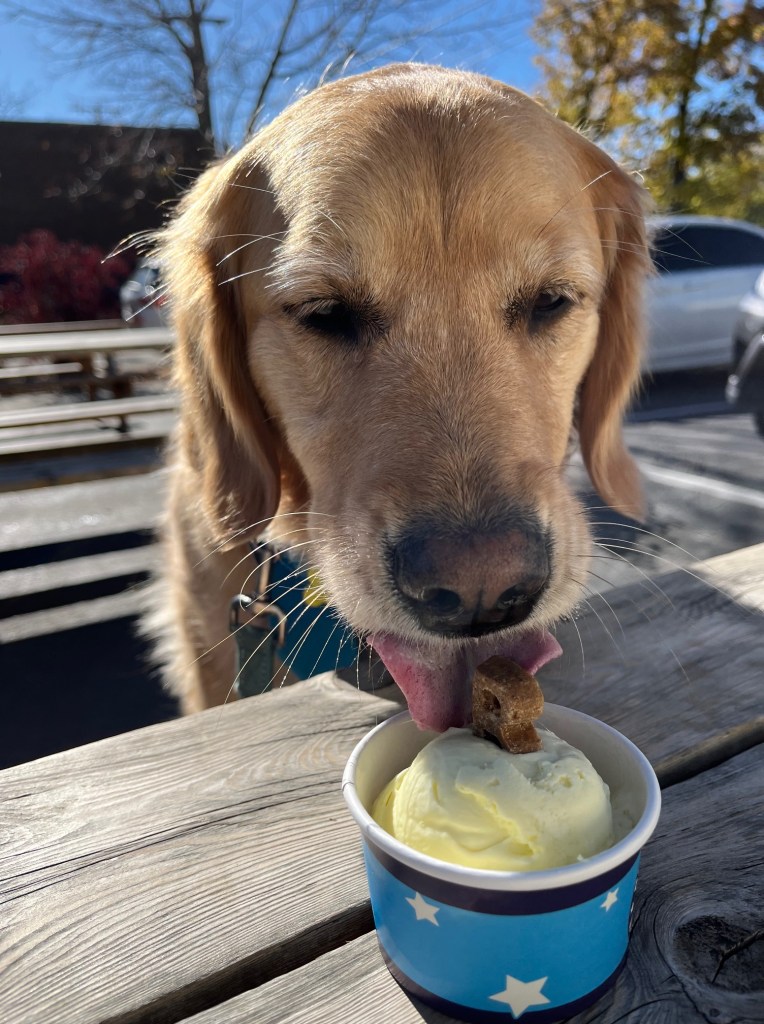
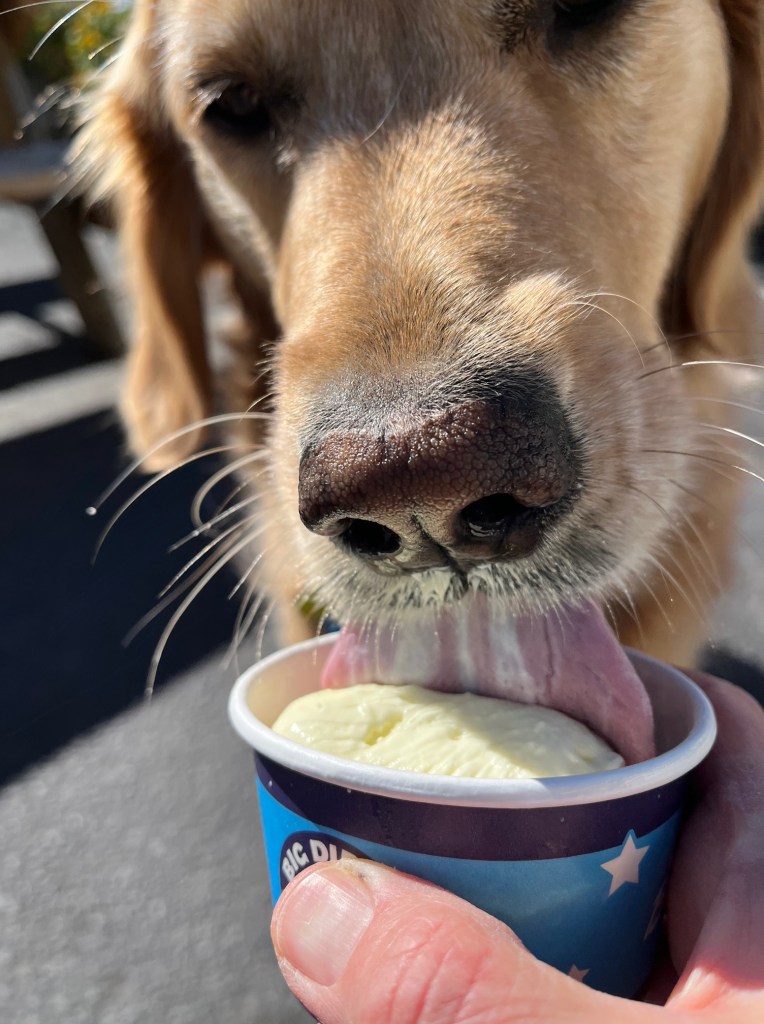
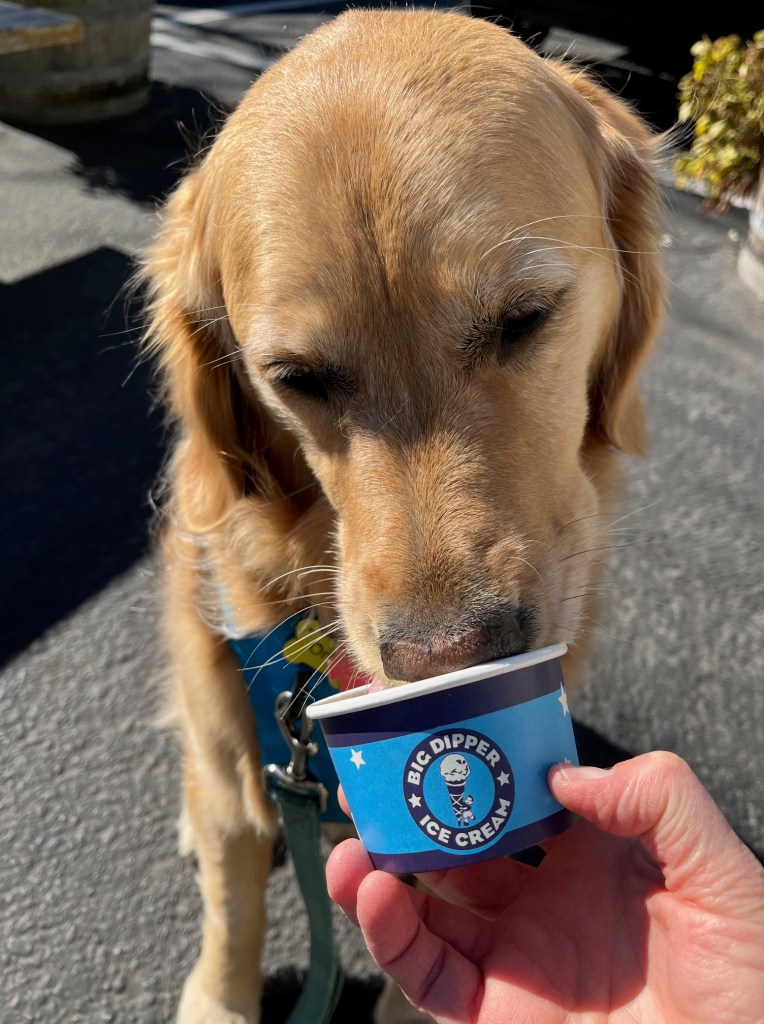
  • Golden retriever Orly enjoys licking yellow-cake flavored ice cream out of a blue cup

Orly turned four on a spectacular fall day. A Wednesday afternoon with golden sunlight, temperatures in the mid-60s, and red and gold trees in full fall glory.

After a weekly meeting, I took my lunch break, and walked with Orly around the neighborhood, through the park, and to the ice-cream stand. There was no line, and the bored-looking young man working there was eager to help.

I asked for a kid-size cone of vanilla in a cup. So far, so ordinary. He asked if I wanted a pup cone for Orly. I said no, thanks, but this cup is for her. It’s her birthday. He pushed back: But the pup cones are free!

I know, I told him. We come here often (Orly disagreed with “often”). But it’s her birthday, I added, and I always get my dogs their own cup on their birthday. With a huge smile, he said, well, then, I will give her the cup for free. I said he didn’t need to do that … he insisted and asked: Is yellow cake ok? that’s what we usually give to dogs.

I said it was. I have never tasted the Big Dipper’s yellow cake ice cream, but if that is what they usually give to dogs, I am certain that Orly loves it.

He asked if I wanted anything for myself. I did, but I asked him to give me Orly’s first. I paid for my mocha-chip in a waffle cone, added a tip to the tip jar, took Orly’s cup, and led Orly to a table.

One advantage to dog ice cream in a cup is that the dog has to lick it out, and it lasts for a few minutes, versus the nanosecond it takes Orly to inhale a pup cone.

As Orly was working on her ice cream, a woman came out of the ice-cream stand and started fiddling with the lock on the ice-cream truck door. She noticed us, said hello, then added, “We give out free pup cones, you know.”

I again explained that we love the pup cones, but that Orly gets a whole scoop for her birthday.

Soon, Orly finished her ice cream, and I got up and collected mine. We decided that I could eat my cone while walking home. Orly kept a close eye on the cone in case it happened to fall out of my hands…

It did not.

However, the end of the cone, as it always does, found its way into Orly’s mouth.

Happy Birthday, Orly!

Finding Super Hedgie

On a recent walk, Orly and I had an unexpected encounter. We have a ‘usual’ morning route (with several variations). On this particular chilly gray morning, we did not detour.

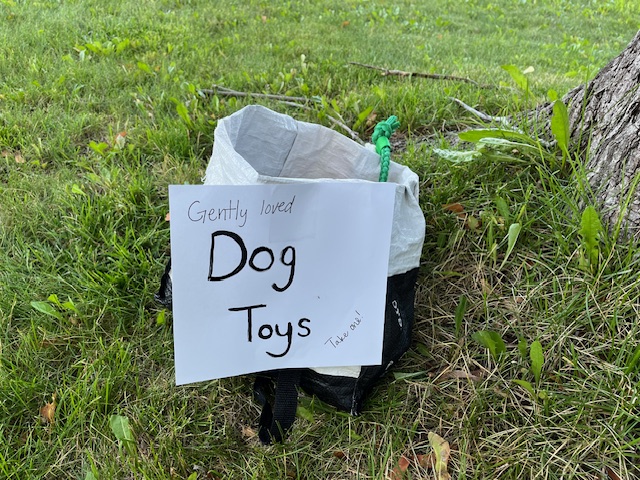
At a corner, I noticed a bag. Missoulians have a habit of placing unwanted things on the corner, in the grassy area that belongs to the city, with a sign indicating that these ‘treasures’ are free. Usually, it’s just trash that they are too lazy to toss in the trash or take to the dump, but not this time:

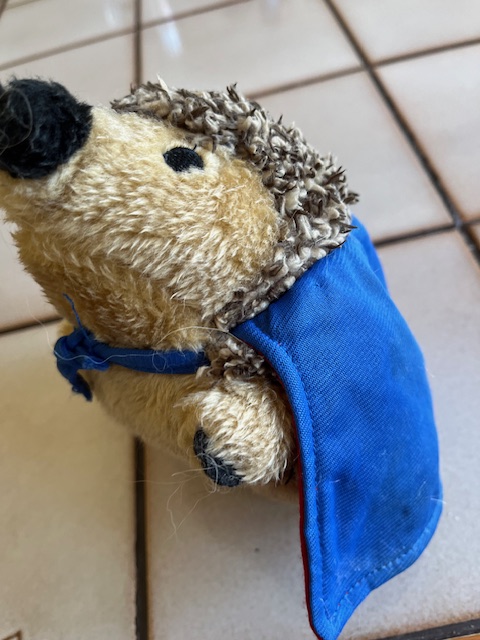
A white bag sits on the grass with a sign reading "Gently Loved Dog Toys Take One!"Of course, we had to investigate. When I looked inside, imagine my surprise when a near-perfect hedgehog toy peered back! Ever since living with Labrador roommate Maverick, I have known that hedgehogs are the Premier dog toy, especially the ones that grunt (rather than squeaking). Alas, this hedgehog, clad in a superhero cape, is mute.

Orly excitedly took hold of Super Hedgie and wagged her tail enthusiastically. OK, this one is going home with us.

A hedgehog dog toy with a blue capeShe led onward, tail high, a spring in her step.

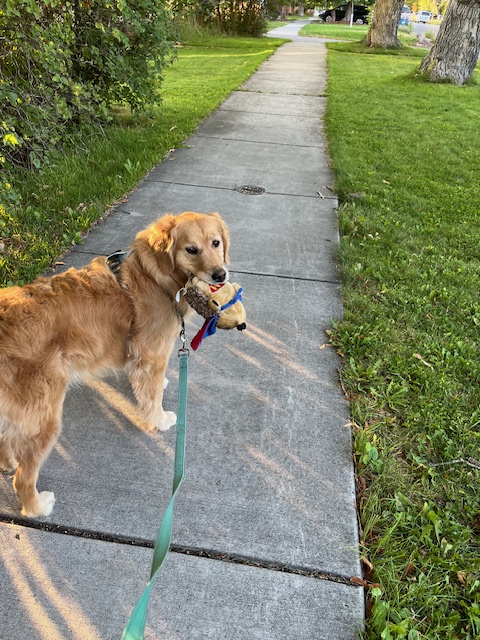
Orly carried her new toy for the rest of our walk (about a half hour), never stopping to sniff, pee, or bark — no matter what another dog said to her. She ignored squirrels and deer alike. Only once safely home did she agree to relinquish Super Hedgie so he could have his portrait taken.

Orly, a golden retriever, holds the hedgehog toy and looks back at me. We're connected with a light blue leash.Hedgie is now one of her favorites — and among the select few toys employed when greeting guests. The guest-welcome ritual, invented by Jana and handed down by Cali to both Orly and Dotty, requires that the golden retriever greet entering guests at the door, then:

  • Rush off to find a favorite toy
  • Return to show the toy to the guest
  • Do a little welcome dance (this element was added by Cali)
  • Allow the guest to pet the golden (but never, ever to take the toy).

We’ve gone on many walks since then, and, though Orly has been on the lookout for more treasures, Finding Super Hedgie was a once-in-a-lifetime miracle. Though she did find part of an ice-cream cone a few days ago (the delicious homemade waffle kind from the Big Dipper).

We’re Back!

I hope you had a great summer!

I will be posting when I can … when I have a good idea for a post …

I am closing my Thinking Dog Facebook account, so if you want to know when there’s a new post, please sign up for an email using the ‘subscribe’ button at the bottom of the page!

Orly’s Door

4-month-old golden puppy Orly, wearing a gray coat, touches a bell next to a wooden doorAs the weather warmed up in fits and starts, I decided that Orly was finally mature enough to get to use her dog door.

Past attempts to allow her to let herself in and out ran into obstacles, primarily a golden-retriever-shaped obstacle named Dotty, who was nowhere near door-ready when she was living here. Other obstacles include tendencies to bark at goings-on in the alley, a compulsion to enthusiastically greet doggy friends (Taco to the east and Cecil and Hans to the west). These have diminished but not disappeared. The habit of digging large holes in the yard, though, seems to have moved along… right around when Dotty did. It’s just not as much fun alone, apparently.

Golden retriever puppies Dotty and Orly dig in a sand pit designed as a dog digging pit
Looking for buried treasure!

This column also encountered an unfortunate bump: It was meant to be an homage to Merle’s Door, a wonderful book about what the author learned about dog intelligence, social lives, problem solving and more, once his dog, Merle, was granted his own door. Merle developed an extensive community and social life, as his door allowed access to a rural area of large open spaces, dog-friendly neighbors, and a wonderful absence of fences and traffic. This post was also meant to link to my review of the book and encourage you all to read both. The problem? It seems that I never actually reviewed the book. Stay tuned. That link might still appear.

Unlike Merle, Orly lives in a fairly urban setting, with a lot of traffic, houses fairly close together, and, therefore, fences. Her door opens to a large fenced yard equipped with sad brown grass, many plants and flowers, a deck for sunning oneself, and a dedicated doggy digging pit. Sometimes there’s a dog pool or splash pad, too. It’s not too shabby as urban dog homes go.

In addition to all of the above, Orly’s door grants her access to her preferred water bowl (the large metal one that lives on the deck all summer), her favorite sunny spots, and the ability to come and go as she pleases, without waiting for the human (who is often sitting upstairs, working at a computer) to notice her “magic sit” requesting doorperson services.

But, as most things with Orly are, this turned out to be less than straightforward.

She does love the door. She sometimes goes in and out, over and over, just because it’s fun. I often go downstairs on a break between meetings to find her stretched out in the grass or on the deck.

But.

As I discovered when trying to get Orly to use a doorbell, Orly appreciates good service — even more than she appreciates freedom. As she sees it, my most important job is waiting on her. She never did take to the doorbell.

Besides, she likes the cachet of living in a building with a doorperson. She will stand by the door and look meaningfully at me. I might say, go ahead; you have agency. You want to go out? Go out!

Unmoved, she continues to give me that look.

Anyone with a golden (or maybe any dog) knows that look. She might nudge me, then go back to sit by the door. There is nothing wrong with her communication skills; she’s crystal clear. She knows she can let herself out; she knows how; she just prefers to be waited on.

Similarly, when she’s ready to come in, she’ll peer through the windows next to the door, press her nose against the door, sometimes even poke her nose through the dog door to give a disdainful snuff, but … right. She stays outside, waiting for me to open the door and let her in.

I’ll re-read Merle’s Door. Maybe I missed the part about teaching your dog to appreciate her privilege and freedom.

Summer Break

The Thinking Dog is taking a break from regular posting. New posts will appear … whenever Orly or Pam has something to tell you about!

We’re hoping to spend more time outside and less time with our screens. We hope that you get outside and enjoy your summer too!

Who’s In Charge Here?

Orly, a golden retriever, wears an expectant lookIt seemed like a good idea at the time. And, to be fair, it was, for a while (and with a different dog).

The idea was to teach Cali not to react to fence-fighting, barking, or just plain rude dogs when we passed them on walks. We started with dogs in yards, but eventually were able to walk past reactive dogs on leashes. Cali remained calm and collected. And as soon as we were past, she’d pause and look at me expectantly. Because the reason she refrained from responding to the rude dogs was that she got a treat and a lot of praise.

Cali and I had several routes we’d choose from for our morning and afternoon walks, many of which included yards with rude dogs. I noticed that she started eagerly looking for the dogs as we approached. So far so good.

Then we got Orly. Cali and I taught Orly the drill. I made sure to have plenty of treats when we left for walks, though they were willing to wait until we got home to be paid, if I made it worth their while (better treats and more of them).

Orly takes over

We lost Cali to hemangiosarcoma when Orly was just over a year old. In the two-plus years since, Orly has matured into a smart, silly, thoughtful, and very resourceful dog. And, she’s engineered our walks, slowly, over time, to to the point where I am not sure who’s leading whom on these walks and other adventures (although I always drive).

I often let the dog choose which route we walk, primarily because walks are their time and their opportunity to experience new smells and catch up on neighborhood news.

A while ago, I noticed that Orly consistently chose the routes with the largest number of rude dogs. She’d peer ahead to see whether Milo and his brothers were out in the yard before deciding whether to go left or right at one corner, for example.

Gradually, I noticed that she liked taking detours from our usual routes. And that these detours always took us past yards with dogs in them.

She started to prefer turning into the alley after we said hi to George (a friendly, not at all rude, golden who is something of a neighborhood mascot. Or prince.) rather than continuing down the hill into the park. It only slowly dawned on me that there were not one but two rude-dog opportunities on the alley route that were not on the park route.

Then one day, I noticed her pulling toward the fence each time we passed one particular yard. It’s a typical 6-foot privacy fence, solid boards, maybe 4 inches of ground clearance under which we often see the nose and/or feet of a little terrier. A terrier who generally ignores us… unless Orly’s nose or feet are visible. Then, the dog would bark, Orly would not, and …

The terrier was no slouch, and soon learned to ignore Orly, so Orly upped the ante, bumping the fence or whining a bit. I was a little slow to catch on, assuming she was just excited — the terrier lives next door to the house with the treat hydrant. (Yes, more proof, for anyone who still needs it, that dogs are smarter than their humans.)

But no (duh!) Orly was doing her best to cause the other dog to react so that she could get a treat. Someone must have taught Orly about back-chaining, a technique to teach dogs (and humans) to perform a series of actions to earn a reward.

Golden retriever Orly, standing on grass, play bowsI did finally figure out her game.

Mostly I am impressed with the creativity and thought behind Orly’s conniving.

But when we merely pass a dog on a walk with her human, or a calm, relaxed dog in his yard, and she turns expectantly to demand payment, I find myself annoyed. I feel used. Is she a doggy mafia don demanding her due? Is our entire relationship transactional?

But then we get home and she cuddles up to me with a contented sigh … and no, I don’t want your thoughts on how she’s manipulating me in those moments, too. Just go cuddle your dog.


Could YOU Raise a Service Dog Puppy?

Dotty, a 7-month-old white golden retriever, watches passersby, wearing a blue service dog-in-training vestWith my first stint as a puppy raiser recently ended, I read this article from a new perspective: Sit, Stay, Say Goodbye.

Puppy raising is hard work. That’s partly because raising any puppy is hard work! But knowing you will not enjoy the payoff — a well-behaved adult dog friend — makes it harder. Having to work through fears or bad habits that you can (and do) let slide in your own dogs makes it harder. Feeling the pressure to get the puppy out, get her ‘experience’ in all kinds of situations — without doing something that screws up her future — makes it harder.

That’s why I am in awe of the family in the article. A family that raises multiple service dog puppies at a time. And has raised 17(!!!) puppies so far.

They are puppy raisers for Warrior Canine Connection, an organization started by my friend Rick Yount. They place service dogs with veterans.

The ideal puppy raiser might be … you. The NYT article profiles the awesome couple, both retired. And a family with 3 young kids and a pet dog. (Having done it solo, I do think having a backup person is a good idea.) A service dog puppy fits in well with a busy life; in many states, a service dog in training can accompany her humans anywhere a working service dog can — grocery stores, malls, the airport, museums, kids’ school sports events, etc.

If you’re in/near Missoula, Montana, or Northern California, you can puppy raise for Dotty’s school. If you’re in the eastern or southeastern US, you could raise a puppy for Hildy, Koala, and Alberta’s school (Guiding Eyes for the Blind in New York state). Wherever you live, a local, regional, or national program might be looking for dog-loving volunteers.

Meet Mikey, a Dog Hero

Continuing the theme of working dogs … here’s a compelling story, one which might raise lots of difficult questions for you, as it did for me.