The Thinking Dog Blog is taking a break to enjoy some gorgeous spring weather. We’ll be back soon!
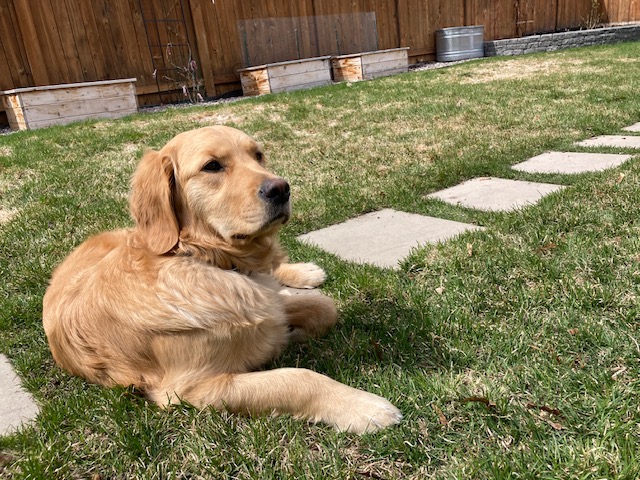
The Thinking Dog Blog is taking a break to enjoy some gorgeous spring weather. We’ll be back soon!

The Thinking Dog Blog finally has some wonderful news to share: Deni recently welcomed Ida, a new guide dog, to the family!
Ida, who just turned 2, is a black Labrador retriever from Guiding Eyes for the Blind.
She’s a great addition to the Thinking Dog clan: She’s smart, seems to be an adept problem-solver, and learns quickly. As a young Lab, she’s also high-energy and very playful.
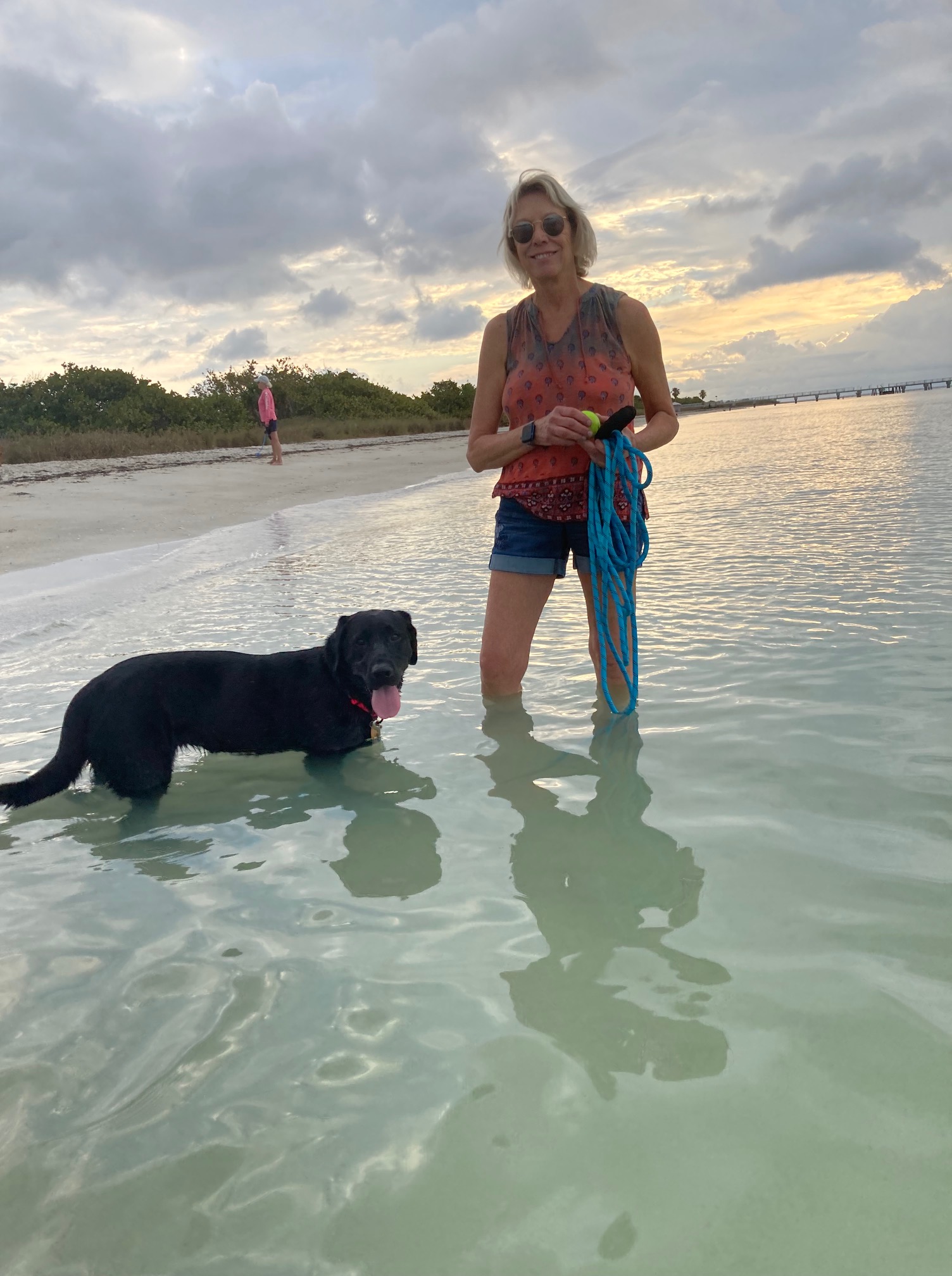 Like Deni’s first Guiding Eyes dog, Alberta, Ida loves it when Deni — or anyone, really — notices her cleverness and comments on how well she’s doing her job. She’s super-friendly and feels entitled — obligated? — to greet people on walks, even starting to head up sidewalks or driveways if neighbors are outside when she’s on a (non-working) walk.
Like Koala, she’s a bit analytical and likes to think things over. During her first visit to the dog beach (on a long leash!) she needed to think about whether sand, surf, and starfish were good things.
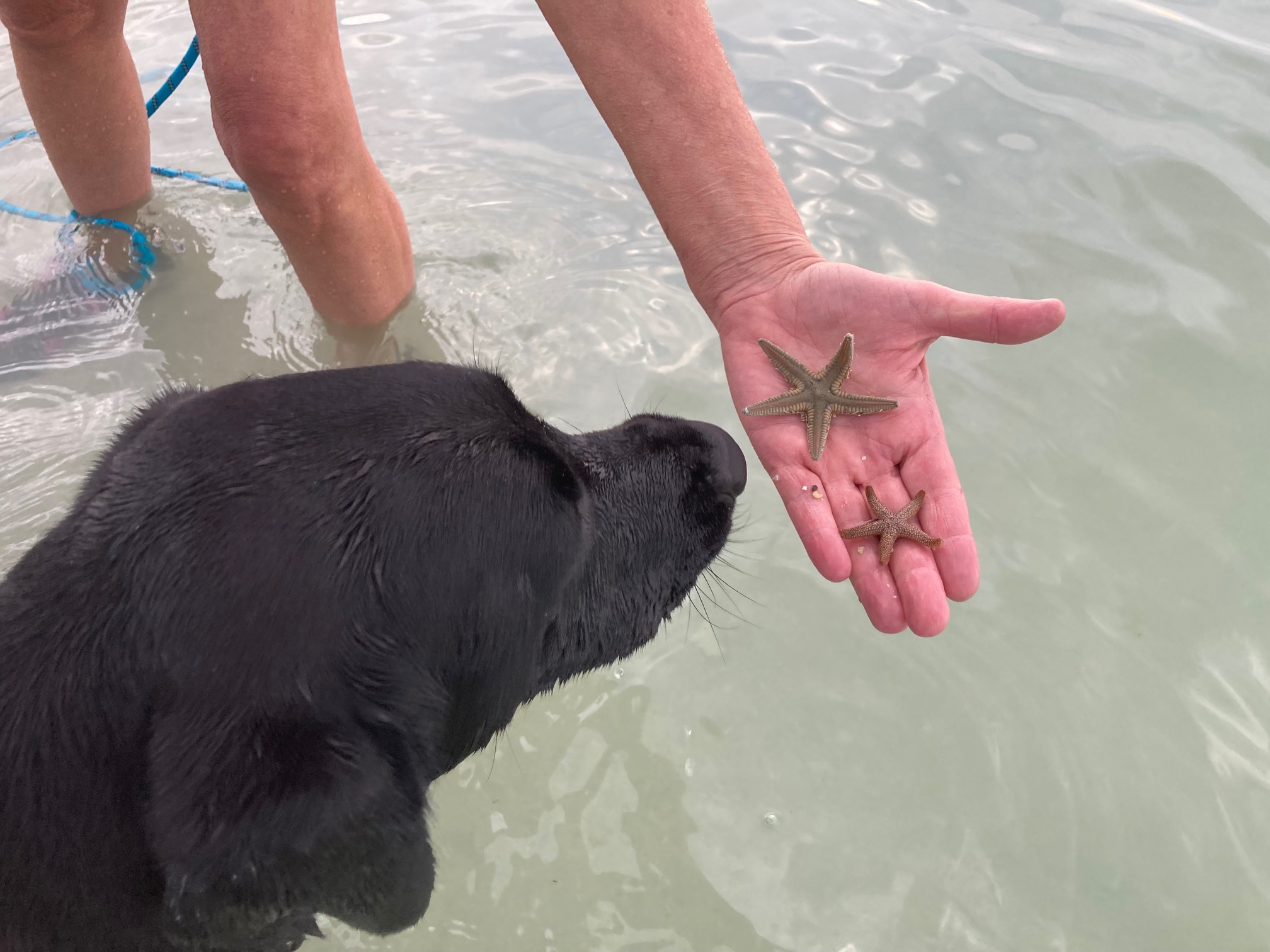 Once she felt comfortable, though, she had a wonderful time. And, back in the fenced dog run area near the beach, she raced around joyfully with another young dog. And, on her second visit, she ran playful, joyful circles as she made friends with other dogs and stepped tentatively into the rough surf.
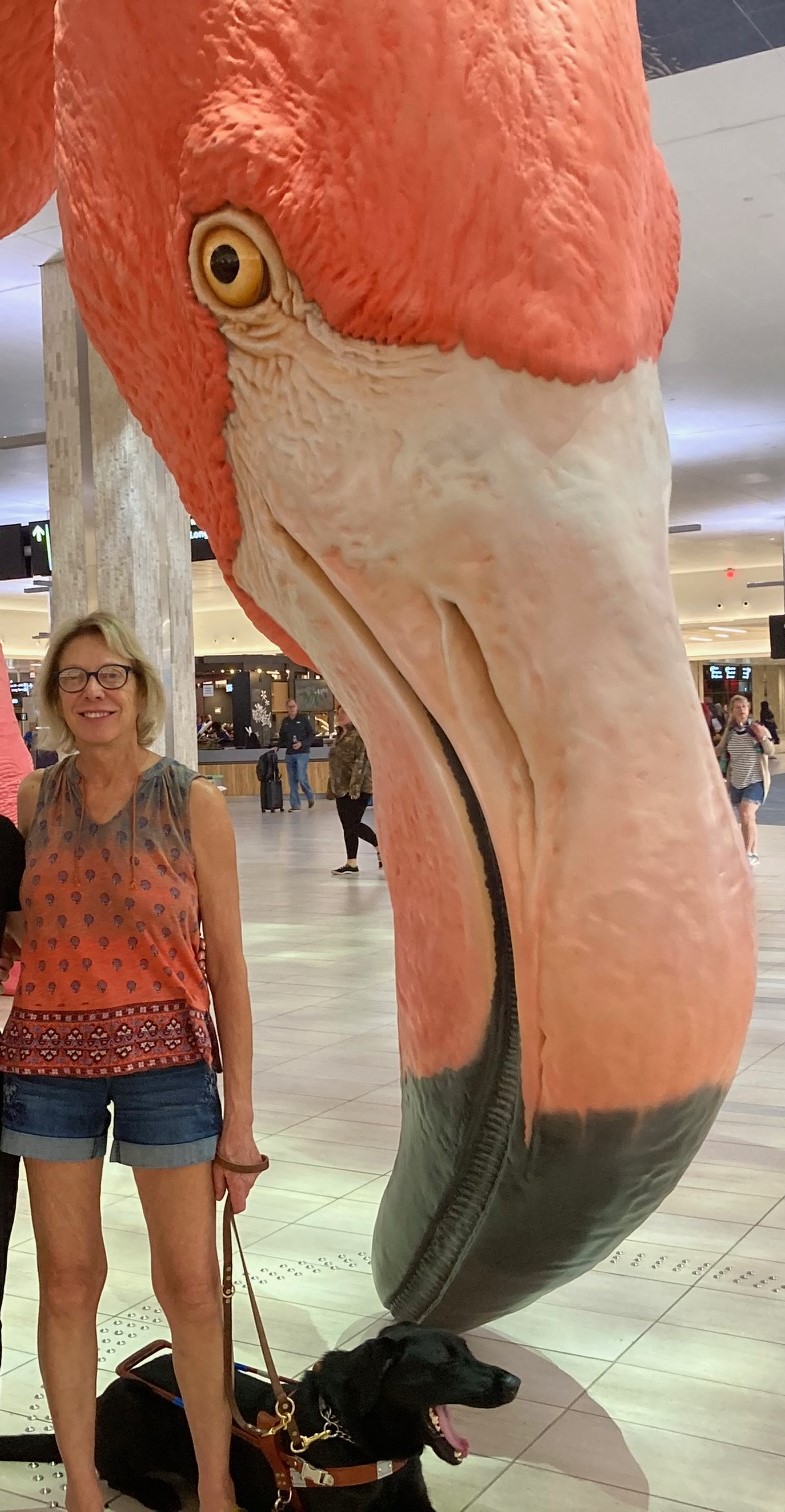
Ida is a happy, bouncy, curious, very social dog who is eager to play. She is still settling in and learning what the life of a working grown-up dog is like, of course, and she might have found the giant flamingo sculpture at the Tampa airport a little unnerving … but who wouldn’t?
She’s also still learning Deni’s routines — and quickly picking up the “extra” skills that all of Deni’s dogs learn, like finding a trash can as soon as she’s done “parking” (a euphemism for pooping).
She caught on quickly to opening gifts on her 2nd birthday — and gleefully played with her new toys! She likes to use her paws, standing on one gift to keep it in place as she removed the tissue-paper wrapping. And she holds her toys while playing with or chewing on them.
Ida is young, and adjusting to a new dog — especially after several years with a precise, polished pro like Koala — is going to be a challenge for Deni. But the two seem to have forged a close connection already, with Ida responding quickly when called even while running happily with another dog.
Their next big adventure together will be a visit to Montana in May — including a few days at Yellowstone. I hope Ida isn’t afraid of bison!
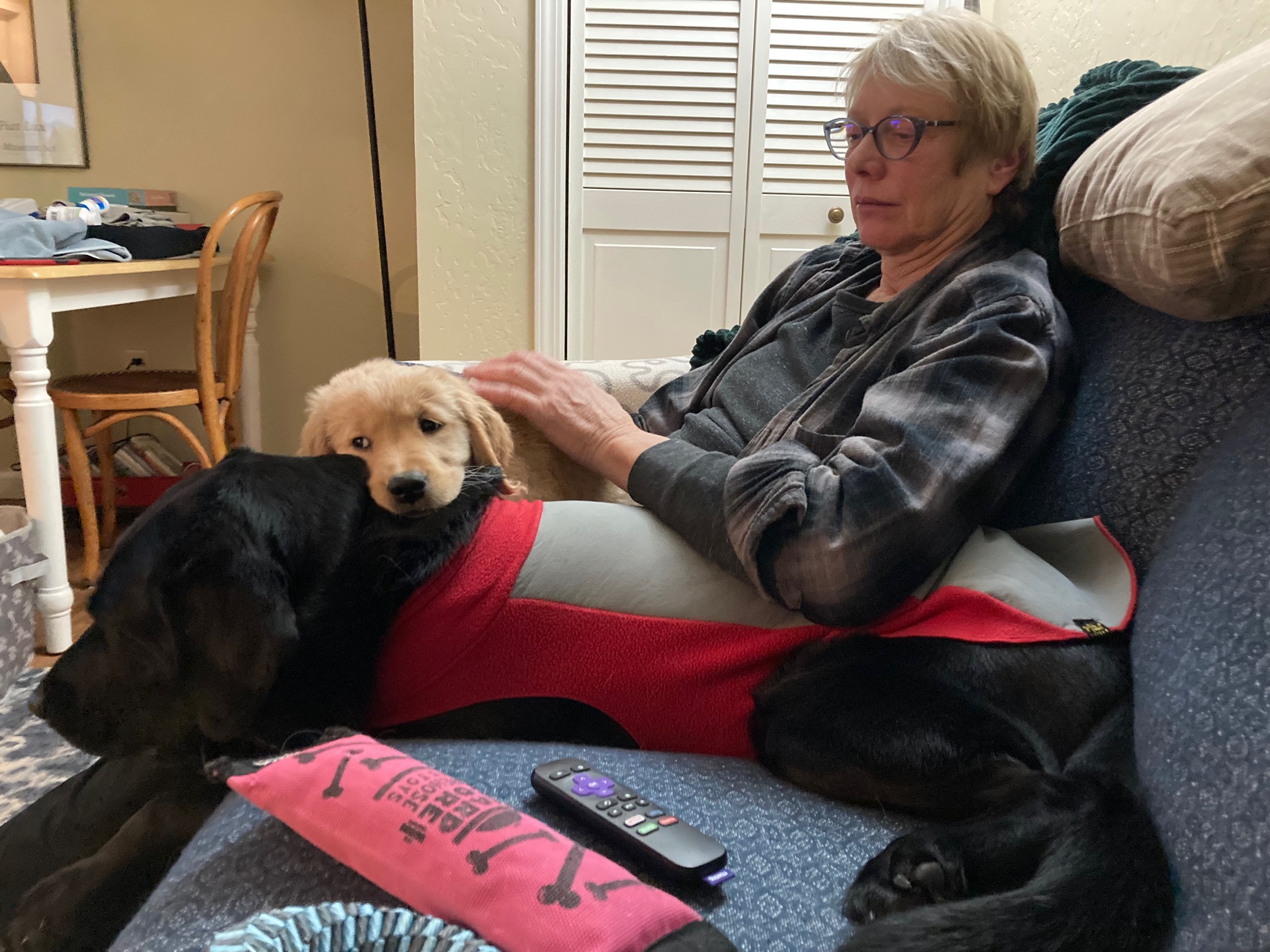
Today is Koala’s retirement day.
She won’t get a gold watch, but I do hope she’ll get lots of treats, multiple walks each day where she can sniff whatever she wants, frequent opportunities to run along beaches, and plenty of activities to keep her mind sharp.
Deni will arrive at Guiding Eyes today to meet her new guide; they will spend just over a week learning to work together before heading home to Florida.
After guiding Deni to her alma mater (Guiding Eyes), Koala will head “home” in a sense; she’s spending her retirement with her puppy raiser!
Many retired guide and service dogs return to their puppy homes for their golden years, and many guide dog schools offer puppy raisers the opportunity to adopt “their” puppies when the dogs are no longer able to work. It’s a nice solution for everyone.
I keep telling myself that, and explain it cheerfully to everyone who asks. But … it’s also tough. I won’t see her again. Deni is giving up her friend and companion of nearly 7 years. Koala was — is — a beloved member of our “family.” Losing her so soon after losing Cali … well, it’s hard.
Some retired dogs do stay with their partners’ families, but that has its own challenges. Alberta, who retired nearly seven years ago, lives with Deni’s nephew and family. Every time Deni visits, Alberta again faces the disappointment of not being allowed to do “her” job; of saying good-bye again. And Koala spent those visits fuming about the other dog who thought Deni was “hers.” Deni didn’t want to put Koala (and the new dog) through all of that.
Koala is an unusually bright and creative dog. She communicates better than most living creatures, understanding full sentences in addition to an uncanny fluency in human body language. She’s a brilliant problem-solver and enjoys figuring out any challenge, whether it’s locating restrooms and Skyclubs in a new airport, finding the nearest trash can or creating efficient ways to return her empty dinner bowl to the nearest human (in exchange for dessert, of course).
She’s also got the best dog social skills of any dog I’ve known. She can size up any dog — young, old; large, small — and immediately intuit the right way to greet and interact with them. She’ll no doubt quickly make new dog friends in her retirement neighborhood, but Orly and I miss Koala already …
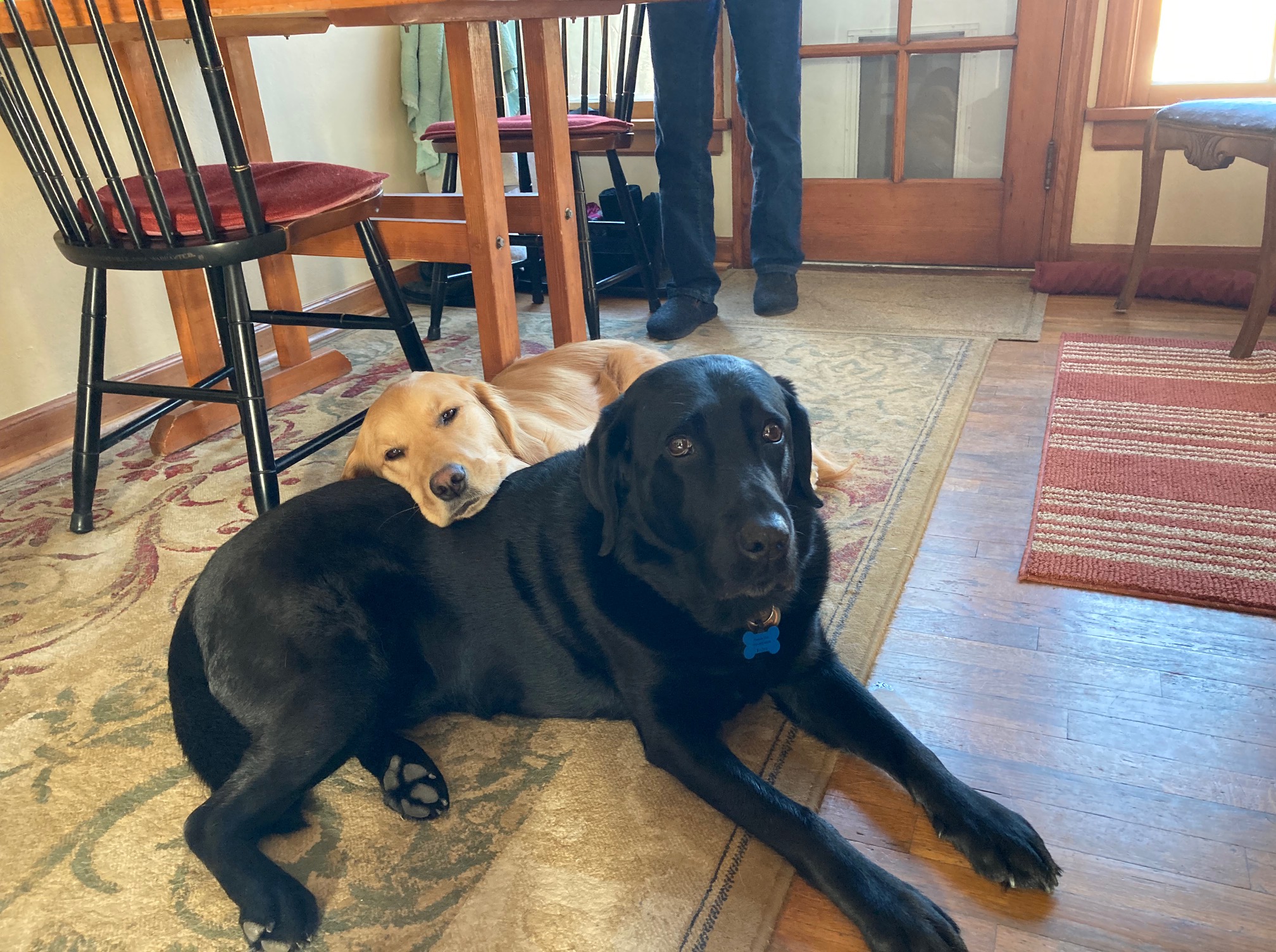
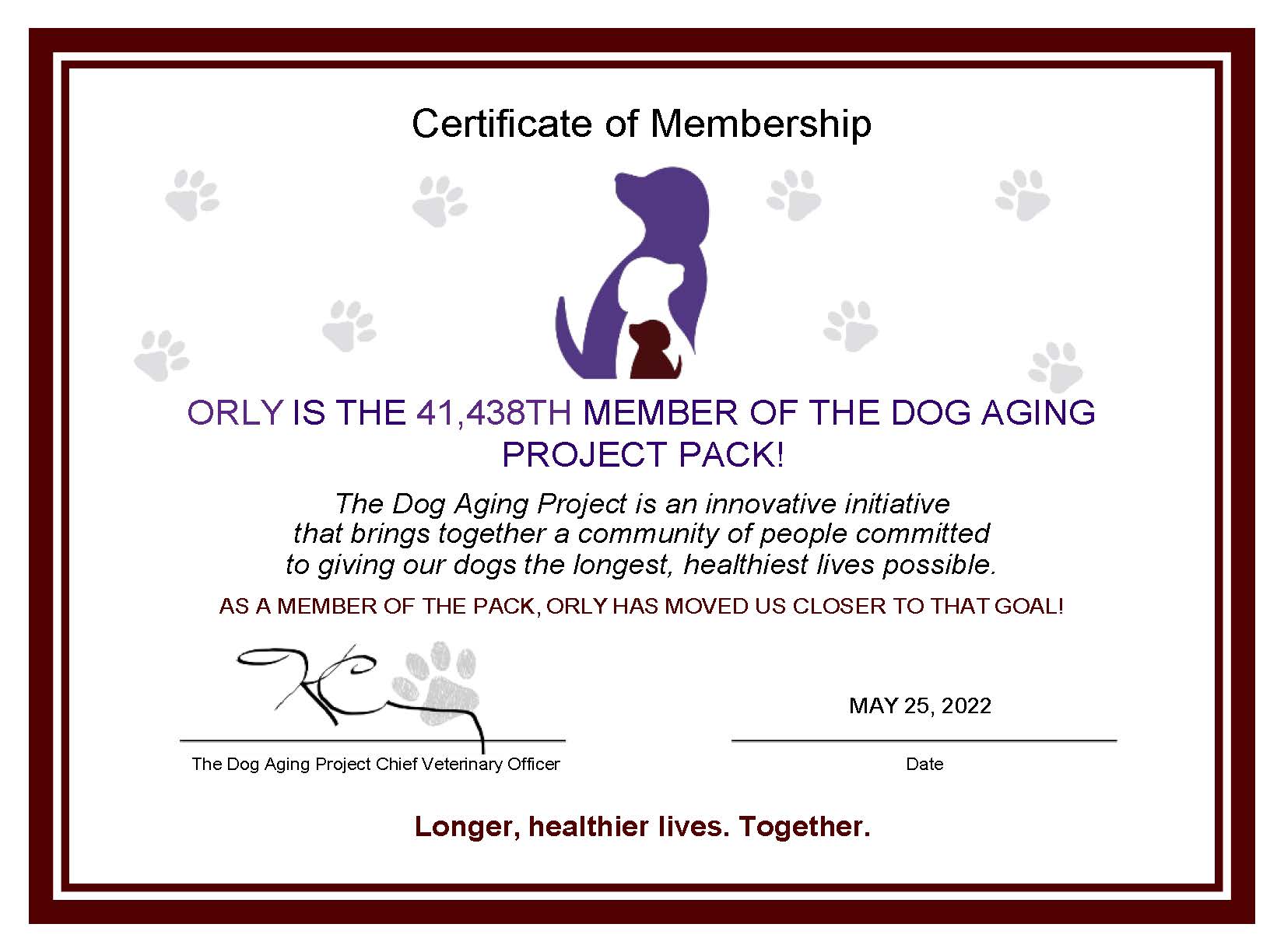
Orly (like her cousin Dusty) is a member of the Dog Aging Project “pack.” (Your dog can join too!) It’s a group of vets and researchers who are gathering data from thousands of dog owners to try to learn more about dogs’ health and behavior as they age.
Orly joined back in May 2022 but only got her first assignment a couple of weeks ago. We were asked to play a game called 1-2-3 Treat. Orly’s eager to try anything that has “treat” right there in its name, so I got busy.
I had to construct three identical boxes from pieces of cardboard. As a person who flunked arts and crafts, over and over, throughout my childhood and who still cannot cut a straight line, even with lefty scissors … well, let’s say it was a labor of love.
Equipped with my three non-identical, lopsided boxes, I moved on to the next step: Marking out the space. This entailed taping an array of x’s on the floor at precise distances, with space to walk around them with Orly.
This was a challenge. It’s March in Montana, which means it’s winter. The nasty part of winter where the back yard resembles a lumpy ice rink. But that’s my largest open space (you need a 10×10 foot area). I moved some stuff around in my basement and figured out a way to get the four x’s the right distance apart with just enough space to squeeze by if Orly walked right next to me (she didn’t but … that comes later).
One x was the starting point, and the other three were where the lopsided boxes went.
The warm-up was where the fun began for Orly. We got out treats!
Then, we followed instructions about which box to approach and when I was to put a treat in which box and whether Orly was allowed to eat it. Amazingly, she cooperated, leaving some of the treats and gobbling down others.
Orly was n leash, and I could choose whether to have her on my left or my right. We’d approach the boxes differently depending on that choice; Orly was supposed to be on the outside, with me between her and the box.
While she stayed close to me, she kept sticking her nose out, across my legs, to try to get to the boxes. She also kept trying to get ahead so she could get to the box first, not realizing that until I arrived, there were no treats in the boxes. Once she caught on, she mostly stayed next to me, though.
We finished the warm-up, recorded Orly’s behavior, and, finally — we were ready for the main game. 1-2-3 Treat, here we come!
We needed 30 treats for this! Orly was enjoying it already.
We followed nine rounds of instructions — variations on put a treat in each box and let Orly eat two of the three; return to the starting point, let her go, and record which box she looks in first for the remaining treat.
Orly made only one mistake, which means that in eight of the rounds, as soon as I let go of the leash, she trotted over to the only box with a treat in it and scarfed the treat. On the error round, she was heading to the correct box after quickly realizing her mistake. But the cruel rules required me to take the treat and not let her approach a second box.
(You are correct if you are thinking that nine rounds time three treats equals only 27. I guess they figure we’ll mess up somewhere and they don’t want us to run out of treats.)
The final step was recording Orly’s stellar performance and submitting her results.
We’ll be asked to do this once a year. The researchers will look at Orly’s results, along with the probably less-stellar results from thousands of other dogs. They say that they are interested in how dogs’ responses change as they age. We’ll see!
Meanwhile, Orly wonders whether a monthly check would provide better data …
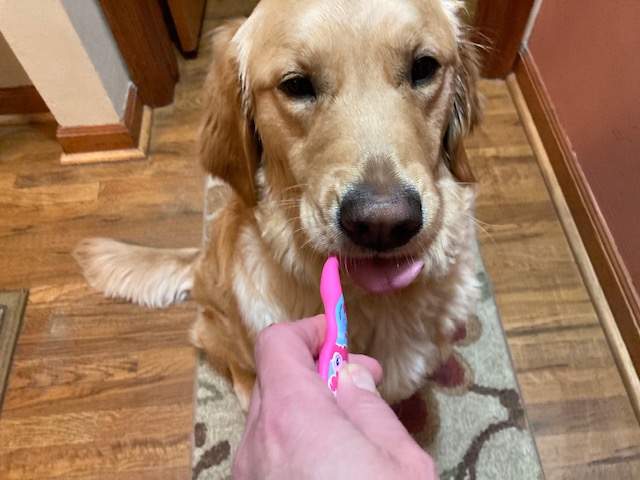
Brushing dog teeth is part of our nightly routine … but I know that that’s not the case for most dogs and their people. (But if your dog gives you dog kisses … you might want to start!)
I’ve known several dogs who lost many teeth as they aged, due to gingivitis or decay. And many more dog families that spent several hundred dollars annually on professional dental cleanings for their dogs.
I’ve brushed my goldens’ teeth, starting when each was a young puppy. When she was little, Cali would walk over to the shelf where her toothbrush was kept and ask to have her teeth brushed. She later decided that she didn’t enjoy it, but she was always cooperative. Orly is still in the asking-for-it stage.
I sweeten the deal with a crunchy treat, and I suspect that that has a lot to do with their cooperation. Whatever works! Jana, Cali, and now Orly all had / have beautiful white teeth!
I use kids’ toothbrushes — soft ones — from the dollar store and dog toothpaste. There are several brands, but I mostly use Petrodex because everyone likes the taste and it’s easy to find.
Orly sits patiently while I brush — top, bottom, inside, outside — then she likes to lick the brush clean. Finally, she gets a cookie and heads off to bed.
Your vet might say that it’s fine to brush a couple times a week, but I found that if I didn’t make it part of a daily routine, I wouldn’t remember to do it at all. So we do it every night.
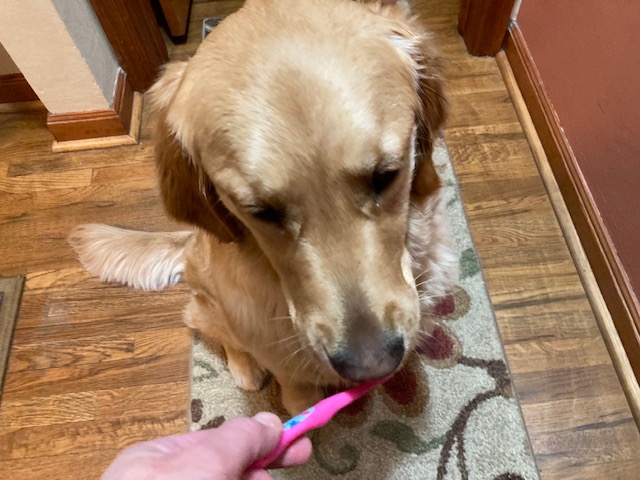 There are other ways to keep dogs’ teeth clean. Dogs who chew a lot of fresh bones or antlers tend to have little plaque buildup. There are also products you can add to the dog’s water to kill bacteria and reduce buildup, but I have never used them so I don’t know how palatable or effective they are.
Brushing only takes a minute and, once you’re in the habit, it’s not a big deal for most dogs. Imagine life with no more “dog breath”! And … think of all the money you’ll save — not to mention the worry of sedation — by avoiding veterinary cleanings!
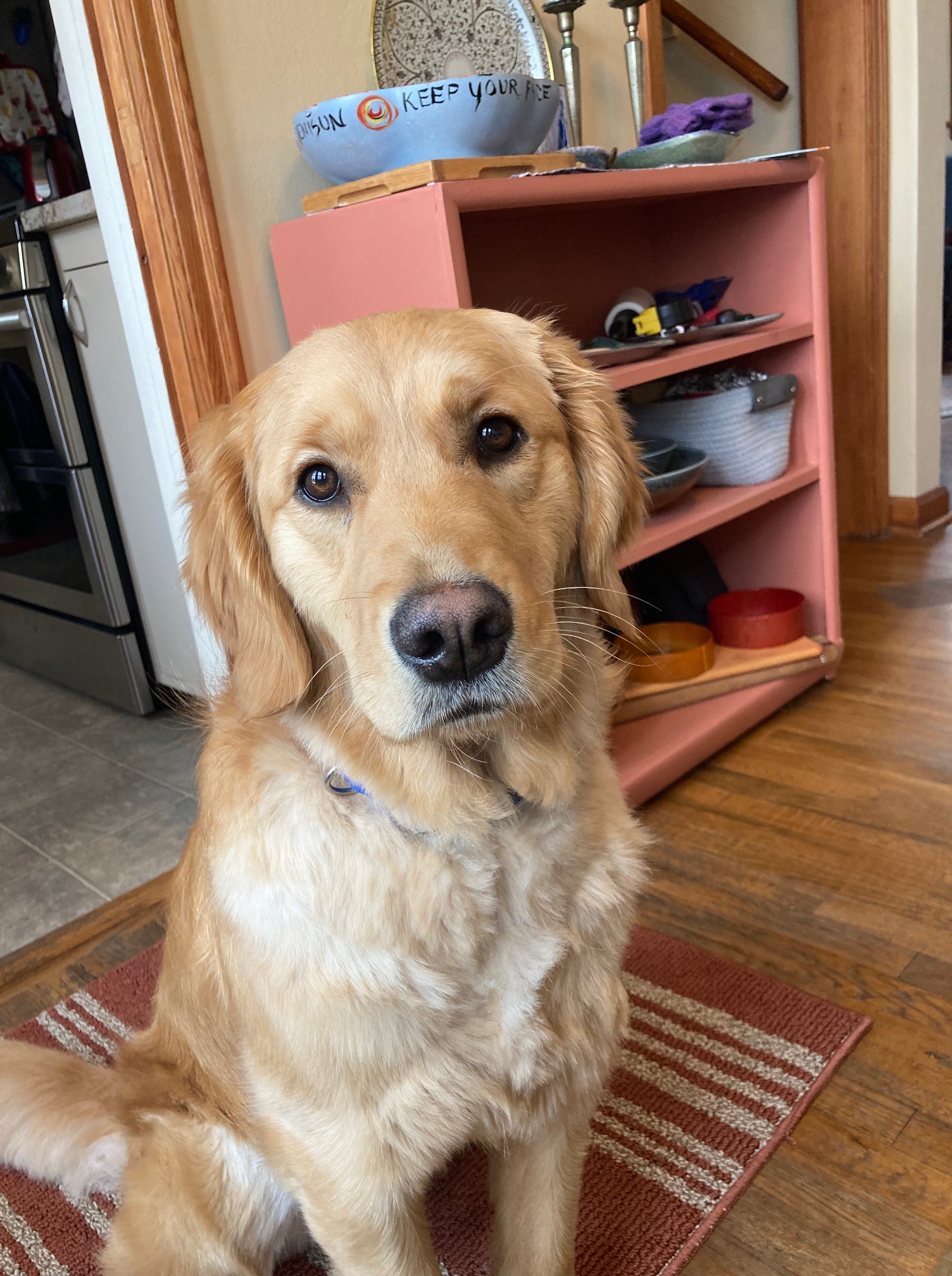 I’ve never been a fan of licky dogs, but I do pay attention to how and when a dog offers kisses and other licks — because, just as all tail wags do not signify a happy dog, not all dog licks signify affection. A recent Whole Dog Journal article on puppy socialization described it really well:
When dogs lick humans with affection, it’s typically one quick flick, or a sustained activity of leisurely soft licks. But the lick that’s worrisome – the one that trainers call the “kiss to dismiss” – looks different. It’s intense, sometimes fast, hard, even frantic. Parents often misinterpret this, thinking the dog is finally learning to love the toddler, but that licking is designed to get the advancing human to stop!
Orly is a very affectionate girl, and her trademark kiss is a tiny tongue flick that just grazes the tip of the nose of her target. It’s usually combined with a sweet snuggle, and the whole package lasts only a few seconds. It’s adorable. (Orly specializes in “adorable.”)
She frequently greets her hike leader with a sweet kiss and cuddle, and pretty much anyone who leans over her is in danger of getting a tiny nose kiss.
Orly will occasionally do the “leisurely soft licks,” but I tend to discourage that.
I’ve seen the “fast, hard, even frantic” lick too. Cali would do that sometimes when I was grooming her. She was not a huge fan of the nail routine, for example.
This intensive, insistent licking is a clear stop sign from any dog, whether you’re grooming her, holding her too tightly, or — where it often shows up — if a child is overwhelming her with attention or simply too much presence.
When people say a dog bite “came out of nowhere” it’s often the case that they missed this — and other — warning signs that the dog was reaching her limit. A stressed dog who can’t escape may well escalate from these clear but harmless signals to snapping or biting.
Check out the WDJ article for more canine stress signals that are easy to miss or misinterpret; though the article focuses on puppies, the stress behaviors hold true for dogs of all ages.

If you’ve been in a vet office lately, you might have seen a brochure advertising the OncoK9 blood test, an early-detection cancer screening test.
I first heard of it when I took Cali to a specialist who ended up diagnosing her hemangiosarcoma. By then, we had done the ultrasounds and were on our way to the splenectomy, so I didn’t “need” the test; I knew she had cancer.
The blood test “uses a simple blood draw to detect abnormal DNA released into circulation by cancer cells,” and claims to be able to pick up on these markers before the dog would be likely to have any symptoms. Dogs with some cancers, like hemangiosarcoma, rarely show any symptoms. OncoK9 is said to be able to detect 30 different types of cancer, including several very common canine cancers.
The company recommends it annually for dogs aged 7 and older, with different guidelines for cancer-prone breeds. They suggest starting screening at age 6 for goldens, for example, and age 4 for boxers (see illustration above).
I can’t answer that, but I can share the pros and cons I see.
An argument for doing the test is that early detection gives you the best chance to treat some cancers.
Now for the “cons.” The test detects cancer markers, or claims to, but it does not give any indication of the type or location of the cancer.
A friend who works for a vet in another state reports that her clinic looked into the test, and her vet worries about the high potential for false negatives — not catching the presence of cancer markers — as well as the smaller, but still present, chance of false positives. Paired with the lack of indication of what type of cancer the dog has, a false positive could send a family on a very costly, stressful wild goose chase to try to identify the nonexistent cancer.
This vet says the test “might be helpful” for a dog with unexplained weight loss and no other evidence of disease; that’s far from a blanket recommendation for an annual check!
Finally, the cost: The test costs $500 at my specialty clinic. Cost will vary by location, but it’s not an inexpensive test. A few hundred dollars (or more) is a hefty addition to your dog’s annual checkup, and it’s unlikely that pet insurance would cover it.
My specialist vet’s office told me that, following a positive test, the next steps would be tests to figure out the type and stage of the cancer. And that anyone with a positive test gets a $1,000 credit toward that testing. I assume that this is because the company that does the OncoK9 test uses the follow-up and test data to refine the test and/or to work on treatments. Either way, the hefty sum tells me that a) the follow-up testing is pricey and b) they don’t expect a huge proportion of positives.
That raises the next obvious question, which is: If I were to get a positive test result, what would I do?
Whether to do the test (and what to do afterward) is, of course is a very individual decision.
Orly is only 1. I am certainly hoping that we have more reliable, less costly ways to detect (early) and effectively treat canine cancer before she’s of an age where I’d face the question of whether to do this type of test. Cali spent her life helping to make that happen; and the many researchers working on canine cancer detection and treatment offer hope for future pups.
 A Washington Post columnist, having failed a a dog-training class with a golden-doodle puppy (and with several previous dogs) notes that it’s actually the human’s failure, not the dog’s.
This should be obvious, but I know that it isn’t.
“Training” class is really just how a human and a dog learn some new ways to communicate — and, to be really honest, it’s mostly about the human learning to understand the very clear and consistent communication the dog is and has always been using. And about the human learning to (try to) be more consistent and clear in how they communicate things to the dog.
As my first dog training instructor loves to say, when there’s a training failure, it’s always the human; never the dog.
As a Washington Post journalist, this writer did not stop with their own epiphany; no, they interviewed several top-notch dog trainers to find out what makes for a successful trainer.
The upshot is what the Thinking Dogs have used this blog to tell you over several years — pay attention to your dog’s communication, collaborate with your dog, and have a relationship.
Old-style obedience training, still sadly common, instead demands instant obedience to random (as far as the dog is concerned) and arbitrary rules and commands. No relationship there; just human ego.
The other point the writer raises is about “pet-parenting style.” Describing three styles, the writer encourages developing an “authoritative” style. Authoritarian is too rigid; permissive parents don’t set clear expectations. Authoritative parents are clear about what they expect, warm and loving, firm but adaptable.
Unsurprisingly, dogs (and children and students and employees and …) do well in this authoritative environment; they have strong connections with their people, are persistent problem-solvers, and are “more resistant to stress and recover from stress more quickly.”
Who doesn’t want that for their dog?
Of course, what the writer doesn’t share is the magic formula to enable all of us regular humans to become those authoritative, clear-communicating, warm, adaptable, and consistentdream dog moms and dads.
I’m doing the best I can, Orly!
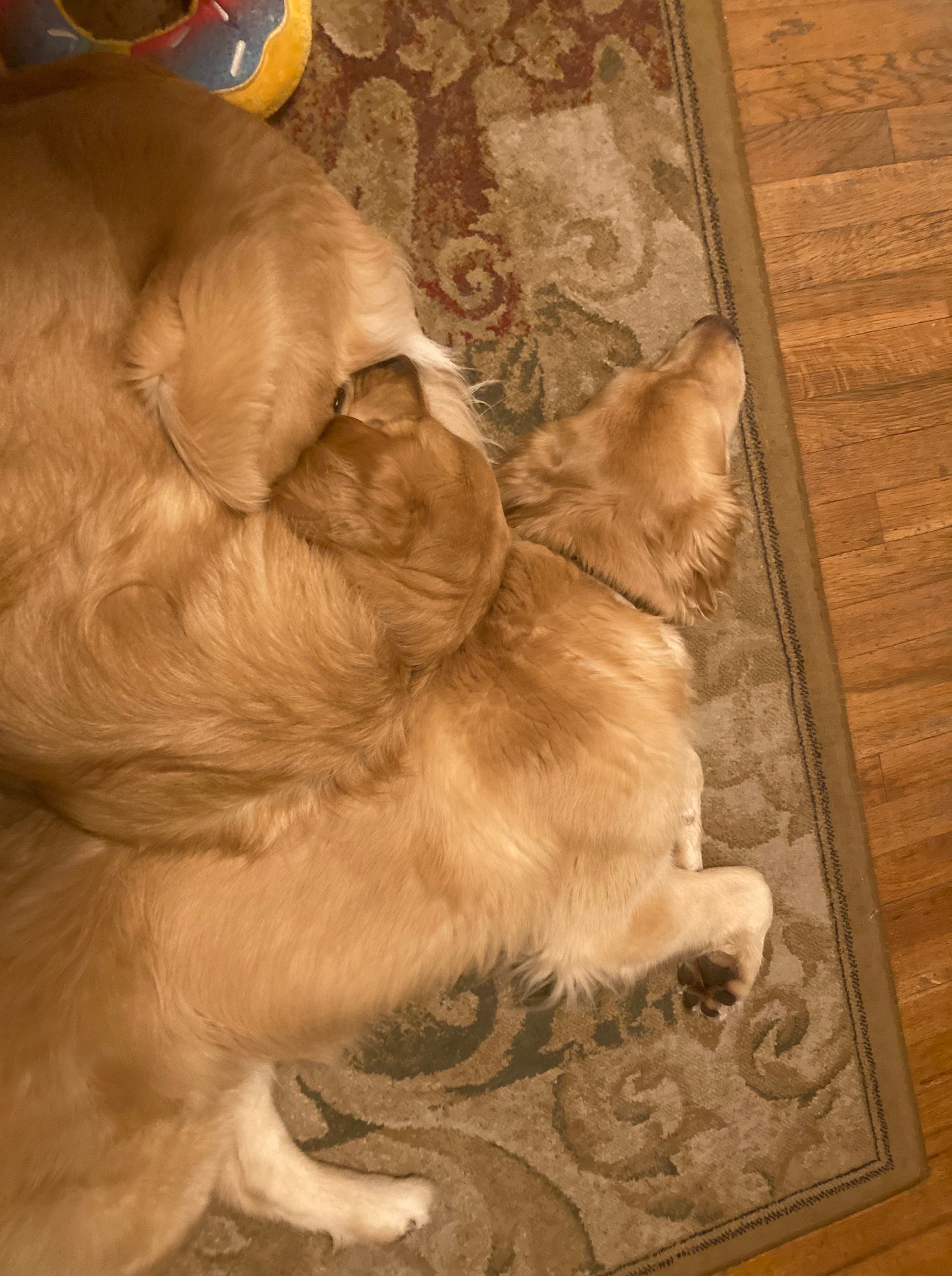
Early January is always a little sad. Holidays, and time off from work, are over; Missoula is gray and cold.
This year, January is sadder than ever. After a wonderful visit, Deni and Koala returned to Florida on Jan. 3. Spirit went home a few days later. Orly does not know what to do with a silent, almost-empty house. We’ve finally had to face the enormous hole that losing Cali has left. And Orly has never been the only dog.
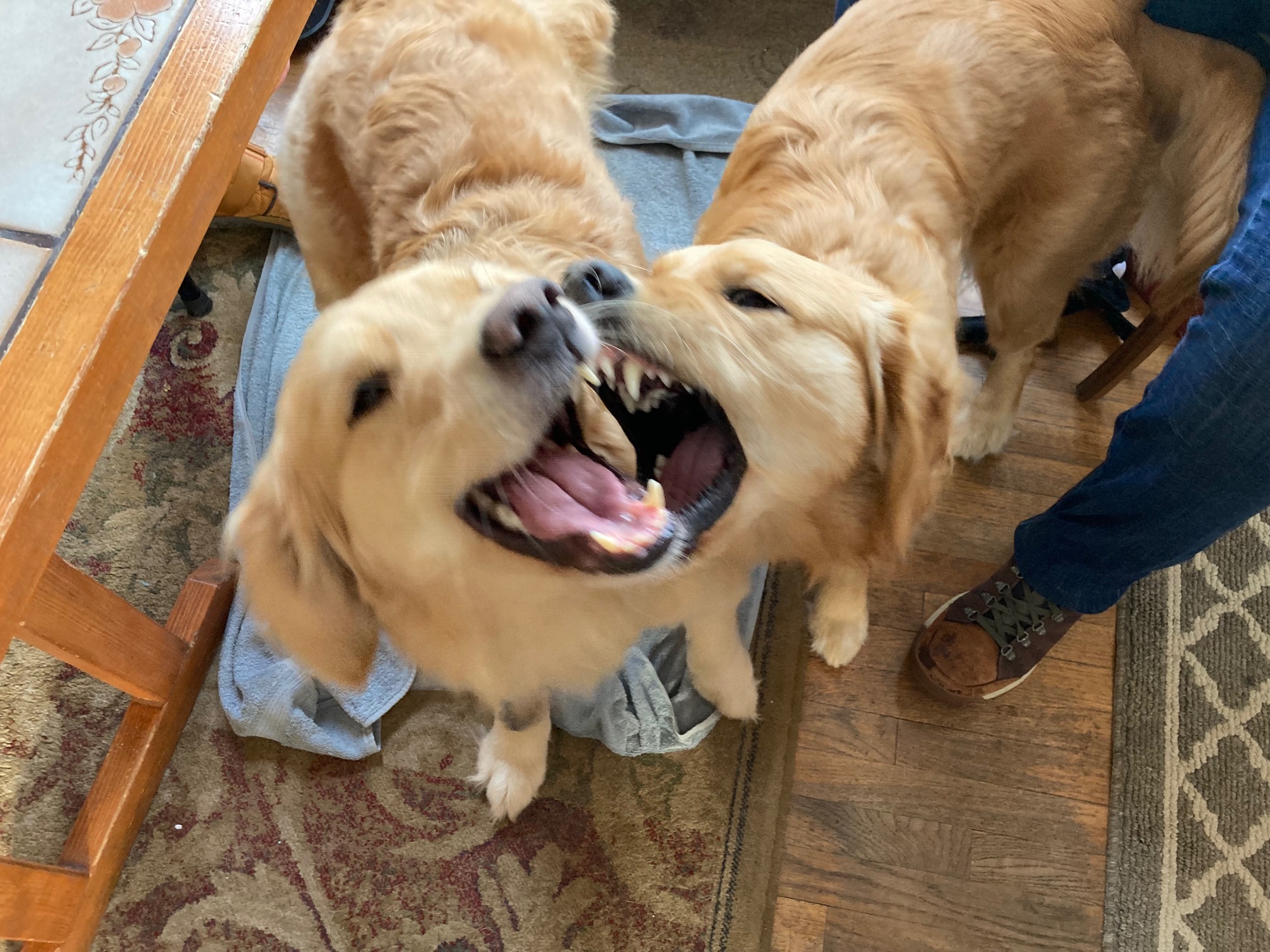 Orly loved having a live-in playmate, one with a similar(ly obnoxious and physical) play style, all paws and mouths and teeth and leaps and jumps. After an energetic bout of wrestling and racing each other around the yard, Orly and Spirit would collapse into a fuzzy golden pile.
Since discovering that they are cousins, I’ve taken to calling them “identical cousins.” It was often hard to tell where one ended and the other began or even who was who.
But now Orly is alone. And mopey and sad, except when she’s outside. Then she’s alert and barky.
She is snuggly and overly affectionate sometimes. I wonder whether she’s worried that I am going to make her disappear as I have caused Cali, Koala, and Spirit to vanish, and she’s trying to ensure that she doesn’t annoy me … The primary reason I do not believe that she’s exhibiting Stockholm Syndrome, though, is that the (brief) cooperative, attentive, sweet, or affectionate periods soon give way to her more common defiant, moody teenager behavior.
She’s mostly just bored. I am boring. Spirit was fun. Koala, too. And with Cali, at least Orly had someone to torment. Now? Boring old human staring at a boring old computer. Humph.
She is going hiking a couple of days a week with a group of her dog pals, and I need to get busy arranging play dates for her on other days. She’ll get me out on lots of walks, too. And of course we have a large selection of treat toys, interactive puzzles, and other things to play with.
Even so, Orly’s life has changed significantly. And she does not see the changes as an improvement.
 Cali left us on Dec. 10. I still can’t say that (or type it apparently) without crying.
I certainly wasn’t ready to write about it for last week’s blog post, and the cheerful post I had written about life with three golden girls had to be shelved.
She held on through her 10th birthday week, which was filled with ice cream, dog treats, long walks, dinner with friends, and a day out with two of her beloved aunties.
And she gave a final gift to goldens of the future.
As part of the Golden Retriever Lifetime Study, the families of deceased heroes can make a final gift: A necropsy that allows the study’s researchers to add to their understanding of canine cancer.
Cali and her beloved brother Pirate died within a day of each other; another dear brother, Sailor — Orly’s dad — died in early summer. All three had internal bleeding, likely from hemangiosarcoma ruptures. I don’t have the lab report yet on Cali, but the wonderful emergency vet who took care of us was pretty sure that hers was from the liver. Both boys also had masses on their livers. Hemangiosarcoma is relentless and so, so common with golden retrievers.
The house feels empty without Cali, even though Spirit (our guest dog) and Orly are constantly tumbling around, wrestling, tugging on each other, chewing toys, and generally being the exuberant young dogs they are. (I especially miss having another adult in the house!) Her optimism and joy were unique.
When I wake up, I look for Cali’s wagging tail and enthusiasm as she greets the morning with a happy dance holding a favorite toy. Then I remember. I wake Orly, shove her off the bed, hug Spirit, and start the day … without my beloved friend. I miss her company as I work in my upstairs office, and have avoided walking her favorite route.
I spent much of the week calling, emailing, and texting some of her many friends with the sad news. She wanted to meet — and befriend — every person on the planet. In her 10 short years, she made significant progress toward that goal, and I clearly couldn’t notify everyone she has touched. We’ll all miss that sweet Cali girl …
Happy holidays from the Thinking Dog Blog! We’ll be taking some time off, but we’ll see you again sometime in the new year.
