Orly’s ‘Little’ Sister

I’m taking a vacation! There won’t be a new Thinking Dog post next week. Happy Labor day!

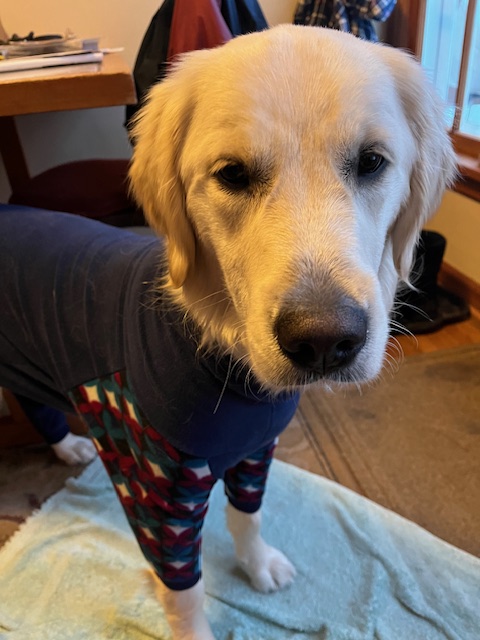
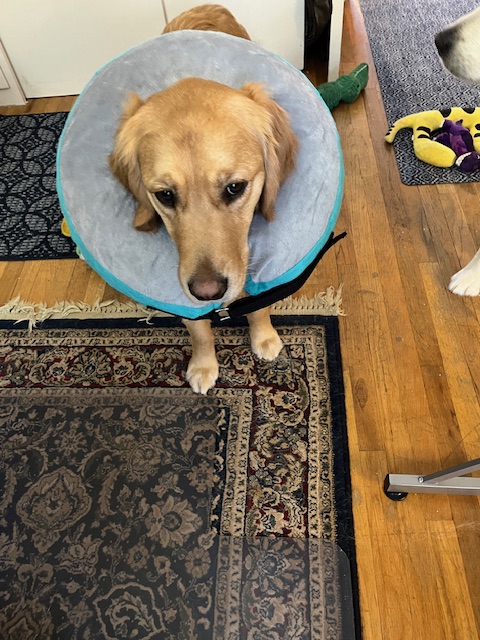
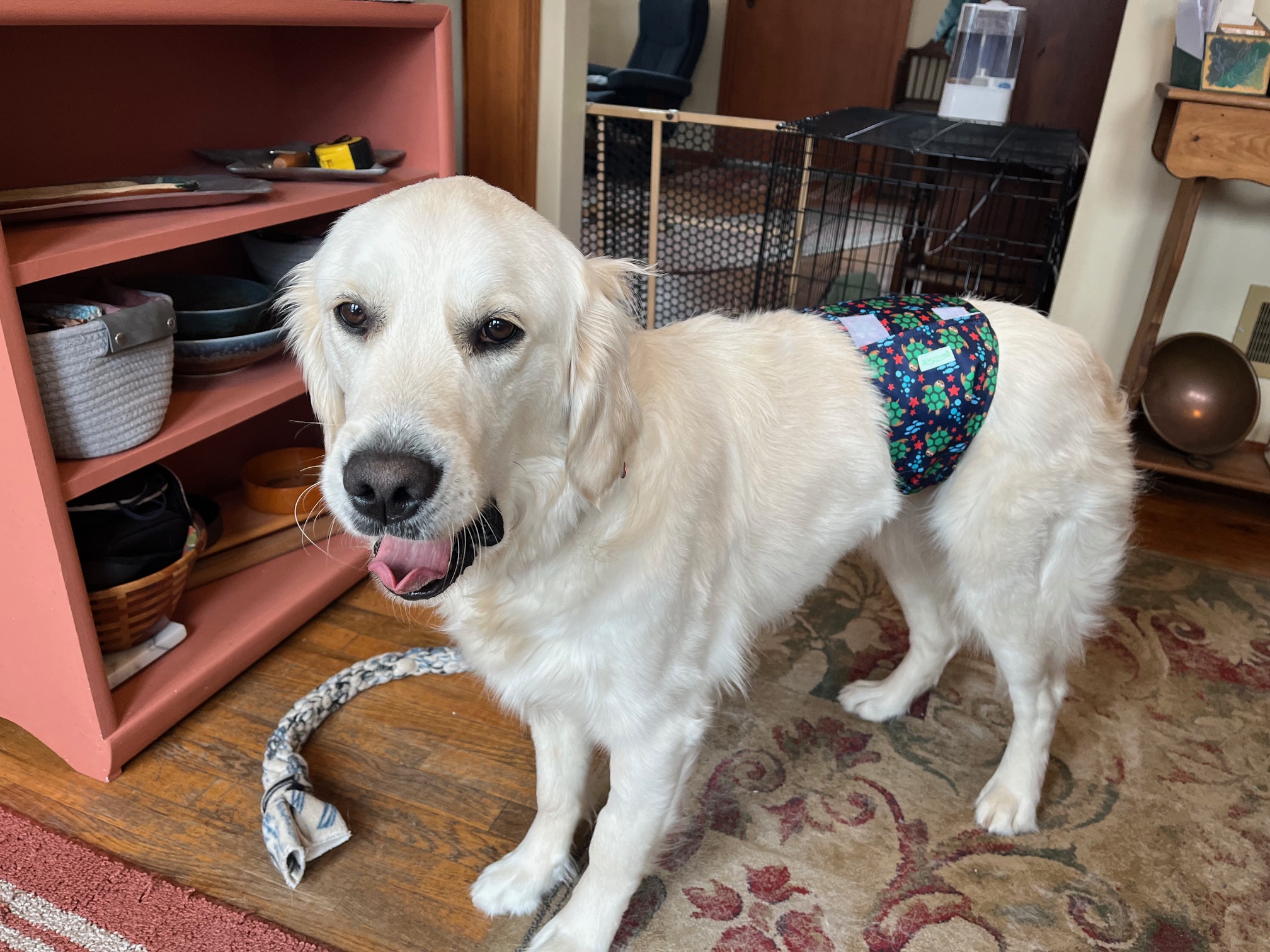
I wanted to leave you with some photos showing how Orly’s little sister has grown … and grown, and grown. I am sure that she’ll be bigger than Orly before she is 6 months old!

This slideshow requires JavaScript.


Step by Step

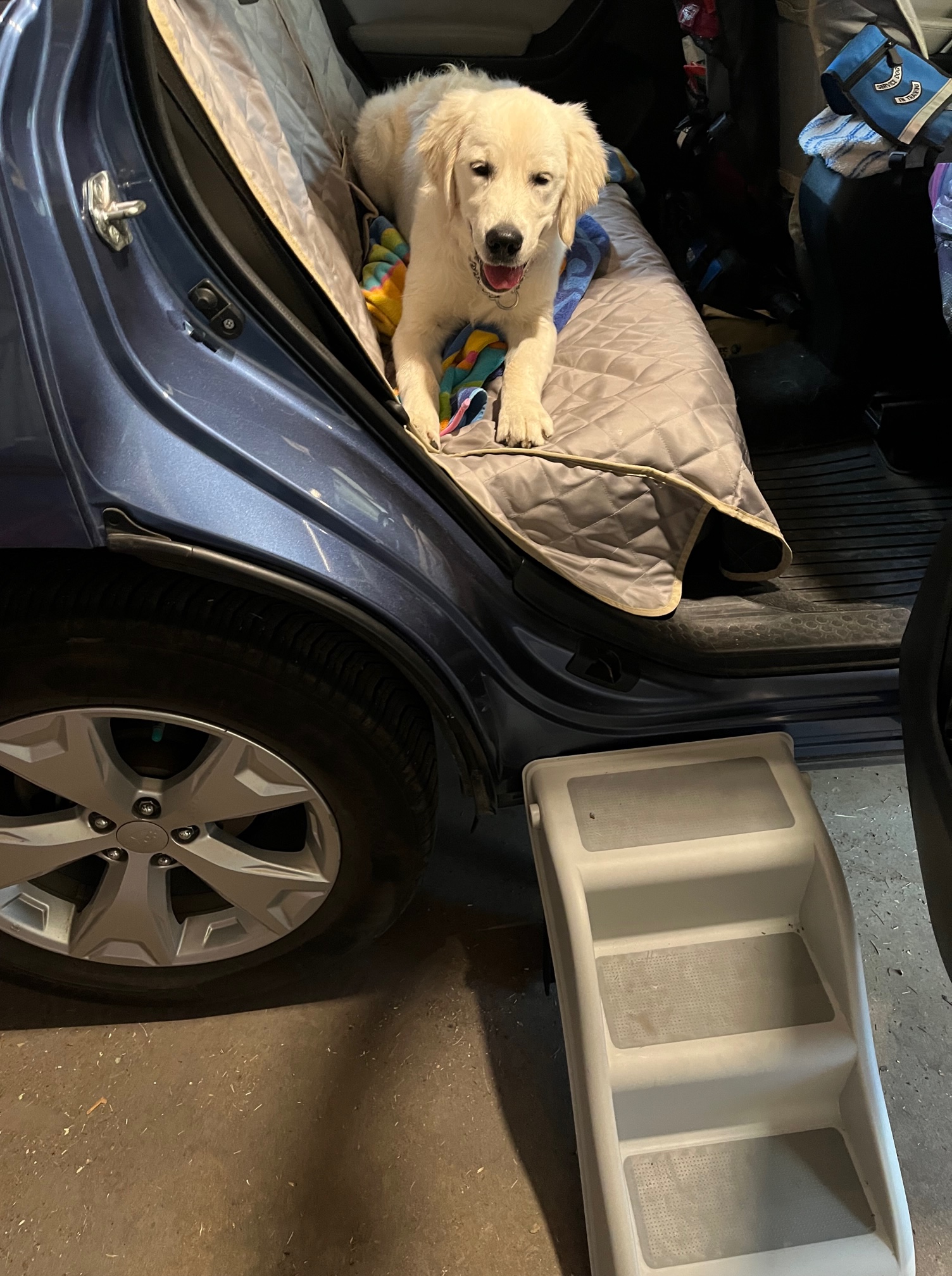
White golden pup Dotty lies on a colorful towel in the car
I refuse to get out of this car!

Dotty does not like getting into the car. She hates (and strongly resists) getting out of the car.

This is a problem when, say, we need to go to the vet or to training class, as it would be with any pup. But as a service-dog-in-training, Dotty simply goes more places than most dogs — and she needs to get used to getting in and out of all kinds of vehicles.

When I trained young service dog puppies, long ago, we took them on field trips in a minivan. We had a folding ramp that they walked up and down to get in and out of the van, where they rode in sturdy crates.

I have a Forester, and the dogs ride in the back seat. Getting in and out requires either a big jump onto the seat 0r, preferably, two smaller jumps — one into the passenger foot space, and then from there onto the seat.

Orly learned quickly (from Cali) how to do all of this, and we never had an issue getting her in or out of the car.

Dotty has learned a lot from Orly … but not this. Despite watching Orly get in and out of the car dozens (maybe hundreds) of times. Treats aren’t helping either.

So I bought her some steps. The ramps I saw for sale were too long to be usable either in my narrow driveway or when parking in a parking lot with only a foot or two between cars. They are also often too wide to use at a passenger side door. But these little steps fit.

They’re plastic and sturdy enough to support a much larger dog than Dotty is (at the moment), but they can move if the dog jumps too enthusiastically. I hold them in place with a foot. Orly doesn’t mind the movement. Dotty… does.

(You may remember, though, that Dotty was not eager to use regular steps … the solid kind that are inside the house … especially the ones going down.)

Golden retriever Orly approaches gray plastic stepsOrly figured it out immediately and eagerly showed Dotty how to bound up and down, in and out. Dotty wanted nothing to do with these steps, not even with our top-rated treats.

We moved to the basement and practiced going up and down the steps to get on and off the TV sofa, the only furniture Dotty is allowed on. She caught on pretty fast, with the help of some yummy treats.

We moved to the deck. Orly again demoed quite enthusiastically.

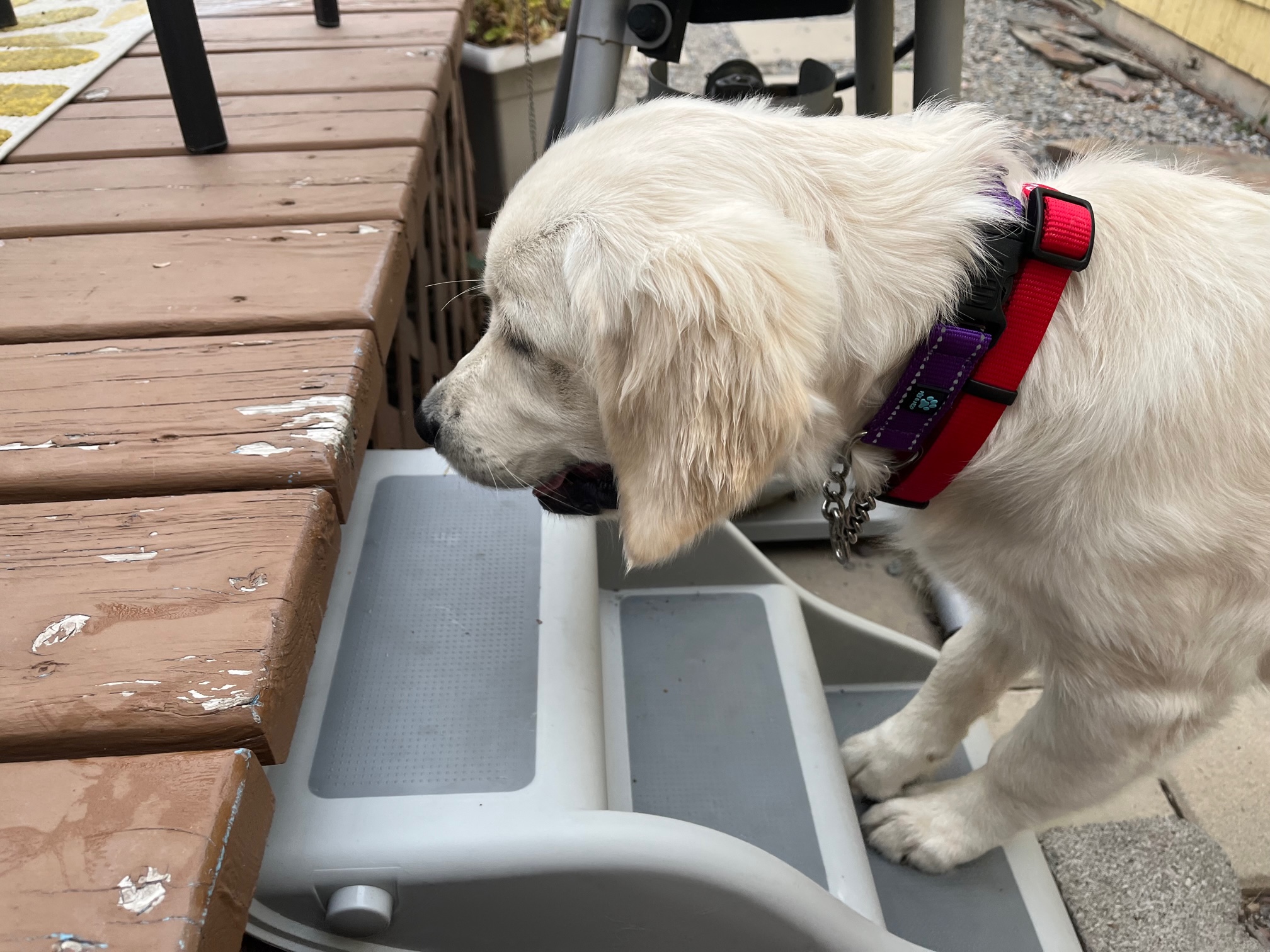
White pup dotty goes up gray plastic steps to a brown deckDotty grudgingly tried (treats definitely helped here)… survived … tried a few more times. Seemed comfortable enough.

Back to the car. She went in. Progress!

But that was it. Dotty did her usual lie down refusal to even consider getting out.

Orly bounded in and out a few more times, showing off her ability and confidence — and making a big deal out of gobbling her treat rewards.

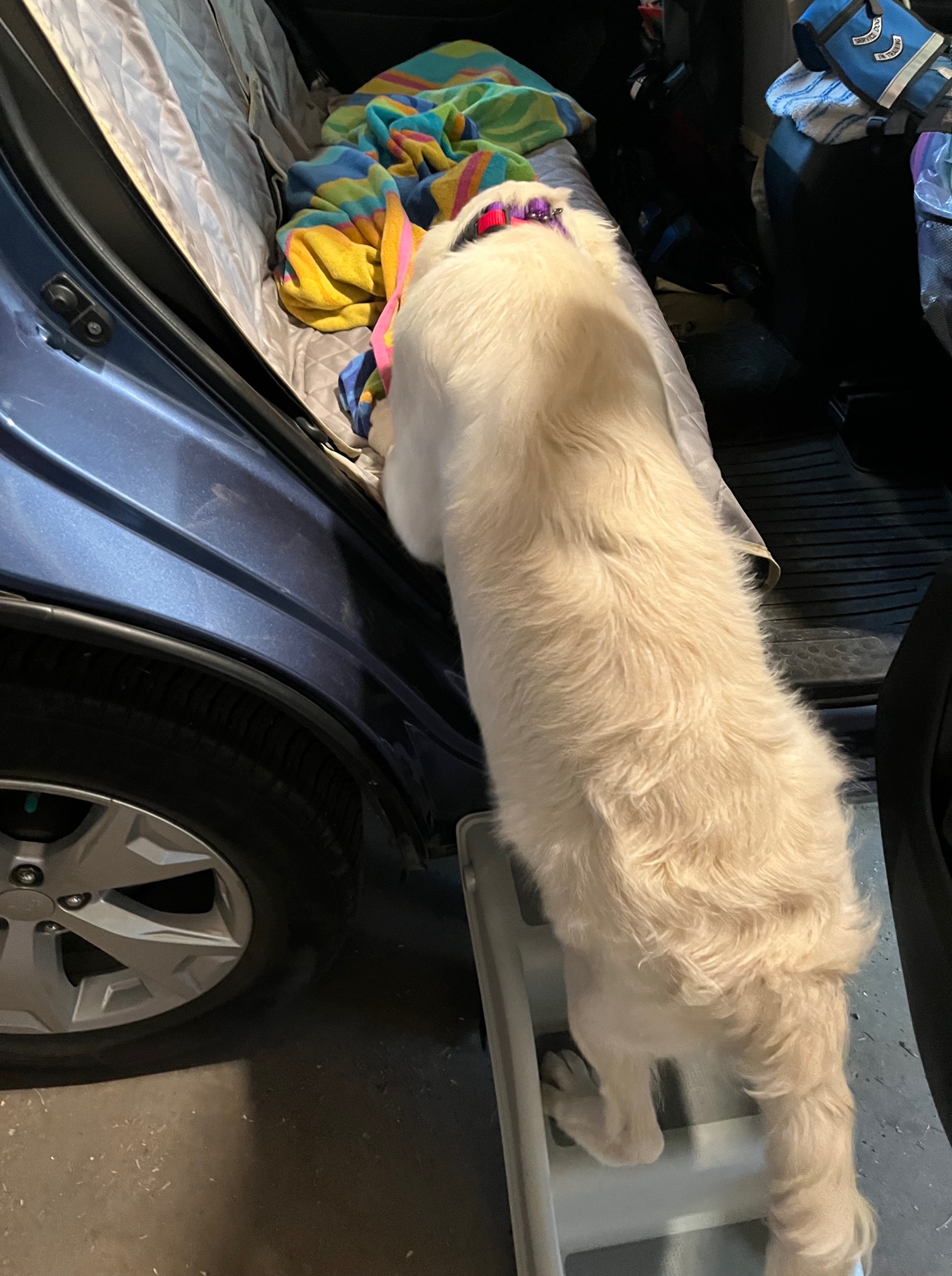
White pup Dotty climbs the plastic steps to enter a blue carUnmoved, Dotty turned her back on us and lay down even harder, if that’s even possible.

We went to training class, where Glenn, our trainer, helped all the dogs go in and out of his minivan using stairs very similar to ours. And a ramp. Dotty did both. She even seemed to like the ramp.

Back to the Forester. She got in, no problem. I coaxed her off the back seat and she — miracle — climbed down the steps and out of the car!

White pup Dotty lies on the car seat, looking out the door, with the gray steps in place to help her out.Once.

Climbed back in and did the hard lie-down. Dared me to try to get her out.

We drove home and … that was it. She was done. Not gonna get out.

I did my usual — picked her up and lifted her out. All almost-40-pounds of her. I cannot keep doing this.

We’ll see who wins this battle. My money is on Dotty, which will present quite a conundrum if she gets any bigger.

Preserving Generational Wisdom

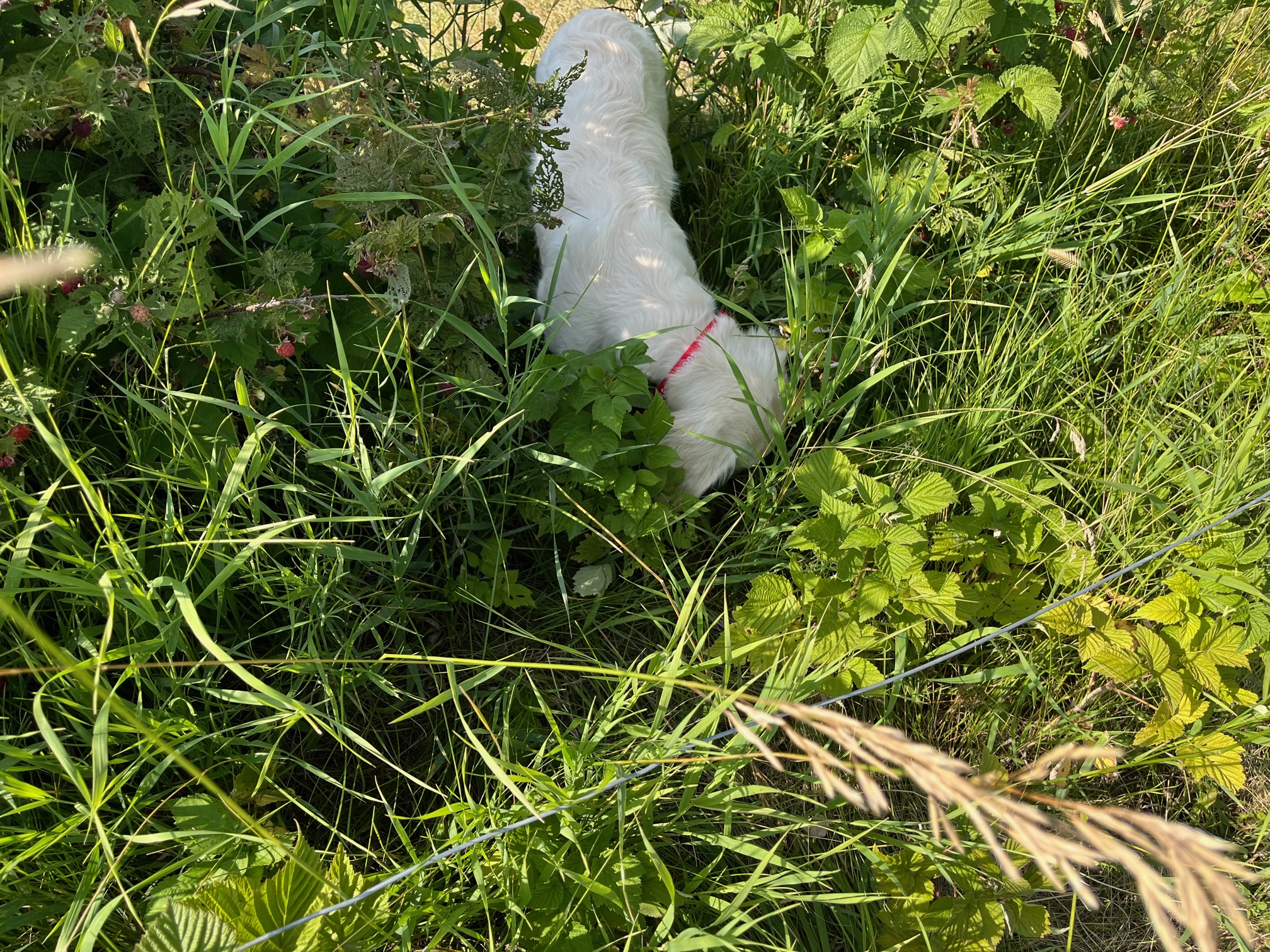
White golden retriever pup Dotty searches among green raspberry canes for ripe berriesEven at the tender age of not-quite-2, Orly is taking her role as the steward of family culture seriously.

Last week, while we were dog-sitting for Orly and Dotty’s new best friends (Stella and Cruiser), Orly thought to leverage an opportunity to hand down Hogle Golden Retriever Culture and Wisdom: She taught Dotty how to pick raspberries.

Berry picking is a revered part of the culture of all Hogle goldens. Jana created this family talent as a young puppy in Israel. She started with strawberries, very quickly learning that the red, sweet-smelling ones tasted better than the green, hard ones. Thus began a daily competition for the finest berries. I usually lost.

Strawberry season in the Israeli garden fed into blackberry season. Jana perfected the art of plucking the ripest, sweetest berries — while avoiding the thorns. We made a deal: Anything above her nose height belonged to me. Anything lower belonged to her.

That deal survived a move to the US, and endured through blueberry picking in Massachusetts. Jana conveyed the cultural knowledge to Cali in California, ensuring it would continue through the next generation — now with raspberries.

Cali perfected raspberry picking over several summers in Montana, teaching the art to young Orly. In one glorious summer, just a year ago, Cali and Orly gorged on raspberries and blackberries. They got a little carried away, though, and might have … destroyed the raspberry bushes in the process.

Never mind. Following some landscaping work, new berry bushes will be ready to fill dog tummies by summer 2024.

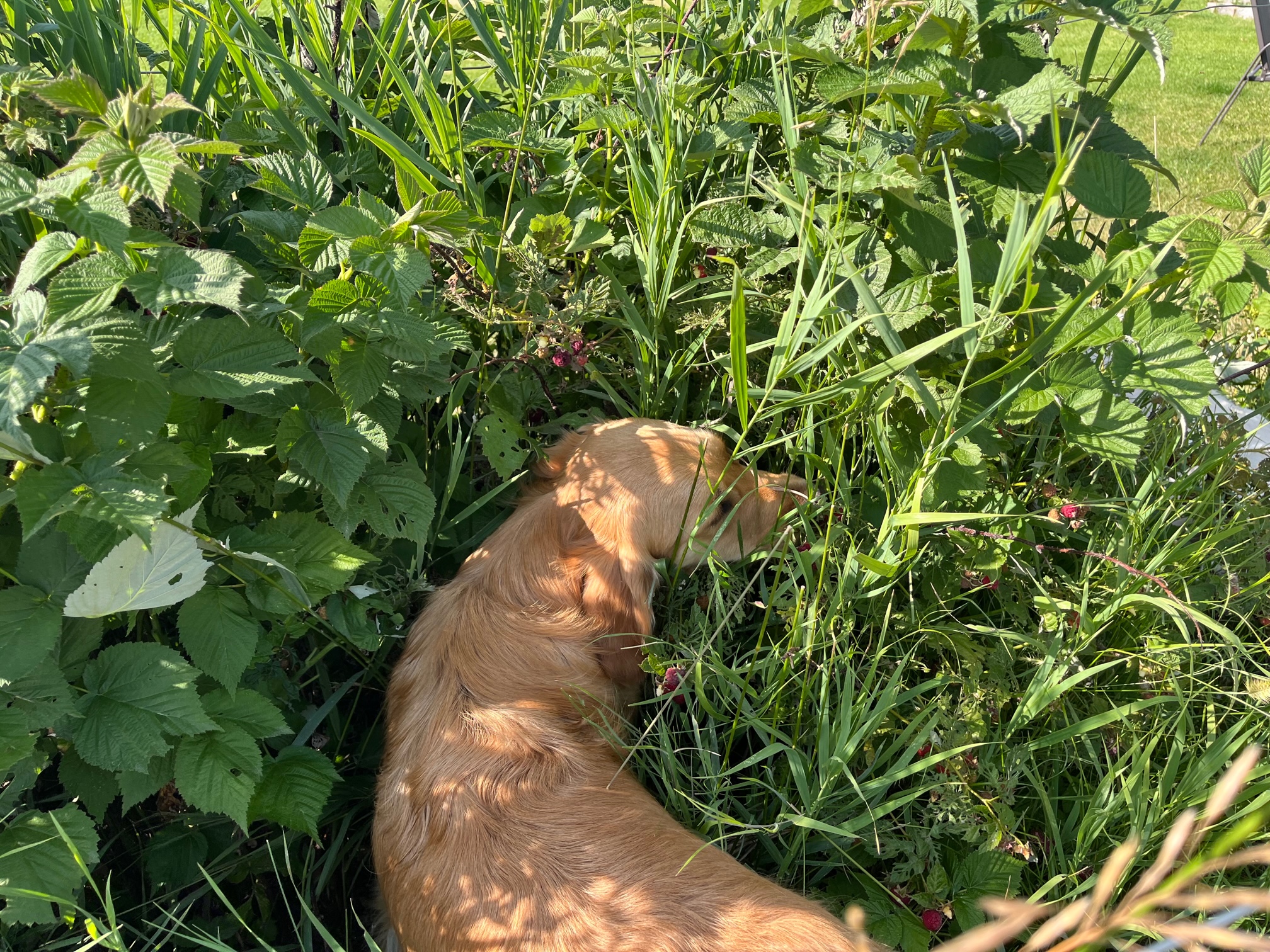
Golden pup Orly noses for fresh berries among thick green raspberry canesImagine Orly’s delight, then, to discover raspberry bushes at Stella and Cruiser’s house!

Not being goldens, Stella and Cruiser had no idea of their good fortune.

Orly took Dotty firmly in paw, led her to the patch, and … Dotty was a star student, picking up on the technique right away, thus ensuring that the cultural tradition would extend to a fourth generation.

Dotty even remembered and was able to apply her new skill in a different environment: Several days after we got home, Dotty remembered that there were raspberry bushes next to the river trail, and immediately headed to them, nosed around, picked and devoured the few remaining berries.

While it used to be controversial to say that non-humans shared culture in their social groups, Jane Goodall identified dozens of shared and taught behaviors among chimpanzees that, she pointed out, constituted culture. Now, many researchers agree that agree that culture “involves a collective adoption and transmission of one or more behaviors among a group” or a pattern of “knowledge, belief, and behavior that depends upon the capacity for learning and transmitting knowledge to succeeding generations” — and that multiple animal species demonstrate cultural knowledge and sharing.


Mall Pup

White pup Dotty holds a plastic tube. She's wearing a blue service dog cape.
Dotty got used to wearing her new cape by practicing a few retrieves while wearing it at home.

On a recent Saturday afternoon, Dotty met up with her sisters at the mall. A friend joined them as they hung out in the mall, greeting people who were shopping or also hanging out. The pack then visited Scheel’s for some light shopping and, it must be said, sightseeing.

(The Missoula Scheel’s has both a country fair-style shooting gallery and a 2-lane bowling alley, ensuring mobs of kids on a Saturday afternoon. And dogs. So many dogs.)

That Dotty and her sisters are 4-month-old golden retrievers and their friend Geo is a doodle is what makes this outing unusual. The girls are in training to become mobility-assistance service dogs, and learning to be calm, confident, and competent in public settings is an important part of their preparation.

This outing was a doozy. So many people, dogs, noises, smells, and experiences. We did spend much of the time in a quiet(er) meeting room, but navigating the store, which allows pet dogs, with its interesting features, was a challenging first public visit.

Dotty did amazingly well, calming down to watch people walking by in the mall, appropriately greeting people (sitting quietly) when given permission, walking confidently next to me through the gauntlet of people, dogs, and noises.

She did start to show some nervousness as we walked out. At this point, it was just the two of us, each sister-and-human pair having headed out separately. Near the bowling alley, a couple of girls asked if they could pet her, and I paused. So far, so good. But then a bunch of their friends came over at the same time that someone started bowling… and it was too much.

Dotty’s tail went down. I immediately apologized to the kids and headed out. Dotty recovered quickly and bounded happily to the car.

We’ve since had one additional outing: We visited the best pet store in Missoula. Dotty got to try out her new superdog cape, get treats, and explore a very exciting (from a puppy’s perspective) new place.

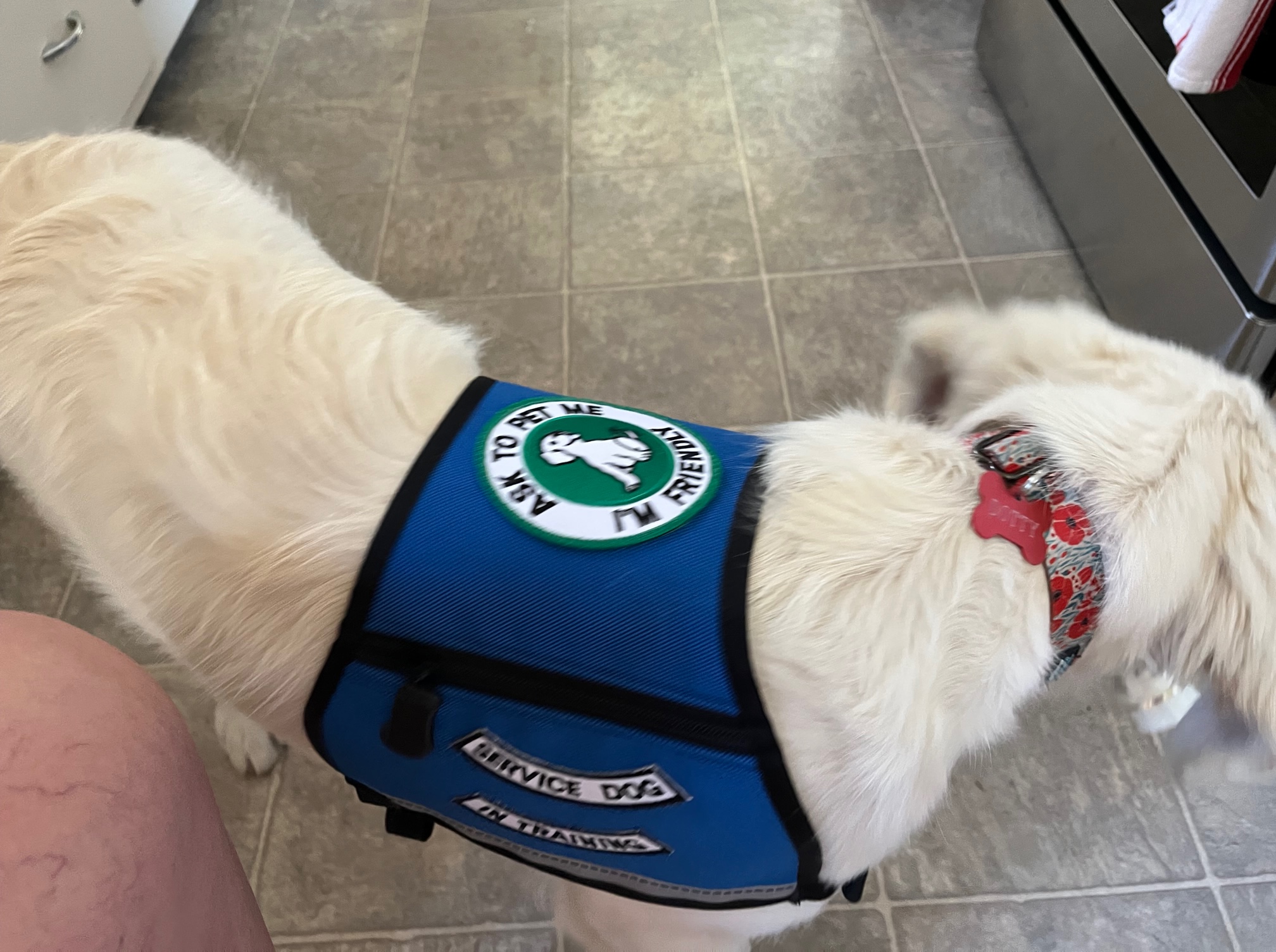
Dotty's cape is blue with patches that identify her as a service dog-in-training.The ADA, a federal law, allows people with service and guide dogs to take their dogs into public spaces that usually bar dogs. The ADA does not include access for people training service dogs, however. Montana is among the states that allows service dog trainers the same public access with dogs in training that a person who works with a service or guide dog has, with the stipulation that the dog in training wear an identifying cape or vest. So Dotty’s “superdog cape” grants her the super power of going where other dogs cannot. Much to Orly’s dismay.


Snuffle Monster

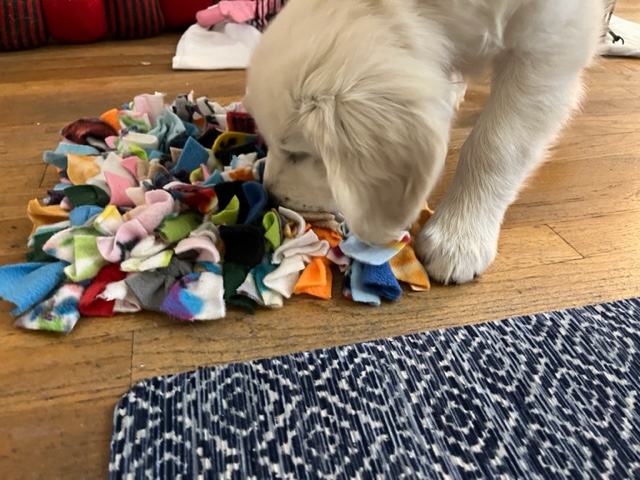
10-week-old white golden puppy sniffs a snuffle mat made of strips of fleeceI’ve created a monster. Think ‘Cookie Monster’ — not ‘JAWS.’

I introduced little Dotty to our little snuffle mat. Adorable in every possible way. She figured it out pretty much instantly. There is nothing wrong with her nose, and, true to her breed, she loves a good snack.

[A snuffle mat is a nest of fleece strips. The human servant hides yummy treats among these strips, and the dog sniffs them out and devours them. It’s a chance to let dogs use their noses and enjoy some mental stimulation. And a snack.)

I generally give Orly a snuffle mat after she hikes, and sometimes we do it after (my) lunch even on days that Orly doesn’t hike. She sometimes asks for it, but is generally happy to get the offer but not insistent.

Dotty is different.

After two — two — snuffle mat sessions, she started walking over to the shelf and trying to pull hers down. She resorted to barking at it when she couldn’t free it from the shelf.

She goes over to the snuffle mats and demands (often quite loudly) that I prepare one for her.

I ignore that, but when I am preparing the snuffle mats, she barks instructions, wriggles, tugs at the corner, pops up to watch where I am putting the treats (or is she counting to be sure that she gets as many as, or more than, Orly?!). She dives for Orly’s as I move to set it down. She impatiently sits, wriggling and sometimes barking, as I give Orly her mat and turn to give Dotty hers.

Once she’s finished clearing the treats from hers — and has thoroughly examined Orly’s mat to ensure that nothing was left behind (as if!) — she has taken to dragging one — usually Orly’s larger mat — around the room.

Snuffle Monster.

Not All Dogs Are Career Dogs

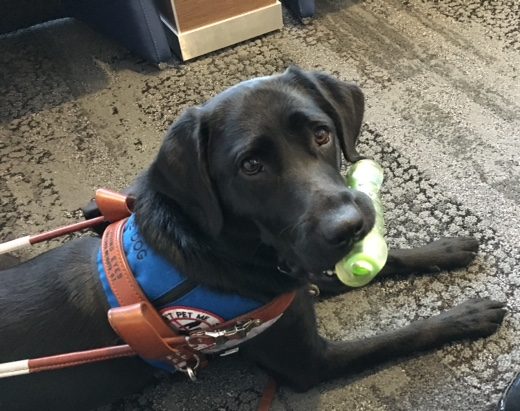
Koala, a black Labrador, wears her guide harness.The post about Ida last week and some conversations with a local service dog trainer got me thinking about the many reasons that dogs don’t succeed in a career as a service or guide dog.

For Ida, the issue was anxiety; she was uncomfortable with unpredictable sounds, with airplane travel, and possibly with other unavoidable features of life as a working dog.

Why else might a dog bred or selected for training as a guide or service dog be released?

For many puppies, and even adults or working dogs, leaving the field is the result of a health issue. Alberta retired 7 years ago after losing an eye to a benign tumor.

For others, it’s temperament. They are too nervous to work safely in public spaces, for example. I’ve known dogs with top-notch skills who simply couldn’t function in a busy public place where pets aren’t expected to be, like a grocery store or a restaurant, or even a busy park.

They may be uncomfortable around unfamiliar dogs; Deni has encountered untrained “service” or “support” dogs in airports and other public spaces who growled or lunged at her working dog. These dogs are too scared and reactive to be safe working in public.

Some dogs have specific fears, like dogs who are afraid of thunder, that mean they cannot focus on their work.

Sometimes, the problem is behavioral: A dog who is so obsessed with food or distracted by squirrels or tennis balls, for example, that she cannot focus on her work will be released.

Working dogs need to be calm under all circumstances, keep working even when they are tired, and not react to other dogs, cats, small (or adult) humans who invade their space and touch them or repeatedly call their names. They need to be flexible and resilient and able to regroup, change direction, and keep their handlers safe.

Working as a guide or service dog asks a lot of a dog and exposes the dog to many things pet dogs never have to worry about. It’s not surprising that many dogs who begin the training don’t complete it. Or, like Ida, once they see what the job is like, they quickly realize that they are overwhelmed.

I am glad I met Ida. She’s a sweet, smart girl. I’m also happy for her that she will have the kind of life she needs and deserves.


Not Meant to Be

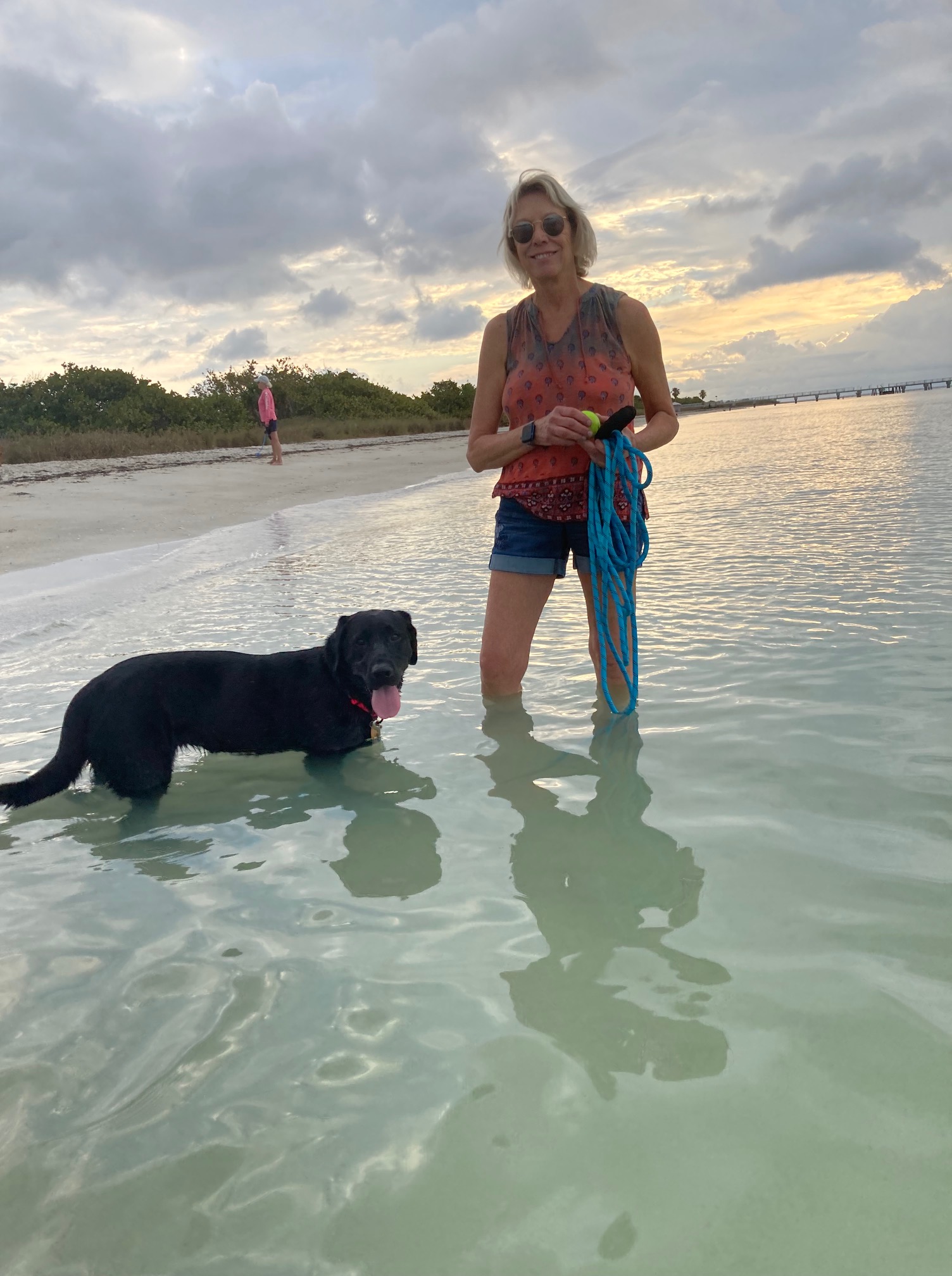
Black Lab Ida wades into the water to stand near Deni, dressed in shorts and tank top, holding a long blue leash.
Ida’s first visit to the dog beach

A guest post by Deni Elliott

The partnership that develops between a well-bred and trained guide dog and a visually impaired human looks and feels like magic. However, as was the case with Ida and me, sometimes things just don’t work out.

Alberta, my first Guiding Eyes dog, and her successor, Koala, matched me perfectly in very different ways. I wasn’t surprised that Ida was not like the others; I thought of her as my sensitive girl.

However, after three weeks with me, Ida made it clear to my Guiding Eyes home trainer and me that she really didn’t want to be a guide dog. I am grateful that Ida made her choice before we set out together on a trip in which she would have needed be comfortable at my side while I gave a professional presentation in Chicago, attended some meetings in Salt Lake City, and then got to know her golden retriever sister and life in Montana, with many hours in airports and flights on Delta in between.

Ida got the life that I suspect she wanted all along — being a pampered pet with the family who raised her from the age of 8 weeks to 16 months. My previous two guides are happy too: when Koala retired after more than 6 years of guiding, she happily returned to her puppy raiser. Alberta, who retired early due to an eye tumor,  is now 12 years old. She lovingly watches over my toddler grandniece, who has shared food with the dog since she was old enough to fling it from her high chair.

I will be fine, even though I miss having a dog at my side and am temporarily using a white cane to help with navigation. Guiding Eyes training staff and placement specialists have come to know me well over the past 10 years; They are working hard to find my next perfect match.

My first two Guiding Eyes partners taught me that dogs with different temperaments can be equally good guides:

  • Alberta exuded confidence. Give her a challenge, and she’d rise up on her toes to say, “Bring it on!” More than once she responded to my uncertainty by nuzzling me to say, “We can do this.”
  • Koala was my introvert, analytical and thoughtful about new environments, but five weeks into our relationship, she flew with Pam and me to Israel without complaint and happily worked trains and open air markets in Jerusalem, as well as guiding me safely up and down the centuries-old stairs that traverse Tzefat.

Ida was brisk, responsive, and responsible when in harness and loved being praised and rewarded for her good work. That’s why she was matched with me in the first place! But, when off duty, she increasingly startled at unexpected sounds and sights, including wind in the trees and birds flying overhead. Within a few weeks, she could no longer shake off whatever surprised her and became more intensely anxious more of the time. Ida taught me that a smart, creative dog can hide her true feelings in her eagerness to please — at least for a while.

A successful guide partnership is a tapestry of collaboration, cooperation, communication, and trust. My dog trusts me to know our ultimate destination and give her clear directions about where we are heading. I trust the dog to alert me so that I can navigate curbs and stairs and locate door handles and empty chairs. She steers us safely around obstacles that I would run into or trip over. Most importantly, she quickly gets us out of the way of vehicles that might run us down. The partnership works only when dog and person agree that the dog has final say in all guiding decisions. We live by the Guiding Eyes mantra: Trust your dog.

Sometimes puppies decide as early as 8 weeks that they are not cut out for the intensity of guide work; others make their reluctance clear as adolescents when learning guiding skills. Dogs past their prime slow down when they are in harness, signaling to their partners that they are ready to retire. Unfortunately, as with Ida, sometimes the dog’s decision comes at a sad time for all of the humans involved: When placed in a real life partnership, they decide that a guide dog’s life is not for them.


It’s Spring (Maybe …)

The Thinking Dog Blog is taking a break to enjoy some gorgeous spring weather. We’ll be back soon!

Golden retriever Orly reclines on patchy green grass
It’s FINALLY nice out. Let’s go for a hike!

Introducing Ida: A New Thinking Dog!

Black lab Ida holds a green rubber toy with her right paw while chewing on a Nyladbone wedged inside it
Ida uses a toy to hold her chew bone steady.

The Thinking Dog Blog finally has some wonderful news to share: Deni recently welcomed Ida, a new guide dog, to the family!

Ida, who just turned 2, is a black Labrador retriever from Guiding Eyes for the Blind.

She’s a great addition to the Thinking Dog clan: She’s smart, seems to be an adept problem-solver, and learns quickly. As a young Lab, she’s also high-energy and very playful.

Black Lab Ida wades into the water to stand near Deni, dressed in shorts and tank top, holding a long blue leash.Like Deni’s first Guiding Eyes dog, Alberta, Ida loves it when Deni — or anyone, really — notices her cleverness and comments on how well she’s doing her job. She’s super-friendly and feels entitled — obligated? — to greet people on walks, even starting to head up sidewalks or driveways if neighbors are outside when she’s on a (non-working) walk.

Like Koala, she’s a bit analytical and likes to think things over. During her first visit to the dog beach (on a long leash!) she needed to think about whether sand, surf, and starfish were good things.

Ida inspects two small starfish on Deni's handOnce she felt comfortable, though, she had a wonderful time. And, back in the fenced dog run area near the beach, she raced around joyfully with another young dog. And, on her second visit, she ran playful, joyful circles as she made friends with other dogs and stepped tentatively into the rough surf.

Black Lab Ida yawns as she rests near the huge bill of a flamingo sculpture, with Deni standing next to her
The Tampa-St. Petersburg airport features a gigantic (and possible scary) statue of a flamingo

Ida is a happy, bouncy, curious, very social dog who is eager to play. She is still settling in and learning what the life of a working grown-up dog is like, of course, and she might have found the giant flamingo sculpture at the Tampa airport a little unnerving … but who wouldn’t?

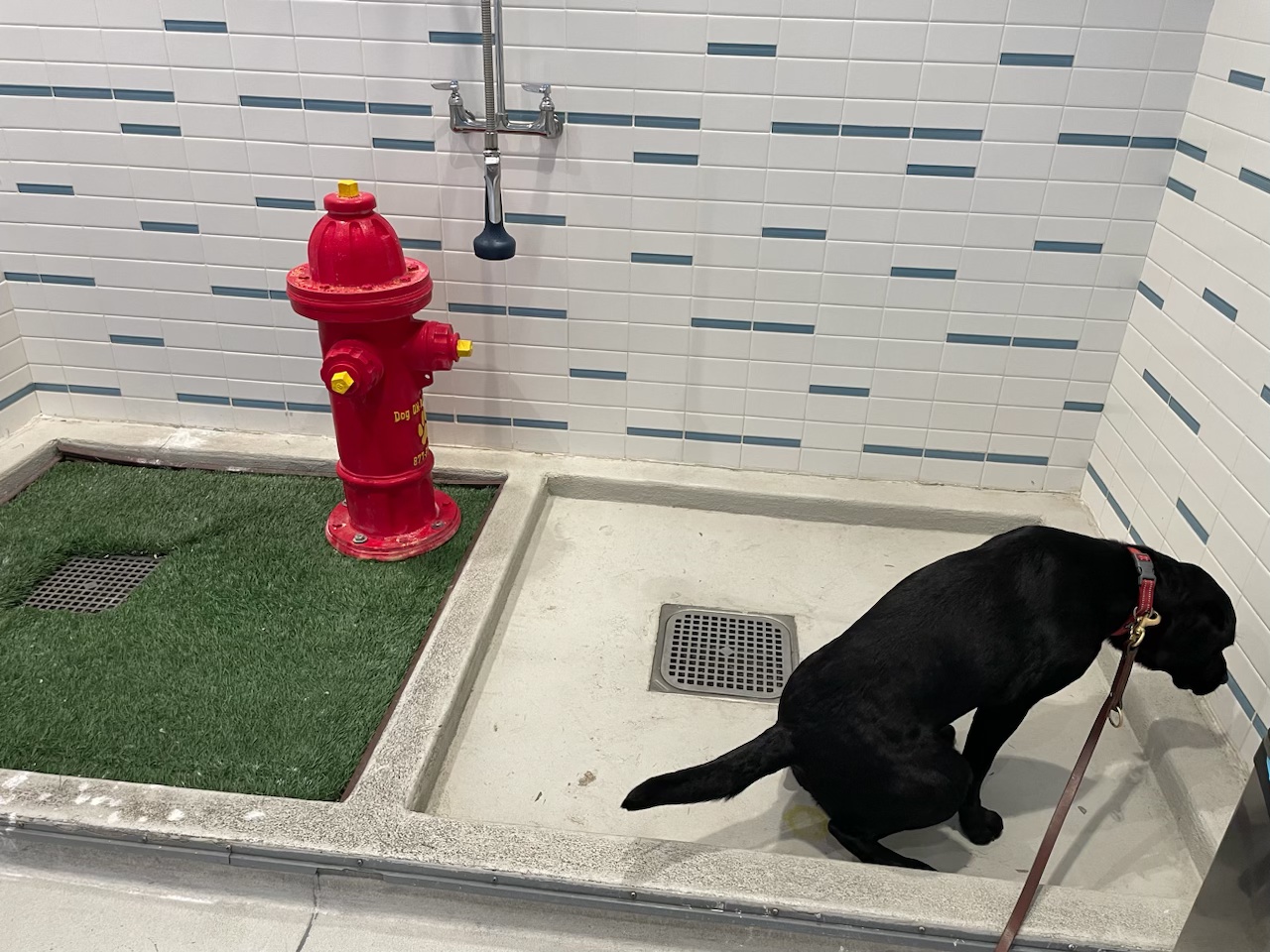
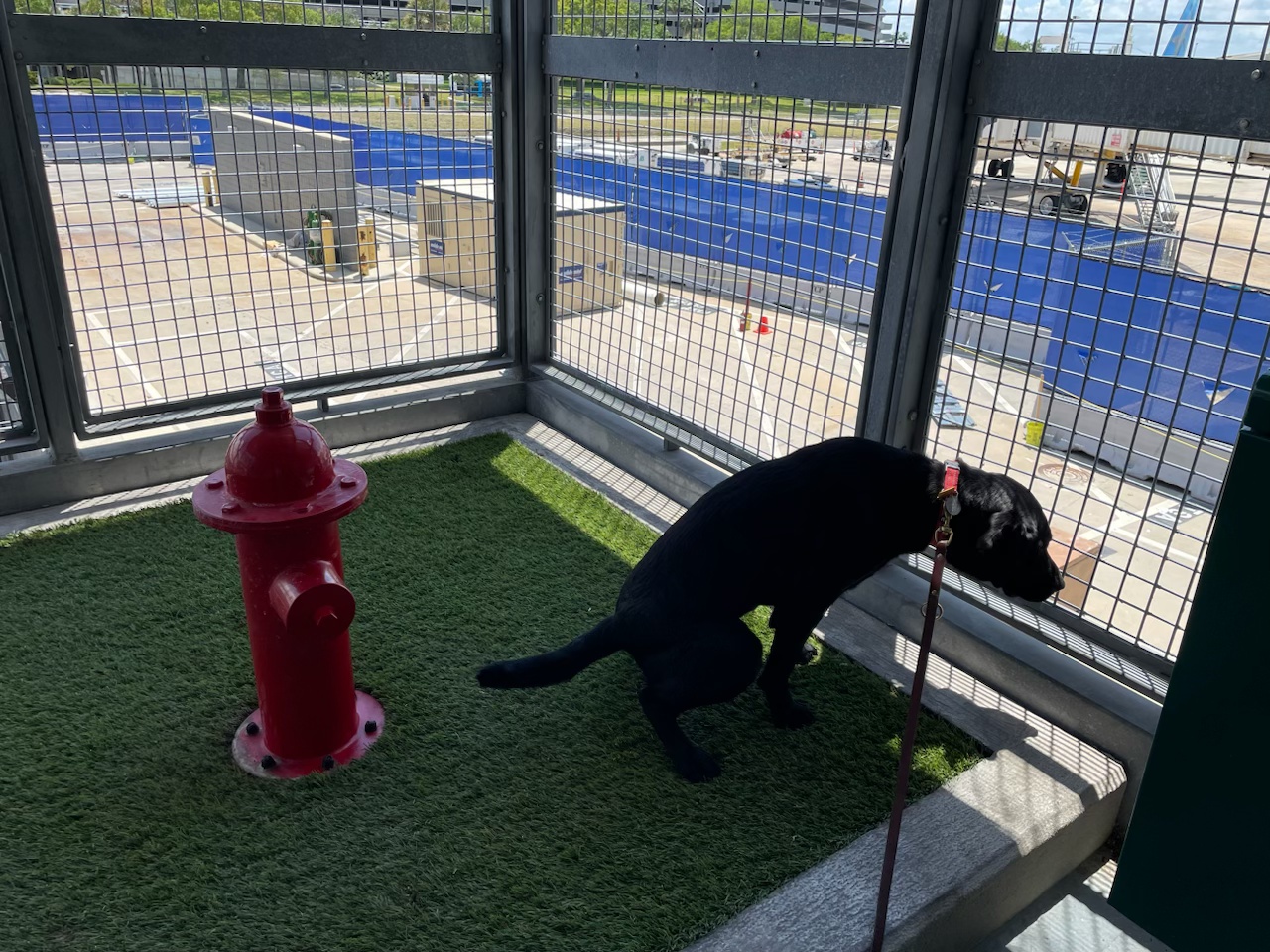
She’s also still learning Deni’s routines — and quickly picking up the “extra” skills that all of Deni’s dogs learn, like finding a trash can as soon as she’s done “parking” (a euphemism for pooping).

She caught on quickly to opening gifts on her 2nd birthday — and gleefully played with her new toys! She likes to use her paws, standing on one gift to keep it in place as she removed the tissue-paper wrapping. And she holds her toys while playing with or chewing on them.

Ida is young, and adjusting to a new dog — especially after several years with a precise, polished pro like Koala — is going to be a challenge for Deni. But the two seem to have forged a close connection already, with Ida responding quickly when called even while running happily with another dog.

Their next big adventure together will be a visit to Montana in May — including a few days at Yellowstone. I hope Ida isn’t afraid of bison!

This slideshow requires JavaScript.


Retirement Day

9-week-old golden puppy Orly rests on black lab Koala's back
Orly and Koala became instant friends

Today is Koala’s retirement day.

She won’t get a gold watch, but I do hope she’ll get lots of treats, multiple walks each day where she can sniff whatever she wants, frequent opportunities to run along beaches, and plenty of activities to keep her mind sharp.

Deni will arrive at Guiding Eyes today to meet her new guide; they will spend just over a week learning to work together before heading home to Florida.

After guiding Deni to her alma mater (Guiding Eyes), Koala will head “home” in a sense; she’s spending her retirement with her puppy raiser!

Many retired guide and service dogs return to their puppy homes for their golden years, and many guide dog schools offer puppy raisers the opportunity to adopt “their” puppies when the dogs are no longer able to work. It’s a nice solution for everyone.

I keep telling myself that, and explain it cheerfully to everyone who asks. But … it’s also tough. I won’t see her again. Deni is giving up her friend and companion of nearly 7 years. Koala was — is — a beloved member of our “family.” Losing her so soon after losing Cali … well, it’s hard.

Some retired dogs do stay with their partners’ families, but that has its own challenges. Alberta, who retired nearly seven years ago, lives with Deni’s nephew and family. Every time Deni visits, Alberta again faces the disappointment of not being allowed to do “her” job; of saying good-bye again. And Koala spent those visits fuming about the other dog who thought Deni was “hers.” Deni didn’t want to put Koala (and the new dog) through all of that.

Koala is an unusually bright and creative dog. She communicates better than  most living creatures, understanding full sentences in addition to an uncanny fluency in human body language. She’s a brilliant problem-solver and enjoys figuring out any challenge, whether it’s locating restrooms and Skyclubs in a new airport, finding the nearest trash can or creating efficient ways to return her empty dinner bowl to the nearest human (in exchange for dessert, of course).

She’s also got the best dog social skills of any dog I’ve known. She can size up any dog — young, old; large, small — and immediately intuit the right way to greet and interact with them. She’ll no doubt quickly make new dog friends in her retirement neighborhood, but Orly and I miss Koala already …

Fully grown, golden Orly rests her head on black Lab Koala's back