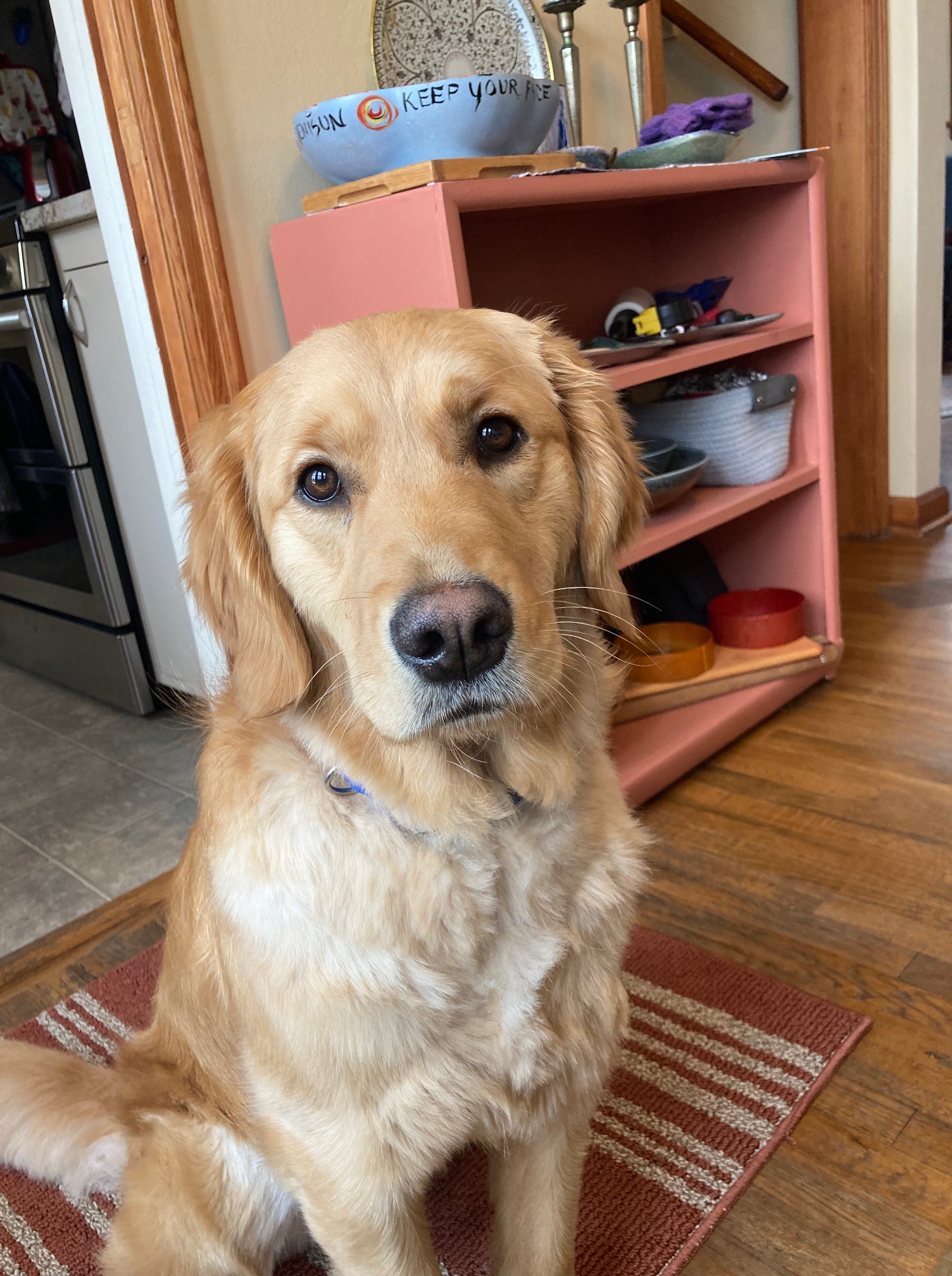
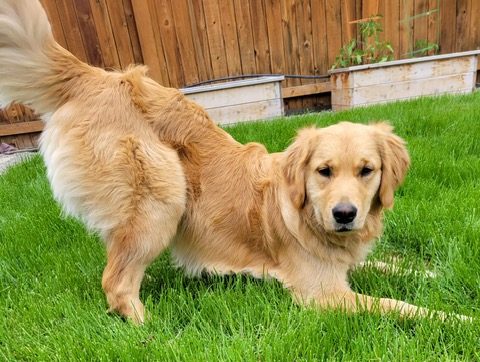
Several months ago, I wrote about Orly’s delight in the freedom her dog door gave her. Though I would revoke her privileges if she abused them by barking at our neighbors, she spent most of the summer free to come and go and come and go and come and go, in and out all day and until late in the evening.
She would frequently check the digging pit to see whether the Sand Fairy had returned (she usually hadn’t) to hide new treats; verify that she had, indeed, eaten all of the ripe raspberries and cherry tomatoes within reach (she had); and roll happily in the too-long grass.
But as summers do, the summer turned more and more autumnal. This happens more quickly in Montana than in many places, with very chilly evenings and mornings starting in August.
Orly’s dog door is in our screen door, and with the colder weather, the dog door was less and less available until it disappeared completely, with the back door remaining firmly closed and her door person permanently, though not terribly reliably, back on the job.
Though she loves fall and is eager for the snow, she is not pleased about losing her free access to the back yard. She’s still unwilling to consider the compromise I have offered — the doggy doorbell. Maybe she thinks that’s just for puppies.
In any case, she has taken to nudging me to ask to go out, which is fine. She’ll even come upstairs to my office to ask for door person service.
Coming back in is where we disagree. Her latest approach is a loud thwack! on the window. I have a pattern of muddy paw prints on my recently washed windows as a result, and I worry that she could hit the window hard enough to break it.
My current challenge: Figuring out how to convince her that sophisticated grown-up dogs can use bells to summon their servants and gain access to the outside. Or inside. Without beating up on the windows.
Hi and happy new year! This was supposed to be the first 2026 post, but it got away from me early. I got it back under control and scheduled it but … at least 3 of you (thanks for being such loyal readers!) mentioned enjoying it. I then remembered the email that goes out when a post publishes so I decided to release this one early. Enjoy!
The egg tax was bad enough.
At some point in her puppyhood, Jana (the original Thinking Dog) had an upset stomach and I made her some scrambled eggs.
In my defense, she was the first golden retriever puppy I raised; I did not realize what a slippery slope I was stepping onto.
She then decided that she liked eggs. Really liked eggs. And that if the human was cooking eggs, there was no reason not to add an extra egg and share with the golden.
Thus the egg tax came into being.
From that moment forward, whenever anyone in my household has cooked eggs, the dog or dogs have assessed the tax and gotten their share. Jana taught Cali about the egg tax. And Oriel. And Wylie. Cali taught Orly. Orly taught Dotty. And so it will continue, passing from generation to generation forever.
Having expanded my horizons a bit — I’ve raised several golden retrievers and have many friends who have also raised golden retrievers and other egg-loving dogs — I realize that the egg tax is a bit like dog “domestication.”
As in: Just as dogs’ wild ancestors realized, independently, in different locations, and at different points in our parallel evolutions, that ancient humans would make great cooks-butlers-doormen-housekeepers and decided to turn us into their devoted companions, the egg tax was not a unique invention.
Other goldens — and even non-golden dogs — have come up with the egg tax. And with additional, similar taxes.
The peanut butter tax was next; why else do humans even buy peanut butter if not to share with the dog?
The banana tax … That one might have predated even Jana. Timo, Jana’s older brother, would run from the yard to the kitchen if I broke a banana off the bunch; that unique sound was enough to trigger a demand for payment.
The carrot tax, where dogs get the bottom half-inch of every carrot, plus the middle part when I am shredding a carrot into a salad and it gets too thin to keep scraping.
On a visit, a friend inadvertently(??) invented a waffle tax, which Orly has eagerly embraced.
One of Orly’s sisters taught the entire litter about the apple tax, via the humans’ convenient family chat.
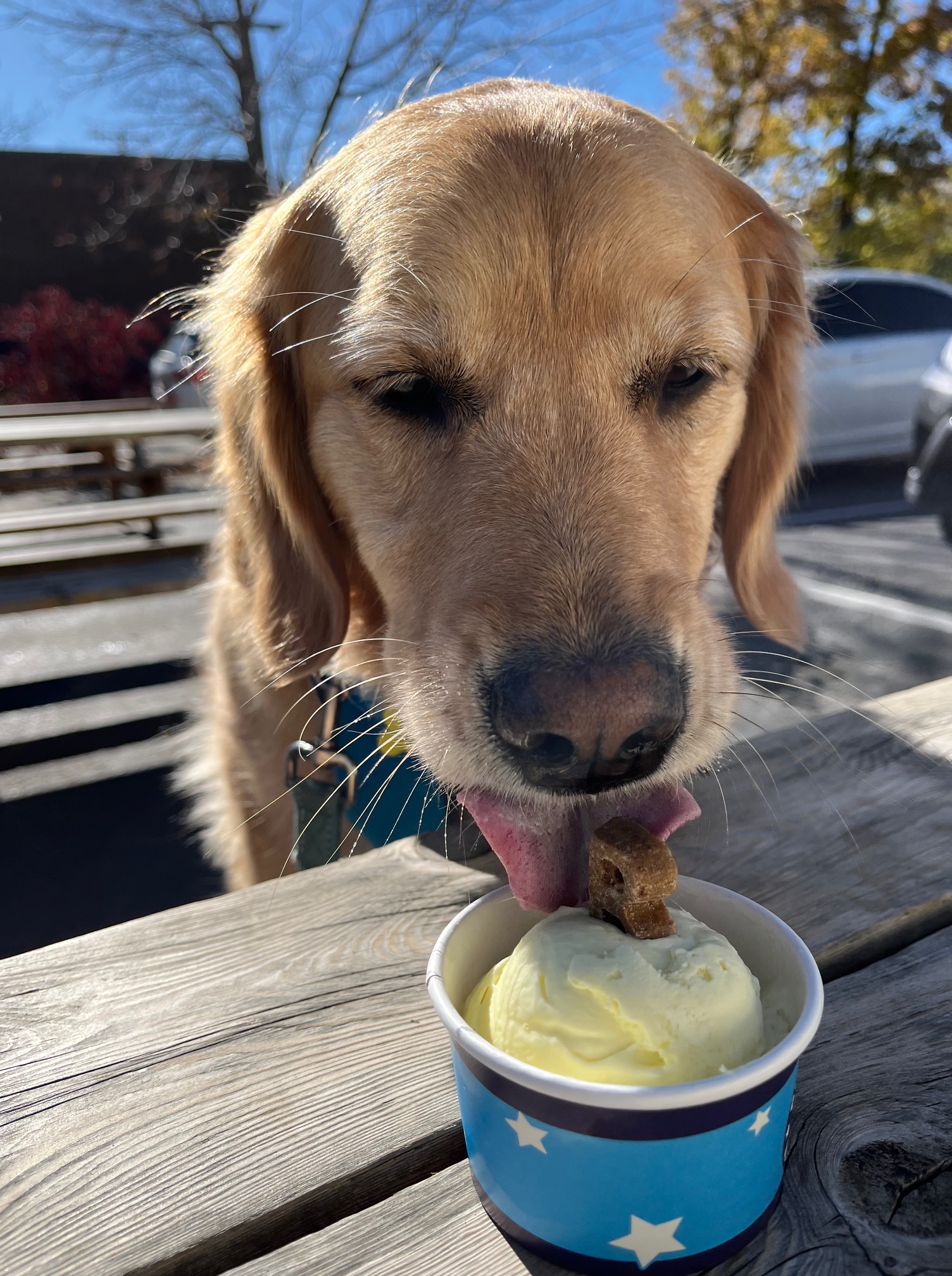
A longstanding family tradition is to give the dog the tip of the ice-cream cone when we’re nearly done with it. Orly and Cali parlayed that into, yep, an ice-cream tax, levied on both cones (the end of the cone) and bowls (licking them clean). This happens after they have already wolfed down their own dog cones, without sharing.
I have heard discussion of a cheese tax among other dog-owned humans, but I don’t think that Orly knows about it (yet).
This has gone far enough!
Orly is currently trying to institute a yogurt tax. And a banana bread tax! I am fighting back. Instead of giving her some every time I scoop out some yogurt for myself, I make her wait. She only gets to lick out the container when I am done with it.
I was excited about these examples of dogs’ creativity, smarts, and problem-solving skill. And I wondered whether all dogs — and their ancestors, wolves — could use tools.
A study published in November shows wolves using tools: They have been captured on camera intentionally and repeatedly tugging a rope to pull up a crab trap, then breaking into the traps to steal and eat the bait. So far, two different wolves have been captured (on camera) raiding the traps.
Since Jane Goodall first wrote about Chimpanzees using tools in 1960, other non-humans have been found to use tools, including elephants, crows, dolphins, octopuses, and even ants!
So far, the animals’ tool use tends to be self-serving, but I am hoping to convince Orly to pitch in around the house at some point. She thinks the vacuum is scary, but maybe she’s willing to try her paw at shoveling snow?
It seemed like a good idea at the time. And, to be fair, it was, for a while (and with a different dog).
The idea was to teach Cali not to react to fence-fighting, barking, or just plain rude dogs when we passed them on walks. We started with dogs in yards, but eventually were able to walk past reactive dogs on leashes. Cali remained calm and collected. And as soon as we were past, she’d pause and look at me expectantly. Because the reason she refrained from responding to the rude dogs was that she got a treat and a lot of praise.
Cali and I had several routes we’d choose from for our morning and afternoon walks, many of which included yards with rude dogs. I noticed that she started eagerly looking for the dogs as we approached. So far so good.
Then we got Orly. Cali and I taught Orly the drill. I made sure to have plenty of treats when we left for walks, though they were willing to wait until we got home to be paid, if I made it worth their while (better treats and more of them).
Orly takes over
We lost Cali to hemangiosarcoma when Orly was just over a year old. In the two-plus years since, Orly has matured into a smart, silly, thoughtful, and very resourceful dog. And, she’s engineered our walks, slowly, over time, to to the point where I am not sure who’s leading whom on these walks and other adventures (although I always drive).
A while ago, I noticed that Orly consistently chose the routes with the largest number of rude dogs. She’d peer ahead to see whether Milo and his brothers were out in the yard before deciding whether to go left or right at one corner, for example.
Gradually, I noticed that she liked taking detours from our usual routes. And that these detours always took us past yards with dogs in them.
She started to prefer turning into the alley after we said hi to George (a friendly, not at all rude, golden who is something of a neighborhood mascot. Or prince.) rather than continuing down the hill into the park. It only slowly dawned on me that there were not one but two rude-dog opportunities on the alley route that were not on the park route.
Then one day, I noticed her pulling toward the fence each time we passed one particular yard. It’s a typical 6-foot privacy fence, solid boards, maybe 4 inches of ground clearance under which we often see the nose and/or feet of a little terrier. A terrier who generally ignores us… unless Orly’s nose or feet are visible. Then, the dog would bark, Orly would not, and …
The terrier was no slouch, and soon learned to ignore Orly, so Orly upped the ante, bumping the fence or whining a bit. I was a little slow to catch on, assuming she was just excited — the terrier lives next door to the house with the treat hydrant. (Yes, more proof, for anyone who still needs it, that dogs are smarter than their humans.)
But no (duh!) Orly was doing her best to cause the other dog to react so that she could get a treat. Someone must have taught Orly about back-chaining, a technique to teach dogs (and humans) to perform a series of actions to earn a reward.
I did finally figure out her game.
Mostly I am impressed with the creativity and thought behind Orly’s conniving.
But when we merely pass a dog on a walk with her human, or a calm, relaxed dog in his yard, and she turns expectantly to demand payment, I find myself annoyed. I feel used. Is she a doggy mafia don demanding her due? Is our entire relationship transactional?
But then we get home and she cuddles up to me with a contented sigh … and no, I don’t want your thoughts on how she’s manipulating me in those moments, too. Just go cuddle your dog.
An Immense World is neither a new book nor a dog book, but I enjoyed it so much that I wanted to share it!
Ed Yong’s second book, subtitled “How animal senses reveal the hidden realms around us,” references philosopher Thomas Nagel’s essay, “What is it like to be a bat?” — then goes on to explore the Umwelt or “perceptual experience” of a being, whether human or not.
Spoiler alert: You won’t learn what it’s like to be a bat from this book. Or a dog, moth, dolphin, mole, or any other creature. You will explore the many-more-than 5 senses that various creatures use to perceive, navigate, and understand their worlds.
You won’t learn what it’s like to be a bat because you can’t!
Bats, and most other creatures have senses that are so astonishingly different from humans’ few, limited means of perceiving our environments that even with a deep scientific understanding of how those senses work, we still can’t imagine or experience the world as their owners do.
There is a lot of science in this book, as well as in the copious footnotes — worth reading; some are really funny! — the 44-page bibliography, and the endnotes. Whew. It did take me more than a month to read the book, though it’s only got 355 pages of actual content. I needed time to digest each sense (each chapter) before moving on to the next. And it’s not exactly light bedtime reading!
My favorite chapter may well be the one on echolocation (humans can acquire this skill!)… or maybe the one on color. Some insects and birds can see whole other dimensions of color that human eyes cannot perceive, literally millions of additional colors.
Yong explores the ways other creatures experience the senses we humans do have, then delves into senses we do not, such as the ability to use echoes and sound to see, or sense magnetic or electric fields and use them to map and navigate our environment.
A thread that runs through the book — and which has always driven my curiosity about dogs — is that our ability to even ask the questions that prompt us to study other animals’ abilities and behavior are limited by our own experience. Which is limited by our senses, perceptions — and willingness to consider that other creatures can do amazing things that we humans cannot.
Dogs’ phenomenal ability to detect and distinguish scents gets some attention, as does a discussion of how dogs perceive color. But no one creature is the star of this book. You’ll encounter familiar and bizarre animals and learn all sorts of interesting, if not terribly useful information: For example, the description of the inky-footprint test used to help determine that European robins know to migrate southwest in the fall using their ability to detect the Earth’s magnetic field is a great story … but a bit complicated for a cocktail-party chat.
If you’re a science nerd who loves animals, don’t miss this book.
Dotty’s spay surgery was expertly performed by my local vet.
The first (and only, so far) time I changed vet clinics because I was tired of being pressured to pay for tests and services that I knew my dog didn’t need was almost 15 years ago. The clinic, where a friend had taken her dogs for several years, was pushing and pushing and pushing. The final outrage was when they suddenly decided that my dog needed a heartworm test every 6 months.
They had been insisting on annual tests before issuing a new prescription for the preventive. I thought this was overkill, since we never missed a dose, and I was confident that my dog did not have heartworm. But every clinic demanded that, so I played along and paid up.
When they refused to give me the prescription for more than 6 months without a repeat test (and vet visit), I took my business elsewhere.
Since then, I have been fortunate to have found locally owned, outstanding vet clinics.
This is getting harder and harder, as more practices are being purchased by private equity companies. This often happens when the owner of a small clinic retires.
As has happened with human health care, private equity purchasers of clinics and hospitals tend to focus aggressively on increasing profit—with the results including higher prices, improved efficiency (which may mean cutting some services), and closing unprofitable clinics and hospitals. In veterinary medicine, it also seems to mean high-pressure tactics to convince pet owners to purchase more services, even if their pets don’t need them.
In addition to higher prices, many pet owners are finding that they have fewer options for routine and emergency care — similar to the scarcity of rural and community hospitals in many parts of the U.S.
Huge growth in pet ownership during the COVID pandemic caught the interest of some private equity firms, a Stateline article said, leading them to purchase small clinics for many times their market value, making it more attractive for a retiring owner to sell to them rather than to a local vet. The new corporate owners might leave the clinic name unchanged, meaning many clients are unaware of the ownership change. This has happened in Missoula, where I live.
Within a few months to a couple of years, though, the changes in business practices are often obvious — and not in a positive way. I know many pet owners who patronized a local clinic for years, remaining loyal through the original owner’s retirement. Ultimately, though, the clinic “went corporate,” and at first a trickle, then a stream of friends were asking for vet referrals.
The privately owned clinic where I take my girls is thriving; they’ve added two vets in the past couple of years and are always busy. Even so, my vet always has time to talk with me and has never tried to talk me into a test or treatment that Cali, Orly, and now Dotty didn’t need.
If your clinic doesn’t deliver that kind of service, check into the ownership … and if needed, search for one that is owned locally, by an actual vet.
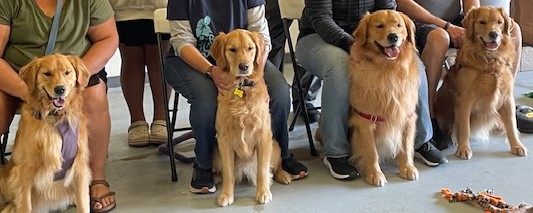
Orly recently got together with several of her siblings, niblings, half-siblings, and miscellaneous other relatives. Sometimes, it’s better not to be too clear on the exact relationships.
There are many family resemblances, starting with Mom Charm’s restrained whimper when gated off from the area she wanted to be in — Orly deploys similar vocalizations when she finds herself on the wrong side of a door, a frequent occurrence. The siblings sure look alike, though Orly was the lightest blond / least red of the group. They are all small for goldens, and several of them share Orly’s little “zipper” — a small patch of rough fur between the eyes that gives Orly a worried look.
Two young puppies — nieces? — were in the mix as well. Hildy was the best pup-playmate, entertaining (& exhausting) the youngsters while the sibs all went from person to person soaking up pats and cuddles.
Our neighborhood doe had twins this summer, and we’ve seen the fawns — with or without Mom — several times. The girls showed little interest. In fact, both Dotty and Orly have been remarkably uninterested in deer in the neighborhood, whether young or adult, alone or in small groups.
(Well, except for that one time when a handsome young buck ran past us out in Crazy Canyon and Orly took off after him … for a moment, before sheepishly returning. Dotty ignored him and enjoyed watching Orly get reprimanded.)
Had been.
Not long ago, we were on our morning walk in our neighborhood. I spotted the family group, this time with a young buck, a block away. I was trying to decide what direction they were headed so we could give them plenty of space. Suddenly, something spooked the twins.
Instantly two fawns were racing down the block — heading right toward us. They are fast!!
The girls froze, suddenly fascinated by deer!
I quickly UNfroze and urged them across the street. By the time the three of us stumbled across the street, the fawns were racing across the spot we’d just been standing, with Mom and Dad? Big brother? in hot pursuit.
To their credit, Orly and Dotty just watched, interested but not predatory, not even pulling on their leashes. Such good girls! They got lots of praise and treats for that!
It has been a while since I wrote about Dotty, so I wanted to give an update.
Dotty is with her trainer, doing some intensive work on a couple of behavioral issues.
When I dropped her off in late February, just before heading out on a trip, I thought I would see her again in a few weeks. It has been more than 2 months.
At first, I worried that I’d flunked puppy raising; that the issues were because I had done something terribly wrong.
As time passes, though, I have realized that I had flagged these issues last summer, and did what I could (& knew how to do) … and she needed more skillful training than I could provide.
I’ve joked that Dotty is at reform school but … that’s not fair to her. She’s not a “bad” dog and is not doing anything “wrong.” She’s a bit overly exuberant for the ideal service dog candidate, and a lot to handle for the average dog handler, but also a sweet, affectionate pup who really wants to be a good girl.
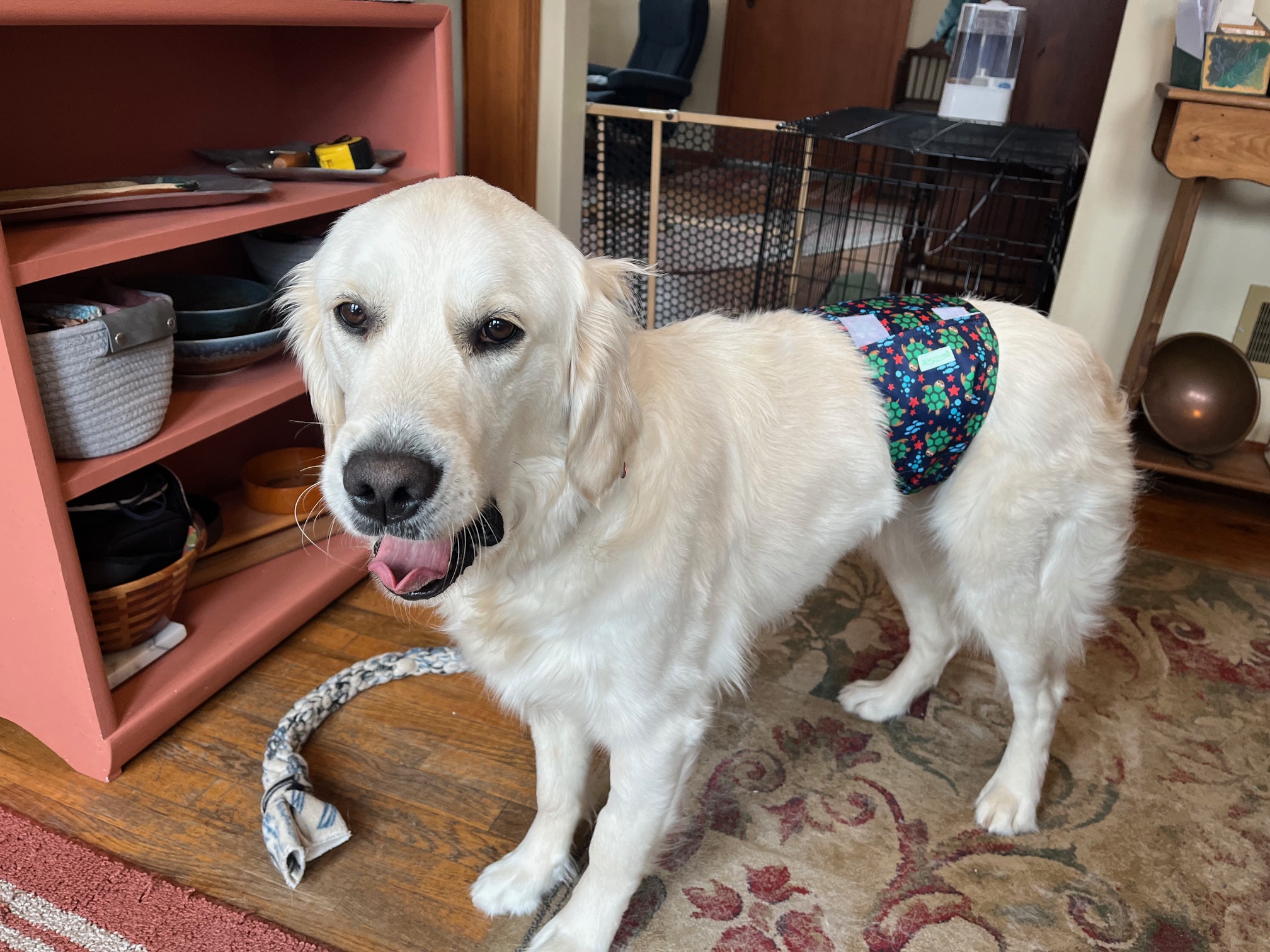
Orly seems ambivalent. I am sure that she misses her playmate, and she seems bored a lot. But … she also seems to enjoy being the pampered “only princess” in the house.
Reactions to seeing people …
One of her issues is termed “reactivity.” This is a very broad term that refers to a dog who, well, reacts to a trigger in a way that the humans dislike. This is a very broad spectrum. Triggers can be cats, other dogs, squirrels, children, noises, things flapping in the wind … and pretty much anything else a dog might encounter. Reactions can be to startle and recover (fine), to growl or bark, to lunge and pull, to leap around excitedly, to show overt aggression, and more.
In Dotty’s case, the trigger is just about any living creature entering her field of vision, approaching her, and presenting the possibility of a social encounter. Her reactions vary: For a squirrel, her response is fascination. She’d sit and watch the squirrels in our yard for as long as 20-30 minutes, utterly fascinated — and utterly still and calm. For cats, deer, and squirrels encountered on the walk, she was interested and might pull a bit, but was responding well to a Leave it! and would walk on by (usually). For people, with or without dogs, and for familiar dogs in a yard — that’s a whole ‘nother story. Especially people.
I have to say: Dotty is the only dog I have known to leap off the ground, almost to my shoulder height, clearing all four paws. Over and over, maybe 5-6 times within a minute or two. It’s quite an athletic feat. It also gets people to laugh, which encourages it …
Cooperative repeat visitors to my house ignored the antics, waiting until Dotty sat to greet and pet her. But on walks, I was not having much luck breaking this habit.
A different sort of reaction
Her other Big Issue has to do with anxiety, lack of confidence or both. When something unexpected happens, she startles, which is normal. But a confident dog will recover quickly and move on, or (even better) quickly go to investigate the weird thing or noise, whether it’s a paper or plastic bag blowing down the street, a noise when something falls, or something else.
Dotty neither recovers nor goes to investigate. In fact, she seems to hold a grudge against the place where the unexpected thing happens, avoiding a room or area of yard or sidewalk where she was startled, sometimes for days. I first noticed this when I started taking her on public “field trips” — a critical element of training a service dog puppy. She wasn’t keen on automatic doors or the freezer doors at the local small grocery store. And after the first encounter, she refused to enter the store.
Again, I worked on this with what I knew and have done in the past, and hadn’t seen many more examples of it happening. I worked through her discomfort with a couple of large statues at the mall, for example — an 8-foot wooden park ranger and a life-size dog mannequin. But she’s still responding that way to new surprises.
This might be tougher to resolve and could disqualify her for service dog role, where she’d need to be confident enough to accompany her person out in public, naturally encountering new and weird things.
What’s next?
When Dotty’s trainer is confident that he has made significant progress on these issues, Dotty will likely come back to spend more time with us. She’s still got quite a bit of growing up to do, though she’s 14 months old already.
Or, the trainer could decide that she’s not able to work as a service dog and place her in a permanent pet home. We’re not there yet. Dotty’s a smart girl and an eager learner, and the trainer is very skilled and patient. I’m hoping it all works out!
Here’s what to do when your new guide dog hunches over and poops in harness while she is guiding you on a moving walkway at the Minneapolis-St. Paul airport:
Be grateful she started at the beginning of the walkway to give you time to react;
Pull out the poop bag you always keep in your front left front pocket;
Find the poop with your bag-mittened hand, glad she got over last week’s diarrhea;
Keep smiling as the bag dangles from your right hand in the final seconds of your ride;
Be glad this dog has learned to find a trashcan when asked and is right on target;
Fight the urge to deposit the dog in the trashcan along with the poop bag;
In a soft voice tinged with horror and embarrassment, ask her “What were you thinking?” hoping the dog remembers that you have stopped in three different Service Animal Relief Areas (SARAs) in the previous 45 minutes where, each time, she insisted that the artificial turf and concrete floor alternatives were just too icky to use.
What she was thinking is that she could wait for me to find her a better bathroom.
I could see Hildy’s point. That day in January was just two months after she left Guiding Eyes for the Blind to become my fifth guide dog. In seven flight days at four different airports, she had already become my best-ever travel guide dog: She slept through every flight, not minding if I got up to use the restroom. Faster than any guide before her, she learned to steer me through the Tampa airport to first check my suitcase at the Delta ticket counter and then lead me without additional direction up the escalator to the E gates where Delta flights depart. She wagged her tail and offered kisses during the TSA pat down. She dutifully turned to go to the SARA for a final chance to potty and then led me to the other end of the terminal where we could find our departure gate.
Clearly, the problem was with the inside-security relief areas. Airport people bathrooms are almost always better maintained than service animal facilities, even in the middle of a holiday rush. Some service animal potties are tolerable; most are not; others are nowhere to be found.
The investigation begins
After the moving walkway incident, Hildy agreed that she had made a colossal miscalculation; I promised to give her more practice.
Together, we decided to do the field experiment as co-researchers: We would visit a doggy potty in every airport. We came up with an objective ranking scale: 1-3 pts for smell; 1-3 pts for clean-up supplies and working sink; 1-3 pts for aesthetics; and an extra point if the accommodation was within eight gates of our arrival or departure.
Hildy and I field tested the SARAs doggedly, anonymously, like restaurant critics but at the tail end. We visited 45 relief areas in 12 airports on 18 flight days. Hildy stoically squatted in each with an improvised SARA stance, balancing with her nether parts in the air. Whether she was posing for my photos or actually peeing, I’ll never know.
The results are in
After five months, we sat down to analyze the data together and agreed that only one doggy potty earned a perfect score.
Despite Hildy’s clear preference for outdoor accommodations, we ultimately agreed that “inside-security” provisions were necessary whenever we had connecting flights.
That required us to eliminate four outlier airports — Rapid City, Raleigh-Durham, Savannah, Rhinelander-Oneida County — that did not have relief areas behind security. This despite the fact that for almost a decade, federal law has required commercial airports with 10,000+ annual flights to have SARAs inside security.
The Lassie artwork and the window earned the Minneapolis-St. Paul SARA extra points for aesthetics
Relief areas at Atlanta, Cincinnati, Minneapolis-St. Paul, NYC-LaGuardia, NYC-Kennedy, and Salt Lake City all ranked in the middle of the pack, with scores of 5-6 points.
Most failed the sniff test, even by human standards, not deserving the minimum 1 point we gave them. As I held my breath and blinked my stinging eyes in the sealed rooms, I wondered how dogs, who detect scent 200x better than humans, could stand it.
Many rooms were out of paper towels or poop bags or the sink didn’t work.
I added the aesthetics criterion once I realized that a red plastic fire hydrant served as the unimaginative focal point for every SARA. Then I learned that federal law requires this type of furnishing, even if airports are allowed to forego ventilation. Apparently, someone at the Federal Aviation Administration convinced his colleagues that requiring a fire hydrant or fake rock in SARAs would encourage male dogs to urinate. Hildy and I, amused by this reasoning, wondered if he needed encouragement as well.
As I couldn’t ethically ding the SARAs for their ubiquitous red fire hydrants, we gave full aesthetic points only when there was art on the wall, a view, seemingly clean tile walls, or some other thoughtful and distinctive feature.
And the winners are …
Second place
SARA with a view — and fresh air with a hint of jet fuel
TPA, Tampa International Airport, came in second.
The caged, outdoor, well-ventilated SARA on the gate level in Airside E is at the far south end of that terminal. The whiff of jet fuel in that enclosure is a breath of fresh air when compared to SARAs that smell like you stepped into the basement of a porta-potty.
However, this SARA lost a point because Hildy and I nearly always fly from the far north end of that terminal, more than 10 gates away from the doggy potty. It nearly lost an additional point for uneven availability of paper towels and poop bags. Since TPA is our home airport, we certainly did some over-sampling here, so, upon reconsideration, we gave TPA a 9.
Drum roll …
The privacy lock indicates that Missoula’s SARA is vacant and available for Hildy’s use
The best in-security service animal relief area in the US, based on our field study, is at MSO, the airport in Missoula, Montana.
This private, one-dog bathroom has self-draining turf and a large window. There was no offensive odor that I could detect or that appeared to offend Hildy. Ample cleaning supplies were on hand for every visit. It is an easy stroll to all four of the airport’s gates.
MSO wins paws down aesthetically for calling their accommodation the Service Animal Restroom instead of animal relief area, and for tucking it between the men’s and women’s restrooms. The vacant/occupied lock system, consistent with those on the human bathroom stalls, is a nice additional touch.
MSO earned the only perfect score: 10/10.
Hildy and I will continue our study of airport service animal accommodations across America and hope to find more that deserve recognition. But for now, thank you to Missoula Airport Board members who appreciate that, indeed, dogs are people too.