What Is ‘Puppy Breath’?

Golden retriever Orly sits while her teeth are brushed with a pink toothbrush.I took Dotty to see a friend recently. The friend hadn’t seen Dotty in quite a while and after commenting on her pony-like stature, she exclaimed, “I can smell her puppy breath!”

Dotty is 16+months old. How is it that she has “puppy breath,” a sweetish scent usually associated with puppies up to about 6-8 months of age? Is puppy breath simply the absence of typically stinky “dog breath”?

It really might be that simple: Dogs’ puppy teeth aren’t around for long enough to get dirty and cause bad breath. Their adult teeth are usually in by the time they are 5-6 months old. Without brushing, those permanent teeth immediately begin to develop a coating of plaque and tartar, and… dog breath occurs.

If this is the cause, then, the secret to extending “puppy breath” throughout your dog’s lifetime is (you know what I am going to say …) brushing your dog’s teeth.

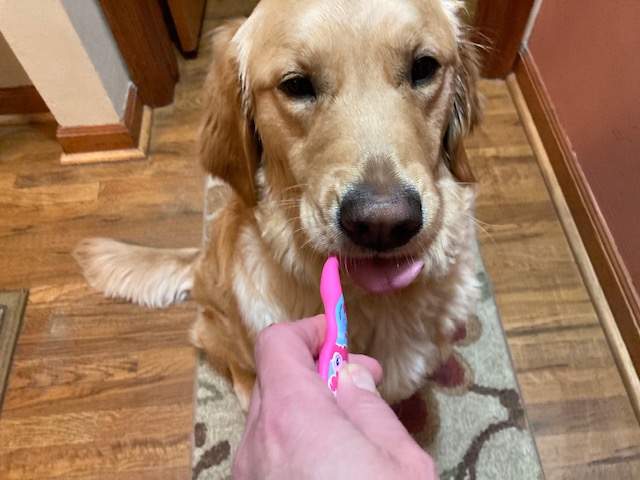
10-week-old dotty, a white golden retriever pup with dark eyes and a very black nose, smiles as she gets her teeth brushed with a pink toothbrush.Dotty and Orly (and Cali and Jana before them) have excellent oral hygiene. That is, they brush their teeth daily. Well, most days. When I leave them with a sitter, I think the daily brushing goes on hiatus.

Cali never had a professional teeth cleaning in her life, and she had beautiful white teeth and good breath. Orly and Dotty are still young, and so far, both have gorgeous teeth.

Their doggy toothpaste claims to taste like chicken (really!). I haven’t verified that claim personally, but the girls like it. I’ve tried other brands over the years, but return to Petrodex because it’s easy to find in a large-ish tube that lasts several months. I also use small, soft kids’ toothbrushes because a lot of the ones sold as dog toothbrushes are stiff and awkwardly large.

Looking through the comments on a recent Whole Dog Journal blog post about brushing dogs’ teeth, I discovered another ally in the battle against dog breath: Kelp powder. The commenter recommended a specific (pricey) brand, but I started looking at other powdered supplements for dogs’ oral health, fell deep into a rabbit hole, and emerged with the conclusion that powdered seaweed sprinkled on the dogs’ food could help keep their teeth clean and breath fresh, as well as providing other potential benefits.

I’m giving them each a small sprinkle once a day of “Raw Paws organic kelp” — about half the amount that the package recommends. They seem to like it (not that golden retrievers are fussy eaters).

This completely unscientific experiment has brought what I consider to be excellent results: After a few months at a training kennel without her toothbrush (or her devoted tooth-brusher), Dotty returned home with some icky brown tartar on her back teeth. Brushing and kelping has completely eliminated that buildup and put her squarely on the path of permanent* puppy breath  (*for as long as she lives with me…).


Should You Crate-Train Your Puppy?

Orly examines a sloth toy in her exercise penI’m generally not a fan of crating dogs, so I read this Washington Post article, “Should you crate your dog? It’s complicated,” with interest. It is complicated.

I have used crated while house-training young puppies and to keep them safe and out of trouble when I couldn’t supervise them. I have had young puppies sleep in a crate until they are sleeping through the night, then I keep all of us in the bedroom with a dog gate. That way, if pup needs to go out, she’s likely to wake me rather than find a remote corner of the living room where she can do her business and go back to bed. I stop gating the bedroom when I am reasonably confident in the dog’s house manners.

I have also used crates when fostering or dog-sitting anxious dogs who tended to be destructive when unsupervised. In both of those cases, the dogs seemed happy to go into and stay in the crates, and seemed less anxious in the crates than when left alone in a room (even if I was home and they could come find me). That assessment is based on their vocalizations and body language.

I think that both of those uses of crates are fine, if:

  • The dog has been acclimated to the crate using positive means
  • The crate is large enough and comfortable
  • The dog is happy to go into the crate
  • The dog is provided with safe chew toys, treats, and/or comfort items
  • The dog is only in the crate for short periods of time (never more than a couple of hours)
  • The crate is never used as place for time-outs or punishment

I have never used a crate routinely when I leave an adult dog home, even when I worked full-time in an office (!!) and the dog(s) were home for many hours. Especially then!

I work hard on house manners with puppies I raise and I have gotten all of my puppies to the point of being trustworthy by the age of 6-8 months. That is, if your definition of trustworthy allows for some unauthorized use of sofas and comfy reading chairs while you’re not there …

This is not possible with all dogs, of course. Some pups and adolescents are more destructive. In those cases, I would suggest working with a trainer and figuring out how to get the dog more exercise and enrichment. A dog hiker or dog walker is a lifesaver when you have an active young dog and work long hours.

Why all dogs need SOME crate training

I also believe that all dogs should at least be exposed to and get used to being in a crate. If you need to transport the dog somewhere, board the dog on short notice, keep the dog on “bed rest” following an injury or surgery, have someone take the dog because you had surgery or an accident — you do not want the emergency situation to be the first exposure to crating.

Some dogs hate crates

Some dogs flip out the first time they see or enter a crate, even if the door is open and they are totally free to leave. Some dogs go right in and curl up as if they’ve been sleeping in a crate their whole lives. The younger the first exposure, the easier it is to move past a bad first reaction.

Alternatives to crates

For dogs who are adamantly anti-crate or are still working on accepting the crate, there are other options. I’ve set up a puppy-safe room when possible — hard floor that is easy to clean, minimal or no furniture, dog bed, and sturdy, safe toys.

10-week-old golden pup Orly stands up in her ex pen to protest. she's holding a red toy.I’ve also set up an “ex pen” or exercise pen. These are sturdy wire mesh panels that are configurable into a square or rectangle. This can be in a living room or rec room where the dog can hang out and see and hear what’s going on — while being safely contained. At least until she learns to climb out.

I tape plastic sheeting on the floor, tape the panel bottoms to the sheeting, and add some rugs or blankets, safe toys, a water bowl if the dog will be in there for a while. It’s like a deluxe, roofless crate. Orly wasn’t impressed and regularly threw tantrums when penned, but she was safely contained while I was cooking, say, or in a meeting and unable to focus on her. And she quickly and eagerly demonstrated impeccable house manners to earn her freedom.

There’s no one answer that works for everyone. As we established, it’s complicated.

Hangin’ at the Mall

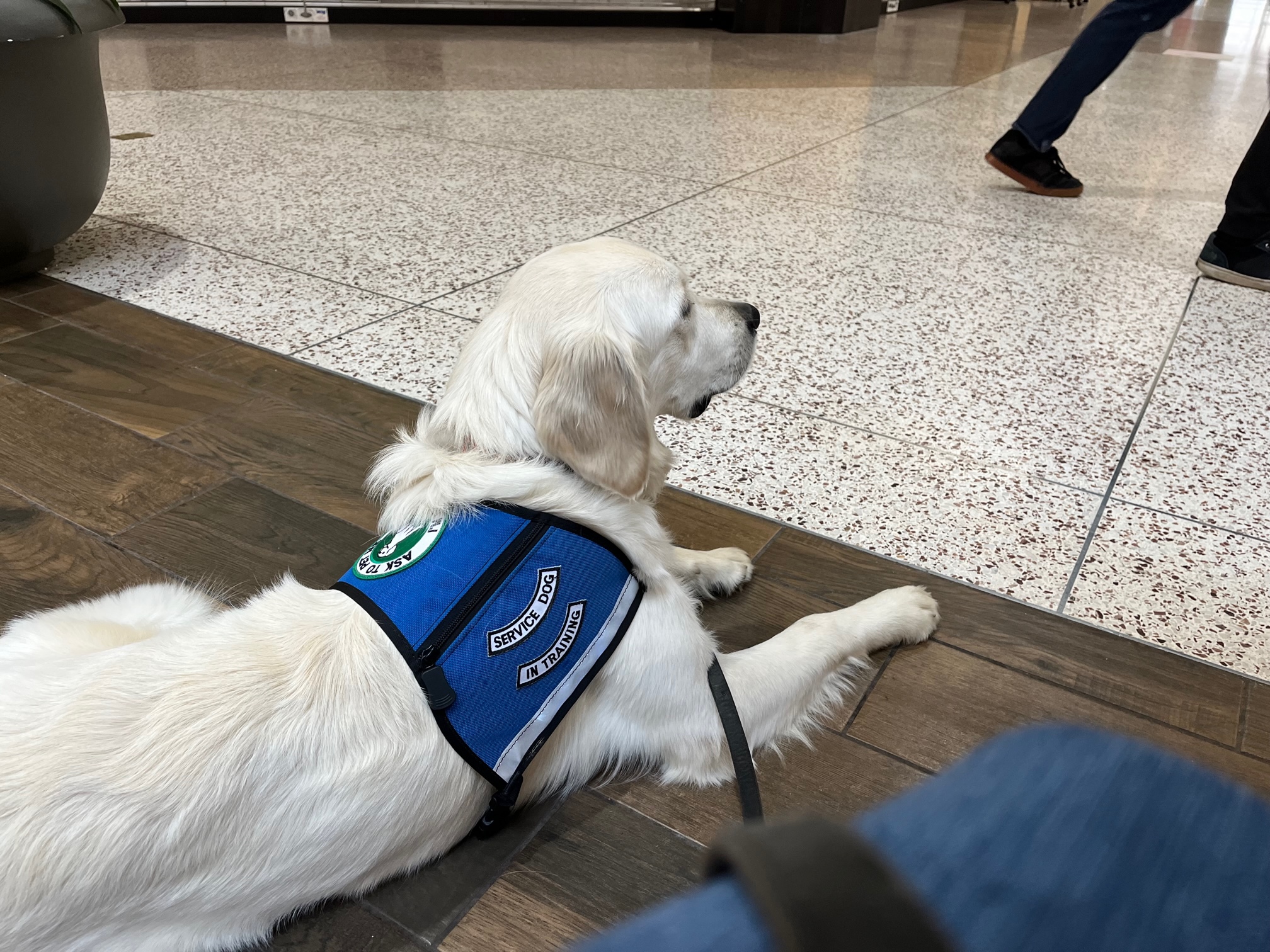
Dotty, a 7-month-old white golden retriever, wears a blue service dog-in-training vestThe brief glimpse of snow is long gone, but the weather has been cold, gray, and often wet. Dotty is hoping to spend more time at the mall.

We’ve visited lots of places that regular dogs are not allowed to go. Besides the mall, Dotty has been to numerous local cafes and bakeries, the airport, some shops and banks, and a grocery store.

It turns out that wheeled carts make her very nervous. She’s not crazy about automatic doors, either, or those weird freezers in the supermarket. But the carts really get to her.

The solution turns out to be hanging out at the mall. Every teenager’s dream. (Well, it was when I was a teenager …)

The point is literally to hang out and watch the world go by. People. Wheelchairs. Children running and jumping and screaming. Those all-terrain, 2-kid strollers that are bigger than some cars. Normal strollers too. Kids riding 3-foot-tall motorized stuffed animals.

And the smells — from the two pretzel shops to the Cinnabon to the stinky bath products stores… the smells are overwhelming to me, and I know that Dotty’s nose is thousands of times more sensitive.

Dotty, a 7-month-old white golden retriever, watches passersby, wearing a blue service dog0in-training vestDotty just watches. Sometimes, something surprises her and she gets up to take a closer look. But we hang out out of the stream of shoppers and mall walkers, just watching.

We also wandered a bit, past the video game arcade and the photo booth and the electronic “rides” for small children. Past the larger-than-life wooden forest ranger (she was not too keen on him) and the massage chairs. She checked out the shoeshine station pretty thoroughly.

This kind of watching and wandering can, of course, be done outdoors as well. But, as the weather turns wintry, sitting in parks has lost its appeal. (We did a fair bit of that over the summer, but clearly not enough.)

The idea is to get her used to everything, and anything. So that she won’t be surprised by people, carts, or whatever else pops up when she’s out and about. It’s a kind of “desensitization” training that, I hope, will build up her confidence in preparation for when she, as service dogs do, goes into new places and experiences unexpected things.

Do You Brush Your Dog’s Teeth?

Golden retriever Orly sits as her teeth are brushed with a pink toothbrush

Brushing dog teeth is part of our nightly routine … but I know that that’s not the case for most dogs and their people. (But if your dog gives you dog kisses … you might want to start!)

I’ve known several dogs who lost many teeth as they aged, due to gingivitis or decay. And many more dog families that spent several hundred dollars annually on professional dental cleanings for their dogs.

I’ve brushed my goldens’ teeth, starting when each was a young puppy. When she was little, Cali would walk over to the shelf where her toothbrush was kept and ask to have her teeth brushed. She later decided that she didn’t enjoy it, but she was always cooperative. Orly is still in the asking-for-it stage.

I sweeten the deal with a crunchy treat, and I suspect that that has a lot to do with their cooperation. Whatever works! Jana, Cali, and now Orly all had / have beautiful white teeth!

I use kids’ toothbrushes — soft ones — from the dollar store and dog toothpaste. There are several brands, but I mostly use Petrodex because everyone likes the taste and it’s easy to find.

Orly sits patiently while I brush — top, bottom, inside, outside — then she likes to lick the brush clean. Finally, she gets a cookie and heads off to bed.

Your vet might say that it’s fine to brush a couple times a week, but I found that if I didn’t make it part of a daily routine, I wouldn’t remember to do it at all. So we do it every night.

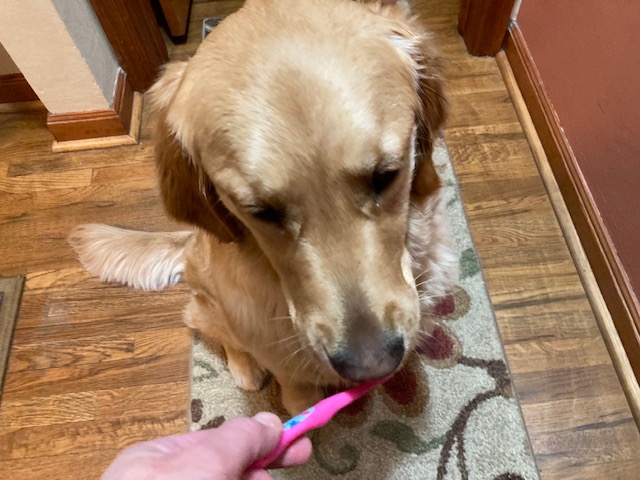
Golden Orly licks the toothbrush clean after brushing her teethThere are other ways to keep dogs’ teeth clean. Dogs who chew a lot of fresh bones or antlers tend to have little plaque buildup. There are also products you can add to the dog’s water to kill bacteria and reduce buildup, but I have never used them so I don’t know how palatable or effective they are.

Brushing only takes a minute and, once you’re in the habit, it’s not a big deal for most dogs. Imagine life with no more “dog breath”! And … think of all the money you’ll save — not to mention the worry of sedation — by avoiding veterinary cleanings!


Is the Early Cancer Detection Blood Test Worthwhile?

OncoK9 recommends screening for giant and high-risk breeds at younger ages.
OncoK9’s recommended ages to start cancer screening

If you’ve been in a vet office lately, you might have seen a brochure advertising the OncoK9 blood test, an early-detection cancer screening test.

I first heard of it when I took Cali to a specialist who ended up diagnosing her hemangiosarcoma. By then, we had done the ultrasounds and were on our way to the splenectomy, so I didn’t “need” the test; I knew she had cancer.

The blood test “uses a simple blood draw to detect abnormal DNA released into circulation by cancer cells,” and claims to be able to pick up on these markers before the dog would be likely to have any symptoms. Dogs with some cancers, like hemangiosarcoma, rarely show any symptoms. OncoK9 is said to be able to detect 30 different types of cancer, including several very common canine cancers.

The company recommends it annually for dogs aged 7 and older, with different guidelines for cancer-prone breeds. They suggest starting screening at age 6 for goldens, for example, and age 4 for boxers (see illustration above).

Should you do it?

I can’t answer that, but I can share the pros and cons I see.

An argument for doing the test is that early detection gives you the best chance to treat some cancers.

Now for the “cons.” The test detects cancer markers, or claims to, but it does not give any indication of the type or location of the cancer.

A friend who works for a vet in another state reports that her clinic looked into the test, and her vet worries about the high potential for false negatives — not catching the presence of cancer markers — as well as the smaller, but still present, chance of false positives. Paired with the lack of indication of what type of cancer the dog has, a false positive could send a family on a very costly, stressful wild goose chase to try to identify the nonexistent cancer.

This vet says the test “might be helpful” for a dog with unexplained weight loss and no other evidence of disease; that’s far from a blanket recommendation for an annual check!

Finally, the cost: The test costs $500 at my specialty clinic. Cost will vary by location, but it’s not an inexpensive test. A few hundred dollars (or more) is a hefty addition to your dog’s annual checkup, and it’s unlikely that pet insurance would cover it.

My specialist vet’s office told me that, following a positive test, the next steps would be tests to figure out the type and stage of the cancer. And that anyone with a positive test gets a $1,000 credit toward that testing. I assume that this is because the company that does the OncoK9 test uses the follow-up and test data to refine the test and/or to work on treatments. Either way, the hefty sum tells me that a) the follow-up testing is pricey and b) they don’t expect a huge proportion of positives.

What do you DO with a positive result?

That raises the next obvious question, which is: If I were to get a positive test result, what would I do?

  • If you are not prepared to go down the expensive route of testing to identify and stage the cancer, then treat it … I’m not sure what you gain by doing the test.
  • If you are, and you have a dog of a breed that is likely to get cancer, then early detection and treatment could give you more time with your dog and/or lead you to an early treatment that spares your dog some suffering, depending of course on what additional testing you did, how quickly you identified the dog’s cancer, and whether it was a treatable cancer — all significant questions.

Whether to do the test (and what to do afterward) is, of course is a very individual decision.

Orly is only 1. I am certainly hoping that we have more reliable, less costly ways to detect (early) and effectively treat canine cancer before she’s of an age where I’d face the question of whether to do this type of test. Cali spent her life helping to make that happen; and the many researchers working on canine cancer detection and treatment offer hope for future pups.

Can a Dog Really Be ‘Hypoallergenic’?

Maisy, a black standard poodle, sits
Why get a cross when you can have an actual Poodle?

Dr. Stanley Coren, a noted psychologist and dog expert, recently wrote a column about the doodle craze. His take on the popularity of these “designer mutts” that are all some other breed crossed with a poodle, is that people believe all poodle-cross pups to be “hypoallergenic,” or “having little likelihood of causing an allergic response.” His focus is that not all poodle mixes are low- or non-shedding dogs, and therefore there’s really no guarantee that they will be hypoallergenic.

I want to take that argument a step farther and argue that, for many individuals with dog allergies, no dog will be hypoallergenic.

People may be allergic to dog fur or dander; they may also be allergic to components of dog saliva or dog urine. Even a bald dog still has those so … for some people, shedding or not, furry or hairy, any dog will induce an allergic reaction.

Of course there is a huge range in the symptoms and severity of allergic reactions, and a dog with much-reduced shedding, and who is groomed and bathed often and lives in a home that is vacuumed and dusted very frequently, may cause few or no symptoms in many allergic individuals. So there are good reasons for people with mild dander / fur allergies who love dogs to look to non- or low-shedding breeds.

But poodle crosses are not the only or most reliable option. To Dr. Coren’s point, without testing your individual pup against your individual allergy, you won’t know. And several breeds do not shed or shed minimally, starting with actual poodles and including large and small dogs of all temperaments.

When choosing a dog, it’s important to do your homework, whether you’re buying a puppy or adopting a shelter dog, and whether your concern is allergies, temperament, health, or all of these.

Orly’s Pedicures

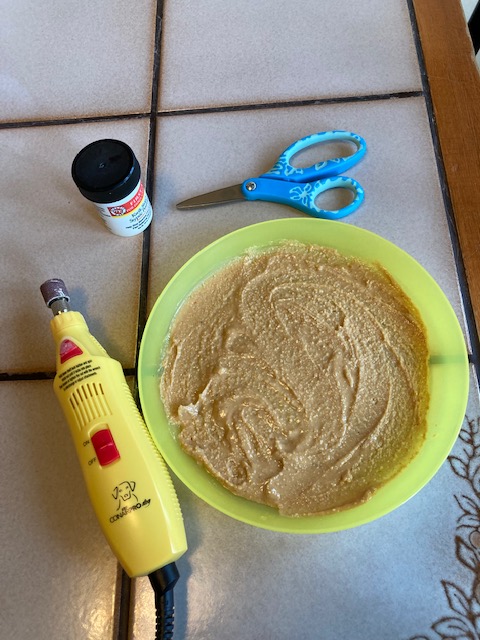
a yellow nail grinder, a plastic plate smeared with peanut butter, blunt scissors and styptic powder are gathered for the pedicure
Prepare your tools before you start the dog pedicure

What’s the best way to trim a dog’s nails? That’s a common question, since most dogs have experienced painful or unpleasant nail trims and loathe the entire process. I have had to find an answer; the secret is peanut butter.

Orly’s nails grow so fast! Cali’s need attention occasionally, but if I let Orly’s go for a couple of weeks, they get unbelievably long. So, it has been important to get her cooperation for frequent pedicures.

I’ve never liked using dog nail clippers. First of all, they all seem to be designed for right-handed people, and I don’t feel like I can get a good grip on the nail and clip it. Second, all of my dogs have either had entirely or mostly black nails.

With black nails, it is really hard to tell where the “quick” is. This is the tip of the blood vessels that feed the nail. In dogs with white nails, you can see the quick (it’s pink). If you cut it, the dog bleeds. A lot. And squeals in pain. It’s horrible.

That leaves a dremel-type tool to file down the nails. It’s pretty easy to do … if the dog cooperates.

With Jana, Cali, and, most recently, Orly, I started dremel training early. Turn it on, let them hear it while getting great treats. Let them sniff it thoroughly when it’s off. If possible, let them watch other dogs get pedicures (and treats, always lots of treats). Things like that.

Jana spoiled me. She loved pedicures. She loved anything that made her feel like a pampered princess. She’d sit still, hold up her paw, and accept my attention (and treats!), looking bored by the whole thing.

Cali is good, but she doesn’t like the nail trims. She cooperates, but pulls her paw away if I spend too much time on it. I rarely do hers, so it hasn’t been an issue.

Orly … needs her nails done nearly every week.

Fortunately, she’s very cooperative. Even better, she loves peanut butter. I mean really loves peanut butter. So I have come up with the perfect pedicure process:

  1. Get dremel, styptic powder (in case of bleeding), and scissors from the grooming kit.Golden puppy Orly licks peanut butter off of a plate
  2. Smear a small plate liberally with peanut butter.
  3. Find a comfortable corner where the plate can be pushed up against a wall and not escape.
  4. Put the plate down and let Orly start licking the peanut butter.
  5. Push Cali’s nose out of the peanut-butter dish.
  6. Turn on the dremel and pick up first paw. File each nail.
  7. Put down the paw.
  8. Turn off the dremel, and push Cali’s head out of the peanut-butter dish.
  9. Move the plate back into place.
  10. Turn demel back on and pick up the next paw.
  11. Repeat steps 7, 8, 9, and 10.
  12. If 4th paw is finished before the peanut butter is gone, use scissors to trim the fur between Orly’s paws.
  13. Give Cali some peanut butter as a reward for being (relatively) patient while Orly had her pedicure.

She doesn’t seem to mind this at all. I’ve never had any accidents (no blood and no pain), and she seems happy to participate in this activity every time I get the dremel (and the peanut-butter plate) out. It actually only takes about 10-15 minutes.

The trick is figuring out how much peanut butter is needed to keep Orly busy long enough to do all four paws. As she gets bigger, her peanut-butter-licking skills are improving rapidly, so the layer of peanut butter gets thicker and thicker. I might need a bigger plate soon. She’s pretty active, so I don’t worry (yet) about the large amount of peanut butter she’s eating. If we get up to half a jar at a time … well, let’s hope that doesn’t happen!

Golden retrievers Orly and Cali lick the last bits of peanut butter off of a yellow plastic plate
Cali is happy to help with post-pedicure cleanup


How Do I Find a Good Dog Trainer?

A prong collar
When choosing a trainer, ask what equipment they recommend.

New dog, adolescent dog, older dog who has suddenly started doing something you cannot live with … when people need a trainer, where should they turn?

First, a caveat: If an adult dog’s behavior changes suddenly — uncharacteristic aggression, for example, see your vet to rule out any underlying health issues before deciding it’s a training issue.

I can make specific recommendations locally, where I know several excellent trainers. But more generally, here’s what I would suggest:

  • Look at the trainer’s credentials. Anyone can advertise as a dog trainer. In a recent review of trainers in one area, nearly all of the websites I looked at gushed about the “trainer’s” love for animals and how they had dogs their whole lives. So what? That doesn’t make you a qualified trainer. The Certification Council for Professional Dog Trainers has widely recognized certifications that check knowledge or (much better but far less common) check knowledge and skills. A number of small or locally focused programs teach people training skills and knowledge; the APDT website has a helpful matrix comparing these.
  • Look at professional memberships. Organizations like APDT (Association of Professional Dog trainers) and PPG (Pet Professionals Guild) require that people meet specific criteria to become professional members. While membership alone does not guarantee that the trainer has specific knowledge or skills, it does show that they care enough to learn and to jump through a few hoops more stringent than setting up a website or getting a business license.
  • Trainers who also have some education on animal behavior and psychology get bonus points, especially for complex issues like aggression or anxiety.

When you’ve identified one or more possible trainers, interview them. Ask what their training approach is and what, if any, equipment they recommend. Avoid anyone who talks about “being the alpha” or showing the dog who’s boss. If a trainer tells you to put a prong collar on your puppy, run the other way. If you’re having a specific issue, such as high prey drive or excessive anxiety, ask about their experience with that problem. If they offer classes, ask if you can watch one.

Other resources to consider:

  • Local dog training clubs — these can be wonderful or very disappointing. You might find a great selection of classes from trainers with broad-ranging experience. If there’s one where you live, it’s worth a visit.
  • Recommendations from your local humane society or pet rescue — there might even be classes onsite, and shelter trainers are likely to have experience with dogs with a wide range of issues.
  • Recommendations from friends with well-trained dogs — be careful here; your dog’s needs may be very different and your friend’s trainer might not be a good fit. But it’s certainly a place to start.

Notice that I am not suggesting that your vet is a great resource. She might be. She might not. As with nutrition, behavior and training are not areas where vets tend to get a lot of education — unless they specifically seek it out. Some do; many do not. If your vet is also a certified animal behavior expert then by all means, consult with her. Otherwise, she might not know any more about the local trainers or what would help your dog (behaviorally) than you do.

When you choose a trainer, pay close attention to your dog’s reaction as well as your gut feelings about how the first lesson(s) unfold. If your dog seems scared, don’t go back. I remember a friend telling me once that her dog ran and hid whenever the trainer came over. Clear sign that that was not the right trainer! And, obviously, if you don’t feel like you are making progress after several meetings, you might need to look for someone else. There are lots of great trainers out there, but it might take a few tries to get the right match for you, your dog, and the specific issues you need to resolve.

Is It My Fault if My Dog Is Overweight?

Golden retriever Cali eats an ice-cream cone.Yes.

That may be a little harsh. A recent Whole Dog Journal article on dog obesity is a little kinder to the dog owners, apportioning blame between the dog and the human. But … the humans control access to the dog’s food, so I lean toward blaming the humans. And, since multiple studies have reported that half or more of the pet dogs in the US are overweight, we need to address this problem.

Obesity can reduce your dog’s already-too-short lifespan by as much as three years.

The WDJ article describes a study of pet owners who are involved with feeding their pets. Nearly 80% of the respondents were women aged 50 or older. Hmm. Many said they determined the amount to feed their dogs “based on perceptions of their dogs’ body weight” and most of the rest by following the feeding guidelines on the dog food packaging or their vet’s recommendations.

Those are not reliable methods. Most dog foods recommend giving more food than a dog needs. It’s a vicious cycle, too. If your dog weighs 60 lbs. and you feed the amount recommended for a 60-lb. dog, you think you’re doing the right thing. But… maybe your dog should weigh 50 or 55 lbs. See the problem? And, many people’s perceptions of what their dogs should weigh are skewed.

For instance, Cali, who is a svelte and very fit 56 lbs, looks thin to many people who are accustomed to seeing fat golden retrievers. Because most golden retrievers in the US are fat. Very fat.

I’ve checked in with my vet on Cali’s diet and weight. She once gave me calorie-based guidelines for feeding Cali and, when I looked at the amount of food I’d need to give Cali to meet them, I was horrified. I would have had to almost double what I was feeding Cali. But at the same time she was recommending this enormous amount of food, the vet also agreed that Cali’s weight was fine.

Piling on …

Dogs aren’t much help in this. It’s hard enough to figure out what and how much regular old dog food to give your dog. But the dog then starts asking for other food … your food. And treats.

Dogs are excellent at manipulating humans, as you may have noticed. They are especially adept at convincing us to feed them. They use gaze, nudges, sometimes even whining or barking … The study took note of this: “The data suggest that dogs may have significant influence in overriding their owners’ self-discipline,” it says, with great understatement.

What’s a dog parent to do?

That is the key question.

Start with knowing what your dog’s healthy weight looks and feels like. This chart can help:

Chart shows range of dogs and cats from too thin to obese

When you pet your dog, you should be able to feel her ribs, but there should be a little fat on them. And her hip bones should not stick out. But if your dog feels like an upholstered sofa … well.

Then, watch her diet. And her treat intake. What you’re feeding matters as much as the quantity. I’m pretty fussy about dog treats (not to mention dog food). I don’t buy anything at the supermarket for Cali other than eggs, Greek yogurt, sardines, and occasional bags of wonderful local / homemade dog cookies … large cookies that I break into 4 or 5 small pieces.

A treat for Cali is about the size of a quarter. She rarely gets an entire large biscuit. And no, she does not feel deprived (yeah, right …). She loves getting a jackpot of 5 or 6 little, high quality treats, which happens when she does something really great (like put all of her toys back into their basket). She gets a handful of very small treats in her snuffle mat almost every day. She gets several more when I brush her or tackle her nails or ears. And of course on special occasions, she gets a doggy cone or even (birthdays only) a small dish of ice cream!

Does she want more treats? Of course she does! So do I!

Cali makes frequent, persuasive pitches for her “fair share” of whatever I happen to be eating, for example. She’s convinced me that I should share my eggs and yogurt, and she’s a helpful and efficient dish-washer. We frequently negotiate over small bites of pizza crust. But overall, her treat intake is moderate.

Take a hike

The other piece of the equation is, of course, exercise.

Cali and I walk two or three times a day. We play ball. She swims. We go for a long hike at least once a week. When she was an adolescent, she ran and played a lot more — and got more food and treats. A very active dog could have more food or treats, while a dog whose exercise consists of walking to the back yard a few times a day, taking care of business, and walking back to the house … may need to be a little more careful.

I’m sure none of this is a huge surprise. The hardest piece of watching your dog’s weight is being honest about what she weighs vs. what she should. That and facing down that stare every time you’re eating something yummy.

image of golden retriever with the message "every snack you make, every bite you take, I'll be watching you"


How Clean Are Dogs’ Paws?

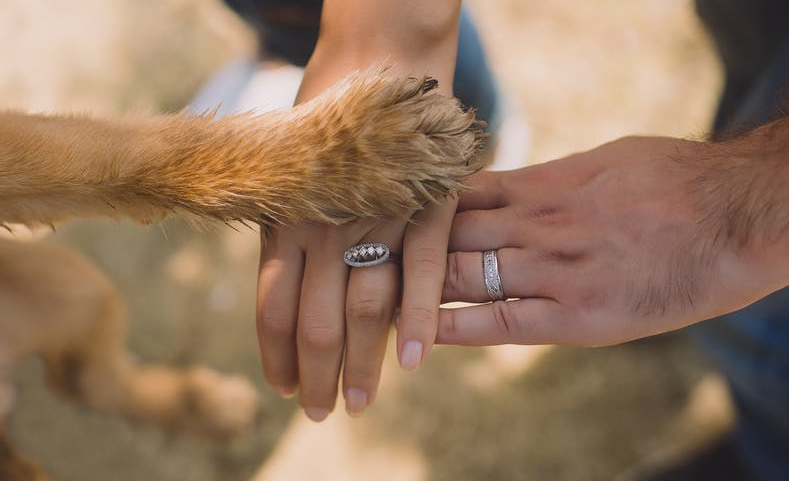
a dog paw and two human hands connect
My paws are clean. Are yours?

A common objection heard from people who dislike (or fear) dogs and don’t want to allow dogs to enter their space is that dogs are dirty.

In response to too-frequent denials of access to assistance dog teams, some researchers in The Netherlands decided to check into this contention. “The main argument for denial of access is that dogs compromise hygiene with their presence, which could cause a health hazard. Meanwhile, people are allowed to walk into and out of public places freely,” they wrote.

They recruited volunteers — 25 assistance dog teams and 25 pet dog / human pairs. The volunteer dogs and humans took 15-30 minute walks together, then allowed the researchers to collect samples from their paws and the soles of their shoes (respectively). The researchers tested the samples for Enterobacteriaceae (a common cause of hospital infections), Clostridium difficile, and other bacteria.

And guess what?

The dogs’ feet showed significantly less bacterial contamination than the people’s shoes. “The general hygiene of dog paws is better than that of shoe soles,” the report concludes. They speculate that dogs’ habit of grooming themselves, including their feet, could be the reason — even people who remove their shoes before going into their own homes rarely clean the soles of their shoes. Dog saliva contains high levels of “antimicrobial substances,” the study says.

In addition, some people routinely clean their dogs’ paws upon returning home. I do that if we’ve been walking where people have used snow-melt chemicals or lawn “greening” chemicals or if Cali is excessively wet and muddy.

To be fair, dirty paws are not the only reason that people think that dogs will bring dirt into their houses or businesses. I haven’t found a study that compares the amount of biological ick (yup, that’s the scientific term) humans shed vs. dogs but … I suspect that goldens and labs would not come out on top. Then there are the drooly breeds … Let’s quit while we’re ahead.