Oriel Finds Her Voice

This slideshow requires JavaScript.

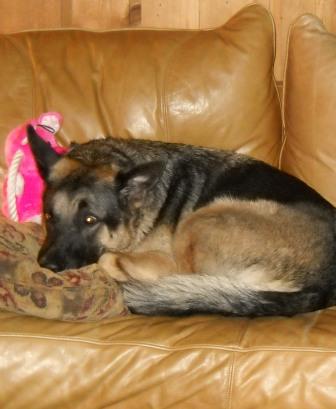
I’d known Oriel for a few years before she came to live with us. She’s a sweet, affectionate dog and I always noticed that — in marked contrast to Jana — she is quiet. In fact, she reportedly barked fewer than a dozen times in her entire working life, and when she did, it was a single, surprised WOOF?

I also noticed that Oriel has the most active dream life of any dog I have ever known, complete with legs twitching and frequent vocalizations. But when she was awake, Ori was pretty much silent.

Then one day, my friend, who is severely allergic to dogs, was visiting. Ori, who frequently solicits petting by approaching people and putting her head under their hands to get the action started, was placed in the office — a large, spacious room, complete with comfy dog bed, water bowl, and access to the outdoors. Jana, since she is a bit aloof and rarely goes up to people and touches them, was allowed to stay with us as we talked in the kitchen.

Suddenly, I heard a sound that was almost like a baby crying. It was heartbreaking. It was Oriel, crying her little heart out over being banished. (We let her join us.) Not long after that first incident, we had several guests and, again, the dogs were behind a closed door. Soon, an unfamiliar, gruff bark sounded. I’ve heard Jana and Wylie bark often enough to recognize any of the myriad variations of their barks. It wasn’t Jana. It wasn’t Wylie.

It was Oriel.

It was the first time I had heard her bark, and she’d been living with us for a year and a half!

Since then, I have noticed that Oriel has discovered her voice. She mostly uses it when she seems to believe that she has been the target of a grave injustice, as in the first two incidents. She now comes out to the dog yard and barks when we get home sometimes, often when we’re late for her dinner. She’s also voiced her objections to being left behind when we go someplace, especially if another of the dogs gets to go.

She’s still not a barky dog. Jana gets the distinction of being our most vocal, with Wylie a very close second. Oriel doesn’t bark at the deer and turkeys who visit the yard, or at the human visitors. (Though she did try to quietly climb aboard the FedEx truck one day and go off on a little adventure.) If she wants to go out and doesn’t feel like using the dog yard, she sits silently by the front door, waiting for us to notice.

When she does speak up, Oriel has a nice, deep, gruff bark — maybe it’s rusty from years of disuse. I’m pleased that Oriel has found her voice at last.

Canine Calculator Story Doesn’t Add Up

Sunday’s Missoulian (the local paper when I am in Montana) front page story, “Canine Calculator,” naturally caught my eye. Beau, a 12-year-old-Labrador, reportedly does math. Not only arithmetic, but algebra too. He also can figure out golf scores. Football, too. Check out the story and video if you don’t believe me. Actually, it was when I got to the claim about the algebra that I smiled at the idea that Missoula has its very own Clever Hans.

Clever Hans was a horse who, supposedly, could count. He lived in Germany in the early twentieth century. Hans was tested and performed his counting feats in front of many audiences. Ultimately, though, in 1907, Hans was defrocked. Controlled study of Hans found that all of his human questioners were unconsciously signaling Hans to stop counting (he tapped his hoof; Beau barks) at the correct number. Since then, the attribution of impossible feats to “clever” animals when, really, they are playing us for fools has been called the Clever Hans Effect.

Back to Beau and dogs. I have no doubt that dogs can count. I have no doubt that they can learn complex concepts and apply them. In fact, I have absolutely no doubt that dogs excel in physics and geometry — they can calculate exactly how far to run, when to jump, and how high to jump to snatch a Frisbee out of the air and make a graceful arc in landing. Even when it is a windy day on a Montana hilltop. They can watch a stick floating down a river and figure out how far and how fast to run and when to jump in to catch the stick. Few of us can do that, instantly, in our heads, as we’re running to catch the Frisbee or stick.

But dogs cannot calculate golf scores. And they cannot solve algebra problems.

They can, however, and do (every minute of our shared lives) watch us intently for cues we are not even aware we’re giving them. They notice and glean information from even the most subtle body language, as I learned when, years ago, trying to teach a puppy to sit, I inadvertently and completely unconsciously dipped my head every time I said, “sit.” It was obvious on video. It was even more obvious to the dog, who had decided that was part of the command, long before I realized I was doing it.

I’m much more careful now. But we’re often not aware of these almost imperceptible signals and might not even notice them on a video. The dogs (and horses) do. Everyone “testing” Hans displayed shifts in posture and facial expression as Hans reached the correct number of taps. The very subtle release of tension told Hans to stop counting. Rather than attributing “phenomenal” (and very human) skills to our animals, let’s appreciate the unique skills they have — and we lack.

Beau’s owner, on the Missoulian video, is doing the same thing as Hans’s testers. He says he’s not signaling Beau, and he’s probably not aware of it. But he is signaling his dog. He watches the dog intently as the dog barks. When Beau reaches the right number, the human’s eyes shift. As soon as the owner moves his eyes, Beau’s ears go forward and Beau stops barking. Beau has learned to look for and respond to that tiny cue.

Beau is said to respond with amazing accuracy, no matter who asks him math questions. I’d bet that nearly everyone gives him a similar signal — a relaxation of tension or shift of attention — and he’s expert at detecting those signals.

He’s not perfect, the owner acknowledges. In fact, on the video, Beau barks an incorrect answer. Why? The guy is talking to the reporter and glances up at the reporter. That instant, Beau stops barking. When the question is repeated and the owner’s attention stays focused on Beau, Beau gets it right.

So, you might be asking, what about those dogs who supposedly read? Is that also a Clever Hans Effect?

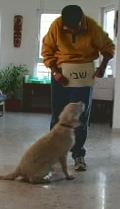
Jana reads. My longtime training mentor wrote an entire book about dogs reading, Teach Your Dog to Read. So, obviously, I think not. What’s the difference?

Dogs do learn to read words or pictures from flashcards and to perform the associated commands. The dog isn’t exactly reading as a form of entertainment, as we might. She is “reading” information from the flash cards, though. In fact, the reading dog is putting the same ability to work — detecting subtle visual cues and pairing meaning with them — as Beau.

The first word Jana read was “sit.” In Hebrew.

Wow, pretty amazing, right?

Not really.

She simply learned to associate the picture or image — what looks like a Hebrew word to me — with  sitting. She learned to “read” several English and Hebrew “words” and a few stick-figure pictures.

Once they get the concept of pairing an image with a particular action, dogs can learn new “words” or pictures very easily. Some dogs even grasp the concept that they should imitate what the stick-figure dog on the flash card is doing. Exceptional dogs are able, the first time they see the cards, to distinguish between a stick figure dog sitting and a stick figure dog sitting with one tiny, thin, stick-figure paw raised in a “shake.”

Just as Beau is “reading” the people for his cue to stop barking, Jana and her reading buddies are “reading” the images on the cards for a cue as to what behavior we crazy humans want them to do.

Why not? It’s easy for them to do, and it pays off in bountiful attention and many, many treats. Not a bad deal for those clever, calculating canines!

Poodle Empowerment

What's this?

Molly, a standard poodle friend of ours, came to stay recently. She’s been a frequent visitor, but this was her first overnight stay. She spent several days with us while her humans were traveling.

Molly can be a little anxious when her mom is out of sight, so we wanted to make sure that she was comfortable. We needn’t have worried; Molly established her sleeping place (the middle of the king-sized bed) and her reclining spot (the leather sofa) right away.

Molly is particular about her diet and came with elaborate feeding instructions. We further embellished her meals with the side dishes our own dogs have come to expect: yogurt, veggies, brown rice, salmon. (Yes, the dogs live quite well at our house.) Soon, Molly was eating like a golden retriever, licking her bowl clean.

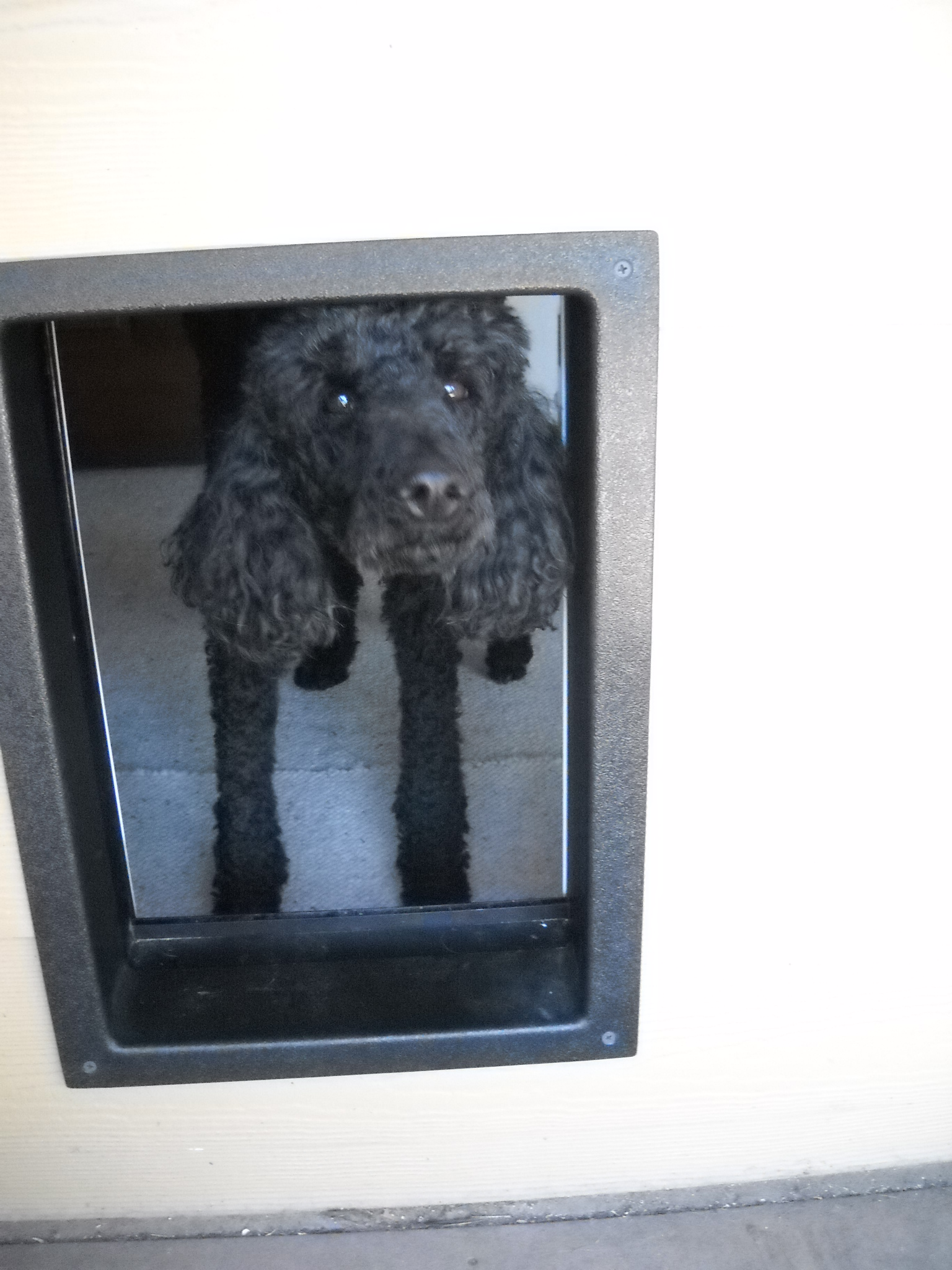
The real transformation came, though, when our automatic dog door — the same model we have in our Florida house — was ready for use. We solemnly attached the magnet-keys to each dog’s collar and turned on the magic portal. Wylie, Jana, and Oriel knew just what to do and were delighted to once again have free access to the outdoors (see A Doorway to Your Dog’s Independence).

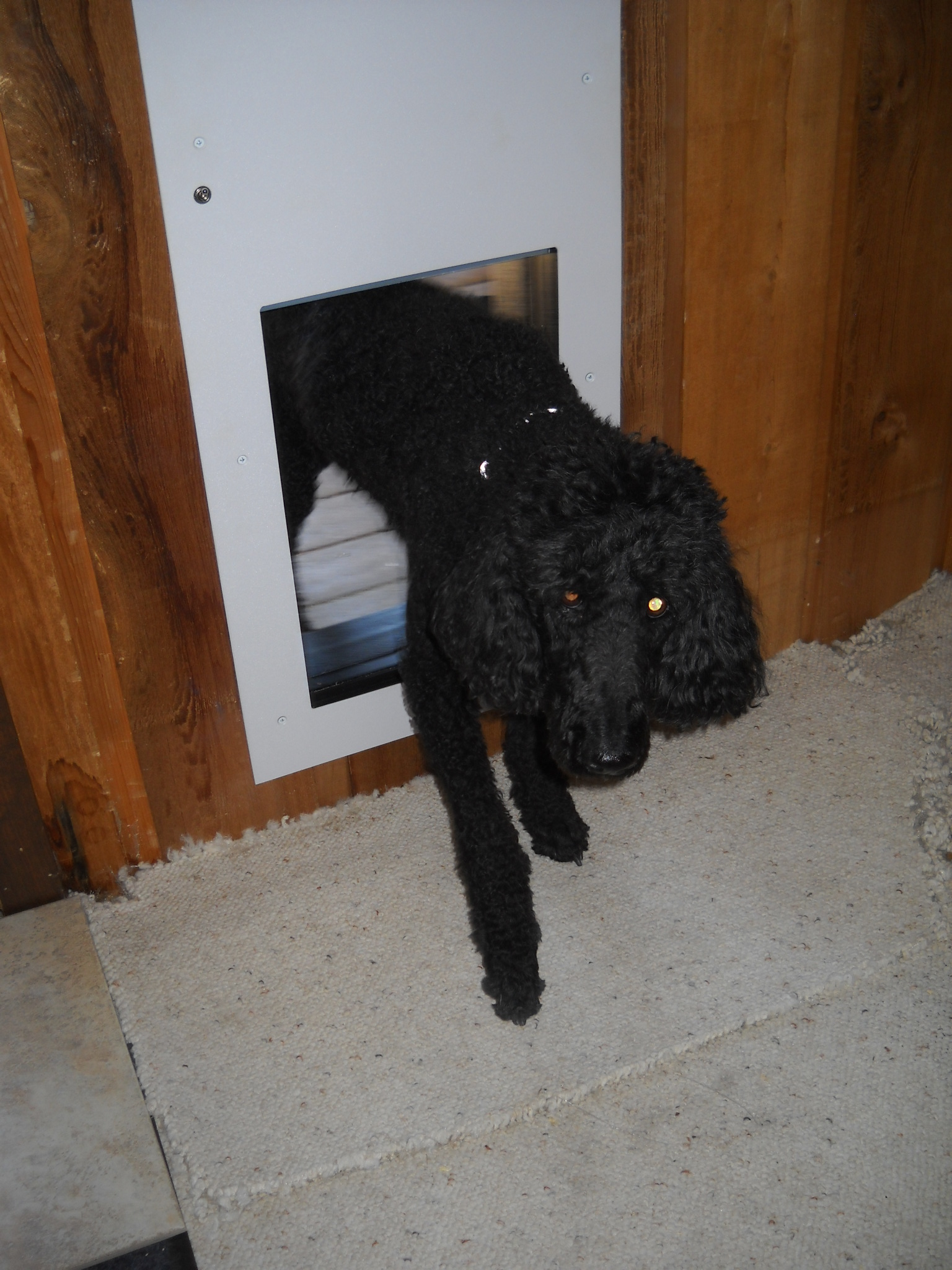
To Molly, though, this was all new. She watched the others go in and out. She put her head through the open door and quickly pulled it back in. A gentle nudge convinced her to step gingerly through. She still wasn’t ready to try this on her own.

Armed with some of her favorite bison treats, I held a short introductory session. Jana eagerly demonstrated opening the door, walking through, and eating a treat on the other side. (She was especially eager to demonstrate the treat part.) I lured Molly through, made a huge fuss over her, and served up the yummy reward.

This was fun!

Oh, THIS is how it works!

Molly tried again, and again, in, out, in — with my encouragement and rewards. I ended the session and decided to wait and see what she’d do next. Jana let herself out. The door closed. Molly approached cautiously, her magnet-key dangling from her collar. The door opened. Molly stepped through! Hooray!

Molly very quickly grew to love her new power. She stood taller. She pranced.

And she went in and out, in and out, several times a day over the next couple of days. Just because she could.

Jana, Oriel and Wylie to try Pilates

This slideshow requires JavaScript.

We’re about to get serious about getting in shape. Dog shape, that is. Jana, Oriel and even Wylie are about to take up the pooch equivalent of Pilates.

It’s called FitPAWS K9 Conditioning, and it is the latest, hippest way for dogs to work their core muscles and get in shape for serious athletics — agility, flyball, Frisbee, dock diving. Whatever your dog’s sport, our friend Val Minnis, who teaches FitPAWS and owns the K9BODYSHOP in Camarillo, California, says that the conditioning will help your dog achieve peak performance. That’s Val and Lexi, a buddy of Jana’s, demoing FitPAWS in the photos.

FitPAWS K9 Conditioning is also great for those weekend athletes who really feel stiff come Monday morning, for dogs who have had surgery or suffered an injury and even for elderly or arthritic dogs. According to Val, the gentle conditioning tones muscles without risking over-exertion or re-injury.

So what is FitPAWS, anyhow? Well, picture an oblong exercise ball. Picture your dog perched on top of it, perhaps doing puppy pushups (sit, down, sit, down …) or turning her head from side to side to ever-so-gently take treats from your hands. While doing these exercises, the dog’s weight is shifting and the dog is getting an excellent core workout just by maintaining her balance on the ball.

FitPAWS equipment comes in peanut, donut and egg shapes (this is supposed to get us in shape?), large and small discs, as well as other balance tools such as balance pads, pods, rocker boards, and more. Workouts can focus on one or more limbs (great for rehab after an injury) or overall conditioning.

During a typical session, Val uses treats, luring, and other encouragement to entice the dogs to place first one, then two or even all four paws onto a piece of equipment. Some dogs jump right on; others are very tentative. By the end of a session, though, nearly all the dogs are eager for more. K9 Conditioning sessions are intended to be fun for the dogs, and the dogs should be allowed to set the pace. Val never uses force (of course not; good trainers know that that’s never necessary) but encourages dogs to progress at their own pace.

The potential benefits go beyond improved athletic performance. Dogs can increase body awareness and confidence, increase their range of motion, improve balance and coordination and increase strength and flexibility. It also sounds like a great way for humans and dogs to have fun together. I’ll let you know what Jana, Oriel and Wylie think — just as soon as our equipment arrives!

Read CL posts!

I’m no longer posting on the Creative Loafing site but you can read all of my posts (about a year’s worth!) here: Thinking Dog posts

Jana and the Orbee Treat Ball

The day Jana defeated her Orbee treat ball, she proved to me, once and for all, that in raising her I broke my rule (the one that says you should never have a dog who is smarter than you are).

Orbee material, made by Planet Dog, is practically indestructible. The Orbee ball is hollow and has a hole about the size of a nickel. The ball is squishable. In my ceaseless quest to find ways to entertain and challenge Jana — who will do anything for food — I figured out that if I forced a large, hard dog biscuit through the hole in her Orbee ball, I could keep Jana entertained for up to an hour. Since she can empty even the most intricately, complex, frozen solid filled Kong in a few minutes, this was a very valuable discovery indeed.

What Jana did was lie on her back, put the ball in her mouth, and chomp hard enough on it to squash it and break the biscuit into small pieces, small enough that they’d come out the hole. That was pretty clever, but what she did next really amazed me: She lay on her back with the ball between her front paws. She squashed away. Then, I noticed her holding the ball out in front of her face and peering at it. She’d then turn it around with her paws, and look again. I realized she was looking for the hole. When she saw it, she turned the ball so the hole was right over her mouth, opened her mouth, and dumped the cookie pieces in. (Check out the video on my Facebook page.)

Then she nonchalantly kept chomping, squashing, and snacking, as if forcing me to re-think everything I knew about dog intelligence as compared with human intelligence was no big deal. This happened  a few years ago, and Jana still loves her Orbee. And anything else connected with food.

Now, Planet Dog is having a contest called “I love my Orbee.” Jana is a finalist. Soon, all of Jana’s friends (that’s YOU guys) can vote for her. You have to be on Facebook, I think. Details will come soon. If you are on Facebook, visit Planet Dog’s page.

Dog-O-Ween No Ordinary Dogs’ Night Out

Wednesday’s Dog-O-Ween outing was no ordinary night out with our three dogs. On arrival at Dominic’s Pizzeria, host of the costume ball, we saw many participants hiding under the tables. Or dancing on top of them.

Dominic’s staff  took it all in stride; they’re used to dogs. The Gulfport restaurant’s patio is always dog-friendly and Dominic’s hosts Yappy Hour every Wednesday. Servers carried trays piled high with bags of doggy treats and nimbly balanced food, drinks, and treats without treading on any tails.

We’d started preparing well ahead of time, seeking the perfect costumes on a weekend shopping trip. Wednesday afternoon, we pulled it all together.

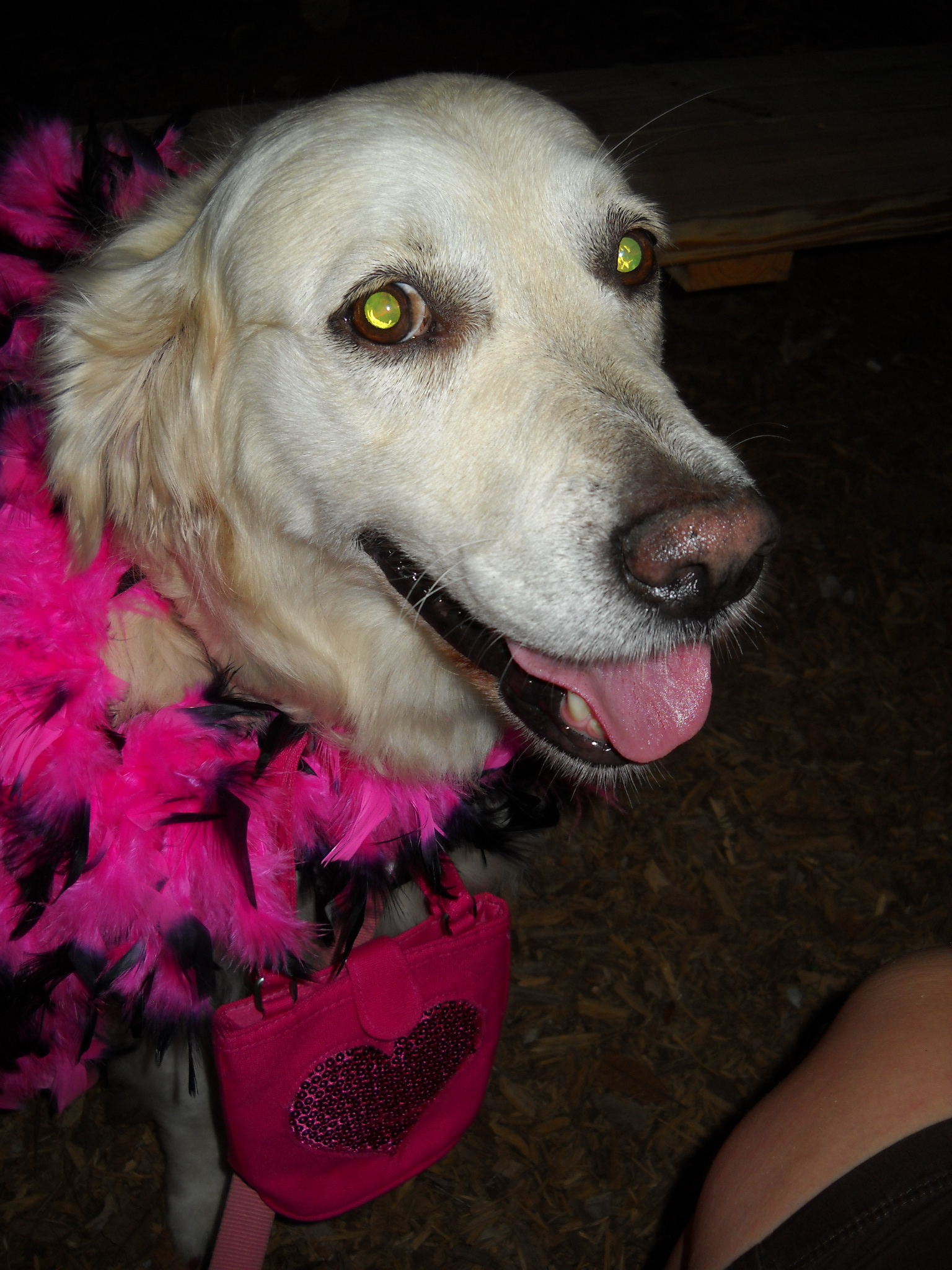
Jana, the white golden retriever, was easy. She watched approvingly as I applied her magenta nail lacquer and wagged happily at the sight of the bright pink feather boa and bling-y purse that completed her Femme Fatale costume.

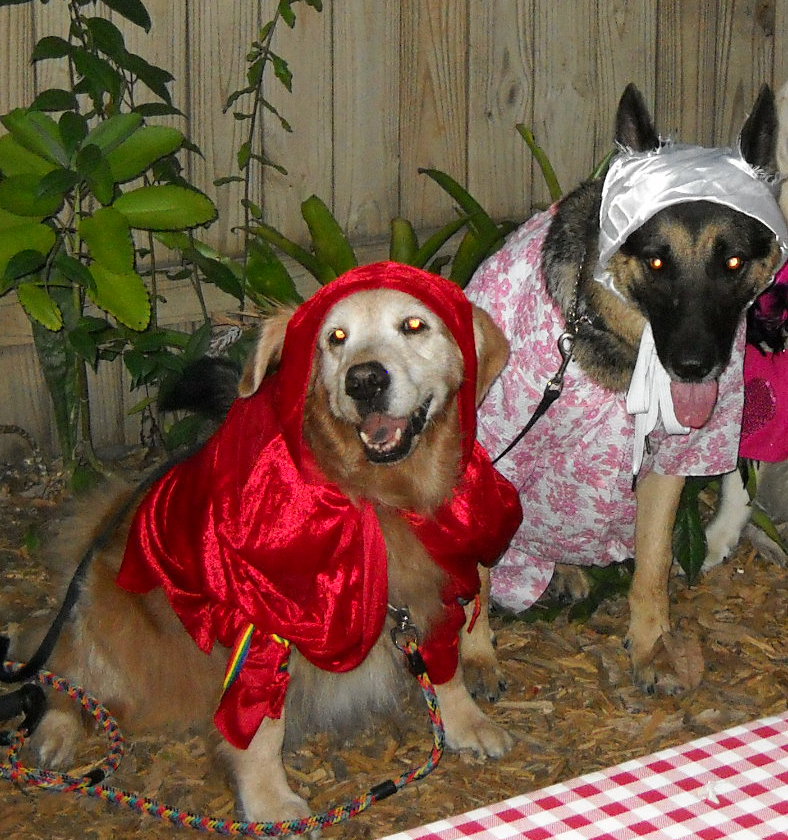
Ever-patient and cooperative, Oriel, our red golden retriever, initially tripped over her Little Red Riding Hood cape. The hood covered her eyes. Adjustments were clearly needed. Holes cut in the hood for her ears held it in place, and rainbow shoelaces reined in the cape’s flapping sides. At last, she could walk without tripping on her costume.

Grandma, what BIG teeth you have!

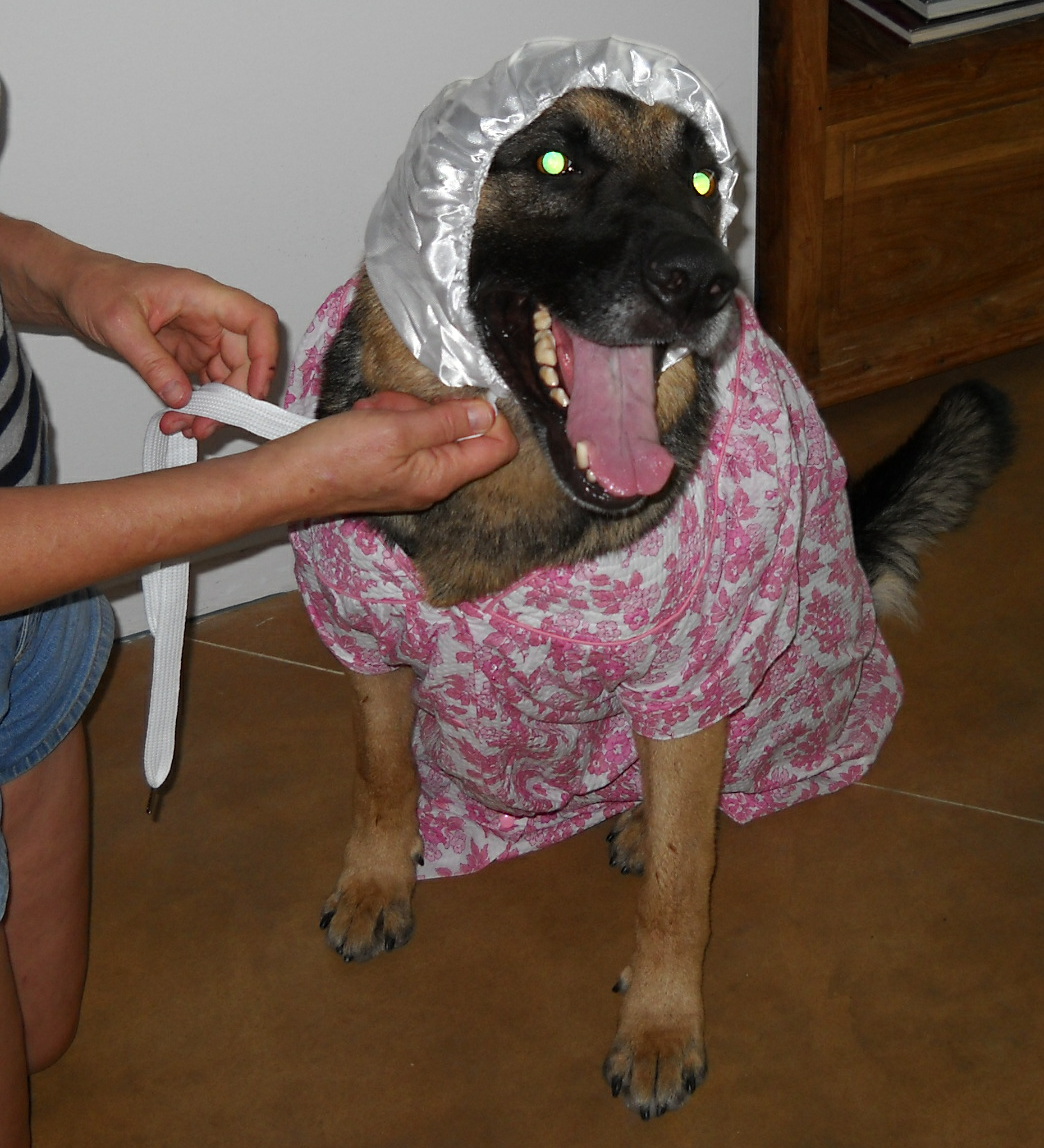
Wylie was the challenge. A tall, athletic German shepherd, Wylie was attending Dog-O-Ween as Ory’s foil: the Big Bad Wolf. His Grandma nightgown needed considerable nipping, snipping, and tucking to be wearable. Ear-holes added to his nightcap enhanced his wolf-like appearance. His expression seemed to signify resigned acceptance of human foibles.

We drove to Gulfport. With a few last-minute costume adjustments, we were ready.

Riding Hood and the Big Bad Wolf

Other guests’ attire ranged from simple T-shirts to elaborate affairs. One large dog was dressed as a doggy bag. A medium-sized dog wore a rooster suit; another was dressed as a cow (his owner wore a matching costume). The Queen of Hearts was in attendance, carried by her gentleman-in-waiting who sported an “Off with their heads” sign. Small dogs came dressed as a  hot dog, a police officer, a princess. A Southern Belle wore a ruffled skirt and gauzy hat.

The Mistress of Ceremonies, Auntie Lynda of Pet Pal Rescue, organized the two dozen or so dogs into a parade. Small dogs first, then medium-sized, and, finally, large dogs. We took our places at the end of the line and watched the contestants stroll past the judges. Many dogs, especially Jana, vamped their way through the spotlight.

Quickly dubbed “the cross-dressing shepherd” by the judges, Wylie was a runaway hit. In fact, our family swept the Large Dogs category: Jana came in third, Little Red Riding Hood took second, and the cross-dresser sashayed off with first prize.

They’ve pooled their prize money to purchase a stash of Halloween treats. Our special order will be waiting at our favorite stand at the Saturday Morning MarketFred’s Finest Pet Treats. Here’s hoping the treats will keep them quiet as we pass out candy Sunday evening!

The Bowl Really IS Half-empty

One of the things I have always loved about dogs is their unbridled optimism. Many dogs, and certainly most golden retrievers, greet every stranger as a new best friend. And car-savvy dogs seem to just know that a car ride always leads to fun for dogs!

And then there’s Jana, my golden. She’s sure that getting in the car means that she is going to be stuck there for days and probably won’t even get dinner on time. She definitely struck me as a bowl-half-empty sort of gal early on. Are dogs like people in that regard — some optimistic, others not?

I was clearly not the only person wondering that. Now, a scientific study has determined that, indeed, dogs can be pessimists.

With Jana, I am sure it began the day she reached adulthood, or late adolescence — whatever age it was that I decided  that she no longer needed three puppy meals a day. Nope, like a true grown-up dog, Jana would have two meals a day. She was crushed when, despite several reminders from her, I failed to serve puppy lunch. I tried telling her that many, many dogs eat only once a day, but she wasn’t buying that. From her perspective, it’s been pretty much all downhill since then.

The pinnacle, or should I say, the nadir, of her existence might have occurred on a cross-country trip a couple of summers ago, when we spent what seemed like a week just crossing Texas. She heaved an I-might-as-well-be-dead sigh and threw herself across the console in between the two front seats — and refused to be consoled. Nothing budged her. Not the promise of walks and playtime, not even a snack. Getting into the console for  sunglasses or a pen required using two hands and a hefty push to lift the lid, dog and all, to gain access.

Jana’s travel companion, Wylie, a German shepherd, is a born optimist if there ever was one. But even his frequent expressions of excitement which could only be translated as  “There’s a place we could stop and play!” “Look, some grass! Let’s go play!” failed to rouse her. Jana refused to so much as lift her head to look out the window. When we got stuck staying at a none-too-clean La Quinta one night, she realized that there was something worse than 12 hours in the car. Even the people were reduced to foraging for dinner at Denny’s. Life was truly not worth living. (Not to worry — our stay at a wonderful French Quarter hotel in New Orleans a couple of days later revived her. She has been plodding along, finding half-empty bowls, ever since.)

Not surprisingly, the intrepid team of researchers who determined that dogs could be pessimists was British. If dogs anywhere would be doom-and-gloomy, stiff upper lip and all that, it would be British dogs, wouldn’t it? The team’s thesis was that separation anxiety behaviors, commonly seen in pet dogs — they estimate that as many as half of Britain’s pets dogs show these behaviors during their lives — could indicate a pessimistic outlook on life.

The dogs studied were first evaluated for their response to being left alone, specifically to determine whether they showed anxiety. Anxiety might be exhibited as vocalization, destructive behavior such as chewing, or inappropriate toileting in dogs who are known to be housebroken. Next, the dogs were taught that bowls on one side of a room always contained rewards, while bowls on the other side of the room never contained rewards.

The optimist/pessimist test, or, if you prefer, the happy dog test, came next. The bowls were placed in one of three ambiguous positions, between the reward and no-reward locations the dogs had been taught to recognize. Dogs who approached the bowl quickly were judged to be anticipating a food reward and thus optimistic; dogs who did not approach the bowls or approached slowly were judged to be pessimistic, i.e., not expecting a reward. Several tests were run for each dog, with the bowls in the reward, no-reward, and ambiguous locations. Each dog’s times for the three locations were charted and compared so that speedy dogs didn’t get higher marks for optimism simply because they had longer legs than other test subjects.

Wouldn’t you know it? Dogs who had demonstrated anxiety at being left alone also had lower happy-dog scores than the calmer dogs. The researchers concluded that separation anxiety might indicate a negative underlying mood. For dog owners and therapists, looking at it the other way around might be helpful — dogs with a naturally bleak outlook might be more likely to exhibit separation anxiety.

While the idea that dogs’ behavior is influenced by their emotions or mood is certainly not news to anyone who has lived with and closely observed dogs, it’s nice to have official confirmation. And for the families of dogs who show classic separation anxiety — I know of one dog who jumped out of a second-story window to get to her departing humans, and have seen astonishing feats of destruction wrought by other distraught paws (and teeth) — understanding the dog’s emotional state and feelings might be calming in those moments when the humans really want to throttle the dog.

The logical question is, though, what are you supposed to do with this information? I am not an advocate of doggy Prozac, and punishing a frightened or anxious dog is counterproductive. Anxious dogs need a tremendous amount of patience from their families, and, sadly, there is no quick fix. One happy effect of the current economic downturn, at least from the dogs’ perspective, is that so many more of us are available, at home, for several more hours each day; we’re also taking fewer dog-less vacations and enjoying less-frequent people’s nights out.

Behavior modification with a qualified trainer who uses positive methods is the best approach to resolving anxiety related behavior in your dog. Find a trainer in your area through the APDT or a local animal-friendly trainers group, such as Tampa Bay Animal Friendly Trainers.

Thinking Dog Blog now on Creative Loafing

Check out the new home of the Thinking Dog Blog — BellaDOG!

View previous posts at Creative Loafing Tampa Bay’s Daily Loaf:

http://blogs.creativeloafing.com/dailyloaf/author/pamhogle/

Dog Happiness!

I’ve been thinking (and writing) a lot about dogs and their emotions lately. I love the way Dr. Marc Bekoff describes animal emotions and says that dog joy or fox grief might not be like our experience of joy or grief but that doesn’t make it any less real. (Check out his book, The Emotional Lives of Animals).
Jana and Wylie certainly exhibit what can only be joy — pure delirious happiness — every time we let them loose in “their new front yard” — Lassing Park, on Tampa Bay.

Wylie runs in delighted circles in the water, kicking up splashes, flying toward flocks of birds, racing, racing, racing until his tongue is hanging to his knees and all he can do is stand, panting and grinning giddily.
Jana is a bit more restrained, usually seeking out the deepest pool of water and lying down in it. Then, she exuberantly rolls in the sand, the grass, any dead thing she can find. And repeats the cycle as many times as I let her. She, too, runs along the waterfront with a big smile on her face.

This undeniable dog happiness is tempered somewhat by what comes next. Bathtime. Rinsing them, we laugh at their disgusted and annoyed expressions, at Wylie’s snapping at the water spray, at Jana’s dance to avoid having all that nice smelly stuff washed off.

Some may call me anthropomorphic, but no one who has observed these — or any other — dogs closely can deny that they are happy.