Looking into the Future

Can dogs anticipate? Can they visualize a future event or state?

Certainly, our dogs learn our routines and recognize the signs that, say, we’re getting ready to take them for a walk or go to work. They might try to guess whether they get to come along on an outing. Wylie, our resident super-optimist, seems to anticipate doggy fun any time we get on a highway that has, once, led to a dog park. Then there’s mealtime. Jana gets agitated if we go out anywhere near (defined as “within a few hours”) a mealtime.

That’s all pretty typical stuff reported by many dog owners.

But Daisy, a very intelligent thinking dog who lives in Massachusetts with my friend Nancy, does something exceptional. She’s 13, and it’s possible that regular access to the “little dogs’ room” is more important to her than, say, to little brother Brandon (age 5). But she’s normally on a pretty regular going-out schedule, and is reputed to have enormous staying power. Nevertheless, she has recently started to pay close attention to Mom’s “leaving” cues. If Nancy is indicating that the outing is by car, Daisy will request an unscheduled pee break. Is she anticipating needing to go and not knowing when Mom will be home?

A similar question arises when I consider Jana’s habit of not drinking water when I am not home. I first noticed this when we lived in an apartment, and I was often gone for a few hours at a time. This was a new predicament for Jana, who has been an extremely lucky dog in mostly having a stay-at-home mom, or being able to accompany me to work, or having access to her yard via dog door. But things had changed.

I first noticed that the water bowl would be untouched while I was out. I also noticed that, the minute I came home, she’d say hello and then head straight for her bowl. The odd thing is, the not-drinking behavior persisted, even after we moved into a house with a dog door.

So, can dogs anticipate needing to go out when their human servants are not around to open the door? What else can they anticipate? How far ahead can they look forward? Is anticipation part of what dogs are doing when they warn people of impending seizures?

We’ll probably never know the answers to these questions (though I’d love to hear your thoughts!). But it seems yet another way that dogs constantly surprise and amaze us with their abilities.

Why We Love Our Dogs

It has been a rough couple of weeks. Oriel, who died 2/22, and whom I imagine running across an endless dog beach in the sky,  has, in less than 10 days,  acquired  the company of two other dogs from my extended family. We were all multi-dog households, so my mom, my aunt, and I were spared the emptiness of a dogless house, but we each feel the loss of our friends very deeply.

No dog is like any other, and no two dogs fill the same role in our lives and our families. We love each dog differently, appreciating (and sometimes lamenting) who they are as individuals. No dog who’s been loved for him- or herself  can be replaced by some other “equivalent” four-footed bundle of fur and personality.

Some dogs are so easy to love. Oriel embodied everything people idealize about dogs. Quiet, affectionate, optimistic and adventurous — and always eager to help — Oriel was a walking teddy bear. She was always happy to cuddle and be cuddled; she gave hugs and patted us back, gently, with her paw. Her “sister,” opinionated, vocal Jana, will accept petting and cuddling only on her terms and in her time. Wylie loves to be petted and stroked, but he demands it and lacks Oriel’s gentle softness in accepting our touch.

Buddy, my mom’s little terrier, and Shaina, my aunt’s beagle mix, filled the “Oriel” role — asking for and eagerly accepting tummy rubs, leaning against someone found to be  sharing “their” sofa, seeking out our company and our touch. The remaining dogs in their households are more like Jana when it comes to being petted.

Wanting someone to snuggle with is a big reason we share our homes with dogs, but it’s certainly not the only one — and different cuddle styles are far from the only individual differences among our dogs. Some dogs are obsessed with food; others are obsessed with toys. Some love to go for meandering walks, sniffing every tuft and leaf; others are athletes eager for a three-mile run. Some live only to please us humans; others believe they would do a far better job of running things if only we’d get out of their way.

Dogs’ individual differences are as varied and complex as humans’. That’s why Bergin University, where I teach, pays so much attention to matching the service dogs it trains with people whose personalities are a close match. An outgoing, athletic person will not enjoy a twenty-four-hour-a-day partnership with a couch-potato dog. A person who craves a cuddler will be disappointed with a service dog who is all business and only grudgingly accepts petting.

While our pet dogs do not have to be as close a match as a service dog, compatibility still helps . We certainly find some dogs easier to live with and manage than others. Dog people tend to build relationships with lots of dogs with lots of different personalities over our lifetimes, and, if we’re lucky, we learn to find the ones who best match our personalities and lifestyles. Regardless, learning to adapt to the peculiarities of our canine family members helps us become more tolerant of the humans who share our lives.

Whatever role a specific dog plays in our life, it’s always hard to lose a friend. Knowing that there are many more wonderful dogs out there who would love to be part of the family  is no comfort. Each dog is as unique and irreplaceable as each person. Each earns a unique place in our hearts. And the death of each one leaves an empty space in our lives.

A Good Dog’s Good Death

This slideshow requires JavaScript.

Guest Blog by Deni Elliott

It seemed to happen overnight. One September day, 12-and-a-half year old retired guide dog Oriel was romping and eating and playing with toys at our mountain home in Montana. The next day, her skin seemed to hang loosely, her muscle all but gone. She trotted rather than pranced to fetch a ball.

The mass in her chest on the X-ray was clear to even a non-veterinarian’s eyes, as was the prognosis. Oriel was dying. Our job was to keep her happy and comfortable and know when she needed pain relief.

September gave way to October and October to November. It was time to rethink our plans. We were on our way to Berkeley for four months. The apartment wasn’t large enough to swing a cat, much less an extra golden retriever, but, if our 83-year-old landlady was willing, it was about to become home to the five of us: Wylie, the German Shepherd and Jana, the golden, and now Oriel too. The landlady was willing and celebrated Oriel’s stamina.

It seemed to happen overnight. One January day, Oriel ate her meals and special snacks, took two walks each day, and played ball in the park. The next day, she was suddenly ravenous, even by golden retriever standards, but unwilling to go for walks or play, planting all four feet in clear protest. She wanted only to eat and spend her time between meals flat on the floor, close to the kitchen.

A visit to an old vet friend brought the expected bad news. “She’s not a happy camper,” Dr. Anne said, stroking Oriel’s ears. Ory stood in front of Anne, smiling at the attention, but panting, panting, panting. “That’s the only way that this dog will tell you she’s uncomfortable,” Anne said. She drew blood and urine to look for something that we might address, but offered no hope.

A call to Dr. Joe, Ory’s Montana vet, a discussion of blood panel comparisons, the idea of repeating chest X-rays — finally he cut to the quick. “How sick do you want her to get before you let her go?” he asked.

“No sicker,” we decided. Both vets agreed that Oriel would only get worse. The list of how “getting worse” might be for Oriel was enough for us to decide that it was better that she drift off to sleep, to death, without sudden bleeds, seizures, or intense pain. Treatment might prolong her life but would not enhance it. We made an appointment for Dr. Anne to put her to sleep.

“Isn’t this playing god?” Pam asked. Yes, but it is the choice we make every time we bring puppies into the world and into our homes, when we integrate them into our families. We are always playing god. Making the heart-wrenching choice to plan their deaths is no exception.

“One last day at the beach,” Pam said. So, days before Oriel was scheduled to be euthanized, we loaded our three dogs into the car and drove across the Bay Bridge to give Oriel a last time to stand in the sand and smell the salt water. We were a block from the beach when Oriel sat up and sniffed the air. She found her second (or third or fourth) wind. She ran on the beach, swam in the surf, and chased the dog who had stolen her stick. She rolled on her back in the sand and wriggled, with sand on her nose, tail wagging, and a huge smile on her face. We canceled her euthanasia.

“Maybe we can help her nutritionally,” Pam said. We consulted with Heidi, who owns Holistic Hounds, conveniently located a block from our apartment (this is Berkeley) and emerged with food and supplements. Oriel’s new diet (of course, Wylie and Jana enjoyed most of these treats as well — how can you indulge one and deprive the other two?) included:

Breakfast: Natural Balance kibble, Grandma Lucy’s chicken formula, Glucosamine, fish oil, Pepcid, and a handful of frozen green beans;

Midday snack: cottage cheese or scrambled egg;

Dinner: Natural Balance, Grandma Lucy’s, 4Life Transfer Factor, Pepcid, a few more beans

Evening snack: cottage cheese

The added protein would help her feel less hungry. She got plenty of freeze-dried liver treats and occasional treats of Saul’s Deli chopped liver for her anemia. We compensated for her digestive enzyme imbalance with canned green tripe. And beach therapy at least once each week. With this regimen, there was no need for Oriel to die to think that she had gone to heaven.

Days flowed into weeks and weeks into a month, and we were able to forget that she was dying. Tuesday, February 21, Oriel had a typical day. She ate well, eliminated well, walked well, and retrieved her tennis ball a few times. She joined us for an evening cuddle. We rubbed her ears and stroked her back; she responded by petting each of us in return — the only dog in my experience to use her paws to pet her people.

It happened overnight. We began our usual morning routine. I took each dog out in turn. This morning, it was Wylie saying, “Me first.” Then Jana. But, Oriel was not standing in line at the front door. I walked back to the bedroom to find Oriel still lying in her bed. At my call, “Ory, Ory,” she lifted and turned her head toward me and then dropped it back on the floor. “Oh, honey,” I said, collapsing next to her, “What’s going on with you?” She put her head on my leg, but made no attempt to stand. I grabbed some liver treats and tried again. She sniffed and reached for the cookies, but made no effort to rise. I shuddered for both of us and held her while I waited for Pam to be done with her shower.

I left the two of them together. Pam had magic with dogs that I had seen before. I took my shower, hoping that the magic would work again. When I got out of the shower, Pam was on the phone with the emergency vet.

The other dogs sniffed Oriel nose to toes before we carried her to the car. We had seen only that Oriel could not stand or support her head for long. The vet noticed that her belly was filled with fluid and that her gums were paper white. Ory was bleeding internally. Her struggle was over. She was not in pain, not distressed, just very, very tired. Ory’s blood pressure was so low that the techs could not get an IV catheter into her back leg.

Pam and I sat on the floor and held Oriel close as we said good-bye, and I said thank you for all of the years that she had served as my guide. We told her to go play with Mav, Ideal, Hams, and Spirit — and all of the other good dogs we knew who had recently died. And, as the vet administered the drugs, our perfect dog peacefully slipped away.

Pam and I returned home, shocked to realize that less than two hours had passed since we’d recognized that Oriel couldn’t stand up. Jana and Wylie sniffed us thoroughly. We had no doubt that they knew that Oriel was dead.

It was hours before I could begin to feel grateful rather than stunned. I was grateful to Oriel for choosing this week, rather than next when I would be out of town. I was grateful that Oriel didn’t suffer a slow decline or put us in the position of trying to decide when it was time to let her go. I was also grateful that Oriel didn’t die in her sleep. I needed to say good-bye and thank you.

Oriel moved through the world with calm, cheerful anticipation of what might await her. She died as she lived. Her presence was profound; her absence is huge. But her message survives: Whatever the world brings, meet it with joy.
What Are We Saying to Our Dogs?

How much of what we say to them do dogs understand? I find myself thinking about this a lot these days, as I teach both a canine language class and a class that looks at influential dog trainers in history (all of whom had definite ideas about what dogs do, or, mostly, do not understand).
Konrad Most, an early trainer whose teachings influenced the training of military and police dogs well into the mid-1900s, believed that dogs did not, could not comprehend words. Rather than describe the verbal cues given to dogs as “commands,” Most called them “utterances,” so as to avoid any chance of ascribing any comprehension abilities to the dog.

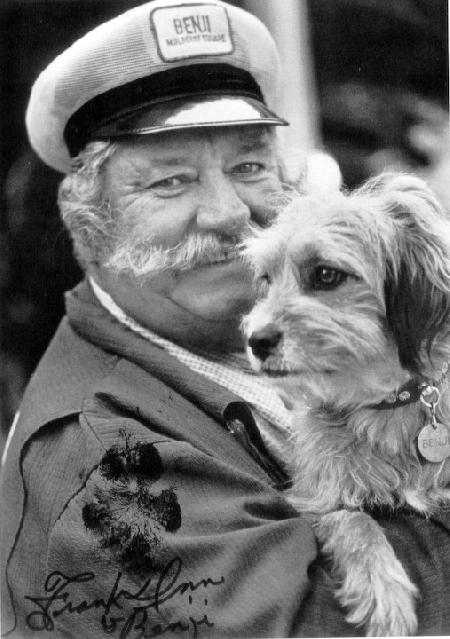
Frank Inn and Benji

At the other extreme was celebrity-animal trainer Frank Inn, who, in the 1970s, taught Benji using a conversational style consisting of full sentences.
Nearly everyone who has dogs talks to them. Some babble and speak in baby talk, others order their dogs around brusquely, but many of us chat to our dogs as if talking to a friend, despite their lack of verbal response. We often swear that they understand every word.

Do they?

Dogs are less focused on words than humans are, but they can certainly learn to associate certain actions with words and phrases and respond to verbal requests. They can learn the names of large numbers of items. However much they are understanding of our overall meaning, they appear to be good listeners, looking at us attentively and at least seeming interested.
Dogs are more visual than we are; they learn hand signals and understand other body language cues even more quickly than they build associations with our words. This can get us into trouble sometimes.
Konrad Most might have been the first trainer to write a description of creating unintended associations. His example was a handler who was teaching a dog a “down stay.” The handler would walk away from the dog (who was remaining, lying down, in place). On reaching the desired distance, the handler would turn to face the dog and immediately release the dog from the down stay. Well, very quickly, the cue to the dog would become — not the release word —the handler’s  turn. That is what Most meant by unintended associations. Nearly all novice trainers learn this lesson through personal experience, unconsciously repeating a movement when giving a particular verbal cue and creating a strong association in the dog’s mind.
Dogs are simply outstanding readers of human body language. They out-perform wolves and even other primates at following the direction of our gaze or interpreting a pointing finger. And dogs’ ability to read us goes beyond the signals we give them — intentionally or not — when we’re asking them to do something.
Very often, they will respond to things we don’t know that we’ve “said.” For example, if our body language tells them that we had a hard day or we’re feeling sad, lots of dogs will offer a cuddle, a lick, a favorite toy. Empathy. If our hand tenses up on the leash or some other cue tells them that we’re nervous or afraid of something — or someone — they might bark or growl at the scary person or thing. I’ve seen service dogs begin to intuit what their new human partners need or want after only a few days on the job.
Konrad Most, like many trainers of his day, didn’t credit dogs with the ability to think or learn concepts. He used training methods that today would be understood to be cruel to dogs. For all his faults, though, he understood dogs’ ability to read our body language. Now, if only we were as good at understanding what our dogs are saying to us!

How Dogs Became Dogs — And Why It Matters

I’m teaching the history of dog training at the Bergin University, and we’ve spent some time  talking about how dogs and people first hooked up. And, more important, why it matters.

There are several theories, starting with Creationist and Native American beliefs that God or a god designated Dog as Man’s companion, helper, and guardian. A Native American legend has dogs offering to take on that role while other creatures disdained it.

Other theories, collected and dissected in a recent book by Mark Derr, are less flattering to dogs. Dogs hung around the garbage heaps outside early human settlements, scavenging trash and scraps. Dogs slunk around the edges of early human camps, hoping the humans would toss them scraps and let them bask in the warmth of the fire. In these scenarios, early humans might have fed, then “adopted” the friendlier or tamer of the wolves and, eventually, convinced enough wolf/dogs to stick around that they eventually became domesticated.

Other theories focus on wolves’ history as successful hunters — more successful, it must be pointed out, than early humans. Somehow, these theorists suggest, stone-age humans made the wolves stay with them and got the wolves to help them hunt. How the humans, without benefit of tools or metal, convinced full-grown wolves to stick around and how the humans imposed their will on these strong, fierce hunters is left to our imaginations.

Derr does a nice job of identifying the factual and logical holes in these theories, looking at scientific and archaeological evidence (or lack of evidence); read his book, How the Dog Became the Dog, if you want lots of detail.

Timing and historical evidence aside, these theories share a huge problem: They completely ignore the point of view of the wolf/dog, considering only human wants and needs. Why would a successful predator hook up with humans and help them become better hunters (and therefore competitors)? The wolves didn’t need the humans’ help (or meager food scraps)! There had to be something in the deal for the dog.

And here’s where we get to the question of why it matters which theory we adopt.

If you see dogs — or any animals — as humans’ possession to do with what we will, it’s too easy to justify exploiting them, neglecting them, or even harming them or their habitat if their needs conflict with humans’ needs or wants.

If you think of dogs as the descendants of “sniveling offal-eaters” (Derr’s description), parasites that humans took pity on and helped, well, you won’t have much respect for dogs or their abilities.

If you adopt the flip side of that view — that dogs are descendants of fierce hunters that humans had to tame and control so as to bend the wolves to their will, well, you might be one of the dwindling-but-still-too-large pool of people who believe that you have to “get dominance over” your dog and show him who’s boss, lest he wrest back control and become the alpha in your little pack. Through much of history, this view has led to cruel treatment of both wild and domestic canines.

On the other hand, if you look at the early relationship from the wolf/dog’s point of view and acknowledge two things — that the wolf/dog got something out of the arrangement and that the dog’s progenitors freely chose to enter into a relationship with humans — you are more likely to look at that early wolf/dog’s modern-day descendants with respect and treat them as partners rather than as parasites or slaves.

A Special Dog Leaves Too Soon

I first met Mav in the prime of his life. At six, he was full of energy, loved going for a walk, and was always eager to bring you his toys — you could ask for them by name — especially if there might be a cookie available for him as part of the deal.

But Mav was more than an ordinary, fun-loving Labrador, “of the Colorado Labradors,” his mom, Sally, liked to say. Mav was a true “old soul” with an almost tangible presence and personality.

He was great company, and never more so than after a long day or when I was feeling frustrated or sad. Stroking his velvet ears could make even the worst day fade away. He always knew what people needed, too.

Once, when Sally’s brother had died and she was visiting with her brother-in-law, Mav picked up on the man’s grief. Lying on his bed by the fire, he looked up at the visitor, head cocked, thinking. He then went to the bedroom and brought his favorite toy, his prized hedgehog, and laid it in the man’s lap. Then, one by one, Mav brought all of his toys and placed them at the grieving visitor’s feet. Here, he seemed to be saying, cuddling these helps me feel better; maybe they’ll help you, too.

The first time I shared a home with Sally and Mav, I was learning to train service dogs, and I nearly always had a puppy home with me overnight and on weekends. A gentle soul, Mav was a great big brother and always eager to join our walks and playtimes. But when I got out the service dog cape to take my puppy on a practice trip to the supermarket or store, Mav would stand there and cry. He knew that the cape meant that he didn’t get to come, and he just hated being left out.

Mav had a special place in his heart for puppies, and was very gentle as he played and wrestled with my service dog trainees, always careful not to use his full strength and endlessly patient. As the puppies got older, they’d make up games together — one pup in particular loved to play tug. For this dog, Mav would lie on his back, holding the tug toy in his mouth. Irresistible. The adolescent puppy would grab the other end, and away they’d go, Mav sliding around the living room on his back, as happy as he could be.

One puppy in particular captured Mav’s heart though. Yasu.
A petite blonde, about eight months old when they first met, she had the airs of a princess. We called her the “Marilyn Monroe dog.” She knew she had been put on this earth to be adored and served — not to be a service dog. And Mav adored her, gazing at her, besotted, as she took away his favorite toys, nibbled at his mouth, and perched on his special bed next to the fireplace.

Mav left us a couple of weeks ago, at the age of fifteen and a half. Sally had nursed him through several serious illnesses, lovingly preparing him tasty meals and, ultimately, encouraging this always-food-obsessed dog to eat. Finally, though, it was time to say good-bye. Fifteen years wasn’t long enough. Mav was a special guy and he will be missed by many people whose lives he touched.

Jana and the Bird

We were working in a downstairs home office on a windy day. We both heard a couple of muffled thumps, and assumed that they were objects, outdoors, being blown around.

A minute or so later, Jana wandered upstairs and began barking. There’s (unfortunately) nothing unusual in that. But this was not her “there’s a deer in the yard” bark; nor was it her “I’m scared” bark or her “I need to get that toy that rolled under the sofa.” It wasn’t even her “I can’t make the dog door work” bark.

This bark had a note of alarm or uncertainty. It very clearly told us she needed help with something. Deni went upstairs. Seconds later, her voice (with that same “I need assistance” note) wafted down to me. I went upstairs. A bird had entered the house through an open window and was standing on the living room floor, a bit stunned.

When Deni had gotten upstairs, Jana had been standing only foot or so away from the motionless bird, barking. She had not touched the bird. She had not chased the bird. She had called us. While Deni held onto Jana and Wylie, who’d finally showed up to investigate, I gently took the bird outside. After a few moments, the bird flew off, unharmed.

What was going on? Jana’s a retriever, and she has a very high prey drive. She loves to chase birds outside (and cats and squirrels and minivans). She often shows interest in dead birds she finds on our walks. But she had not chased the bird.

She could easily have grabbed and killed, even eaten, the bird. We were busy downstairs and would not have noticed until it was too late to intervene. All that we know about canine instinct would say that was the natural course of action. But she hadn’t done that.

What she did was bark — call for help — and stand there, watching, while we helped the bird.

I’ve considered her actions from every angle, and I believe that Jana’s behavior points to a thinking process where she consciously chose a response. Nothing in her behavior indicates an instinctive reaction, nor was this an automatic or “programmed” response to a stimulus. It was not an emotional reaction triggered by fear or panic. This was not a response that we’d taught her. She’d never encountered a situation like this before. She encountered a situation that she did not understand and she called for help. There might be other explanations, but I believe that she simply made the “right” choice  — to call for help — despite that choice going against her “instincts.”

We ALL Make Mistakes

We humans have an uncanny ability to notice what we don’t like. Just look at all the nasty comments posted online, or listen to people’s conversations. Sometimes, it seems that all we ever do is complain about the dumb things other people did or said. We jump on people for every mistake they make. We do it to our dogs, too. We always notice when they are barking at the deer in the yard or they jump onto the sofa, uninvited. We yell, criticize, complain, even punish.

Busted!

Old-school training methods emphasize punishment. Rub your puppy’s nose in it if he pees in the house. Smack your dog with a rolled-up newspaper. Put him in a crate for a time-out if he is mouthy. Knee him in the chest for jumping up to greet you. Shock him for barking or for crossing some invisible line that is supposed to separate “his” territory from the rest of the world.

As I wrote in Reward or Punishment?, we all can learn from negative consequences that a particular behavior was not a good choice. Yes, a dog can learn what not to do through punitive “training” methods. But that information doesn’t often help him figure out what would be a better or the correct choice of action. There might be a lot of other options, and most of them might be equally wrong. Punishing a dog who hasn’t been taught what the right behavior is, is unfair. And, even when we know what is wanted of us, we all make mistakes.

Instead of jumping on every mistake, positive training focuses on eliciting or teaching behaviors that we want the dog to engage in — and rewarding them.

Some people use targeting or a lure to elicit a behavior. This could be as simple as patting your leg to encourage a puppy to come to you or having the dog follow a treat held above his nose to get him to sit or lie down.

Some use shaping, which is waiting for the dog to do something that might barely resemble the behavior you want, and rewarding that, then slowly raising the bar until you get the desired behavior. An example is teaching your dog to turn left. You might first reward a tiny glance to the left. Then a longer glance. A slight head turn. A half-turn of the head. A full head turn. Etc. Until the dog turns left.

What is most important about these teaching techniques is that if the dog guesses wrong, turning his head to the right, say, rather than the left, or backing up instead of sitting — you don’t do anything. No scolding or yelling, no “correction” or punishment. You simply change position and try again.

If the worst consequence to getting it wrong is that the puppy doesn’t get the treat — but he immediately gets to try again, making mistakes is safe. He’ll soon learn that trying different ways to do something until he gets it right is not only safe but it’s fun. That will make him more likely to guess again than if the consequence of an incorrect guess is painful or unpleasant. He’ll also be more willing to try new things — which teaches him to think and problem solve. Don’t you want a thinking dog?

Reward or Punishment?

A response to a previous post accused me of being “painfully obvious in your contempt for any form of training outside of rewards or ( +R ) only” and ill-informed and biased to boot. I feel compelled to respond.

Anyone who thinks that any training (or life) can be wholly positive is wholly mistaken. Life delivers consequences, sometimes for actions taken intentionally and sometimes simply by chance. Some of the consequences are pleasant, some are not. There is no way to ensure that my life, my dog’s life, or the life of any dog I am training will be aversive-free. And, I believe that we all learn from the consequences of our actions, whether those consequences are pleasant or not. So, yes, I do believe that we, and our dogs, can learn from aversives. If we get burned, we are more careful around a hot stove. That said, I believe that, as a teaching tool, using aversives is unnecessary and cruel — and a lot less effective than other methods.

Behaviorism identifies four “paths” of learning through consequences, or four types of behavior-consequence pairs. What my critic referred to as “+R” is positive reinforcement, rewarding a behavior in hopes of encouraging the dog (or person or goldfish …) to repeat it. This is the foundation of motivational training. But some of the other three behavior-consequence pairs are useful too. Few trainers use only one; I would go so far as to argue that it is impossible.

What are the other three?

Next up is negative reinforcement.

Since this is often confused with another type, negative punishment, I’ll offer an easy way to sort out the four types. Dr. Pamela Reid, an outstanding trainer and behaviorist, and one of my teachers, explains it this way: “Positive” means you add something; “negative” means you take something away. “Reinforcement” makes a behavior more likely to be repeated; “punishment” makes it less likely.

Thus negative reinforcement (like positive reinforcement) is likely to cause the dog to offer a behavior again, but instead of giving the dog a reward (positive reinforcement), you are taking away something that the dog doesn’t like. Our dogs use this on us all the time; they get us to play with or feed them by bugging us until we do. By performing the desired behavior (feeding) we end the negative (heads jostling our hands when we’re trying to type and sad-eyed faces resting in our laps).

So what is negative punishment? Well, it’s punishment, so it makes a behavior less likely to recur. And it’s negative, so it means taking something away. Here’s an example: when our shepherd gets mouthy and rough during play with a ball or Frisbee, I warn him once not to touch me. The next time his mouth touches my hand, the game ends. Ending play early is a punishment to him; I am taking away something he wants. It does make the mouthy behavior less likely to recur; he is always more careful the next several times we play.

The fourth pair is positive punishment. This is adding something that will make behavior less likely to be repeated. Kneeing a dog in the chest for jumping up on you is a common example. This is the one pair I try hard not to use in teaching or training.

I have studied learning theory and behaviorism, and I have applied this knowledge in training hundreds of puppies. I have also studied the effects of punishment. Based on both my research and my experience, I firmly believe that the best way to teach new skills or encourage desired behaviors is through motivation and reinforcing those behaviors. But this is not always practical, and, in some situations, negative punishment can also be useful.

I also believe that anyone who chooses to use positive punishment must think carefully about the consequences and the alternatives. There might be situations in dog training where it is justified, but these are few and only, I think, when a dog’s or a person’s life or safety is in jeopardy. I cannot justify the routine use of positive punishment as a part of my training toolkit.

Motivating and encouraging a dog to do something tells the dog what you want — and rewards him when he gets it right. This is knowledge he can apply in the future and generalize to learning new behaviors and skills. Simply punishing him for getting it wrong tells him what not to do — but for every one behavior we are looking for, there might be hundreds of wrong guesses. Punishing each wrong guess is not going to give the dog information that steers him toward the right answer, but it might shut him down and discourage him from trying.

Kneeing your dog in the chest for jumping up in greeting, the example given above, can be harmful to the dog. It almost certainly harms your relationship with your dog. It might teach the dog not to jump on you in greeting. What it does not do is teach him how you want him to greet you. He might try barking wildly as his next guess. Not an improvement.

Your dog jumps because it is a normal doggy way to greet, because he’s happy to see you, because he wants attention. But, since you are the human and, at least in theory, you are in charge, you can decide that you’d rather he bring you a toy or sit next to you or walk around you in a circle when you get home. You can use positive reinforcement to teach the dog to do that, rewarding him, let’s say, with treats and attention each time he sits quietly to greet you. You can add in some negative punishment by ignoring him when he jumps. Soon enough, the dog will learn that to get your attention, he needs to sit next to you, not jump. You’ve not only reduced or eliminated the bad behavior, you’ve replaced it with a good one, all without hurting your dog. In the process, you have probably had fun with your dog, and you have improved communication with him and probably strengthened your bond as well — not a bad return on your investment of a little of your time and a handful of dog biscuits.

Peanut Butter and Invisible Fences

We’d been congratulating ourselves all summer on the absence of rodent roommates in our Montana residence when, on their first night here, our visiting friends spotted a mouse. Out came the mouse traps, baited with peanut butter. Out came the baby gates, keeping the dogs away from the traps.

A couple of mornings later, forgetting that there were still traps out, I let Jana come downstairs with me. Zeroing in on the scent of peanut butter, Jana beelined for its source. SNAP!

Jana’s head jerked back, then her nose immediately moved forward again, seeking and finding the now disarmed peanut butter. Once she’d licked the snapped trap clean, she hunted for others. A week later, she was still checking that area of the office for traps, uh, peanut butter, every morning.

I will do anything for food

Though I have no doubt that her reaction would have been different if the snapping trap had actually nipped her nose (she might have taken a full minute to recover before going for the peanut butter) the experience reminded me of why I so strongly dislike invisible fences:

If a dog’s motivation to go after something is strong enough, a moment of shock or pain will not deter her.

The thorough training that is supposed to — but rarely does — accompany the installation of invisible fencing should, it is claimed, teach the dog to avoid the “fence” so as to avoid receiving an electric shock. The dog is fitted with a collar that normally gives a warning beep if the dog approaches the underground wire that makes up the “fence.” The collar is supposed to deliver a shock only if the dog ignores the warning. Leaving aside the issues of malfunctioning fences and collars, this system rarely works as perfectly as the salespeople describe.

For some dogs, the experience of the shock, felt during “training” is enough to deter the dog from ever again approaching the perimeter of the yard. (For some dogs its enough to deter them from going outside at all, and it can have even worse effects, too, but that’s another blog.) But dogs who are that easily deterred are rational enough to be taught to stay in the yard without shocking them. For many other dogs, the shock wouldn’t work.

For instance, take a dog like Jana, who is highly motivated by food. A moment of pain isn’t much of a deterrence. She’d cross an invisible fence in a heartbeat if someone on the other side proffered a spoonful of peanut butter.

A more likely scenario arises with dogs like Wylie, dogs who love to run and chase things. These dogs would be unlikely to consider — or even notice — the shock as they flew across the yard and over the boundary, in hot pursuit of a running cat, deer, or other fleeing animal. This dog might, however, think twice about coming back into the yard on his return home after the chase. Winded, walking more slowly, he’d approach the “fence,” hear the warning beep, and, quite likely, decide that going home wasn’t worth the pain.

An additional problem with invisible fences is, of course, that anything at all — the mean dog from down the street, a cat, a coyote — can get into the yard and harass or harm the resident dog, who cannot run away without being “punished.”

So. An invisible fence doesn’t keep your dog safe and won’t contain the sort of dog who most needs strong boundaries. The only thing that can do that is a lot of (humane) training and a watchful human on the premises.

If you’re wondering what happened to the mouse, he (she?) was electrocuted while chewing through the wires to a bathroom light fixture, shorting out the light in the process. No rodent friends or relatives have been spotted, and the light has been replaced.