Precious Precocious Puppy

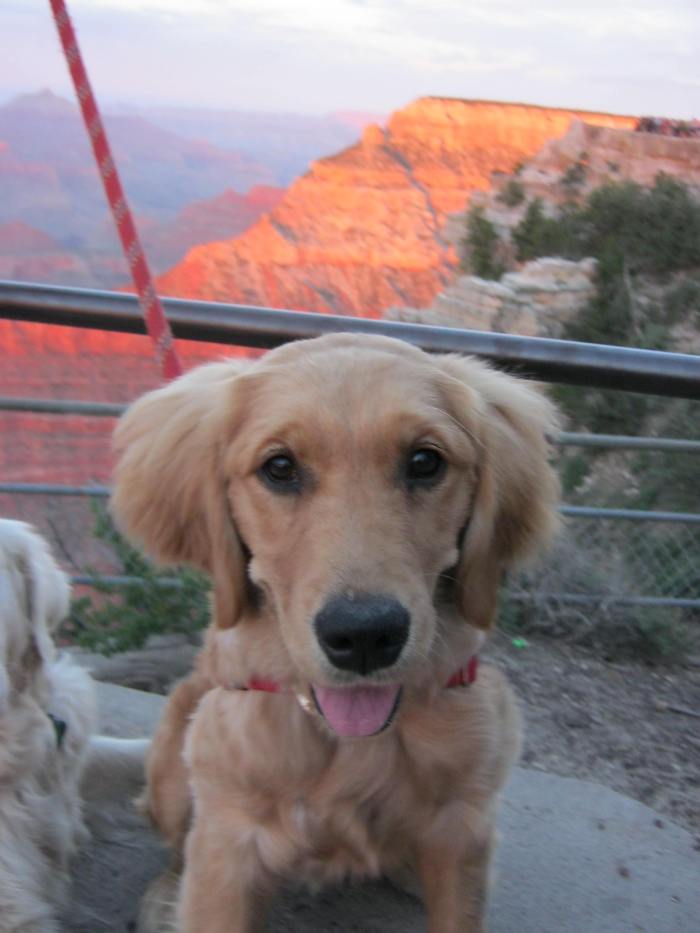
grand canyon

Not every five-month-old-puppy can handle a 3,800 mile drive, so I was a bit nervous about driving from California to Florida with Cali and Jana. Fortunately, my mom came along to help. Cali, like big sister Jana, turned out to be an excellent traveler, though.

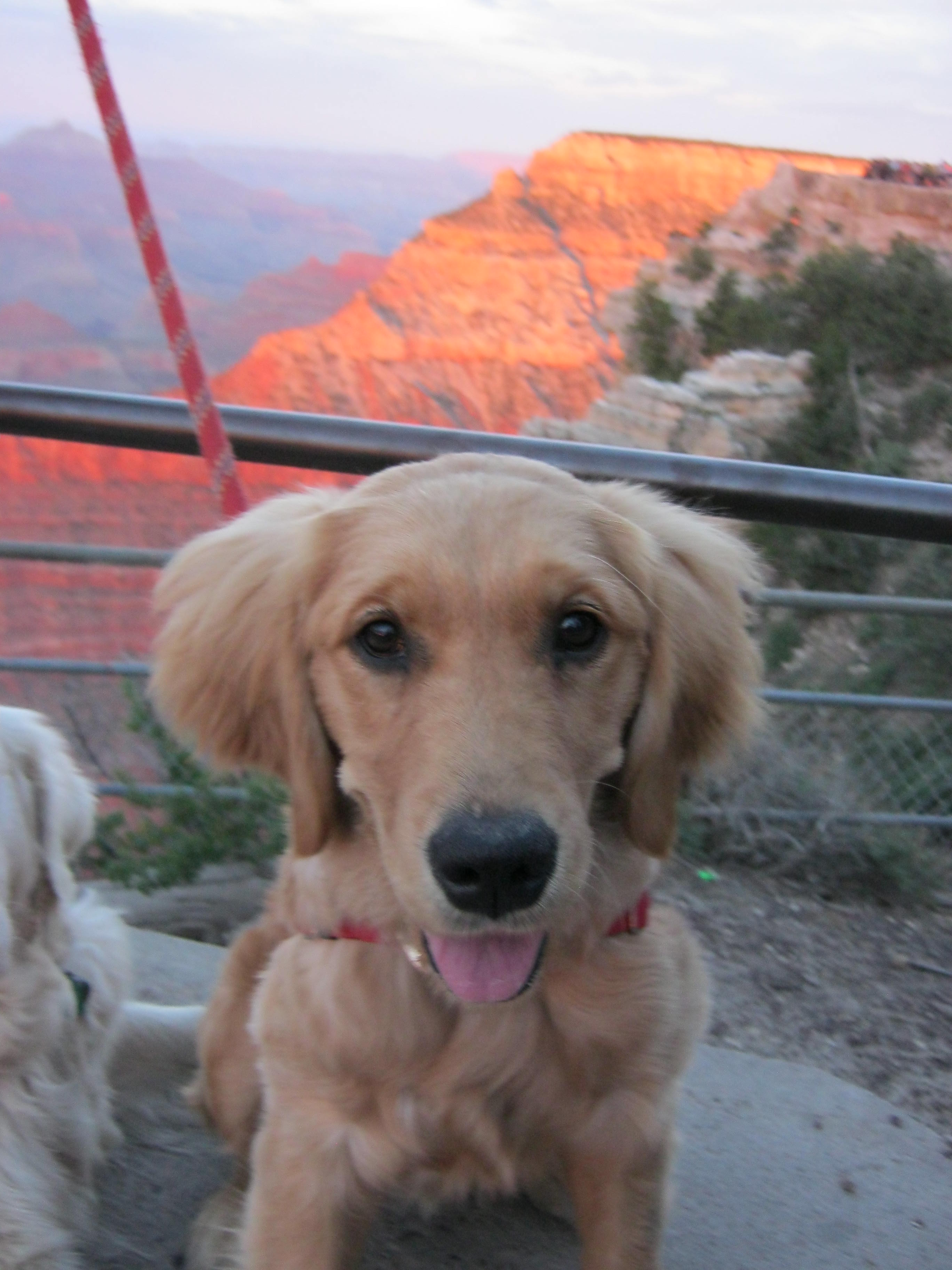
Cali took the Grand Canyon at sunset in stride. This was after a morning spent at The London Bridge in Lake Havasu City, AZ (a consolation trip, once we discovered that the Hoover Dam does not allow pet dogs on site at all, ever, no matter what). Near the river in Lake Havasu City, Cali and Jana also encountered a weird piece of sidewalk that spouted water. And had ducks. Very cool, they thought.
IMG_0317Cali liked the Painted Desert and Petrified Forest, too. Kansas City and a visit with cousins Hannah and Ziggy was a huge success. Cali then slept through a few more days in the car, and we were home. In Florida.

Scary, scary Florida.

We arrived home on a Wednesday. First thing, Mom and I opened the windows and turned on the ceiling fans. I turned around, wondering where my puppy had gone in this huge house, so different from our one-room studio in Valley Ford, CA. She was hiding under a table in the dressing room. Would not come out, even for food. Well, after some coaxing, Cali was able to dash into the kitchen for her dinner, but she kept casting nervous glances at the dining room ceiling. Ah. Ceiling fans. Terrifying. Who knew?

The truth is, it is pretty normal for a puppy to be afraid of a weird thing moving overhead and casting all sorts of weird shadows. I just hadn’t thought about it.

After dinner, it was time to visit the back yard. Which requires navigating a bead curtain. Again, very scary.

By bedtime, Cali had conquered her fear of the curtain. The fans took longer. But, by dinner time the next day, Cali was willing to hang out in the same room as the fans, though she still gave them a wary look from time to time.

That same Thursday afternoon, we took her (poor kid) to the beach across the street. Not surprisingly, calm, shallow, warm, waveless Tampa Bay is much more to her liking than the ferocious Pacific Ocean. She bounded right in. When the ball floated out to sea a bit, she bounded after it. Until, on landing from her leap, there was nothing under her paws.  A panicked look at me — then she quickly realized that her paws were paddling of their own accord. “I can swim!!” her happy expression said.

What else did Florida throw at this poor puppy? A dog door lesson. She’d been watching her all-powerful big sister Jana use her magic to open this amazing portal. Now it was Cali’s turn. She got her key (our dogs wear magnetic “keys” to open the dog door; this keeps out cats, opossum, and other local wildlife) and we headed to the back office.

With my helpful mom standing on one side and me on the other, both armed with treats, the lesson was quick. About 12 seconds, I think. I called her. Out she came. Treat. Mom called her. In she went. Treat. Four or five repetitions and Cali was a dog door pro. She loves going in and out, just because she can. (Her reaction is not so different from Wylie’s, when we first installed the dog door.)

Is anyone counting? Cali has conquered ceiling fans and bead curtains, mastered electronic dog doors, and found out that she could swim. All before she turned 6 months old. Actually, all in about a day. The resilience of youth!

While we were on the road, Cali was showing some hesitancy around things she’d seen before — statues, motorcycles — and I was worried that she’d hit a fear period. Puppies go through stages in their development where they suddenly become fearful of new things, or not-so-new things, and a fear period and a cross-country drive are not a good combination. But she seems to have passed through the fear period quickly and without a scratch.

Since arriving in Florida, Cali has also discovered things like neighbors and traffic. While our neighborhood is relatively quiet, it’s a far cry from our rural home in California. People come and deliver or remove things — mail, trash, dry cleaning — regularly. Cars pass by. Pedestrians, too — many with dogs. Cats wander through the yard. Other critters too, though we had our fair share of those in California. Lizards are everywhere here, and endlessly fascinating to a puppy. There are so many people to meet, so many things to bark at in Florida!

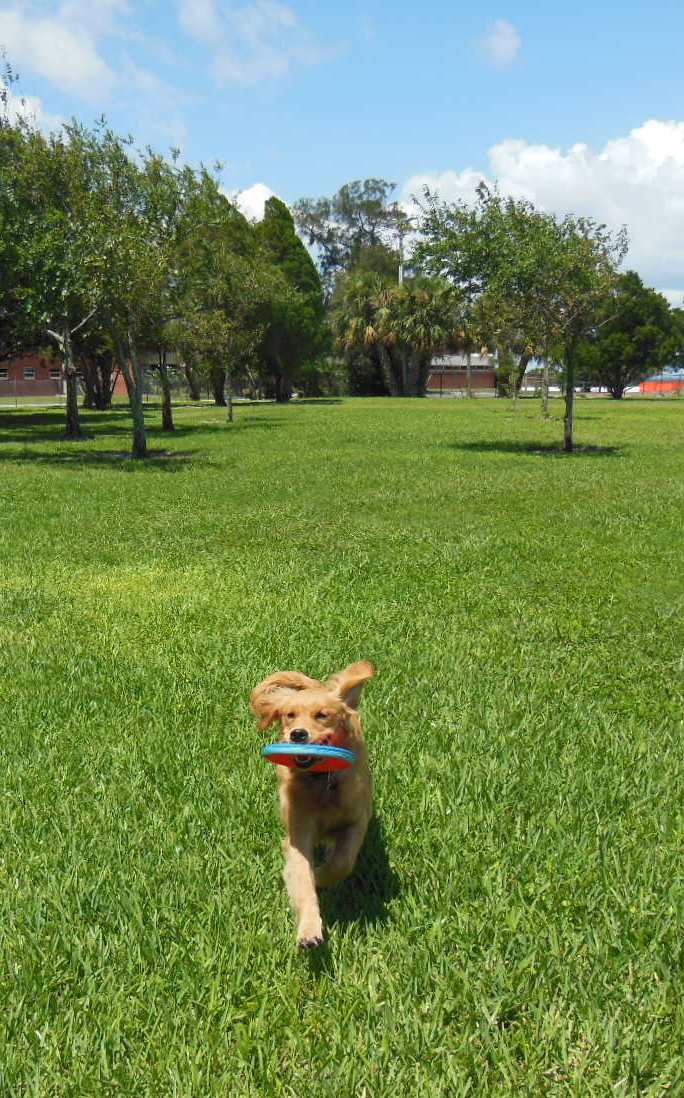
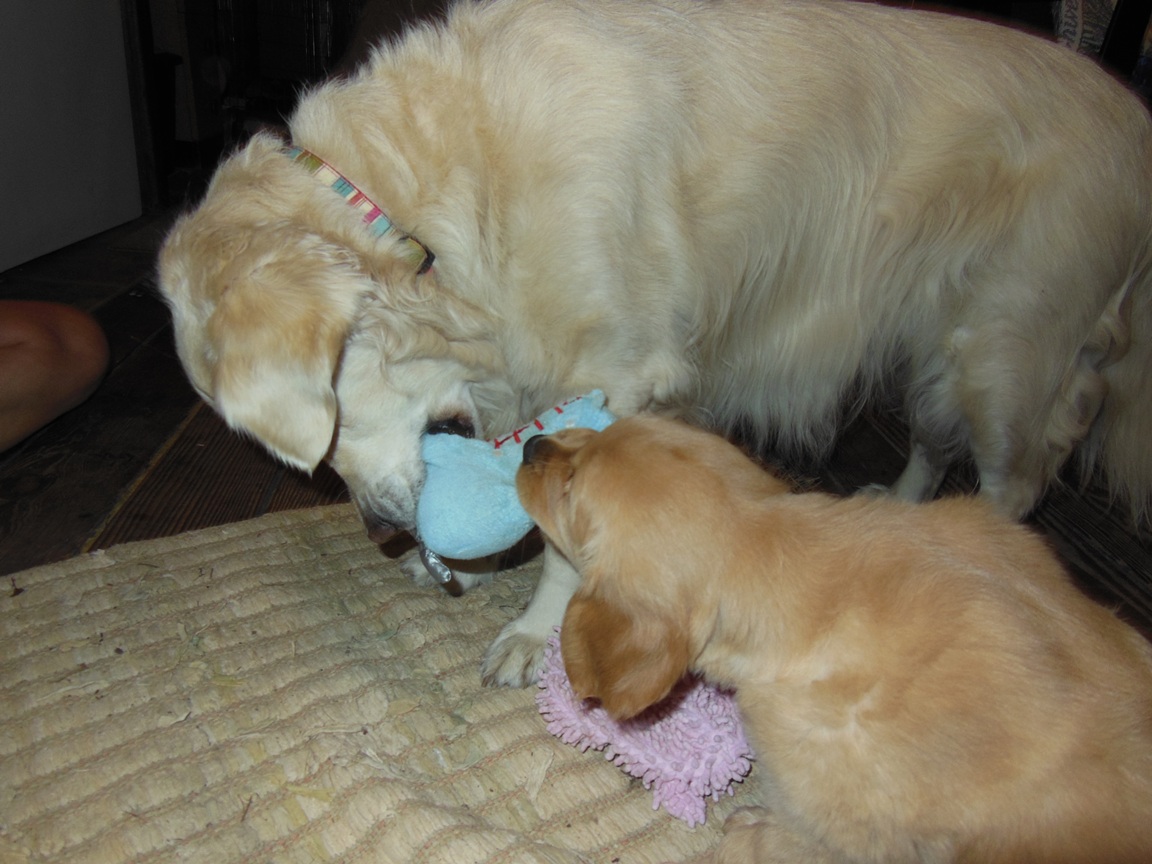
Cali’s next challenge is convincing her new sister Albee to play the way she wants. Albee invites Cali to play tug by whacking her on the head with a tug toy. Cali invites Albee to play by choosing a toy and playing keep away. Neither is getting what she wants — yet. Both love to play ball and Frisbee, though, so we’re confident that they will figure out how to communicate about other games.

Cali is lucky that she gets to experience so many new and exciting things. I am lucky that she is mostly confident and curious, and that, when she is fearful, she overcomes it fairly quickly. This combination is setting her up to be a confident and calm dog who won’t be easily overwhelmed by new sights and sounds — a dog who could, someday, be a service dog working comfortably out in public.
 

Dogs and the Paleo Diet

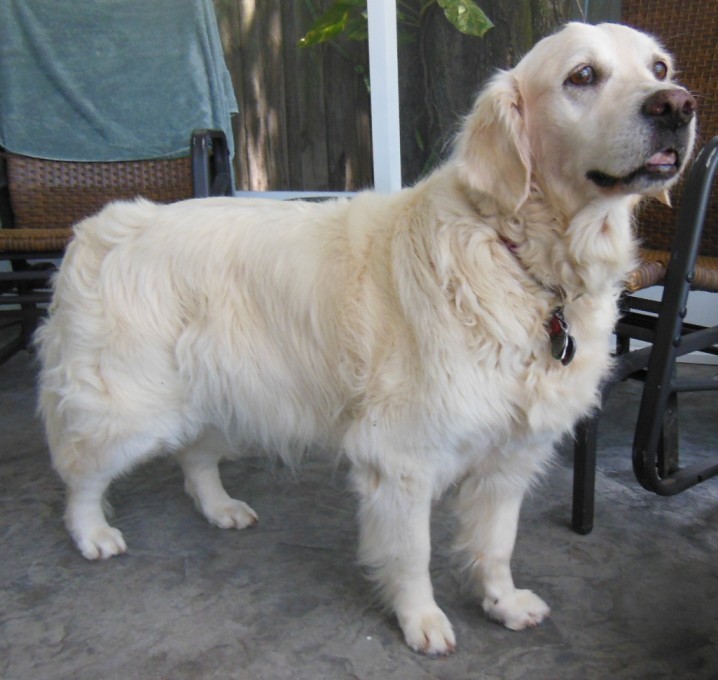
Time for a snack! (photo by Sae Hokoyama)

Figuring out what to feed a dog never used to be so complicated. For generations, dogs simply ate whatever the people in the family ate. Or, to be more precise, whatever they didn’t eat — dogs were often fed the leftovers from a family’s meals.

Then came commercial dog food. Kibble, canned, semi-moist — all were convenient and were touted as much more healthful for our canine companions. Over the past 10 years or so, dog food has gone gourmet, with organic foods, human-grade foods, foods that cost more than the average family spends on groceries for the humans … but is it better for the dogs?

The latest fads are raw food and no grain or low carb diets, all touted as closer to dogs’ “natural” diet. The “natural” diet is defined by looking at what wolves eat. Wolves eat a high-protein diet, with lots of bones mixed in. They are opportunistic omnivores and will eat fruit, greens, and vegetables if they find them or if meat is scarce, but they thrive on a high protein diet. Carbohydrates can lead to inflammation, some argue, and aggravate problems, such as arthritis, that feature painful inflammation. Raw diets are easier to digest. The less processing the better. Dogs may have evolved considerably since diverging from their wolfish ancestors, but their digestive system hasn’t changed. In short, the Paleo Diet for dogs. (The Paleo Diet encourages eating lean meats, seafood, vegetables and fruits and avoiding dairy, grains, legumes and processed foods.)

Or so one theory goes.

Yet another theory points to a recent study that shows that, in fact, dogs’ digestive systems have changed as they’ve become our housemates— they’ve evolved the ability to process and use (small amounts of) carbohydrates more efficiently than their ancestors. Their life sharing the sofa and the remote with their couch potato humans has made them more amenable to snacking on (and digesting) potato chips. This could be a boon for dog food manufacturers who pack their products with inexpensive and starchy fillers.

This theory is based on research by evolutionary geneticist Erik Axelsson. He was looking for genetic differences relating to dogs’ and wolves nervous systems. But he found something surprising: He found that the three key genes involved in digesting starch are different in dogs and wolves.

While several theories are debated concerning how dogs became domesticated, all involve wolves spending enough time around humans — and humans’ food and leftovers — to form a relationship. That the wolves hanging out with the humans evolved to eat the kind of food the humans ate makes sense. (And hey, if our early ancestors were eating starch, doesn’t that make the Paleo Diet irrelevant and wrong? Pass the popcorn!)

Which theory is right? What should we be feeding Fido?

First of all, dogs are not wolves. In dog training, myths based on idea “dogs are the same as wolves”  have done untold damage to dogs’ relationships with their humans. Is the same sort of damage now being done to their health through misguided nutritional guidelines?

Modern humans eat a wider variety of foods than our long-ago ancestors did, and our bodies work differently — though a diet high in unprocessed, whole foods and low in simple carbohydrates is still the healthiest option. The same is true, I believe, for our dogs.

In a discussion of Axelsson’s study, PetMD.com’s Daily Vet blog recommends a balanced approach. If your dog’s diet includes grains, whole grains are recommended. Less-processed food is preferable to highly processed. Starches should only form a small part of the dog’s diet.

What might matter more than whether your dog’s food includes brown rice and barley or is completely grain-free is the quality of the ingredients and the relative proportions. As I wrote in “Ask the Thinking Dog” last spring, choosing a safe, healthful dog food can be challenging. I look for U.S.-sourced, high-quality ingredients and avoid food processed in any of the large pet-food factories that are the source of the never-ending recalls. Our dogs eat Fromm Family kibble and Sojo’s, but each dog’s needs are different, so you’ll need to figure out how best to meet your dog’s needs.

A word of caution: While discussing your dog’s diet with your vet is a good place to start, I have found that many vets strongly recommend foods that they sell — but that might not be the best choice for your dog. For example, several vets over the years have recommended putting our dogs on prescription diet foods, available only (and at extremely high cost) through the vet. In most cases, a “prescription” food is not necessary, and a higher-quality food can be purchased less expensively elsewhere.

Do your research! Understanding what proteins and other ingredients work best for your dog can help you choose the correct (non-prescription) food. Talk to the people at a locally owned (not big-box) pet supply store that sells a variety of high-quality foods. Often, these folks are quite knowledgeable. Talk with other dog people, and pay attention to how your dog’s energy level, digestive system, and skin and coat health are affected by different foods.

A Doggy Sense of Fairness

doublebed

Do dogs have a sense of fairness? A sense of justice? Many people argue that only humans can grasp and use such higher-level concepts, but more and more research is showing that this simply isn’t true. And anyone who has lived in a multi-dog household knows that, if one dog is getting something good, the other dogs certainly notice if they are being left out or shortchanged — that is, they are being treated unfairly.

Ethologist and primatologist Frans deWaal states that reciprocity and empathy are the foundations of morality; these are also essential elements of fairness and justice. But fairness and justice are a little higher up on the cognition and morality concept scale. Fairness and justice go beyond the immediate exchange. An animal — or human — who does not recognize and practice reciprocity cannot truly have a concept of what is fair or just. Similarly, lacking empathy would make it difficult or impossible to understand the concepts of fairness and justice. De Waal has published research that shows evidence of reciprocity and empathy, and even fairness and justice, in chimpanzees and elephants. Dogs, with their long history of socialization with humans, surely are capable of these higher-level concepts as well.

We certainly know that some dogs have a strong sense of empathy. They feel the pain of other dogs or their people and offer cuddles or favorite toys in a gesture of comfort. And, we know that dogs illustrate reciprocity. They “take turns” winning at tug games with other dogs, even when the bigger, stronger of the two could easily win every match. I’ve even seen dogs line up for a turn at the water bowl.

Dogs are highly social animals. They learn and follow social rules. This starts when littermates temporarily refuse to play with a sibling who is playing too roughly. Dogs routinely shun playmates who are known to cheat — that is, dogs who give a play signal and then perform an action, such as biting, in a rough, non-playful manner. Doggy social skills matter — enough that many dog owners spend hundreds of dollars to teach their dogs proper social skills. The owners with dogs who don’t get it  — those whose dogs howl and lunge at the sight of another dog, for example — find themselves ostracized by other dogs and dog owners. I’ve heard enough stories of people who walk their dogs only in the wee hours of the morning or drive out to deserted paths to ensure they won’t meet other dogs to know how important proper canine social skills can be.

Social skills rest on rules about how we treat each other — which is a neat definition of a moral code. It is all about reciprocity, about not doing to others what you don’t want them to do to you. It is also about each member of the group getting his or her due. Fairness.

The next question is when and how this develops in dogs — and how far it goes. Cali wails in despair if I take Jana for a walk without her, so why doesn’t she object when she and I head to school — leaving Jana behind? Where’s the reciprocity? Is her sense of fairness focused only on herself?

Jana enjoys the solo walks — but she also accepts calmly the times that Cali and I leave her home alone. Then again, when young Cali gets puppy lunch, Jana demands her share — or an equivalent perk, like a treat toy with a really good cookie tucked inside. So, do dogs grow up and grow into a broader application of fairness, a greater willingness to reciprocate? Or does it all come down to protecting their self-interest?

In humans, we can trace the stages of moral development, from being very focused on one’s own needs and wants, through focusing on external approval, to an increasing ability to “do the right thing,” even if there is a personal cost. Stories of hero dogs hint that this moral growth is possible in dogs as well. Deni’s new guide dog, a highly food-motivated Labrador (hmm, isn’t that redundant?) passed a tough training exercise with flying colors: ignoring treats raining down around her as she guided Deni to a chair. This is a grad-school application of the “leave it” exercises I am practicing with Cali, and it demonstrates an ability to rein in impulses and refrain from gratifying a need or want — but why does she refrain? Because it’s the right thing to do? Because the human wants her to? Or because the dog knows that ignoring the treat will pay off in a reward?

The answer to that question, elusive though it may be, tells us where a dog is in the “moral development” process. In a class I teach, we’ll soon begin to examine a moral development theory that was developed to describe humans. It labels stages of development based on which reason is behind a person’s decisions. We’ll examine how these concepts apply to dogs and search for examples of dogs doing the right thing just because it is the right thing to do.

That does not mean never acting in their own interest: One fundamental of human moral development theory is that it is OK to take care of yourself, so long as you are also doing the right thing in regard to others. The canines I know would certainly agree with that. They might have learned not to take each other’s food, but they can (and do) certainly enjoy their own meals while being “good” to their canine sibs.

Puppy Tries to Downsize Older Dog, Steal Her Job

At the ripe old age of not-quite-three-months, Cali made her first play for Jana’s job. She liked the idea of a paycheck, in the form of some treats, delivered as soon as the work was complete.

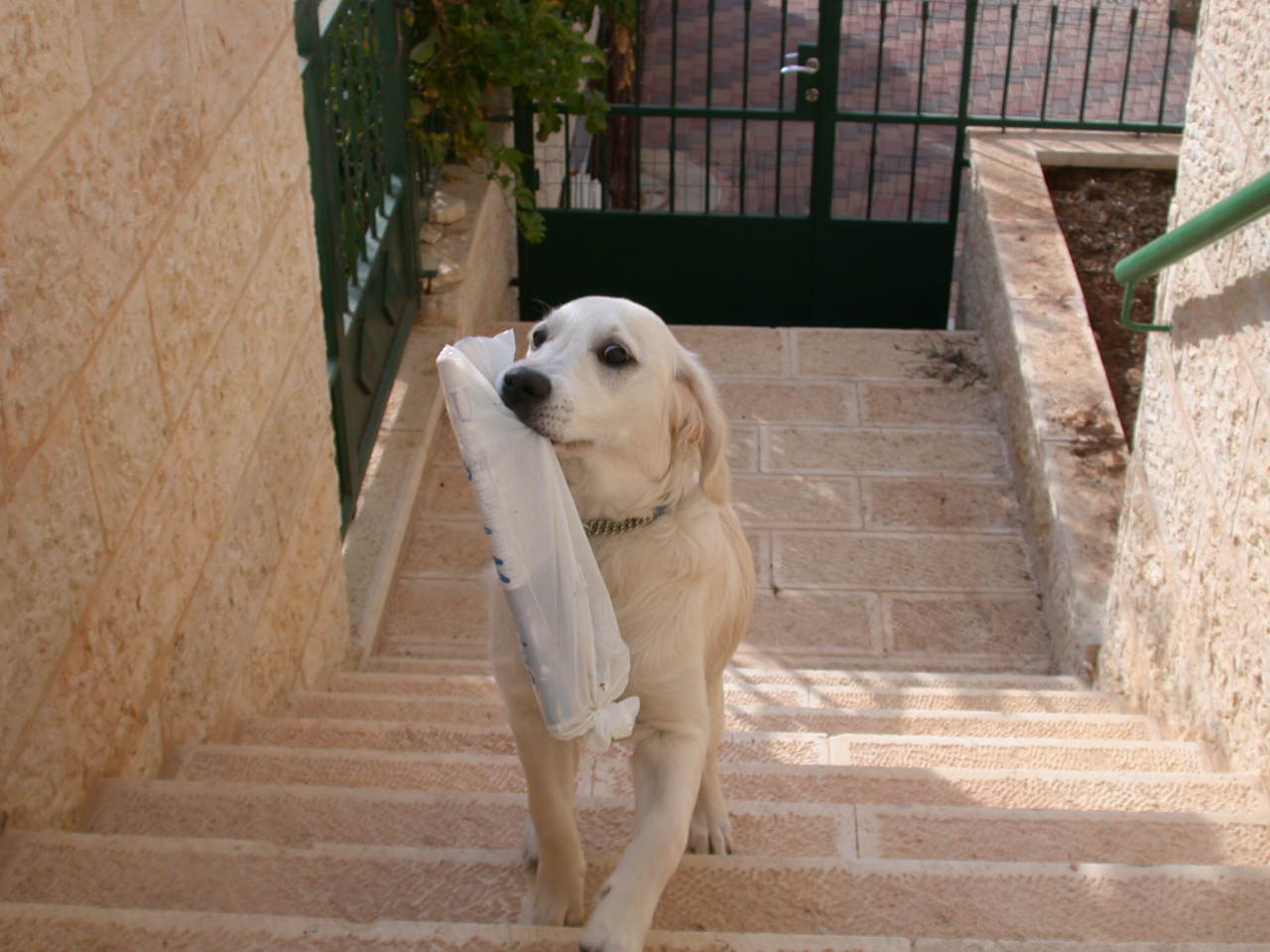
The newspaper was still bigger than Cali the first time she grabbed it and dashed off ahead of Jana. Reined in by a too-short leash, Cali was soon overtaken by Jana. Jana looked at her in annoyance, then reached over and snatched “her” newspaper back.

Jana’s held this job since she was a tiny pup, and she is not ready to retire.

get the paper

Since that day, I try to get the girls to take turns, and I give each one a reward, but Cali still wants that job. And Jana is not giving up without a fight. Sometimes the paper bears the brunt of this literal tug-of-war.

Cali and the Sunday Paper

Dogs need jobs. Ever more, dogs need opportunities to earn rewards. But I think what is really at play here is that Cali looks up to — worships — Jana and wants to do everything that Jana does. Cali learns new skills very quickly and I am sure it is partly because she is watching what her adored big sister does and copying every move, albeit in her clumsy puppy way.

Still, I think the best solution might be a second newspaper subscription.

The Best Big Sister!

play

I was worried about Jana’s reaction to the new puppy. She’s never been fond of puppies, to understate the situation. Usually, she pretends any nearby puppies simply don’t exist. If a puppy gets in her face, she usually raises a lip in warning and puts considerable distance between herself and the little brat. So, I wasn’t at all convinced that bringing a puppy into our one-room temporary home was a great idea.

Then Cali arrived with all her sunny friendliness and puppy charm.

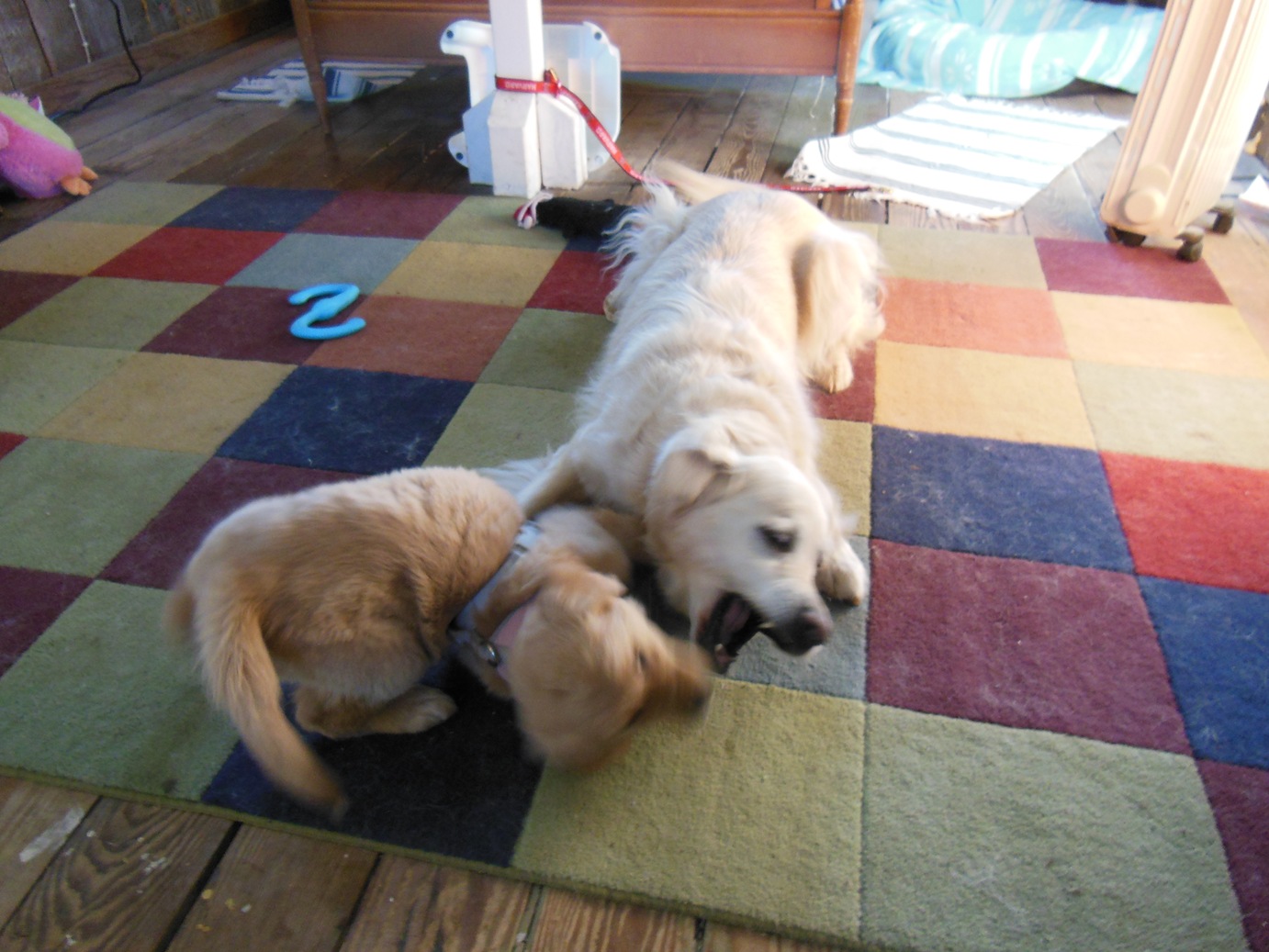
Within a few days, the first miracle: I caught them tugging on a toy, Cali’s comical puppy growls mimicking Jana’s play growl. The next day, the truly impossible happened: Jana forgot her elder-dog, anti-puppy dignity and actually invited Cali to play. It’s happened a number of times since then. In fact, when I start playing with them, they quickly re-engineer the game — to exclude me. I am beginning to feel like the waitress / doorperson / spa attendant. See them in action here: Cali and Jana playing.

Jana eagerly shows Cali what to do in training sessions and is teaching her all kinds of ways to have fun — roll in the grass! Eat mulch! Ignore Mom when she calls you to come inside! Drive Mom crazy by asking to go out every 5 minutes! Especially when it’s raining!

Cali watches worshipfully and carefully mimics everything Jana does. She so badly wants to be a big girl just like Jana.

There are lines though. Carrying the paper up the long, long driveway is Jana’s job, and Cali really needs to learn that. In fact, after wrestling the paper away from Cali this morning, Jana showed her outstanding work ethic: As we rounded the corner of the house, she spied a cat! She lunged, barked, lunged again, barked some more — all without letting go of the paper. I suspect she was putting on a show partly for Cali’s benefit.

There are minor areas of tension. Certain special bones are Jana’s. Only Jana’s. When Jana is choosing a toy, Cali had better stay away from the toy box, no matter how long it takes Jana to choose. And if Jana changes her mind and wants the toy Cali has, well, she is the big sister. Like most big sisters, Jana is often bossy and never lets Cali forget who is in charge.

At the same time, she’s amazingly patient with Cali’s boundless energy and need to play, bounce, cavort, run, jump, spin, and generally demand attention. Cali has gone too far only once, and she got a slightly nipped ear to impress upon her the foolishness of disregarding Jana’s warnings. Mostly, though, they are polite and appropriate with each other, they wrestle and tug and play happily together, and they share their toys far more amicably than most human siblings.

They are both girlie girls; their favorite toys are all pink. Small, purselike toys are popular, as is the bright pink pig that Jana selected on her first trip to a PetSmart several years ago, and a huge (pink) owl. They both like to play tug (with the pink rope), and both are highly food motivated. In some ways, though, they couldn’t be more different. Jana is very analytical and extremely selective about which people (or dogs) she’ll allow into her personal space. Cuddle? Hands off, please. Cali, on the other hand, has no concept of a “stranger.” Each human and dog on the earth, she is certain, was placed here to be her best friend — especially you. In fact, she just can’t wait to meet you. And you, you, and you. When she does, she’ll smother you with kisses, her tail madly wagging the whole time.

Come to think of it, how could Jana resist? How could anyone?

Introducing Cali!

on janas bed

Our family is growing! Meet Cali, the newest member of the Hogle and Elliott household. Except, of course, she’s in California with me and Jana now, not home in Florida with Deni.

Single puppy parenthood is a challenge! Cali is wonderful about asking to go out when she needs to … but that means that I have to be quick to respond, whatever the time of day — or night. How do parents survive months of this? After just over a week, Cali is waking up pretty consistently around 1 a.m. and again between 4 and 5 a.m. The second time, I just let her cuddle with me until it is time to get up at 5:15 or 5:30.

Yes, mornings begin early with a puppy. She’s full of energy, happily greeting her toy box like a long-lost friend, bouncing from one end of the small studio to the other, trying to get Jana to play, turning somersaults, and generally being a puppy. All while I am trying to find the ON button for the coffee pot.

By the time dogs go out, dogs come in and wipe their feet, I build a fire in the wood stove and take a shower, dogs have breakfast, we all walk down to fetch the paper (Jana does all the work here), I have breakfast, we play, puppy goes out again … well, I am ready to go back to bed. And it is only about 7 a.m.

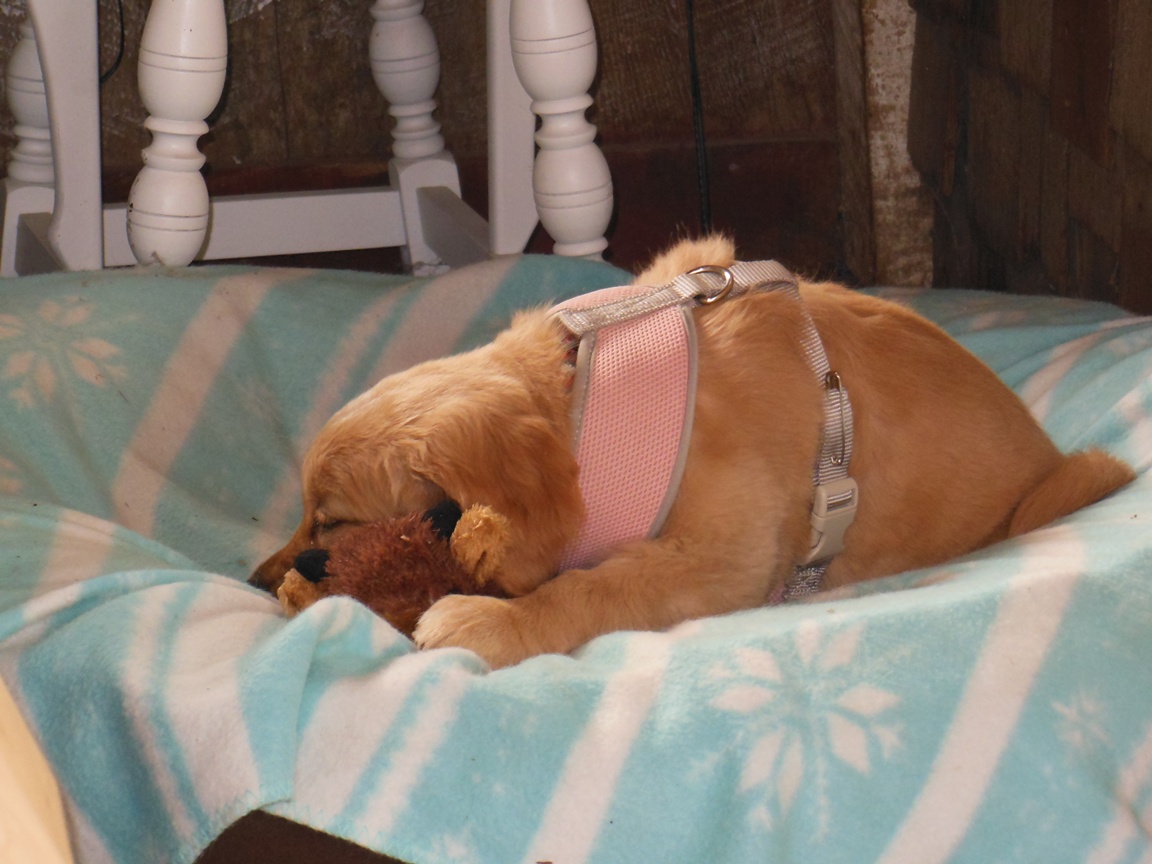
The good thing about puppies is, they take a lot of naps. But, many of these are power naps, which means that, after 20 short minutes, Cali is wide awake, full of energy, and eager to play. I, having tried to get 3 hours’ worth of work done during those 20 minutes as well as pay some attention to Jana, am less refreshed and eager to play. Sometimes, she’s lucky she’s so cute.

She uses her cuteness on others as well. At Bergin U, where I am teaching this semester, Cali has charmed the students, staff, and volunteers. She is easily the most popular girl on campus. The benefit for me is that, the more people who come play with her, the more naps she takes! In fact, she’s taking one now, having been thoroughly worn out by a dedicated volunteer who drove in from more than a half-hour away — to play with Cali!

I was a little worried about her the first few days she was home. She didn’t show much interest in eating and even left food in her bowl! She has adjusted quickly, though, learning the attraction of food-filled Kong toys, solving her Brainy Bone puzzle (to get at the hidden Charlee Bear), and begging for meals and training treats.

Speaking of training, this puppy is clearly a genius, well on her way to learning several cues and tricks. I think she’s a lefty; she shakes with her left paw about 3 times out of 4. She’s got a nice “sit” and is catching on to “down,” “turn,” and a few others. She’ll even pick up a wooden dumbbell, but is not quite reliable about giving it back to me yet.

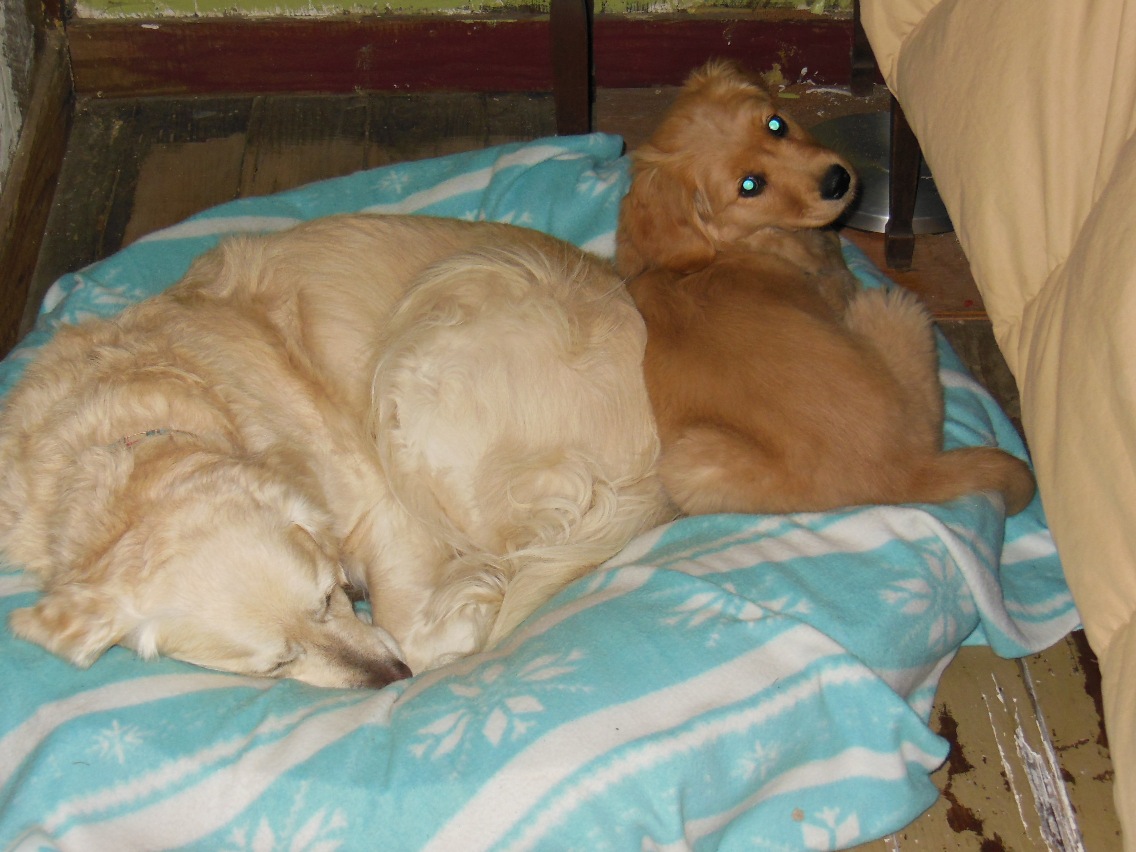
Most miraculous of all, Cali seems to be on her way to charming big sister Jana. She is definitely the annoying little sister sometimes — clamoring for attention, bugging Jana to play, appropriating Jana’s bed and toys. But, yesterday morning, something momentous occurred. Jana asked Cali to play. The two romped and tugged with her for a few minutes before Jana remembered her older-dog dignity and her opposition to puppies and went back to bed. The puppy tires her out too!

Tug

Bidding Farewell to Wylie

Cool

Wylie is heading off to learn his new career this week. Deni’s difficult decision to let him go and to seek a professionally trained guide dog, whom we hope will be a better fit for both her personality and her needs, is described in Loving and Letting Go, an earlier post on the Thinking Dog Blog. But Wylie was part of my pack, family, life too — and saying good-bye brings up some tough issues.

I think of dogs as family members. Taking a dog into your life, I believe, is a lifetime commitment — you take it upon yourself to care for the dog for the rest of his life (or the rest of yours). Yet I believe that letting Wylie move on to a new life is the best choice for him as well as for the rest of his pack/family. I’ve been struggling to reconcile these conflicting views.

Wylie wasn’t a pet; he was a guide dog. But he wasn’t a good fit for the job Deni had assigned to him. We’re both confident that his new job, working with a veteran, will be a better match for Wylie’s personality and needs. He’ll revel in the intense companionship and enjoy his new responsibilities. He might be matched with a young, athletic guy who can give him the exercise he craves, too.

None of that makes it easy to say good-bye. What makes it hard, I think, is that for all that I try to study human-dog communication and improve my ability to communicate with dogs, I am still human — with that human tendency to be overly reliant on words. For all his intelligence and perceptiveness, Wylie is a dog who doesn’t use language the way we do. That gap is sometimes tough to bridge.

So we can’t prepare Wylie for what is happening, can’t help him understand that we love him and want him to be happy, can’t call him on the phone to find out how his training is going. He’ll be confused and sad when Deni leaves him with Jennifer, his new trainer. There’s no way to explain to him that, after some training, he’ll get to go live with a guy who will be his best friend and constant companion. While he senses that something is up, Deni says, he doesn’t understand what.

I also know that dogs are more “now” focused than most people are, which means that Wylie will quickly adapt to his new routines. He makes new friends easily. I am sure that he’ll be the star of the training class before long. Even knowing all of that, and feeling sure that it’s the best choice for him, it still feels strange and sad to say good-bye.


Loving and Letting Go

A Guest Blog by Deni Elliott

wylie ballSometimes things just don’t work out. He is intensely athletic; I’m a stroll-on-the-beach kind of gal. He always wants to be in charge; I think that responsibility should be shared. He likes hanging out with the guys, and he unabashedly flirts with the girls; I crave a less-social life and want him to have eyes only for me. But when we are alone, I need some private time; he dogs my every move.

After four years of trying to make our partnership work and then carefully planning for our separation, I’m ready to announce this to the world: I love Wylie more than I can say. He’s smarter than I am, good-hearted, and generally well-intentioned. But Wylie and I are breaking up.

My guide dog’s career change feels a lot like ending a human relationship. As with intimacy between humans, the partnership of human and guide dog is a dance of inter-dependency and cooperation. Compatibility is required.

Wylie counts on me to give him everything that he needs to be a well-adjusted German shepherd, and he is not shy about communicating his demands to me.

I put my life in his paws every time that I slide the harness over his shoulders and say, “Forward.” I trust Wylie to choose the path as he guides me under low-hanging branches, steers me around obstacles, and takes us across streets, avoiding the traffic that I can hear but cannot see.

We communicate moods and expectations up and down the harness as we let each other know what is next in our progression from Point A to Point B. If we’re out of sync with one another, we both get frustrated. And while our ability to read one another has astounded others observing us, the frustration has become more than either of us can handle.

8 wks Wylie (2)Wylie is the second guide dog that I have raised from young puppyhood, enlisting the expertise of professionals to accomplish training that I couldn’t do on my own. I’ve owned and trained dogs since I was a child. My visual loss was progressive, but slow. I thought that I was better able than a guide dog school to prepare a dog to meet my special needs.

As a puppy, Wylie showed strong potential to become a guide. My successful partnership with my first guide dog, a golden retriever named Oriel, made me unrealistically confident. Oriel was, in the words of many who knew her, “the perfect dog.” When she retired, I assumed that I could make the guide relationship with young Wylie work just as well. I struggled through the first year and thought that he would mature and grow into his job. I was wrong. Wylie’s basic personality did not change; nor did mine. When I finally realized that I couldn’t make things better, I knew that I owed Wylie the chance for a better life.

On January 23, Wylie will start training to be a service dog for a veteran with Post-Traumatic Stress Disorder (PTSD). For the first time in more than 12 years, I will depend solely on my white cane to pick my way through my travels. Wylie and I will both be in transition and will grieve the loss of one another.

But not for long.

Wylie (2)Wylie will have new challenges from the start. He will live first with Jennifer Rogers, director of PAALS, a service-dog training school that is affiliated with Fort Jackson, the U.S. Army base in Columbia, South Carolina. Wylie and other dogs-in-training will spend one evening each week on the base with active-duty service members and veterans who are coping with combat-related anxiety. Under Jennifer’s supervision, the dogs will learn to help people with PTSD; the soldiers and veterans will teach the dogs how to assist others like themselves. Dogs and humans will learn to support one another.

When the time and match is right, Wylie will become an “intensive companion” dog for a veteran who is not yet ready for the challenge of working with a service dog out in the community. Dog and veteran will be encircled by a team of mental health and service dog professionals who will support their journey together.

I will be supported in a new journey as well. On March 4, I will join a training class at Guiding Eyes for the Blind in Yorktown Heights, New York. After intensive training there, I expect to return home with a 2-year-old mellow yellow Labrador retriever at my side. I’ll have a guide dog bred and trained by experts who create and maintain ethical working dog relationships. After many hours of application to, evaluation by, and conversation with Guiding Eyes personnel, I trust that they know better than I how to find me the best guide dog match.

Wylie’s new life will be very different from guiding me around obstacles that I cannot see. Crucially, it will be a life that is more in tune with his nature. The behaviors that he will be trained to do on cue include leaning against his partner, resting his head on his partner’s knee, lying on his partner’s feet, and providing a friendly-but-safe barrier between his partner and others. With me, Wylie got to connect like this only after his harness came off and he was done guiding for the day. Providing a partner such physical support 24/7 is Wylie’s dream job.

Wylie has always wanted more physical connection than I could handle. When I was done working for the day, I wanted some time free of my canine umbilical cord; Wylie wanted the intense physical contact that he lacked when he was walking two steps ahead of me, in harness.

The behaviors that have been problematic for me will be just what Wylie’s new partner needs. Wylie will bond with a veteran who needs a canine companion to guide him out of a darker place than I have ever experienced. It is likely that Wylie’s new partner — a veteran with deployments in Iraq, Afghanistan or both — will be no more than 30 years old. Wylie will finally have a young partner who is able to provide the daily intensive exercise that he craves.

Wylie will no longer endure long hours lying under a desk while I work in the office or teach my classes. He will no longer sigh and resign himself to STILL being on duty when I sternly command him to turn left to guide me to the Dean’s office when he wants to turn right to walk home and be done for the day. And, most importantly, Wylie will no longer have to pant and tremble as he struggles to guide me through airports and onto airplanes, a task that he finds increasingly stressful.

CoolSome people will criticize me for not letting Wylie retire and spend the rest of his days lounging at home. But, all dogs need stimulation; a young, intelligent dog like Wylie, who is accustomed to life out in the world, needs it more than most. Long days spent alone and doing nothing would be unbearable for him. Others will say that it is cruel for me to give him away, suggesting that I don’t love my dog as they love theirs. But I know that Wylie would not be happy watching me leave home with another dog doing “his” job, even if it is a job that he sometimes hates. I love Wylie enough to recognize that he’ll be happier moving on.

I will get over losing the goofy frat-boy who has been part of my life for 6 years. I will have learned yet one more lesson in loving and letting go. I’ll get past the guilty feeling that I failed this dog. From this perspective, it seems to me that I’ve been helping Wylie get ready to be the helper dog that he was really meant to be. I appreciate his true nature enough to let him go forward and be that dog.


Special Delivery

A story Deni told me about Jana has been going through my mind for several weeks now. I haven’t figured out the answer; maybe the students in my spring-semester class on the dog’s perspective will help me figure it out.

We have had a lot of work done on the house lately, and somehow, the gate to the backyard got left open. I was away.

Deni reports that the dogs woke up and took themselves out the electronic dog door as usual. Then, suddenly Wylie was back at the bed, barking at her, quite insistent that she get up. Not fully awake, Deni complied (Wylie rarely takes “no” for an answer). She noticed that Jana had not come back inside. Wylie was frantically urging Deni to the back of the house, where she noticed the open gate. And no Jana.

Now fully awake and worried, Deni quickly pulled on some clothes. Again, Wylie alerted her. This time, she followed him to the front of the house … where Jana was standing at the front door. Not only that, Jana was holding the morning newspaper (hmmm, too bad she didn’t nip out for fresh bagels while she was at it).

Relieved, Deni let Jana in and lavishly praised and rewarded her. But for what?

While Deni was delighted that Jana had stayed home, she and I both wonder how Jana understood the event.

Did Jana think she was being praised for simply doing her usual morning job of getting the paper? Or had she made a conscious decision to not seize the unexpected freedom and go for a swim or chase the cats next door? Did she understand that Deni was grateful for her restraint?

Maybe Jana finds too much freedom frightening and chose to return to safety.

Maybe she was afraid she’d get in trouble for being out and hoped that the paper would mollify Deni and mitigate punishment.

These are plausible explanations.

But Jana has had other opportunities to run through open gates, and she’s never passed one up. Just this week, when the roofers were packing up, I inadvertently let her out the back door before the back gate was closed behind the roofer’s truck. Within seconds, she was in the back alley. She did return immediately when I called her, though. And she’s often wandered off on her own during walks or hikes, farther than the front porch (but never so far that she could not see me or Deni).

She’s never gotten more than a scolding (and a leash) when she’s wandered too far afield in the past, so fear of punishment is unlikely.

She may have simply made the choice to stay close to home because she knew that that was the “right” thing to do. Could she have understood that Deni could not easily pursue her?

Which begs another question: Why did Wylie go to alert Deni rather than seize the moment, as it were, and go for a run? He has done so in the past. Was he worried about Jana or about keeping his pack intact? Was he delighted at the role reversal — that he got to be the good dog (and the tattletale) this time?

Though many people do not believe that dogs are capable of such deep, conceptual thinking, I do believe that Jana and Wylie are capable of making the judgment to do the “right” or the expected thing, even in the face of temptation. I have seen it many times in working dogs (including Wylie) — as well as in Jana and other pet dogs. I’ve also seen  both Jana and Wylie give in to temptation and follow their impulses or their instincts. Just as we humans sometimes “do the right thing” and sometimes do what’s fun or feels good, so do dogs.

All things considered, my best guess about that morning is that she didn’t want to miss breakfast. Your thoughts are welcome.

Squirrel Dude, the Undefeated Champion

A young Kong addict

I’ve sunk quite a bit of money into toys for Jana over the years, starting with stuffed Kongs when she was a tiny puppy. It took her only a few days to master the art of completely emptying a stuffed Kong. Soon, she had it down to mere seconds, even when I had the Kong filled with softened kibble, mixed with peanut butter and frozen (most puppies love these, and tossing in a Kong make crate training so much more fun for the puppy).

Thus, when little Jana was only a few months old, my quest began for the perfect treat toy. “Perfect” being defined as “will keep her busy for more than 10 minutes.”

I have tried everything. She has a collection of treat toys large enough to open a museum, or at least a doggy day care. Sucker that I am, I will shell out retail if I see a new toy that looks promising. Online deals are another money pit. We’ve got the Dog Puzzler, the Buster Cube, and the Twist N Treat. We’ve tried the Tricky Treat Ball, Orbee ball and TreatStik. We’ve got complete sets of Kong Genius and Busy Buddy Linkables, rubber toys of various interlocking shapes. And no, the Thinking Dog Blog does not receive any free products to try out.

Enough treat toys to stock a doggy day care

Jana is now 9 years old. She has, at long last, met her match: Squirrel Dude.

Squirrel Dude is a large purple squirrel made of hard rubber. He is hollow inside (much like Jana) so I stuff him with treats (much like Jana). Her job is to get the treats out.

Simple, no?

No.

She has been known to work at emptying Squirrel Dude for a couple of hours … and still bring him back to me with a biscuit piece or two rattling around in his belly. The introduction was made by a good friend and superior dog mommy (thanks, Emmalee!). It is a match made in heaven.

Squirrel Dude’s secret is a set of prongs or fingers that hold the treats in. That, and he’s quite fat,  so it is not easy for her to squash him enough to break the biscuits into small pieces that will fall out through the (smallish) hole.

Squirrel Dude wins the day

In many rounds of competition, Squirrel Dude has defeated Jana every time. Yet losing to this formidable purple rival has not diminished her affection for him at all. In fact, she is cradling him now, cookie bits still trapped in his belly, as she lies, exhausted, next to me.

Squirrel Dude’s closest competitor is the Busy Buddy Linkables, whose many possible configurations sometimes keep her busy for up to an hour. And the Orbee ball was an early success. Watching her figure it out — finally by rolling onto her back, squashing the ball with her jaws to break the biscuit, and manipulating the ball with her paws so the hole was lined up with her mouth and the pieces of cookie dropped right into her mouth — taught me a lot about her intelligence and problem solving ability. But she now has the whole operation down to about 3 min., and it only takes that long if I use a really thick, hard-to-crush biscuit.

What’s interesting is that Wylie is not at all interested in any of these toys. He likes the TreatStik and the Tricky Treat ball. Basically, as Deni says, he wants something he can just push around with his nose and have the treats fall out. Just goes to show that not all toys work for all dogs.

Jana, who is extraordinarily food motivated, will work much harder than Wylie to extract food from a toy. She enjoyed a TreatStik, too — only rather than push it around, she attempted to enlarge the hole the treats were falling out of. I finally took it away when she reverse-engineered it by figuring out how to unscrew the top.

I do offer her the other toys occasionally, if she needs a quick snack or if Squirrel Dude needs a day off. But, really, how can I resist a hunky purple guy who keeps my girl safely entertained for hours, challenges her mentally and wears her out?

A tired dog is a good dog, after all. And if the sweet little smile on her face is any indication, a happy dog as well.