Frans de Waal Was a True Friend to All Animals

The cover of Mama's Last Hug shows a close-up of an elderly cimplanzee's faceAll of us animals, humans and non, lost a great friend and advocate with the death of primatologist, author, and storyteller Frans de Waal in March.

Gently and convincingly, de Waal debunked the arrogant assumptions that only humans experience complex emotions, are capable of empathy, or engage in complex thoughts and behaviors.

A prolific writer, de Waal authored the bestselling “Are We Smart Enough to Know How Smart Animals Are?” and “Mama’s Last Hug: Animal Emotions and What They Tell Us About Ourselves.” His style is approachable, and the stories he shares are profound. One of my favorites is the study he did on pay equity with Capuchin monkeys. Spoiler: Monkeys recognize — and push back on — unfairness, as do dogs, chimps, and many other non-humans.

Unafraid of controversy, de Waal took on more than moral behavior in animals, addressing “alpha” male behavior, gender differences, and much more, consistently challenging “accepted” wisdom and expanding our understanding of non-humans’ abilities.

His final work, on how humans’ thinking about animals has evolved, will be released next year, according to the New York Times obituary for de Waal.

A Guide Dog’s Vision of Freedom

Artist Emilie Gossiaux stands in front of a 15-foot tall white cane and talks to visitors. Red and purple flowers are in the background.

What does freedom look like to a guide dog? If the hierarchy ranking people above dogs — and people without obvious disabilities above people with — vanished?

Deni and black Lab Hildy look closely at a 5-foot, white sculpture of a playful dog, London, who is standing on her hind legs.An art installation by Emilie Gossiaux attempts to answer these questions. I described her work, titled Other-Worlding, in a post a few months ago — without having seen it. Then, I was among a fortunate few able to participate in a “touch tour” on the exhibit’s closing day. Along with the tour, we got to eavesdrop on a conversation between Emilie and curator Sarah Cho.

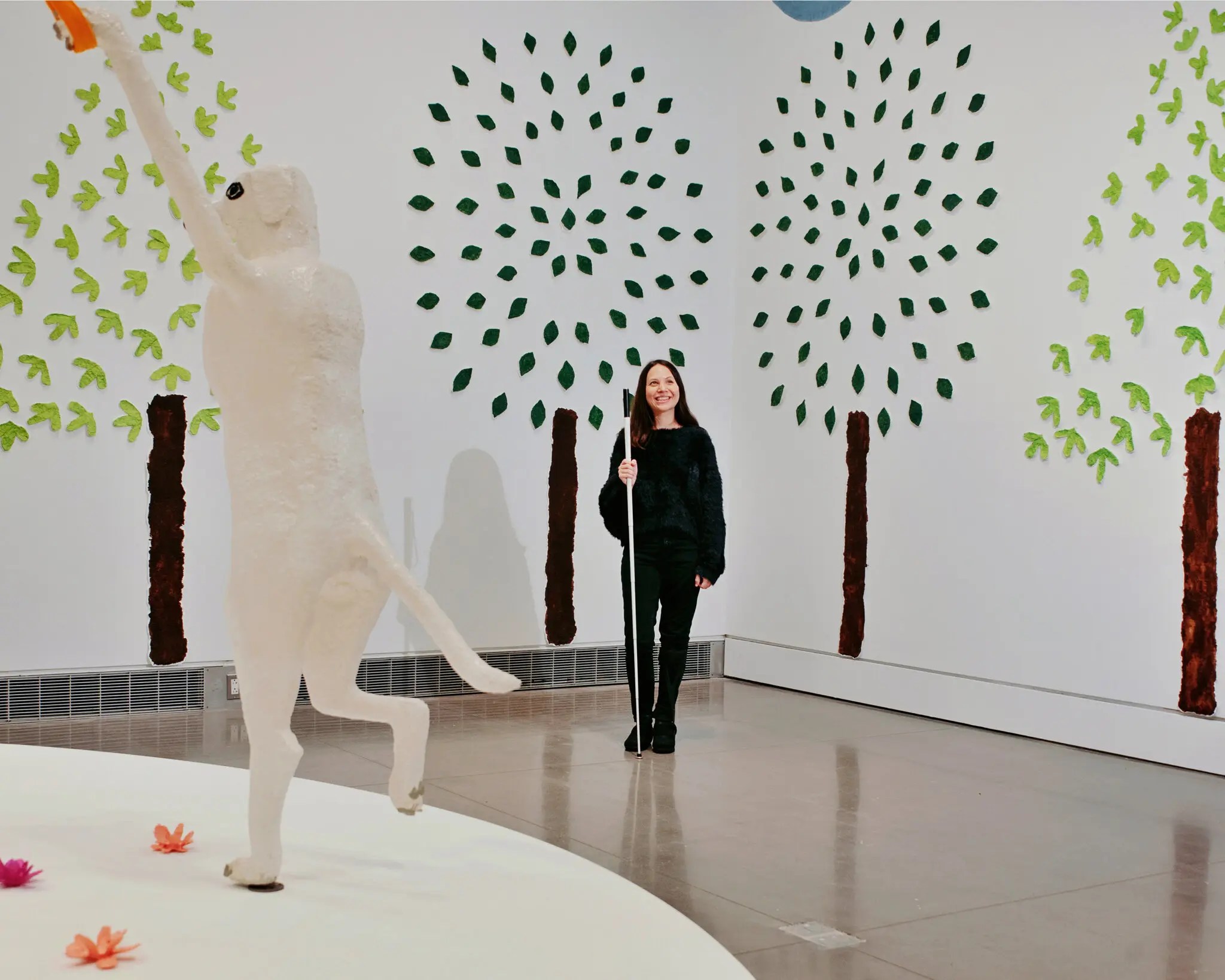
The center of the exhibit is a 15-foot-tall white cane of the type many people with visual impairments or blindness use to navigate. Its central role in the sculpture emphasizes  the importance of a cane to Emilie’s independence.

Around this cane, turned into a whimsical maypole, dance three human-sized dog sculptures — each a vision of a liberated London, Emilie’s recently retired guide dog. One London is attentive and alert: ready to guide. One London is relaxed and blissful: London on break. The third London is playful and uninhibited. Each London, rather than being attached by the neck to a leash, instead loosely holds the handle of a brightly colored leash — the streamers on the maypole.

For Emilie, both the cane and the guide dog represent independence, a liberation of sorts from limitations imposed by her impaired vision. But the art piece goes beyond that to imagine London liberated as well, from the constraints of a society that sees dogs, and all non-humans, as “less than” humans: less valuable, less capable, less worthy.

Black Lab Hildy stretches to sniff a red papier-mache flower.… All while leveraging dogs’ and other non-humans’ extraordinary capabilities to do things that humans cannot.

During the tour, each participant touched various pieces of the installation, describing what we saw and felt — textures and colors, the dog’s body position and expressions. Even Guide dog Hildy got in on the action, gently sniffing a papier-mâché flower. Afterward, in her conversation with Sarah, Emilie described the importance of her use of color and texture in creating each element of the installation: Flowers and leaves, tree trunks, the dogs’ bodies with palpable texture, and a smooth material to create the dogs’ noses, paw pads, and nails. Spring colors, a bright green for leaves, peachy orange, opalescent purple, and deep red for flowers, gold, red, and purple leashes, along with a bright sun and moon, add joy and energy.

She also described her research into societies that move beyond conventional hierarchies and boundaries. The title, Other-Worlding, is from the work of feminist scholar Donna Haraway; Emilie’s ideas on the dog-human partnership draw on Beasts of Burden, by Sunaura Taylor, and Dogsbody, by Dianne Wynne Jones. Though I am not familiar with either work, I enjoyed the perspective of guide dogs as full partners to their humans and the image of a world where dogs enjoy liberation and the enlightened respect of humans who value them as they deserve.

Should You Crate-Train Your Puppy?

Orly examines a sloth toy in her exercise penI’m generally not a fan of crating dogs, so I read this Washington Post article, “Should you crate your dog? It’s complicated,” with interest. It is complicated.

I have used crated while house-training young puppies and to keep them safe and out of trouble when I couldn’t supervise them. I have had young puppies sleep in a crate until they are sleeping through the night, then I keep all of us in the bedroom with a dog gate. That way, if pup needs to go out, she’s likely to wake me rather than find a remote corner of the living room where she can do her business and go back to bed. I stop gating the bedroom when I am reasonably confident in the dog’s house manners.

I have also used crates when fostering or dog-sitting anxious dogs who tended to be destructive when unsupervised. In both of those cases, the dogs seemed happy to go into and stay in the crates, and seemed less anxious in the crates than when left alone in a room (even if I was home and they could come find me). That assessment is based on their vocalizations and body language.

I think that both of those uses of crates are fine, if:

  • The dog has been acclimated to the crate using positive means
  • The crate is large enough and comfortable
  • The dog is happy to go into the crate
  • The dog is provided with safe chew toys, treats, and/or comfort items
  • The dog is only in the crate for short periods of time (never more than a couple of hours)
  • The crate is never used as place for time-outs or punishment

I have never used a crate routinely when I leave an adult dog home, even when I worked full-time in an office (!!) and the dog(s) were home for many hours. Especially then!

I work hard on house manners with puppies I raise and I have gotten all of my puppies to the point of being trustworthy by the age of 6-8 months. That is, if your definition of trustworthy allows for some unauthorized use of sofas and comfy reading chairs while you’re not there …

This is not possible with all dogs, of course. Some pups and adolescents are more destructive. In those cases, I would suggest working with a trainer and figuring out how to get the dog more exercise and enrichment. A dog hiker or dog walker is a lifesaver when you have an active young dog and work long hours.

Why all dogs need SOME crate training

I also believe that all dogs should at least be exposed to and get used to being in a crate. If you need to transport the dog somewhere, board the dog on short notice, keep the dog on “bed rest” following an injury or surgery, have someone take the dog because you had surgery or an accident — you do not want the emergency situation to be the first exposure to crating.

Some dogs hate crates

Some dogs flip out the first time they see or enter a crate, even if the door is open and they are totally free to leave. Some dogs go right in and curl up as if they’ve been sleeping in a crate their whole lives. The younger the first exposure, the easier it is to move past a bad first reaction.

Alternatives to crates

For dogs who are adamantly anti-crate or are still working on accepting the crate, there are other options. I’ve set up a puppy-safe room when possible — hard floor that is easy to clean, minimal or no furniture, dog bed, and sturdy, safe toys.
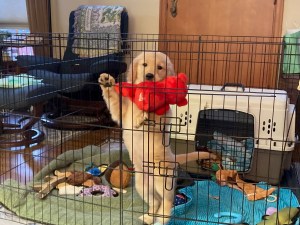
10-week-old golden pup Orly stands up in her ex pen to protest. she's holding a red toy.I’ve also set up an “ex pen” or exercise pen. These are sturdy wire mesh panels that are configurable into a square or rectangle. This can be in a living room or rec room where the dog can hang out and see and hear what’s going on — while being safely contained. At least until she learns to climb out.

I tape plastic sheeting on the floor, tape the panel bottoms to the sheeting, and add some rugs or blankets, safe toys, a water bowl if the dog will be in there for a while. It’s like a deluxe, roofless crate. Orly wasn’t impressed and regularly threw tantrums when penned, but she was safely contained while I was cooking, say, or in a meeting and unable to focus on her. And she quickly and eagerly demonstrated impeccable house manners to earn her freedom.

There’s no one answer that works for everyone. As we established, it’s complicated.
Happy Birthday, Dotty!

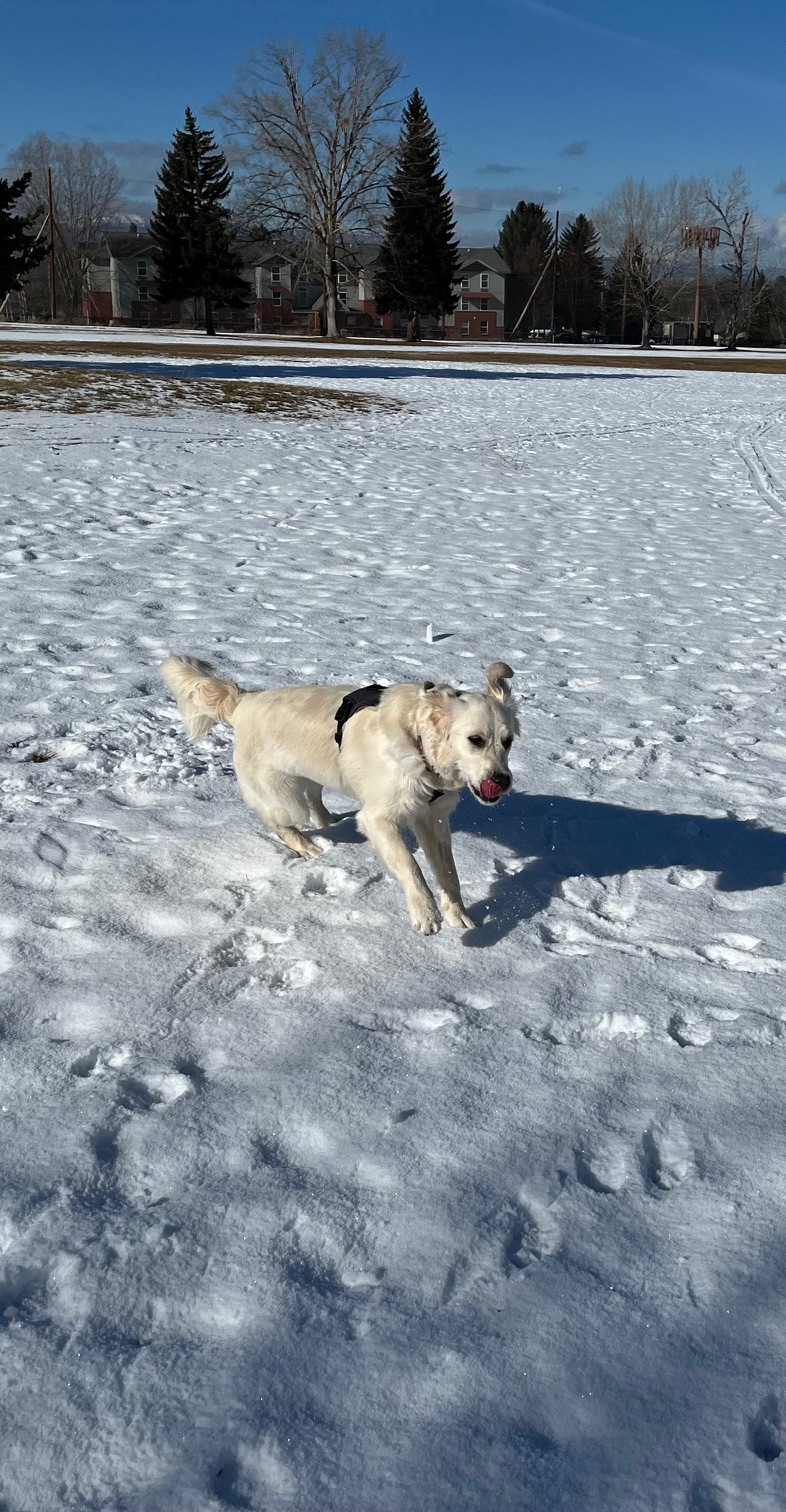
White golden retriever Dotty leaps on a snowy field, her ears flyingDotty is one year old today!

Unfortunately, my celebration with her will be delayed …

She’s spending some quality time with her trainer. A great deal of quality time, which started during a recent trip I took. Dotty went to board with her trainer, and he promised to work on some of the issues I’d raised with him and … well … found that Dotty needs a lot of work.

To be fair, she’s very typical of golden retriever puppies; she’s just more than most puppies I’ve worked with: More energetic; more aware of every little sound or movement in her environment; more excited to see people she knows, people she doesn’t know, dogs, cats, squirrels, deer…

Orly had a Highly Energetic phase in her adolescence, but it only lasted a few months. Dotty … hasn’t settled down yet. And Orly never achieved the heights — quite literal — of Dotty, who is given to leaping high into the air, with all four feet off the ground, several times in a row(!) when she’s excited.

So Dotty is learning to have better impulse control and to focus on the task at hand even when temptation tempts, whether in the form of a squirrel nearby, a plastic bag blowing in the wind, or a random stranger walking toward her on the sidewalk.

Dotty is also typical of golden pups, adolescents, and adults in that she adores everyone, loves to snuggle, and is sweet and goofy. We (her trainer and I) are still optimistic that she’ll be a fabulous service dog some day. But maybe not just yet.

Walk Your Dog!

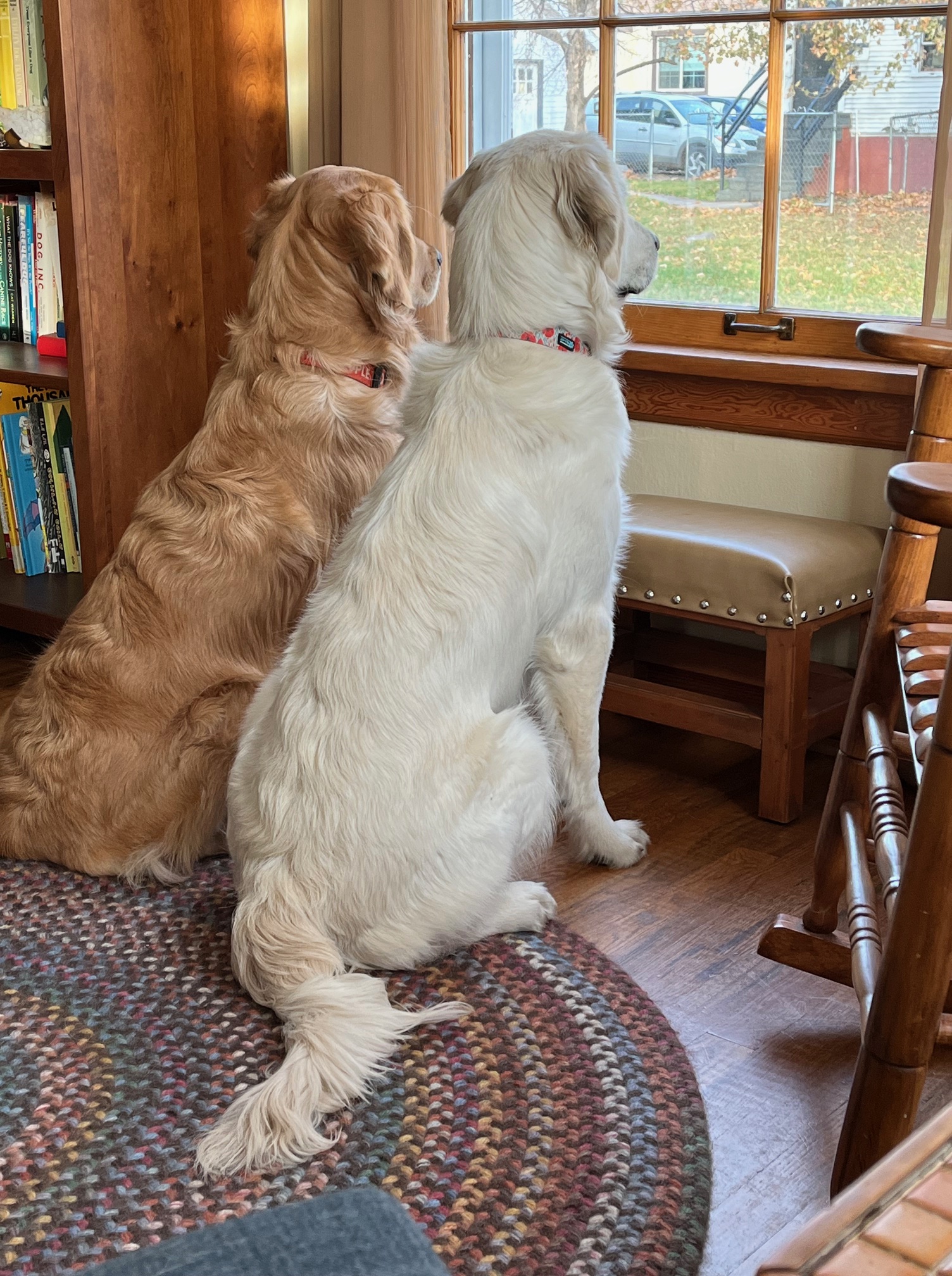
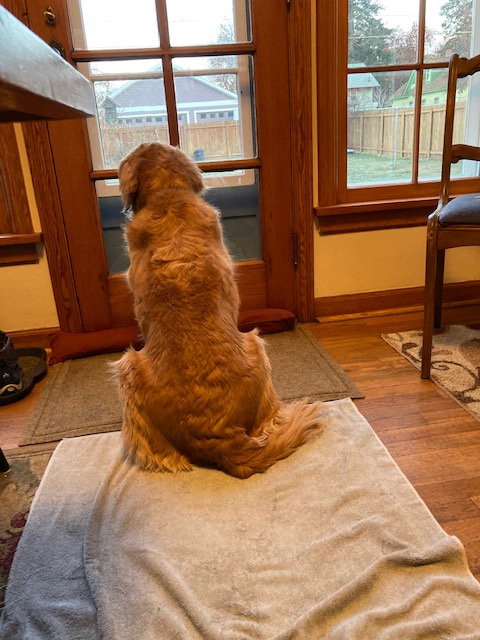
Golden retrievers Dotty (white) and Orly (gold) look out a large wood-framed window.
Watching the world go by is nowhere NEAR as much fun as smelling it!

Bored? Feeling stiff? Been staring at a screen — any screen — for too long?

Walk your dog.

A recent Washington Post article points out the many reasons to walk  your dog. Nothing earth-shatteringly new, but it bears repeating.

Walking your dog is good for your dog in so many ways — mostly not about exercise. Or not primarily about exercise.

Quality time

Your dog loves spending quality time with you. Walks are the pinnacle of quality time for dogs (well, for some dogs a game of fetch or tug or a belly rub might claim the top spot). This means no “multitasking,” mostly seen as fiddling with your phone while walking your dog. Focus on the dog — and on meeting the dog’s needs and wants.

I do this by letting the dog(s) choose the direction we walk and by letting them stop and sniff frequently.

Dogs need to sniff & learn

The sniffing is essential. As Kelly Conaboy, the Post writer says hanging out only in their own yard is like “reading the same book over and over again.”

Dogs discover so much about the neighborhood and its other canine (and squirrel, raccoon, and deer…) inhabitants by sniffing. Entire books have been written on the importance of sniffing (to dogs) and their astonishing abilities. Smell walks provide the kind of mental stimulation that we dull humans cannot provide, no matter how many treat toys, training sessions, and games of backyard fetch we offer.

For Dotty and Orly, the sniffing is huge — but so is the opportunity to see new things. They are ardent squirrel-watchers, love our safely distanced encounters with deer, and live for the frequent opportunities to greet friends, neighbors, and random strangers: Whenever we walk to the park, we get to say hi to George, an older golden retriever gentleman who is nearly always in the most beautiful yard in the neighborhood, and who comes running over to say hi (OK, maybe I am the one who gets the most out of these encounters …). A chance encounter with the neighbor who always carries top-grade dog treats is like winning the lottery! A stop at a different neighbor’s always-stocked treat jar (actually a plastic fire hydrant with an elaborate screw-off top) is a close second, more like winning $50 from a scratch-off. Some days, we get all three!

In the months she’s been with us, Dotty has watched a large house get a new roof; seen an old house be demolished, a new foundation dug, and walls begin to go up; and studied countless fire trucks, street sweepers, delivery trucks, motorbikes, and more. She’s met preschoolers at the playground and watched them splash in the turtle fountain and play on the climbing equipment. We see the neighbor kids board the school bus many mornings, often after they give each dog a pat or scritch.

Exercise for both (all) of you

With two young dogs at home, I could take the easy way out and let them play in the yard. They get plenty of exercise wrestling and chasing each other.

When it’s very cold and icy, I (very occasionally) do that. But we go for at least one and usually two (or more!) walks a day. I need the exercise and the break. They need the exercise and the break.

Most dogs will not get enough — or any — exercise alone in a yard. The exception is a young dog like Dotty, who has far too much energy for her own good: She often runs laps in the yard just to burn off steam. This makes me sad (and a little relieved …) since it makes clear how far I am from meeting her needs. Unless she’s training to run in the next Missoula marathon…?

Shockingly (?) a third of the respondents to a 2011 study admitted to not taking their dogs for regular walks. (How many more lied?) Don’t be one of them! Dress for the weather, leash up … and head off to wherever your dog takes you!

“Bed Rest” for a 10-Month-Old Puppy?!

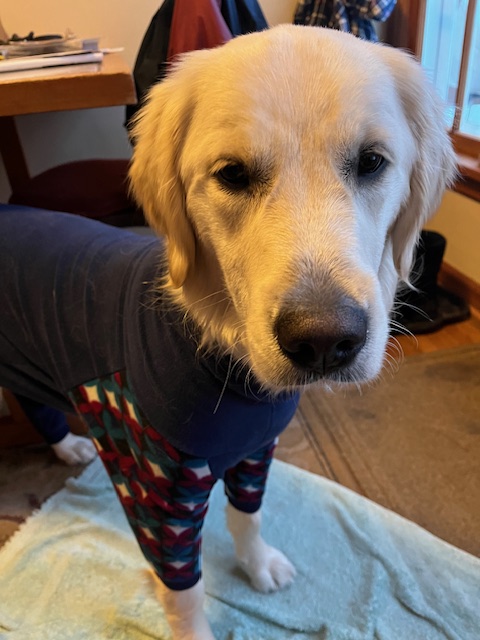
White golden retriever pup Dotty wears a navy blue fleece with red-patterned sleevesDotty was spayed recently.

She’s not my first puppy, so I have been through the post-surgery experience before, several times. But Dotty is far more energetic, impulsive, and active than any of my previous puppies.

Keep her “quiet” for the next two weeks, the vet tech says. As Dotty, mere hours post-surgery, explodes into the exam room, dancing and bouncing. Quiet. Right.

I prepared by purchasing some new dog chews and stuffing Kongs and Toppl toys with kibble and peanut butter and freezing them. I dug out the “suitical,” a doggy onesie that snaps around the tail.

The first few days were fine. Dotty likes clothes, so she was happy to wear the surgical suit, as well as a fleece jumpsuit that covers her belly. She did not try to lick, chew, or scratch at the stitches.

But by four days in, Dotty had forgotten about the surgery. She wanted to play. She desperately begged Orly’s hiker to take her along. She ran in circles in the back yard.

Orly was no help, constantly play-bowing to Dotty and trying to sneak in some wrestling while I was in work meetings. I hauled out the Kongs and separated the girls with gates.

Protecting the surgery site

I also failed to prepare in one critical way: I did not get out the soft cone and get her used to that.

Soon, the clothes got dirty. More furry than anything (except the time I forgot to unsnap the suit before taking her out to pee…). Ok, I thought, I’ll just wash these and put the cone on …

Silly me.

Dotty took one look at the cone and ran up the stairs. I lured her back down, showed it to her … and off she bolted.

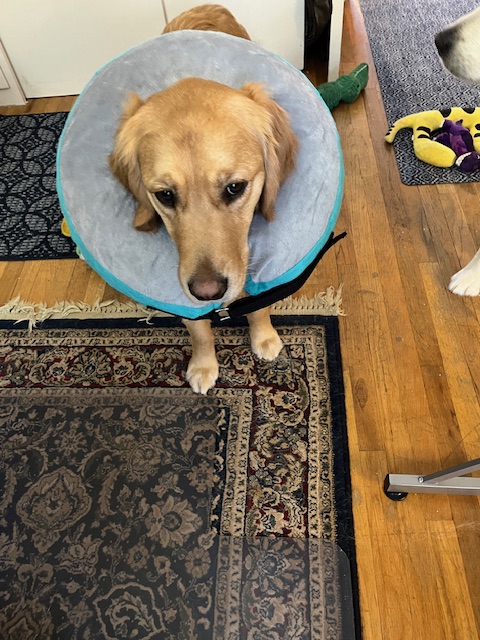
Golden retriever Orly models a gray and teal donut-shaped collar
More cookies. NOW.

I got a surgical “donut collar” and … similar response, even after Orly (unhappily) agreed to model it while eating cookies. Lots of cookies.

We spent a couple of days playing with the donut. Orly would poke her head through and get a cookie. I put it on the floor and put cookies inside it. After watching Orly scarf down dozens of treats, Dotty wanted in. A few play sessions later, she gingerly agreed to put her head through the donut. By the next day, she was reluctantly agreeing to wear it.

At this point, though, my barely functioning brain had come up with a new idea: belly bands.

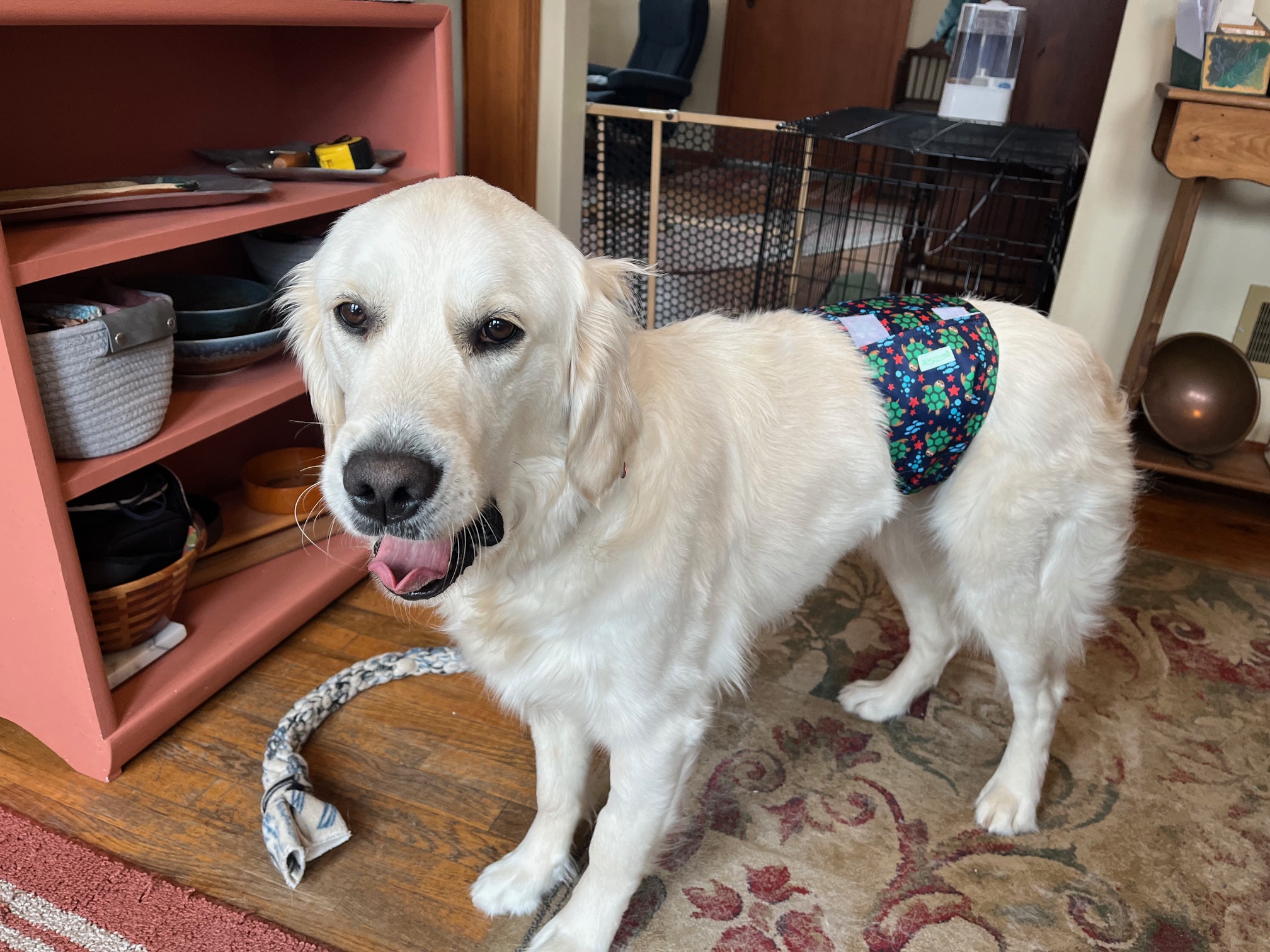
Dotty, a white golden retriever, wears a blue belly band with small turtles on it. She's yawningThese are designed for boy dogs who are either not house-trained or have incontinence issues (post surgery, or injury or age-related, etc.). Coincidentally, the target area for soaking up boy-dog dribbles is an anatomical match for the girl-dog post-abdominal-surgery stitch area. In other words, a belly band perfectly covers the stitches while fitting closely enough to block curious noses and scratching paws. Even better, it allows the dog to pee, unhindered.

Belly bands are inexpensive and washable. So basically, the perfect solution has been available all along, and I only figured it out with the last puppy I plan to raise … Typical.


My Most Demanding Job

Goldens Orly and Dotty and boxer mix Stella line up at the door, asking to go out in the dark early morningMy teammates at work might think that my most demanding job is prepping for the annual conference where I select and manage the speaker program. They’d be mistaken.

My year-round, 24 x 7 x 365 job is to serve as doorperson.

I spent Christmas with some of my favorite members of the extended “pack-family” — Stella and Cruiser. They, along with Orly and Dotty, kept me pretty busy. Besides the critical responsibility of letting them in and out, constantly, there were auxiliary duties: Playing tug with Stella and her Large Orange Toy. Throwing balls and other toys so Cruiser and Dotty could run after them, catch them or pick them up, then run around with them and not bring them back.

4-month-old golden puppy Orly, wearing a gray coat, touches a bell next to a wooden doorBut mostly, it’s doors. Dogs and doors have an ancient issue, which is that dogs are always on the wrong side of the door. People, having invented doors and therefore caused the problem, are duty-bound to solve it. Over and over and over.

Golden retriever Cali tries her magic sit by the wood-and-glass back door, facing the yard

Some dogs, like a very young Orly, learn at a young age to use tools to get their humans to open doors more quickly. It’s really fun to ring the bell over and over, getting the human to open the door, close it, open it, close it. Bonus points if you time the ringing to seconds after the human sat back down.

Others try to use the magic sit, which only works if the human is in the same room and paying attention.

Dotty is learning the bell system, mostly from Orly. She still abuses it, asking to go out to play, wanting to go in and out constantly.

As a member of a steeped-in-tech generation, Dotty is quickly picking up a new solution I am testing out, the Smart Bell 2.0 from Mighty Paw. I first saw this as a “Gear of the Year” selection in Whole Dog Journal, and quickly ordered one. Dotty adjusted to the change immediately, while Orly, of a slightly older generation, is taking a little longer to catch on to the nose-press gadget that triggers a sound that gets the human to come to the door.

It’s still new, but advantages I see are that I can put a transmitter outside, so the girls can let me know when they are ready to come in, and the sound (which offers multiple ring tones and volume levels) is loud enough that I can hear it anywhere in the house.

I’ll let you know how it’s going!

The ‘H’ Dog Is a Superstar!

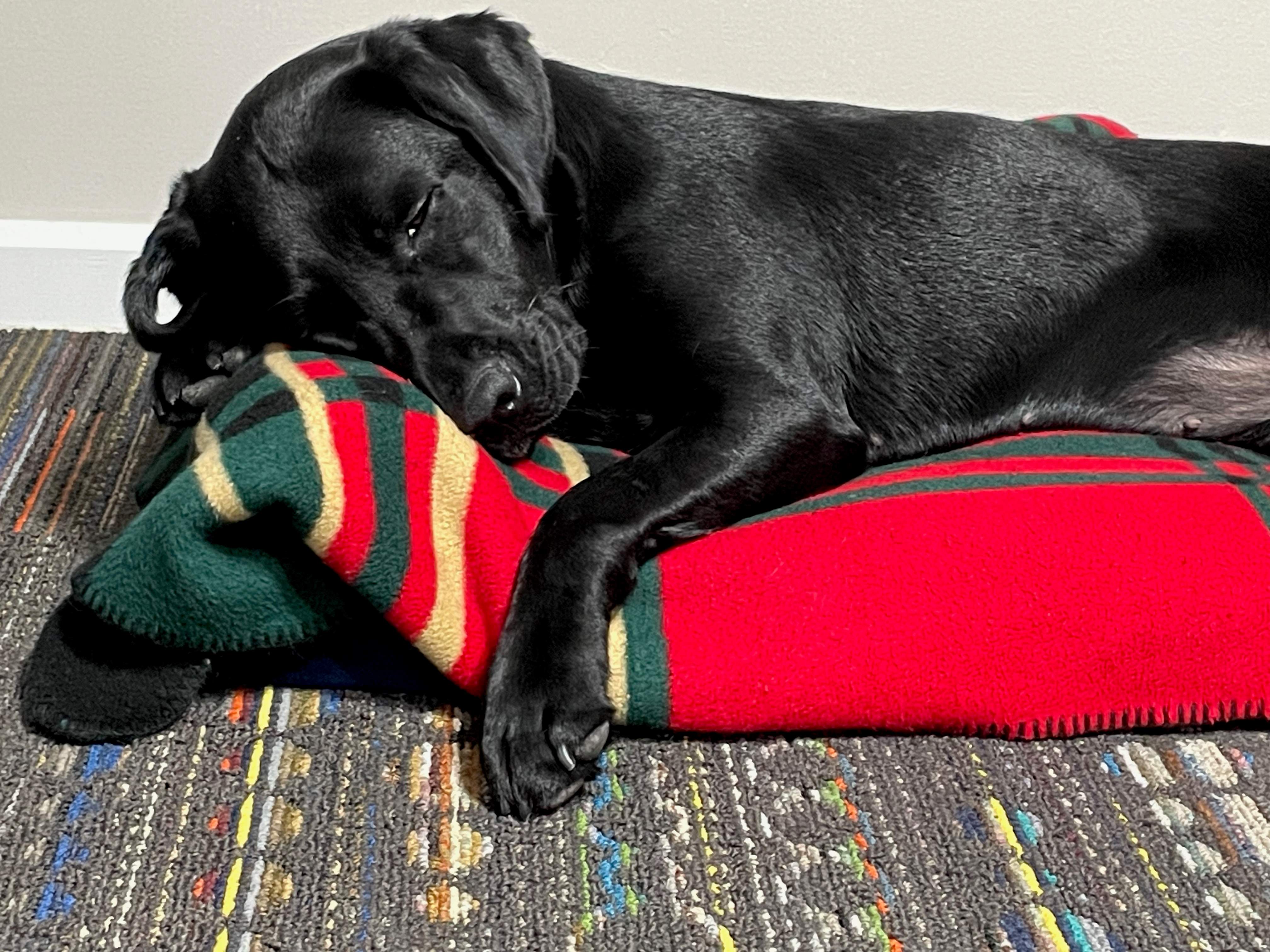
Black Lab Hildy lies on a red pillow with her front paws cuddling the pillowGuiding Eyes Hildy, who had no desire to be called Hayley, Hilly, or anything else, has proven an outstanding addition to the Thinking Dog pack.

She’s taken to the neighborhoods of St. Petersburg like the pro that she is, unfazed by wind, strange birds — even very large ones blocking the sidewalk — and large palm fronds blowing around or also blocking her way. She expertly guides past construction, broken sidewalks, cars, bikes, boats, and anything else in her path. She was momentarily startled once by a dog-and-raccoon kerfuffle (don’t ask) but even took that in stride.

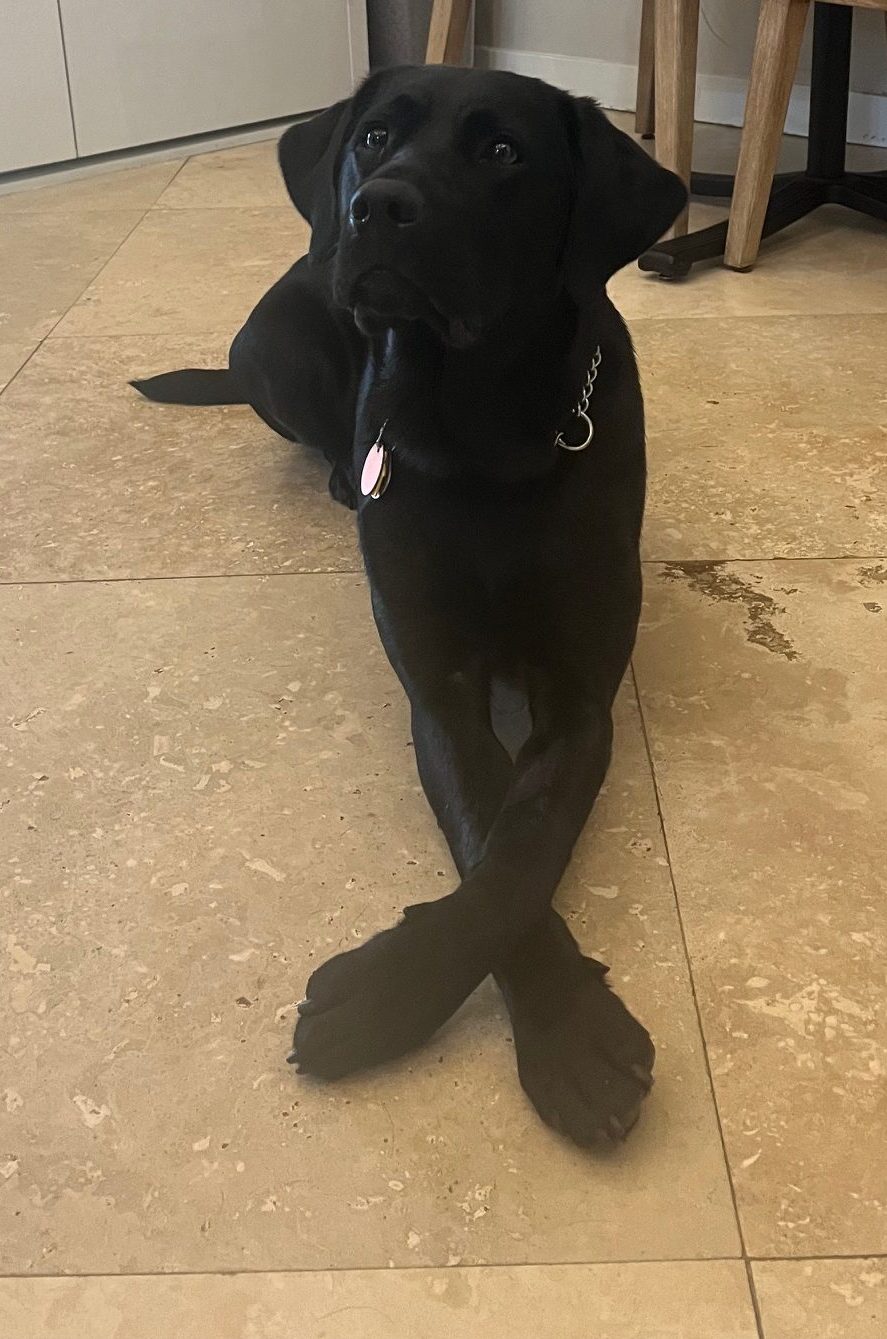
Black Lab Hildy stretches out on a tan floor with her front paws crossed. She’s charmed the groomer, the vet, the neighbors, the yoga class, and fellow concert-goers throughout the city. She enjoys watching yoga, perched on her own mat, with her paws delicately crossed, though she often chooses to join in, performing each pose with natural grace.

Best of all, she’s an excellent traveler. Hildy is quickly learning all of the tricks of the trade, finding Sky Clubs, identifying her suitcase on the carousel, and finding the correct restroom as needed. She’s calm on the plane. Well, except for that incident with the severe turbulence … but even then, all she wanted was a cuddle. After a long travel day with many delays, Hildy made peace with airport restrooms-for-dogs and understood the value of an opportunity to take a break.

She’s playful and silly when she’s off duty, and she shares Koala’s and Alberta’s love of the midday treat-ball break, efficiently bringing the ball to be filled, emptying it, then putting it away. (Maybe she’ll teach Orly and Dotty??)

Good girl!


Guide Dog Stars in New Museum Exhibit

Artist Emilie Gossiaux holds a white cane as she stands in the room with her exhibit. Two trees with papier-mâché leaves are behind her.Artist Emilie Gossiaux’s recent fellowship at the Queens Museum resulted in an art installation centered on her guide dog, London. Three Londons, in fact, dancing around a maypole. The maypole is actually a 15-foot-tall white cane, a symbol of how she regained freedom following an accident that caused her to lose her eyesight.

Her artwork since then has often focused on London, her 13-year-old Labrador guide — and more broadly, on removing barriers between animals and humans and celebrating their partnership and mutual dependency.

The Queens Museum exhibit, while Gossiaux’s first solo museum exhibit, is not London’s first starring role in her art. Gossiaux told the New York Times that her work featuring London has been influenced by the writer and scholar Donna Haraway, who examined relationships between humans and non-humans in multiple works, including The Companion Species Manifesto.

In addition to the human-adult-sized dancing Londons, Gossiaux has created other sculptures and drawings focusing on other aspects of her life with London and of other interspecies relationships.

Other Worlding is on exhibit at the Queens Museum until April 7, 2024. If you’re lucky enough to be in New York before then — and can arrange to visit the museum — let me know what you thought!

A Dog by Any Other Name …

Black Lab Hildy holds a blue stuffed toyThe Thinking Dog family has welcomed a new member, Guiding Eyes Hildy. Or Hil, Hilly, Hillary … or maybe Hayley. Miss H is Deni’s new guide dog from Guiding Eyes for the Blind, and she arrived at the end of November!

Whatever Deni ends up calling her, she’s off to a very promising start.

Hildy is a creative problem-solver and a bubbly and affectionate pup, wrapped in a compact black Lab body. She’s been with Deni for just over a week as I write this and has already explored some of St. Petersburg’s best restaurants, shops, and parks, as well as visiting the airport, the vet, and, of course, the dog beach.

Hildy shares many characteristics with Alberta, Deni’s first Guiding Eyes dog: Her sense of humor; her willingness to try new things; her silly, licky, wriggly love for physical contact; and a penchant for sitting with her hands crossed during rare moments of calm.

That may be because they are closely related: Hildy’s grandma is Alberta’s half-sister!

Hildy loves toys; a favorite is a squeaky koala. She likes to be challenged and is already a bit bored with the morning walk along the waterfront. She was delighted with the dog beach, unsurprisingly. After an moment of hesitation, she entered the water cautiously — and within a minute, was racing up and down the surf, swimming, and splashing.

I hope that Deni and Hil…ly enjoy many years of working and playing together!

This slideshow requires JavaScript.