The happy person driving down the road while his buddy rides along, head hanging out the window, ears flapping in the wind, is an iconic image for dog lovers. That’s why it was so exciting when Beau, my aunt’s new dog, jumped into the car with no help — and with great enthusiasm — recently. He had surgery on both knees before my aunt adopted him from a boxer rescue group, and his hind legs are still shaky.
We were even more thrilled when he jumped onto the back seat from the foot space. He wanted to sit next to me, which was gratifying. But I’m no longer visiting, and he’s still getting up onto the seat. He seems enthusiastic about going for rides and is equally thrilled with the adventures in store when the car arrives at its destination. He’s been on walks in different places and helped drop off the recycling once. Now that Beau is willing to get onto the seat, we’re wondering what kind of rider Beau will be. Is he the head-hanging-out-the-window type? Not all dogs are.
Cali’s riding style is to sit up and look out the window, watching everything that goes by. When she realizes we’re going someplace familiar and fun — her sister’s house, for example, or the dog beach — she gets really excited and starts pacing and sometimes squealing. For this reason as well as for general safety, I usually seatbelt her (and the other dogs) when we’re off on a car adventure. Cali gets the window seat on the passenger side of the car; if she were sitting behind me, I’d have to contend with more than her vocalizations: She likes to lean over the shoulder of whoever is sitting in front and nuzzle that person’s neck — and drool on her shoulder.
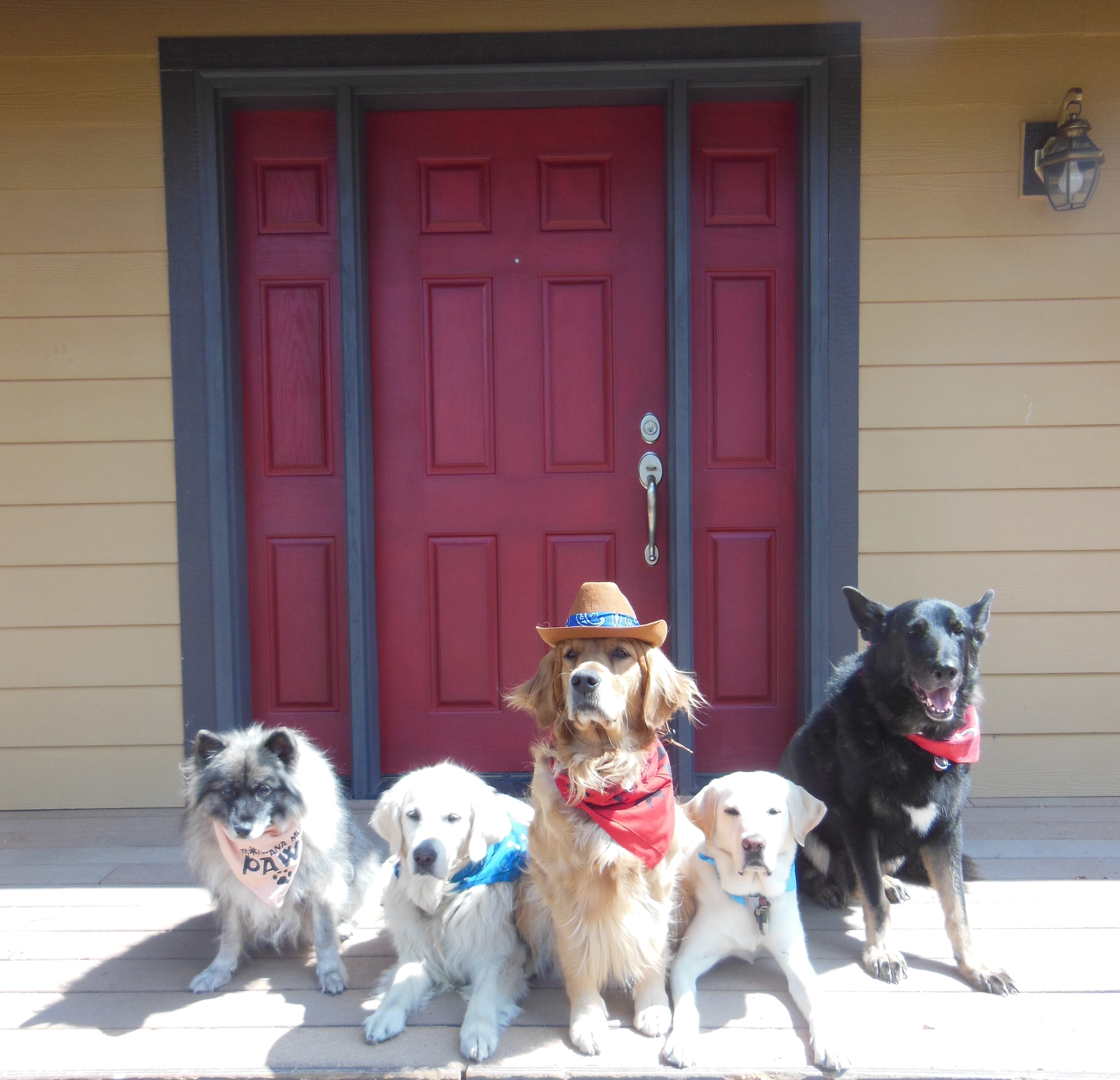
Alberta gets the middle because she likes to poke her head between the front seats and say hi to the driver and passenger. For a petite Lab, Alberta has a surprisingly heavy head. It can be hard to get into the storage console when she’s in the car, using it as a pillow. And forget about using that console as an arm rest.
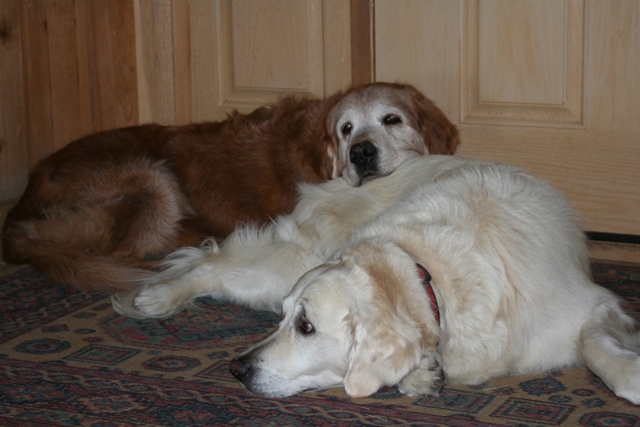
Jana is the most mellow rider in the family. She curls up and snoozes. Sometimes she cuddles with Alberta. Several years ago, when Oriel was still with us, Jana and Ory spent most of a cross-country drive snuggled up together in the back seat. On a recent trip to Yellowstone, we did get Jana to sit up and take notice, but only when the bison came right up to the car.
Fortunately, all of our dogs love car rides. But some poor dogs are scared or get carsick. For them, a car ride is worse than a nail trim! Whether Beau hangs his head out the window, drools on his driver, or just sits there and smiles, I wish him many miles of enjoyment in the car.
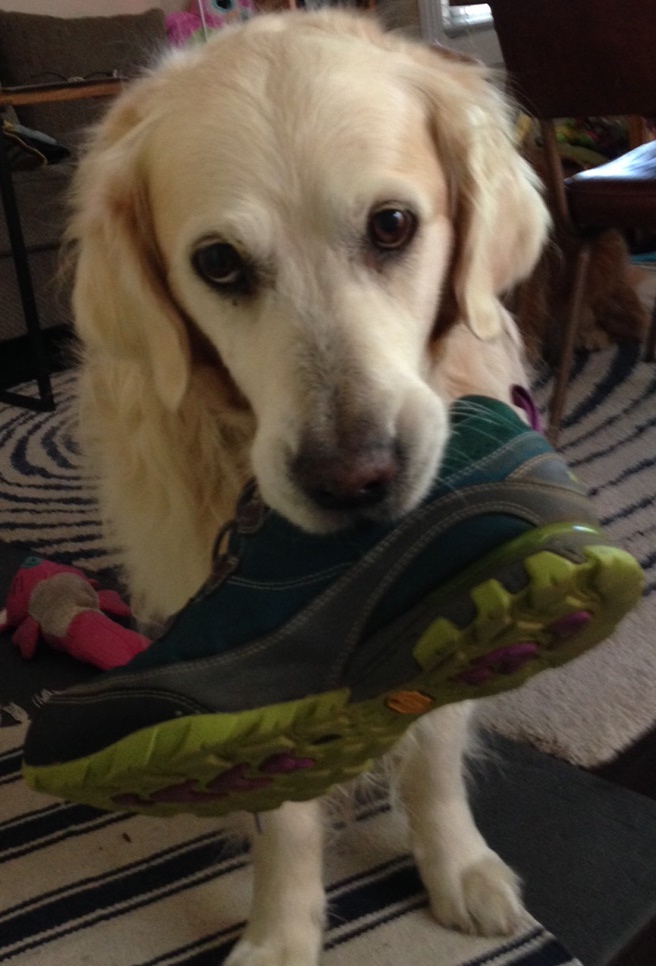
Our dogs have jobs that they are expected to do, similar to assigning household chores to a child. Jana brings in the morning paper. Jana and Cali each bring me a shoe when we’re getting ready for a walk. And each dog is expected to bring me her food bowl when she’s done eating.
Jana learned this task very quickly. She does it eagerly, always happy to receive her dessert in exchange (a small cookie). Alberta is also an eager participant, usually the first to finish her meal and deliver her bowl. If I am not paying attention, she’ll push it into my leg, hard, in a not-at-all-subtle demand for her pay. Past dogs have learned the task too, though Wylie made it quite clear that he saw this task as beneath him — girls’ work — and he would immediately depart for more masculine pursuits upon finishing his meals. Jana was happy to pick up the slack (and the extra cookie).
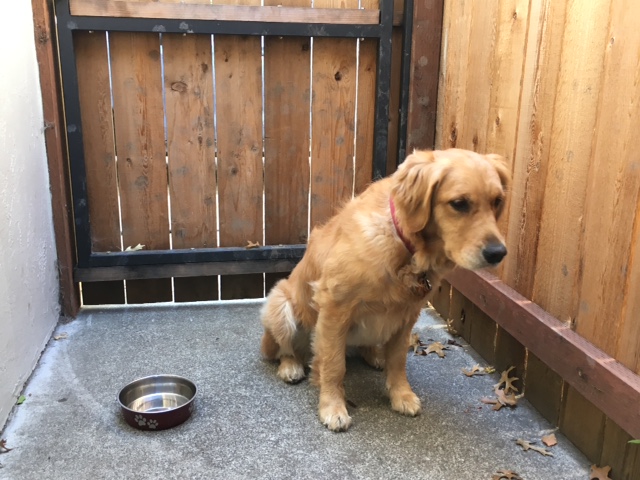
Then there’s Cali. For months, she’d pretend to try, lifting the bowl by one edge before dropping it with a loud clang. Putting on her saddest golden retriever face, she look at me as if to say, “I tried, Mom, but I just can’t lift it. It’s a very large bowl, and I am a very small puppy.” As the very small puppy became 56 lbs. of solid muscle, this excuse held less and less water, but the sad eyes … well, let’s just say that she does a very good “sad golden” face.
Along came Deni. Not only did we switch Cali to a smaller bowl this summer, but Deni took over much of the feeding supervision. Deni wasn’t moved by the sad face. Weeks of cajoling and praise and cookies paid off. Cali started bringing her bowl, but reluctantly and only with much encouragement. Once we knew that Cali understood what was expected and that she was fully capable of doing it, the coddling was phased out.
Now, as Deni explains, Cali broods over the looming task or “stands there and glowers at her bowl.” She knows she’s supposed to pick it up; she simply does not want to. It’s similar to her reluctant acquiescence to brushing her teeth. But, more and more, Cali talks herself into bringing the bowl with no prompting from either of us. Deni reports that if Cali sees that extra-special treats are being offered for dessert, she is able to convince herself to pick up the bowl much more quickly, and she does so with far more energy and enthusiasm.
The battle of the bowl shows Cali’s increasing maturity and offers a window on her personality and intelligence. We all sometimes choose to do things that we do not want to do. Sometimes we do them for rewards (a paycheck, working extra hours to earn a vacation …) or to avoid worse consequences (dental checkups) or because we don’t want to disappoint someone we care about. Whatever the reason, we all face large and small decisions every day. Cali is no different.
In his wonderful book Beyond Words, which I have mentioned before, Dr. Carl Safina talks about sentience, cognition, and thought as the “overlapping processes of conscious minds.” He defines sentience as “the ability to feel sensations”; cognition as “the capacity to perceive and acquire knowledge and understanding”; and thought as “the process of considering something that has been perceived” (page 21).
We see all of these at work in Cali’s struggle. She understands what she needs to do and how to do it; she feels stress, anxiety or discomfort of some kind when she thinks about this expectation, and she considers how to resolve it. Sometimes the feeling of anticipation or desire for a treat wins; sometimes, probably, the desire not to disappoint Deni or me tips the balance; sometimes she needs some prodding. But she is very definitely making a choice. Whether she decides to go for the cookie or she’s concerned about our reaction or she walks away and lets Alberta or Jana pick up her bowl, she is in control; she weighs the options and makes her choice. She is not instinctively or automatically responding to a stimulus in a conditioned way, as some behaviorists would argue. Every day, every meal, Cali shows what it means to be a thinking dog.
I recently read a study that compared wolves’ and dogs’ ability to solve a “puzzle” — opening a plastic box with a piece of sausage inside. The wolves did much better than the dogs, and, from the articles I read about the study, it seems that many researchers are interpreting that to mean that the dogs are dumber than the wolves, at least when it comes to problem-solving. The comments were rather unkind to dogs, and, I think, wrong.
One comment, in the New York Times, came closest to “getting it.” This person suggested that perhaps the dogs had been taught not to take human food or open food containers. Paired with the fact that most dogs’ food is handed to them by humans, while most wolves must find their own food, I’d say the dogs were set up to fail.
The study was published in a British journal by an Oregon State University researcher, Monique Udell. In her own analysis, she paid more attention to the fact that the dogs spent more time looking at the familiar human (who was present for some trials of the test and who provided encouragement in some trials) than at the box. Various commenters’ interpretations of the dogs’ looks ranged from “seeking assistance” to “slavish.”
Half the dogs tested were pets; the other half were shelter dogs, but no information was provided about how many of those had spent part or most of their lives in homes before landing at the shelter. The wolves had been socialized to humans, but even a tame wolf is still a wolf, not a domestic pet.
It makes sense that the dogs would have been taught not to take food or been punished for taking food. It also makes sense that, if a familiar human were present, they would seek help, information, or even permission before helping themselves. When I give my dogs a particularly spectacular treat (a 2-inch piece of sausage would certainly qualify), they often look at me, look at it, look at me — going back and forth a few times, seemingly questioning whether this bounty is truly meant for them. They are polite. They know the rules. They are also quite happy to indulge in exceptions to those rules, once they’re sure they won’t get reprimanded for doing so.
I would have been much more surprised if the dogs didn’t look to the human for permission or help. After all, thousands of years of living together has resulted in close partnerships and, at least on the dogs’ part, exquisite ability to read human’s communication. We humans are less successful at reading the dogs, sadly. Their survival depends on reading humans’ cues and behaving accordingly. Wolves have no such hangups (nor should they).
Some comments on the study went so far as to suggest that training dogs has made them dumber and less able to solve problems, that their social connection to humans puts them at a cognitive disadvantage. I disagree. While some training approaches do discourage dogs from thinking, modern approaches to training that use motivation and reward actually encourage problem-solving. Far from dumbing dogs down, their enhanced social sensitivity to humans enables them to thrive in our world and, in many cases, enjoy comfortable lives and strong connections with their adopted families.
And if those strong connections compel dogs to ask before eating your food, what’s wrong with that? Many people wish their roommates were as considerate.
The study, “When dogs look back: Inhibition of independent problem-solving behavior in domestic dogs,” by Monique Udell, was published in the British journal Biology Letters on Sept. 16, 2015.
I’m reading a wonderful book (go get it right now!), Beyond Words by Carl Safina. A review will be posted … once I finish the book. I’ve finished the sections on elephants, wolves, and, best of all, dogs. Orcas are up next.
He takes great delight in lampooning several ludicrous studies that purport to prove humans’ superiority in matters of self-awareness and “theory of mind.” In reading Safina’s analysis of the mirror test, I realized that I got it all wrong. His explanation is brilliant — and so obvious.
The mirror test has been used for decades to establish, so some researchers say, whether an animal has self-awareness. This is variously defined as recognizing that you exist as an individual separate from other individuals (and your environment) to, more absurdly, the definition put forth by the creator of the test and quoted in Safina’s book: “Self-awareness provides the ability to contemplate the past, to project into the future, and to speculate on what others are thinking.” Other definitions include the “capacity for introspection.” I’m not sure how recognizing yourself in the mirror reveals a capacity for introspection or an ability to project into the future, but the folks who wrote those definitions did not explain that detail.
The test involves surreptitiously putting some sort of mark on the test subject’s forehead. When the person (whether human, ape, dolphin, dog, etc.) looks in the mirror, if the person touches or tries to remove the mark, he or she is recognizing that the reflection is not some other creature but an image of himself or herself. I understand that. What Safina points out, though, is that that says nothing at all about self-awareness. What it reveals is an understanding of how reflection works. Seems pretty obvious, no?
He goes on to talk about what self-awareness really means — being aware that you, yourself, are separate from other “selves” and from the environment. He says that a creature that does not recognize this would assume that the reflection was itself since it would not differentiate its own “self” from anything else, but that would also make it impossible to move, eat, find a mate, or do much of anything, like survive. He provides wonderful examples of all kinds of non-humans showing exquisite understanding of their environments and other beings that populate those environments.
I’ll leave his discussion of theory of mind for another post.
So, what does all of this have to do with Jana? In a long-ago post, I described Jana’s experience with the mirror test, and I described her as not only self-aware but also as self-absorbed. While this might be true, I did not give her enough credit. You see, Safina points out that what some non-humans (and who knows, maybe some toddlers as well) do when they first encounter mirrors and do not (yet) understand reflection is that they try to engage with or attack the other being in the mirror. While many psychologists will say that this means that they are not self-aware, Safina makes the (again obvious) point that it absolutely shows self-awareness. Trying to play with or attack another being requires that understanding that you and he are not the same creature!
So. Jana. When Jana was a puppy, we had an older dog, Timo, who resented the puppy and did not play with her. My mom had two adult dogs, Buddy and Daisy, who also were not keen on playing with this relatively large, high-energy puppy. But at my mom’s apartment, Jana made a wonderful discovery: a puppy who kept play-bowing and acting friendly and excited to see her. Jana could not understand why this other puppy never moved beyond the play bow, however. Within a few weeks, Jana did recognize that the puppy in the mirror was actually her, and she stopped trying to get the puppy to play. I used to tell this story and say it meant that little Jana didn’t yet have self-awareness. How wrong I was!
Thanks, Dr. Safina, for pointing out that of course my brilliant puppy knew that she was a distinct individual — an individual who simply wanted a playmate.
I originally wrote this post for PPG Barks, the blog of a professional positive trainers networking organization. The post was rejected; I think the reason is that I am asserting that dogs deceive each other and humans. I am very interested in this topic, and I plan to revise the post further (or write an entirely new post) about dogs and deception. Meanwhile, I’d love some feedback from you. Please comment on the post or to me privately if you feel inclined. I am interested in what other dog people think about the question of doggy honesty and deception.
How much is a dog willing to bend the truth or improvise in order to get a reward?
That’s not a crazy question. Dogs routinely exhibit all of the cognitive behaviors needed to form an idea, plan, and execute deceptive or manipulative behavior. Consider:
Cookie, please
Dogs deceive each other or fake each other out to get what they want. One dog will pretend to hear someone at the door and bark the warning bark — anticipating that his doggy sibling will run to the door. The conniving canine then steals the dupe’s rawhide, toy, bed, choice spot by the TV, etc.
Dogs who have been taught to ring a bell or bark when they need to go out tend to go through at least a short period of ringing that bell constantly … or at least testing out how often they can get Mom and Dad to “hop to it” and let them out, even when all they want to do is roll in the grass or bark at the neighbor.
Is there any dog who hasn’t tried to convince her owners that they have “forgotten” to feed her?
Many dogs will retrieve items that have not been requested in hopes of getting a reward. My dogs routinely bring me extra shoes in the morning, after they’ve been asked to bring my dog-walking shoes (and have been rewarded for doing so). This is probably optimism more than dishonesty, though. I routinely reward them for bringing me things that I have dropped, whether I was aware of dropping the item or not.
It gets even more sophisticated. For example, our German shepherd used to pretend not to know where the ball had landed when we threw it and he was busy sniffing something or chasing a squirrel. A request or two to get the ball would be completely ignored. Or, to humor the annoying humans, he’d search half-heartedly for a few seconds before doing the dog equivalent of shrugging and going back to something more interesting. “OK,” we’d say. “If we’ve lost the ball, it’s time to go home.” In under 10 seconds, he’d have found and delivered that “lost” ball.
Then there’s the golden who used the bells on the door to get Mom to open the door, knowing that her annoying puppy-sister would go charging out the door … while she stood there, smiling, as Mom closed the door with puppy outside and her inside.
So. While I will concede that not all of the above examples necessarily show deceptive behavior, some do, some might, and others at least indicate an ability to manipulate humans to obtain a desired end. I believe that dogs do lie and that they sometimes deceive each other and us. And they do it for a variety of reasons, including the possibility of getting a reward.
I’ve been thinking about this since I read What the Dog Knows by Cat Warren. It’s a great book; I posted a short review here on the Thinking Dog Blog not long ago. It’s about scent-dog training, specifically, cadaver dogs. The author raises an interesting topic: False alerts. She’s brave to do this, partly because many dog people ran into what I think I am running into: Many people cling to decades-old and thoroughly debunked ideas about how limited dogs’ cognitive abilities are. But mostly she’s brave for another reason: Many handlers proclaim that their dogs are never wrong and become incensed if anyone suggests otherwise.
Some false alerts are the handler’s fault. Particularly when the handler is a beginner, and the team is at an early stage of training, the handler’s body language or other unintentional cuing might hint to the dog that “this is where” he should alert. In this case, the dog is not lying; he is trying to follow the cues he’s just learning, and thinks he’s doing what the handler wants.
Training and working in situations, like cadaver searches, where the handler is not always able to tell whether the alert is false further complicates the discussion. Some false alerts, as Warren explains, might not actually be false. She says that if they are training in a vehicle junkyard, for example, and her dog alerts on the seat of a smashed car with a shattered windshield, while that is not the target she’s searching for, she rewards the alert anyhow. The scents linger for a long time, and the dog probably did detect the scent of human decay (parts of the book do require a strong stomach!).
I’m not talking about those instances though. I wonder if — and at what stages of training — dogs intentionally, knowingly lie about detecting the target scent. There are certainly working situations where the handler might not know if the scent is present and therefore is likely to trust the dog and reward an alert. False alerts occasionally do cause problems in law enforcement.
She draws a distinction between false alerts that are outright lies and those that are more nuanced and, she says, even more insidious (though not always because of misbehavior from the dog). The dog is detecting something but is not entirely sure it’s the correct scent; or the dog has detected the scent but not found the precise location and alerts anyhow; whatever the case, in these instances, she explains, the dog isn’t consciously deciding to lie. As with human behavior, not all situations are easily explained, black or white.
Warren says she will never know whether her dog’s false alerts are inadvertent or are deliberate lies — but she does not rule out the possibility of a dog lying. She also says that her dog’s body language is so clear that she thinks she could tell if her were lying. Many humans betray their dishonesty through body language. Sometimes those “tells” are very subtle. A close study of our dogs’ body language might be our best chance at knowing when they are — and are not — trying to con us.
What do you think? Have you ever worked with a pathological doggy liar? An occasionally dishonest dog?
Of our three girls, only Cali is truly secure and comfortable in her dogness. Alberta and Jana are quite sure that they are not dogs.
How do I know this?
Cali happily goes in and out the dog door, delighted with her independence and freedom to enjoy a large yard, from which she can survey the surrounding hills and valleys. Jana and Alberta go to the people door and bark. If their staff fails to appear in a timely fashion and let them in, they bark louder. They both will, if forced, use their keys to open the dog door and step disdainfully inside. But they really shouldn’t have to resort to that.
Cali is fine being left home, particularly if she can let herself out. She calmly accepts being banished to the porch with a visiting puppy to play. She’s perfectly content hanging out with other dogs, so long as she knows and likes these dogs. Alberta, rightly, assumes that Deni should take her along everywhere she goes. Jana just plain does not want to be left with the dogs. She does not want to be excluded from adult company, relegated to the puppies’ table (or porch), or treated like a dog. If left at a dog place — she has, on rare and very stressful occasions, been left at a groomer’s or a boarding facility — her facial expression, resistance, and loud protests all say: PLEASE don’t leave me with all these dogs!
I would say that Jana and Alberta are anomalies, shaped by our treatment of them to believe that they are somehow not quite dogs — but I have met so many other dogs who seem to be equally certain that they are not dogs. Molly, for example, whom I mentioned in a recent post. Of course, she’s a standard poodle, and I for one do not think that poodles are dogs. They are so close to being human. Molly clearly agrees.
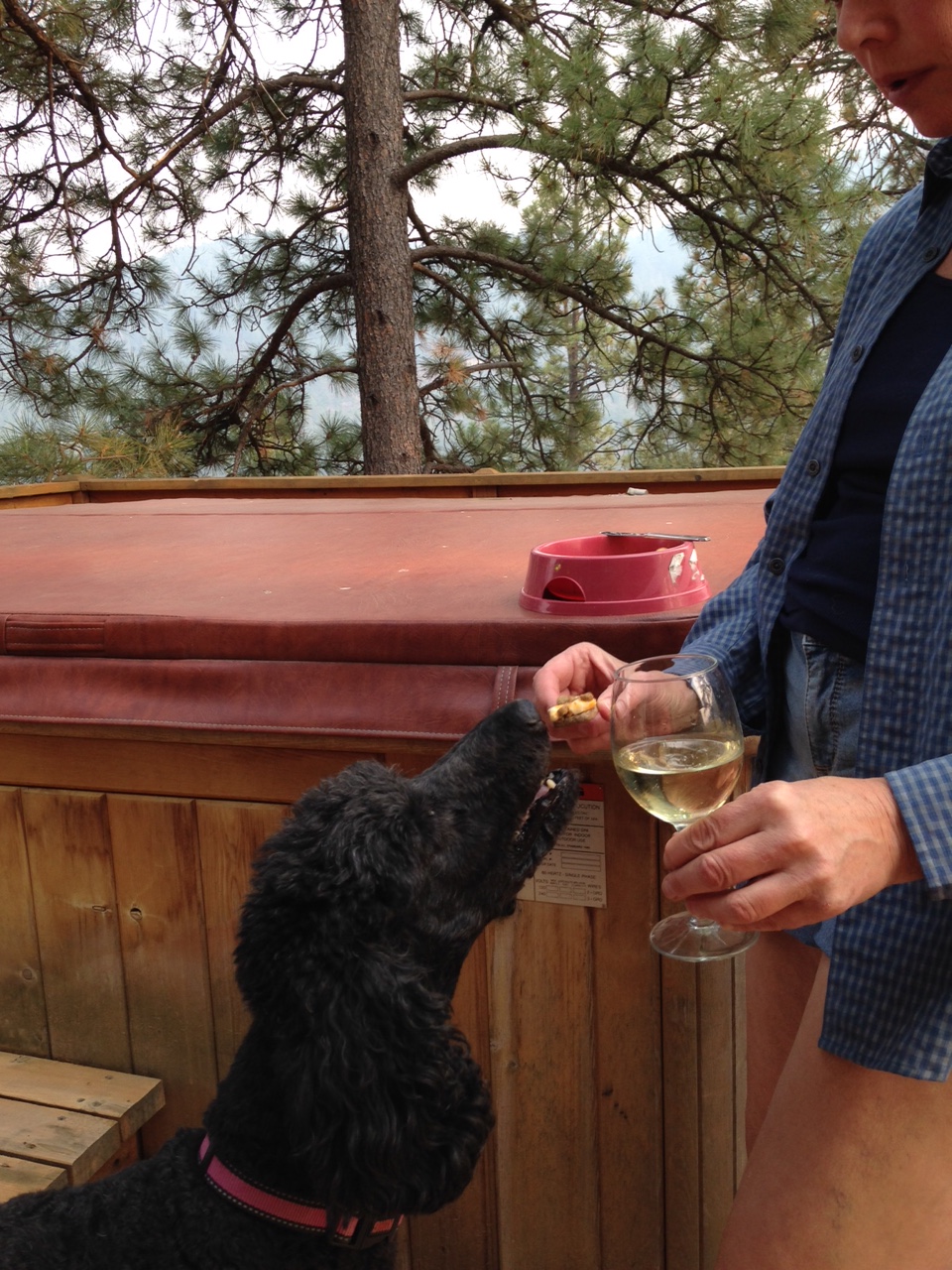
When Molly was visiting, she would not — could not — eat in the laundry room with the other dogs. Excuse me. With the dogs. She dined solo, al fresco, with a white-jacketed server in attendance. OK, so maybe Deni wasn’t wearing a white jacket, but the rest is true. Not only did she dine in solitary patio splendor, she had special meals. Chunks of cheese, biscuit crackers, slices of deli meat … the only way that Molly would eat kibble was on a cracker (biscuit) or in a turkey roll-up. She prefers white wine, not too dry and not bubbly. (OK, OK, she didn’t actually get any wine, either. But the rest is true. Really.)
But back to Cali. It is nice to have at least one dog who actually is comfortable being a dog and is happy to fulfill her role as the family dog. She’s very cuddly, for example, and loves to be petted. She’s always enthusiastic about going for a walk or out to play. She enjoys doggy things, like chasing after a tennis ball and refusing to bring it back, barking at deer, licking all the hand lotion off of my fingers, and begging for treats. She wants to be near me most of the time, even when I am doing boring (to her) things, like writing a blog post (she’s at my feet) or grading papers. Like her ancestor Oriel, Cali embodies everything people love about dogs. She’s sweet, affectionate, playful and goofy sometimes. She’s great company and very friendly. And secure in her dogness.
Do dogs miss us when we’re away? Do they miss places they’ve been or items they’ve loved?
It’s clear that dogs remember people and places — and often, the landmarks or scents on the way to places that they either love or hate. Dogs can recognize a person whom they haven’t seen in years. Or a place that they haven’t visited in years: Oriel, our late and much-missed golden retriever once ran joyfully to the site of a small pond that had been dry for about a decade. The former pond was a short walk from her former home in Montana, and she hadn’t been there for at least 3 years. She became very excited as we approached the road to the house, too. And of course all of our dogs know the way to fun places and begin to show excitement ridiculously early in any journey in the general direction of the dog beach, Cali’s sister Dora’s house, the park where we play ball …
It’s also clear that dogs use these memories to anticipate, with pleasure or dread, future experiences. Dogs generalize and can become fearful of people or situations that remind them of unpleasant experiences in the past. A dog who fears going to the vet, for example, can recognize a vet’s office, any vet’s office, from several blocks away. Happy experiences have the same effect. Thus a dog who loves to run and play will decide that any open green space you happen to drive past would be a really fun place to stop and play ball. He might helpfully point out all the nice play opportunities say, between Northern California and Missoula, Montana, as you are driving. Believe me, there are hundreds of open green spaces in the American Northwest.
But do they miss us? Do they miss places?
This question becomes more relevant each day, as our departure from Montana gets closer and closer. Does Cali miss her play park and friends in Petaluma? More to the point: Will she miss her private play yard in Montana? Will she ever forgive me for taking her away from this idyllic place where she is so happy?
It’s also a question that many dog owners ponder if / when they leave their dogs with a dog sitter or boarding kennel when they travel. Does the dog pine for them? Wonder where they are? Or, as dogs do so well, does the dog simply live in the present moment, enjoying the attention of the dog sitter?
I’ve heard enough stories about how dogs behave after the death of a loved human or canine playmate or family member to believe that dogs grieve. Isn’t that an indication that dogs miss people or dogs who aren’t present?
I don’t have a definitive answer to any of these questions. I suspect that some individual dogs form closer ties to people, dogs, places, and other beings or objects and do, indeed, miss them. Other dogs appear to be — and may truly be — happy in the present moment, loving the ones they’re with.
So the answer might be similar to my answer to so many questions about dogs: It depends. Dogs are individuals. Your individual dog might miss you very much when you are gone. Or she might happily hang out with whomever is nearby. Cali might miss Montana. But Cali’s such a sunny optimist that I am betting she’ll be happy to be back in Petaluma and enjoy picking up our old routine and reconnecting with her playmates there.
Cadaver dog training? Don’t make the same mistake I made — I was put off by the topic of this book and didn’t read it when it first came out (or even when I first got my copy). Once I started reading it, though, I was hooked. I breezed through it in a few days. Author Cat Warren does a wonderful job of weaving the history and technique of training scent dogs, and in particular cadaver dogs, into her story of training Solo, a German shepherd.
Like most of the books I love and recommend highly, this on puts heavy emphasis on the relationship between handler and dog. Warren is brave; she reveals her mistakes and failures as both the guardian of a high-energy puppy and as a novice trainer. She even admits to feeling overwhelmed by the intense, high-energy, demanding adolescent dog who shares her life, home, and hobby. We readers gain tremendously from her bravery, as these admissions both increase our understanding of how difficult cadaver training is and help us learn from someone else’s very understandable gaffes.
The book is rich with portraits of top cadaver dog trainers and handlers and with detailed descriptions of the training and the work. In her honesty and detail, Warren even mentions a great taboo among scent dog people: false alerts. They do happen. Her discussion of this raised a question in my mind about how deliberate the dogs are. I don’t know (yet) whether any formal studies have been done, but I am intrigued about whether the dogs are actually lying (intentionally alerting to get a reward) or whether they are simply unsure or scenting something that might be the target and responding because it seems to be what the handler wants or because they truly think they have identified the target scent. Look for more on this topic in an upcoming post .
Meanwhile, if you have any interest in scent dog training or cadaver dog training — or merely in a great dog-and-person story — read this book.
Cali and Jana’s cousins came to visit recently. Ziggy and Hannah live in Kansas, where summer is full of scary thunderstorms and terrifying lawnmowers. Up here on the hilltop in Montana, there are no lawnmowers at all. Thunderstorms are rare. There’s a huge play yard and lot of places to go hiking. Ziggy was excited.
Cali, Jana, and their cousins went to Missoula to visit Scarlett and her sister, Gracie. Then they went for a walk by the river, saw a huge carousel, met some really friendly Montana kids, and then, best of all, they got to go out for ice cream. The nice lady at the Big Dipper gave each dog her own cone! Ziggy and Jana and Cali ate theirs really fast, but Hannah showed her good breeding and manners, licking her cone delicately and not dripping it anywhere.
Hannah and Ziggy quickly learned to use the automatic dog door, and they each got their own key. Hannah thinks that it opens when she barks at it. She likes to bark, so that suits her just fine. Jana’s friend Molly came for a visit, and she remembered how to use the dog door right away, even though she hadn’t been over to visit in a really long time! She’s super-smart because she’s a poodle. She knows that barking is not what makes the door open.
Molly likes to bark too, but with all the girls barking, Jana and Cali’s mom couldn’t get any work done, so she told everyone to be quiet. Meanie!
The cousins and Molly loved playing out in Cali’s big play yard. They chased the ball, chased Cali or Alberta chasing the ball, ate grass, barked at deer, chased each other some more … when they got tired, they went back inside and piled onto the dog beds or stretched out on a rug. Hannah and Ziggy thought that Montana was pretty awesome. Molly, a native Montanan, couldn’t agree more.
After Hannah and Ziggy and Molly went home, Cali, Alberta, and Jana finally made plans to go to Packer Meadow. Jana loves this place and told Cali and Alberta all about it, but Cali and Alberta had never been there. It’s huge and very green. Jana remembers being there when it was so full of purple flowers that it looked like water. Speaking of water, there’s this really great stream that runs through the meadow. Brrrr. The water is very cold. But a dog can jump in and climb out and jump in and climb out and jump in and … all day (or until her mom makes her leave. Meanie.).
Unfortunately, the day they went, Packer Meadow was closed because it was too close to some huge forest fires. Good thing that Mom always has a backup plan; the girls had a great afternoon at Jana’s second-favorite place, Fort Fizzle. Jana found the first of her heart-shaped rocks there. She loves splashing in the river, finding rocks, rolling on the bank, and chasing sticks. Cali chased tennis balls; one almost got lost way out on the rocks, and Alberta wouldn’t bring it back, but Cali finally agreed to go and get it. She got a bunch of cookies for that. Maybe Mom is not such a meanie after all.
And guess what! They still get to go to Packer Meadow in a couple of weeks. Montana sure is a great place to be a dog.
Cali and Alberta both have great social skills, and their play together is cooperative and fun. They never fight and are good at reading each other’s signals. When one wants a break, the other complies.
Bringing a third dog into play always changes the dynamic, and when it’s a puppy or adolescent who’s still learning the rules of social interaction, everything changes. So, when Scarlett joins Cali and Alberta in play, the energy level goes up — and sometimes the tension level escalates as well.
Often, the three girls have a ball chasing each other around Scarlett’s huge yard, tugging on Alberta’s ears, sneaking veggies from the garden, and generally being silly together. Sometimes, though, one dog — most often Cali — seems to be trying to calm things down. When she’s not able to do this, I know that I have to get involved.
How do dog owners know when play is going well and when they need to intervene? This question is especially important at dog parks, where the playing dogs might not know each other well and where, unfortunately, many owners don’t pay enough attention to what their dogs are doing.
As our dogs’ protectors and advocates, it’s important that we are aware of what’s going on whenever our dogs are playing with other dogs (or with children). I suspect that, even among friends and family, most dogs don’t play much when their people aren’t around. I think that our presence helps them feel safe and confident that things won’t spiral out of control. It’s our job to understand that responsibility — and to step in when our dogs need our help.
So, back to Cali, Alberta, and Scarlett. The photos at the top of this blog post show healthy play. The dogs’ tails are held high. Their faces are animated, and their mouths are open in relaxed (not stressed) smiles. They are not holding their ears back tightly or tucking their tails.
The way they are playing is also important: There is not one dog who is always being chased — or doing all of the chasing. When they are wrestling, again, there is not one dog who always seems to be the target (or aggressor). They change roles, change games, go from chase to wrestle to tug to chase with a fluidity that comes from reading each other’s body language and paying attention to each other’s signals.
What does it look like when it goes wrong?
I step in if I see Cali’s tail go down or I see her trying to walk away. If she’s trying to leave the group and one of the others (usually Scarlett, an energetic eight-month-old) jumps on her or runs after her, I know that Cali needs a little help. Sometimes, she just stands there with her head and tail down, looking overwhelmed. Calling her to me or gently redirecting Scarlett to a toy works. Scarlett is a smart girl and wants to play — she’s not bullying Cali. She simply is not always ready to stop playing or quick enough to read the signal that Cali has had enough. I know these dogs and can read their body language pretty well. I can step in and ask everyone to calm down — and get them all to cooperate.
In more public spaces, like dog parks, owners might need to intervene more forcefully to help their dogs if play with unfamiliar dogs starts to deteriorate into something too wild or rough. Also, if there are a lot of dogs around, “dogs getting carried away playing” can turn into bullying or even a fight in seconds, with more dogs piling on.
Owners of relatively soft dogs (like Cali) who won’t stand up for themselves should be prepared to extricate their dogs if a situation becomes overwhelming — and this can happen any time a softer dog is playing with other dogs. Body language to watch for includes repeated looks to you, as if seeking help; lowered ears or head; a tucked tail; or any baring of teeth.
If you’re not sure of the other dogs, it’s best to avoid the situation. We’re fortunate to have a play area where we live that attracts a regular crowd of very nice dogs. Cali has become comfortable with most of these dogs. Even so, she usually prefers to play ball with me and rarely engages with another dog. It’s not that she doesn’t enjoy lively play; when she’s with her sisters or a good friend, she lets her guard down completely.
If you don’t have a “regular” play group, look for a few well-matched (size and energy level) dogs and try to set up regular play dates. Or find ways to exercise your dog without other dogs. Plenty of dogs would rather play with their humans anyhow!
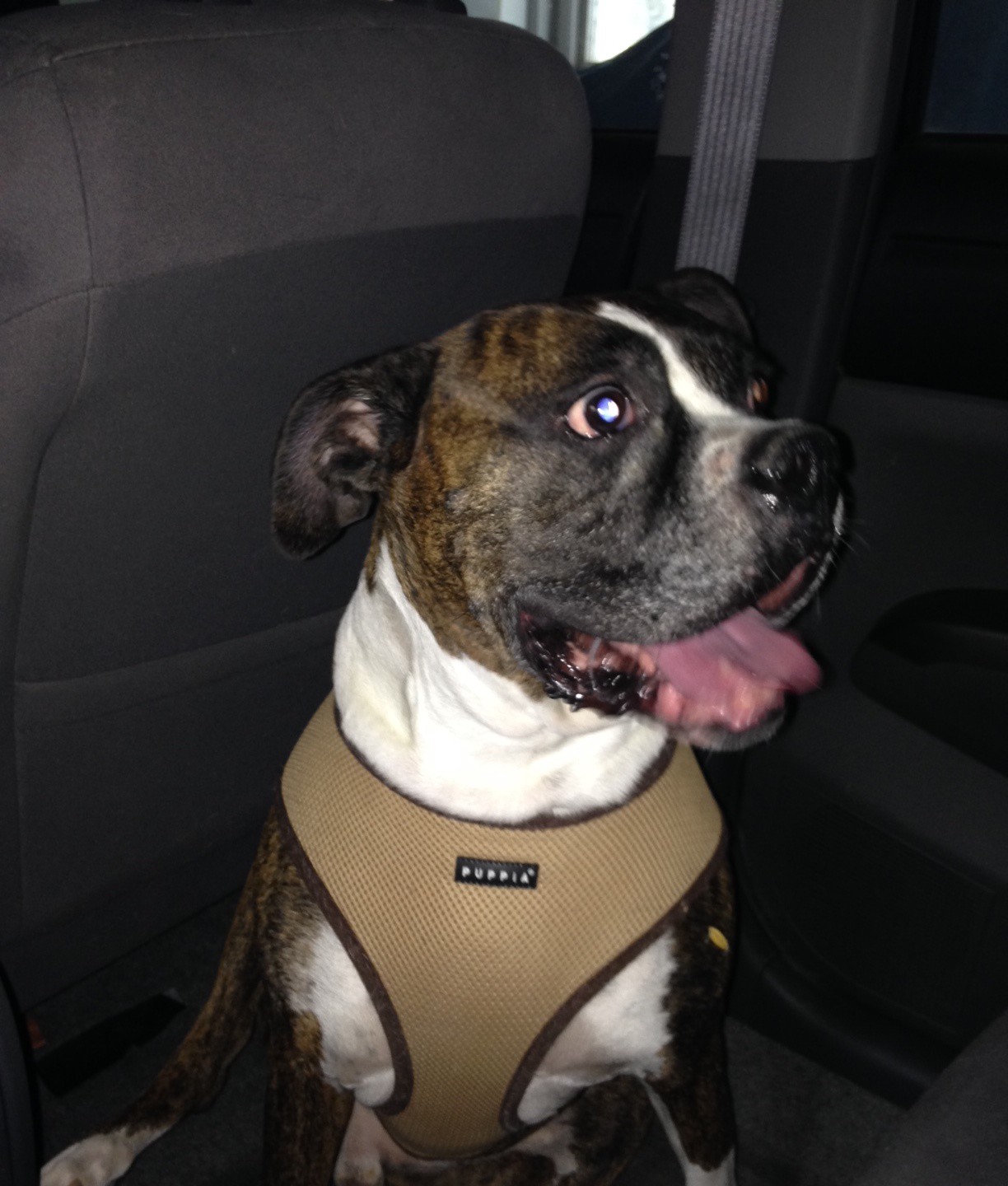 The happy person driving down the road while his buddy rides along, head hanging out the window, ears flapping in the wind, is an iconic image for dog lovers. That’s why it was so exciting when Beau, my aunt’s new dog, jumped into the car with no help — and with great enthusiasm — recently. He had surgery on both knees before my aunt adopted him from a boxer rescue group, and his hind legs are still shaky.
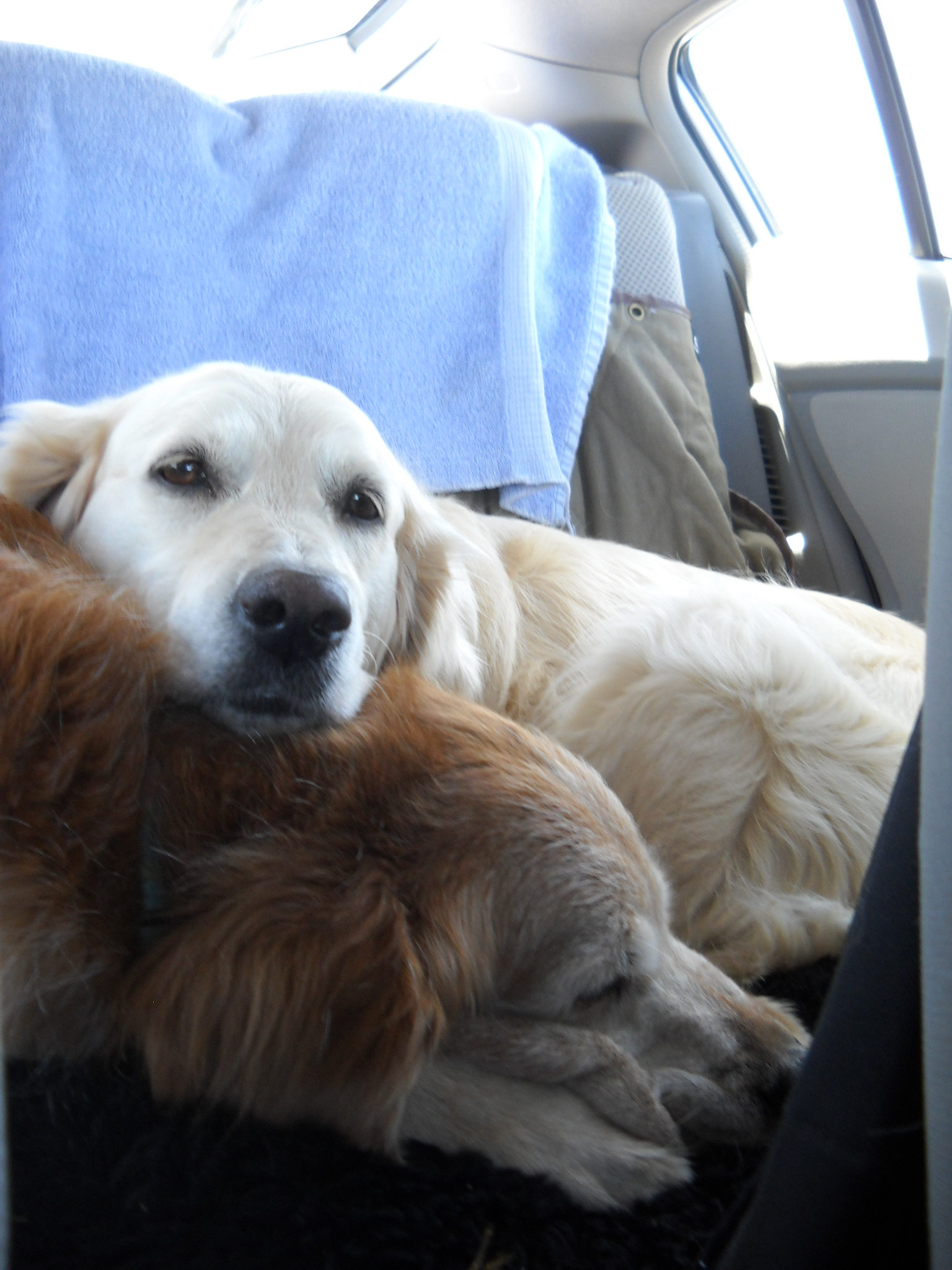 Alberta gets the middle because she likes to poke her head between the front seats and say hi to the driver and passenger. For a petite Lab, Alberta has a surprisingly heavy head. It can be hard to get into the storage console when she’s in the car, using it as a pillow. And forget about using that console as an arm rest.