Pets and the Environment: A Partial Review of and Response to Run, Spot, Run

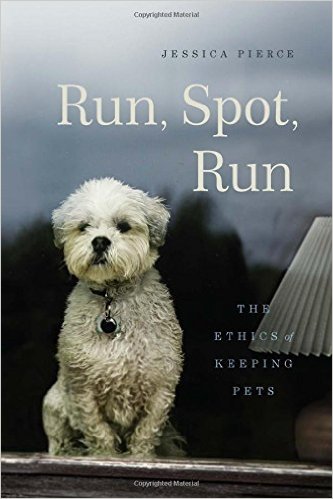
Run Spot RunIn Run, Spot, Run, author Jessica Pierce devotes a chapter to “Pet and Planet;” the environmental impacts of owning pets. This chapter considers a few areas: the effects of environmental toxins on our pets, the environmental impacts of pet-food production, and the effects our pets themselves have on the environment. In just a few pages, she really had me thinking hard.

The first one’s relatively easy. I filter our tap water, don’t use horrible chemicals to clean my tiny apartment, don’t buy Jana and Cali those vinyl toys that last about 5 minutes and leach terrible phthalates (whatever they are; all I know is that they’re bad) into our pets’ bodies. Basically, I protect Jana and Cali from environmental pollution as well as I can — and at least as well as I protect myself.

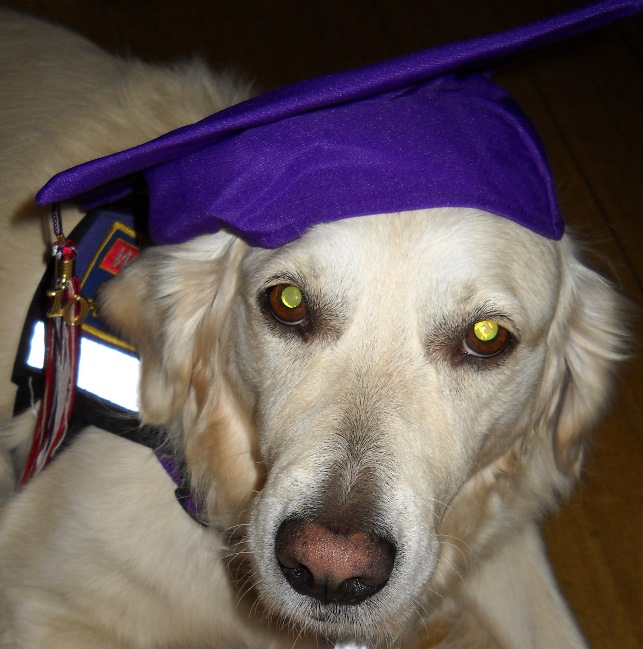
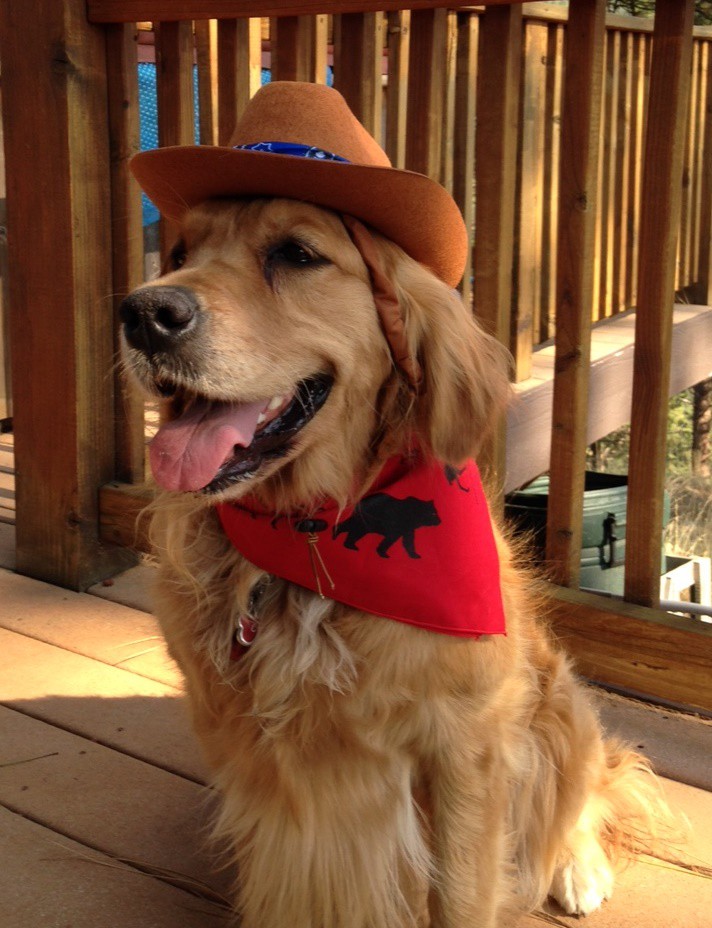
The third one is a bit tougher: how pets affect the environment. I often think that future civilizations, having unearthed millions of those knotted plastic poop baggies, will think that dogs were in charge (they’ll be right …). Pierce also mentions all the stuff we buy our pets. Yep, three cushy dog beds in my minuscule two-dog home. Big basket of toys. At least six leashes. Cali’s cowgirl hat. Stuff galore. I can rationalize the environmental impact of my pets: I don’t go overboard; I don’t generally buy a lot of stuff. All of our life choices have some impact on the environment — and they’re not always bad. I walk a lot more because I have dogs, spend more time outside. I pick up trash so my dogs won’t eat it; I pick up other dogs’ poop at the park. People have children despite their impact on the environment (and they require a lot more stuff than dogs). Getting the typical American child from birth through potty training results in a pretty big pile of plastic diapers. While I think that pet owners and petless people alike should do what’s feasible to minimize the damage they cause to the environment, I am not convinced that it’s a convincing argument against having dogs.

It’s that middle one, the pet-food production argument, where I have the most trouble. I don’t eat meat, mostly because I dislike everything about the food-animal industry. I think that being vegan is the best choice, though I am not there yet.

Cali and Jana are not vegetarians.

I buy high-quality dog foods for them and make sure that all their food is sourced and produced in the USA (or, at minimum, from trustworthy sources that are not in China). But … meat and seafood consumption are key contributors to global warming, pollution, and over-fishing. Ironically, those of us who seek top-quality ingredients for our pets exacerbate the problem. Cheap pet foods use a lot of the waste material from the food industry. The standards for what can be used in animal feed are distressingly and disgustingly low. But by insisting on good quality ingredients, I fuel the same factory farming industry that I have opted (mostly) out of for myself. One suggestion Pierce offers is that people buy sustainable meat and fish for their pets and decrease their own consumption proportionally. That argument has some merit, and I’ve made great progress … on the “reducing own consumption” part.

If the goal of an ethics book is to get people thinking about tough questions, Pierce’s book is already a huge success, and I am only halfway through it. I doubt that anything she says will convince me not to have dogs. But I don’t think that’s her goal. Getting readers thinking will lead to changes in their behavior. Cali and Jana are already looking forward to lovingly home-cooked meals of organic, pasture-raised meat, sustainable seafood, and local organic veggies … in their dreams.
What Have I Done?

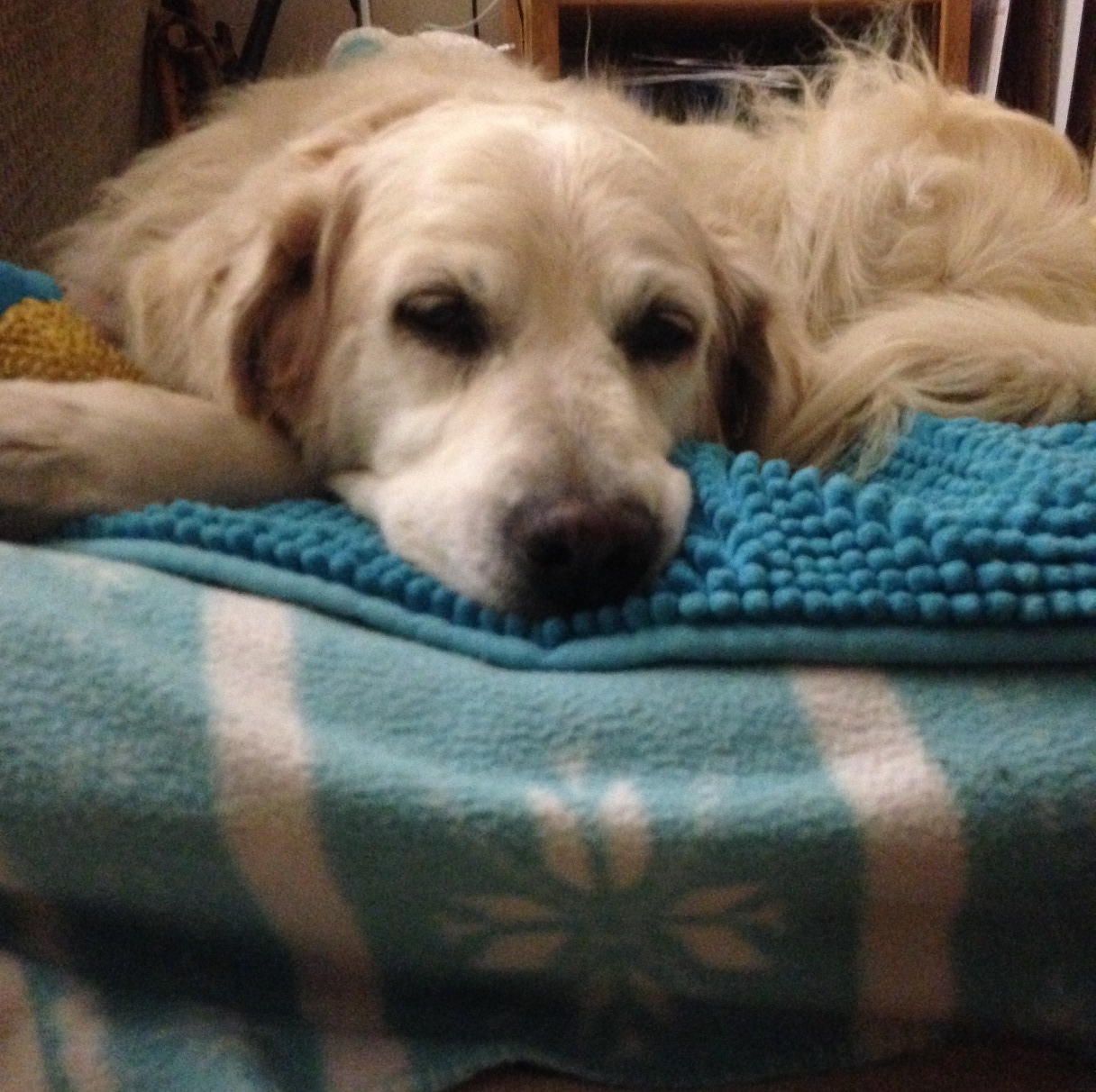
Relaxed Jana_cropIn a couple of weeks, I will start a new job. It’s a full-time job at an actual office. I haven’t done that in a while, and I have enjoyed a lot of aspects of freelancing, especially the amount of time I get to hang out with Cali and Jana.

I’m already planning early-morning walks and looking for local dog walkers. I’m trying to figure out how other people manage to work full-time and have dogs — and even kids and spouses. Wow. I used to be able to get everything done while working a demanding high-tech job. I was a lot younger then … but I know it’s possible. The dirty secret of freelancing is that I waste a lot of time. I know I can do things more efficiently.

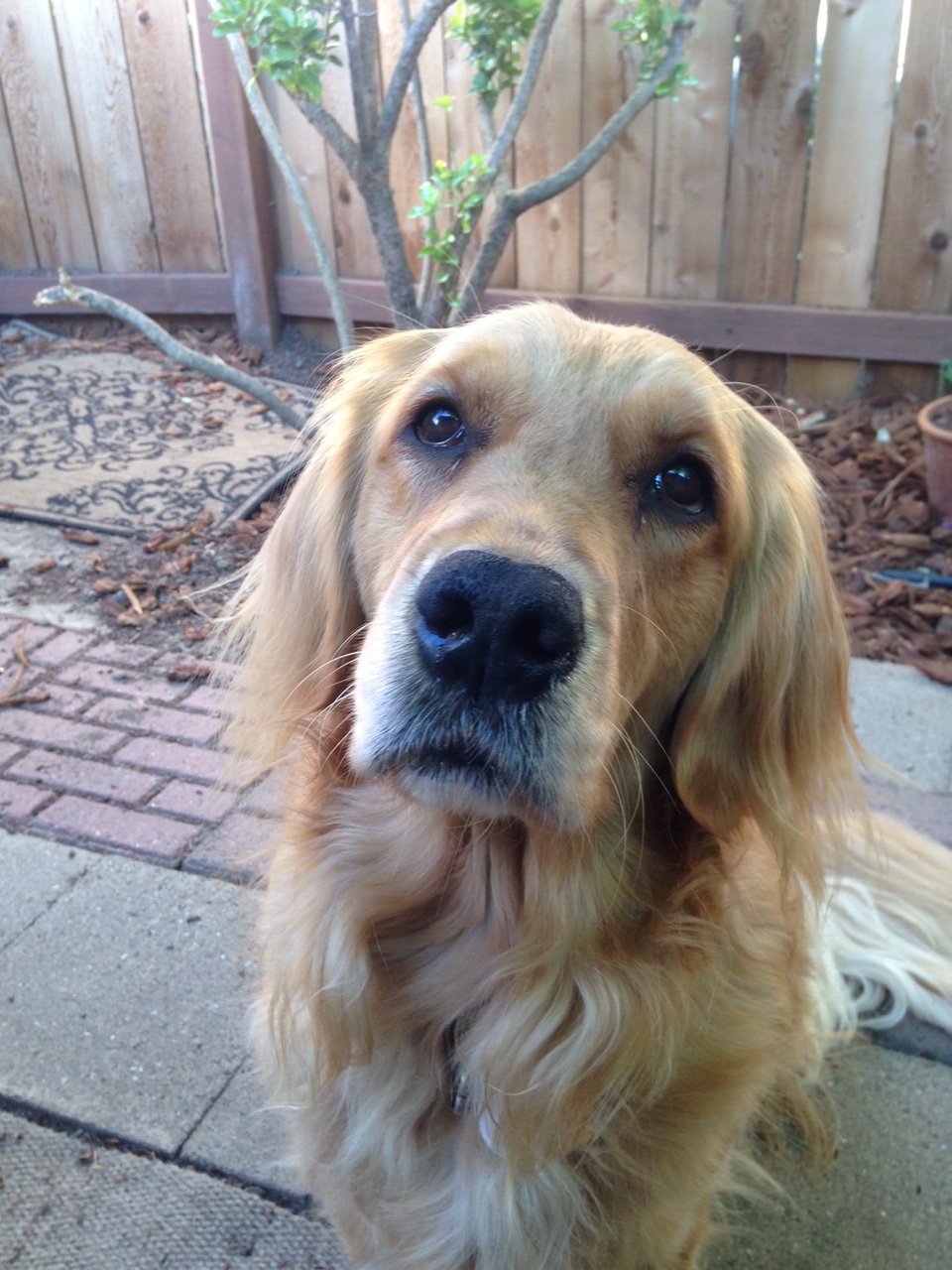
Sad Cali

Still … the quality of life issue is not trivial. Our pets pay the price for our decisions. I’m  reading Jessica Pierce’s book, Run, Spot, Run, mentioned in a recent post, about the ethics of having pets. She raises a lot of good questions — and she offers no easy answers. I also keep seeing commentary on the tragic killing of Harambe the gorilla and its implications for keeping nonhuman animals captive.

I do look at dogs differently from the way I consider captive wild animals. Dogs are so much a creation of their relationship with people that I cannot argue that living in human homes is unnatural for them. But their need for social contact, their tremendous cognitive and emotional intelligence, and their dependence on us to meet all of their needs all mean that we can’t just interact with them a few minutes a day, when it suits us, and tell ourselves that they’ll be fine on their own for the other 23 hours-plus of every single day.

It’s a question of balance. I will still give Cali and Jana two walks a day, most days, when I start working. I will find a dog walker for some days. I’ll try to think of other ways to make their environment more interesting. I will tell myself that, even when I am home, they spend plenty of time sleeping or just ignoring me. And I will do fun things with them on weekends.

But I will still feel guilty. Especially when Cali gives me that look.

The Experts Finally Noticed

That dogs have feelings, emotions, and thoughts probably seems obvious to readers of this blog, as well as to most people who share their lives with pets. But, as I tell my students at Bergin U, sometimes things need the stamp of approval of science, via peer-reviewed research, to be fully accepted as Truth. Many, many studies of dogs’ behavior and cognitive abilities do not, actually, reveal anything that we didn’t already “know.” But these studies solidify that knowledge and induct it into the Body of Knowledge that gets academic credit, credibility, proof.

That’s why the establishment of a new scientific journal dedicated to the study of animal sentience is significant. Acknowledgement and study of animals’ thoughts and emotions has grown tremendously over the past twenty years or so. Now, those studies have their own journal. Animal Sentience: An Interdisciplinary Journal on Animal Feeling is a publication of the Humane Society Institute for Science and Policy (HSISP), based in Washington D.C.

Alva Noë, a philosopher, says in an NPR article that “A new scientific journal is not merely a new venue for publishing research, it can encourage new science, create a new community of investigators and, to some degree, contribute to the establishing of new fields.”

That’s an exciting thought for people who care about nonhuman animals — and dogs in particular. For centuries, dogs were not considered worthy of academic study. Now, several universities host canine cognition labs; at Bergin U and elsewhere, students study the canine mind, along with canine behavior and communication, as they explore ways to expand the human-canine partnership.

The journal embraces a broad definition of sentience or “feeling”: “Feeling can be any sensation, such as seeing, hearing, touching, tasting, smelling, moving, wanting, pain, pleasure, emotion, mood, anticipation or intention.” Intention. Anticipation. I know that my dogs experience these higher-level “feelings.” I also know that generations of researchers have been ridiculed for asserting that dogs (or any nonhumans) could.

It matters that people recognize dogs’ sentience so that the we can improve how we, as individuals and as a society, treat dogs. Before we had anticruelty laws, we had to know that animals could suffer, could feel pain. Now, as we consider how dogs fit into our lives and our society, it is equally important to recognize that they feel more than pain. They think, wonder, plan, feel happy or sad, they grieve — and they empathize when we feel sadness or grief. How do we need to change our laws and our treatment of dogs to accommodate this new understanding?

It’s a Dog’s Life

A recent op-ed in The New York Times considered the question of whether it is ethical to have pets. For most non-domesticated animals, whose lives as pets means being confined to cages or tanks, the writer was quickly able to establish that, no, it is not: the best we can do is a life of “controlled deprivation.” She — and I — have a harder time answering that question with regard to dogs and cats. I know little about life with cats, so I’m really only considering dogs here.

BORED

Dogs have evolved as domesticated companions to humans, so in their case, it’s not at all unnatural to include them in our homes and families as pets and family members — if we do it right.

Most pet dogs live a pampered, but far less than ideal, life. I honestly don’t think that most dogs enjoy long days spent home alone, even if they get to spend that time on a $100 memory foam bed (or on your $1,000 plush, memory foam dial-a-number luxury bed). Even dogs who have canine company spend much of their “home alone” time sleeping, staring out the window … or worse. Many dogs experience severe anxiety when left home. At best, their lives are boring, revolving around a few minutes of dining once or twice a day and, if they are lucky, one short walk. Many pet dogs don’t even get that. The really lucky ones get a daily walk with a person who is focused on them, not simultaneously on the phone and/or dealing with a child or two.

Jana enjoys springSome dogs — most of the dogs I know well — are luckier than that. My friends with dogs tend to be more engaged than the average dog-owned person. These dogs get regular walks, usually more than one a day. On these walks, they actually get to stop and sniff things. Some of them get to go to parks and play with their friends (yes, dogs have friends!), they go to the beach sometimes, on car trips, to dog-friendly cafes, to laser therapy appointments (hi, Jana!), acupuncture, agility or Rally classes … any number of enriching, fun activities. They get excellent health care, they eat carefully selected, healthful diets and treats, and they own baskets full of toys. For these dogs, life is pretty good.

Considering the broad range of doggie experience, it is hard to answer the question of whether sharing life with dogs is ethical. The dogs I described in the previous paragraph are a minority of American dogs, though, and only a tiny, tiny minority of the world’s dogs live like that. Put that reality together with my absolute inability to imagine a life without dogs and, well, it’s a dilemma.

As a person who loves dogs and has the means to offer my own dogs a good life, and who teaches future dog professionals, I’ve pretty much dispensed with the question of whether to have dogs. Instead, I think about this question: How is it possible to ensure that our lives with dogs are ethical? By ethical, here, I mean that in deciding to bring dogs into our homes, we commit to making the dogs’ lives interesting and fulfilling, to allowing the dog(s) to develop their full range of doggy abilities and enjoy a high quality of life.

This would include, of course, providing everything on ALDF’s Animal Bill of Rights — for pets, that is shelter, food, and medical care. But I think our obligation goes beyond that. The Bill of Rights also mentions “an environment that satisfies their basic physical and psychological needs” — and what that means is different for every dog.

As I consider returning to a more structured work life — you know, the kind of job where you actually have to show up at an office several days a week, rather than working at home, wearing yoga pants and taking frequent toss-the-ball breaks — I think about how Jana’s and Cali’s lives will change, and how so many dogs’ lives consist of long, lonely, boring hours punctuated by brief interactions with their tired, busy humans.

This question became urgent for Deni as she agonized over how and where Alberta should spend her retirement. No ordinary dog, Alberta has a college education; she’s been a local celebrity, a model, a career dog. Her retirement, forced by health issues, leaves her young, energetic, educated, and accustomed to days filled with new experiences, travel, encounters with dozens of people a day, and constant stimulation. On my best days, I can’t provide all of that for my dogs — most people cannot, even though we all do the best we can.

Would Alberta be best off with her family, even if that meant watching Deni head off to a work day with a different dog? Or would she be better off with a different family, most likely consisting of people and dogs she knows and loves, living as a more ordinary pet? Was retirement to Montana, as part of Deni’s extended family, the best choice? Alberta is fortunate in that all of her options were good ones, with people who love her and who understand that a dog needs more than a comfy sofa and a basket of toys to lead a fulfilling life.

Improving can be simple. Make a commitment to your dogs to take them for more walks, or to go to the dog beach once in a while. Spend a few minutes a couple times a week interacting with a puzzle toy or even just throwing the ball more often. (Cali suggests at least 10 minutes every hour as a starting point.) Leave the phone at home next time you go for a walk, and let the dog stop and sniff whatever she wants (that one’s from Jana). The funny thing is, once you build this new interaction into your relationship with your dog, you’ll feel better, too!

Kudos to Jessica Pierce, who wrote the NYT op-ed and is the author of a new book on the ethics of keeping pets, for raising these questions. Thanks to her, maybe more of us will think about — and improve — our pets’ quality of life.


Alberta Is Heading West

Post opToday’s post will be short — an update on Alberta.

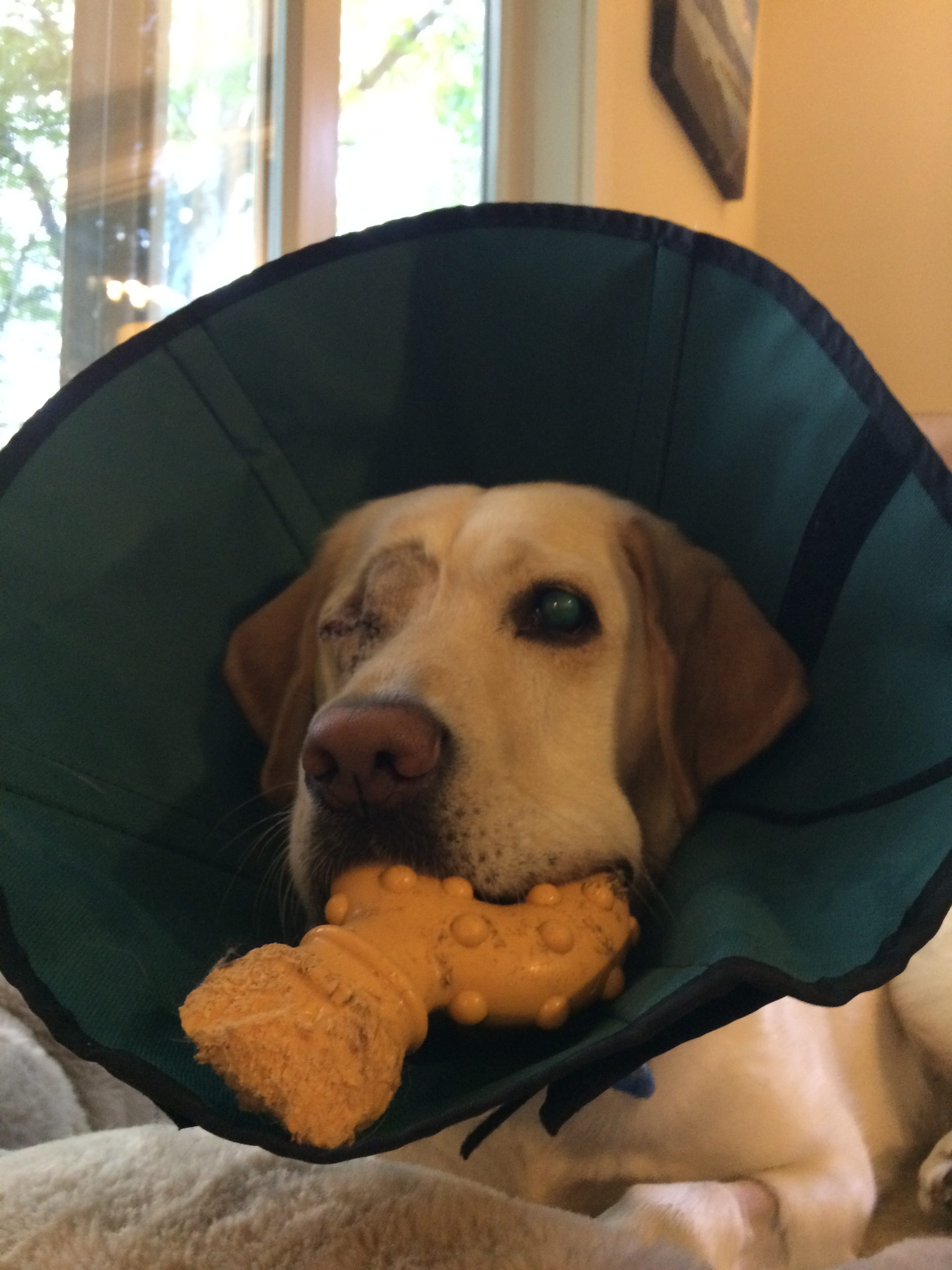
Alberta had her surgery last week. Her right eye was removed. She also had all kinds of medical tests and — Great News! The tumor was benign, and she is completely healthy (no cancer)!

I still encourage you all to register your dogs with the Morris Animal Foundation for future canine cancer (and other) studies!

Alberta is recovering with friends near the Guiding Eyes for the Blind campus in Yorktown Heights, New York. Her host dogs (and humans) are being very gentle and sweet to her as she adjusts. They’re also working on a way to fashion an eyepatch — or, more likely, an entire wardrobe of eyepatches —for her to wear.

When she’s fully recovered, and her cousins are settled in their new home in Lolo, Montana, Alberta will join them. She loves Montana, will have a busy and interesting life, and, best of all, will still be part of our family.

Ever the celebrity, Alberta is one of very few career dogs to merit a retirement party and front-page news story. It’s a follow up to the feature story that introduced her to local readers three years ago.

Join the Fight Against Canine Cancer

Cali’s superhero cape was at the cleaners …

If you read last week’s post, you’ll know that canine cancer is on my mind. Not only Alberta’s, though. Cali, as many readers know, is a Hero. That’s what the Morris Animal Foundation calls participants in its Golden Retriever Lifetime Study.

Cali does her bit to fight cancer by “enduring” a very thorough annual physical, which is coming up next month. She blogged about  last year’s visit. She pretends it is awful, but the nonstop tail (and butt) wagging gives her away. Anything that involves that many cookies can’t be all bad.

Cali’s one of 3,000 goldens in this study. Morris started signing dogs up a few months before she was born. Two of her brothers are also in the study. The oldest dogs accepted were two years old. The study will examine a huge amount of data and try to identify genetic and environmental factors that lead to canine cancer.

Why am I saying all of this? Some of the participants, none of whom could be older than six, have already gotten cancer. Some are in remission; a few have died. I don’t know how many. I follow the experiences of participants whose humans post on the group’s Facebook page; it’s a very unscientific sample. Some participants have older sibling-supporters (like Jana!) and some of them, too, have died of cancer in the three and a half years that I have been part of this group.

It’s too much!

What can you do? Funny you should ask that …

You can register your dog for the draft. The Morris Animal Foundation Canine Lifetime Health Project draft, that is. It is a registry of dogs /  humans willing to participate in future studies. Morris is not registering for a specific study right now, but the re-opening of the registry might mean that they soon will be. It’s a chance for your dog to be a hero too. And for you to help fight this killer disease that takes too many of our dogs too soon, and causes millions more to suffer. In fact, their research is not limited to cancer, so your dog might be able to help researchers understand other serious canine illnesses.

Think about it. Take a look at the website. Cali, Alberta, and thousands of other dogs will thank you.

Early Retirement

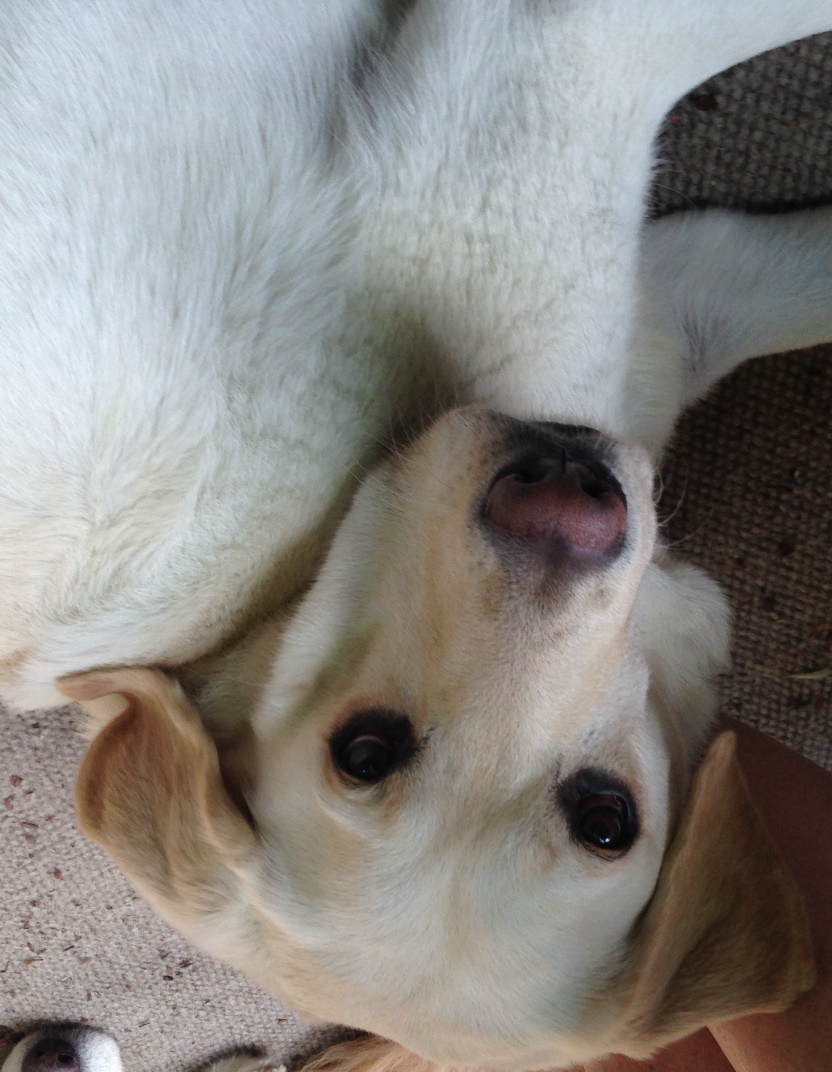
Alberta_closeupThe one constant in life with dogs is change — and that can be tough sometimes.

There’s no way to sugarcoat this: Alberta is retiring. Alberta and Deni are a match made in heaven if ever there was one. They adore each other, and Alberta is a cuddly, affectionate Mommy’s girl. For all her goofiness and antics, though, Alberta is an outstanding guide dog, a creative problem-solver, and the life of any party (or classroom … or faculty meeting …). In harness, she’s a consummate professional; off-duty, she’s an eternal puppy. Her love of fun will serve her well in her early retirement.

Alberta has a rare type of tumor in her eye. She will have surgery to remove the tumor (and the eye) this week, and she will retire from work as a guide dog. She will move to Montana later this summer to live with her cousin Mack and Mack’s parents.

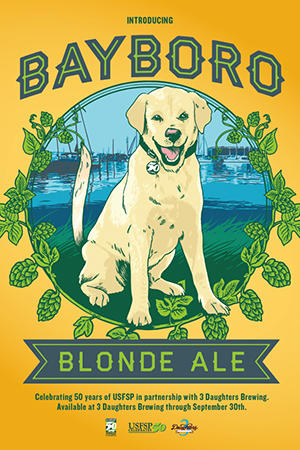
Bayboro_Blonde-smAnd, knowing Alberta, she’ll figure out a “retirement job” soon enough. Maybe she’ll build on her experience as the model and spokesdog for 3 Daughters Brewing’s Bayboro Blonde Ale. Or further her media superstar career, launched by an article in the Tampa Bay Times, frequent blog appearances, and a USA Today story.

I’m sure she’ll continue to delight and amaze everyone she meets. I’ve learned a lot from her about doggy humor, intelligence, and empathy. She taught me how dogs can pass the marshmallow test, which turns out to be pretty similar to the way young children do it (they distract themselves). She taught Deni, the Dog Training Club of St. Petersburg, and dozens (hundreds?) of dogs and handlers that Rally and other dog sports are a great way for guide dogs and their humans to let off some steam. She’s helped Deni navigate torrential downpours, bizarre obstacles, and hostile vehicle and foot traffic, especially in crowded airports; in fact, she’s so good at it that Deni has no idea how many (thousands of) people Alberta has gently but effectively nosed out of their path over their too-short three years together.

While she’s leaving her job, she’s not leaving this blog; I hope to continue to follow her adventures from afar (and sometimes in person). And I’ll continue to tell Alberta stories whenever they’re relevant to revealing the amazing cognitive abilities of our canine friends.

Deni has a tough few weeks or months ahead: getting used to life without Alberta, waiting for a new guide, then adjusting to the new dog. Despite her delicate, petite physical appearance, Alberta leaves some pretty big paws to fill.

Does Jana Need Glasses?

Jana and I are both learning the effects of getting older firsthand. I’ve written about her increasing anxiety, which I attribute, at least in part, to declining acuity in her vision and/or hearing. Now I have scientific backup: Jana might need glasses.

Jerome Hernandez and five other authors published a paper in February that investigated whether ophthalmologists’ tools could be used to measure the effects of aging in dogs. Turns out they can. “Dogs, like humans, experience eye changes with aging, i.e., hardening and clouding of the lens and accumulated oxidative damage from UV sunlight. Development of cloudy lenses in older dogs, referred to as nuclear sclerosis, occurs with the aging process,” the authors say. Many pet owners think that this cloudiness is a cataract problem; it usually is not, and it generally does not significantly affect the dog’s vision.

The researchers used with the dogs a “refractive evaluation” technique that is commonly used to assess vision in pre-verbal children. Now, many humans notice that, as they age, it gets more difficult to read things that are close up. When their arms are not long enough to compensate, they get reading glasses. With dogs, it’s the opposite. They become nearsighted, which means they have greater difficulty seeing things at a distance.

Here’s where Jana and I have something in common! I’ve been nearsighted since I was about 12, but I’ve noticed my vision changing a bit lately. But not for reading; like Jana, I seem to become more myopic with age. I’ve noticed that she has more trouble finding me again when she wanders across the large field where we play in the morning. She also seems to have more trouble hearing me call her, but selective hearing is not an age-related issue in Jana (or most dogs); that problem shows up in very young dogs.

Joking aside, I do think that her hearing is less sharp. She seems to be startled more easily, especially by cars approaching from behind us on our walks.

I haven’t had Jana’s eyes (or ears) checked, but this article backs up my suspicions. Jana’s world is getting a bit fuzzier, and that makes her feel less secure. If her hearing is also less sharp, that would compound her confusion and insecurity. It happens slowly, but those of us with aging dogs need to be aware of these changes. While I don’t know of any purveyors of doggie glasses and hearing aids, we can help in other ways: Using larger hand signals when trying to communicate across distance, for one, and going over to the dog if she seems confused or agitated.

The article is available on PLoS One here; and an article about it by Dr. Stanley Coren is here.


The (Not-So) Mean Girl at the Dog Park

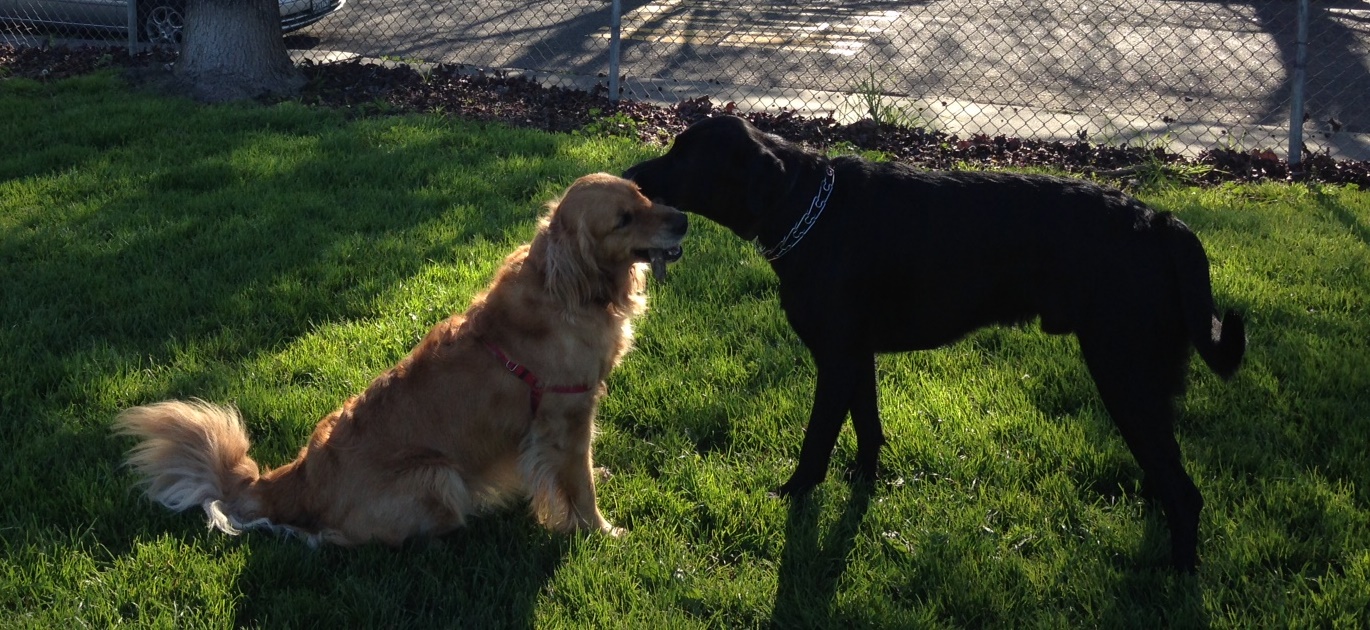
Cali and Ronen play tug with a very small stick

A few weeks ago, I wrote about Cali’s unfortunate experience with a mean girl at the park. The mean girl has been back, and I think she really was just having an off day. An off couple of weeks, maybe.

Not long after she bullied Cali, I saw her go after a sweet older gentleman, a Labrador, who was lying down and minding his own business. A toy that Ms. Meanie wanted bounced too close; he must have moved to get it, and she was on him in a flash. Her dad reacted quickly and took her out of the park. Someone who was there commented that she’d done the same thing to a different dog earlier that week.

At this point, I was gunning for this dog. They’d better not bring her back to this park, I fumed.

Well, the dog came back. We had just arrived at the park when I saw them come in. My first instinct was to leash up the girls and leave. On the way out, I wandered over to a friend to chat for a moment. I said I didn’t feel comfortable with that dog there, and we talked about the best way to handle the Situation as we watched the mean girl.

She was playing energetically with Ronen, a sweet, goofy, year-old big male Labrador. Her hackles were up, and she was being very assertive, but not aggressive or even inappropriate. She played with a few other dogs, while I kept Jana and Cali close and on leash. She’s young, assertive, and high-energy, but she definitely wasn’t showing aggression or even bad manners. I finally decided to be a grown-up and actually talk to the mom.

She apologized for the Cali incident, and we talked about the other incidents and what to do about resource guarding. She said that they had signed the dog up for training  classes (hooray!), and they had exposed her to lots of other dogs for supervised play. They were working hard on a solid recall. The dog had been grumpy / reactive several times over a period of a couple of weeks, the mom said, but hadn’t had issues before or since. It sounds to me as if they are doing everything right, and they really care. I wish more dog parents were as concerned.

I’m still wary of this dog, but Cali seems to have completely let the incident go. She’s always thrilled to be at the park, happily plays with or alongside other dogs, and shows no fear of this or any other dog.

I need to learn from her: No grudges. Cali might well pick up on my anxiety about this dog, and I can create a problem where, at the moment, none exists. Wouldn’t we all be better off if we could learn to move on as effortlessly as our dogs do?


Melatonin Might Soothe Your Anxious Pup

As she ages, and perhaps as her hearing and eyesight fade, Jana has become more anxious and reactive. She gets startled easily and barks when cars come up behind us on walks; we avoid busy streets. She barks at anything wheeled that moves toward us — bikes, scooters, hated skateboards and loathed minivans (and joggers, even though they lack wheels) — but that’s always been true to some extent.

What’s harder to figure out is her evening anxiety. She often (well, it used to be often) would start barking in the evenings. Anxious, high-pitched woofs. The barking sometimes went on for several minutes. Woof. Long pause. Woof woof. Long pause. Etc. Not much fun for me. Or for Cali. Definitely not for the neighbors.

I’ve had some success with the Comfort Zone DAP plug-in. Sometimes a wrap would calm her. But some evenings, nothing worked. When I asked Jana’s personal physician for ideas, stipulating that I wasn’t yet ready for hard-core anti-anxiety meds, she suggested melatonin. A good friend had also suggested melatonin that same week!

With this weird coincidence striking me as a good omen, I decided to try it. It’s not addictive, it doesn’t cause liver damage or other health problems, and it’s not expensive. And, it does seem to help. I started with a single 3 mg. tablet in the evenings, and, with Jana’s doctor’s agreement, recently upped that to 3 mg. morning and evening.

It’s not a miracle cure; Jana’s not a new dog. She still gets anxious sometimes. She still hates skateboards. But the melatonin does seem to take the edge off. She relaxes some evenings. Yesterday, she actually rested her head on my knee and let me stroke her for about 20 minutes. Yes, it really was Jana. No, I did not mix her up with Cali. True to her “no-touch cuddling” credo, she did get up an move after I petted her too many times.

Seriously, though, it is nice to see her relax; maybe a larger dose can relieve more of her anxiety. Maybe she’ll turn into a cuddler like Cali! (OK, let’s not get too carried away…)

Melatonin might have other uses for anxious dogs. The Whole Dog Journal, which tops my short list of highly trusted dog magazines, recommends melatonin for dogs who are afraid of thunderstorms (the linked story might be available only to WDJ subscribers). Some websites (none that I know well enough to put on my trusted list) say melatonin can reduce the number of seizures in epileptic dogs or help with separation anxiety. Fortunately, I don’t have either of those problems, so I can’t comment.

Whatever issue you think melatonin might help your dog resolve, check with your vet first on whether to try it and how much to give.

Also, and this is essential: Check the label. A helpful reader of the xylitol post noted that her brand of chewable melatonin tablets had xylitol! That dog poison seems to turn up everywhere, so reading the label on anything you plan to share with your dog is essential.