Superdogs in St. Petersburg

Four caped, colorfully painted superdog statues

A pack of canine superheroes is visiting St. Petersburg. It’s a fundraiser for Southeastern Guide Dogs, a guide dog school nearby in Palmetto, FL. Packs will soon establish their territories in Sarasota and Tampa as well. These caped Labrador crusaders are doing their bit to help humanity; the public (that’s us) is invited to vote for our favorites. Each $1 vote trickles a bit of cash to the guide dog school. Each hero was decorated by a different local artist. No voters are illegal, and stuffing the ballot box is recommended. Vote early and vote often! Actually, there is no early voting. Vote online from June 6 through Sept. 18.

The vanguard of what will ultimately be 50 canine heroes took their positions in early March. Their packmates will join them over the next several weeks. When every dog has her (or his) den, the Superheroes on Parade website will post maps, enabling dog lovers to find their favorite pups.

Lots of cities have hosted “decorated sculpture” parades for lots of good causes, but in my opinion, superhero dogs are the best yet.

A Step Too Far

No tech gadgets for this dog!

In December, I wrote about Mood Collars. Shortly after, I heard about another product that goes even farther — it is essentially a Fitbit for dogs. Actually, it’s more than that. It is a comprehensive health, mood, and activity tracker. Big Brother for your pup.

According to the website, the gadget attaches to the dog’s collar and measures your dog’s movements, also recording whether the dog is eating, drinking, sleeping, pacing, etc. Data are sent via wifi to the company’s server. The data are crunched like a good bone, providing info for you, the owner, to access from a dashboard.

Is your dog stressed? Appropriately active? Scratching a lot? Watching too much TV? Ordering pizza on your credit card?

Ok, it doesn’t monitor TV consumption or shopping habits, which is unfortunate, because I think that Cali is addicted to nature shows. But it does have algorithms that, the website claims, can suggest whether the dog is ill, if he’s not drinking enough, or if he’s itchy. The website is chock-full of high techy buzzwords, like “machine learning” and “onboard neural network”— words that crop up in my work all the time, but have no place in my relationship with Cali. It touts the “wellness matrix” developed by vets, which it pairs with data gathered on your dog, over time, to decide whether your dog is active enough, too active, anxious, or showing signs of illness. It sends you alerts, notifications, and suggestions, and you can also monitor the dashboard.

The techy and impersonal nature of this bugs me. Yes, I’d like to know if my dog is sick or anxious, but I am not sure I need to measure “key health and happiness indicators on 6 axes of freedom” to know that; I just need to spend time with her. Of course I want to know if she barks when I am away, though I suspect that my very human neighbors would let me know if she did. The claims to be able to detect “diseases such as hyperactivity, cognition troubles on senior dogs” and “anomalies such as arthrosis” by analyzing a dog’s activity and comparing it with a profile for his age and breed are dubious at best. Some things just can’t be done via remote technology, a thought that occurred to me this week as I filled out a survey from my own healthcare provider. Would I have preferred a phone or video consultation to my office visit this week, it asked. Um, no. Acupuncture by video probably wouldn’t work. Neither does caring for your pet via app.

Even though I leave Cali home while I am at work, I still spend enough time with her to know her as an individual. She’s not a line on a chart. She’s not identical to every other 56-pound dog or every other 4-year-old golden retriever. She’s Cali. I’ve known her since she was 8 weeks old. I can tell if she’s itchy or anxious. I don’t need a $200 gadget to tell me. But the gadget’s Kickstarter campaign has more than 300 supporters, so somebody thinks it’s a good idea.

To be fair, I can see some uses for it. It’d be a useful way to collect research data, since owner reporting is not very reliable. This gadget could help me figure out if Cali really is a return-anticipating dog who knows when I am heading home, which would be cool. Beyond that, though, I am not sure it adds anything that a good dog-person relationship doesn’t already uncover. Sure, if I had my dog in a kennel, I’d like a way to keep tabs on the caretakers, provided that there was wifi in the kennel. But I don’t leave her in a kennel; I leave her with dog sitters whom I trust— and talk to regularly. Besides, Cali already thinks I spend way too much time staring at screens when I should be outside, throwing a ball for her or walking through a park with her. She’s right.


Who Gets the Dog?

Dogs are family. That’s obvious to most people who share their lives with family. But under the law, pets are treated like property — no different from a table or a toaster. That causes a host of issues, one of which is, if the family splits up, who gets the dog?

According to the Animal Legal Defense Fund, thirty-two states allow courts to protect pets under domestic violence protective orders. A law passed in 2006 requires that state and local disaster plans include provisions to evacuate and care for pets and service animals. So, slowly, some laws are acknowledging that dogs are not toasters. But, while some judges have been willing to consider pets in divorce court, there has been no legal prod for doing so.

Until now.

Alaska is the first state to require courts to consider the “well-being of the animal” in custody disputes. The law took effect January 17.

While pets are often major points of contention in divorce cases, no one has represented their interests. People fighting about property and messily ending a relationship might, it can be imagined, be concerned with their own feelings; they might also be driven by a desire to seek revenge, hurt the other party, or just to “win,” whatever that means. Their judgment as to what would be best for the beloved dog or cat might be clouded. Recognizing this and specifically directing the court to consider the pets’ interests is a huge step forward.

Kudos to the ALDF, which has long advocated for courts to take this step. And, let’s hope that Alaska starts a fifty-state trend!

Understanding “Human”

How much of what you say does your dog really understand? (And how much of what you don’t even know you are saying does your dog understand?)

The answers “dog experts” will offer for these questions range include:

  • Dogs don’t understand any human language
  • Dogs can learn simple, one-word commands, but not very many and not if they sound similar to one another
  • Dogs understand full sentences; can learn thousands of words, and can even understand grammar and syntax
  • Dogs can read you better than any human can read another; they know your thoughts, feelings, and intentions.

A hint for new readers: I tend toward those last two. I truly feel sorry for dogs who live with people who favor those top two bullet points. Those are just silly.

Jana and I had long, deep conversations. But Jana was exceptional. Cali is a much more typical dog. In fact, Cali is the embodiment of every positive stereotype of dogs, especially of golden retrievers. And she, with shamefully little teaching from me, understands me and other humans — pretty darn well.

She understands the obvious questions, of course: Want to go for a walk / to the park / for a ride? Are you ready for dinner / breakfast? Do you think there might be some eggs left for the dog? OK, the last one might not be so common. But in our house, there is a rule (instituted by Jana and eagerly adopted by Cali, Alberta, Koala, and all visitors) that anyone who makes eggs has to share with all the people in the  house, dog people included.

I can also say things to her like, “Why is there a dog in the kitchen?” (She backs up and carefully sits with her paws exactly on the line between kitchen and not-kitchen.) A variation is: Please wait outside the kitchen. (Same response.) The whole dog, please (when the feet are still planted inside the kitchen). She understands and she’s a dog who is constantly testing boundaries. She even understands what it means when I start counting to three. I don’t even know what it means. Well, I do know that it conveys,  “do what I asked and you ignored right now.” But I have no idea what happens when I get to three. Jana did. And she must have told Cali, because Cali knows too. Whatever it means must be really serious; they respond. So I’ve never actually gotten to three and had to figure it out.

Cali even knows silly things like, “I need my boots!” Of course she does; that is the magical prelude to a) Cali trading each boot for a cookie, followed by b) a walk to the park. Took her about 10 seconds to learn that one, including actually bringing the boots!

Cali’s ability to understand my communication, intentional or not, far exceeds my ability to understand hers. She is an astute reader of my body language — and my mind. She knows when I am about to stop working and get up from the computer. She knows when I say, “Let’s go for a walk,” but I mean, “Let’s go for a walk after I go to the bathroom, eat a cracker, put on my shoes, hunt for a lost glove, answer a phone call, and spend several minutes deciding which shoes and which jacket to wear.” (She waits patiently until shoes and coat are actually on before deigning to reply, by getting excited.)

According to Deni, Cali even knows when I am on my way home, even when I am not following any regular schedule. I can’t verify that, of course, but I have been interested in that possibility since reading Rupert Sheldrake’s work on “return anticipating” dogs several years ago.

It’s about relationship. Cali has been studying me since she moved in exactly four years ago. I talk to her a lot, and we spend a lot of time together. Your dog probably has similar “magical” abilities.

Chaser, the dog who knows more than a thousand words and has demonstrated her understanding of syntax and grammar, got many, many hours of formal education.  Chaser learned language in private tutorials. I definitely think that all dogs who live with people should get some formal education a puppy class or lessons on some basic manners like sitting nicely to greet people and walking politely with humans.

But even with only basic education, your dog will learn an awful lot of language. And she’ll learn to read your communication. Understanding that changed the way I regarded dogs; it has deepened my respect and affection for them.

So go on, talk to your dog. No need to feel silly. She’ll probably surprise you with how much she already understands, and she’ll never get tired of the attention.

What Marshmallow Tests Mean

I’ve written about both Alberta’s and Koala’s adventures with the marshmallow test and I’ve been thinking about what it tells us about each dog. Is Koala a “better” dog because she didn’t have to work as hard as Alberta? Is she more obedient ? (No!) More — or less — intelligent?

Dr. Walter Mischel, the psychologist who originated the test, wrote a book about it a few years ago; he also was interviewed in The Atlantic. The topic of both book and interview was some common misunderstandings about the test.

Mischel said that it is less about self-control than about achievement and making choices. It’s also, to some extent, about how and when a person (or dog) chooses to exercise self-restraint, not whether she can. Other research shows a phenomenon called willpower fatigue; exercising self-control takes cognitive energy. Using that energy on one task means you have less of it available for other tasks, whether they are cognitive tasks or exercising self-restraint.

Maybe Koala would do less well on the marshmallow test after navigating Deni through a strange airport, hotel, and restaurant than she did in the morning on her home turf.

After reading the interview with Dr. Mischel, I don’t think that the test tells us whether a dog is “good” or smart or even obedient. It tells us that training helps a dog make good decisions, and that making those decisions comes more easily to some individuals or at some times. Dr. Mischel told The Atlantic, “What we do when we get tired is heavily influenced by the self-standards we develop and that in turn is strongly influenced by the models we have.”

In other words, when we’re challenged, we fall back on our training and experience.

Alberta and Koala both had excellent training and socialization. They were also both taught the “leave it” cue. The original children tested were from affluent, educated families. These children, as well as Koala and Alberta, had some respect for and trust in authority figures (the children were tested, as were the dogs, by a familiar adult). These circumstances set up a person or dog to succeed. A random puppy pulled from a shelter pen by a stranger would likely not fare so well on the test.

That’s why it is so important to teach puppies to sit quietly, even if only for a few seconds, before they get to eat or greet someone; it’s why it’s important to ask them to wait at doorways and before jumping out of a car. Yes, we are teaching them manners and protecting their safety. We’re also giving them models and a basis to form “self-standards” that include self-restraint.

They might slip up sometimes. Cali gets so excited about meeting new people that she wriggles and dances. And when we approach the office of her friend the cookie lady, she’s a jumping, pulling, dancing demon.

It’s not just Cali. We all experience willpower fatigue. For instance when the scent of fresh-baked chocolate chip cookies … mmmmm!

What’s so funny?

Cali seems to laugh; pictured with Dora and Jana
What’s so funny, Cali?

What do dogs think about human laughter?

People often ask me this question. I think that dogs understand that laughter is a good thing; it means that the person is happy — with them, with life in general. I also think that some dogs actively try to get their humans to laugh.

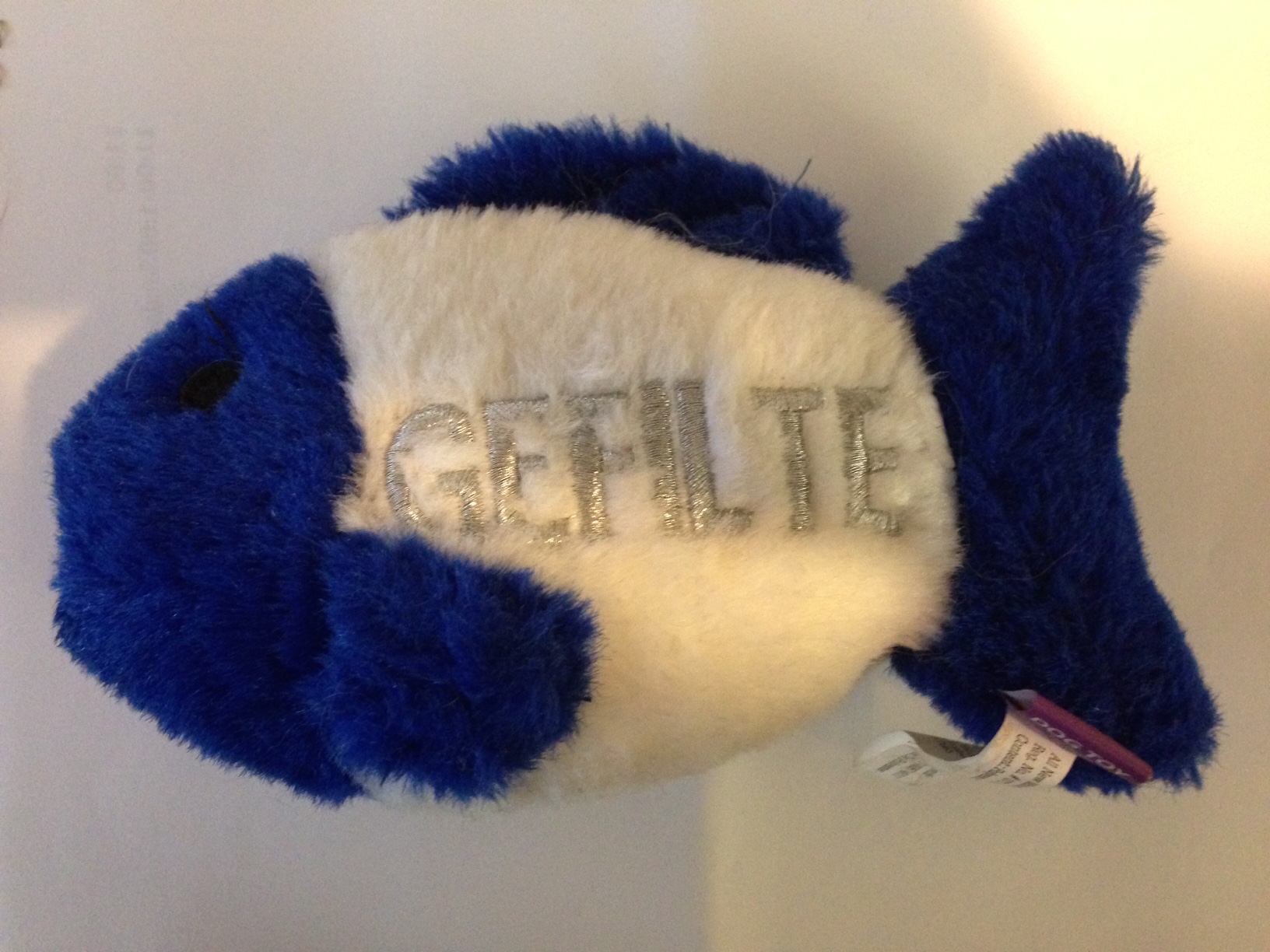
img_3944-copyJana had a toy called a “gefilte fish. She’s had several, actually. Instead of squeaking when squeezed, the fish says, in a distressed voice, “Oy, vey!” It then makes a bubbling sound. When Jana first got that toy, she squeezed it a lot. Each time, I would laugh. She soon took to standing in front of me and “oy, vey-ing” the fish. She’d watch carefully, and if I seemed about to stop laughing, she’d “oy vey” again. She’d give a little tail wag each time she got a laugh from me.

Cali tries to get me to laugh, too. If I am preoccupied or otherwise not paying enough attention to her, she’ll lie on her back and madly bicycle her back legs so that she propels herself around the room. I laugh, of course, at her silliness. She looks slyly at me, her signature sideways look, and makes sure I am watching her.

Dogs not only understand human laughter, they have a way of laughing too. I’m far from the first person to suggest this. In Man Meets Dog, respected ethologist and Konrad Lorenz describes a smiling, panting, most often seen during play, that he characterized as dog laughter. Bark magazine also ran an article discussing dog laughter.

It’s not only dogs; researchers have found that rats, chimps, and other nonhumans laugh. Why not?

So, you’re not imagining it if you think that your dog is laughing (at you?) or enjoying your laughter. Many dogs have a great sense of humor. Even more dogs have a silly side, like Cali. Sharing a joke is just one more way to deepen and enjoy our relationships with them.


I Don’t WANT a Little Sister

This slideshow requires JavaScript.

I don’t want a little sister. Or do I? Cali wondered. 

Cali met Koala with great ambivalence. She loved Alberta, Deni’s previous guide. Alberta and Cali joined the family at the same time, though Alberta was older, and a career girl to boot. Cali looked up to her and admired her. And, after a week or so of struggling to understand each other, they worked out a play language of their own.

But then, Alberta retired and moved to Montana (lucky Alberta!).  And Koala waltzed into Cali’s living room, bounced off the walls a few times, then settled down on the Good Bed. You know, the one Cali was always stealing from Jana.

That look on Cali’s face stunned. Disbelieving. Outraged. It was priceless. Hmmm, Cali, paybacks are … tough to handle sometimes, aren’t they?

Cali and Koala I just call them Koali haven’t spent enough time together to have their own play language yet. And I think Cali is ambivalent, maybe confused about where Koala fits in. She’s younger and newer to the family. Little sister. But she works and travels and seems to get all sorts of special privileges. What’s up with that? She’s also a bit pushy and intense. But she is fun, and we spend a lot of time at the park when she’s around so … Cali just isn’t sure.

A Dog’s Purpose: Was the Dog Abused?

A reader asked me what I think of the controversy over the movie “A Dog’s Purpose” and allegations that a dog was abused during filming.

I had tickets to a preview showing that was a fundraiser for a local rescue organization. The preview was canceled and the rescue org took a loss once the film clip showing the alleged abuse was released, so I was following this controversy.

Here’s my take on it.

First, a caveat: We’ll never know the whole story. There have been good questions raised about the film clip like, how much it was edited and why the person(s) who had it waited more than a year to release it and why they filmed rather than intervening. I don’t know the answers to those questions, and they could point to an agenda on the part of … someone.

But. I watched the film clip several times. That dog is terrified. His tail is tucked and he is using every bit of his strength to try to get away. Out of the water. Away from the edge. At one point, he leans, hard, into the person who is pushing him toward the water. He is doing absolutely everything he can to say, “No. I don’t want to do this.” He’s scared.

Actor Dennis Quaid claims the dog was just tired and not afraid. The video does not bear that out. Besides, since when is Dennis Quaid a dog behaviorist?

American Humane says the dog was never in danger, he was not forced, and the film clip shows footage from two different times edited together. This could all be true. It does not change the dog’s body language, though. The dog felt that he was in danger, and he let the humans, who are supposed to keep him safe, know that. They responded badly.

Various responses say that there was a diver ready in case Hercules (the dog) needed help, the water was warm, etc. That all might be true too. So what?

The bottom line, for me, is that, even if the dog was not actually harmed; even if the humans nearby knew that he was in no danger because they were standing by to rescue him if need be, the dog was scared. Terrified. Even if ultimately the trainers did not force Hercules into the water, they clearly asked him to do something that he was very, very uncomfortable with. They persisted, even pushing him, holding him to keep him from escaping. To me, that is forcing him into a terrifying situation. Hercules had no way of knowing that a diver was ready to “save” him. He probably wasn’t worried about whether the water was too cold. He might have been tired. If so, to me, that just points a finger back at the producer and the American Humane people who were supposed to be Hercules’s advocates.

Hercules was being used to film a movie. A movie. To entertain, well, us. The audience for that movie is dog lovers: Me. You. Nearly all of my friends and family. I personally do not want to be “entertained” by something that was created by scaring a dog (or possibly several dogs) and working him to the point where he is so tired that he freaks out. Do you? I didn’t think so.

That is the point. You want to use animals in entertainment? Fine. Train them, humanely, patiently, and sufficiently that they can do what is asked without fear or force. Work them in short spurts, make sure that they are treated well on and off the set, and ensure that they are always safe and they always feel safe. Even without knowing all of the facts, I feel comfortable saying that I do not think that those conditions were met for Hercules.


Beau’s New Coat

Beau lives in Michigan, which has had some very cold and snowy weather this winter. He’s a boxer, with very short fur and no thick undercoat. So his mom bought him a winter coat.

Beau wasn’t impressed.

Many years ago, I had a small dog, Timo, and lived in a cold and damp climate. My friend made him a beautiful coat—tweed, lined with fleece. He didn’t like it at first, so I let him get used to it gradually. I knew little about dogs at the time, so I didn’t know about conditioning and rewarding and all the means that trainers use to create positive associations. But what happened was that Timo realized that the coat was warm and cozy. He liked it! He ended up wearing it inside sometimes, when the weather (and house) was especially chilly. I’ve seen other dogs with sparse fur coats wearing jackets and sweaters, and some of them also seem to be comfortable in their clothing.

So I suggested that Beau might decide that he liked the coat once he realized that it kept him warm. His initial reaction was to walk very stiffly and refuse to do his business while wearing the coat.

Over several days, he did, indeed, begin to enjoy wearing the coat. He’s willing to go for longer walks, and his gait is less stiff. But he’s still not taking care of business.

His mom writes, “He walks totally differently when he’s wearing it. Instead of sniffing the ground and peeing on everything, he walks down the street with his head up, sniffing the air, and keeps stopping to look at things I can’t see and listen to things I can’t hear. And won’t pee or poop at all.”

She wonders whether he thinks it is a superdog cape and he just doesn’t want to get the coat dirty… or he might believe that it gives him a special power. We both wish we could get inside the dogs’ minds and know what they thought about their clothes—and whether the other dogs are envious or laugh at their clothed buddies. I especially wonder about all the dogs who wear holiday sweaters!

Cali models her raincoatDogs have varying reactions to clothing. Some take to it right away: Cali took to her raincoat pretty quickly. She doesn’t really like the hood, but she’s perfectly happy to wear the coat on walks, and it doesn’t interfere with her her activities, whether sniffing or eliminating. Other dogs freeze in place when dressed, while many don’t even seem to notice the clothing.

Lest anyone think that I am one of those silly people who dresses her dogs in clothing all the time, I’m not. I got raincoats for the girls, plus a spare for Koala’s visits (and Dora’s) because I was tired of having wet dogs lying around all the time. Jana’s coat took hours to dry completely, and both girls were cold and uncomfortable when they were wet after a walk. Now, Koala’s gone home after a no-rain visit, so Cali has three raincoats to choose from.

I do think that people need to be sensible about dressing their dogs. No clothing should interfere with the dog’s ability to move freely, lie down comfortably, or see. A dog with a thick fur coat should not be dressed in clothing that could make him overheat, but a thin-coated dog in a cold climate should have clothing for warmth. A whippet who had the misfortune to spend a winter in the NEADS puppy nursery while I worked there had a large wardrobe of warm jackets and sweaters, which she definitely needed. But, aside from raincoats and the occasional festive bandanna (and Jana’s beloved feather boa), I don’t dress my dogs.


Speaking Dog

One golden retriever bows to invite another to playI saw a sad little exchange today. A brown dog and a black dog met, and, while their humans chatted, the brown dog play bowed and invited the black dog to engage. The black dog’s human reacted by jerking his dog backward, away from the brown dog in what seemed a defensive or fearful response. Brown dog’s human pulled his dog away too, then leaned down and gave brown dog a stern talking-to. It seemed that both humans completely misunderstood the play bow and the friendliness in brown dog’s approach and demeanor.

This happened just a few minutes after a conversation with a friend who had described her communication with her birds. She doesn’t teach them English; she doesn’t exactly speak their language, but they have all evolved a communication that goes beyond words and human language to describe a relationship and mutual respect and understanding.

I know little of birds; I do strive for that sort of communication with the dogs in my life, though. The dogs learn many words of English (Hebrew, too, in Jana’s case). They also excel at reading human body language. But there is another layer that comes from a deep, close relationship. It is communication. It might be language, but it’s not something anyone outside the group would understand. When a person gets to that level of communication with her dog (or her bird), it is very satisfying and intimate. Jana and I had that kind of connection, and it’s what makes her loss so hard.

Most dogs seem to try very hard to understand their people; many succeed at understanding lots of people and dogs, even cats, if they live with a cat or two. It would be nice if more people made the effort to learn the basics of dog-to-dog and dog-to-human communication.