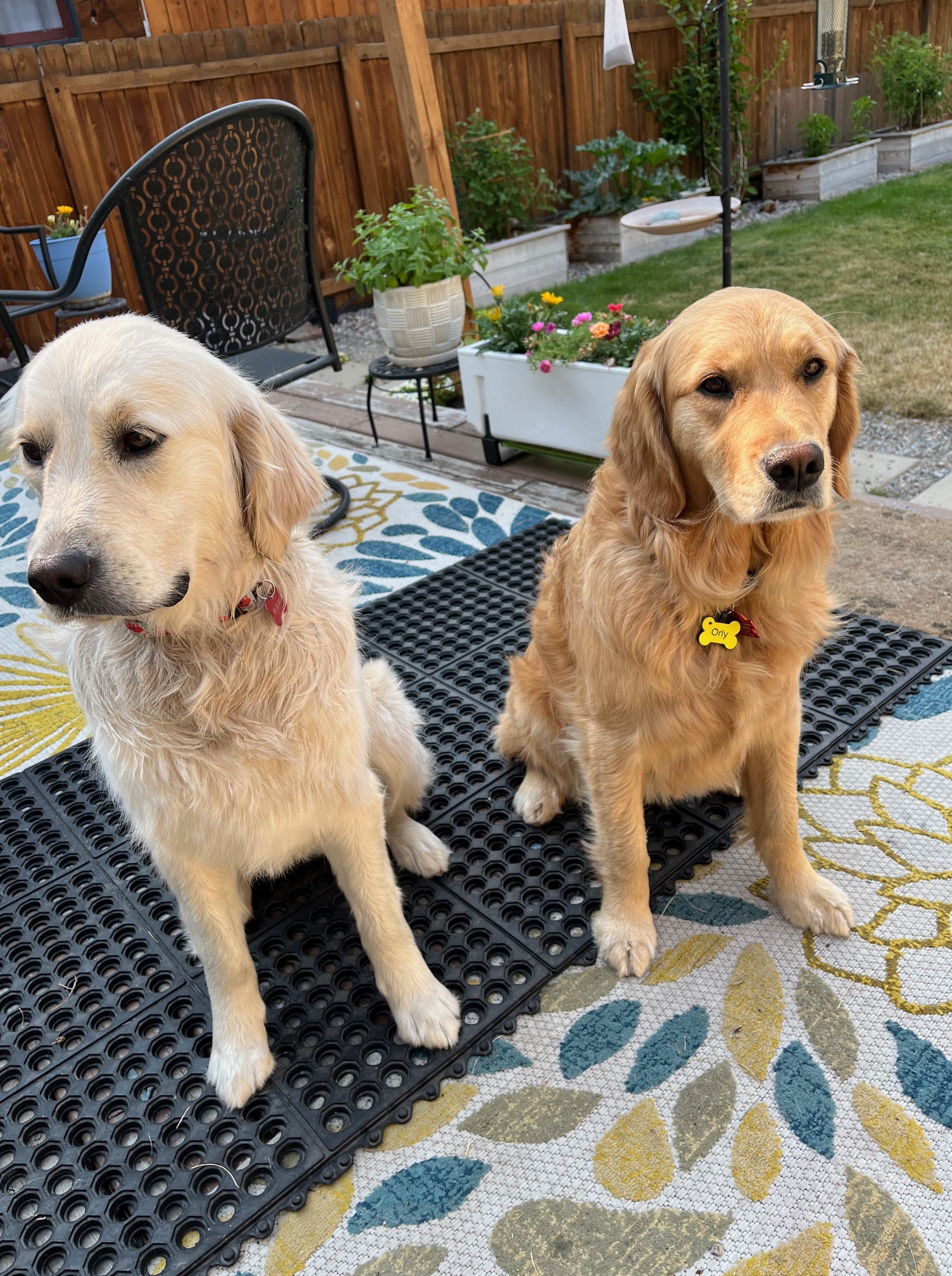
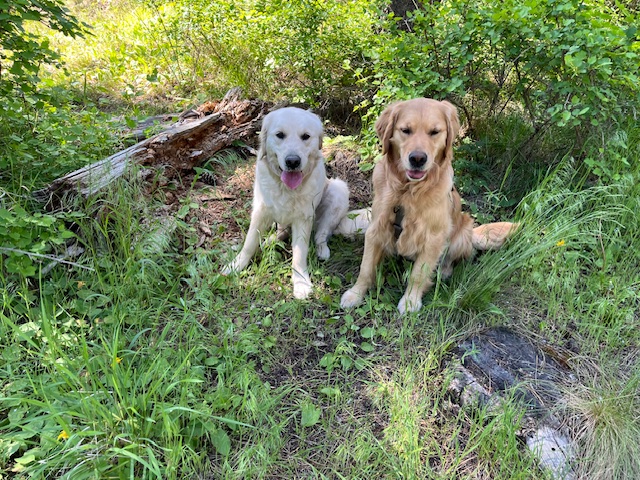
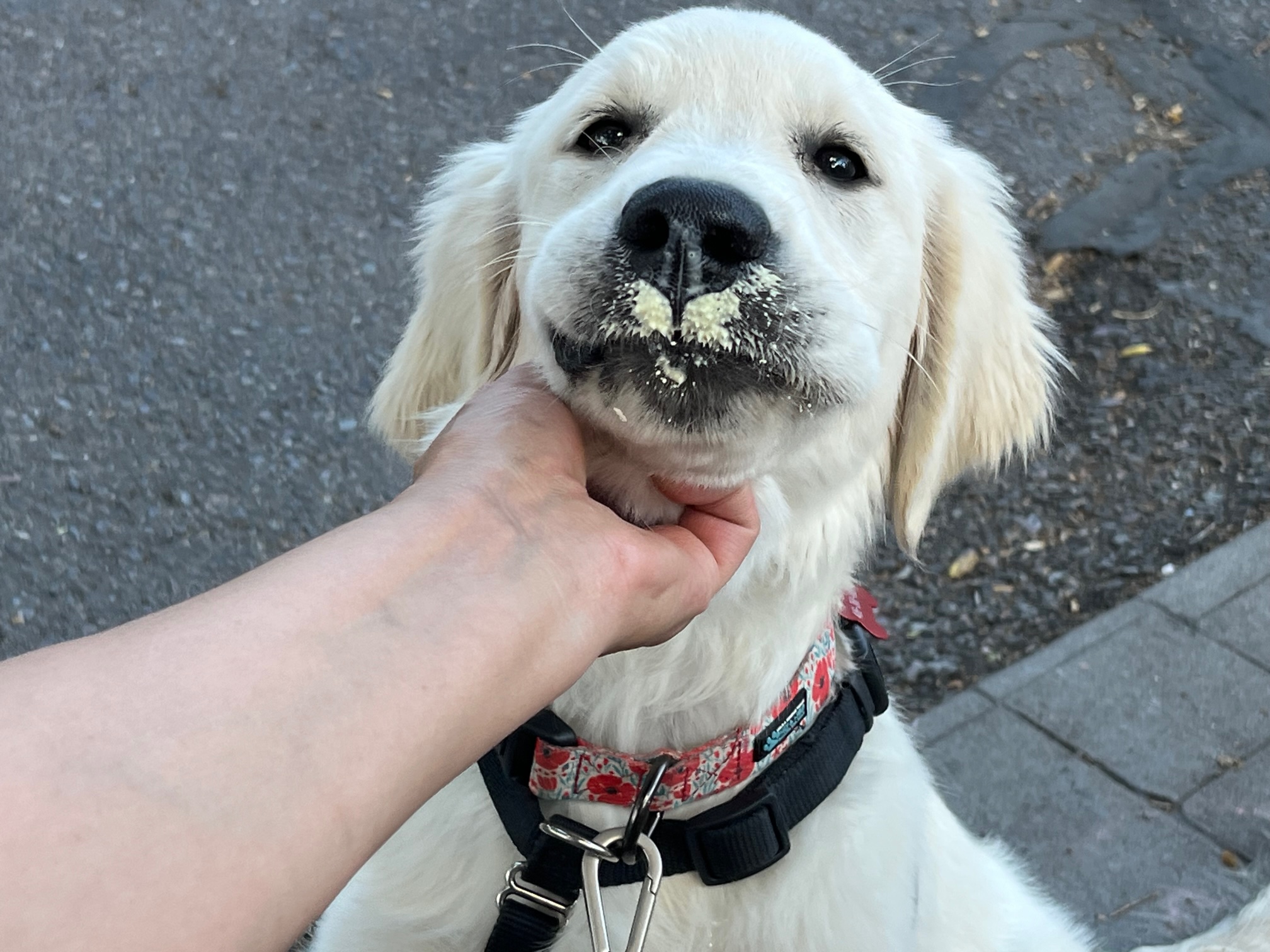
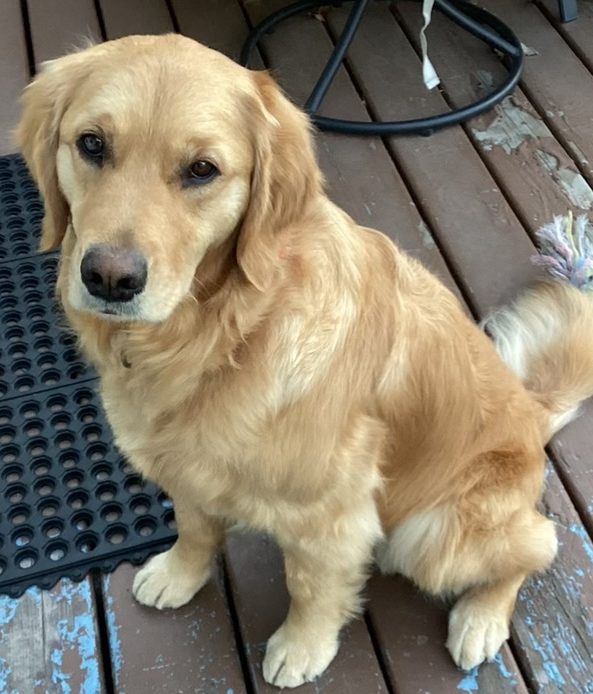
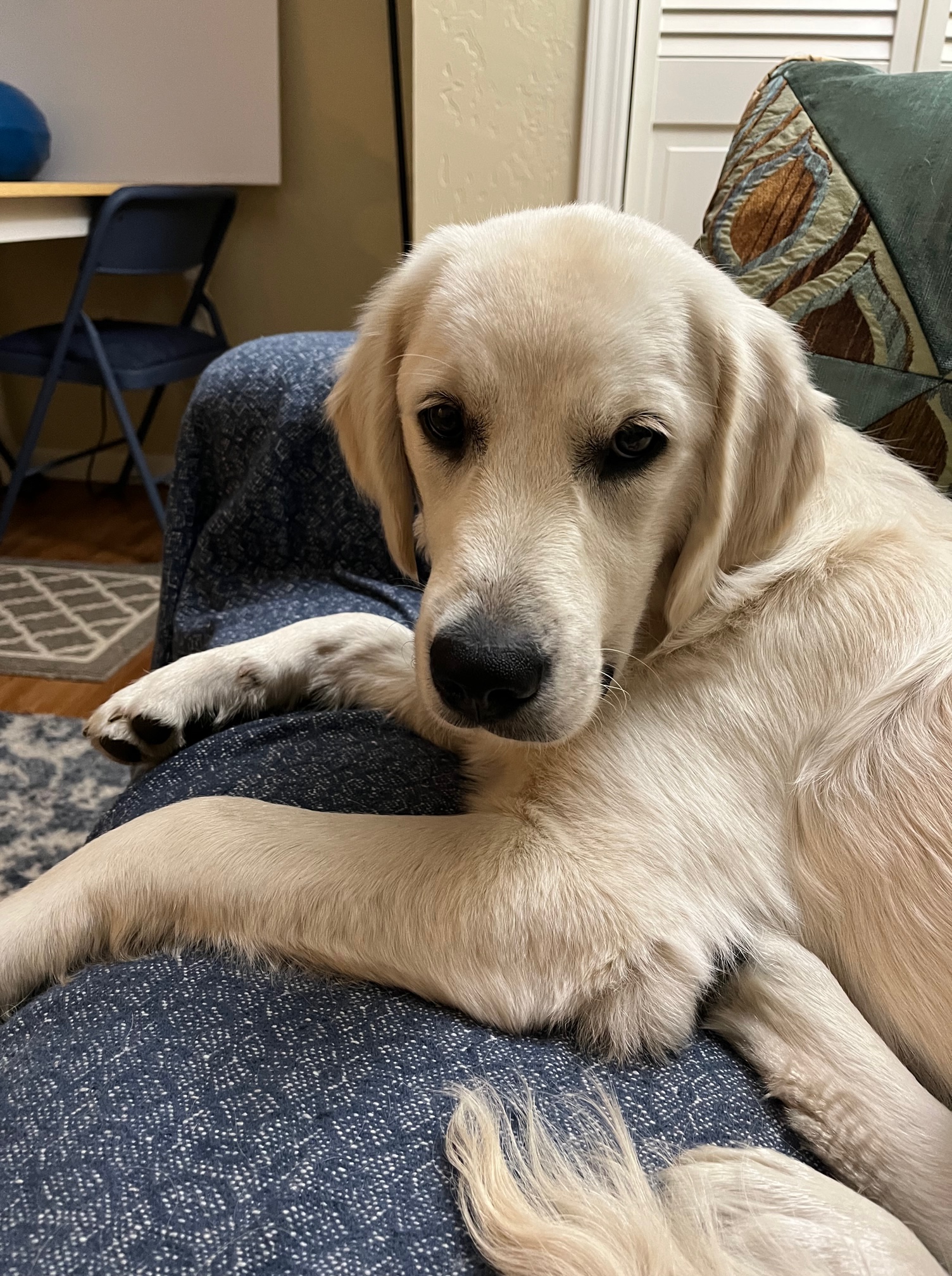
I took Dotty to see a friend recently. The friend hadn’t seen Dotty in quite a while and after commenting on her pony-like stature, she exclaimed, “I can smell her puppy breath!”
Dotty is 16+months old. How is it that she has “puppy breath,” a sweetish scent usually associated with puppies up to about 6-8 months of age? Is puppy breath simply the absence of typically stinky “dog breath”?
It really might be that simple: Dogs’ puppy teeth aren’t around for long enough to get dirty and cause bad breath. Their adult teeth are usually in by the time they are 5-6 months old. Without brushing, those permanent teeth immediately begin to develop a coating of plaque and tartar, and… dog breath occurs.
If this is the cause, then, the secret to extending “puppy breath” throughout your dog’s lifetime is (you know what I am going to say …) brushing your dog’s teeth.
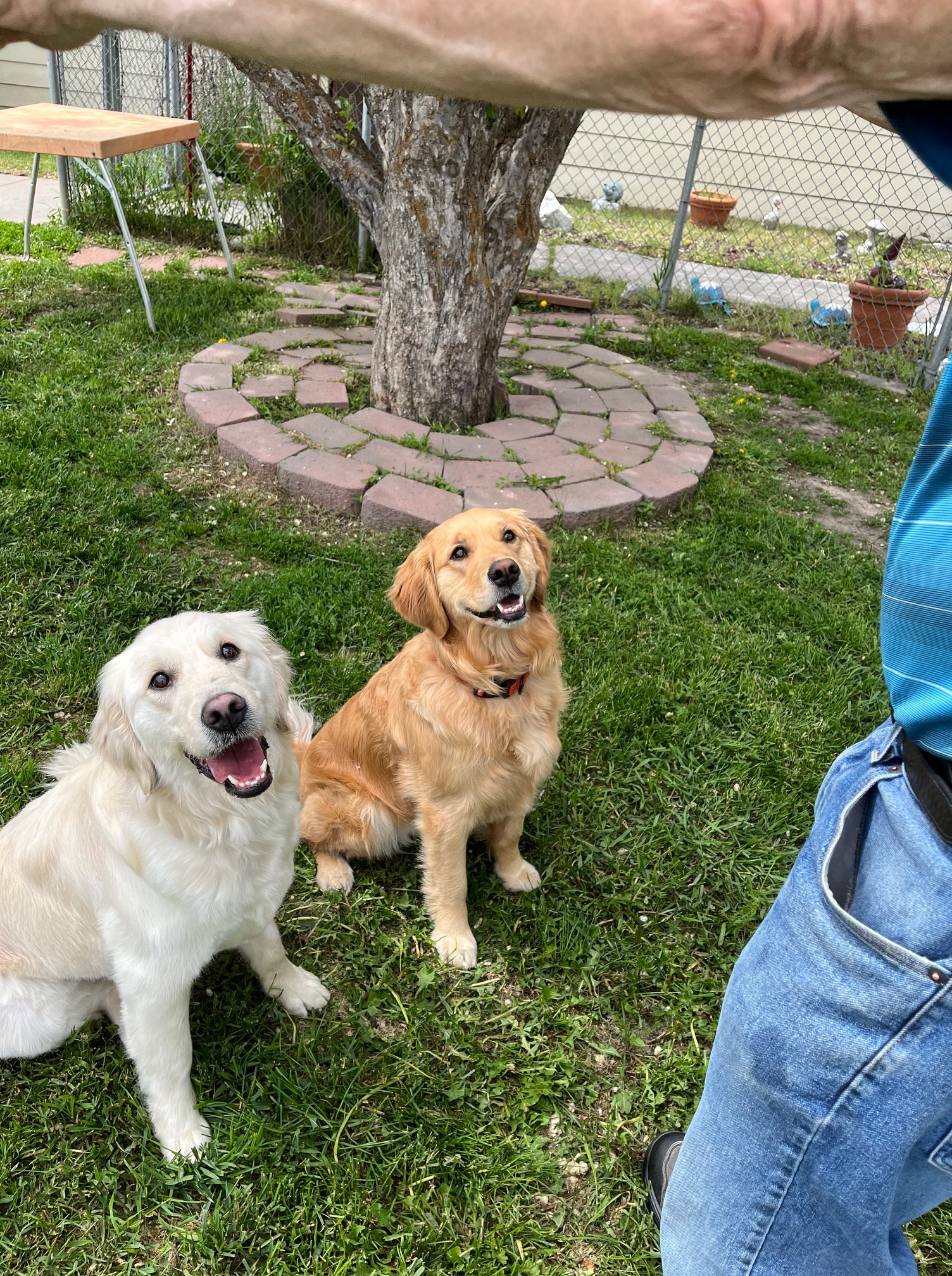
Dotty and Orly (and Cali and Jana before them) have excellent oral hygiene. That is, they brush their teeth daily. Well, most days. When I leave them with a sitter, I think the daily brushing goes on hiatus.
Cali never had a professional teeth cleaning in her life, and she had beautiful white teeth and good breath. Orly and Dotty are still young, and so far, both have gorgeous teeth.
Their doggy toothpaste claims to taste like chicken (really!). I haven’t verified that claim personally, but the girls like it. I’ve tried other brands over the years, but return to Petrodex because it’s easy to find in a large-ish tube that lasts several months. I also use small, soft kids’ toothbrushes because a lot of the ones sold as dog toothbrushes are stiff and awkwardly large.
Looking through the comments on a recent Whole Dog Journal blog post about brushing dogs’ teeth, I discovered another ally in the battle against dog breath: Kelp powder. The commenter recommended a specific (pricey) brand, but I started looking at other powdered supplements for dogs’ oral health, fell deep into a rabbit hole, and emerged with the conclusion that powdered seaweed sprinkled on the dogs’ food could help keep their teeth clean and breath fresh, as well as providing other potential benefits.
I’m giving them each a small sprinkle once a day of “Raw Paws organic kelp” — about half the amount that the package recommends. They seem to like it (not that golden retrievers are fussy eaters).
This completely unscientific experiment has brought what I consider to be excellent results: After a few months at a training kennel without her toothbrush (or her devoted tooth-brusher), Dotty returned home with some icky brown tartar on her back teeth. Brushing and kelping has completely eliminated that buildup and put her squarely on the path of permanent* puppy breath (*for as long as she lives with me…).
Our neighborhood doe had twins this summer, and we’ve seen the fawns — with or without Mom — several times. The girls showed little interest. In fact, both Dotty and Orly have been remarkably uninterested in deer in the neighborhood, whether young or adult, alone or in small groups.
(Well, except for that one time when a handsome young buck ran past us out in Crazy Canyon and Orly took off after him … for a moment, before sheepishly returning. Dotty ignored him and enjoyed watching Orly get reprimanded.)
Had been.
Not long ago, we were on our morning walk in our neighborhood. I spotted the family group, this time with a young buck, a block away. I was trying to decide what direction they were headed so we could give them plenty of space. Suddenly, something spooked the twins.
Instantly two fawns were racing down the block — heading right toward us. They are fast!!
The girls froze, suddenly fascinated by deer!
I quickly UNfroze and urged them across the street. By the time the three of us stumbled across the street, the fawns were racing across the spot we’d just been standing, with Mom and Dad? Big brother? in hot pursuit.
To their credit, Orly and Dotty just watched, interested but not predatory, not even pulling on their leashes. Such good girls! They got lots of praise and treats for that!
Missoula experienced a long “heat dome” with what seemed like months of 95+ temperatures. Added to our long summer days — in July, it’s light out until nearly 10 pm — it was brutal. (We have no air conditioning.)
As a recent post shared, we tried lots of ways to keep cool. It’s possible that Dotty might have gone a bit overboard.
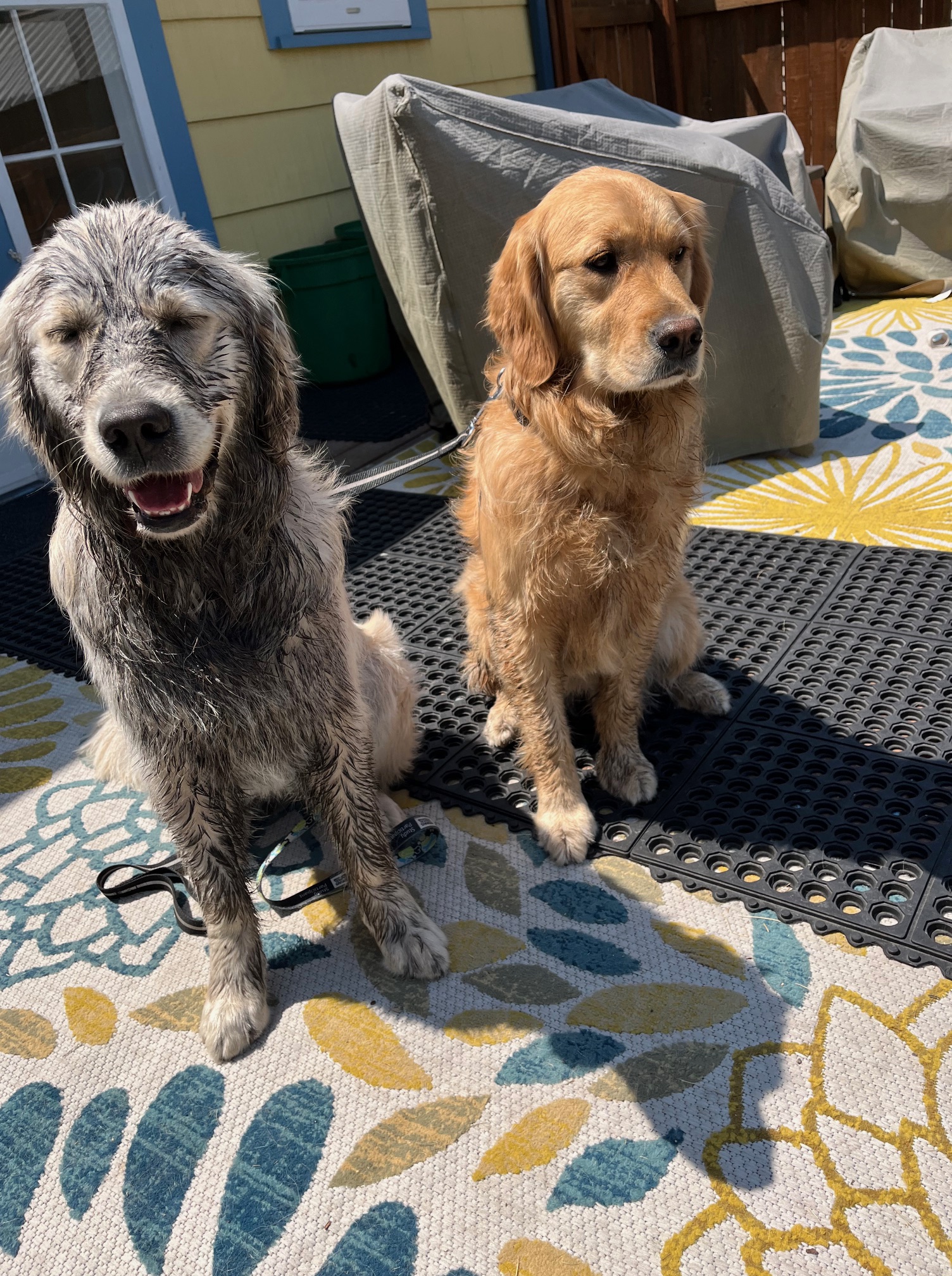
On one of their hikes, the girls encountered a mud puddle. Cool, wet — what’s not to love?
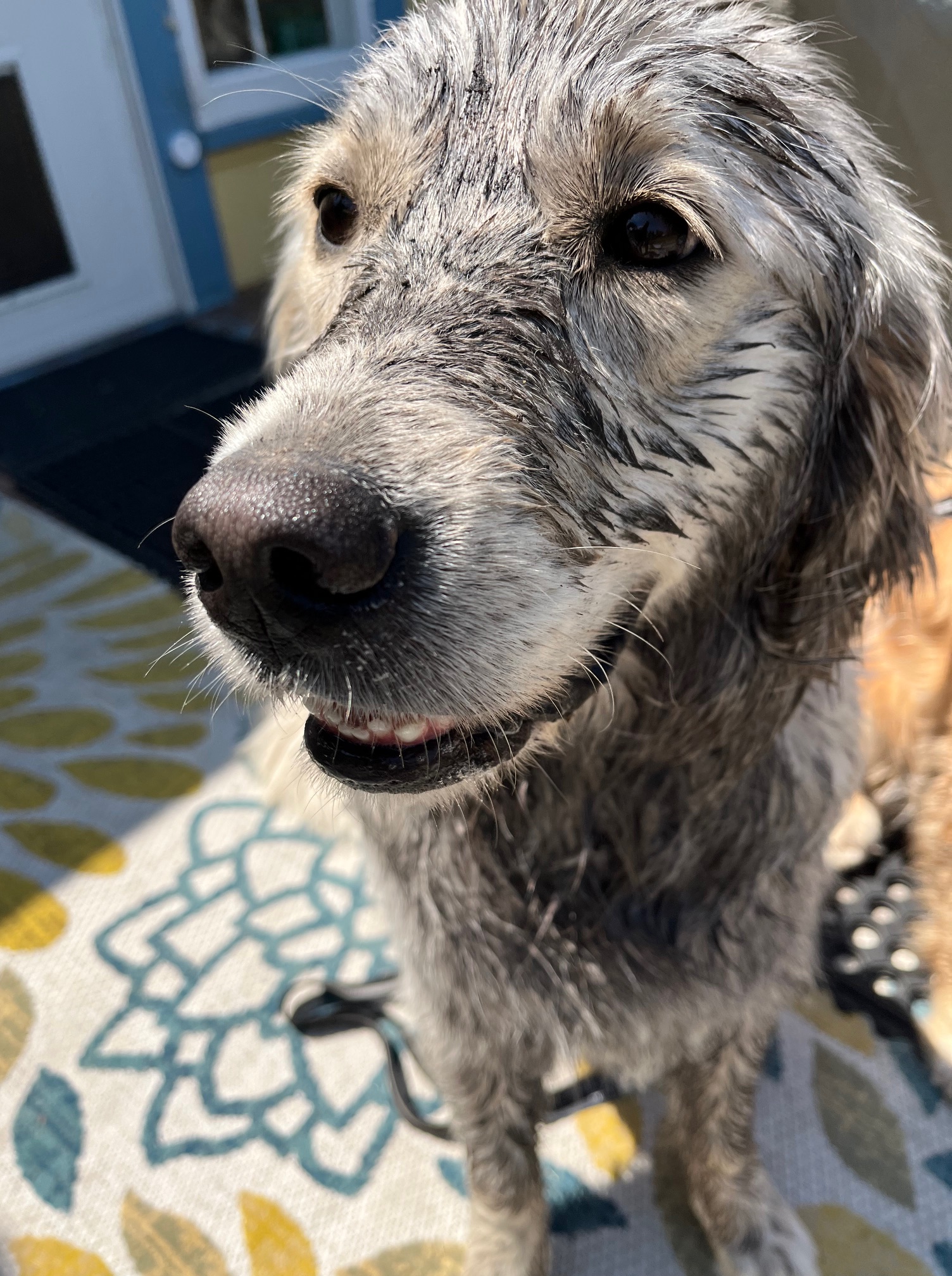
While Orly’s legs and belly were pretty muddy, which is to be expected when one wades into a muddy puddle, Dotty flung her entire front half into the mud. My normally white dog was black. But cool, very cool.
And, judging from her expression, pretty pleased with herself.
Orly’s more worried expression, once back at home, might have been born of experience.
These dogs were not allowed into the house.
Nope; they were marched straight to the backyard for the indignity of a hosing-off.
What? No warm water??!!
In their post-hosing-off photo, Dotty’s glum expression matches Orly’s. The price of fun …
Somehow, I doubt that she regards it as too high — or will even remember it. And, to be fair, they got to enjoy some frozen yogurt-banana-peanut butter treats while drying off on the deck. (Even Mean Mom has a softer side …)
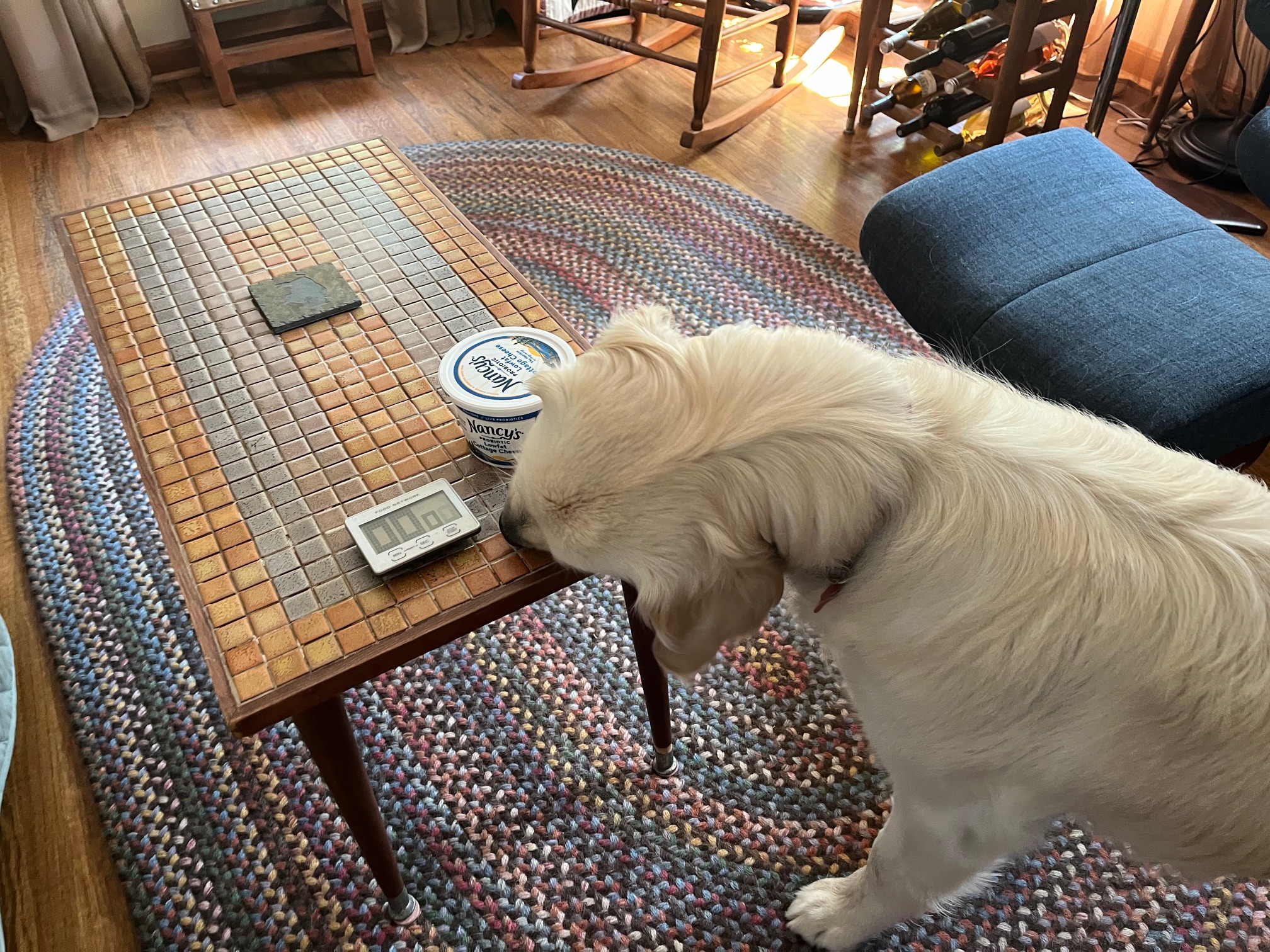
Dotty has learned not to take the treat until she hears the sound
Dotty is getting ready for her future career: She’s going to be a hearing assistance dog. Hearing dogs assist people with hearing loss by alerting them to key sounds, such as a timer, a smoke alarm, a doorbell — even someone calling their name.
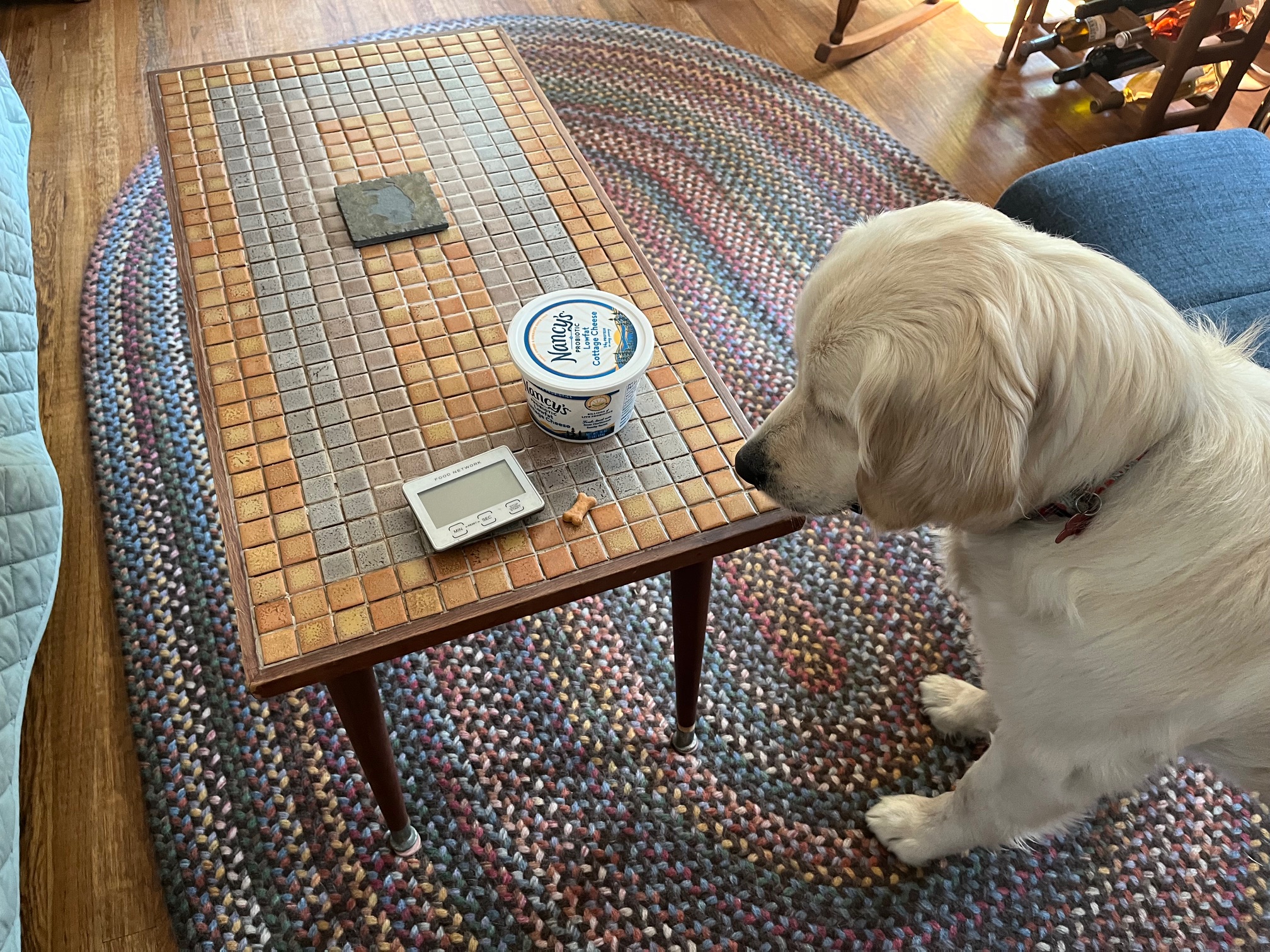
During her last weeks with us, Dotty is practicing the first steps in hearing-dog training. We set a timer. I place a cookie near the timer and guide Dotty away. Initially just a few feet, but we’ve expanded the distance a bit.
Returning to the table in response to the timer’s beeping, Dotty eats her reward
When the timer rings, Dotty goes to it and eats the cookie. That’s the easy part. Then, she is supposed to come and alert me. We introduce this with another cookie (are you beginning to see why Dotty loves practice sessions?). She nudges my leg and gets the cookie. I then ask her “What?” She is supposed to lead me to the sound and, you guessed it, get another cookie. (The cookies are very small.)
When Orly is home, she sometimes tries to steal the first cookie. If she refrains and heads back at the end of the alert, she gets a ‘good helper’ cookie.
As Dotty gets better at this, we can make things tougher. The first thing we’re doing is adding more time between when Dotty sees me set things up and the timer rings.
We’ll als0 add more distance, with me waiting in a different room or even hiding from her. Eventually, we’ll start working with a second sound. We’ll go back to the basics, with her watching me set it up and the sound alerting only a few seconds later.
As she progresses, her professional trainer will continue to make things more difficult — adding new sounds, increasing distance and time, and moving to unpredictable alerts, where Dotty would not see the setup happening. That’s all pretty far away for her.
In her more advanced trainer, she might also learn different responses to some sounds. For example, if she’s alerting to a smoke alarm, she might lead me to the door — not to the alarm.
We’re only at the early stage of her training, and Dotty is an enthusiastic learner who learns quickly.
Missoula got its own heat dome recently, with temperatures in the upper 90s. Orly and Dotty came up with a few ways to beat the heat.
Get out the splash pad
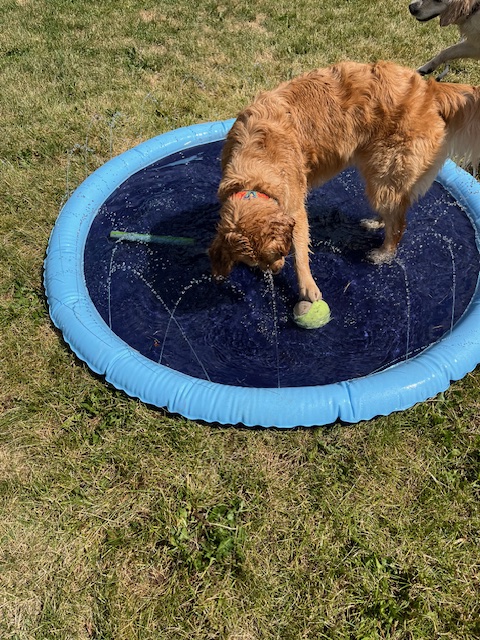
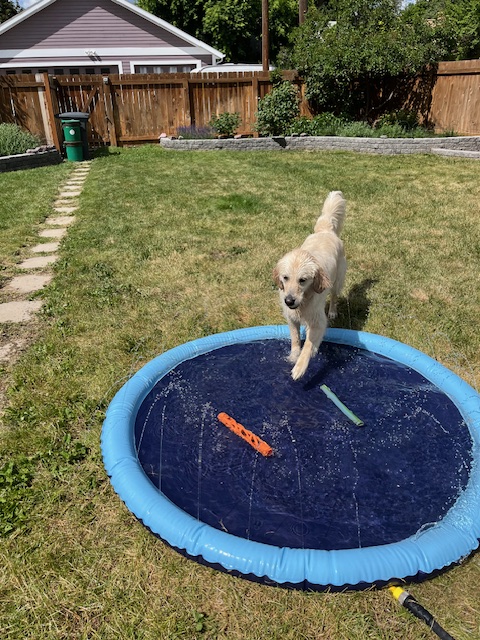
The splash pad is always a popular way to cool off. Several of Orly’s siblings have had the same idea and shared photos on our group chat.
Orly bounds right in; Dotty is a little more tentative. Once Orly splashes in after a toy, though, Dotty is eager to try it out.
Eat special frozen treats
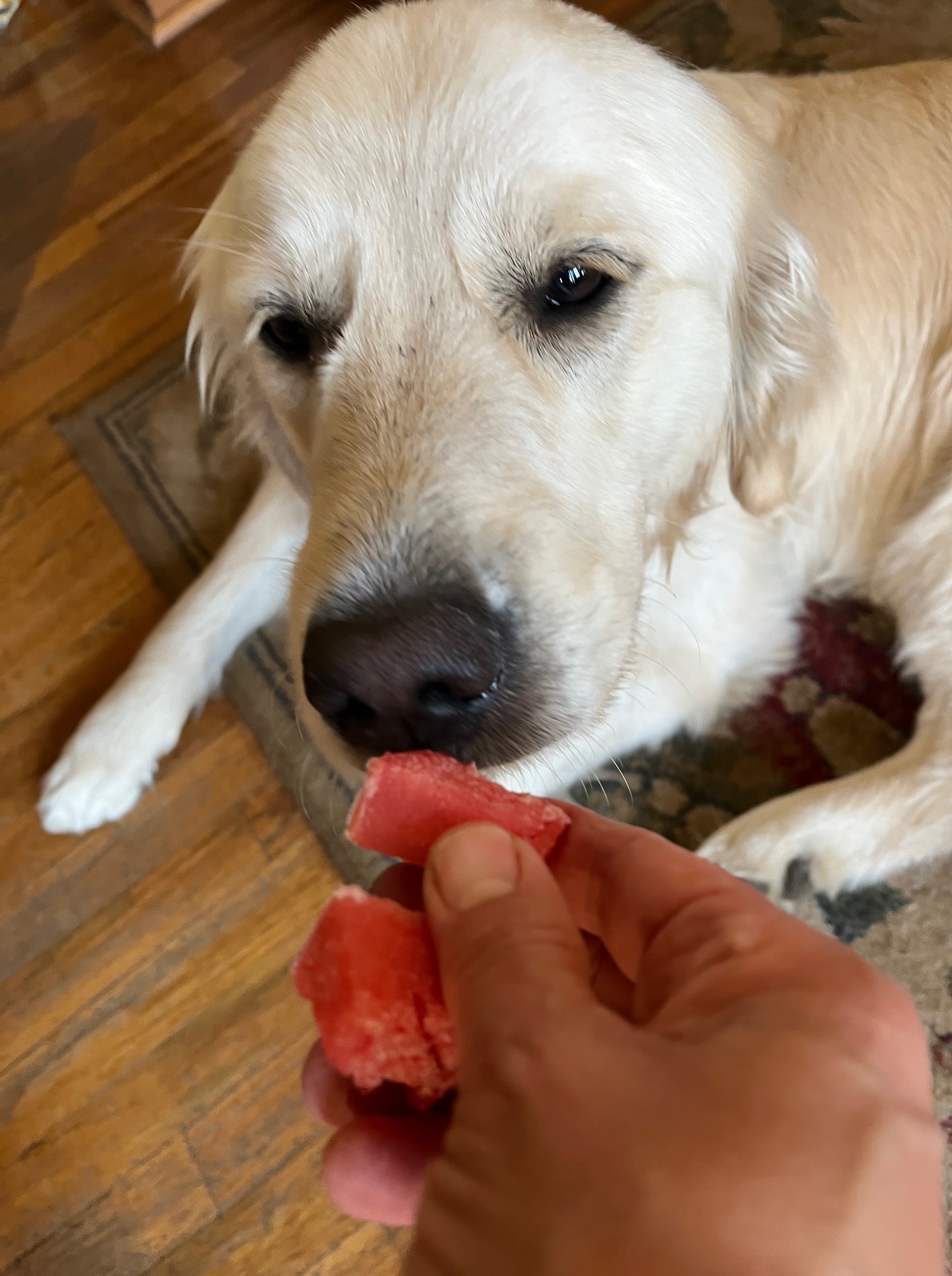
Get your mom to make frozen treats. Cubes of watermelon freeze nicely and are delicious. Other favorites are coconut water ice cubes (put a couple of berries in each one!) and a new addition to the menu: yogurt-peanut butter-banana mash.
Orly and Dotty love this mixture in frozen into a Kong or Toppl (and it takes them a good 10-15 minutes to lick out every cool, yummy drop). Or just freeze blobs on a cookie sheet. The girls are NOT fussy!
Take a walk in the woods
One of our favorite hiking spots, Crazy Canyon, is always shaded and at least a little cooler than our neighborhood.
Head for the river (along with all of Missoula)
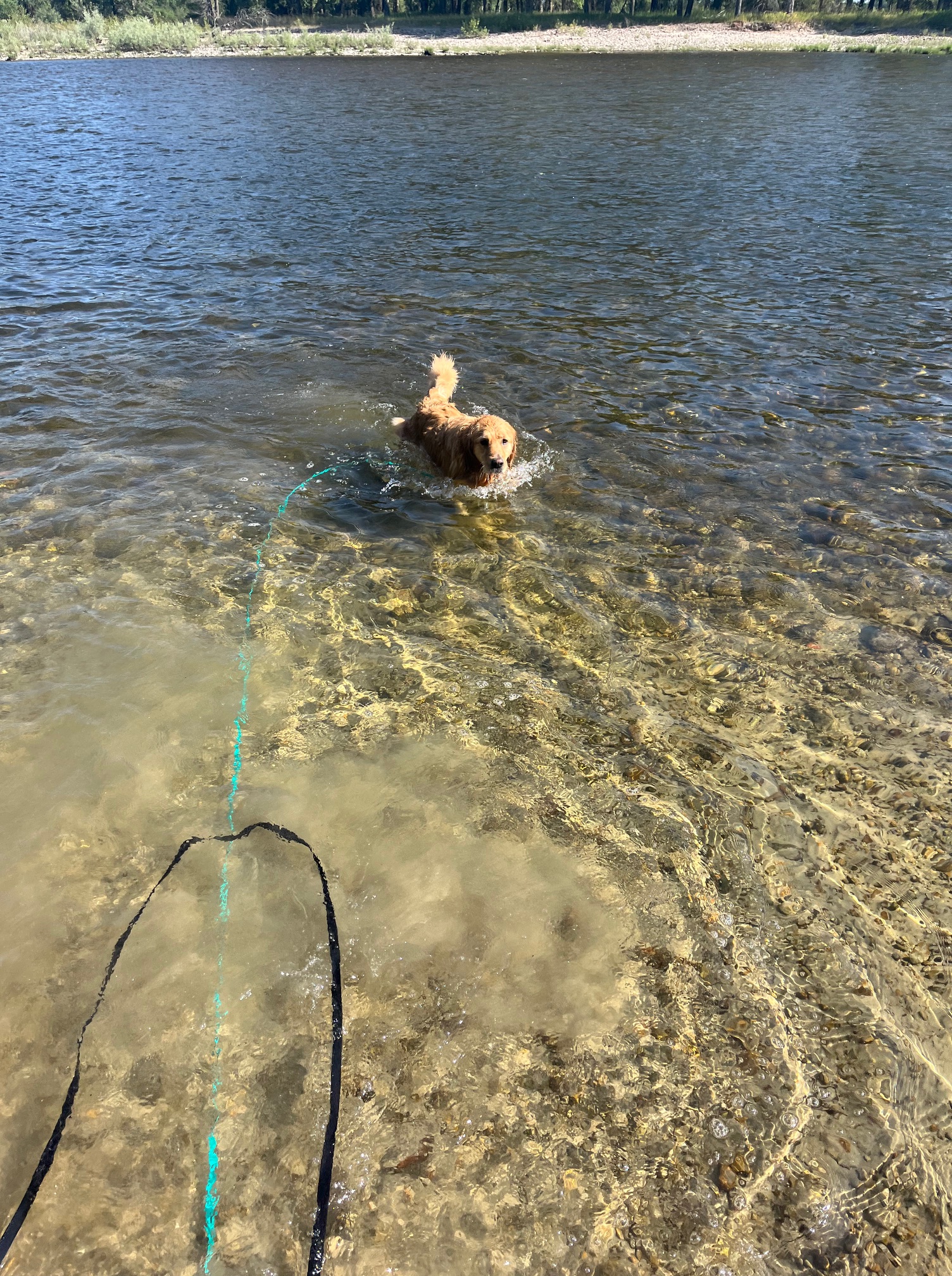
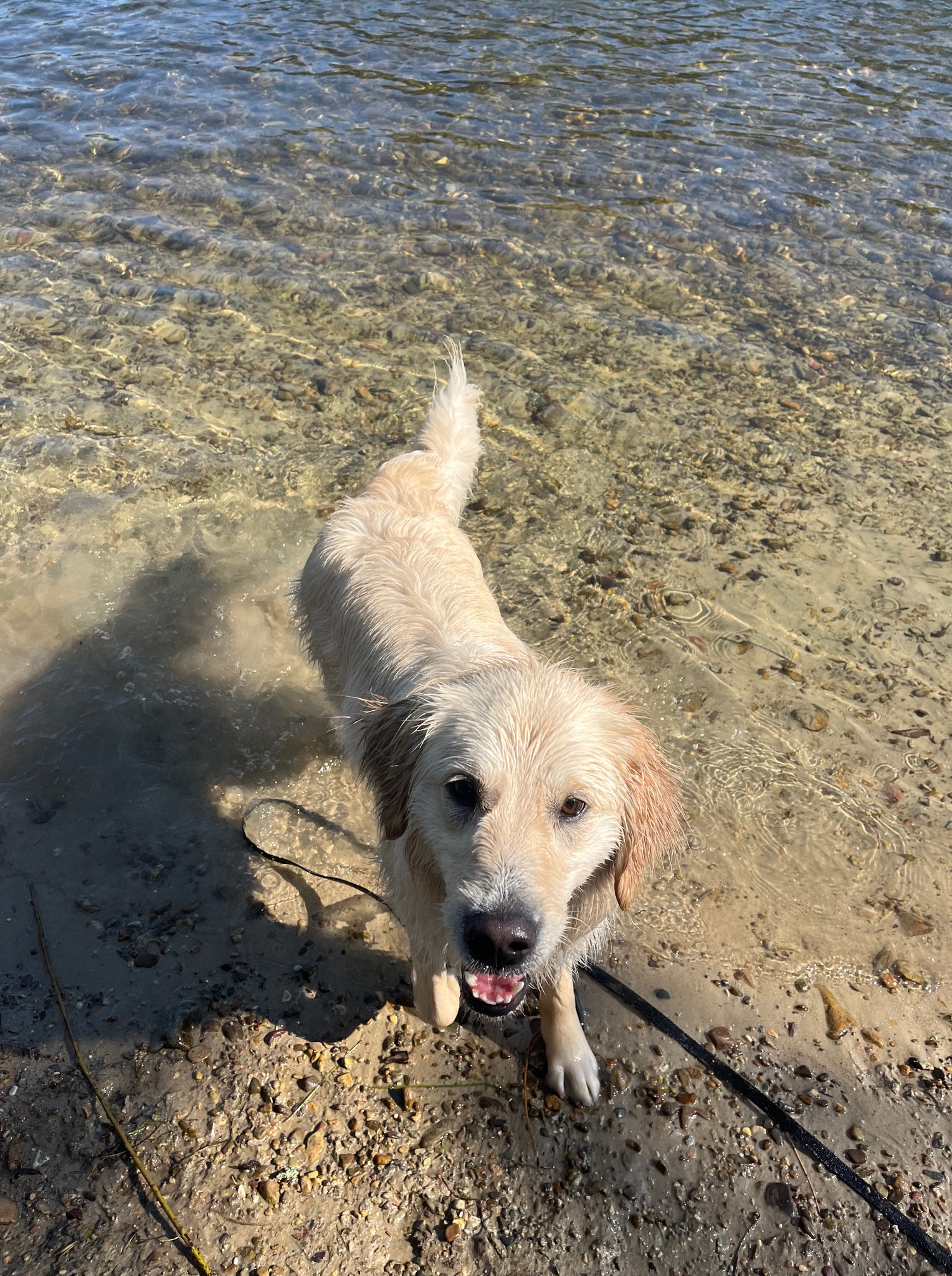
We got there early and went a bit off the beaten path for a cool swim / splash. Orly is a strong swimmer. Dotty is more of a splash around the shallows gal, with the added excitement of giving occasional soaking hugs to her favorite human.
Orly loves to swim after a stick, and Dotty … doesn’t, so they made up a game. The nearest human throws a stick; Orly swims out to grab it. As she returns, Dotty meets her partway and grabs the stick. The human must be ready with a new stick to throw … and the game continues.
… Or farther out of town
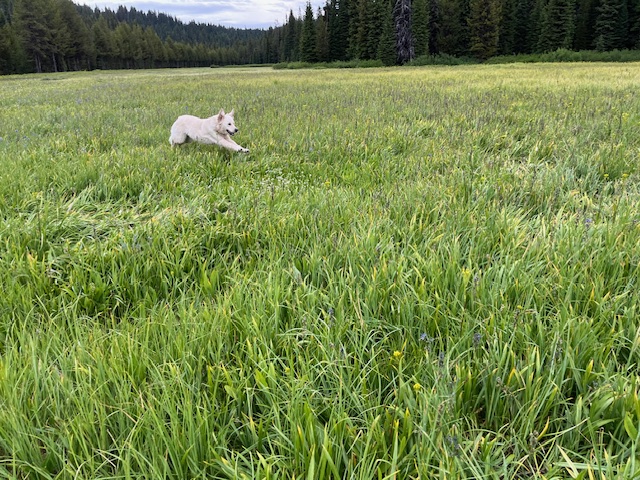
Packer Meadow, located at a higher elevation, is always a cool spot that offers opportunities to run and swim.
And of course … visit the Big Dipper
Summer would not be complete without several visits to the Big Dipper, the iconic Missoula ice-cream stand conveniently located a few blocks from our house. The free dog cones are definitely a lure. The dogs’ only complaint is that they are not open at 7 am when we pass by on our morning walks …
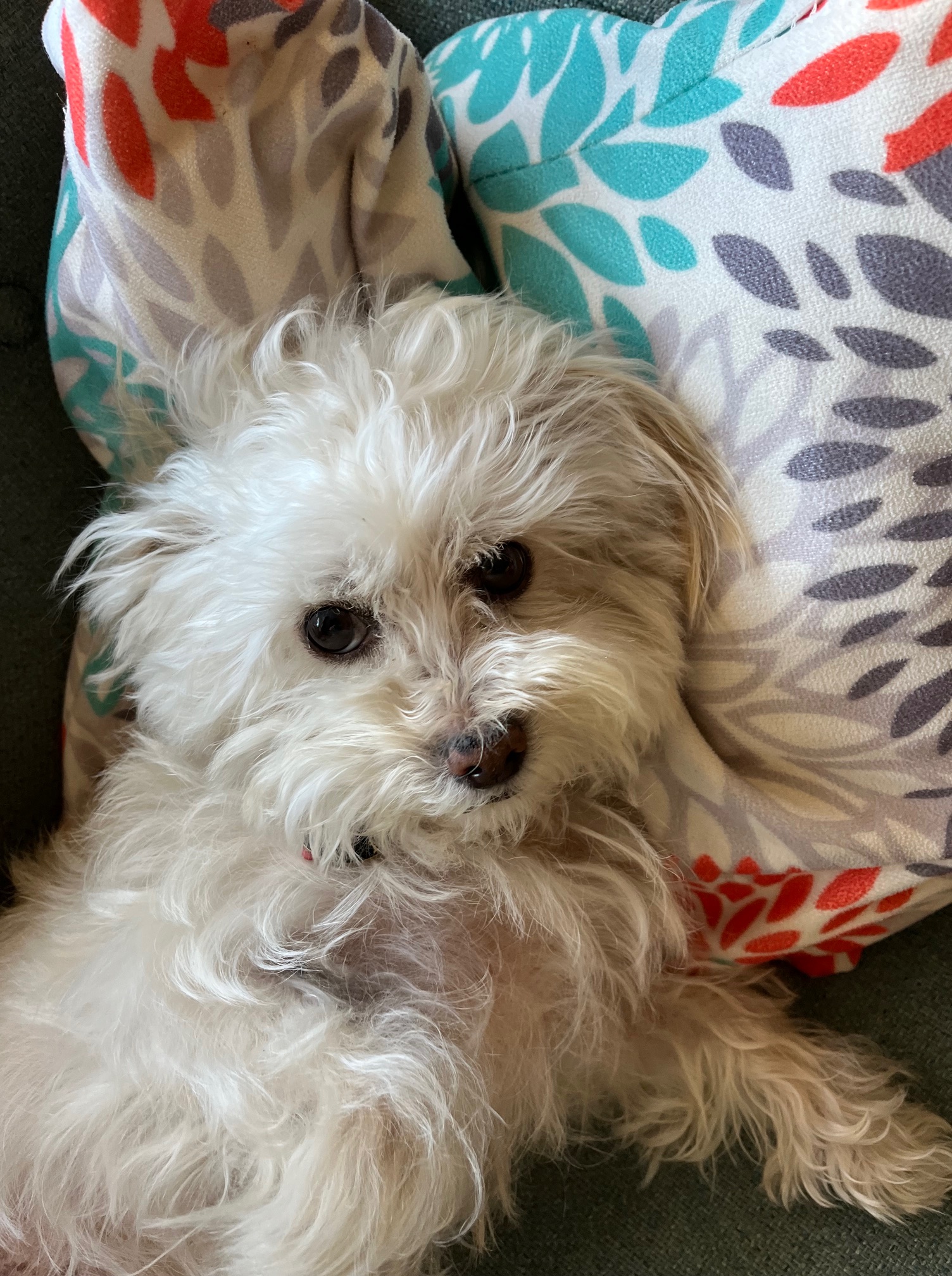
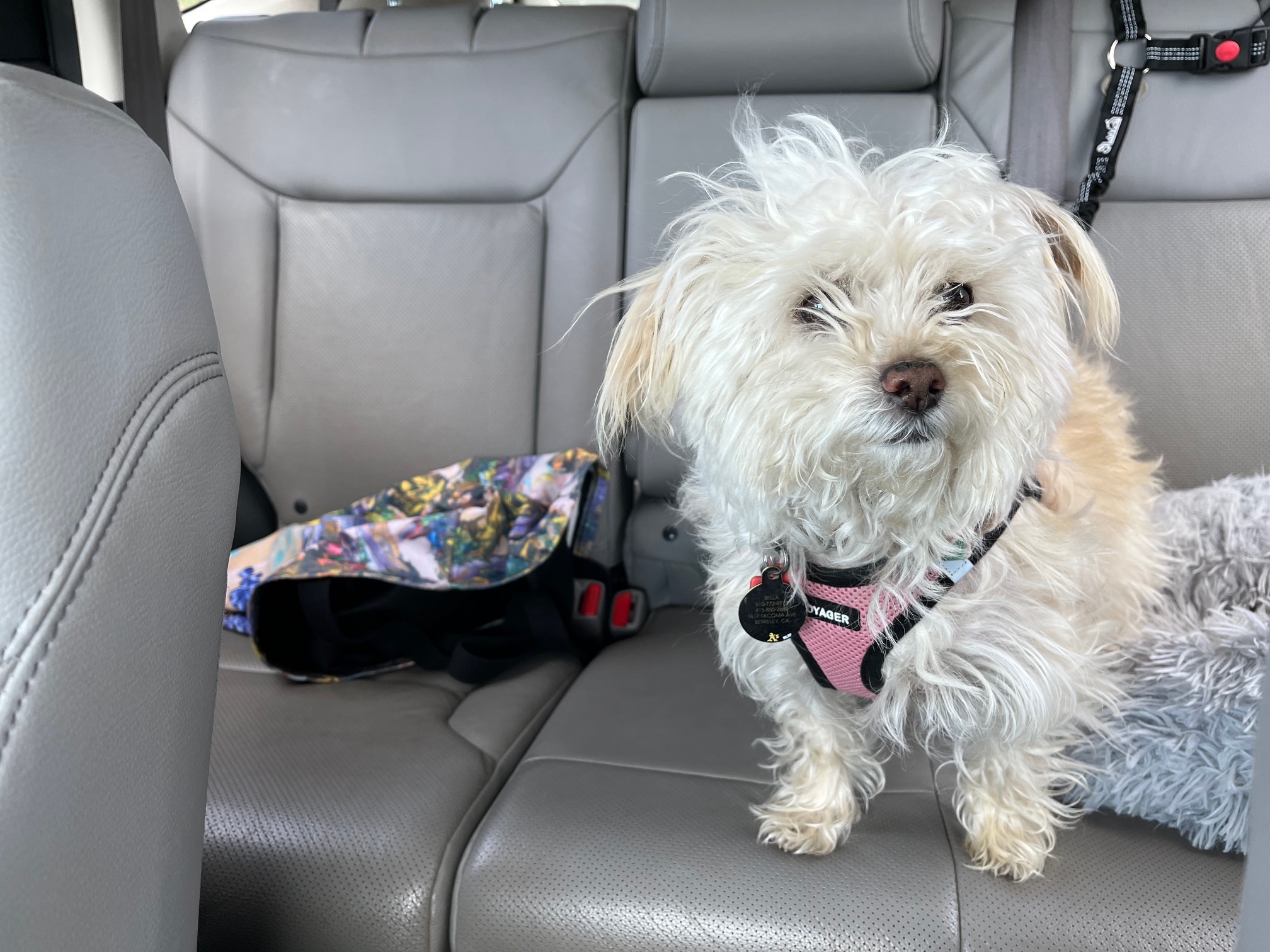
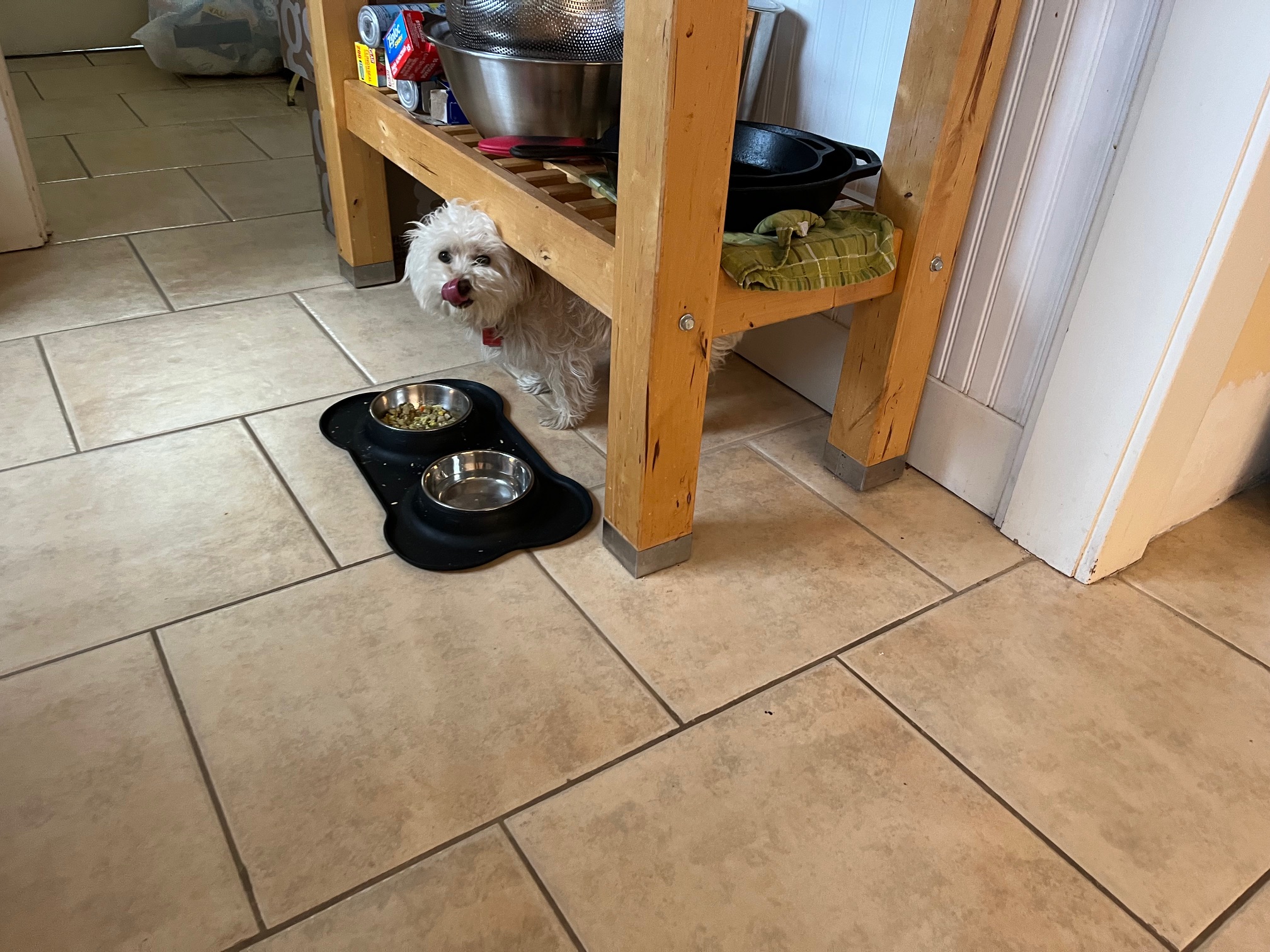
My new buddy Bella taught me about living with a small dog during a recent visit. I took care of Bella for 4 days while staying at her home and visiting friends.
Bella mightweigh 10 pounds, and her perpetually disheveled curly mop of white-blonde fur accounts for a good percentage of that weight. She’s got the spirit of a much larger dog, though.
Bella spends a lot of her time curled up in her dog bed, reclining on the sofa, or, apparently, snuggling the nearest human. She’s very relaxed, quiet, and agreeable to being petted, brushed, given belly rubs, or just hanging out together.
But she gets very excited when offered a walk, dancing a bit and sometimes even barking with excitement. And she’s up for adventure. She trekked with me through the neighborhood, ventured out to meet a friend for a walk by the Bay, and kept up with the much-bigger pup on a jaunt with friends to a local brewpub.
On walks, she’s curious and eager to meet people and dogs, and loves to stop for long, deep sniffs along the way. She’s gentle, never pulling and always mindful of where I am. I haven’t lived with a small dog in a very long time; walks without being pulled were a nice change.
One thing made me a little sad: Whenever a car that sounded like her mom’s or dad’s passed, she’d immediately stop and look eagerly … then show a moment of disappointme
nt before returning to her “sniffari.” But, when I’d return from a non-dog-friendly outing, she’d greet me at the door with an excited dance and a few yips — even after realizing that I was not Mom or Dad.
If someone says something rude to you as you walk past them, it’s only natural to want to respond — though it’s usually better to just walk on by.
Our neighborhood is full of dogs, many of whom spend part of their time in fenced yards making rude comments to other dogs. First Cali, then Orly, had a hard time resisting the impulse to bark back — louder.
So I tried a little experiment with Cali several years ago. I’d ask her to stay calm and, if she walked past the rude dog(s) without barking or pulling, I gave her a treat. Cali caught on very quickly (she was a golden retriever, after all), and our walks were peaceful, if sometimes highly caloric.
Not a very reactive dog to begin with, young Orly caught on quickly to the idea of getting rewarded for walking calmly past noisy dogs. I caught on less quickly when Orly added her own twist.
I like to let my dogs choose where we walk. We have a few routes and, as we head out for a walk, I will ask them to choose left or right at the corner. This way or that way as we walk through a nearby park.
I finally caught on that Orly’s choice had a lot to do with whether the neighbor dogs were in their yard. We’d get to the edge of the neighborhood park and she’d look at the yard, look down the street, glance at me, and choose a direction. Fine, right?
Except that nearly every time she chose “left,” the barky dogs were out. She’d stroll slowly past and, a few feet farther on, stop and look at me expectantly.
Similarly, on walks back from a different park, she’d detour to one of two corners with reliably rude pups, slowly pass the yard, looking at the barking beasts, then stop and wait for payment.
The light bulb finally went on. Orly is deciding which way we walk based on where she thinks we’ll find the noisiest dogs.
I am not sure where that line is where I cross from training my dog to being trained by her, but in this case, I am pretty sure we crossed it ages (and miles) back.
Dotty is home for a visit! She’s calmer and a little more mature, but the silly, playful puppy is still there.
And … she is still obsessed with hands. She’s very paw-oriented and loves to dig, paw at people to say hello or ask them to play, and hold her toys with her paws.
When she first saw me after several weeks, she wanted to hold hands, maintaining constant contact by resting a paw on my hand or knee.
She’s also obsessed with human hands, and she appears to believe that the only reasons hands exist are to either feed or pet and play with dogs.
WHY are you not petting me?
Correction: Pet and play with Dotty. If I am patting Orly or, horrors! another dog, she tries everything she can think of to move my hands — and attention — over to her.
Her focus on hands is especially noticeable when I am trying to relax or to exercise. I like to stretch in the mornings, and some evenings, I try to relax with a short yoga video.
Sometimes I also just sit, watching TV or reading, with one or both hands unoccupied.
These situations are simply Unacceptable. If either or both hands are still, maybe just lying there on the floor or sofa — Dotty simply can’t stand that.
She’ll lick them. Nudge them. Paw at them. Push her nose under my hand and attempt to make it pet her. If I react at all — a laugh, even a smile — she’s encouraged to increase her efforts.
Orly is a little more restrained. While she also enjoys licking and nudging my hands, her favorite trick when I am exercising is to wait for me to close my eyes, even for a second. She darts in and gives me the tiniest kiss, right on the nose.
I’ve seen videos of people doing yoga with their dogs … and the dogs are just accompanying them. Exercising together. Doesn’t that sound nice?
Not these girls … they make it all about them. Or maybe they just understand that laughter is the best exercise and are nudging me toward more laughing, less stretching? Yep, that must be it!
It has been a while since I wrote about Dotty, so I wanted to give an update.
Dotty is with her trainer, doing some intensive work on a couple of behavioral issues.
When I dropped her off in late February, just before heading out on a trip, I thought I would see her again in a few weeks. It has been more than 2 months.
At first, I worried that I’d flunked puppy raising; that the issues were because I had done something terribly wrong.
As time passes, though, I have realized that I had flagged these issues last summer, and did what I could (& knew how to do) … and she needed more skillful training than I could provide.
I’ve joked that Dotty is at reform school but … that’s not fair to her. She’s not a “bad” dog and is not doing anything “wrong.” She’s a bit overly exuberant for the ideal service dog candidate, and a lot to handle for the average dog handler, but also a sweet, affectionate pup who really wants to be a good girl.
Orly seems ambivalent. I am sure that she misses her playmate, and she seems bored a lot. But … she also seems to enjoy being the pampered “only princess” in the house.
Reactions to seeing people …
One of her issues is termed “reactivity.” This is a very broad term that refers to a dog who, well, reacts to a trigger in a way that the humans dislike. This is a very broad spectrum. Triggers can be cats, other dogs, squirrels, children, noises, things flapping in the wind … and pretty much anything else a dog might encounter. Reactions can be to startle and recover (fine), to growl or bark, to lunge and pull, to leap around excitedly, to show overt aggression, and more.
In Dotty’s case, the trigger is just about any living creature entering her field of vision, approaching her, and presenting the possibility of a social encounter. Her reactions vary: For a squirrel, her response is fascination. She’d sit and watch the squirrels in our yard for as long as 20-30 minutes, utterly fascinated — and utterly still and calm. For cats, deer, and squirrels encountered on the walk, she was interested and might pull a bit, but was responding well to a Leave it! and would walk on by (usually). For people, with or without dogs, and for familiar dogs in a yard — that’s a whole ‘nother story. Especially people.
I have to say: Dotty is the only dog I have known to leap off the ground, almost to my shoulder height, clearing all four paws. Over and over, maybe 5-6 times within a minute or two. It’s quite an athletic feat. It also gets people to laugh, which encourages it …
Cooperative repeat visitors to my house ignored the antics, waiting until Dotty sat to greet and pet her. But on walks, I was not having much luck breaking this habit.
A different sort of reaction
Her other Big Issue has to do with anxiety, lack of confidence or both. When something unexpected happens, she startles, which is normal. But a confident dog will recover quickly and move on, or (even better) quickly go to investigate the weird thing or noise, whether it’s a paper or plastic bag blowing down the street, a noise when something falls, or something else.
Dotty neither recovers nor goes to investigate. In fact, she seems to hold a grudge against the place where the unexpected thing happens, avoiding a room or area of yard or sidewalk where she was startled, sometimes for days. I first noticed this when I started taking her on public “field trips” — a critical element of training a service dog puppy. She wasn’t keen on automatic doors or the freezer doors at the local small grocery store. And after the first encounter, she refused to enter the store.
Again, I worked on this with what I knew and have done in the past, and hadn’t seen many more examples of it happening. I worked through her discomfort with a couple of large statues at the mall, for example — an 8-foot wooden park ranger and a life-size dog mannequin. But she’s still responding that way to new surprises.
This might be tougher to resolve and could disqualify her for service dog role, where she’d need to be confident enough to accompany her person out in public, naturally encountering new and weird things.
What’s next?
When Dotty’s trainer is confident that he has made significant progress on these issues, Dotty will likely come back to spend more time with us. She’s still got quite a bit of growing up to do, though she’s 14 months old already.
Or, the trainer could decide that she’s not able to work as a service dog and place her in a permanent pet home. We’re not there yet. Dotty’s a smart girl and an eager learner, and the trainer is very skilled and patient. I’m hoping it all works out!
Here’s what to do when your new guide dog hunches over and poops in harness while she is guiding you on a moving walkway at the Minneapolis-St. Paul airport:
Be grateful she started at the beginning of the walkway to give you time to react;
Pull out the poop bag you always keep in your front left front pocket;
Find the poop with your bag-mittened hand, glad she got over last week’s diarrhea;
Keep smiling as the bag dangles from your right hand in the final seconds of your ride;
Be glad this dog has learned to find a trashcan when asked and is right on target;
Fight the urge to deposit the dog in the trashcan along with the poop bag;
In a soft voice tinged with horror and embarrassment, ask her “What were you thinking?” hoping the dog remembers that you have stopped in three different Service Animal Relief Areas (SARAs) in the previous 45 minutes where, each time, she insisted that the artificial turf and concrete floor alternatives were just too icky to use.
What she was thinking is that she could wait for me to find her a better bathroom.
I could see Hildy’s point. That day in January was just two months after she left Guiding Eyes for the Blind to become my fifth guide dog. In seven flight days at four different airports, she had already become my best-ever travel guide dog: She slept through every flight, not minding if I got up to use the restroom. Faster than any guide before her, she learned to steer me through the Tampa airport to first check my suitcase at the Delta ticket counter and then lead me without additional direction up the escalator to the E gates where Delta flights depart. She wagged her tail and offered kisses during the TSA pat down. She dutifully turned to go to the SARA for a final chance to potty and then led me to the other end of the terminal where we could find our departure gate.
Clearly, the problem was with the inside-security relief areas. Airport people bathrooms are almost always better maintained than service animal facilities, even in the middle of a holiday rush. Some service animal potties are tolerable; most are not; others are nowhere to be found.
The investigation begins
After the moving walkway incident, Hildy agreed that she had made a colossal miscalculation; I promised to give her more practice.
Together, we decided to do the field experiment as co-researchers: We would visit a doggy potty in every airport. We came up with an objective ranking scale: 1-3 pts for smell; 1-3 pts for clean-up supplies and working sink; 1-3 pts for aesthetics; and an extra point if the accommodation was within eight gates of our arrival or departure.
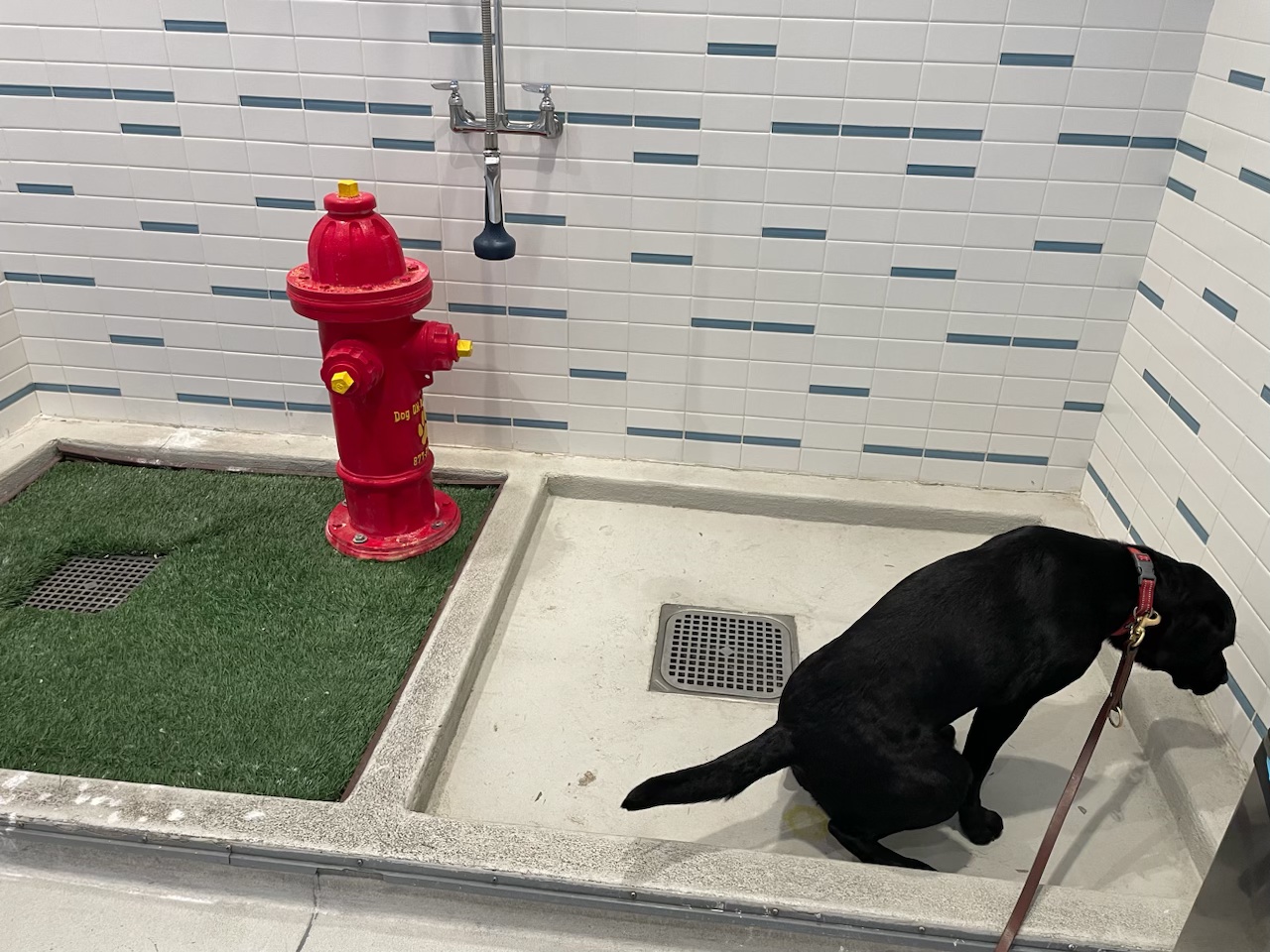
Hildy and I field tested the SARAs doggedly, anonymously, like restaurant critics but at the tail end. We visited 45 relief areas in 12 airports on 18 flight days. Hildy stoically squatted in each with an improvised SARA stance, balancing with her nether parts in the air. Whether she was posing for my photos or actually peeing, I’ll never know.
The results are in
After five months, we sat down to analyze the data together and agreed that only one doggy potty earned a perfect score.
Despite Hildy’s clear preference for outdoor accommodations, we ultimately agreed that “inside-security” provisions were necessary whenever we had connecting flights.
That required us to eliminate four outlier airports — Rapid City, Raleigh-Durham, Savannah, Rhinelander-Oneida County — that did not have relief areas behind security. This despite the fact that for almost a decade, federal law has required commercial airports with 10,000+ annual flights to have SARAs inside security.
The Lassie artwork and the window earned the Minneapolis-St. Paul SARA extra points for aesthetics
Relief areas at Atlanta, Cincinnati, Minneapolis-St. Paul, NYC-LaGuardia, NYC-Kennedy, and Salt Lake City all ranked in the middle of the pack, with scores of 5-6 points.
Most failed the sniff test, even by human standards, not deserving the minimum 1 point we gave them. As I held my breath and blinked my stinging eyes in the sealed rooms, I wondered how dogs, who detect scent 200x better than humans, could stand it.
Many rooms were out of paper towels or poop bags or the sink didn’t work.
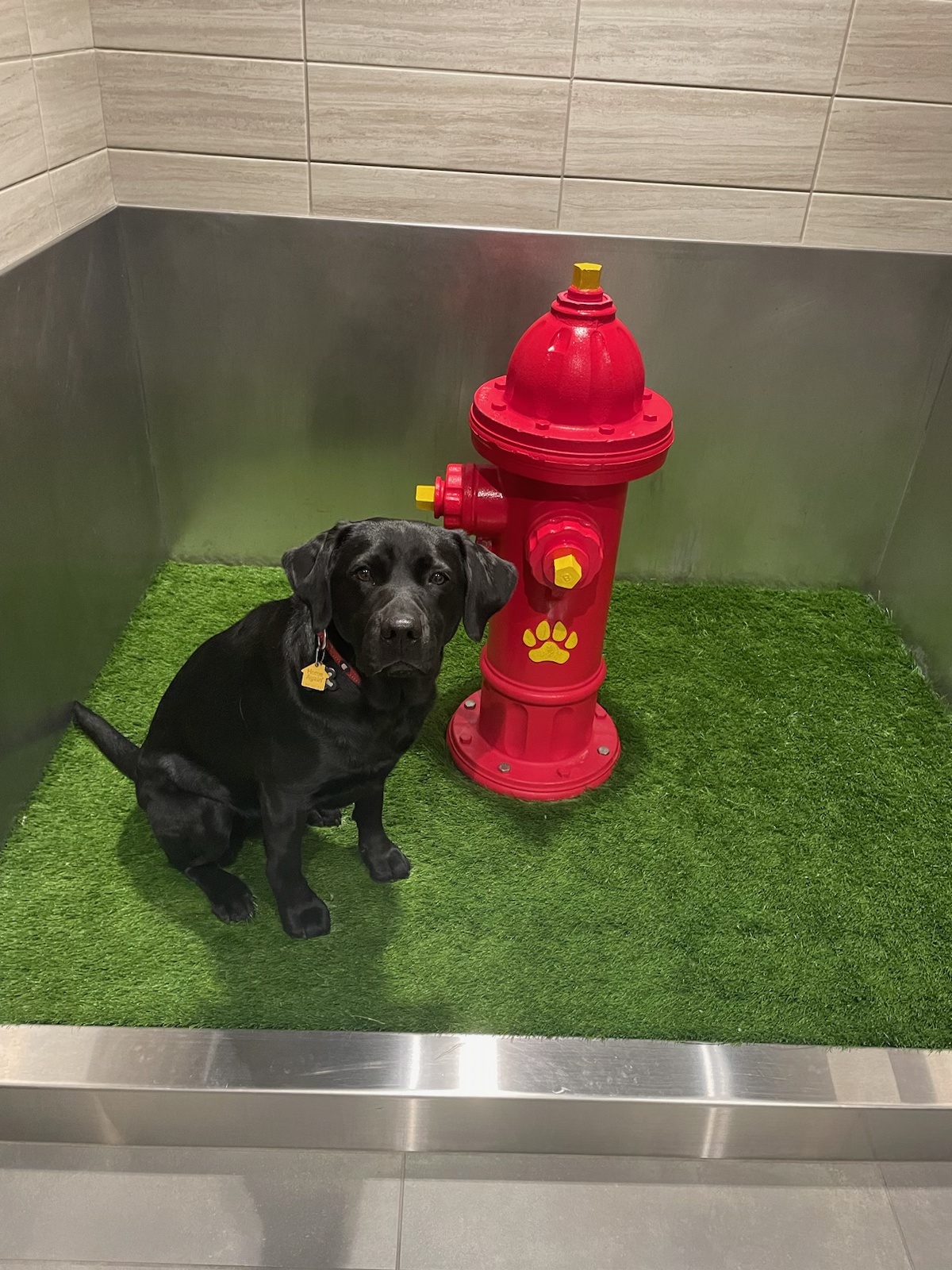
I added the aesthetics criterion once I realized that a red plastic fire hydrant served as the unimaginative focal point for every SARA. Then I learned that federal law requires this type of furnishing, even if airports are allowed to forego ventilation. Apparently, someone at the Federal Aviation Administration convinced his colleagues that requiring a fire hydrant or fake rock in SARAs would encourage male dogs to urinate. Hildy and I, amused by this reasoning, wondered if he needed encouragement as well.
As I couldn’t ethically ding the SARAs for their ubiquitous red fire hydrants, we gave full aesthetic points only when there was art on the wall, a view, seemingly clean tile walls, or some other thoughtful and distinctive feature.
And the winners are …
Second place
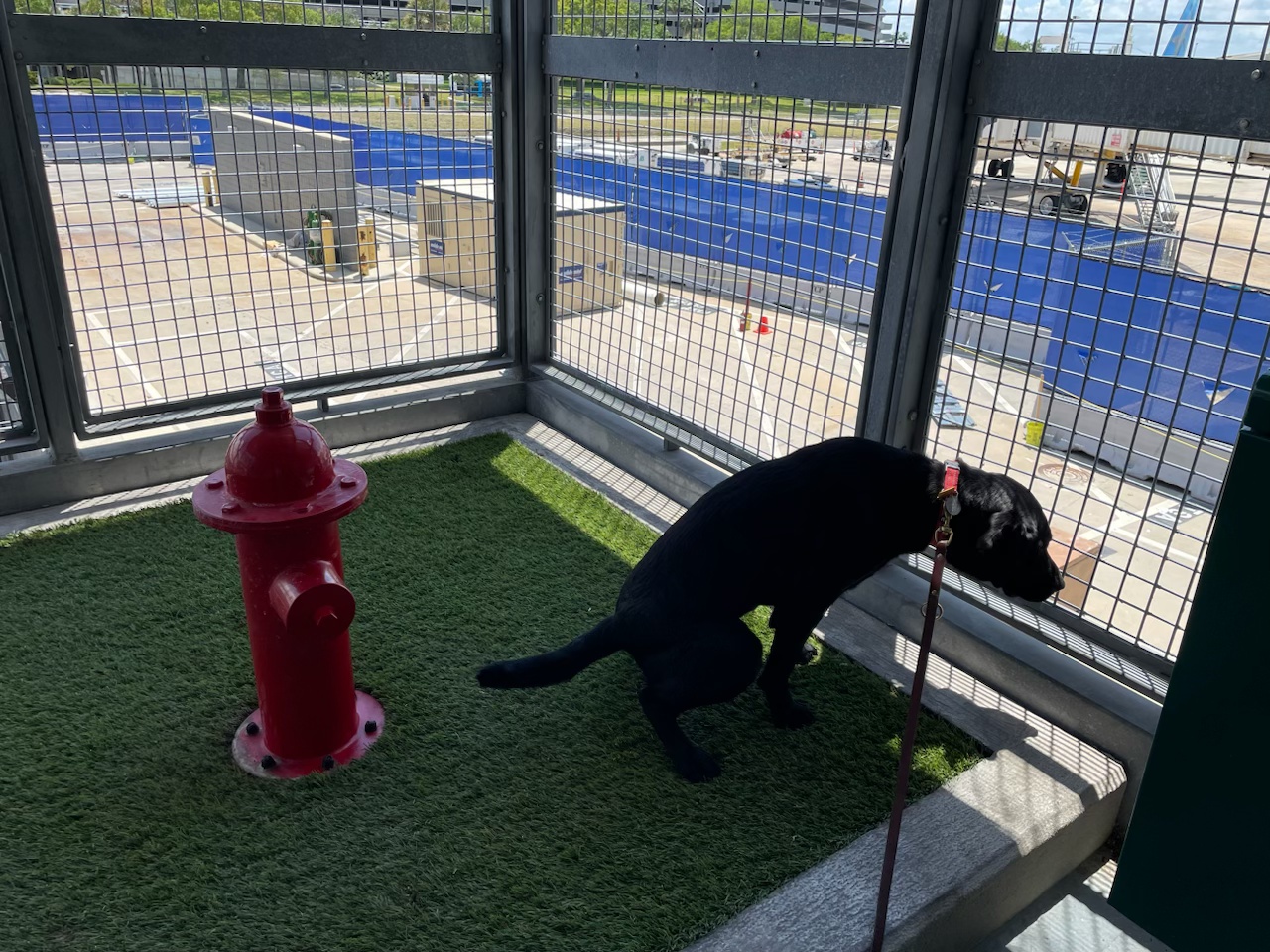
SARA with a view — and fresh air with a hint of jet fuel
TPA, Tampa International Airport, came in second.
The caged, outdoor, well-ventilated SARA on the gate level in Airside E is at the far south end of that terminal. The whiff of jet fuel in that enclosure is a breath of fresh air when compared to SARAs that smell like you stepped into the basement of a porta-potty.
However, this SARA lost a point because Hildy and I nearly always fly from the far north end of that terminal, more than 10 gates away from the doggy potty. It nearly lost an additional point for uneven availability of paper towels and poop bags. Since TPA is our home airport, we certainly did some over-sampling here, so, upon reconsideration, we gave TPA a 9.
Drum roll …
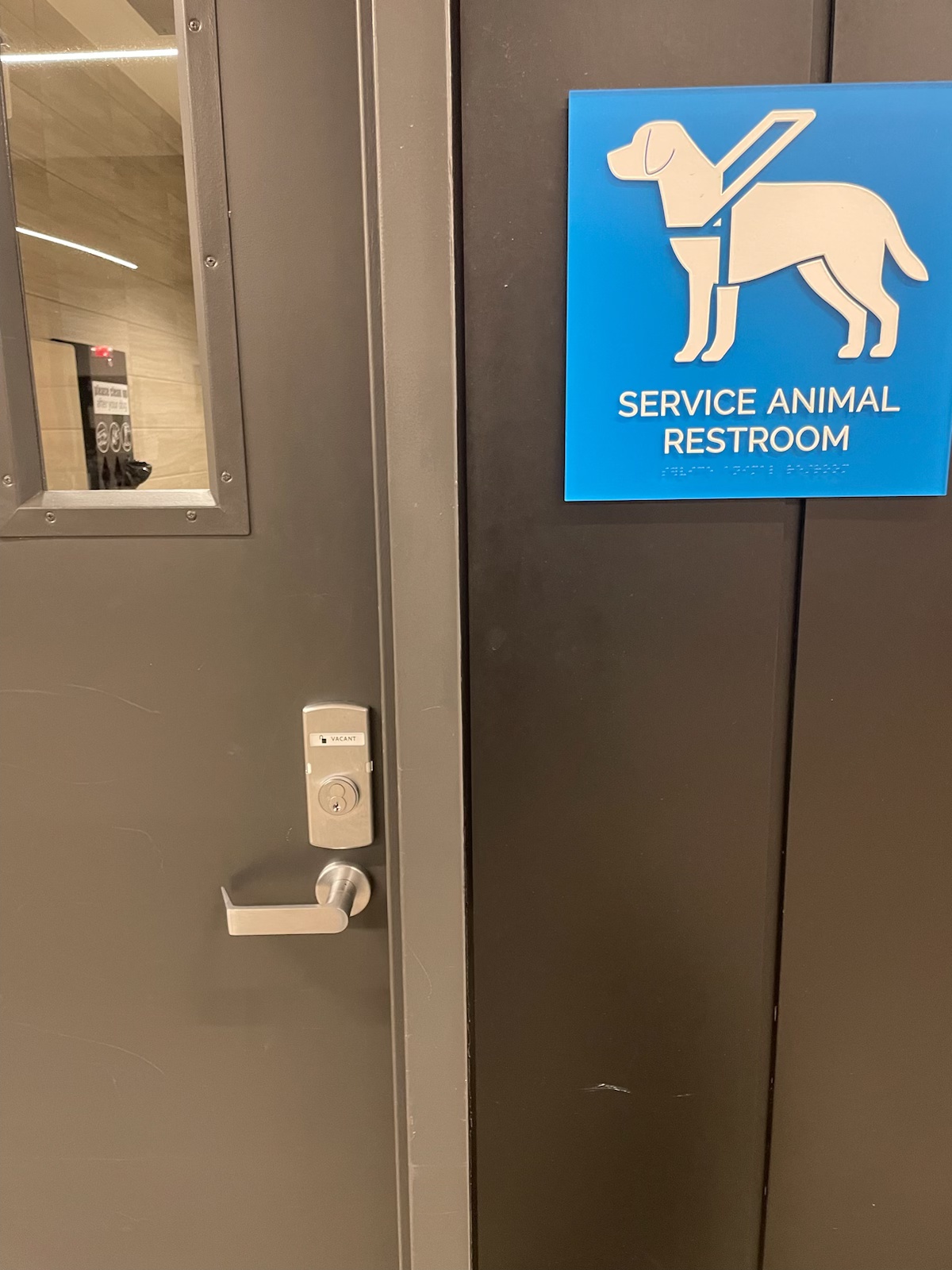
The privacy lock indicates that Missoula’s SARA is vacant and available for Hildy’s use
The best in-security service animal relief area in the US, based on our field study, is at MSO, the airport in Missoula, Montana.
This private, one-dog bathroom has self-draining turf and a large window. There was no offensive odor that I could detect or that appeared to offend Hildy. Ample cleaning supplies were on hand for every visit. It is an easy stroll to all four of the airport’s gates.
MSO wins paws down aesthetically for calling their accommodation the Service Animal Restroom instead of animal relief area, and for tucking it between the men’s and women’s restrooms. The vacant/occupied lock system, consistent with those on the human bathroom stalls, is a nice additional touch.
MSO earned the only perfect score: 10/10.
Hildy and I will continue our study of airport service animal accommodations across America and hope to find more that deserve recognition. But for now, thank you to Missoula Airport Board members who appreciate that, indeed, dogs are people too.
 I took Dotty to see a friend recently. The friend hadn’t seen Dotty in quite a while and after commenting on her pony-like stature, she exclaimed, “I can smell her puppy breath!”
 Dotty and Orly (and Cali and Jana before them) have excellent oral hygiene. That is, they brush their teeth daily. Well, most days. When I leave them with a sitter, I think the daily brushing goes on hiatus.