A Dog Can Help You With That …

Whatever you need help with, chances are, a dog can help out. Need help finding your way around? Easy-peasy. Need a guide who also lets you know about important sounds? Dog’s got that handled too.

Funny thing is, not too many humans believe that dogs can do all that (and more). Fortunately for some people, Guiding Eyes is an organization that takes chances on people — and dogs.

As someone who’s sure that we haven’t come close to tapping dogs’ full potential, I see this as a sign that Guiding Eyes (or GEB) really “gets” dogs in a way that few people, even dog professionals, do.  This understanding leads the organization and its trainers to willingly take on challenges that few people would even think possible: Tasks that require a belief in dogs’ ability to be adaptable and to become creative problem solvers, for example. GEB dogs do things that it’s really not possible to teach them without a shared understanding and buy-in to shared goals, so the trainers have to know that dogs are capable of higher-level thinking, problem solving, and working toward goals.

What do I mean? GEB places dogs with a tremendous variety of clients, including individuals who have both visual impairments and another disability, such as a mobility or hearing impairment. The clients whose dogs alert to sounds as well as guiding range from people who are legally blind and hard of hearing to individuals who are both blind and deaf. I could be wrong about this, but I believe that GEB is the only U.S. guide dog school that is willing to provide these clients with a guide dog. In any case, it was the first organization to do so.

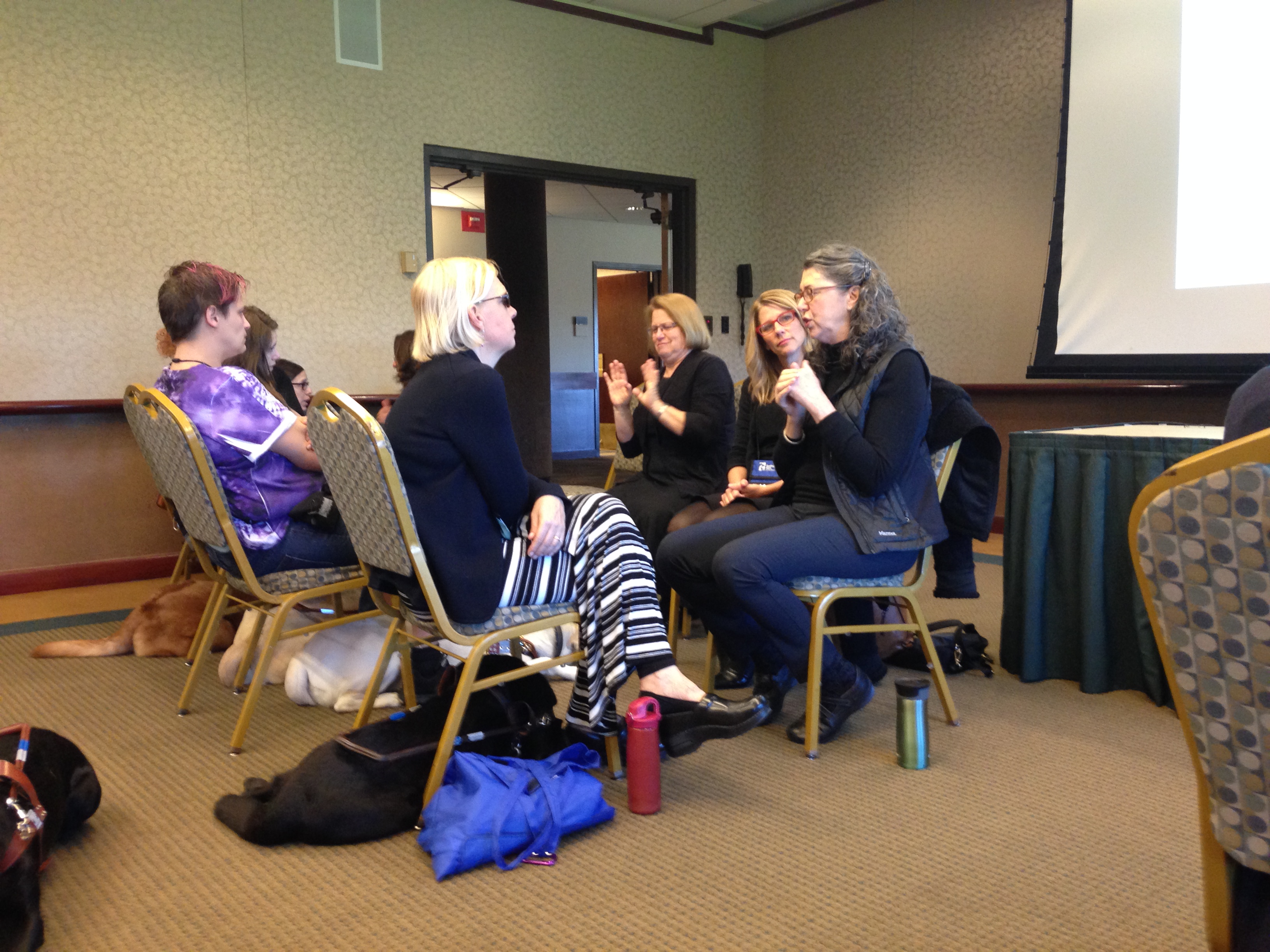
As registration opened for the Guiding Eyes continuing education weekend, a number of these grads registered. Planning committee member, grad, and GEB consumer outreach and graduate support manager Becky Barnes Davidson waved a magic wand and somehow found funding to bring a cadre of interpreters to the weekend, ensuring that all of the grads could participate fully in the events.
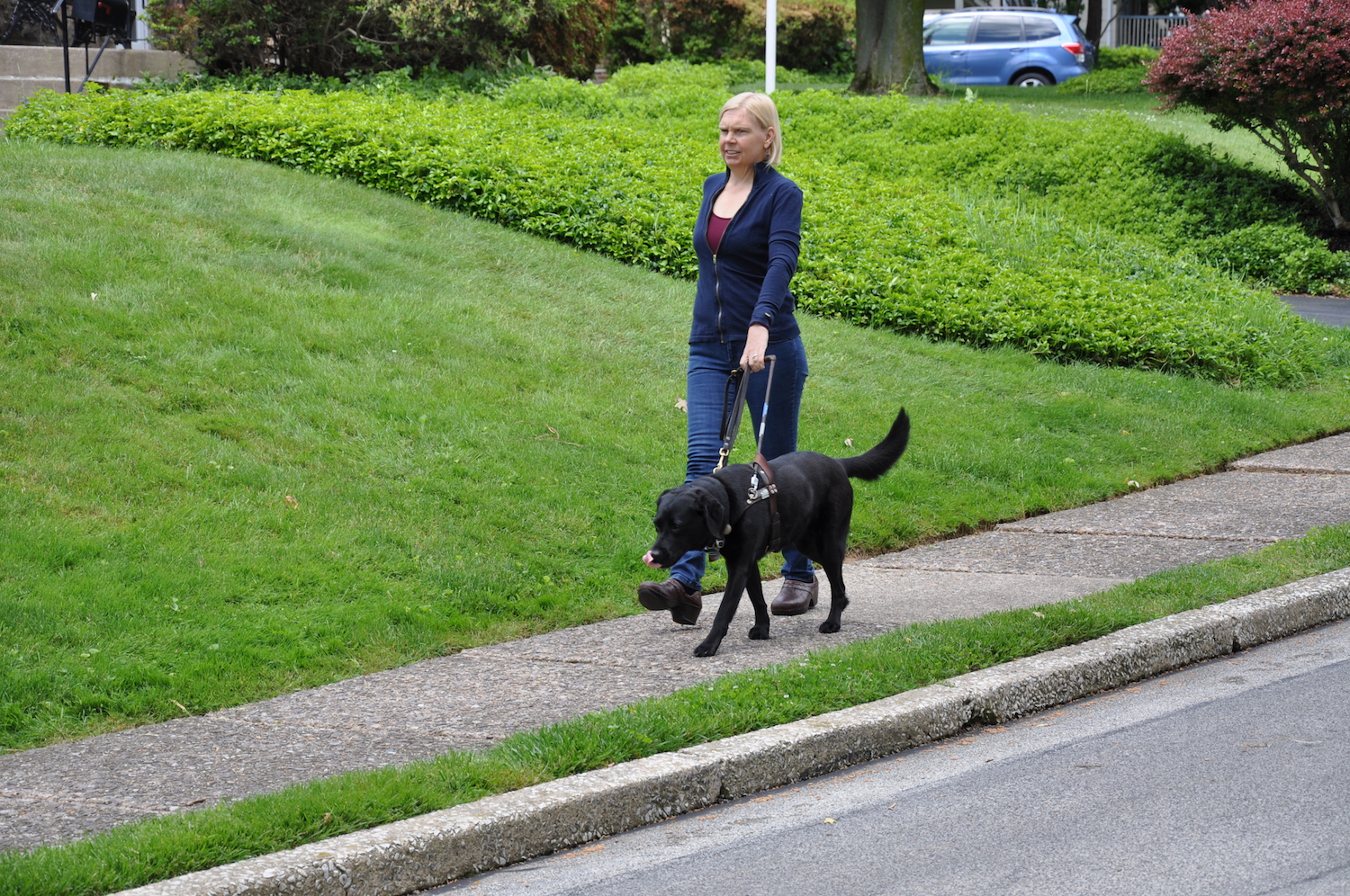
Deborah and Gypsy walk togetherI had the opportunity to chat with one of these grads, Deborah Groeber. She got her first Guiding Eyes dog in 1987. GEB didn’t yet have its “Special Needs” training program, which got off the ground in 1990, but, Deborah said, it was the only guide dog school willing to try training a guide for her.

Having guide dogs has, of course, made a tremendous difference for Deborah, especially in her frequent travels. She describes traveling with her dogs (current guide Gypsy is her fifth) as “phenomenally different” from traveling with a cane.

“I think Gypsy is a great match for me because she loves going from the suburbs into the city every day, loves taking trains, buses, escalators, stairs, revolving doors and working obstacles and construction sites. She is bright, confident and self-motivated, but she also loves praise and food rewards,” Deborah said.

Deborah is about to participate in another unique Guiding Eyes program. Gypsy is nearing retirement, and Deborah’s next guide will be a member of GEB’s new program, Running Guides.

Running Guides perform the usual guide dog work as well as guiding their partners while running. The first Running Guide team graduated in 2015. And Deborah’s dog will, as Gypsy has, learn to alert her to sounds, such as smoke alarms, phones, and doorbells. Deborah knows how to teach her additional alerts as needed. Sometimes Gypsy figures it out on her own, too.

Once, not long ago, Gypsy alerted her to a carbon monoxide alarm when Deborah’s husband was traveling for work. Gypsy is not allowed in the basement, Deborah explained, but she kept alerting to the basement door, because she heard the unexpected sound of the alarm. She’d not been trained to respond to that sound, but somehow understood that it was an urgent problem. Deborah got both the CO and smoke alarms, Gypsy told her which one was making noise, and she was able to respond and resolve the problem.

That story underscores the connection and communication that develop between members of a guide team. Many of us plain old pet-dog owners, who have the good fortune to be able to see our dogs’ body language and hear their vocalizations, are nonetheless unable to figure out what they are telling us. And I bet most of our dogs would react to an alarm and try really hard to get us to do something about it. That we’d all die of carbon monoxide poisoning anyhow would not be the dogs’ fault…

As someone who has tremendous faith in dogs’ abilities to figure things out, communicate, get what they need, figure out what their humans need, and so much more, I am not amazed that a single dog can perform both guide and hearing work, with a side gig as a personal fitness trainer. I am impressed that enough people at Guiding Eyes believed in dogs back in 1987 to give combined guiding and hearing dogs a try, and that the organization is continually coming up with new ways to stretch and grow the partnerships between their amazing dogs and clients.
Social Dynamics

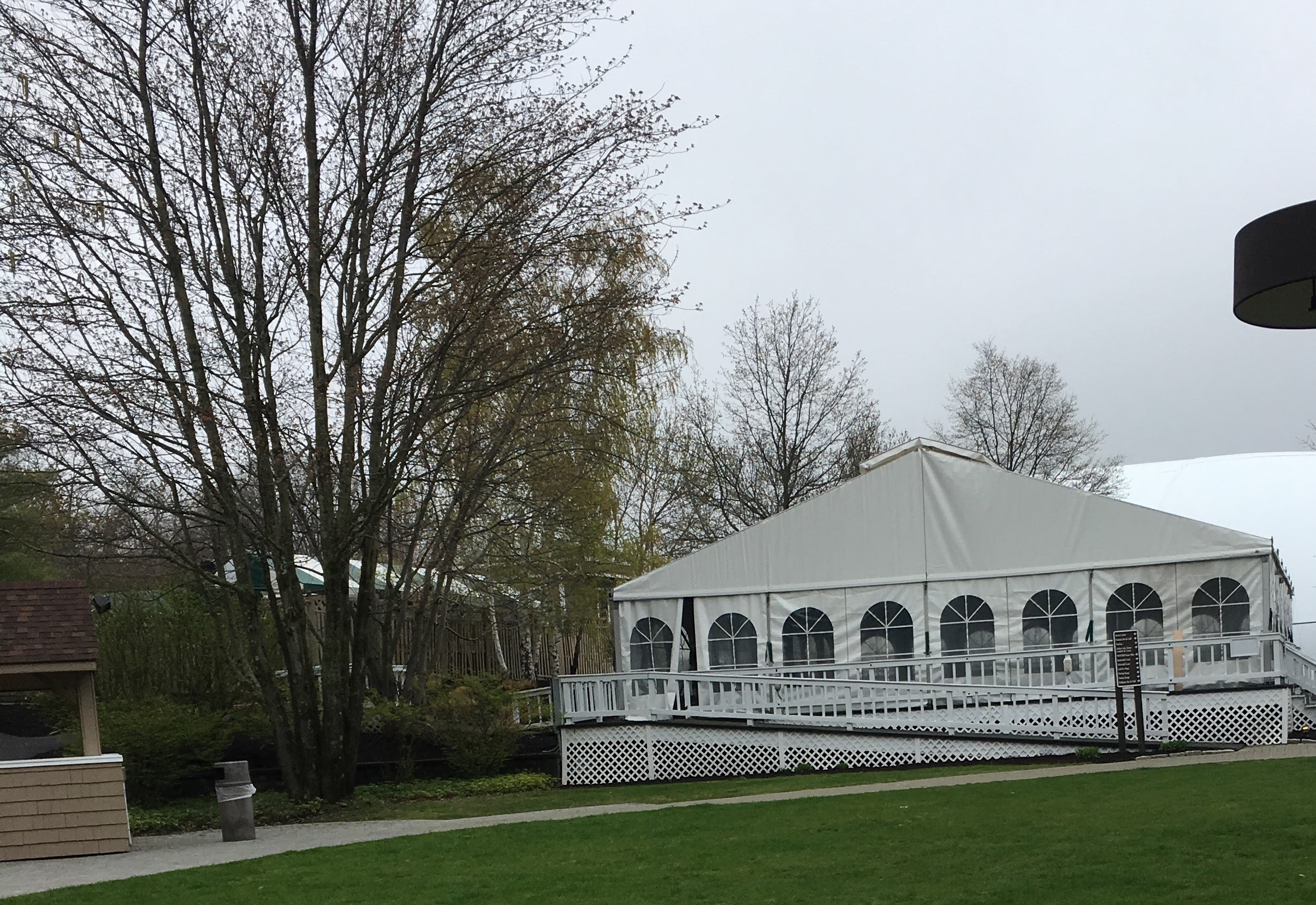
A large white structure that served as the dog play pavilion at the Guiding Eyes seminar
Photo by Michelle Russell

Watching dogs figure out the social dynamics of their constantly changing groups is fascinating. Many people assume that it’s OK to put dogs who’ve never met together in any group configuration and they’ll just instantly become friends and play nicely together. That’s an odd assumption, particularly considering that most people also don’t think that dogs communicate particularly well.

At the Guiding Eyes weekend I recently attended, I got to see how a group of experienced dog professionals handled group play. The hotel had given us the use of a covered pavilion — the type where wedding receptions might be held. It was a large space, walled in by a low fence and covered with a heavy, waterproof white cover.

Eighty guide dog teams attended the event, and they were given time slots for dog play. In addition, people wandered in and out of the play area during unscheduled evening and morning hours.

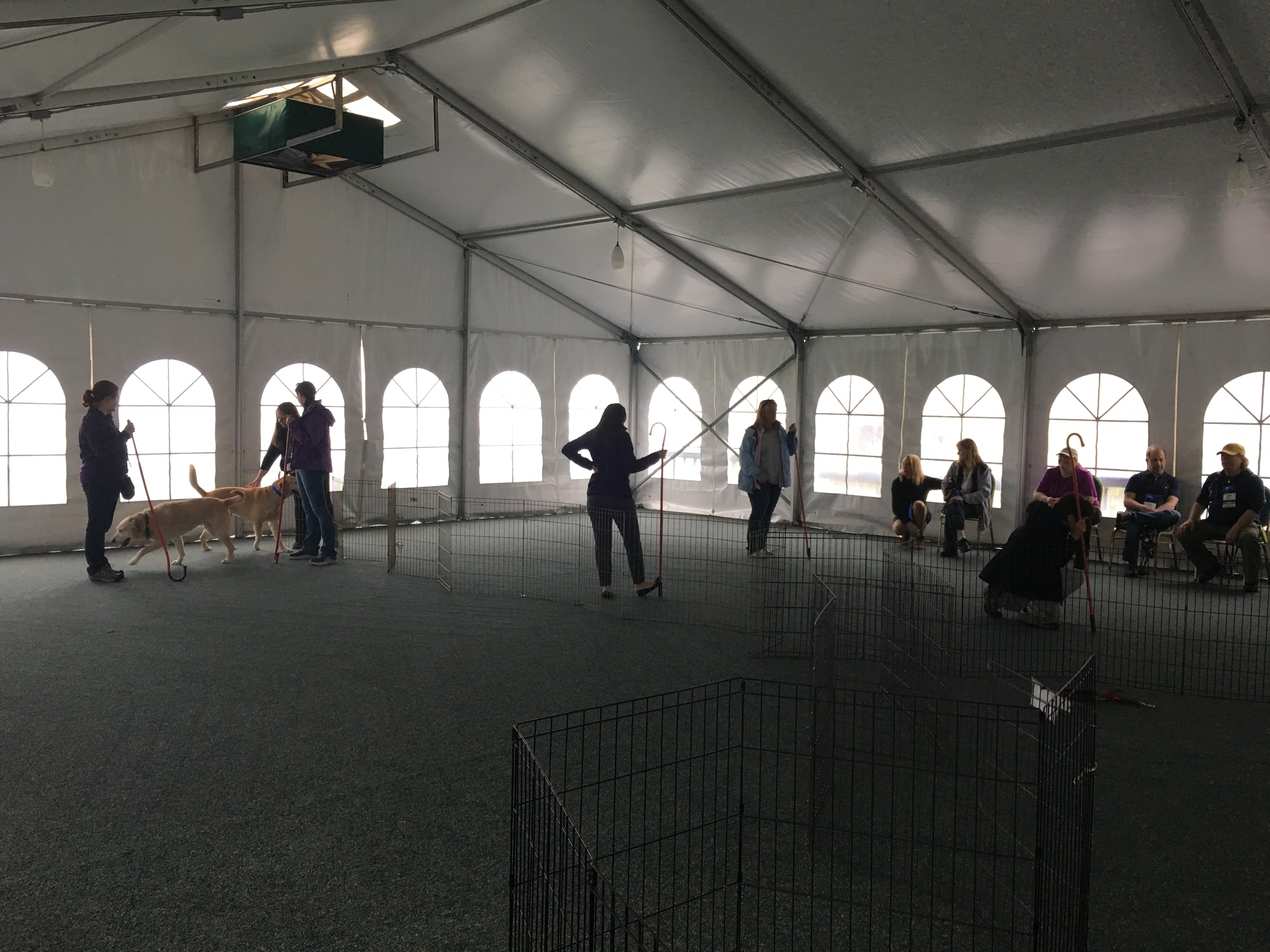
The trainers brought exercise pens to use as dividers and other equipment. It hadn’t even occurred to me that they’d divide up the space, but it was a great idea. They created three smaller play areas, never putting more than three or four dogs together. Each section had a couple of trainers keeping watch. Before putting a dog into a play yard, the trainer removed the dog’s collar, which had tags that could get caught on something (like another dog’s teeth), and replaced it with a plain collar. The dog’s partner was told the color of this temporary collar.

Trainers watch playing guide dogs at the Guiding Eyes seminar; the dogs' partners are seated along the side of the play area.
Photo by Michelle Russell

As the dogs played, the trainers watched them constantly. If a dog became overly excited or rough, the trainers used shepherd’s crooks, slipping the hook under the dog’s collar, to gently guide the dog in a new direction. During the times I was watching, I never saw any play morph into aggression or any dog get hurt, and dogs rarely needed separating.

When a dog was done playing, she’d get her collar back and return to her partner. Once, two similar-sized black Lab girls ended up with play collars of the same color. Though each partner was sure she had the right dog, the trainers scanned their microchips and checked the numbers against a list they’d brought, just to be 110 percent sure that no dog mix-up occurred.

The microchip check is probably not needed in the average dog day care or dog park, but the other precautions the trainers took are. The Guiding Eyes dogs are all very well trained, and many dogs at the weekend conference knew each other — they’d been in the same puppy raiser region or in the kennels for training at the same time. Even so, the trainers were careful to keep play groups small, match size and energy level, and monitor all the dogs’ interactions.

That’s how the pros do it.

That contrasts with what I often see at day cares and other places where dogs play. An indoor dog park a trainer friend recently described, for example, has one huge play space and minimal or no supervision. The managers allow as many as three dozen dogs to play at once. Sounds scary; much as I like the idea of an indoor play space, I doubt I’d feel comfortable letting my dog play there.

Even dogs who know each other well need close supervision when they are playing. In a large group, play can quickly escalate to aggression or bullying. Even dogs who know each other well can get over-excited or possessive of a particularly valuable toy or chew. That’s another thing; the trainers made sure that the only toys in the Guiding Eyes play pavilion were tug ropes, which the dogs, mostly Labradors, loved.

From breaking up the space to using shepherd’s crooks to ensuring constant supervision, the trainers provided a great model for dog play.

No Thumbs? No Problem!

Koala had a problem. When she tried to chew on her antler, it would move. Sometimes it would slip out of her paws — oh, if only she had thumbs — and skitter across the floor. She loved the noise it made (especially when Deni was on the phone), but it was not efficient. She wanted to chew.

Koala has another chew toy, a nylabone ring. It’s not as nice to chew on as the antler, but it’s OK. Its primary advantage is that it’s not as slippery as that antler. But, with some creative thinking, Koala solved her problem.

This slideshow requires JavaScript.

As the photos show, Koala figured out how to solve her problem using the ring as a base to hold the antler steady. She tried it with a different nylabone as well, Deni reports, but the ring-and-antler combo works the best. Koala’s quite the little toolmaker!

Tool use in nonhumans is not new; Jane Goodall discovered chimps using tools in 1960. Since then, researchers have acknowledged that other nonhumans use tools as well, including crows, dolphins, and elephants.

An accepted definition of “tool use” is “using objects external to the self to accomplish a goal.” I might argue that, using this definition, every pet dog and cat in the world uses humans as a tool, but that’s not really what we’re going after here. There’s a great YouTube video that recently made the rounds of a pair of cats ringing bells to get their (trained) humans to give them treats. That is arguably tool use.

I could come up with dozens, maybe even hundreds, of examples of doggy problem-solving, but most of those don’t include actually using a tool. I’ve heard stories and seen videos featuring dogs who push things into position and stand on them to gain access to out-of-reach food. Jana used a tennis ball to massage her back (I do the same thing, and I think that counts as tool use). And a friend’s dog tugged on a pool cover to haul in a ball that had landed in the pool.

I don’t actually know of any formal study of dogs’ creation and use of tools, but I am sure that there are many other stories out there. Does your dog use tools? Send me your stories!

Where do dogs go when they’ve gotta go?

Black and red no pooping graphic

Since I posted last week’s description of the continuing education seminar I attended with 80 guide dog teams, I just know that there is a burning question in many readers’ minds. People who work with guide or service dogs always get this question when traveling, and I am sure that the idea of 80 guide dogs in one hotel raises it too: where do they go?

So here’s the answer. The conference team hired a professional scooping crew. Scoop Masters, otherwise known as Tim and Maria Stone, have handled many a guide dog convention. And in case anyone is wondering, the Guiding Eyes dogs had hardly any accidents — less than half the accident rate of a recent guide dog users conference with, you know, dogs from other schools. Just saying.

Scoop Masters alight the day before the conference and case the joint. They figure out the best spots for doggy break areas and set up. They purchase supplies. Sometimes they actually assemble what is essentially a giant wooden litter box filled with absorbent material. At our conference, they didn’t have to do that; the hotel management allowed the dogs to use the grass. Scoop Masters set up bag stations and trashcans. They had scoops and buckets, poop bags galore, paper towels, enzymatic cleaner to clean and deodorize indoor accidents … essentially a giant version of the puppy accident kit that experienced puppy raisers know to take on any socialization field trip (it takes only one field trip to become experienced, by the way). Volunteers provided pickup assistance when needed. Scoop Masters replaced trash bags and poop bags and did spot checks periodically. That’s really all there is to it.

The main reason they were there was to take care of any accidents and emergencies. They are on-call around the clock in case a dog becomes ill or a team doesn’t make it outside in the middle of the night. There were very few accidents and no emergencies. Such good dogs!

This is a serious business, though. Besides the conference and special event service, Scoop Masters — and others like them — provide their services to homeowners’ associations, condo and apartment buildings, and even individual homeowners. They can set you up with waste stations and even provide DNA testing programs to identify scooping scofflaws. So if you’ve ever wondered why we don’t all step in it more often … thank Scoop Masters.

Amazing

This slideshow requires JavaScript.

I spent a recent weekend at an event that brought together guide dog teams, puppy raisers, and trainers, all from Guiding Eyes for the Blind, a New York-based organization. It was a “continuing education” weekend, offering training and coaching for teams, education on dog related topics ranging from breeding for success to technology that eases travel for guide dog teams, and opportunities for people who work with guide dogs to meet the people who raised and trained them. Nothing like it had ever happened before at any guide dog school.

The weekend was three years in the making. The idea was initially met with skepticism from the training staff, though it was immediately embraced by the grad teams and puppy raisers. As teams arrived at the hotel, those of us who had planned the event and were checking them in began to have doubts. 80 guide dog teams in one hotel? What were we thinking? Arriving dogs, on recognizing kennel buddies, puppy pals, trainers, or, best of all, their puppy raisers — their first families — momentarily forgot their manners and bounced, danced, and wagged with joy. Grads, meeting familiar friends and encountering new ones, were equally emotional. The dogs, at least, quickly remembered their excellent breeding and top-notch training and focused on getting their partners to their rooms. Which was no small challenge in the most confusing hotel I’ve ever seen.

Over the weekend, humans and dogs continued to amaze. An army of volunteers, primarily puppy raisers, escorted blind attendees to tables in the dining room and helped them navigate the extensive buffet meals. In sessions, anywhere from a dozen to eighty calm dogs relaxed under tables and at handlers’ feet, oblivious to distractions. They worked through bustling hallways and deftly steered around other teams, running children, concrete pillars, and tempting indoor gardens of lush vegetation.

The weekend was important for so many reasons. Puppy raisers, including some who have been raising and socializing puppies for more than twenty years, got to see living, breathing examples of how their hard work and devotion improves lives. Graduates got to meet the wonderful people who raise the puppies who become their partners. All of us met new friends (or finally met in person people we’d been communicating with for years!). Everyone got a better understanding of what it takes to turn a tiny puppy into a working guide.

This special event provided enough information and stories for several blog posts, which I’ll write and post over the next weeks. Most of all, it was an outstanding example of how capable, creative, and flexible dogs — and their human partners — truly are.

In Her Own Time

Koala, a black Labrador, relaxes on a hammock-style dog bed

I wrote last week’s post on Koala and her reluctance to move to a big-girl bed a few weeks before it was published. Since then, she went on a long visit (with Deni of course) to Deni’s mom’s house. There, she did not have a crate. And, she decided, upon returning home, that she was ready for her grown-up bed. She wouldn’t even look at the crate. Crates are for babies, she said. Why would I want one?

The crate is gone.

I think it is more about choice than about where Koala sleeps. She wants to — and should be able to — make choices about things that affect her quality of life (to a reasonable extent, of course … Cali does not get to do the grocery shopping, for example, and neither does Koala).

I’ve had an interesting email conversation over the last couple of weeks with a reader who has taken her dogs’ communication and ability to make choices to an unusual level. She uses an approach similar to what I have seen a few other people do, which is to present two options and have the dog choose a hand. Left for yes, right for no, or left for “go for a walk” and right for “play ball.” Things like that.

I have not taught this to very many dogs, but Jana and Cali picked up the idea pretty quickly. Cali’s favorite daily choice is between two tennis balls (yes, she’s a bit obsessed). Our morning routine goes like this: Walk to the park. She skips and dances ahead and has to be reminded not to pull. As we get close to the gate she literally wriggles with joy and excitement. She gets to the gate first and stands at attention, touching the gate with her nose. I open the gate and reach down to unhook her leash. She bounds into the park, turns and sits, looking eager and expectant. I pull the Chuckit and two tennis balls out of the bag. I offer her both balls. She sniffs each one deeply, sometimes wavering, then makes a choice. She watches carefully to make sure I don’t pull a fast one, swapping the balls. I put the rejected ball away, slip the chosen ball into the Chuckit, and throw.

Occasionally we have a variation: She somehow gets hold of a ball at home and carries it to the park. I throw that one.

She always carries her ball home from the park.

The point is that, along with getting to play her favorite game, (which is not what you think) she gets some control over that game. The game, by the way, is not fetch or catch. It’s: Run after the ball, grab it, then keep it away from everyone else, human, canine, avian, or whatever, in the vicinity. Occasionally let a human get it and throw it again. Repeat for as long as you can get the humans to cooperate.

Anyhow, in addition to that, Cali gets to choose. She takes her choice very seriously. There are other choices in her day. She occasionally gets to choose between two treats or two games; she might get to choose whether to go for a walk or have a play session; she often gets to choose which direction we go on a walk. But really, she doesn’t have that many choices in her life. The few areas where she gets to exercise some control are important to her. I think that’s true for Koala as well. And for every other intelligent creature, canine or otherwise.


Not Quite Ready

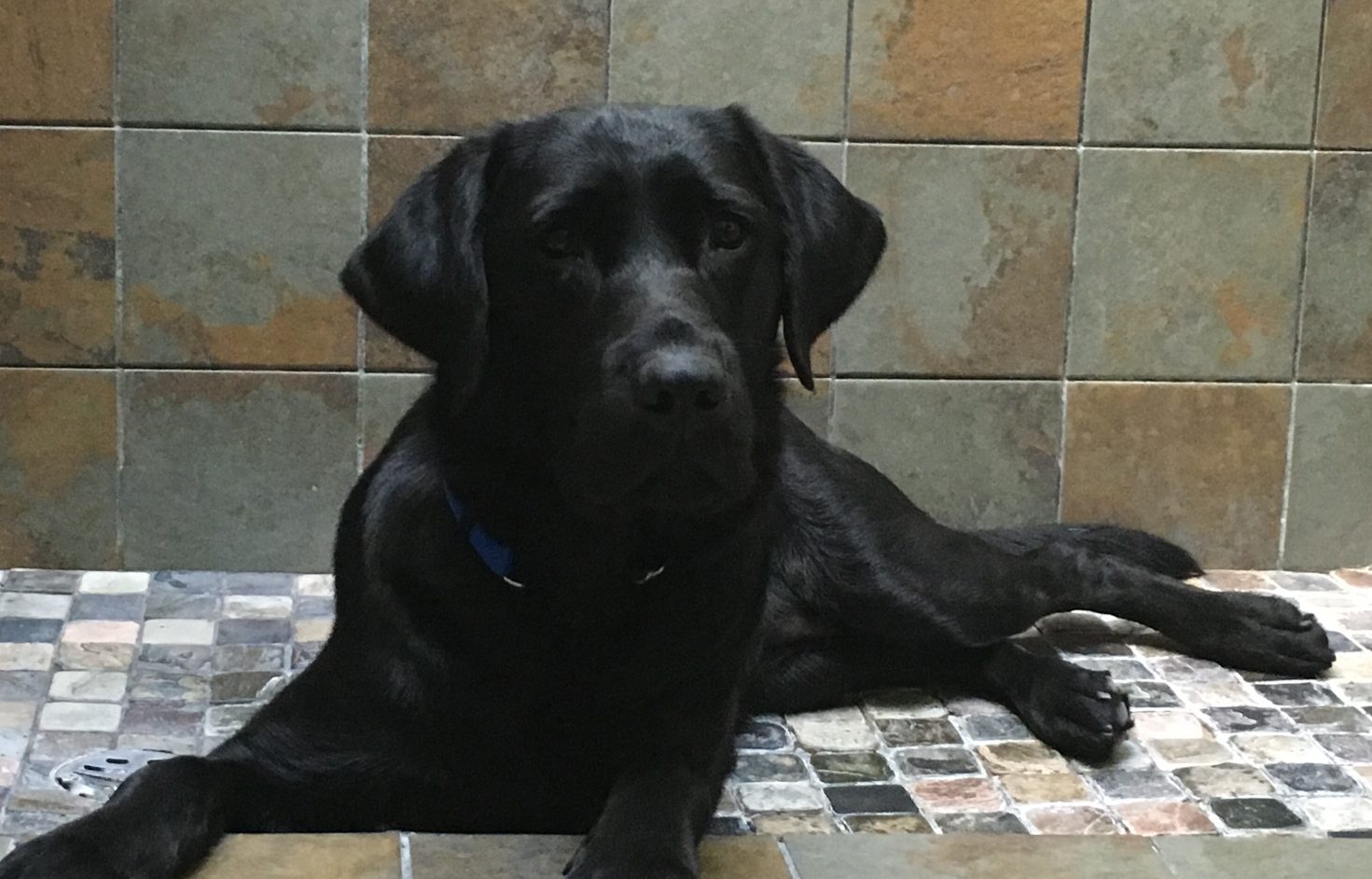
Koala, a black Labrador, lies down in a stone-tiled shower
Koala is always in search of a cozy place to rest.

Koala loves her crate. Deni thought that she might be ready to move to the big-girl bed, which is a really nice hammock bed with a cozy blanket on it. Deni put the hammock bed next to her own bed, and she moved Koala’s crate way far away. Koala likes to be near Deni, so, Deni hoped, the position of the beds would be an incentive for Koala to try the grown-up bed.

No dice. Koala slept in her crate.

Oh, sure, she tried out the bed. She spent part of the night there. She lay down on it when Deni told her to. But first chance she got, she crept into her crate. She likes her crate.

She even started stealing off during the day for little naps in her crate, which she never used to do.

“What’s the big deal?” I asked Deni. “Why can’t she have her crate?”

“It takes up too much space” was the response. “It’s ugly.”

Well. Dora, Cali’s sister, loves her crate too. She still sleeps in it most nights. She loves her nice dog bed in the living room, and she enjoys cuddling with Mom and Dad on the bed, but she loves her crate. Some dogs just love the feeling of having a private room.

Cali might still love her crate, too, if she had one. But her puppy crate was borrowed and went back to the dog school when Cali, Jana, and I moved out of Cali’s puppy home four years ago. Cali has moved a lot, and the crate was a casualty of that first move. She’s never seemed to mind, but if she’d had the choice, who knows?

Koala is adjusting to the hammock bed. She does seem to like it. But she also likes her crate. I think she should have the choice. But I am a big believer in giving dogs choices. And, of course, I don’t have to trip over a huge crate every time I want to get clothes out of my closet, so I do understand Deni’s desire to get rid of it.

It’s too soon to know who will win this battle of wills. My money’s on Koala though.

The Value of a Tennis Ball

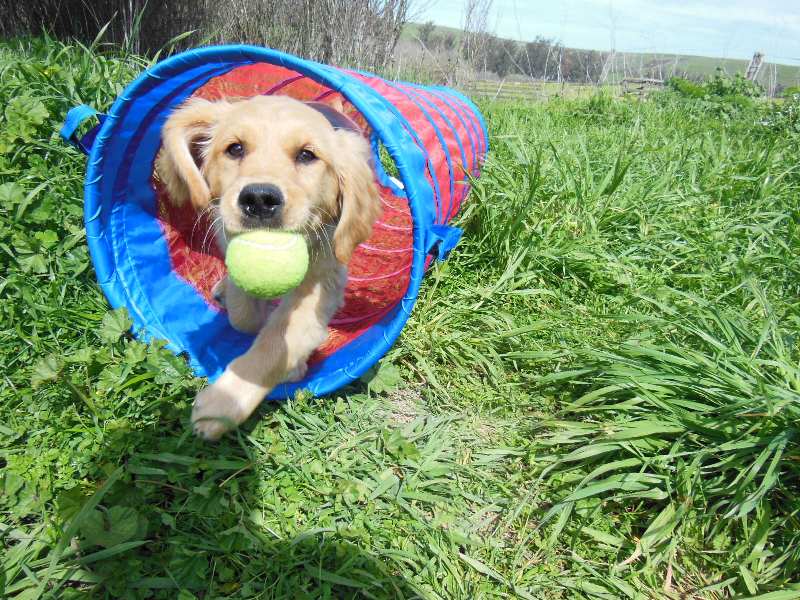
Cali, as a very young puppy, runs through a tunnel holding a tennis ball.
Cali was a young tennis ball addict

Cali showed her entrepreneurial spirit this week when she decided to buy a tennis ball. Cali adores tennis balls. She loves chasing them, holding them, drooling on them. She especially loves getting one really wet and drooly and then rolling it in the dirt she’s carefully prepared by digging a new hole in the yard. She then tries to sneak it into the living room. She’s not allowed to have tennis balls in the house.

I also like tennis balls. When my shoulders feel stiff and sore, I use a tennis ball to loosen the muscle cramp. I learned this trick from Jana, who loved to position a tennis ball under her shoulder and then roll it down the length of her spine while wriggling on her back. My yoga teacher advised using a tennis ball for this as well. There are two ways for people to do this: lying on your back on the floor, with the ball under your shoulder; or standing against a wall with the tennis ball pinned between your shoulder and the wall. Both work. The problem with the floor version, I have found, is that Cali cannot resist temptation, and she tries to steal the ball from under my shoulder. I end up with no tennis ball and a lot of drool on my neck. So I use the wall method.

The other day, there I was, leaning into the tennis ball. Cali was on her bed, watching intently.I think that part of the appeal for Cali is the “breaking the rules” aspect of getting her teeth on a tennis ball inside. She got up, rooted around in the blankets a bit, and found her Kong. Cali has two Kongs, and at the time I was working on the tennis ball, I knew that one was empty and one had a big chunk of a biscuit inside.

A very young Jana studies her Kong toy.
Jana was a young Kong addict

Now, Cali has only recently become a fan of Kongs. Jana was an early Kong addict, and by the time Jana was about 6 months old, there was nothing that I could pack into a Kong that she couldn’t devour in less than 30 seconds, leaving the Kong sparkling clean. But as long as Jana was on the scene, I could not give Cali a Kong. Cali is more leisurely in her approach to Kongs. She’ll work at it for a few minutes, get some of the food out, then abandon it. A few hours later, she’ll find it and work some more. It’s more of an all-day snack than a quick nosh. She’s also more likely to dribble bits of whatever is in the Kong onto the floor, the carpet, her bed … Jana would not let a drop or a crumb escape.

Cali picked up one of her Kongs, walked over to me, and sat. She looked at the shoulder where the tennis ball was, then looked me in the eyes. Back to the shoulder, back to the eyes. Then, still holding the Kong in her mouth, she poked her nose at me a few times, looking me right in the eyes. Oh, I said, are you offering me that Kong? I held out my hand. She placed the Kong in my hand and looked at the tennis ball shoulder again. I handed her the tennis ball. Purchase complete, Cali walked back to her bed, smiling.

I looked at my newly purchased Kong and discovered that it was the one with the biscuit. I pulled the biscuit out and called Cali back to me. She came, leaving her new purchase safely on her bed.

You’ve overpaid, sweetie, I told her. Here’s your change. She accepted her change, ate it, and returned to her tennis ball.

Dog trainers know that the dog gets to decide what a worthy reward is for any task. Cali is more obsessed with tennis balls (and less obsessed with food) than any other Lab or golden retriever that I’ve worked with. But she knows what she values and how to get it. She also knows that a Kong has value, and that one with food is worth more than one without. She doesn’t seem to understand scarcity and how it should affect value, though; we have lots and lots of tennis balls, but only two Kongs. To her, a tennis ball clearly has more value than even a Kong-with-snack, even though one is scarce and the other is common.

Or maybe the joke’s on me: She might also know that she’ll get the Kong back, filled with biscuits, each morning when I head out the door. So it’s not a scarce resource after all.

Now really, who’s the smart one here?

The Education of Will

Photo of the book cover of The Education of WillPatricia McConnell wrote on her blog about her frustration that most bookstores place The Education of Will with the pet books. She’s right. It’s only partly a dog book; a wonderful dog book, by the way. It’s also a memoir. But far more powerful than either of those, it’s a book about overcoming trauma, understanding how experiencing trauma affects every aspect of the survivor’s life and behavior — and gathering the courage, compassion, and forgiveness to face the trauma and heal.

Though chock-full of stories about Will, Dr. McConnell’s troubled border collie puppy, and sprinkled with tales of other traumatized and terrified dogs she has helped over the years, The Education of Will is primarily Dr. McConnell’s story. It is deeply personal; writing in is courageous and testament to her ability to examine the worst experiences a person can have, work through them, and share them in all their frightening, embarrassing, horrifying detail.

If you’re a dog person, you should read this book — and Dr. McConnell’s other books, her blog … If you are a human being, you should read this book. If you’re a dog with fear-based behavior problems or a dog who’s experienced trauma, you should read this book (ask your human to help).

Will, as an eight-week-old puppy, reacted to sudden noises with explosive terror. Dr. McConnell has no explanation for this; he did not, as far as she knows, experience any trauma in his first weeks. He was terrified of other dogs, particularly if they were inside his house. However, he adored any and all people. Her work with him was painstaking and slow; they experienced frustrating setbacks, as it is not always possible to control a frightening environment and avoid noises, dogs, injuries, and any previously unknown triggers.

As I read the first chapters, I wondered whether I’d have the patience and skill to work through problems like Will’s. I thought about how the agony of his early weeks and months affected his overall quality of life and that of Dr. McConnell’s other dogs. I wondered whether there are more than a handful of behaviorist or trainers who could cope with a dog like Will. I know that there are literally thousands of dogs like him.

Unfortunately, many dog owners see the behavior of a dog like Will — lunging, barking, maybe snarling or even biting — as aggression. It often manifests as aggression, sure, but at its core, it is fear. In her work with aggressive and fearful dogs, Dr. McConnell had to face her own fears as well as convince the dogs’ owners that their dogs needed compassion and patience as they worked to overcome the fear underlying the dogs’ aggression.

Too often when dogs act out, trainers perpetuate the myth that the dog is “being dominant” and that owners need to “be the alpha.” This approach only encourages responses, like yelling at the dog, hitting him, or administering leash corrections, that are likely to exacerbate the dog’s fear and escalate the aggression. Fearful and traumatized dogs need lots of patience, gentleness, and understanding, not violence or punishment. Some will recover; many will not. Will is so lucky to have landed with Dr. McConnell — as are the thousands of clients and dogs she’s helped throughout her career.

This is the best dog book and non-dog book that I have read in a long time. In case you are still wondering where I stand: Four paws up. Read this book!

Are Raw Diets Safe?

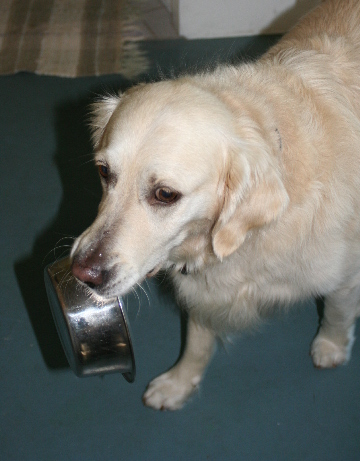
Jana holds her food bowl in her mouth

A recent Canine Corner post by Dr. Stanley Coren, a well-known writer on canine cognition strongly suggests that they are not. I’d like to present an opposing view of this often contentious question.

Full disclosure: I feed Cali a partially raw diet; I did the same for Jana for several years and she thrived on it. Cali’s sister Dora recently added raw food to her diet, and she’s healthier and more energetic than I have ever seen her. Other dogs I know have had similar experiences. So, with some caveats, I favor raw or partially raw diets. How’s that for hedging my bets?

I have a lot of respect for Dr. Coren; I’ve read most of his (copious) work on canine intelligence and relationships with people; I’ve even taken a graduate seminar with him. He’s a psychologist, though; not a nutritionist, so I am skeptical of his advice on canine nutrition.

His column starts with a terrible story about someone who fed raw until her child got salmonella; he then goes into detail about why many veterinarians recommend against raw diets and how the people who feed raw diets tend not to trust vets. I have no idea if the statistics he quotes are accurate or representative. But it doesn’t really matter.

I go to my veterinarian, as I go to a doctor, for medical advice, diagnosis and treatment of medical problems. Just as my doctor might advise me to lose weight or warn that my weight could cause health problems, I’d expect my vet to warn me if my dog were severely overweight. (If my golden retriever were underweight, I’d already know there was a problem!) If a medical condition indicated a particular dietary restriction, I’d expect the vet to tell me that, too. But if I needed more detailed diet advice, I’d go to a dietician, not my internist. Similarly, when I seek nutrition information for my dogs, I look to experts who specialize in canine diet and nutrition.

In most cases, that is not the vet. Surprised?

Just as vets are the wrong address for questions on behavior and training, the vet is not the best source of information on canine diet. Of course, just as some vets are also certified companion animal behaviorists, some take an interest in nutrition and become experts, even board-certified nutritionists. But these are the exception. And the nutrition courses that vet schools offer are unlikely to focus intensely on canine nutrition; vets learn to treat many species of pet and farm animals.

I’m fortunate that one of Cali’s vets has taken a deep interest in canine nutrition and has continued to study nutrition and new research throughout her career. This vet firmly believes in and advocates a raw diet for dogs. She urges low-carb diets, too, and, since most kibbles have a lot of carbs, she’s not a huge fan of kibble. She argues, convincingly, that fresh, real food is far more healthful, and, based on dogs’ ancestry, a more natural diet for dogs than hyper-processed cooked kibble.

Another source of in-depth information about canine diet is The Whole Dog Journal. It takes no advertising, so is not beholden in any way to pet food companies. This is markedly different from the average vet, who sells (and profits from) so-called “prescription” diets and who may also push a particular line of foods for all their clients. The Whole Dog Journal publishes detailed reviews of canned, dry, and dehydrated raw dog foods every year. It has published several articles exploring the pros and cons of raw diets as well. (See: Raw Dog Food and Salmonella Risks and High Pressure Processing and Your Dog’s Raw Food, for example.) When evaluating commercial foods, WDJ asks probing questions of the manufacturer; it has a fairly high bar for including a company in its list of acceptable or recommended foods. I’ve said it before: If you don’t subscribe to The Whole Dog Journal, you should!

Recently, a nutritionist who works with Deni’s guide dog school recommended a raw diet for Koala, Deni’s guide. Koala has “leaky gut,” and the nutritionist said that the raw diet was easier for her to digest than kibble and would allow her gut to heal. I found that interesting because one of my hesitations with raw diet was that I thought it was recommended only for dogs with a healthy digestive system. But Koala is doing very well; she has not had any of the issues — vomiting, stomach upset, etc. — that she had consistently on a kibble diet.

I still would be very careful about introducing a raw diet to a dog with a compromised immune system, but I think it is a healthful and desirable option for most dogs.

What is my other area of concern? Well, the story that Dr. Coren based his blog post on illustrates it nicely: safe handling.

The woman in the story let her young son feed the dog, handling the raw food. I don’t eat meat or seafood, but when I did, I would not have trusted a child to handle and prepare it safely or to thoroughly clean the utensils that had been in contact with it. Similarly, I would not let a young child feed Cali her raw food or do the cleanup. I wash everything carefully, just as I would with raw meat if I were cooking that for myself. It seems like common sense. But if I had young children in the house, I probably would avoid a raw diet just because it would be harder to enforce the safe handling protocols.

So, all that is a long lead up to this: I think that raw diets are perfectly safe if handled with proper care. The presence of Salmonella in some samples does not worry me; eggs and chicken commonly carry some Salmonella. Many dogs “shed” Salmonella and other pathogens in their feces; that is not an indication that they are sick and most never have symptoms. But it is an argument for picking up your yard often — and washing your hands afterward. Dry foods have more recalls for Salmonella contamination than raw dog foods, though that might just be a question of volume. Lots more dry food is out there than raw!

The bottom line is, we eat food — as do our dogs — from an imperfect system that exists in a world full of germs and pathogens. We therefore should take precautions with all of our food. A raw diet has many, many benefits for dogs, and, if you can afford it and handle it safely, it is something that I think is worth considering.