Denied!

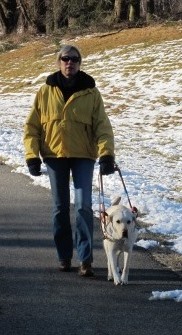
Photo by David Trawin via Flickr

A recent article in the Washington Post described the hurdles that would-be dog adopters often face when trying to offer good homes to dogs who need them.

I’m ambivalent about this. I think that rescue groups and shelters should ask that potential adopters show that they recognize the needs of a dog and that they are prepared and able to meet those needs. And they should have procedures in place to weed out people who have a history of neglecting or abusing animals. But from stories I have heard and read, many groups may be going too far.

For example, some organizations routinely turn down applicants who do not have a fenced yard. While having a fenced yard is certainly ideal, millions of dog owners (including me, at the moment) live in apartments. We walk our dogs. The dogs are fine. Besides, putting a dog out, alone, in a fenced yard and assuming that that equals meeting the dog’s needs is absurd. Dogs don’t exercise themselves! And they need social interaction — with their people, and maybe with other dogs.

Another criterion that, while ideal, is unrealistic as a requirement is that the owner should work at home. I work at home, but that doesn’t mean I play with my dog all day! And when I’ve worked in offices, I have had a variety of arrangements from dog walkers to friends who provided play dates to going home at lunch to walk the dog.

If an adopter has a multi-person household and/or shows awareness of and a plan for meeting the dog’s needs, that is preferable to leaving the dog languishing in a shelter. And, some of the same organizations who turn down working adults also reject seniors as too old. So … working age is out and old is out. That leaves …? College students? Un- or under-employed people who cannot afford a dog? Busy stay-at-home parents who may already be over-extended? Even if all of those people adopted dogs, there’d be hundreds of thousands more dogs needing homes — and those situations aren’t ideal for all dogs either!

An even bigger problem is that adopters who don’t meet the lofty ideals of a rescue might end up buying a dog from an unscrupulous breeder or front for a puppy mill, since those folks do not ask any questions. So, rather than aiding the dogs who’ve already become victims of a system of unethical breeders, pet stores, and unprepared owners that channels millions of dogs into the rescues each year,  the rescues are actually fueling that economy and, yup, helping to pump more dogs into the rescue and shelter system.

A better approach would be to look at the individual needs of each dog and match them with the needs and lifestyle of the adopters. For the apartment-dwellers who work full-time, maybe the 9-month-old Lab isn’t the best choice, but a smaller, less-active, or older dog might be very happy with two walks a day and a comfy sofa. Sure, shelters are full of young, active dogs. They’re also full of senior dogs, dogs with medical issues, and dogs who are really just fuzzy couch potatoes or lap warmers. Not all dogs have the same needs.

I don’t know what the best answer is, but there has to be a way to place more of the countless dogs and cats who need homes than ruling out good people because of overly idealistic criteria.
Travel Nightmares

United Airlines is, once again, drowning in terrible publicity. This time, it’s about major screw-ups with canine passengers. I’ll put the news-averse among you out of your misery: In two of the three incidents, the dogs survived.

I’ll start with those. One dog, who was supposed to go to Akron, wound up on a flight to St. Louis; earlier in the week, a German en route to Kansas traded places with a Great Dane bound for Japan. Traveling with a dog checked in as cargo is nerve-racking enough without having to worry about whether the dog is headed to the same destination you are. But there really has to be a better way to arrange pet travel.

Which forces the conversation to the third incident on United: The puppy who suffocated. I don’t know who to be more angry with: The flight attendant who ordered a frazzled mom to put her puppy into the overhead bin — which is against policy, not to mention common sense; the mom who did it; or the other passengers who watched, heard the puppy crying … and did nothing.

Here’s my rant: You are your dog’s only advocate and voice. If someone tells you to do something that would harm your dog, there’s a simple response: Refuse. Don’t do it. I wasn’t there, and it sounds like the mom had more than she could handle. But that doesn’t let her off the hook. I’m sure that being a flight attendant is extremely stressful. That doesn’t let the flight attendant off the hook. And the other passengers? I don’t even know what to say.

Everyone let that puppy down, but the primary responsibility is with the owner. If you have a dog, you have accepted the enormous responsibility of being that dog’s advocate and protector.

United has the most incidents resulting in pet loss, injury, and, especially death. The airline has a terrible record. But the numbers (which anyone can look up here, on the FAA’s consumer complaints site) don’t tell the whole story. Why not? Because some airlines won’t accept pets as cargo. Others won’t accept pets on board. Some won’t accept pets at all. Many pet-owners have bypassed the system by pretending that their pets are emotional support animals, though airlines are beginning to close that loophole.

People who need to get pets from one place to another have few options. No trains or buses. Driving isn’t always feasible. I heard recently that Pet Airways, which closed down a few years ago, is coming back to life. I don’t know what their plan is or whether that will become a solution, but … Maybe we should all just stay home!


Guide Dog Haiku

Deni Elliott learns to work with Guiding Eyes Alberta, who is now retired.

Several Guiding Eyes dogs’ human partners recently posted haiku and other poetry to a graduates’ email list. The poems show their appreciation and love for their guides. A member of the list asked (and received) permission to share some of the poems, which appear below. Feel free to add, in the comments section, your own service- guide- or pet-dog haikus, odes, ballads … or tributes in any literary form.

Naughty puppy face
Harness on, working face on!
What to do without?

Night comes, harness off
Naughty puppy face once more
We dream together.


The trees and sky breathe
My golden girl goes forward
Our hearts together


My vision as wide
As a dog can see, hear, smell
Guiding Eyes radar


Walking by my side
You safely show me the way
Teamwork every day


Our talks as we walk
Open volumes clearly spoken
Unheard by strangers


They don’t know our language
We speak silently yet so loudly
RIGHT!  LEFT!  STOP!  I LOVE YOU!

A movement, a language, a laugh
in voices so clear to us
So invisible, so silent to strangers
Roxanne, I hear you

You speak more loudly
“You do, too, when you smile at me.”
I smile back
A wag of  tail
A snort and shake of collar
A lean against your leg
A huff, a snort.
I smile back

Strangers never know
We laugh out loud at them
Out loud but silently
Our talks when we travel
Volumes never heard so clearly spoken
So secret, so open


The partnership and communication between guides and their humans is unusual, but service-dog partners and working-dog partners often experience  a comparable connection. True communication develops best in relationships where both partners’ roles are recognized and each acknowledges the necessity and the significance of the other’s contribution. This idea goes to the heart of the Thinking Dog Blog and my reasons for writing it, which is why I wanted to share these heartfelt tributes to guide dogs, both working and retired.

Shame on You, Barbra

Irreplaceable (photo by Cathy Condon)

I don’t think I will be able to watch “Yentl” or “Funny Girl” again. I am so angry with Barbra Streisand. And with the news and entertainment media that have given her a platform to talk about cloning her dog.  NPR used a cute headline to share Streisand’s cloning story; the New York Times offered her a platform on its op-ed pages to promote her vile choice, in addition to its dishonestly positive article on pet cloning. Though NPR briefly mentions the down sides of cloning, the media coverage generally presents the option of cloning as if it’s a normal thing to want, to do, to advocate.

It’s not.

Cloning is horrible for so many reasons.

First of all, no matter how good the process gets, some aspects of how dogs reproduce mean that dozens, sometimes hundreds of dogs must be used, yes used, like machinery, to create a single clone. Or attempt to; it does not always work. These dogs are treated as machinery. Dogs. Thinking, feeling, loving dogs, treated as factory machines. To learn a little about this process, read my review of Dog, Inc. To learn even more, read the book; you will be truly and justifiably horrified.

For someone who loves her dog so much that she can’t live without a flawed facsimile of that dog to be willing to put hundreds of dogs through torture to … what? Pretend that dogs lucky enough to be owned by wealthy people don’t die? This, to me, is unconscionable.

Secondly, a clone is a genetic copy, but it is not in any way the same dog. The dog might not even look the same. Barbra is quoted as saying she’s waiting to see if the clone puppies have her late dog’s brown eyes. (They should.) But even if the dogs look the same as the “original” (the clonee?), they are not mini-Samanthas.

They — like every dog on the planet — are individuals. They deserve to be loved and appreciated for who they are, not who they replace. The owner of the clone is different — older, more experienced, saddened by the loss of a beloved canine friend — than when she got the clonee. She will raise the puppy differently. People often get two or more clone puppies, so the experience of being raised as one of multiple pups makes everything different — for the owner and the pups. Each individual has her own experiences — positive and negative — that shape her. Each dog is an individual and deserves to be treated as one.

The selfishness of causing suffering to hundreds of real dogs just to satisfy an unrealistic whim is nauseating. The waste of money is as well. Someone who truly loved dogs would use the tens of thousands of dollars it costs to clone a dog to instead alleviate suffering of existing dogs — not cause more of it.

And there are myriad ways to honor the memory of a beloved dog. Artists everywhere make beautiful jewelry with bits of the dog’s cremains or DNA or fur or nose print. If that’s not your style, how about a memorial stone for your garden or mantel? Write a poem or a book. Build a shrine in your living room. But don’t torture other dogs.

I miss Jana every day, as does Cali. But I never for an instant considered cloning her. I am even leery of getting a white golden retriever puppy with big brown eyes … OK, if someone offered me one, I’d have a very hard time saying no … but I would not want or expect a mini-Jana. Jana was unique. As is every other puppy.

I have several large heart-shaped rocks that Jana brought me; they hold a place of honor on my bookcase, along with photos of Jana. I plan to bury her cremains in my backyard and plant a blueberry bush in her memory (we went blueberry picking together and she loved to eat the fallen berries). But I can never replace Jana, and I wouldn’t try.

Cloning is not a valid option and, despite gushing, positive media coverage, it is not a harmless choice. Shame on you, Barbra, for using the media and your celebrity to promote a cruel and heartless practice, just because it makes you smile.


Update, 3/6: I am so happy to see that I am not the only dog-lover-who-writes who is angry with Ms. Streisand. Read on:

The Hidden Dogs of Cloning, by Julie Hecht

You Love Dogs? Then Don’t Clone Them, by Jessica Pierce (author of Run, Spot, Run)

Even Dog, Inc. author John Woestendiek weighs in: Barbra Streisand has cloned her dog twice


Dogs Can Get the Flu, Too

Cali’s not sick; she’s just bored.

Has your dog been coughing, sneezing, and acting lethargic?

If so, get her quickly to a vet; she could have the flu!

Canine flu does not infect humans, but it can spread easily among dogs who come into contact with a sick dog — or an infected toy, bowl, bedding or clothing item, or other object. Dogs can also catch the flu from sick dogs’ sneezing and coughing.

Flu viruses (among many species) change and adapt quickly and also “jump” to new species. One form of canine flu that exists in the U.S. was discovered in 2004 in greyhounds in Florida; it was found to have originated from a horse flu. A second strain of canine flu originated from a bird flu and was first detected in the U.S. in 2015.

Though one or both strains have been seen in most parts of the U.S., the number of cases is still small. If your dog is rarely around other dogs and seems healthy, there’s probably nothing to worry about.

Canine flu is not seasonal, and many dogs show no symptoms. Severely ill dogs can get pneumonia, but that is rare. Canine flu has not spread everywhere in the U.S. yet, but some areas have had outbreaks this winter, including California and Nevada.

Dogs who are frequently around other dogs, at boarding or day care facilities or dog parks, for example might be good candidates for a doggy flu shot (yes there is a vaccine!). Check with your vet. The vaccination requires two shots, several weeks apart.

A Task Only a Dog Could Do

Is Cali a budding search dog?

I heard a great story on NPR recently about dogs helping people. OK, so stories about dogs helping people are nothing new, but this one is different.

I’ve spent a lot of time in Northern California, mostly in Sonoma County not far from where the horrific wildfires burned 5,000 homes and businesses a few months ago. The story was about — stay with me here — trained cadaver dogs helping people whose houses had burned. The dogs were assisting people who had had cremains of family members in their homes.

The dogs are actually able to distinguish the ashes of human cremains from the massive amounts of ash on the home sites.

The forensics expert said that the texture and appearance is different, so, once the dogs alerted to the presence of cremains, the human team was able to separate out the cremains and return them to the families.

A woman interviewed on the show said that her mom had passed away not long before the fires and she’d been planning a memorial service and burial … when the fires intervened. Having lost everything, she was devastated to lose her mom’s remains as well.

Cadaver dog teams came in and the searchers had two dogs, separately, search and alert. If they alerted to the same spot, the humans got busy.

I’m not at all surprised that dogs can do this; I think that dogs can identify and seek out any unique scent, no matter how many other scents are mingled with and surrounding it. I love that people are creative enough — and trust their dogs enough — to come up with an endless variety of ways dogs can help humans do things that, let’s face it, there’s no way humans could do without dogs.

A great book that tells more than you’ve ever wanted to know about training and working cadaver dogs is What the Dog Knows. But it’s not only cadavers … dogs sniff out rare and endangered wildlife (or their scat); living humans; drugs; disease; explosives … anything you can imagine, someone has (or could) trained a dog to find it.

When Cali’s complaining about being bored, I know the problem isn’t with her; it’s my lack of imagination in finding new challenges and games for her. The problem’s hardly ever the dog; it’s the human.

Wipe Her Feet!

Winter’s back. We’ve had  a pretty mild winter here in Missoula (much to Cali’s dismay), but after a couple weeks of 40s and 50s and melting snow, we woke up to a couple of inches of new snow on Friday.

Actually, I woke up to the distinctive scraping sounds of the guys who zip along our sidewalks on ATVs with mini-snowplows, clearing the sidewalks by 6 am. It’s miraculous.

Cali greeted the new snow with delight and romped around a bit on the “grassy” area by our patio. Once I was fully dressed, we ventured out for a walk. The snowplows are reliably followed by the bucket brigade, spreading blue snow melt stuff. It’s salt and other chemicals.

It’s terrible for dog feet. Some dogs are very sensitive to it; I remember a puppy I was training crying in pain as soon as his feet came into contact with it. Cali’s feet seem tougher, but I am very careful to wipe them with a towel and with baby wipes (organic, natural ones) so that she’s not licking the salty stuff off later.

There are other ways to help dog feet cope with winter:

  • I rub Musher’s Secret into Cali’s feet every week or so. It creates a barrier that protects her pads. It helps protect against hot pavement in the summer, too.
  • For hairy-footed dogs (like Cali), regular trims are helpful. The less hair there is between the dog’s pads, the less the snow balls up and sticks, which can be very uncomfortable for the dog.
  • For dogs who walk on snow, snow-melt chemicals, and ice often, boots are a good idea. Most dogs dislike this idea, but they can often be convinced (bribed) to wear their boots.
  • I haven’t tried this yet, but I’ve heard that vet wrap — that stretchy elastic bandage wrap that comes in bright colors — can be wrapped around the feet to improve traction and provide a barrier to the ice and chemicals.
  • If you take care of your own sidewalks, choose pet-safe snow melt. It’s more expensive, but less caustic to the pup’s feet.

Do you have other tips? Please share!

Have a safe and FUN winter!

Every Dog Needs a Hobby …

Cali is often bored. I work from home, so I spend several hours a day at the computer. Cali finds this tedious, and often suggests alternative activities. She’ll bring her ball in and suggest a game, for example. But she has also taken up a couple of pastimes on her own.

When we were still living in Petaluma, Cali (and Jana) loved spending their days out in our little yard while I worked. I put up a bird feeder, and we soon had a large flock of regular diners. They’d scatter instantly if I came out, which I found a bit hurtful. I was the one who bought and served their meals, after all. They’d settle back in to the feeder if I sat outside quietly, though, so I forgave them. They never minded the girls, though. Cali could come and go as she pleased. She spent many hours with her bird friends.

Here in Missoula, I put the bird feeder up near our patio. Cali has to watch from inside, but she lies on the carpet by the sliding patio doors and watches the birds. There’s a chubby squirrel who often pays a visit, and Cali gets very agitated. She’ll run to the office; I’m not sure if she’s trying to look out the window here or just tell me what’s going on, but she runs back and forth, panting. So I get up and chase the squirrel away. This happens three or four times and then the squirrel gives up for a few days. He always comes back, though. I suspect that he has several bird feeders, perhaps all equipped with tormentable dogs. In any case, he’s quite well fed.

The birds do not fly away when Cali is there, or when she comes and goes. But, like the Petaluma birds, as soon as I walk into the living room, they disappear. When I go out to refill the feeder, there’s not a bird in sight. They’re close by, though. They reappear within seconds after I go back inside.

When the birds leave, Cali moves to the bedroom. From the bed, she can watch the comings and goings of everyone in our building. She’s always sure to let me know when UPS or FedEX is about to knock on the door, but, unless another dog spends too much time standing outside our window, she’s content to watch quietly.

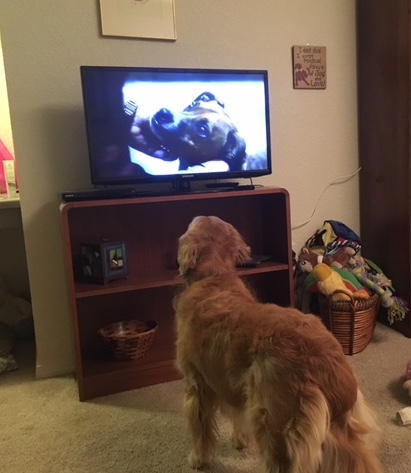
Cali’s other hobby is watching dog and wolf shows on TV. She’s sometimes interested in other nature-themed documentaries, but, really, it’s wolves and dogs. The other day, I was fiddling with a new digital antenna and managed to tune in PBS, crystal-clear. A show on arctic wolves was on. They were eating (I was not, thankfully). Cali ran in from the bedroom and sat right up in front of the TV, mesmerized. My mom always told me not to sit that close, but I didn’t think that a few minutes of watching would harm Cali’s eyes. As soon as the wolves were replaced with people, Cali lost interest.

Then, a few days later, I got a text message with a video of Dora (Cali’s sister) playing with her friends. As soon as Cali heard Dora’s bark on the video, she came running into my office. I held the phone where she could see it, and she was again, fascinated. I don’t know that she recognized Dora (maybe!), but she was certainly interested in watching the dogs play.

Cali’s great aunt, Oriel, used to love watching TV. Jana was not much of a TV girl. I’m really curious about what the TV watchers are thinking. And, who knows? Maybe Cali will improve my viewing habits. She’s shown no interest in Grey’s Anatomy, for example. Maybe I need to watch more PBS documentaries, just to spend more quality time with my dog.

Remembering Our Friends

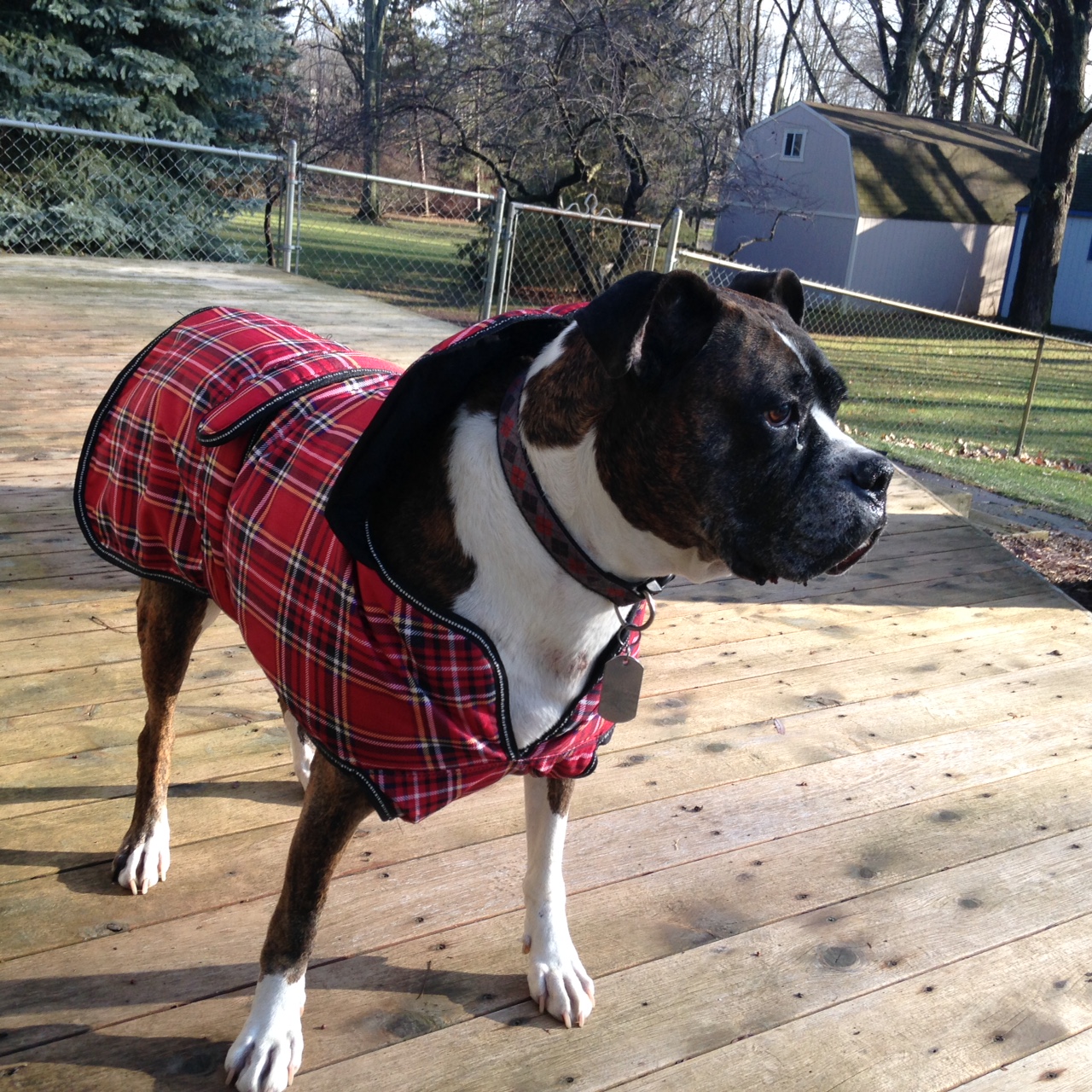
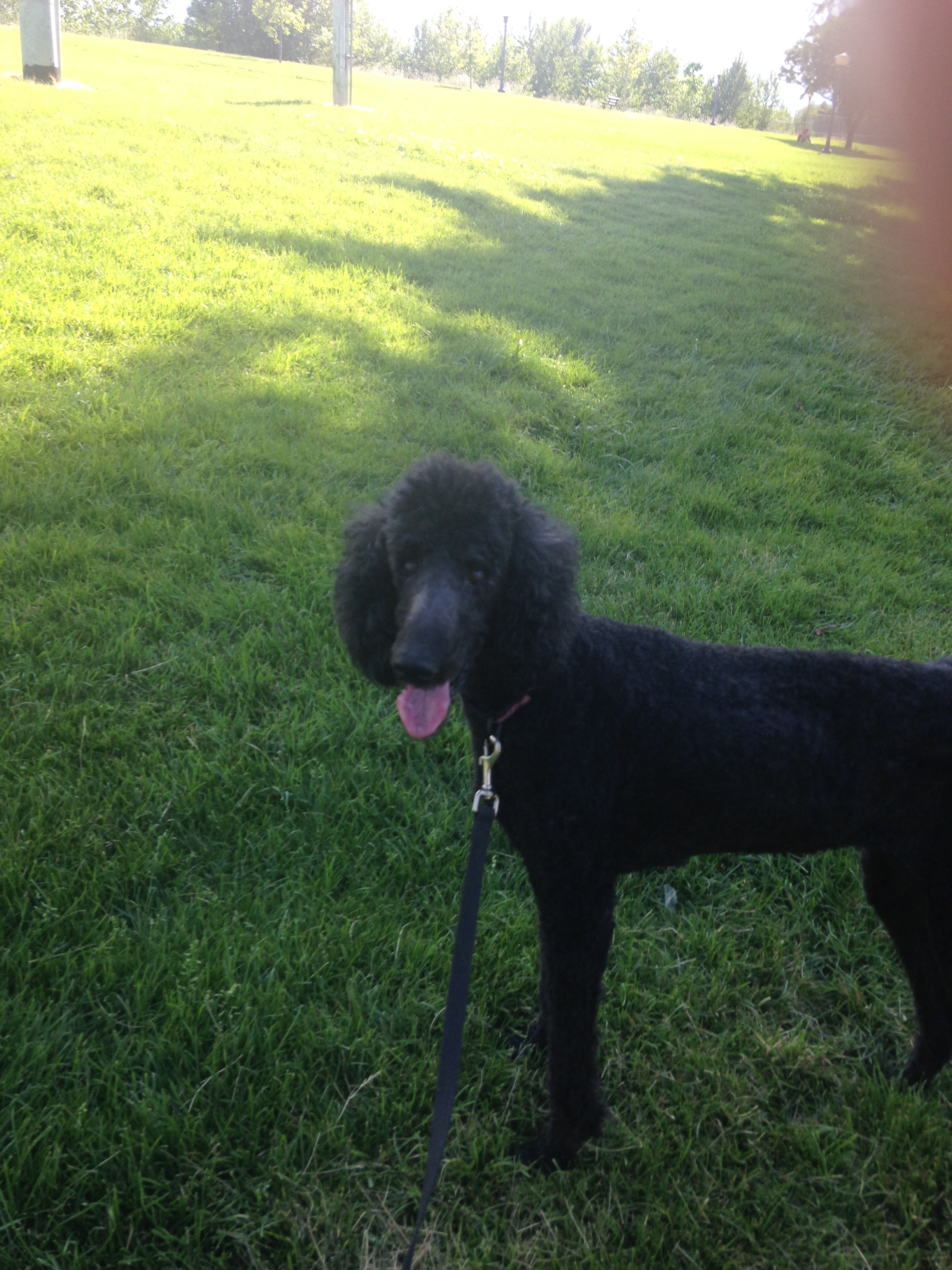
Beau, a boxerA lot of my friends have senior dogs. Unfortunately, that means that a lot more of my friends had senior dogs. Over and over, I face the loss of a friend, a dog I have known for years. A family dog like Beau, who loved my visits because he got extra walks and tons of attention (not that he was exactly starved for love and affection otherwise). A longtime friend’s dog like Molly, who was a frequent guest in my home, or little Casey. (They were both poodles, though, so it might not be fair to lump them in with dogs; I am convinced that poodles are a link between canines and humans, tending more toward the human than any other dog breed.)Molly, a black standard poodle

Each time a beloved dog passes away, I search for the perfect card. I’m always disappointed that the best dog-product stores have all the top treats, toys, clothing, and accessories for dogs, endless adorable birthday and thanks-for-taking-care-of-me cards … and pathetically few sympathy cards. And many of the few they do have are, well, awful. In addition to the card, Deni and I have a custom that we’re getting better and better at honoring. We choose a charity that we are sure that both the late dog and her or his human would support and make a memorial donation. I have to admit that I have missed doing this on many occasions, but I do feel that it is a meaningful way to mark the life of a beloved friend. Unfortunately, beyond offering these gestures, we haven’t come up with a way to make the loss any easier.

A number of books have been written about the loss of a dog. A particularly good one is Anna Quindlen’s Good Dog. Stay. I haven’t re-read it in a while, though I should; I have recommended it over and over, though.

What do you do to help a friend through the loss of a dog? What have you found helpful? Let me know, and a future Thinking Dog blog post will feature reader suggestions.


How does getting a second dog change your relationship with your first dog?

Jana and Cali, aged 9 weeks, play tug

A reader recently asked me how my relationship with Jana changed when I brought Cali home. Cali was an 8-week-old puppy; bringing an additional adolescent or adult dog into the family would probably affect the older dog differently.

I expected Jana to want nothing to do with the puppy, but within a day, she was gently playing with Cali and allowing her to share her bed. Jana was a fantastic big sister, and, as I said in response to this question, we “co-parented” Cali.

This mostly worked out well. Jana definitely helped Cali learn where to toilet, for example; Cali was a very clean puppy who had no accidents. I taught Cali many of the house rules, such as which furniture dogs could and could not use (this did not always go so well); Jana taught her other house rules, such as the “egg rule” — anyone who makes eggs has to make enough to share with all family members. Cali has, in turn, taught that sacred family rule to Koala.

Jana and Cali, aged 9 weeks, rest after playingJana was protective of Cali and taught her to play tug and keep away and other essential dog games. She led by example, showing Cali that the play tunnel was fun, not scary, and that nail trims and toothbrushing led to tasty treats. When we went to the dog beach, Jana provided thorough instruction, including demonstrations, of how to get soaked and then wriggle in the sand to ensure maximum coverage and sand retention for the ride home. Cali has surpassed her teacher in this endeavor.

As for my relationship with Jana, well, we were the grown-ups, nurturing and educating the baby. Jana and I shared many eye-rolls watching Cali’s puppy antics. We took walks together to enjoy some adult time, and I tried to reinforce Jana’s status as the second-in-command. Jana was not shy about asking for belly rubs, games of tug, or walks to the places she wanted to go. Cali is pretty easygoing, but she did try to steal Jana’s bed and claim more than her share of attention, and she sulked if Jana or I rebuked her.

Cali, age 10 weeks, shares Jana's bedI think what’s hard about adding a dog of any age is giving each dog individual attention. Jana and Cali were very different personalities, in addition to being at completely different stages of their lives. Jana was slowing down, due to arthritis and age, just as Cali became an active (very, very active) adolescent and young adult. I hated leaving Jana behind to do active exercise with Cali, and I hated denying Cali the hiking and other activities that Jana and I had enjoyed when she was young. So we made a lot of compromises. I took Cali to agility and Jana to nosework classes. I took everyone to the beach. Every day, we walked, at Jana speed, to a park where Cali could race after her ball while Jana socialized with the other adults (humans) and a couple of other older goldens. I’d like to think that each of my girls got what they needed and deserved, but I am sure there were times when one or both felt that her sister was claiming too much time or attention.