Cali just had her first vacation to Yellowstone. Koala came, too. Neither of them had visited the park before, and they loved seeing all of the wildlife.
A side note — we visited Yellowstone several times with Jana and Wylie, and Deni and I both thought that the restrictions on where dogs can go had gotten more strict since our last visit. We’re unlikely to visit again with a pet (Koala is allowed in more places, as she is a guide dog).
That said, we had a nice time. The girls got to see dozens of elk and bison. We all — not in the park — watched a grizzly stuff his face. (We were a couple hundred yards away in the car, and the bear was in a huge field, surrounded by surprisingly nonplussed cows, so no one was in any danger. )
The humans saw wolves, also at a very safe distance, using the scopes that the wonderful wolf-watchers in Yellowstone generously share with the visiting tourists. On the way back to the cabin, we saw more wolves, visibly from the car. Pups, playing. Cali was fascinated.
In fact, Cali was fascinated by all of it, her favorite nature programs come to life. She sat glued to the window, staring out at the animals, the mountains, the snow. Yes, the snow. She loves snow and was far more delighted than the rest of us with the very early first snow.
She also enjoyed her first geyser show, watching Old Faithful erupt along with an appreciative human crowd.
Koala is a bit more jaded. A dog who has traveled extensively and seen it all, apparently, she looked for a few minutes when we encouraged her to, then curled back up on the seat, with a deep sigh. Longing for her warm Florida home, no doubt. Koala is not a fan of Montana’s cool weather. And that’s as true in August as it is in September or January.
They’re both great travelers, good at letting us know when they need a bio stop, grudgingly accepting when they have to wait in the car for us to eat or shop, and generally easygoing and pleasant company. As I write this, we’re enjoying our last night of vacation in our favorite dog-friendly spot, Chico hot springs. Happy (Jewish) New Year, everyone!
Everyone needs a place to play. Even dogs. Especially dogs.
Cali loves, loves, loves her back yard. She’d live there if I let her. She’d also dig it up, rearrange the plants, harvest all the green tomatoes (but get good and sick inside, preferably on a rug), and dine on raspberries every night.
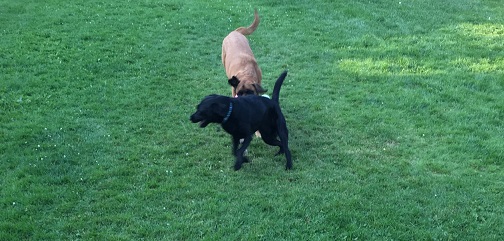
Cali and Koala do play in the yard a lot. But Koala is a delicate Florida Labrador, and cannot take the cold Montana mornings. Or the warm Montana afternoons. She wants to be inside.
It’s a dilemma.
I don’t want them wrestling and playing tug in the living room, but they can’t or don’t want to play outside all the time.
We’ve solved this issue by making the TV room in the basement a dog play area. Now, when they pick up a toy and Cali gets that mischievous gleam in her eye, we intervene. Before she entices Koala to play and gets them both in trouble, we tell them to “take it downstairs.”
It took a bunch of repetitions with us steering them downstairs, but they’ve caught on. Now they happily trot off down the stairs and play freely (and loudly). When they have friends over, they might take their friends down to play in the rec room.
They have a toy basket downstairs where most of the tug toys are kept. Well, that’s the idea, anyhow. There are often toys scattered over every inch of the floor, but sometimes, Koala even picks up the toys and puts them away. They’ll both clean up with a lot of encouragement (and a few cookies).
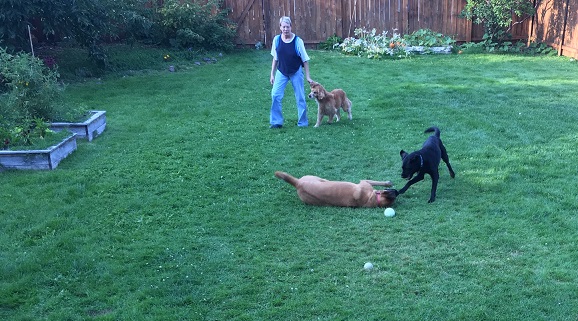
Have you ever watched dogs of very different sizes play together?
Koala recently made a new friend in the neighborhood, Lilly. Lilly is a 3-year-old Mastiff. Koala is a rather petite Labrador.
That didn’t matter a bit. They immediately launched a rambunctious bout of play. Cali was a little worried and tried to police their fun, but they ignored her. When she couldn’t resist barking at them, she had to be escorted out of the play area.
Koala and Lilly wrestled and chased each other and rolled around in the grass, having a blast. No one got squashed or hurt.
Koala has the best social skills of any dog I know, and she has a wonderful sense of how to play with any dog, big, small, young, old … it doesn’t matter. In seconds, she figures it out and invites the other dog to play.
Cali tends to get anxious when other dogs are too rambunctious. And I think she’s a little envious when other dogs come over and Koala plays with them. Cali takes longer to size up the situation, while Koala jumps right in, so I think Cali feels left out sometimes.
When all three dogs got to go out for ice cream together, Cali realized that Lilly would be a fun friend to hang out with, and she relaxed a little.
A while back, I wrote about a solution that Koala found to the problem of her antler chew skittering away from her.
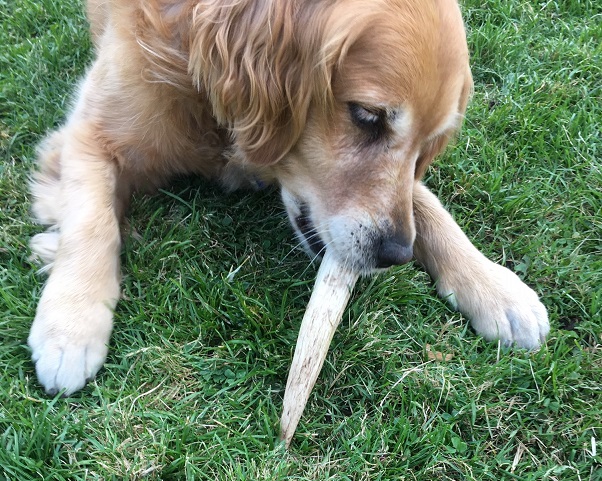
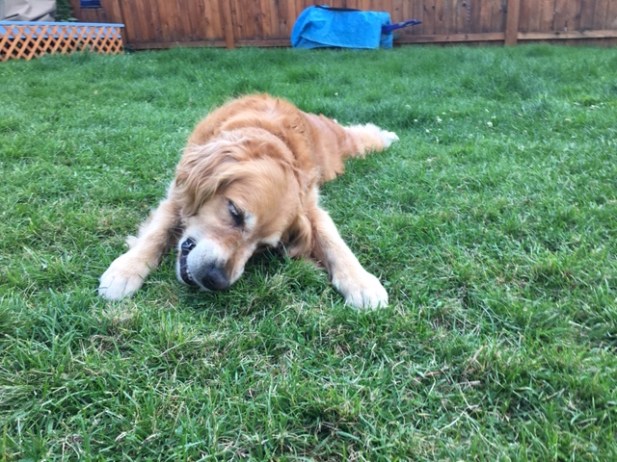
Those antlers are no less slippery when the dogs chew on them outdoors. But Cali recently solved that problem:
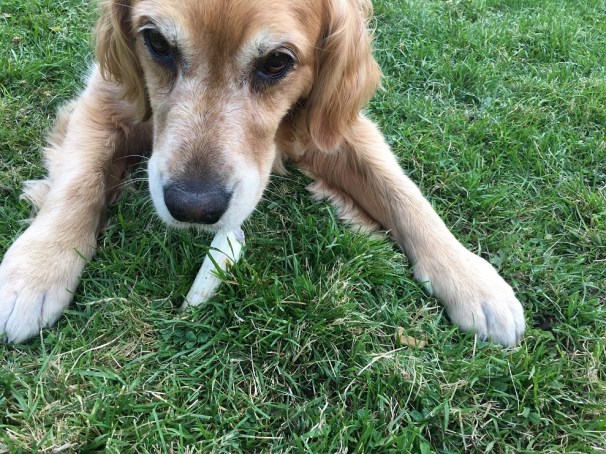
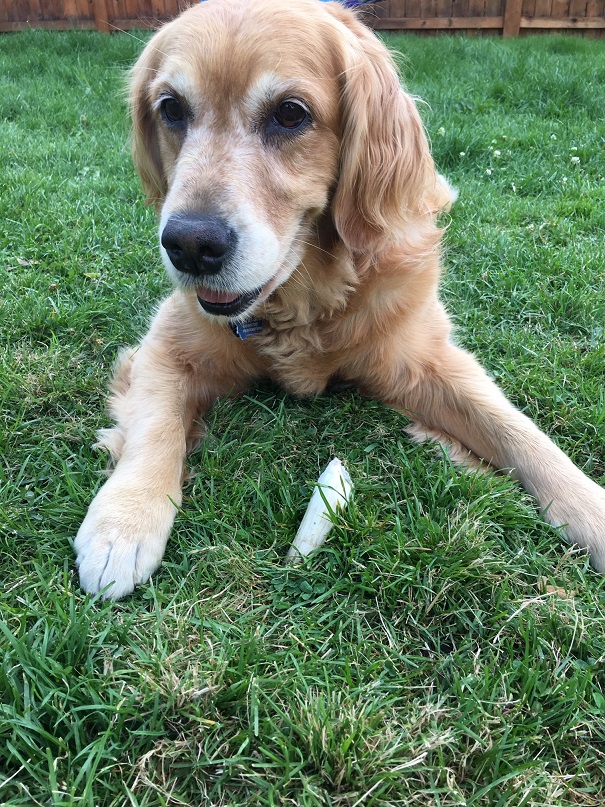
Once the antler is deep enough that it stays in place, Cali stretches out her paws, relaxes, and enjoys a chew.
The antler stays right where she wants it.
It I pull the antler out and put it away, Cali sticks it right back in the ground the next time she wants to chew it. This seems like a similar type of problem solving to Koala’s use of another toy to hold the antler in place.
Koala seems to agree. When Cali walks away from the antler, Koala steps right in and chews the antler-in-the-ground.
I wonder what Cali will come up with in a couple of months when the ground is frozen …
In the past couple of years, both Cali and Koala have decided that they dislike thunderstorms.
Cali becomes increasingly anxious as a storm approaches. It’s not the noise of the thunder that bothers her; she is anxious long before the storm starts. She’s totally fine with ordinary rainstorms, too. But large storms with air pressure changes ratchet up her anxiety. She paces and acts clingy. In really bad storms, she wants to sit on my lap where she shakes as I soothe her.
I’ve tried several things that help a little … melatonin, CBD treats, T-Away oil, a Thundershirt.
But.
I’ve found a remedy that really works: Aromatherapy.
I got an aromatherapy kit for my birthday (thanks, Kurt & Casey!!). It came with several essential oils, including lavender and something called chill pill. I used it a few times … and Cali seemed to like it. Then I decided to try it during a storm. Knocks her right out.
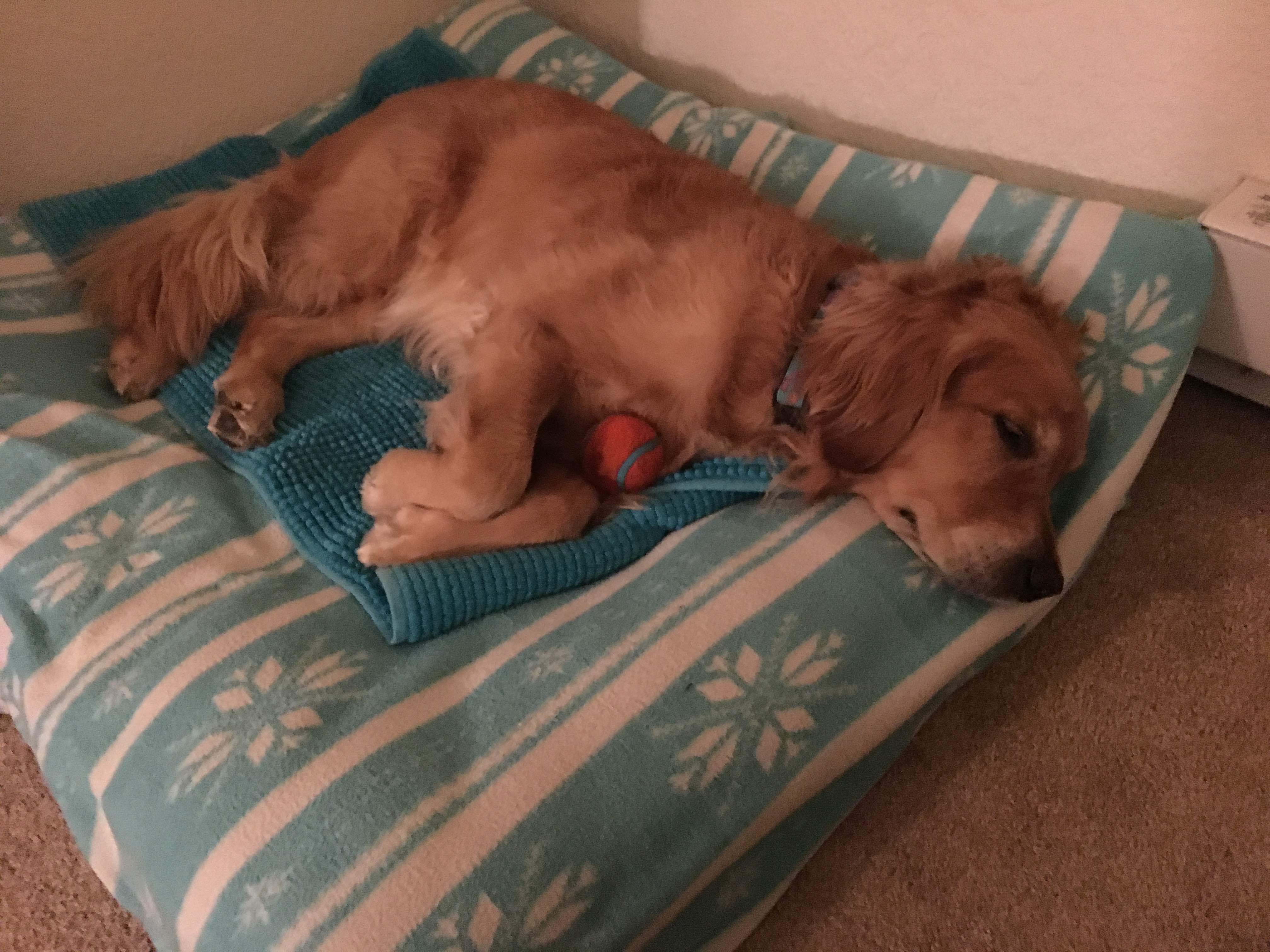
In the last storm, a really windy one with hail and thunder and heavy rain, I used chill pill. Cali and Koala both stretched out under my desk and snored away. Totally unconcerned.
I like it too.
Note that some essential oils are harmful or toxic to dogs. Here’s a list:
The US Transportation Department (DoT) has issued a “final” statement on service animals in air transportation. I’m a bit skeptical of that finality, but it’s definitely worth taking a look at what is the current last word.
When I last looked at this, airlines were issuing strict new policies, and the DoT was taking public comment on changes it was considering. They received more than 4,500 comments, and have released their final (for now) policy.
Here’s a summary:
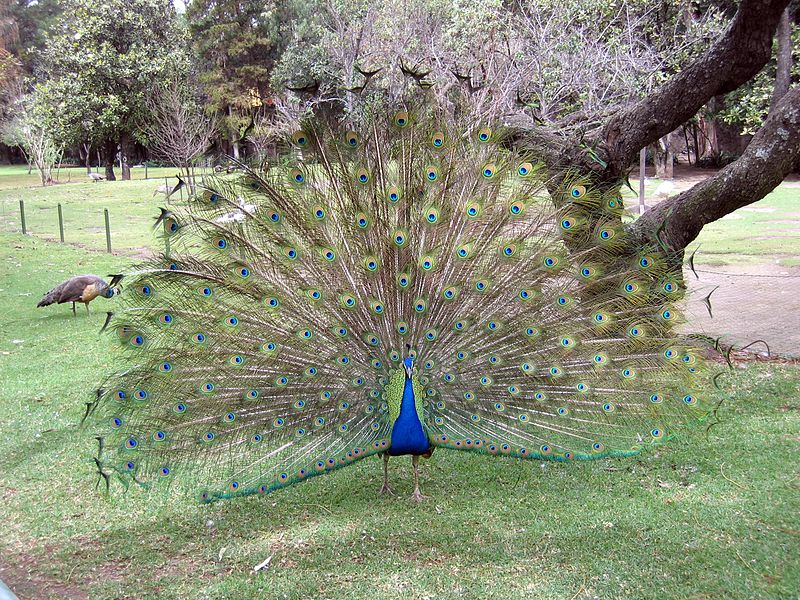
Airlines cannot categorically ban specific breeds of dogs. They also cannot categorically refuse to transport all animals that are not dogs, cats, or miniature horses. They can refuse reptiles, ferrets, rodents, and spiders. The “emotional support peacock,” and possibly the pig, however, appear to be cleared for takeoff.
Passengers may travel with a total of three service animals, including one ESA; the DoT will focus enforcement on passengers who’ve been prevented from traveling with up to 3 animals, but will not allow airlines to enforce a strict limit at all.
Airlines may not categorically ban animals over a specific weight, but they are allowed, on a case-by-case basis to refuse to allow an animal in the cabin if it is too large or heavy. That could mean weight- or size-related bans on certain smaller aircraft, but not, as some airlines have tried, across-the-board weight-based bans.
Airlines may ban “service” animals that are younger than 4 months, since “those animals would not be trained to behave properly in a public setting.” But the DoT does “not anticipate exercising our enforcement resources” in this area.
Airlines may not ban emotional support animals (ESAs) on flights longer than 8 hours. They can however require anyone traveling on longer flights with a service animal to provide documentation that the animal either “will not need to relieve itself on the flight or can do so in a way that does not create a health or sanitation issue on the flight.” There’s no hint as to how someone might document that. They may also require 48 hours’ notice that a passenger has a service animal and they may also require early check-in, in person, in addition to the documentation.
Note that the document uses “service animal” as a broad term that includes ADA service animals, emotional support animals (ESAs), and psychiatric service animals (PSAs). I believe that this will prove to be an enormous hassle for people traveling with, say, guide dogs or mobility service dogs, on long flights.
Airlines may request documentation from a medical professional from passengers seeking to travel with an ESA or PSA and can request but cannot require that passengers use a specific, airline-created form.
In addition, they may ask any passenger traveling with a service animal “limited questions” to determine the passenger’s need for the animal, regardless of whether the animal has a tag, vest, or other service dog paraphernalia. What these questions are is not stated.
Note that the ADA does not apply to air travel, so airline personnel are not limited to the ADA questions (whether it is a service animal and what task it does).
Airlines may not require people with disabilities using task-trained, non-ESA/PSA service animals to produce documentation in advance of travel. However, airlines may request documentation related to “vaccination, training, or behavior” if the airline reasonably believes the documentation would help assess whether the animal poses a “direct threat to the health or safety of others.”
There is no explanation of what form this documentation might take or how it might help make such a determination, so this point could be very problematic. They do not envision taking enforcement action against airlines asking for this documentation.
Airlines may require passengers traveling with ESAs or PSAs to check in, in person, in the airport lobby and present their documentation — prior to entering the “sterile” area (post-security check). They may also require these passengers to provide 48 hours’ notice that they are traveling with an ESA or PSA and require them to check in up to an hour earlier than other passengers. These requirements do not apply to non ESA/PSA service animals (which are not defined).
Airlines may require that service animals of all types be “contained” (including leashed), and complaints will be evaluated case-by-case. In general, requiring some means of tethering is allowed.
But … While airlines may make other requirements to ensure safety and to ensure that other passengers have use of their “foot space” — but they also have to allow the animal to provide emotional support or perform tasks. Translated, that means people may be permitted to remove their ESAs from crates (and we all know that people do so even when it’s not permitted).
Airlines cannot limit the total number of service animals on any flight (including ESAs and PSAs).
That’s a lot. It’s similar to the interim document that has been in force for a little over a year. But it certainly does not address the clear problems that triggered the new document, which included rampant fakes, non-domesticated animals with no training traveling in crowded planes, along with untrained, stressed, and sometimes aggressive dogs, and people with trained service dogs being hassled and worse.
Under the new policy, the documentation that airlines can require for non-ADA service animals is vaguely defined, and what they can ask of service dog users is not defined at all. Airlines still will rely on check-in personnel, who are not animal behavior experts, to evaluate whether an animal poses a risk. They’ll still face pressure to accommodate unsuitable animals. Lots of them. I’m imagining planes full of people with 3 “service” animals apiece, all outside their carriers.
Walking into the lobby of an airport is an unusual activity and would be stressful for an animal not trained for or used to public spaces. Since there are no laws that grant public access to people with ESAs, and no training is required, this describes most ESA.
But that’s just the beginning; an untrained staffer might not notice that an animal is stressed at this early stage. Airline personnel have no expertise or way of evaluating whether an animal will remain calm under stress or whether the person can safely handle the animal during travel. Many handlers wouldn’t notice or be aware of signs of stress. The animal’s stress level is likely to rise as new, weird experiences pile up: TSA check; maybe riding on a tram of some sort; sitting in a crowded gate with loud noises and anxious people; being stuffed under a tiny seat, hemmed in by strangers; more loud noises and weird smells … Under increasing stress, it’s likely that more animals will react quite naturally — and people will get hurt. And when the untrained, stressed-out dog stuffed under the middle seat bites the passenger in the window seat, that poor person is still trapped in a tiny space with no way out.
The DoT’s mission was to protect the safety of all travelers, the rights of people who are legitimate service animal users, and the safety of traveling service and support animals. The new regulations were intended to address a tsunami of fake service and emotional support animals on airplanes, traveling with people ill-prepared to handle them safely. I don’t think that this document comes close to accomplishing any of those goals. In fact, the new policies might invite even more abuse than the old rules.
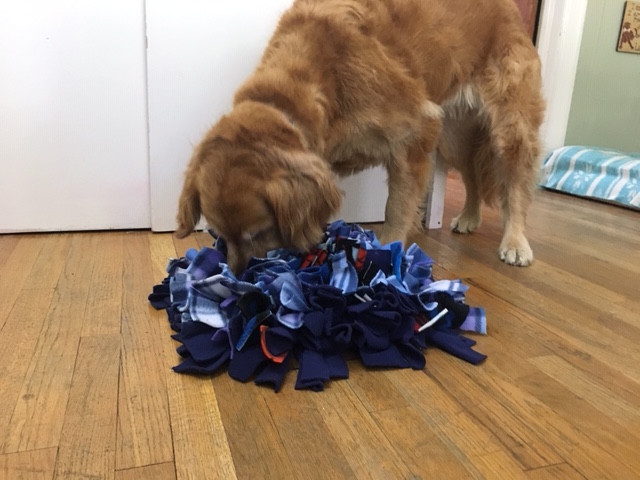
I always loved Mr. Snuffleupagus. Maybe that’s why I immediately found the idea of a snuffle mat appealing; I like the name. Too lazy to make one, I’d sort of been looking to get one for Cali, but hadn’t actually done anything.
Then, at my friend Tom’s house, I saw one for the first time. I knew that Cali would love it. The idea is that you bury kibble or treats in the mass of fleece strips, and the dog uses her nose to sniff and snuffle — and find the treats.
Cali loves food (she’s a golden, after all) and she loves using her nose. Perfect.
Tom told me that he got it from a fellow trainer who lives nearby. That’s “nearby” in Montana terms, which may not mean what you think it does.
In any case, Deni and I decided to take a nice drive one Sunday afternoon. We met trainer Joni Muir, who makes these mats during long Montana winters. We chose two colorful mats and were on our way.
Unsurprisingly, the highly food-focused girls needed little guidance. Their noses work just fine, thank you.
I took Cali’s upstairs. While I’m working, she often hangs out with me. When we need a break, I take a few minutes to hide treats in the fleece forest. I keep telling her not to watch while I hide them, but she doesn’t listen.
She then spends about 10 minutes finding them. She first does a survey of the entire mat and nabs the obvious ones. I’m using Charlee Bear treats, and they are always tucked out of sight. So the obvious ones are not obvious to me.
She then does a methodical up-and-down sniff of the entire mat, in rows. Then a second survey in columns. She is very thorough. Only once have I found a single overlooked (oversmelled?) Charlee Bear.
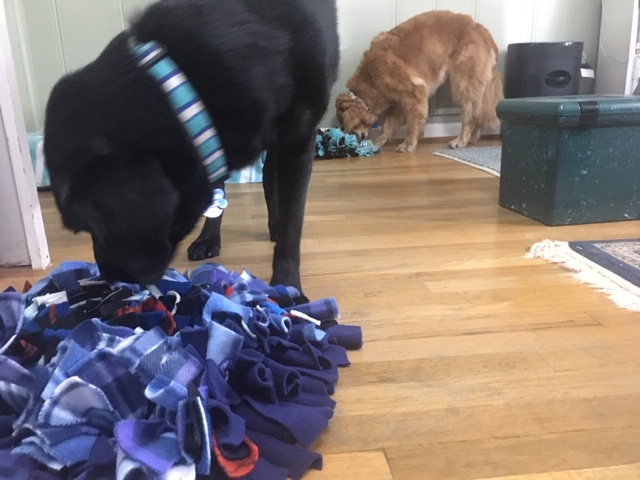
Koala joined us upstairs a few times while Deni was away, and I set them both up with their mats. Cali was a little pushy and got started a few seconds ahead of Koala, the instant I put the first mat on the floor. Even so, I think they had a photo finish, both scenting and scarfing their treats in a few minutes.
I suspect that, the more we use the mats, the more they will smell like food and the harder the girls will have to work to suss out the hidden treats. But their noses are so much more sensitive than mine that I can only speculate. Freshly hidden treat could smell completely different from day- or days-old treat residue. Only the dogs know!
It’s a paradox: Training a dog takes a lifetime; but everyone has time to do it. How’s that?
Dogs, like humans, continue to learn throughout their lives. It is, in fact, possible to teach old dogs new tricks, and doing so enriches their lives (and yours).
At the same time, each training “session” can be only minutes long.
People often think training a dog takes hours a day and requires special skills and they just don’t have time for it. Instead, they spend hours cleaning up messes made by unschooled puppies or rearrange their schedules to walk their reactive dogs very early in the morning, hoping to avoid other dogs. Or, rather than spend 1 minute a day brushing their dogs’ teeth, they spend hundreds of dollars annually and accept the many risks associated with sedating their dogs for a professional cleaning.
Here’s the thing. You have the time — and the skills — to teach your dog the basic manners that will make your lives (yours, your dog’s, your family members’, and your guests’) better.
Young dogs can only handle a few minutes of training at a time. Even if you’re doing formal training, such as teaching tricks or putting behaviors like sit, lie down, or keeping 4 paws on the floor when greeting people, on cue, you can really only actively train for a few minutes at a time. Under 5 minutes for puppies; maybe 10-15 minutes for older dogs. But 5 minutes is fine for them, too. You can cover a lot of ground in 5 minutes.
Training doesn’t have to be formal, though. You’re teaching your dog how to behave all the time, whether you think about it or not. What makes it informal training is thinking about it — how would you like your dog to behave? And how do you teach her what you want? Then, build that into daily routines.
You feed your dog, right? (I hope so!) Teach your dog to stay out of the kitchen or in a specific spot, out of your way, while you prepare her meal by guiding her to the spot and saying, “Wait on your mat,” — or any cue words you want. As long as you use the same cue each time, you’re fine. The dog will learn to associate the place, and the words, with meal prep. The other piece of this equation is a “release” word that gives the dog permission to come over to her bowl once her meal is ready. It can be the same release word, like, “OK” that you use for other things, like going out the front door or greeting another dog or … just about anything you’d like your dog to wait for permission to do.
Your dog already knows how to sit and lie down, but putting those behaviors on cue control means that you can ask for them. All that means is teaching the dog to associate hearing a word, the cue, with doing the action. In other words, learning that sit means sit. One way to build this association is catching the dog doing the behavior and naming it. Another is using a lure, like a cookie, to induce the dog to sit (or lie down, etc.) while introducing the cue. Many trainers practice eliciting the behavior before using the cue to be sure that the dog learns to associate the right behavior with the cue and not, say, think that “sit” means “sniff my hand for a cookie.”
Here’s the daily routine part: You do stuff every day that your dog could and maybe should sit for: Put down a bowl of food, put on a leash for a walk, go out a door or down stairs, pet your dog, allow your dog to greet a visitor. Practice using the sit cue and waiting for the dog to sit before doing these things. The meal itself can be the reward for sitting nicely while you’re serving it; for other behaviors, you might reward with attention and petting or use very small treats as rewards. (Very small treats means maybe one Charlee Bear or piece of kibble; not a huge dog biscuit. The idea is to teach the dog, not make him obese!)
Some behaviors are more challenging. Teaching a dog to walk nicely on leash, for example, takes a long time. If your dog is very reactive to people, cats, or other dogs on walks, you may need to call in a trainer for assistance. But for basic manners, and even fun things, like shaking hands or bringing you things you’ve dropped, spending a few minutes a day teaching your dog will produce great results. Besides, it’s fun!
In last week’s post, I described some things to consider when choosing a dog trainer for your puppy or adult dog. Here, I’ll provide a few resources to help you locate a suitable trainer.
Professional organization listings
Two professional dog training organizations that I have been involved with have directories of positive trainers. These are a great place to start your search — or continue it if efforts to get recommendations from dog-obsessed friends have failed:
Pet Professionals Guild — This is a 100 percent positive trainer group that is very serious about continuing education. They publish a journal and a blog; have regular webinars, workshops, and conferences, and are a truly dedicated group of professionals.
Their mission statement: The Pet Professional Guild is a membership organization representing pet industry professionals who are committed to results based, science based force-free training and pet care.
APDT (Association of Professional Dog Trainers) — The APDT is dedicated to “least intrusive, minimally aversive” training approach. This is a mostly positive approach that emphasizes humane and effective strategies to change behavior. They offer a ton of resources, have huge (really fun) conferences, and are also very dedicated professionals.
Dog training clubs
Many cities and counties have dog training clubs. These vary widely in their size, philosophy, and what they offer. St. Petersburg, Florida, has a very active club where you can find puppy classes, obedience, Rally, agility, other dog sports, and much more. Google, ask fellow-dog owners, and dig around to see what your city offers.
Shelters
Many shelters offer classes, especially to people who’ve adopted their dogs. But most are open to the community, reasonably priced, and focused on basic manners or obedience.
Ask lots of questions
Whichever path leads you to a potential trainer or class, ask about the approach used and what equipment is recommended. If anyone says to bring a choke or prong collar to your first class, run! If you’re advised to do something that seems off, ask for an explanation. Follow your instincts; your role is to teach and protect your dog. You do not have to hurt him to get him to behave!
Most trainers love to talk dogs. If you have questions about (mis)behavior, problems, or simply are new to dog-parenting, ask, ask, and ask more questions.
Don’t be put off if the trainer suggests more classes. Building a relationship takes work and time. Training classes are a good place to learn what to do. And, realistically, most people don’t practice much between classes, so continuing to attend ensures that you continue to work on behavior problems in a calm place where you have help — which beats yelling at your dog in frustration whenever she does something “bad.” Even “frivolous” classes like trick training and scent work are great for building your relationship, improving communication with your dog, and just having fun together.
So, you’ve got a new puppy, or a newly adopted dog — or you just want to work on some behavior or other things with your dog. How do you find the “right” or “best” trainer?
Get recommendations … but use caution. Ask a lot of questions. Ask both the person recommending the trainer and the trainer:
What approach does the trainer use?
Is it a clicker trainer, a mostly dog sports or competition oriented trainer, an obedience trainer, a trainer who works with all kinds of dog/human teams from pets to service dogs to dog sports nuts?
Trainers who use mostly or entirely positive methods are the best choice for most dogs — certainly for puppies — and for most people. A trainer who is expert in a specific type of training is a good choice for advanced training.
When you are just getting to know your dog, the focus should be on building a connection and communicating. A positive trainer will help you develop skills in communicating to the dog what you want her to do and also in understanding your dog’s communication with you. That is the best foundation for your relationship.
A more “traditional” or obedience focused trainer might introduce punishments for “bad” behavior — things the dog does that you don’t like. At any point in your relationship, but especially at the beginning, this has the effect of cutting off communication with the dog. The dog begins to worry about what might trigger the next punishment. Often, you’ve given the dog little or no (or very unclear) information about what you do want her to do. On the other hand, when she does perfectly normal doggy things, like having accidents, if she’s a young puppy, or eating some interesting smelling thing, unpleasant and scary things happen. This does not build trust.
Red flags to look out for: Trainers who advocate using harsh tools, like prong collars, on puppies or very early in training; trainers who routinely use shock collars or who expect you to use them for an extended period of time (more than 1-2 uses); trainers who emphasize the need to “be the alpha.”
Does the person do classes, private training, or board-and-train? A combination?
You may have preferences for a class vs. private; board-and-train might sound tempting. Think through the options.
For a puppy, a great combination is a puppy play with short training classes. The opportunity to play with other puppies in a supervised, appropriate (size, age, play style) group is essential to developing good doggy social skills.
If you have an older dog, classes and private training are good options. Private training is ideal for focused work on a specific problem. Classes that focus on reactive dogs or trick training or scent training or some other fun or serious topic can also be helpful. It’s good to see how other dogs and their humans do things, it’s fun to meet the other people and make connections. General manners or basic obedience classes, Canine Good Citizen training, or classes geared toward teaching manners for dogs who are out and about with their humans are all fun and helpful. They tend to focus on things that every dog needs to learn: walking nicely on leash, staying calm around other dogs and people, not jumping, settling quietly. Your options may be limited, depending on where you live, but I hope you can find something that works.
Board-and-train might be a good choice for some adult dogs for some types of training. I do not recommend it with puppies because the puppy should be forming her primary bond with you / your family — not with a trainer. Obviously it can work; many service and guide dogs spend their puppyhoods with families and then transfer their bond to their new partner. But given the choice, I think your new puppy belongs with you.
Choosing board-and-train to work on a specific problem or if you need to leave your dog for a time period anyhow (maybe during a 2-week no-dog vacation) could work out well — if you are realistic in your expectations.
The trainer, likely an experienced professional (choose carefully), will probably make a lot of progress with the dog during the training weeks. But when you get back, you and the dog have made no progress at all. That is, the dog has no reason to behave any differently with you in your home environment than she did before you left.
Many dog owners mistakenly assume that the trainer imparts knowledge to the dog and the dog then knows exactly what to do in similar situations from that time forward.
For example, your dog goes nuts when she sees another dog, a squirrel, or a cat when you’re out for walks. The trainer spends 2 weeks working on this, and is able to walk the dog calmly through a park filled with squirrels, cats, and other dogs out for walks or even playing off leash. So you’ll have no more problems, right?
Wrong.
Your dog is going to go just as nuts with you as she did before the training, unless and until you work with her to change that.
The trainer has taught your dog an alternative behavior, but the dog still needs to learn that she has to use that behavior with you. That requires undoing an established pattern (the dog going nuts, you freaking out …) and learning a new one. This will be much easier since the dog has already learned the new pattern, but…
Board and train is not a replacement for work, lots of hard work, with your dog.
I’ll cover more trainer-selection criteria in another post.
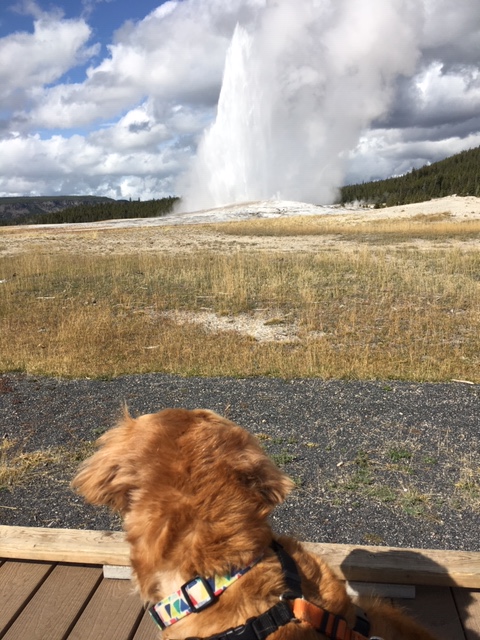 Cali just had her first vacation to Yellowstone. Koala came, too. Neither of them had visited the park before, and they loved seeing all of the wildlife.