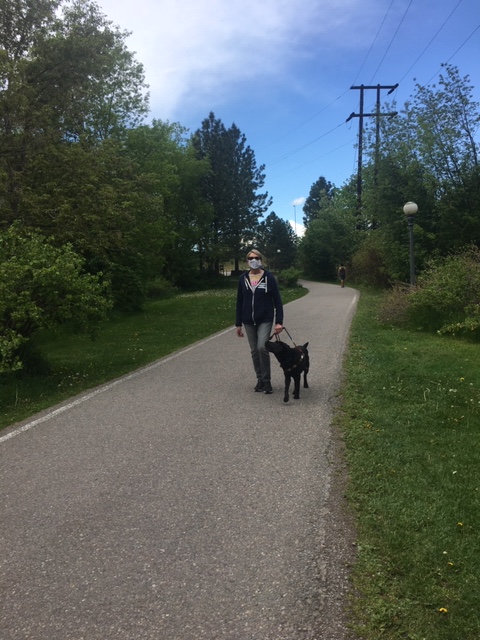
I like to reward Cali and Koala when they are especially helpful or face down a challenge. For example, Cali gets a cookie for bringing in the paper in the morning; Koala gets one for picking up the breakfast dishes. On our walks, we pass several yards with loud, aggressive dogs. If our girls walk by without reacting or pulling on the leash, they get a cookie.
But they don’t get free cookies just for being cute.
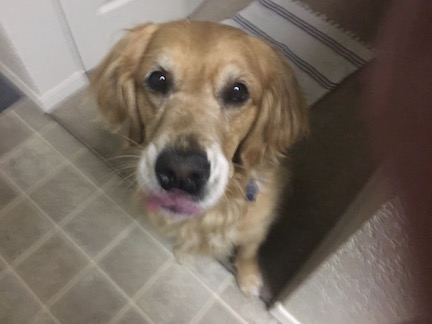
Koala especially seems to think she should. If she knows I have treats in my pocket — or have had treats in a pocket at some point in the past, oh, lifetime or so, she knows it. And wants one.
She sits in front of me an fixes those big, dark eyes on me. She does her mind meld. Sometimes she badly miscalculates and she whines. Or she nudges my pocket. Over and over. Harder and harder. The whining and repeated nudging are met with a very sharp rebuke.
Cali is more subtle. She’ll sidle up next to me as I am working and verrryyyy gently, almost imperceptibly, touch me. Sometimes I am not even sure I really felt it. Then I look down and see a hopeful face.
Argh!
Those big brown eyes are hard to resist. But that nudging and begging. No! I am not a Pez dispenser or a gumball machine. You cannot just push a magic button on my leg and get a treat!
Cali and Koala get plenty of earned rewards. They also eat very well, between their top-quality regular meals, their puppy lunch and snuffle breaks, and their nighttime snack of kefir and a cookie. I don’t know where they got the idea that they can also have snacks on demand but … it’s not going to happen.
It started out as a cancer study, and, with the huge amount of data collected, has evolved into a study of risk factors for many diseases that affect dogs — and some that affect humans as well. The Foundation recently held a webinar that presented some information on the study; it took place the day after Cali’s annual physical exam.
Cali’s exam went well — she’s fit and healthy. She was really annoyed by the lack of breakfast, of course. And, as usual, she steadfastly refused to provide me (or Deni) with any samples whatsoever, no matter how long we spent walking her around the back yard with a plastic container at the ready. She refused to pee at the vet’s too — until 1:30 in the afternoon.
All of this got me thinking about her participation in the study. Why we’re doing it and whether it’s worth the Day of Suffering that she seems to endure each year. So the webinar was very well timed.
5 million points of data
The researchers have gathered 5 million data points from the 3,044 dogs who enrolled in the study. As of mid-June, 221 dogs had died, and 100 had withdrawn for other reasons. Of the dogs who’ve died, 139 deaths were from cancer of some type.
Among the participants are 1,225 doggy siblings, including 2 of Cali’s brothers.
The data relate to genetics, environmental exposures, nutrition, and the dogs’ lifestyles. The dogs could enroll at age 6 months to 2 years, and the first dogs enrolled just about 8 years ago — August 2012. Cali enrolled as soon as she turned 6 months old, in June 2013. The researchers are studying a long list of issues, from the role genetics plays in obesity and the role the dog’s age at spay or neuter plays in obesity to various studies on the gut biome to causes of hypothyroidism, allergies, epilepsy, renal failure, and heart diseases.
They have found that early spaying or neutering does not correlate to a higher risk of obesity as dogs mature. But spaying or neutering dogs under the age of 6 months does correlate strongly to a higher rate of orthopedic injuries in adult dogs.
The most common health problem in study participants is ear infections. Cali is proud to say she’s never had one of those!
They’re looking at the lifespan of goldens — and studying whether there are genetic cues to why some dogs live longer.
The Foundation is launching a related study, called Golden Oldies. They are enrolling golden retrievers aged 12 or over who have never had cancer. This is perfect for older sibs of study participants who were not eligible — or any senior goldens who want to make a difference! If you are a senior golden, or you share your life with one, please consider participating.
Back to Cali
So is Cali’s suffering worth it?
The truth is, she still gets very excited about going to the vet. And even though she doesn’t get treats the first 1,000 times she asks, once she’s given up her samples, she is showered with treats. That’s in addition to all the attention she laps up while she’s there. I know she hates the delayed meal and is stressed by the crazy spectacle of her mom or a vet tech chasing her with a plate or a ladle when all she wants is some privacy … but I think it is worth it. She recovers instantly; that is, the instant a cookie enters her mouth.
But I realized that the real bottom line is that she’d have an annual checkup each year even without the study. And, as Cali’s officially a senior golden, that check would always include blood tests. So … whether she loves it or hates it is not really the issue. The real question is whether she’s going through all of the sampling and stress for herself only — or for a bigger cause. Considering the range of studies — and the number of researchers who are or will use the data to improve dogs’ health — I’m glad that Cali is part of this group of golden heroes!
Cali is a raspberry fiend. When our bushes have raspberries, she’s constantly nosing through the canes, looking for ripe, almost ripe, or just about any berries she can reach. She somehow manages to avoid the thorns.
Throughout the winter, she also kept nosing around, trampling the canes and occasionally chewing on one. I kept telling her that she’d be sorry in the summer because if she ate the bushes, there’d be no raspberries.
I was wrong. I was completely ignorant of the benefits of a dog nosing through, trampling, and chewing on raspberry canes. Our patch is bigger and stronger than ever. And both old and new canes are loaded with potential raspberries. They are not even at the stage of underripe berries as I write this, but within a few weeks … Cali will be stuffing herself.
She’s excited. Every day she goes to check on them. She conducts a thorough inspection of every cane. She sniffs every emerging berry. She sits patiently next to the canes — for hours — waiting for them to ripen.
We’re going to have a bumper crop of raspberries. I hope that the humans get to eat a few.
Like many golden retrievers, Cali has some arthritis pain. And like a growing number of dogs (and humans) she’s trying CBD for relief.
CBD is derived from hemp but, unlike medical (or recreational) marijuana, it has no THC and Cali does not get a “high” from her Special cookies.
According to a recent study, the benefits are real and measurable — dogs getting CBD, vs. a placebo, had reduced inflammation and pain and greater mobility. Owners and veterinarians reported on the dogs’ condition and any changes in their gait. All the dogs had bloodwork done before and after the treatment. No ill effects were recorded — but the study lasted only 4 weeks. Nine out of 10 dogs who got the CBD showed improvement that lasted for a couple of weeks after the treatments ended.
The participating dogs got daily treatments, though, and Cali is probably taking far less CBD. She may need more of her CBD treats… a prescription she will be delighted to follow!
She’s also getting chiropractic adjustments and laser therapy. She is cheerful, playful, and happy, and eager to run and jump for a tennis ball, so I don’t think she’s in a lot of pain. But she’s still young, and her arthritis is likely to get worse, so I am learning what I can about available therapies.
This small, short-term study is promising. It could lead to studies with humans. CBD is popping up everywhere, including local pet stores. It’s great to have some indication that it could be effective.
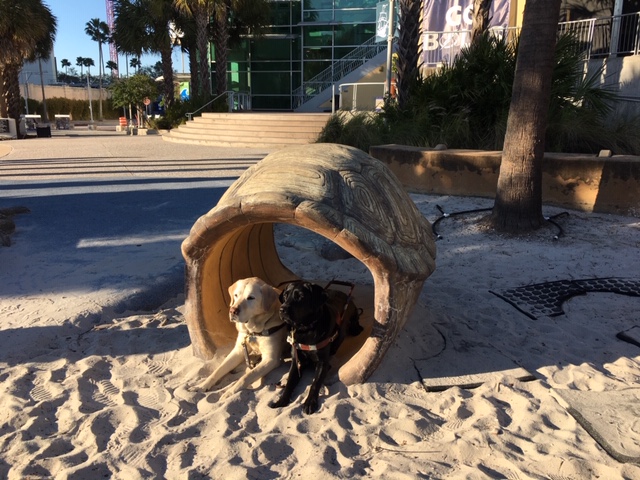
Ryan, left, and Koala, caught up on guide school news during Ryan’s visit to Florida in late February.
Our friend Ryan finally got to retire.
Ryan, a yellow Labrador, is — or was — a guide dog. He was all set to retire in March. He had his retirement planned and new toys lined up. He thoroughly enjoyed his last work trip, a visit to friends in Florida, and he looked forward to hanging up his harness.
Then COVID-19 hit.
Ryan wasn’t the only essential canine worker who had to do overtime due to the pandemic. Hundreds, maybe thousands more, had the opposite problem: Their start dates for their new jobs were delayed indefinitely.
But things are slowly starting to reopen, and Ryan was finally able to retire in early June. He even got to help train his successor. Since Ryan’s human wasn’t able to attend training camp in New York, the new dog and a human trainer came to Ryan’s house. The human trainer showed the new guy the ropes in the mornings, while in the afternoons, Ryan let the youngster know how things were going to work around the house.
Finally, just in time for summer, Ryan is retired. He’s looking forward to some well-earned rest and relaxation.
Cali and Dora are sisters. Dora’s parents are among my closest friends and our favorite humans.
For the first four and a half years of their lives, we lived near enough to one another that Cali and Dora got together regularly.
They each have other friends. Dora was part of a regular pack of dogs who walked and played together. Cali has always had friends who come for play dates. But their time together was always special. I am sure that they knew they were sisters. Cali was comfortable enough with Dora to play without inhibition. She also made herself right at home in Dora’s house, on Dora’s bed, with Dora’s toys …
Then Cali and I moved to Montana.
We’ve been back twice for visits. We drove back and spent a couple of weeks there each time, and of course the girls got together.
They definitely know each other and remember their special connection. Cali gets excited when we’re many miles out but getting close to Dora’s house. As soon as Dora senses us outside she gets excited. Cali’s only problem is who to hug, dance around, and squeal over first — Dora, Dora’s mom, or Dora’s dad. The three of them are really Cali’s extended family and she’s so excited when we are all together.
Another chance encounter a long time ago convinced me that dogs do recognize their birth-family members: I was walking Jana once and we ran into her mom. Jana was grown, maybe even a year old. She hadn’t seen Mom since the day I took her home when she was just 8 weeks old. Jana was delighted to see mom and bounded up to say hi, all wags and smiles. I think Mom recognized her, too … but her response was to curl her lip, give a little warning, and turn away. Jana was crushed and came back to my side, sad and subdued.
Maybe her mom didn’t recognize her and just didn’t want to say hi to this bouncy young dog. I cannot know for sure. But I’m pretty sure I read Jana’s excitement and disappointment accurately. Jana was an extremely introverted dog and never approached strange dogs or tried to greet dogs we met on our walks. Her surprise and delight at seeing her mom were obvious. My best guess is that dogs recognize family members, friends, enemies, and others they’ve met before based on smell. I’ve seen dogs after a long, long absence, some who I knew as puppies and re-meet as adults, and they definitely recognize me.
The bottom line is that I have to get Cali together with Dora as often as I can!
Guiding Eyes Koala gives me advance warning when we are about to cross paths with another dog. I can feel added tension in the rigid handle attached to her harness. She keeps walking us straight down the sidewalk, but as the person and dog get closer, I can feel Koala rise up. She walks on her tippy-toes, restraining herself from sniffing as we scoot past the dog.
A person alone on the sidewalk is way less interesting; as far as Koala is concerned, they might as well be a trash can to walk around. In that case, Koala is likely to walk by without giving any indication that there is something that needs my attention. It isn’t until I hear footsteps that I realize that the obstacle we are passing is a living, breathing human being.
In this period of cautiously returning to public contact, what my guide dog communicates has become an urgent matter of concern. Guide dogs know how to squeeze and weave themselves and their partners around any obstacles. They aren’t likely to understand the concept of staying six feet away from others. So, the question for people who are blind or visually impaired is: How can we manage social distancing when we can’t see the distance?
I’ve found that the answer depends on how crowded your community is and on whether the guide dog team is navigating outside or inside.
In areas with lower population and more attuned neighbors, if people see a guide dog working in harness, they may naturally cross the street or provide space. In high population areas or or where sighted people are more focused on their phones than on other pedestrians, the guide dog handler will have to take a more proactive approach.
When walking on harness outside, if the guide dog signals that another dog is nearby, the handler should ask the person approaching to keep the distance. “Please stay six feet away,” is normally all that is required.
It’s harder when your guide gives no warning, and the handler suddenly finds herself shoulder-to-shoulder with someone on the sidewalk. Again saying, “Please stay six feet away,” is kinder than shouting, “Can’t you see that I’m blind?”
Working a dog in harness inside in the COVID-19 era provides new challenges that most guide dog teams can’t overcome on their own. Some grocery stores have designated aisles as one-way. Any place open for business has six-foot markers for people standing in line at the check-out counter. People with visual impairments are not likely to see any of this. It is kind for sighted shoppers to offer directions, but unfortunately, many sighted people just stop and stare.
The blind or visually impaired person can do some advance planning to make the trip to the store as efficient as possible. If the store has special hours for vulnerable populations, it is good to take advantage of the smaller crowd and the likelihood that the other shoppers will also be working to keep distance. This is one time that it is a good idea to call the store in advance, explaining to the manager that the need for employee assistance. That helper can quickly locate items and help the guide dog team stay out of the way of others, while everyone maintains a six-foot distance.
Some people have pulled out their long white canes as an additional signal for sighted people to keep the right distance. Others who aren’t coordinated enough to handle the dog in harness on one side and cane on the other – I’m one of those – may need to provide additional visual cues for those around them. Vests, tank tops, and tee shirts that say “BLIND” or “VISUALLY IMPAIRED” in high contrast are used by athletes and are available at ruseen.com. These draw more attention to disability than most of us would like in our daily lives. But at this time in the world, it is better to be noticed than infected.
Cali loves to dig. She loves to dig deep holes at the dog beach, sending sand flying. She loves to dig through the snow, sometimes over-zealously sending clods of partially frozen grass and dirt flying.
Most of all, she loves to dig in the yard. The first time we planted tomatoes in our raised garden beds, Cali immediately dug them right back up. She’s since learned that the raised beds are off-limits but … that leaves the whole rest of the yard for her, right?!
I now have two or three large pits in my back yard. Any attempt to refill them is met with more digging.
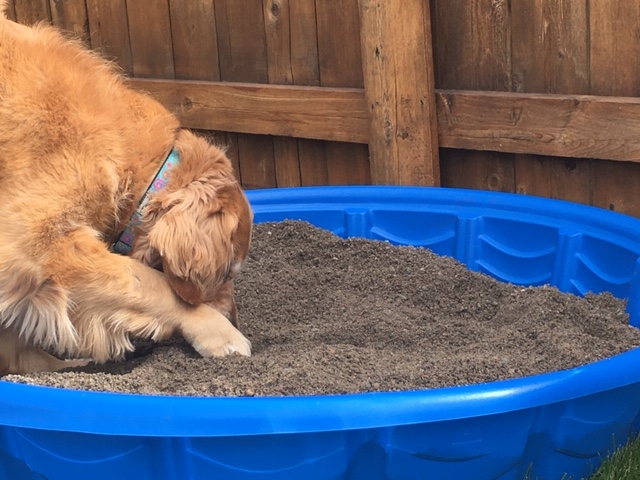
But! I have a possible solution. A couple of weekends ago, I built Cali a digging pit. It’s a kiddie pool with sand. I considered other fill materials — wood chips? Pea gravel? I didn’t want something that would get too hot for paws or would harm the grass or the lawnmower if / when some got scattered on the grass. I thought about getting those plastic balls used in kids’ ball pits but they’re pretty expensive and they squash or puncture easily (not to mention blowing / rolling around the yard!). So I settled on sand. I cover it at night and I don’t get many cats in the yard anyhow with the dogs around.
I bury things — tennis balls, bones.
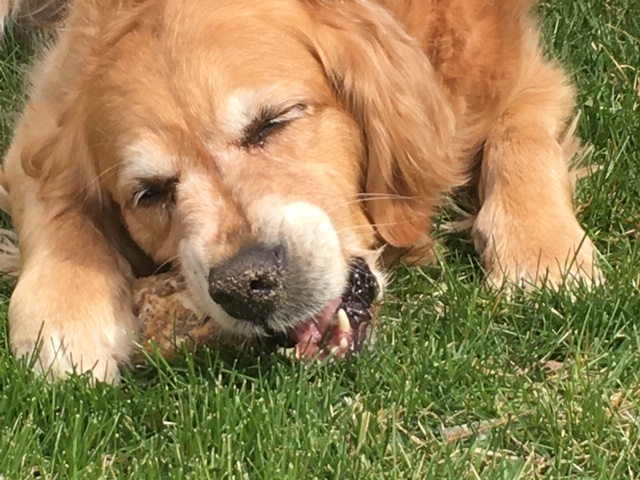
Koala does not seem to see the point, though she will pull a bone out every so often and gnaw on it. But Cali seems to like it! She’ll dig something out, chew on it for a while, then wander back to dig for a new treat. As the days grow longer and warmer, we’ll all spend more time outside, so the pit will be uncovered more often. Time will tell whether this diverts Cali from her yard excavations … or simply adds to her digging pleasure.
For over two years, I opposed Puppy Lunch. I made fun of it and told Deni that Koala had really wrapped Deni around her paw.
I was wrong.
Cali now has Puppy Lunch every day alongside Koala.
Puppy Lunch is a late morning snack. Ideally it would be a mid-day snack, but Koala has adeptly moved the time forward bit by bit, and it’s now generally served at about 10:30. Soon we’ll need to call it Puppy Brunch and perhaps add Puppy Happy Hour at 2 or 3 pm.
But I digress.
Little puppies eat three times a day. Big grown-up dogs eat twice a day — some only once! (Koala finds that very hard to imagine.) The worst day of Jana’s life was the day she grew up and outgrew Puppy Lunch. Cali’s too, apparently.
Koala convinced Deni as well as the Guiding Eyes trainers and nutritionists that she could not possibly survive — much less work(!) — without the sustenance that Puppy Lunch offered.
Cali did just fine without Puppy Lunch.
Then Cali lost some weight and was looking a bit thin. Her vet pronounced her in excellent health but underfed. Cali said, “I told you so!” about a thousand times. Cali’s vet, her favorite human on the planet, suggested … a mid-day meal.
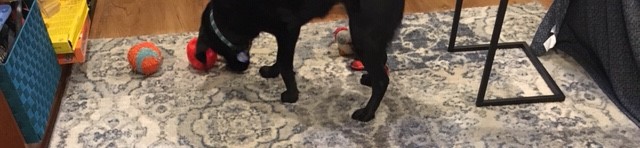
Here’s the part I misunderstood, though: Unlike breakfast and dinner, Puppy Lunch is not simply food poured into a bowl. Puppy Lunch is a small amount of kibble served in a treat ball. Cali and Koala each have an orange treat ball that is used solely for this purpose. Koala brings the balls upstairs; Deni fills them. The girls then bump their balls around the basement play area until the balls are empty. Koala then returns them to the toy box.
It’s a nice routine. More than that, it’s an enrichment activity. They have fun, use their noses and paws, and get a break in their fairly dull days of watching us work at our computers. Both girls have become skilled at keeping their balls from rolling under things or behind furniture.
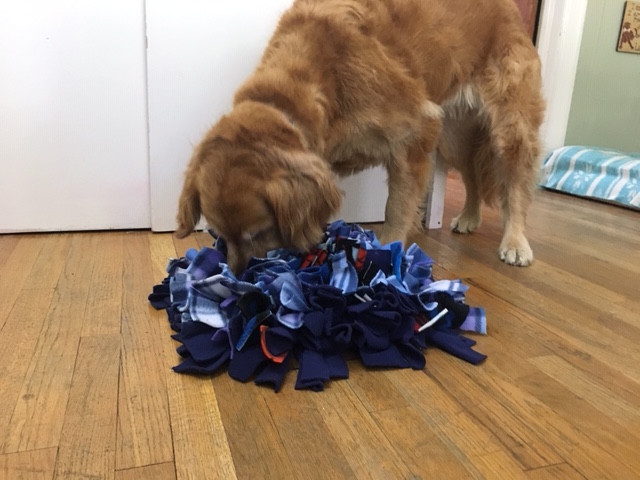
Cali often has a second break in the afternoon, with her snuffle mat although, for some reason, Koala rarely joins her. (Hmmm… perhaps Cali has already trained me to provide Puppy Happy Hour …)
When Deni and Koala are working at the university in Florida, Puppy Lunch gives Koala a nice work break and a chance to play in the middle of what can be long workdays.
Cali’s weight is back up to where it needs to be. She’s fit and very healthy. But the routine continues — because adding some fun into her life has been good for her. It’s an easy enough thing to do, especially with Koala reminding one or both of us about Puppy Lunch well in advance…
I have a confession to make: The real brainpower behind the Thinking Dog blog comes from Koala. She’s shown, above, reviewing drafts of blog posts on her iPad.
She wanted to be sure that no one missed the important news that her distant cousins are going to save humans from themselves by fixing this whole coronavirus mess.
Eight Labradors are learning to use their super power to fight the COVID-109 pandemic: Their noses.
Dogs have already demonstrated their ability to sniff out viruses, which apparently have unique odors — either from the virus itself or from the body’s response — that dogs can detect before an infected person is symptomatic. Dogs are ideally suited for this job. Their detection ability is better by far than available detection equipment, and they can easily travel and work anywhere that humans gather.
Coronavirus-detection dogs could be more accurate than taking people’s temperatures. Their potential to sniff out contagious people who have no idea they are infected could make it safer for people to travel and resume other activities. A similar project in the UK aims to deploy these canine superheroes to airports to screen passengers.
Airports offer so many opportunities for working dogs — I wonder how the vegetable-sniffing dogs, the explosive-sniffing dogs, and the virus-sniffing dogs will all get along. Koala would like to point out that all of these hard-working airport employees deserve potty parity. She’s appalled at the conditions of the airport restrooms she’s expected to use while working and traveling and believes that the dogs who actually work at the airport deserve far better!