Don’t Get Ripped Off!

Many years ago, when I started giving Jana glucosamine supplements, I carefully reviewed all of the special products formulated for dogs, finally choosing one that my vet recommended. Over the years, I have given my dogs many dietary supplements, such as (not all at once):

  • Glucosamine / joint support
  • Fish oil
  • Green-lipped mussel
  • Probiotics
  • Digestive enzymes
  • Vitamin E
  • CBD
  • Pumpkin
  • Yogurt / kefir
  • Sardines

All of these are things that some people use for similar reasons — to enhance their digestion, reduce inflammation or aches, improve overall health. But do you need to get special products for dogs? Not always, though the line can be fuzzy.

Glucosamine, CBD, probiotics, digestive enzymes, and vitamin E are not things that I would generally eat for dinner. I might use them if I thought they’d help resolve an issue, like painful joints or an upset stomach. Can Cali share mine?

I’m not an expert in canine digestion, but I suspect that the doggy digestive tract and microbiome are quite different from their human equivalents. So when I have selected digestive enzymes and probiotics for my dogs, I have used canine-formulated products. I use a canine joint support powder, too, though that is primarily because it’s easy and inexpensive. I mix together a joint supplement, a digestive enhancer, and extra turmeric and scoop a little onto each meal.

But for many dietary supplements, and especially things like fish oil, sardines, or pumpkin — there is absolutely no difference between the “canine” and human products; the human product might even meet higher production or safety standards — and cost a lot less.

Buying 100% pumpkin puree “for dogs” is just silly, for example. As long as you get the puree, not the pumpkin pie filling, there’s no difference. Same with fish oil or sardines, though those dried ones are handy as treats (if you can stand the smell).

If you watch the dosage, you can use green-lipped mussel (powdered) and vitamin E sold for humans; I do, and have safely done so for years. I’ve used generic Immodium and Pepto Bismol and Prilosec for dogs (& humans) as well. And I know many people who do the same with CBD oil, though for edibles … I stick with the doggy ones; no CBD gummy bears for Cali

A lot of foods that are healthful and beneficial for humans are also great treats for dogs: Eggs, fish, fish oil, pumpkin, Greek yogurt (plain) or kefir, peanut butter, many raw vegetables and fruits. As long as there’s no added sugar and absolutely no xylitol, your dog can safely enjoy small amounts of these foods. Cali would add ice cream and pizza crust to this list.

Don’t fall for the marketing and reach for the puppy pumpkin! Instead, share a healthful treat that you and your dogs can all enjoy together.

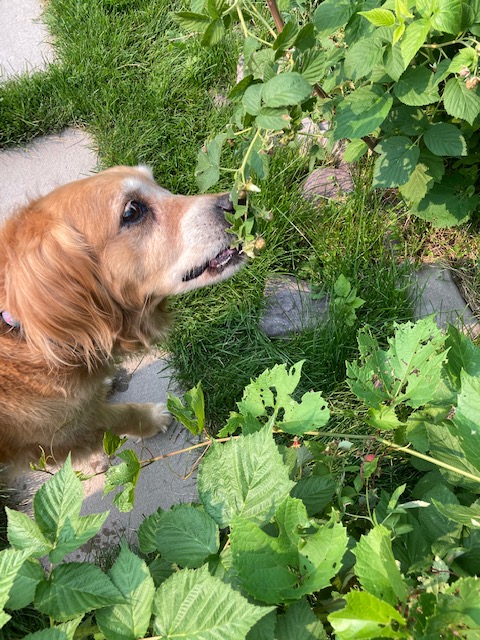
Cali plucks ripe berries from a mixed cluster, leaving green ones behind
Some fresh-picked raspberries perhaps?

Dog Days of Summer

Cali plucks ripe berries from a mixed cluster, leaving green ones behind
Yum!

Cali enjoys summer in Montana; she gets to do all of her favorite things. I recently commented to a colleague about how “busy” Cali is, and my friend asked for details. A typical summer day for Cali might involve some work — and always involves some fun.

During late June and July, for instance, she can often be found harvesting raspberries or trying to pilfer some cherry tomatoes or strawberries from the garden. Blaming her lack of thumbs for an inability to drop berries into a bucket, she eats them all.

She is often called on to make an appearance at meetings, whether social or work gatherings, that her mom attends. She wonders what the fuss is, and she’s really over zoom. What good is it to see all those tiny people if you can’t smell them — and they can’t scritch your ears and feed you treats? She’s dying to go “back” to the office and check out some in-person meetings, not that she’s ever been to a meeting. Or an office, for that matter.

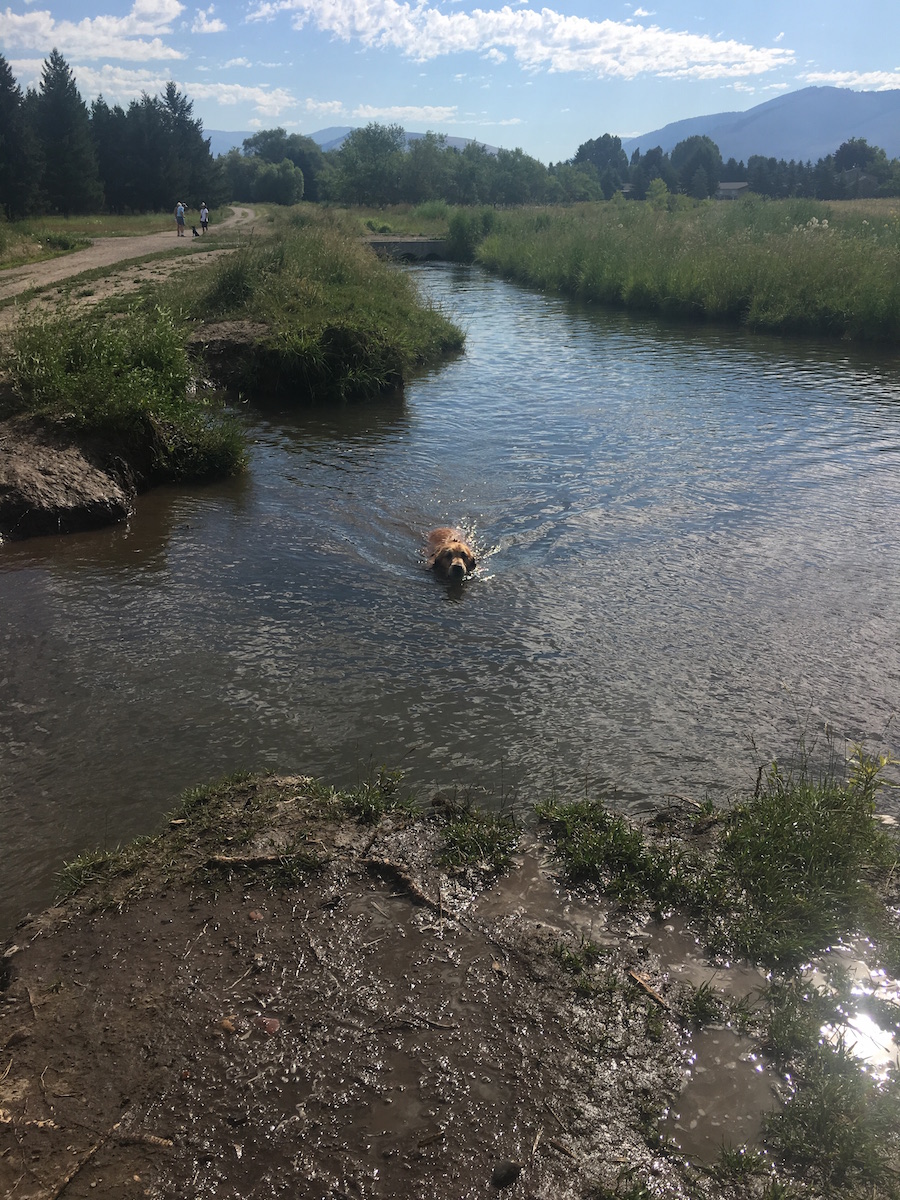
Cali swims to the bank of a river with her ballShe also enjoys swimming. We go to a huge area that belongs to the state department of natural resources conservation where dogs can run around; people walk, jog, and sometimes ride horses; and best of all, dogs can swim. There’s an irrigation canal that channels river water throughout the more rural neighborhoods of Missoula — and the natural resources department’s land.

There are two spots where the water has carved out decent-sized pools. I toss in a tennis ball and she paddles after it, over and over. She’s got a little routine where she climbs out of the water, walks about 20 feet away, shakes off the water, and drops her ball. Then she sits and waits. She’s not big on the “retriever” part of her name, and she has trained me to come over and get the ball, walk back to the edge of the channel, and throw it again. She’ll do that swim, walk, shake, sit cycle over and over, for as long as I’m willing to throw. Or until another dog comes to play in ‘her” swimming spot.

When she and the ball are waterlogged and muddy, we walk back to the car so that she can get in and shake muddy water alllllll over.

Once home, no matter what the clock says, it’s time to eat. Swimming makes Cali so hungry! I understand that! Then, perhaps she’ll relax on the deck or stretch out on a cool patch of grass.

Video!

If it’s not on video, it didn’t happen, right? So here are a couple of short (very amateur) videos.

Cali harvests raspberries, above, and enjoys a swim, below.


Farewell, Wrangler …

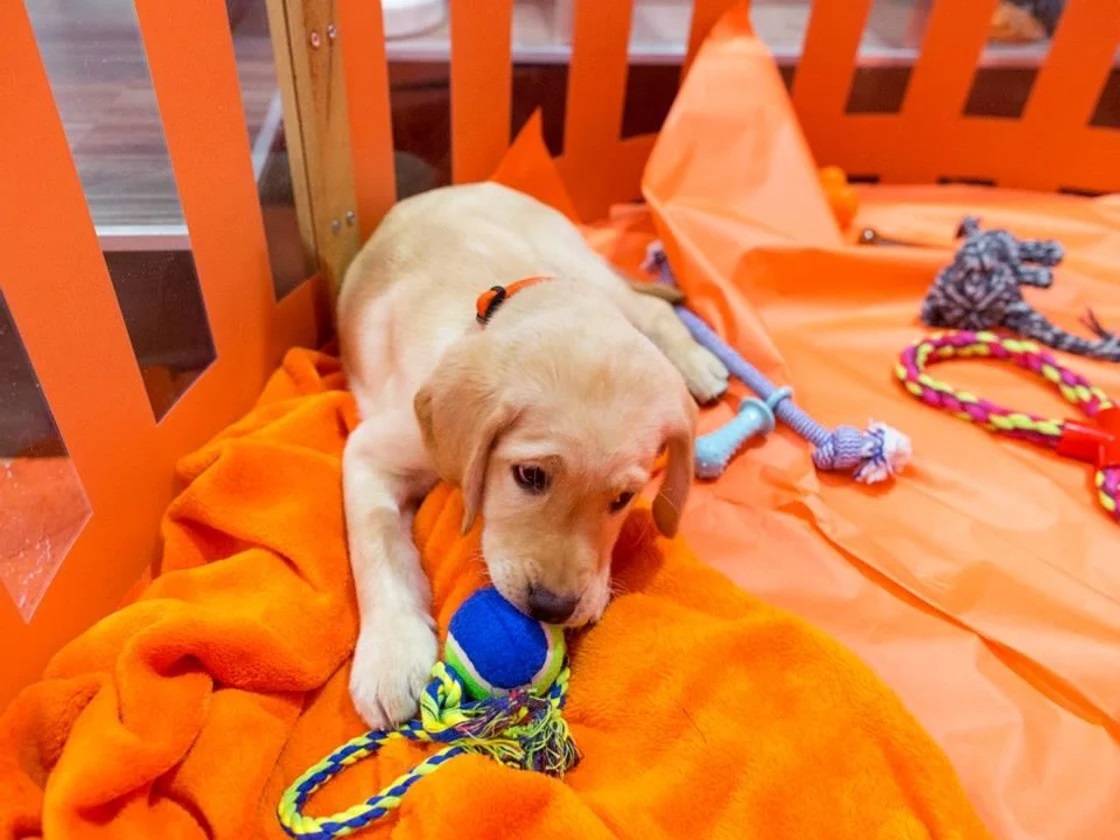
Wrangler, a yellow Lab puppy, chews on a tennis ball toy in an orange pen
Photo from Today Show website

A dog who used his charm, good looks, and luck to spread knowledge of guide- and service dogs has died. Wrangler was only 6 when he died in July of liver disease.

He became famous as a Guiding Eyes puppy who was puppy raised on The Today Show. As an adorable 10-week-old Labrador puppy, Wrangler made his TV debut. He grew up on camera, educating millions of viewers as he learned his manners and early skills. The studio, as well as his home life with a carefully selected puppy raiser, exposed Wrangler to the many sights, sounds, smells, and experiences that shaped him into a calm, confident, resilient adult dog.

An initial job as a guide dog didn’t work out for Wrangler, and he moved on to a second career as an explosives detection dog for the Connecticut State Police. In his short life, Wrangler showed the best of what a dog can be and touched many, many lives and hearts.


Is There an Emergency Vet Near You?

A red cross with a paw print in the centerMy sister sent me a link to an alarming article in the Whole Dog Journal about emergency vet services reducing their hours.

The writer, the WDJ editor, says that three clinics in her area had suspended their overnight services, and that she’d heard of this happening in other parts of the country.

Even if you’ve never used an emergency vet, now’s a good time to check out what is available in your area and whether they’ve made changes to their hours.

I decided to do that, and I discovered that both emergency services in Missoula are still working — 5 pm to 8 am weekdays and 24 hours on weekends and holidays. Whew.

When I mentioned the article and the reduced hours, one clinic’s response was “we’re doing quite the opposite!” — they are planning to expand their hours to 24 hours 7 days a week. The other partners with a “regular” vet clinic and is open when that clinic is not, so effectively … yep, 24×7. Missoula’s pets are in good hands.

I’ve been lucky. Cali hasn’t needed emergency services, and the only time Jana did … it didn’t turn out well. But the emergency clinic staff and vets were wonderful, and I was very appreciative that they were available, late at night on a holiday.

The reason clinics are cutting hours appears to be staffing shortages. When I was trying to find specialist services for Cali a few months ago, I ran into that problem: Appointments for the nearest doggy neurologist (3 hours away in Pullman, WA) were booking out several months. They have a shortage of veterinary anesthesiologists, they explained, and they do not want to schedule exams if they cannot then perform the recommended (very costly) scans.

Cali may not need to go; she’s trying some alternative therapy while waiting for her appointment, and it was never an emergency situation.

But I am relieved to know that if we ever do need emergency care, it’s available.

I’ve got both clinics entered into my contacts. But I hope I never need to call them.


It’s Here!

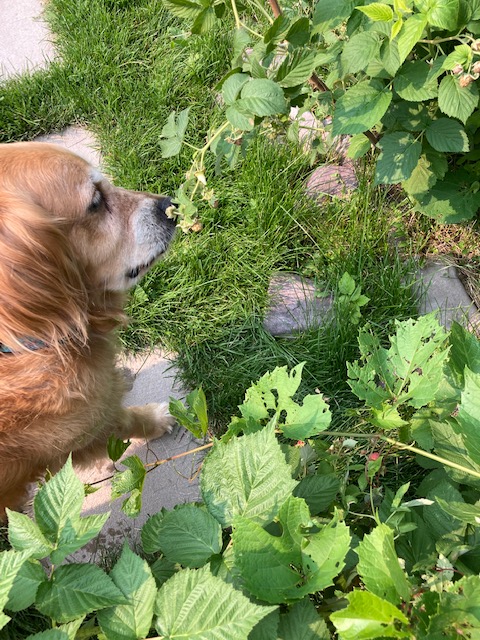
Golden retriever Cali sniffs to check whether any berries are ready
Do these berries pass the smell test?

With the incredible heat wave we’re having, raspberry season arrived early!

Cali waits for the raspberries eagerly each summer. She checks at least hourly to see if they are growing, then ripening. She naps in a little space between the berry canes so she won’t miss anything. A space that she created by pulling out, chewing, or flattening whatever was growing there.

As the tiny berries start to appear, her inspections increase. Until! There’s a partially ripe one. She grabs it!

As the days unfold, she gets more selective, choosing only the juiciest ripe berries. She’s careful to avoid the tiny thorns and, unlike me, is rarely clumsy enough to knock a perfect berry off, letting it fall into the thicket of canes (and weeds).

Cali plucks ripe berries from a mixed cluster, leaving green ones behind
Yum!

The season is ramping up, and there are enough berries for both of us. I pick the ones higher up on the canes, while the lower ones — and the ones I drop — are Cali’s. I also get all the ones in the back alley.

When I pick berries, I tend to put at least as many into my bowl as I put into my mouth: One for me, one for the bowl, one for me  …

Not Cali. She picks hers like this: One for Cali, one for Cali, one for Cali, one for Cali…


I’m Doing This on Purpose

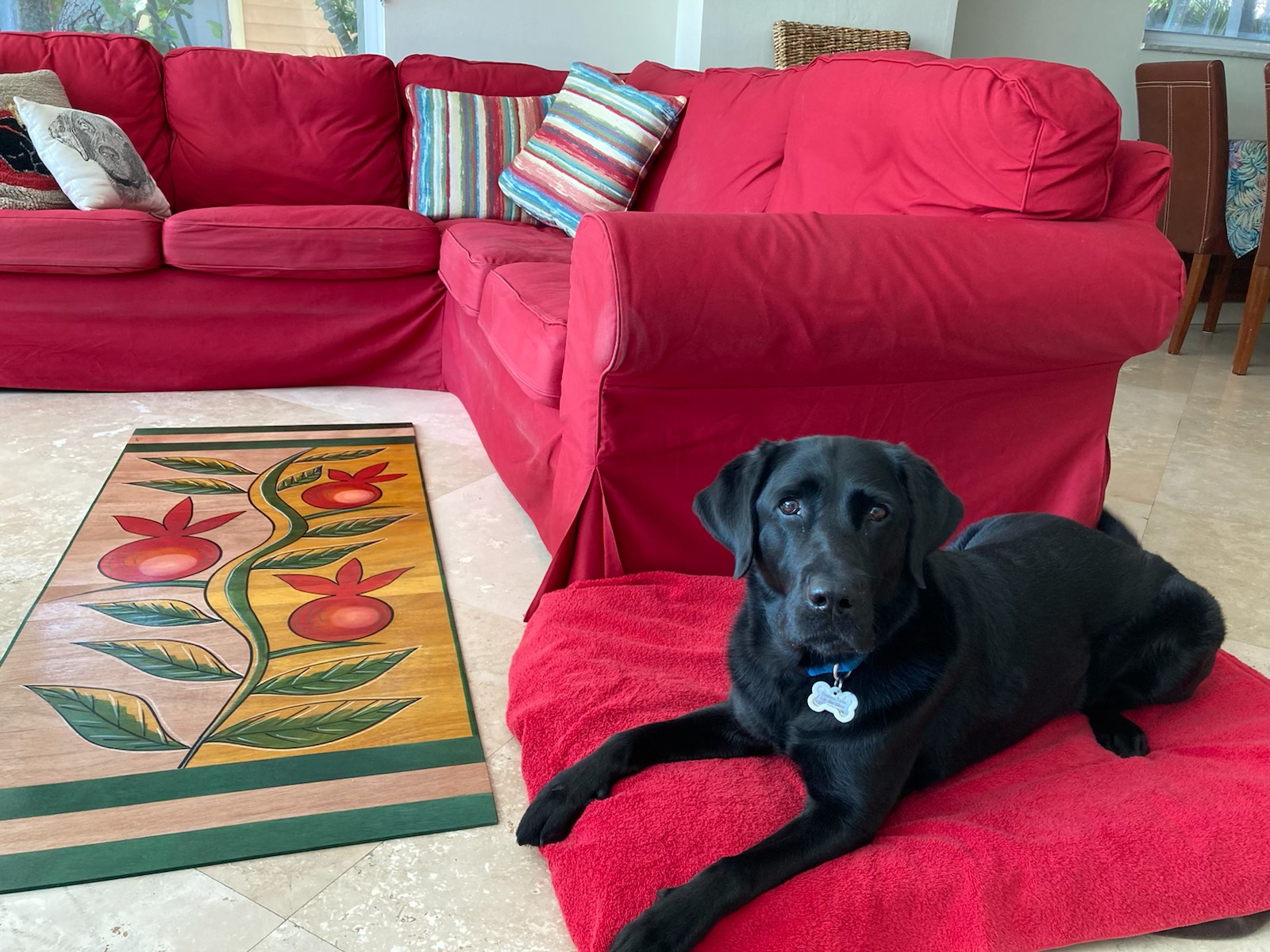
Black Lab Koala rests on her bed, next to the forbidden sofaIn keeping with our recent theme of communication with our dogs, Koala staged a mini-protest recently. A lie-in if you will.

Seemingly out of nowhere, she decided to spend her alone time on the living room sofa in her Florida home. Several days in a row, when Deni arrived at the door, she was able to see Koala step gracefully off the sofa and saunter over to the door to greet her.

“She’s doing this to make a point,” Deni told a friend one day as they entered the house. “She knows I’m home well before I get to the door. She knows the sound of the car.”

The friend agreed — and pointed out that some recent changes had affected Koala. And were probably the reason for Koala’s behavior.

Those recent changes in Koala’s home decor included swapping the TV viewing space with the dining space, Deni mused, not understanding the connection.

Go on, the friend prompted.

Finally, Deni got it.

Formerly, toward the back of the living room, a sofa and comfy dog bed marked the TV corner. These had been relocated to the former dining room. And now a table and four chairs occupy the front-room space. No dog bed.

AHA!

It had not dawned on Deni that perhaps Koala liked spending her time waiting for Deni to return both in the living room — where she could keep an eye on things — and in comfort. Koala chose a not-very-subtle way to communicate that to Deni.

It’s a good thing that Deni has dog-savvy friends to interpret for her, or she’d be frustrated with Koala’s recent “bad” behavior, while Koala would be rolling her eyes at the obliviousness of humans. Again.

Even better, this friend had recently passed along an extra dog bed, so a solution was at hand. Or paw. Now Koala has a comfy bed in the front of the house — and she no longer needs to occupy the sofa.

Dogs and People Communicate Differently

Cover of book called Doggie Language

In a recent blog post, I described my failure to convince Cali and Koala to use buttons to “talk” and make requests.

Their unwillingness has nothing to do with being hesitant to order humans around; they are quite adept at that. Nor do I believe that they are incapable of understanding English or even using it correctly — if they wanted to. Both dogs (especially Koala) demonstrate a deep understanding of the things we humans say to them. They are able to respond to requests and answer questions, though their answers use body language rather than words.

Chaser admirably demonstrated mastery of more than 1,000 words as well as basic grammar and syntax. Dogs effectively use body language and vocalizations to communicate with us, and don’t give up even when we misunderstand.

But I don’t believe that Bunny, the dog who is supposedly using her buttons to talk about love, make sentences, and ponder her place in the universe, is actually saying a lot of the things her admirers credit to her. (I do believe that dogs are aware of their own “selves,” though and that they have definite likes, dislikes, wants, and agendas.)

Communicate on dogs’ terms

Humans desperately want to communicate with non-humans. The trouble, as I see it, arises when we demand that they do it in our way and on our terms. And pretend that they are formulating complex sentences based on a shared understanding of concepts like love, strangers, or even pain.

While I am sure that dogs feel pain, what humans understand as pain or discomfort might be radically different from how dogs experience it. Even humans from different cultures have very different concepts of pain, illness, and discomfort.

And I am as sure that Cali loves me as I am that I adore her. But assuming that my personal concept of pain, love, or anything else translates to my dog’s experience would be arrogant. And probably wildly inaccurate.

Making the enormous leap to assuming that my inept attempts to get her to associate a specific button with deep concepts, and “teach” her to string together buttons to convey complex thoughts that make sense to a human … well, I have plenty of dog-training experience and I am quite sure that I can’t do that.

So what do I think is going on?

This story might help …

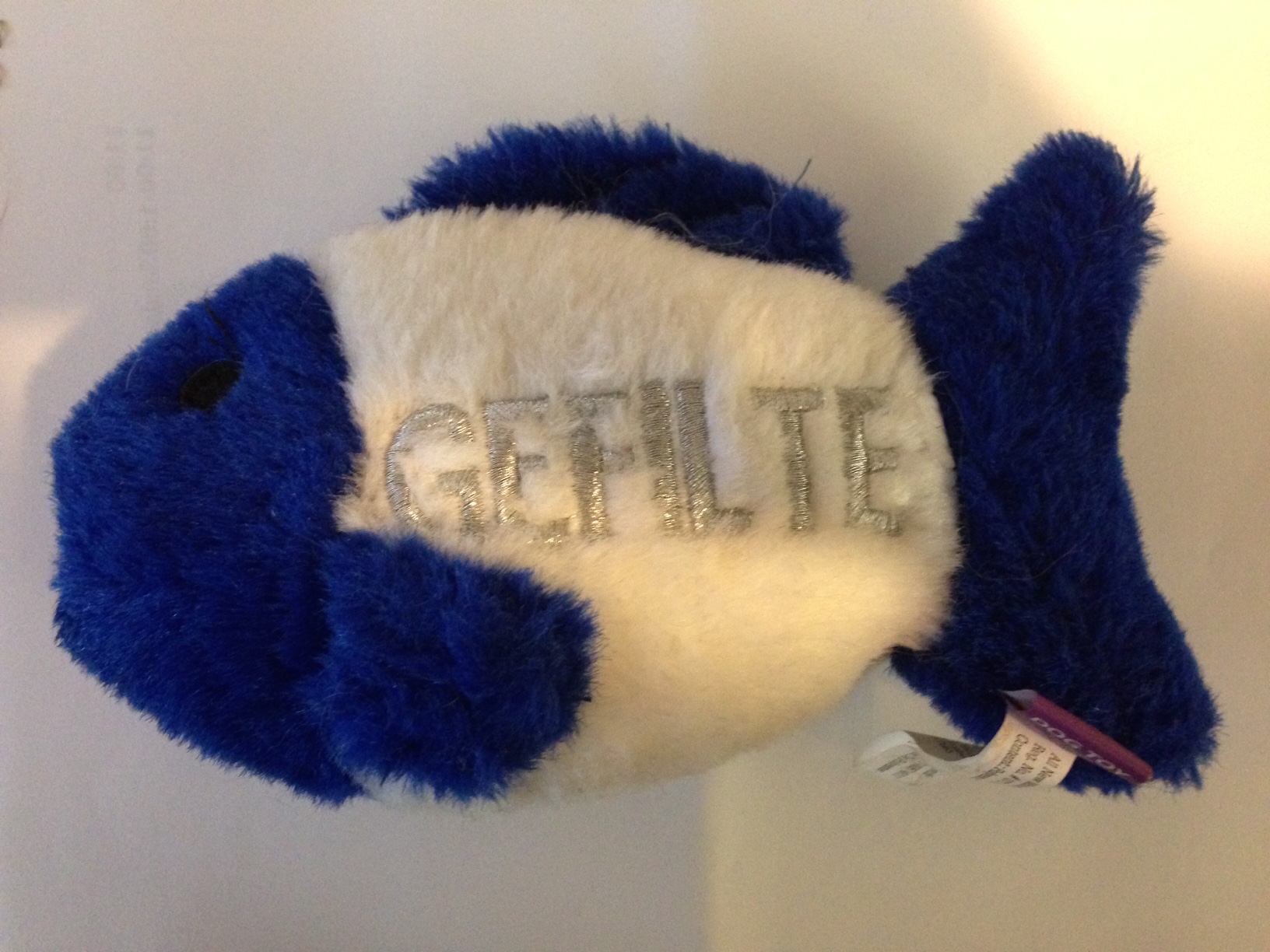
I once found a fabulous toy for Jana. It was a blue-and-white stuffed fish. When I pressed on it, instead of squeaking or grunting, it made a burbling sound then said, “Oy, vey.” In a sad, disappointed tone. Every time I heard it, I laughed.blue and white fish-shaped stuffed toy with "gefilte" written on it
Jana quickly figured out that she could make me laugh — and yes, I do think that dogs understand that laughter is a happy event. So she would get the toy, squeeze it, and watch for my reaction. When I stopped laughing, she’d look right at me and squeeze the fish again. She enjoyed provoking a happy reaction. My laughter was reinforcing, so she kept squeezing the fish.

When Bunny, or any other dog, presses the button that the human has self-servingly programmed to say, “I love you,” I am confident that the human delights in this action and, as I did, responds very positively. So the dog is reinforced and does it again and again.

Let’s be clear: I am not disputing that dogs can and do make the connection between pressing a specific button and being let out or getting a belly rub or a play session. So sure, Bunny and other dogs are probably using the buttons to ask for things. I’m also not disputing that dogs understand deep concepts. I’m sure that dogs have a concept of death and feel grief when someone they love dies, for example.

But that’s not the same as understanding complex concepts, in the same way humans understand those concepts; formulating verbal descriptions of their feelings and thoughts; and using the buttons to talk about them. We have no reason to believe that dogs think or dream in words, and they don’t sit around discussing their feelings. Smells are far more relevant to dogs than words.

As ethologist Marc Bekoff says over and over, dog joy is different from human joy (or cat joy or bird joy). We can’t really know how they experience love, pain, grief, or anything else. We can know that they are experiencing these emotions by their behavior — if we are paying attention and have made the effort to get to know them as individuals and understand how they communicate.

A solution in search of a problem

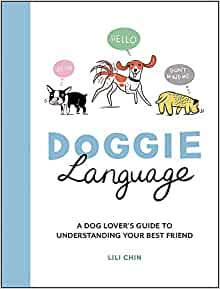
While the question of how extensively dogs (or any other non-humans) can learn and use human language is interesting and the study of the button-using dogs is fascinating, I’d rather see humans making the effort to understand their dogs’ natural communications. There’s no need to go through the considerable effort of teaching a dog to push combinations of buttons to communicate. The dog is already communicating. Constantly. And there are many excellent dog body language “dictionaries” available to help humans learn to understand what the dog is saying. (Start with this simple one; it’s charming.)

The buttons and the complicated sets of doggy signs are a solution — high-level inter-species communication — in search of a problem that dogs have already solved. They just haven’t solved it by learning to speak English.

I can’t help feeling that, to justify the effort put into teaching the dogs this unnecessary system, the humans feel compelled to “discover” all sorts of new cognitive abilities this communication device reveals … But the cognitive abilities aren’t new any more than dogs’ ability to communicate is a breakthrough.

Our dogs already show us and use their considerable cognitive might in so many ways. If only we’d pay attention.

 

Major Problems

Champ and Major Biden, both German Shepherds, adorned the White House christmas card

My heart goes out to Major Biden.

Moving is challenging for dogs; moving into the White House must be especially confusing. There are so many new people around and so much commotion.

Major was already having a hard time adjusting, evidenced by his “biting incidents.” Then the poor guy had to get used to living with a cat. This can be a tough adjustment for many dogs!

And now, poor Major has lost his big brother, Champ.

Yes, sadly, First Dog Champ Biden passed away on June 19 at age 13.

Champ was a much-loved longtime companion to the human Bidens and probably a cherished big brother and mentor to Major. Losing your sib and best friend is hard, and I am sure that Major is grieving.

Major has had a lot of stress to deal with lately. I hope that his life settles down soon as he adjusts to life as the First Dog.

I also hope that he gets the doggy equivalent of a therapist — a positive trainer who takes the time to understand the individual dog and address his needs. Unfortunately, as of April, that did not seem to be the case.

Force- and punishment-based “training” approaches are abusive as well as being ineffective. You cannot force a dog to stop being scared or anxious, which is the root cause of much of what’s characterized as aggression or “reactivity.”

Overly aggressive “training” could just add to poor Major’s stress, leading to more unfortunate incidents. Let’s hope that doesn’t happen and that we see happier news from Major in days ahead.

Ouch! Hot Surfaces Hurt Dog Paws!

Golden retriever Cali tries on some hiking boots
Boots can protect dog feet from cold or heat

A friend passed along a horrifying local news story this week: A new bridge is under construction in my neighborhood. One side has been completed and opened recently, just in time for some very hot weather. A local character nicknamed The Beagle Guy was biking with his pack when he noticed them behaving oddly. He stopped to see what was wrong, touched the ground … and realized it was HOT. He told construction workers and got his dogs out of there.

A civil engineer on the project recorded a temperature reading of the bridge surface: A whopping 147 degrees! Nearby concrete sidewalks registered a toasty 106 and a metal handrail, painted black, was “only” 114. But the day hit the low 90s, so this could be a rare problem, right?

Unfortunately no: Another day, when the temperature was in the 80s, common during Missoula’s short summers, the bridge surface was 145 degrees.

Those poor dogs!

During extreme weather in particular, but really, always: Think about your dogs’ experience. Paw pads are sensitive: Extreme heat or cold is painful. Many snow-melt chemicals burn horribly. Rough terrain — icy or rocky or sandy — can scrape and cut pads. When walking or hiking with your dogs, think about that. If you wouldn’t walk barefoot on the surface, don’t ask them to.

Solutions?

On hot days, I don’t ask Cali to walk on asphalt. I won’t walk her across the new bridge at all. In winter, I avoid any sidewalk that has ice-melt on it. If you’re an avid hiker or live somewhere wintry, consider boots (I know, dogs hate them… but many dogs will accept them with proper training that includes a lot of treats).

If your dog has severe burns or you suspect they might, go to your vet or an emergency vet. Burned paws are very painful!

To soothe mildly cut or burned pads:

  • Plunge the paw(s) into cold water and soak for several minutes
  • Clean gently to remove debris
  • Pat the paw dry; do not rub the pads
  • Use a natural balm, such as Musher’s Secret or pure aloe vera gel
  • Wrap the paw loosely with gauze or a sock
  • Keep the dog off her feet (yeah, right!)

How does this happen?

The panels covering the bridge surface use a newish “polymer” material used “all over the world,” according to the Missoulian. It’s significantly lighter weight than concrete.

But most bridges are outdoor, and, though covered bridges are quaint, they are not terribly common, so this cannot be the first bridge using this material that gets direct sunlight. How has this problem never been discovered previously? And why is testing the surface temperature in various weather conditions not a routine part of QA testing?

OK, done ranting.

But, since we can’t count on the world to be safe for dog paws, we need to protect our pets. Have a safe and cool summer!

Update!

The hot side of the bridge got a warning sign as well as a new (temporary) paint job to protect paws and other unshod feet! I am impressed with the speed at which a fix was found — and I hope that a permanent solution is implemented soon!

A sign warns of pavement too hot for dog feet


Talking Dogs?

Profile of Cali, a golden retriever, and her silicone-wrapped tag
Cali communicates effectively without words.

It’s been a few months since I first read about Bunny, a dog that supposedly uses a vast network of buttons with recorded messages to talk with her human. I’ve used that time to read the media coverage of her feats, which is disappointingly lacking in critical thinking, and to consider the idea of teaching dogs to talk to us.

Bunny’s human and the FluentPet company, which makes the buttons and hexagonal boards with which to network them together, are not the first to try to teach dogs to talk (or do math). Researcher and author Sean Senechal devised a dog sign language system several years ago.

I tried both and find them to be extremely complicated ways to teach dogs something they don’t need to know: Human language. Dogs communicate with us constantly and effectively. If we’re not getting it, that’s because we’re not trying hard enough, not because the dogs need to learn to use English words.

These tools are complicated in that teaching the dogs to use them requires many steps, much practice, and a degree of consistency that few humans are able to achieve. You have to learn the signs or program the buttons. Teach the dog what each sign or button means. Practice; reinforce correctly, in a timely manner, over and over and over again. Then — hope that your dog agrees to go along with it!

Cali doesn’t want to talk

I bought a test kit of 2 buttons from FluentPet and went to work trying to teach Cali to use the button to go outside. She already knew the “touch” cue and was able to push a button, so I didn’t have to start at the very beginning. I recorded, “Outside, please.” My — I thought reasonable — goal was to teach her buttons for outside and play, then to try to convince her to distinguish between wanting to go out to play ball and needing to go out for bio-breaks. And getting her to ask in a way I might hear if I was upstairs working, rather than sitting by the door.

Outside is an easy place to start, because you, the human, can reliably open the door and let the dog out any time you or the dog hits the button. The next step is in the dog’s paws: She has to make the leap from going out when you push the button and let her out to asking to go out by pushing the button herself.

Cali tries her magic sit by the back door
Cali hopes that the magic sit (or lie down) will produce results — even when no humans are nearby

Cali would push the button for a cookie. She would push the button before going out if I insisted, but she really, really did not see the point.

Cali clearly communicated that she did not want to do this. She’d look away from the button. Do elaborate stretches. Sit staring at the door. Look at anything but the button. Even walk away. This from a dog who always wants to go out.

She was perfectly happy asking to go out in her usual ways. Another problem we quickly discovered is that the button has pretty poor audio quality and low volume, so … it would only be helpful if I were right next to the button.

I decided to stop bugging Cali and see if Koala wanted to talk.

Koala doesn’t need buttons to talk

Koala is quite an effective communicator. She, too, thinks the buttons are silly.

They’re right

We don’t need to jump through — or try to force our dogs through — silly hoops yo get them to talk with us. They already communicate clearly.

And, as much as I like the idea of encouraging dog people to spend time teaching their dogs new skills, I’m pretty sure this is not the right way. It’s frustrating, for both the dog and the human. It’s not easy to come up with ways to explain the concepts you’re trying to teach to the dog. Using buttons or choreographed paw movements to “talk” to us is not a normal doggy thing to do.

Cali and Koala and I get much more enjoyment spending our time together going on smell walks, snuffle-matting, playing ball, or learning Rally. In addition, I think that the claims about what dogs are saying when they use the buttons are overblown. That’s a topic for another post, though.