A special, brilliant dog passed away recently: Eclipse, the most famous passenger to regularly ride Seattle buses.
Eclipse, a fun-loving black Lab mix, took herself to the dog park on the bus a couple times a week. She’d board the bus near her home … and somehow always knew where to get off.
Like most Labs, she loved her playtime. Unlike most, she was determined to get out to see her friends, no matter what! Truly a dog on a mission.
It’s cute and funny, but also revealing. Was she recognizing the stop by scent (likely); by watching for specific landmarks; by amount of time on the bus? We’ll never know for sure. The story points to yet another of the many areas of hidden talent and intelligence in dogs that we humans so often fail to notice, understand, or appreciate.
More mysteries to ponder: How did she know when the bus would come? And when the bus home was due? How did she pay her fare (or are buses free in Seattle, as they are in Missoula)? Should I teach Orly to take herself to the park by bus?
Sadly, aged only 10, Eclipse was diagnosed recently with cancer and passed away soon after.
I’m sure she’ll be missed by her human family and her co-riders.
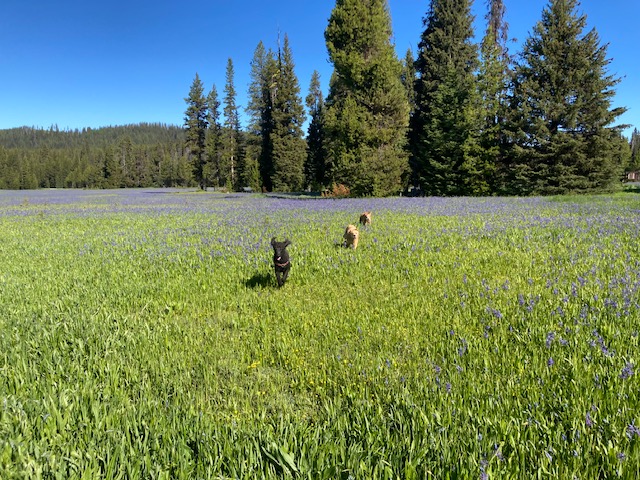
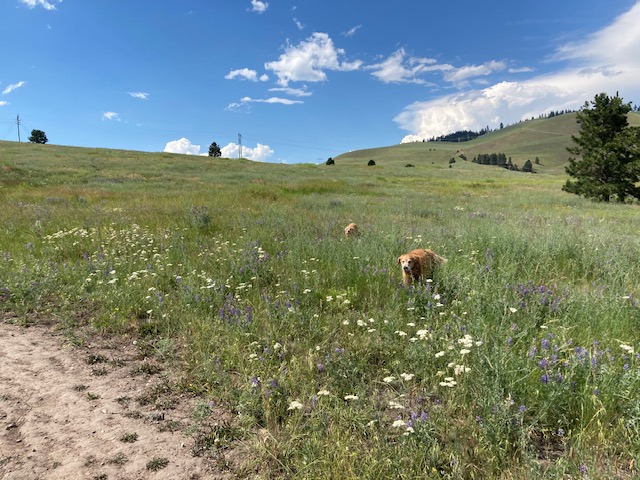
Maisy, Cali, and Orly love visiting Packer Meadow. Here, they enjoy the spring camas flowers.
I love watching happy dogs running free. Letting her run and run and run is also the only way I can get Orly tired enough that she calms down … for a very short while.
So, over the summer and fall, we’ve gone on lots of dog adventures to places where dogs can be off leash. This can be tricky, since many off-leash places around Missoula are wilderness and, you know, full of bears and coyote … and millions of acres where a dog could get lost.
In her youth, Cali had a tendency to wander off. She did not get many off-leash hikes.
I did a better job of teaching Orly to come back when called (or, more likely, just got lucky). She comes instantly, collects her high-value special hiking treat, and zooms off to run circles around more trees.
That works out well. It means that I can send her out with her doggy hiking group a few times a week. It also means I can take nice hikes with both girls. Cali is now old enough that she doesn’t wander far, and Orly regularly checks in and demands a snack break. Cali has learned to check in and ask for snacks as well. Sometimes when she hasn’t even left my side.
Watching them run through the woods, splash in the river, or run huge circles in a meadow is beautiful. Their joy is contagious! (Until, of course, Orly finds a muddy ditch and decides on a soak …)
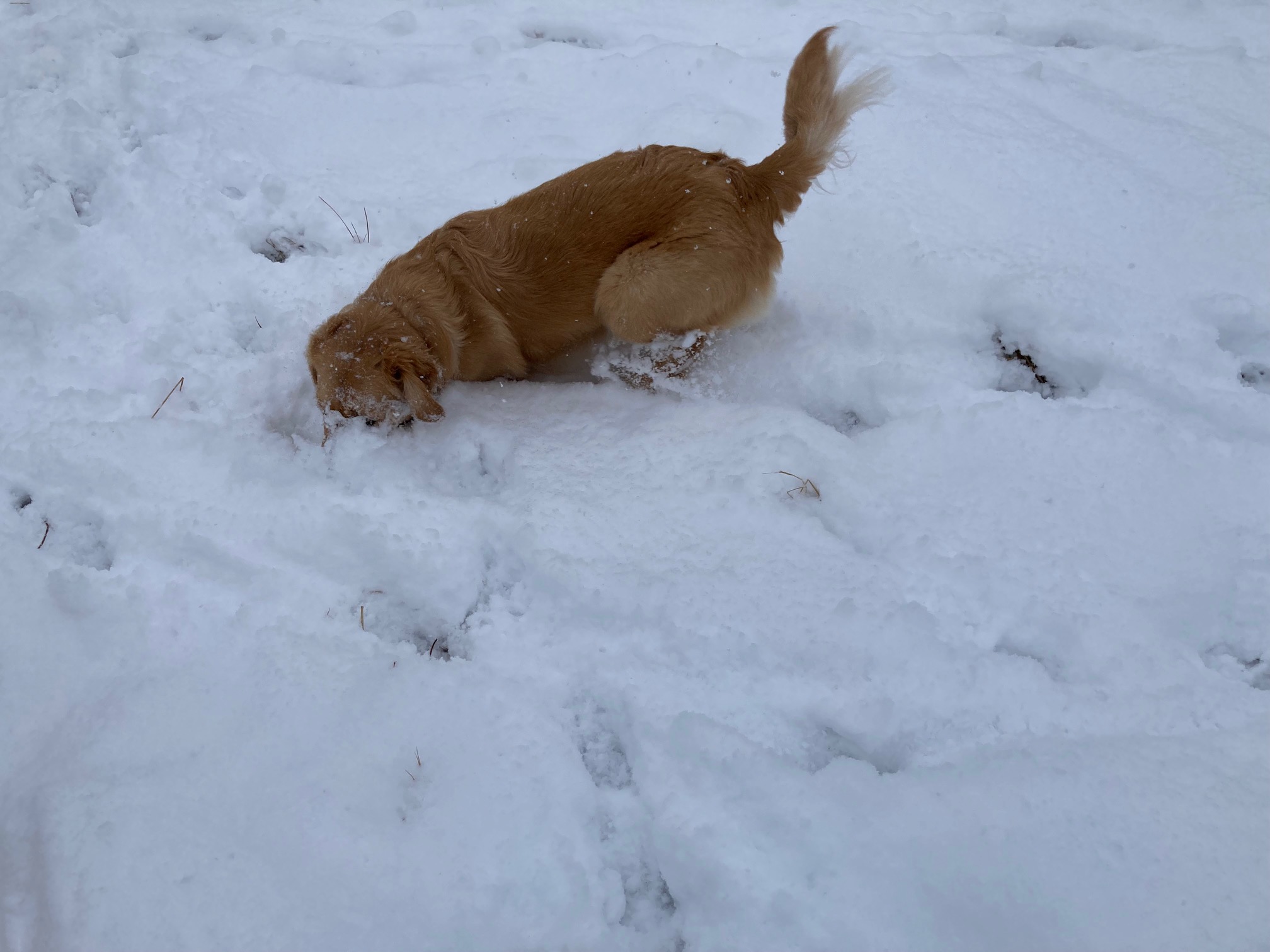
A late-fall trip to Packer Meadow gave the dogs a chance to play in SNOW!
Orly celebrated a significant birthday over the weekend: She is 1 year old! All grown up … I wish.
The day started off in typical adolescent-golden fashion: She wanted to go see her friend next door, so she decided to dig a tunnel under the fence. Hmmm. That resulted in an impromptu rinse-off by a very annoyed human.
All that happened before breakfast, so there was still a lot of time for more suitable birthday activities. It rained all weekend, so our traditional birthday trip to Big Dipper was put on hold; instead she had friends over and got lots of presents and a small amount of ice cream at home.
She played with her new toys, ate far too many treats, and had a great day. That was Saturday, her actual birthday.
The fun continued on Sunday, when I took the girls, along with their friend Maisy and favorite aunt (Maisy’s mom) to Packer Meadow.
It wasn’t raining there … it was snowing! What a special treat.
When the rain stops, we’ll head down to Big Dipper to cap off Orly’s birthday marathon.
Cali is done with her first round of chemo, so I thought I’d give everyone an update.
She did really well with the first two infusions. A little tummy upset, not wanting breakfast the day or two after; some indigestion. Tired. But she rallied after a few days and was back to her usual appetite and energy levels. Most important — even on the “down” days, she was cheerful, silly, and playful.
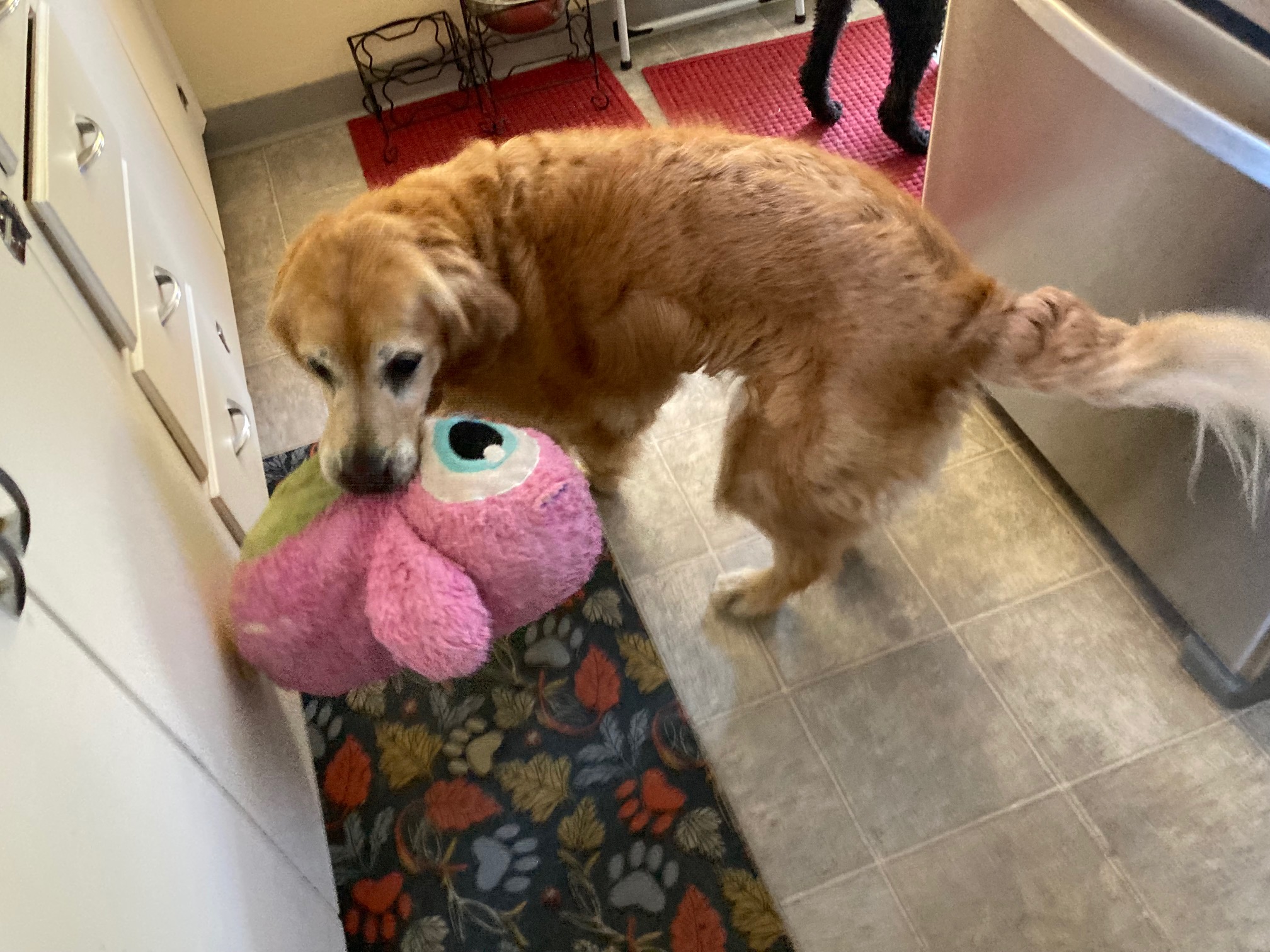
The third infusion hit a little harder. The digestive stuff stuck around for longer … and I started noticing clumps of fur everywhere. Now, flying furballs are a daily hazard when you live with two goldens, but this was different. Her once-magnificent, full tail is a thin wisp (but it still wags just fine!); she has bald patches on her throat and near her ears, and thinning fur all over. I’m looking into getting her some fleece sweaters for the looming Montana winter.
Fur loss is an unusual — but not unheard of — side effect of chemo for dogs. Also skin discoloration (dark pigment). Cali is experiencing both. She’s also more tired. On our off-leash walks, she’ll still run and play with Orly … for the first 10 or 15 minutes. Then she walks more slowly with me while Orly bounds through the forest. These walks are getting shorter.
I conferred with Cali’s medical team — her regular vet, her specialist vet, and her chiropractor vet (who is an emergency vet here in town). We did some bloodwork and a scan, and everything looks good; she has no visible tumors. Even so, we decided to skip her fourth infusion, since side effects tend to get progressively worse.
We’ll soon move on to the next chemo, which is two daily pills: A chemo pill and a pain pill. If she tolerates it, she’ll be on it for the rest of her life. They are very low-dose pills and have to be sent from a compounding pharmacy, so I am waiting for the info on how to get them.
Cali’s still taking her magic mushrooms. We’re working through the bucket list and squeezing in extra ice-cream dates with friends whenever possible, And Cali and Orly continue to wrestle, play, and gobble treats.
To say that Cali is a “good eater” and not at all fussy about food and treats is to vastly understate. Which is why I was astonished when she rejected proffered treats recently.
We have a hierarchy of treats. This is an essential element of training and motivating dogs to do the right thing. The harder the “right thing,” the better the treat. High-value treats — treats that dogs will do anything for, must be reserved for the most challenging situations, or they lose their value.
I have special treats that I use only for off-leash recalls. This can be practice in an enclosed area or, more commonly, when we’re hiking in the wide-open spaces around our Missoula home. For more ordinary moments, and for walks in familiar places, I use doggy trail mix, a try-your-luck mixture of second-best treats like freeze-dried liver, lower-value, but still delicious, treats we find at the local holistic pet store, and “filler” treats — Charlee Bears and Cheerios, usually. These take on scent and taste from their better cousins in the doggy trail mix jar and are usually accepted eagerly by Cali and Orly.
I would have said “always accepted eagerly” until yesterday.
The weather was dicey, and I wanted to get them out for a run. When the rain paused, I grabbed girls and leashes, and off we went. Astute readers will note no mention of grabbing the good treats. Indeed. The dogs noticed that too.
I always have a handful of doggy trail mix in my coat pockets, and a reserve supply can usually be found in the car. So we’re walking along, dogs off leash, me periodically calling them back and offering treats Continue reading →
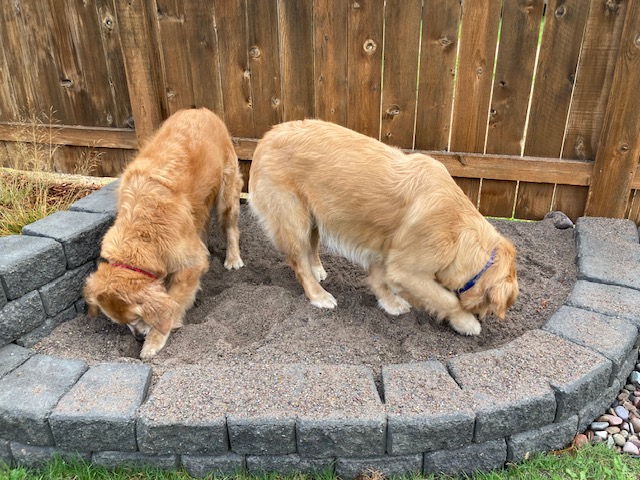
I recently had extensive landscaping done in Cali’s yard. In naive hope of keeping the dogs out of the new beds, and to provide them stimulation and fun, I had a digging pit put in.
Don’t get me wrong: They love it! It just doesn’t keep them out of the beds … or keep them from digging in the lawn (at least not yet).
The digging pit lets them follow their noses to find buried treasure. It is fun and lets them do natural doggy stuff (dig, make a mess, eat stuff they find) in a way that doesn’t cause conflict with their human.
If you live someplace where you see lots of free-roaming cats, it would not be a good idea though … the sand might draw the wrong kind of crowd. While we have many roaming neighborhood cats, not a one has been seen in the yard since Cali and I moved in. It appears that Cali made some sort of agreement with the cats early on, and our yard is a cat-free dog and bird haven. (Actually, that’s not quite true: There was one cat, once, in the yard, stalking the birds at the feeder. Cali chased him out and, I don’t know what she said, but that cat has not been seen since, not even in the back alley.)
Our digging pit is far enough back in the yard that any sand on the dogs’ paws and coat drops into the grass as they run back to the house. There is some spillover into the yard, but so far, it’s not too messy.
The digging pit is only interesting when stuff is buried in it, though, which requires the human to keep it going. I bury, they uncover; as often as I bury, they will dig. So there’s always some pressure to come up with stuff to bury. I bury dog biscuits, bones, and tennis balls. No soft toys or small or soft treats. I admit that I do not keep up my end of the deal every single day.
The pit has failed in its mission to keep the dogs out of the new beds. There are too many enticing smells in there, apparently. And (see above), often, the pit lacks buried treats to find.
It does not help matters any that Cali is convinced that there is buried treasure in the yard. There’s a particular spot next to my garden shed where she cannot resist digging. She digs; I fill; she digs, etc.
We’re working on all of that: The lawn is green; the dirt is soft. The landscaping is still new and exotic. The blackberry bushes draw the girls in with a few late-season berries, tantalizingly close to the ground. For the moment, the dogs are winning most of these battles.
I have high hopes for spring, when I will seed the bare patches on the lawn, block dog access, and keep them entertained in their digging pit until they forget all about how much fun it is to dig in the grass and get their paws good and muddy. Yeah, right.
Jana, my first golden retriever, knew the names of many items
Who remembers Chaser, the border collie who learned English grammar? Chaser’s first moment of fame came from the recognition that she knew the names of more than 1,000 toys. Her dad, Dr. John Pilley, meticulously documented her training. He then demonstrated that she could apply different verbs to each toy (e.g., bring, take, give) and that she knew the difference between the object of a sentence and the indirect object, a mastery of English grammar that puts many high school grads to shame.
In the years since Chaser’s accomplishments became known, other dogs have demonstrated proficiency in learning names of objects and showing basic linguistic comprehension.
But not, apparently, in Hungary.
Bizarrely, a dog cognition researcher at a well-known university — whose dog cognition group has published reams of amazing research — found that the dogs she worked with could not learn any words.
Dr. Claudia Fugazza told Modern Dog: “We started investigating and we found that irrespective of the age when you start training, most dogs do not learn the name of objects. We trained a group of dogs very intensively for three months—we included a group of puppies around three months old and a group of adult dogs—and none of them could learn any words.”
I find that strange because every dog I have ever lived with understood many, many words. Some in two languages. Even without any training at all — simply as a byproduct of living with humans who used words and phrases over and over.
“Want to go for a walk?”
“Who wants a cookie?”
“Let’s get you some dinner.”
These — or variations on these — sentences are known to nearly all well-cared-for dogs.
But Dr. Fugazza was specifically interested in and focused on teaching dogs the names of specific items.
Fair enough.
But here, too, all the dogs I know have learned the names of at least a few favorite toys or items — ball, bone, hedgehog (a nearly universal favorite toy). With minimal effort, intention, or knowledge of dog training, many dogs’ families teach them dozens of words.
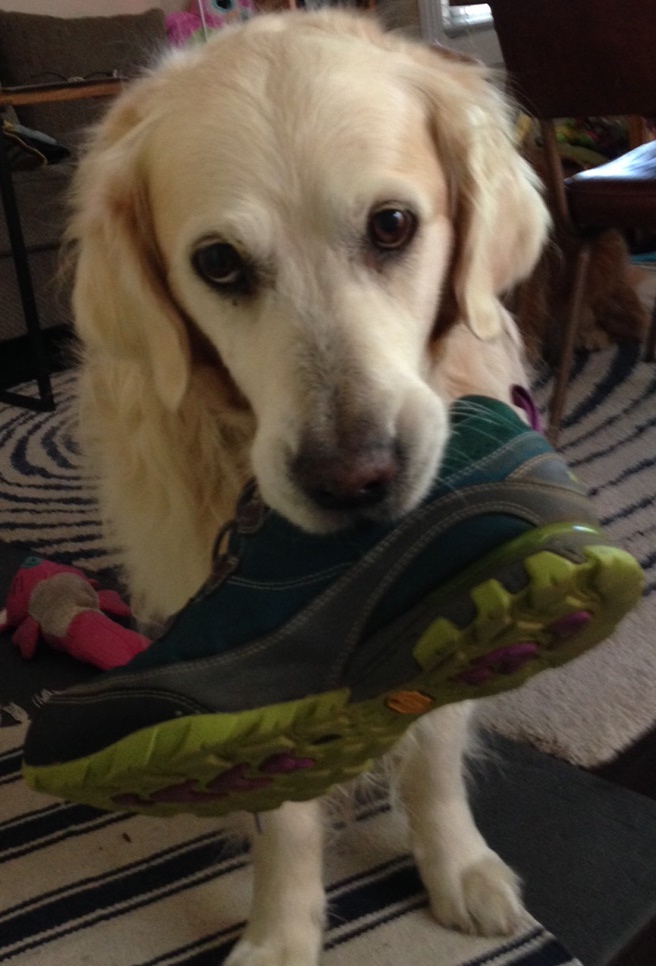
Service dogs routinely learn to bring multiple items by name — shoes, slippers, keys, glasses, even tissues or pill boxes. By the age of one, Jana (the original Thinking Dog!) could choose the requested snack — “chips” or “Bamba” — from our pantry and bring it to us in the living room (potato chips and Bamba, a peanut-butter snack, smell very different).
Yet a two-year, global search by the Hungarian research team for their “Genius Dog Challenge” identified only six dogs, all Border collies, who could retrieve items by name. I missed their search somehow. Which is unfortunate, since I could name six dogs just in California who can do that, and not one of them is a Border collie.
I guess those dogs are all geniuses, as are Cali and Orly (and probably thousands more Missoula dogs). Is yours?
Orly and Cali spent a chunk of Labor Day weekend at the Grizzly Campground in Montana’s Lolo National Forest. It was Orly’s first camping adventure, so Cali had to show her the ropes a bit. Not that Cali has a lot of experience … she may have exaggerated a bit when telling Orly her campfire stories.
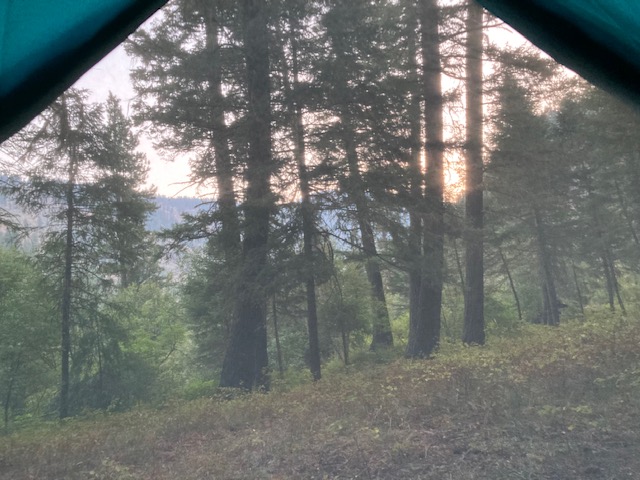
The view from the tent window
They did not get their own tent; we all shared. Our tent has a huge window, and Orly spent most of the first night looking out the window at the treetops and the stars. We were all pretty relieved that she did not spot any bears.
As the temperature dropped overnight, the girls crept closer and closer, until we were all cuddled into a single mass. They also tried to steal the sleeping bag.
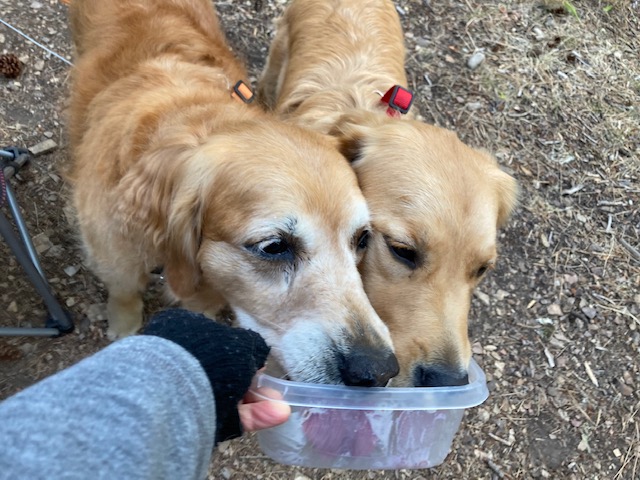
Both girls spent hours hiking, running along the trail and splashing in Rock Creek and Ranch Creek. They gnawed bones, wrestled, grumbled at the dogs in the neighboring campsites, and gobbled treats.
The girls helped with the dishes
It wasn’t all play, of course. In addition to their responsibility to watch for bears and supervise meal prep, the girls had chores. They energetically tackled keeping the campsite “floor” clean, for example, by removing all sticks, pine needles, and dirt — and unselfishly carrying it around in their fur. Cali does have extensive experience with this and could be seen coaching Orly in the finer points of the roll, with tips on how to wriggle the hips and shoulders just so for maximum pickup efficiency. They also helped clean the dishes after every meal.
Needless to say, their first activity upon returning home was a bath. That may have soured them on future camping trips, but I doubt it!
Cali had her post-surgery follow-up liver scan, and the vet saw no tumors!
That is fantastic news, because dogs who have tumors large enough to see on an ultrasound (a half-centimeter) generally have a very bad prognosis (a few weeks).
With hemangiosarcoma, no visible tumors does not mean no tumors. There are almost certainly hundreds or thousands of tiny hemangiosarcomas all over Cali’s body.
But they are small. Very small. And with her magic mushrooms and her chemo, we’re slowing their growth. That could buy her anywhere from several months to a year — or more. Our acupuncture vet knows a dog who was diagnosed 3 years ago … the mushrooms seem to be working for him!
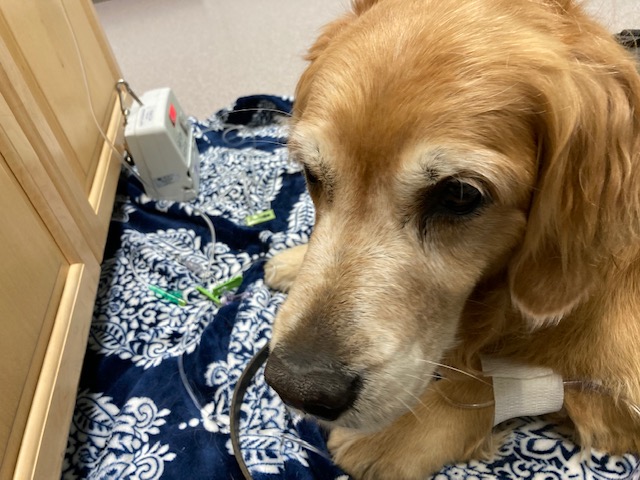
With that good news, Cali bravely completed her second chemo treatment. She had mild stomach upset a few days later that could be related … or not. She’s also been over-indulging in the abundant blackberries on the bushes in her garden.