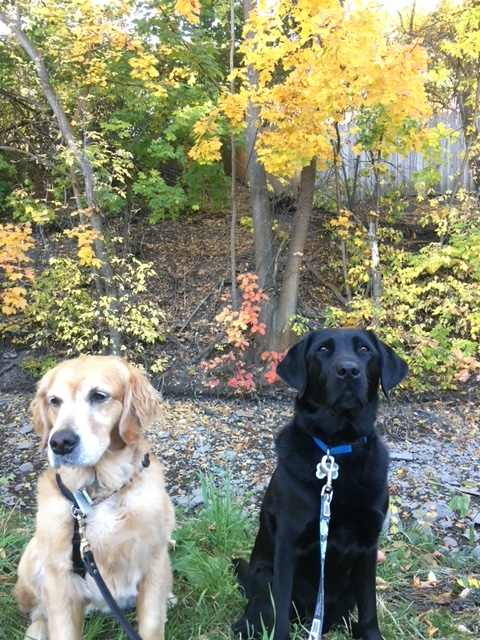
Thoughts of Dog is more than a book or a calendar. It’s a peek into the mind of a loving, sweet, sometimes silly golden retriever and their human. The dog, who is nameless, has a constant companion named Sebastian (Sebastian is a stuffed elephant). Dog also has a human of course.
That human is named Matt Nelson.
And they are simply brilliant.
Nelson & dog capture the human-dog relationship perfectly. They’re poignant, laugh-out-loud funny and sardonic in turns. Always spot-on.
Koala and Deni left Montana a few weeks ago, and recently a friend asked me whether Cali misses Koala. He then jumped to the next level and asked whether dogs understand that someone has left temporarily versus having “crossed the rainbow bridge.”
Those are pretty big existential questions for dogs to consider, but I think they are up to the challenge.
First, does Cali miss Koala? I think that she misses Deni more and that there are lots of aspects of being an only dog that Cali thoroughly enjoys. Cali has regular play dates with her pal Maisy — and the two of them play better together than the pack of three did. Cali always gets to choose where we walk, as well as where we stop so she can sniff. She gets all of the dog eggs at breakfast and can have her snuffle mat whenever she wants (within reason).
But yes, I think she does miss Koala. Life is quieter and more boring when Koala is not here, and Cali rarely has a playmate. Not that Koala is always the nicest playmate, but the girls do often have a lot of fun together. When Koala is not pulling on Cali’s tail, that is, or scheming to steal her treat ball.
I also think that Cali understands that Koala and Deni have gone somewhere else — and will come back. Cali goes to the airport to see them off; they are healthy; and, I am guessing, Koala lords it over Cali for days before a trip: I get to go on an airplane and I get eggs in the Delta lounge and I get to meet the security team … that kind of thing. Cali knows that Koala isn’t simply ghosting her.
When Jana died after a period with many health problems, Cali’s reaction was completely different. She knew that Jana was gone. She cried and moped and grieved for days.
So, yes, I think dogs do understand different types of separations and have appropriate reactions to temporary versus permanent ones. Though if she did think that Koala was ghosting her, I do not know what an appropriate reaction would look like …
On a single walk last week, Cali and I were approached by two unleashed dogs. One, a young, friendly, waggy mix, telegraphed youthful enthusiasm and friendliness and even wary Cali was happy to say hello. The second was far more territorial, larger and, to both of us, a bit scary. Neither listened to their human’s call. Nothing bad happened, but things could so easily and so quickly have gone wrong.
Those two were dogs I’d never seen before, but on our usual walking route, there are many frequent flyers. Or runners. The dogs who “always” stay in their yards … except for every single time I have walked by. The ones who growl menacingly when we approach — even where we already know to cross the street and make a wide detour. Walking in our beautiful neighborhood park, we’ve met multiple off-leash dogs, including the young golden who never fails to growl at Cali. Always off leash.
We’re often greeted by loose dogs, gamboling about in their (unfenced) front yards or “just” going from home to car or car to home. Doesn’t matter. During that 30-seconds of freedom, terrible things can happen. I live on what passes for a busy street in Missoula, and too often to count, across-the-street neighbor dogs, heading to the car, have been distracted by Cali (on leash). These dogs don’t look both ways before plunging into traffic.
It’s not only the danger to the loose dog that bothers me.
The dynamic between a leashed dog and an unleashed dog is very different from two leashed dogs meeting, though I generally try to keep my distance from unfamiliar leashed dogs as well.
When an unleashed dog approaches, the leashed dog can’t get away. Even when the approaching dog seems friendly, one of the dogs could decide there’s something unsavory about the other and the encounter can turn ugly, fast. Or maybe the leashed dog is inherently anxious — or dog aggressive. Or simply having a bad day. The owners of the unleashed dog have no way of knowing, even if they’re 100% certain that their dog is universally friendly, cheerful, and loving toward all of dogkind. And humankind. (Note: this is not possible; not even Cali is that perfect.)
Unable to escape the oncoming dog, the leashed dog’s only recourse is aggression — a growl, maybe a lunge.
But, if both dogs are leashed, either human can quickly head away. The dogs can get out of one another’s range. Ironically, with both dogs leashed, neither feels trapped by the encounter. Neither feels trapped because the encounter is avoidable.
Dogs don’t need to say hello to every dog they see. Mostly, they don’t want to either.
Cali is very specific about which dogs she wants to greet. Goldens and most Labs are ok. Anyone smaller than she is, preferably female, is ok. Doodles of all sizes, though, are out. She’s got a bizarre set of rules, true. But that’s her right. She doesn’t have to be social with anyone on four feet. By leashing your dog, you keep your dog safe and respect both dogs’ right to choose not to say hello.
When the approaching dog is attached to a human, both dogs can choose: They can stay close to Mom or head out to say hi.
The same is true when humans approach without dogs. Some dogs want to greet every human on the planet (hi, Cali!); others do not. If Cali weren’t leashed, she’d run up to every single person we encountered.
The human has choices too, when the dogs are leashed. While I choose not to let Cali get close to unfamiliar dogs, I confess to letting her greet humans who seem amenable (which means they look at her, talk to her, reach out a hand to the nose that is straining toward them). But when humans seem immune to her charms, we give them a lot of space (who’d want to meet those people anyhow?).
Please leash your dog. Cali will thank you. And your dog will be safer.
In a recent conversation about puppy training, Deni mentioned trainers that “teach puppies false beliefs” about humans. One example she gave was that some puppy trainers “teach puppies that they can control” what the person does — by their own behavior.
I thought about that for a minute, then responded that I didn’t think that was what was happening. Instead, I describe that as teaching default behaviors.
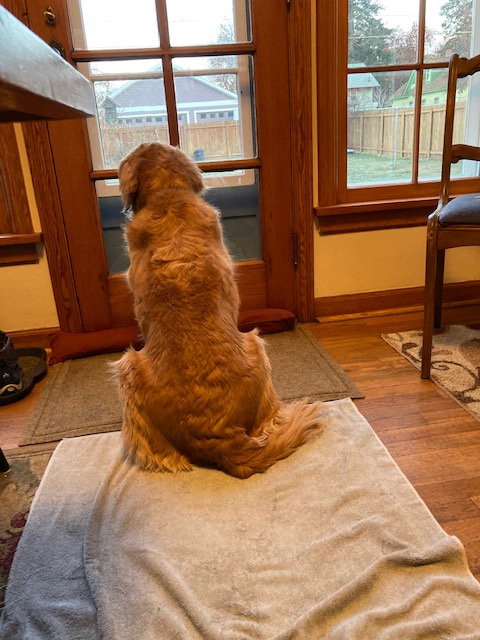
Cali hopes that the magic sit (or lie down) will produce results — even when no humans are nearby
I don’t see that as teaching puppies that they can control the human’s behavior (though that belief may be naive …). I describe it more in behavioral terms: The puppy learns that good things happen when she sits. If her trainers or human family members are consistent, the puppy also learns that those same good things do not happen when she jumps, whines, paws, or does other unwanted behaviors.
If puppy training starts very young (3-4 weeks of age), as it does for some service- and guide-dog puppies, the puppy catches on very quickly. Within a couple of weeks, you’ll have a tiny puppy who sits as hard as she can, placing herself right in front of you, to show you how good she is being. In hopes of getting a cookie, of course. This is where Deni’s reading of the situation comes in. The puppy (and older dog) does try to use this “good” behavior to get rewards on demand.
Who’s in charge here?
But that’s not how it is supposed to work. The human is supposed to retain some modicum of control. (Hey, it’s a nice idea, right?)
If the human is paying attention, they will ask the puppy to sit in many situations: Before going out an open door; while the human is getting meals ready for the puppy; for grooming; when greeting visitors or returning family members. You get the idea.
When the sit is paired with predictable situations and equally predictable rewards, the puppy internalizes the idea that the thing she wants — dinner, access to her yard, attention — arrives when she sits. And only when she sits. So sitting becomes the “default” behavior — what the puppy tries when she wants something the human has or controls.
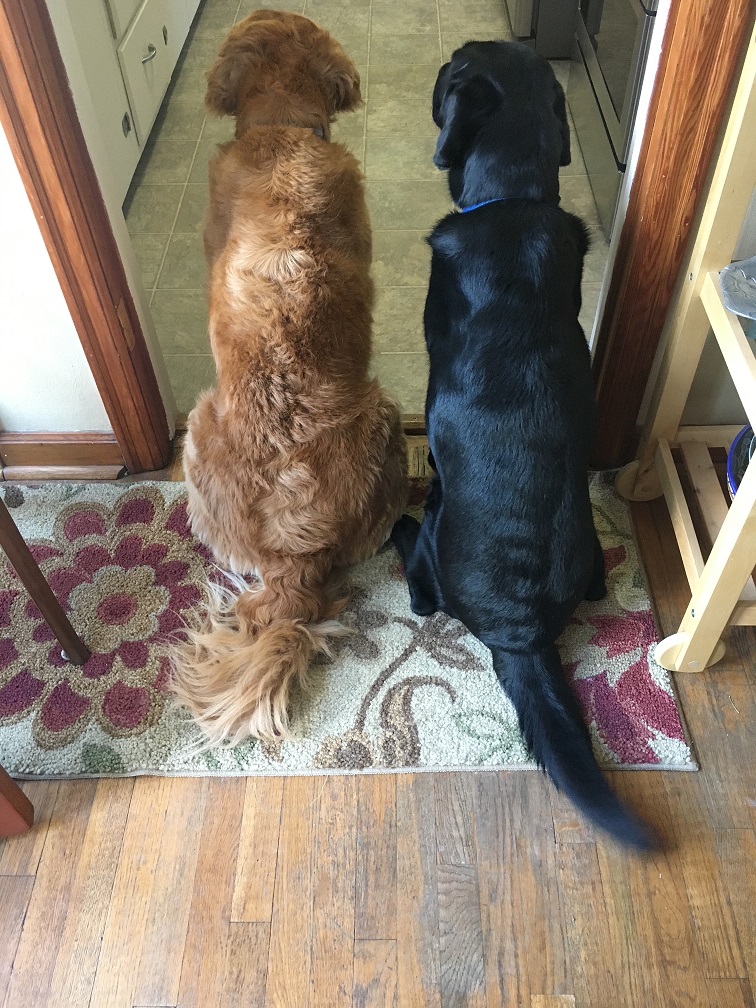
Soon, the human doesn’t even have to ask the pup / dog to sit. When we’re about to get dinner for Cali and Koala, a meaningful look is enough to get them to sit at the kitchen doorway, quiet and not underfoot.
Unfortunately, most humans have a tough time being consistent. And puppies will always remember very fondly that one time (or one hundred times) she got rewarded when she jumped, barked, or whatever. And try it again. And again.
Dogs are pretty good at getting us to do what they want and need. Luckily for us, though, you can teach an old dog new tricks.
If your dog’s usual way of getting you to play with her or feed her or let her out is too rough or pushy, start teaching her a new way to ask. (Enlist a positive trainer if you need some help getting started.)
Once the old way stops working, the dog will eventually stop trying it. Remember, though, if your dog has spent years successfully getting you to play with and pet her by jumping up on you, for example, it could take a very long time to convince her that that no longer works.

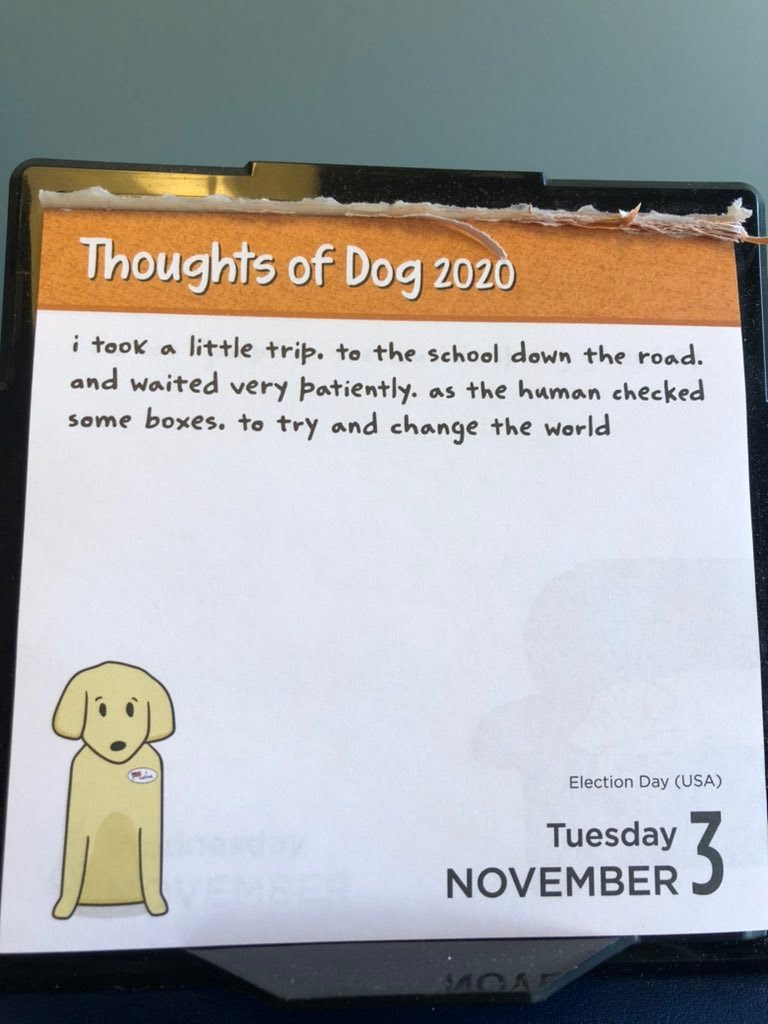 I first heard of Thoughts of Dog when a friend shared a page from last year’s calendar. I immediately ordered the 2021 calendar.