After four long years, there are once again dogs in the White House! That’s a clear sign of better times ahead. No one can effectively perform a stressful job without at least one dog by their side.
President and Dr. Biden have two German Shepherd dogs. While Cali and I think they ought to have at least one Golden Retriever, we agree that GSDs are better than no dogs.
Champ, the senior dog, might weigh in on whether the White House is preferable to the vice-president’s residence, One Observatory Circle, where he lived as a young dog.
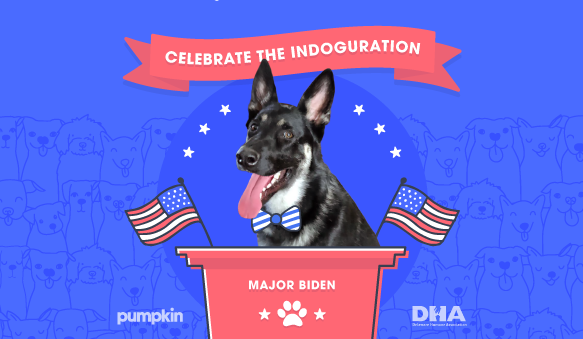
Major, not quite 3 years old, was adopted from a shelter near the Bidens’ home in Delaware in 2018 as a young puppy. He’s the first shelter dog to reside in the White House. The shelter has celebrated their young alum’s fame and fortune, throwing him an Indoguration party and launching a children’s book dedicated to Major and his big brother, Champ.
Pets in the White House are a longstanding tradition; you can find a full list on the website of the Presidential Pet Museum. While mostly dogs and a few cats, some presidents had more unusual pets, such as President Hoover’s son’s alligators.
According to the New York Times, presidential dogs have helped former leaders through some tough times and helped them improve their image.
As anyone who lives with a dog knows, that’s just the beginning. Life with dogs is just better. And I certainly feel a lot better knowing that Champ and Major will be helping their humans run things from now on.
When they get amped up playing inside — in the living room or dining room, to be specific — we tell them to “take it downstairs.” And they DO.
Downstairs is a mostly finished basement with a large room we inaccurately call the TV room. Sure, there’s a TV there, and a sofa. There’s also an open space and an overflowing toy box. And usually a half-dozen toys scattered around the floor. And, of course, a large dog bed. So it’s really the dog playroom, where we are sometimes allowed to watch TV. While cuddling one or more dogs on the sofa.
They are allowed to tug and play growl and wrestle and roll around to their hearts’ delight — downstairs. Not upstairs, where small rooms house my nice(r) furniture, my books, breakables …
In the summer, I have been known to shoo them outdoors when they start playing, but, as Koala points out (hourly): It’s Montana out there.
What’s impressive about the girls’ “taking it downstairs” is that their most energetic play sessions seem to coincidentally coincide with our phone or zoom conversations. Even so, even though they know we are distracted, they’ll take their toys and head downstairs.
A few minutes later, panting, happy dogs will reappear and settle down on the living room rugs for a nap. A tired dog is a good dog, after all.
Cali believes in the magic sit. The magic sit is what causes humans to pet puppies — when they stop jumping and sit, magically, a treat and lots of fuss and petting happens. The magic sit is a great way for puppies to get cookies in other situations as well, as little Cali discovered those many years ago … It works when friends visit and she wants them to pet her and admire her toy, for example.
Her faith in the magic sit has never wavered.
Quitting time
When it’s past dinner time and the clueless humans are still staring at their stupid boxes, a magic sit (often paired with some strategically dripped drool) can produce dinner.
When the humans are fixing dinner, the magic sit makes the bowl appear on the floor, full of delicious food.
When deployed at the back door, the magic sit can cause the door to open in a way that jumping and whining rarely do.
When the humans are eating breakfast, a magic sit (or occasionally the magic lie-down variation) can make a small portion of eggs for dogs appear.
Cali’s faith is so strong that she often deploys the magic sit when it’s not time for dinner or time to go out. She faces into the kitchen, positioned between the dining room and kitchen, as if waiting for dinner. Or she sits by the back door, gazing steadily at her back yard, tantalizingly close. But her humans are not there. They might be behind her in the dining room or in the living room or even upstairs. It doesn’t matter, Cali thinks. The magic sit will work.
So she sits. And hopes. And waits. Believing in the power of the magic sit to get her … what, exactly? We may never know.
Koala faces daily ethical dilemmas, as do many dogs. She’s a highly educated dog who loves to show off her smarts. She also tends to follow rules. But something about the puppy lunch routine is her ethical undoing.
The routine is predictable: Deni gets the girls their puppy lunch each day. Koala brings the treat balls upstairs; Deni fills them; and everyone heads downstairs for PL, as we’ve begun calling it (as if they girls don’t understand …). After PL, Koala puts both treat balls into their little box, and she gets an a cookie as payment for her work.
A daily dilemma
Black Lab Koala nudges her orange treat toy to empty and eat the kibble that’s inside
For a while, Koala did daily battle with her inner bad dog.
She’d quickly finish emptying her treat ball.
But Cali works more slowly. Koala couldn’t stand it. Cali had a treat ball and she didn’t! She began plotting. Each day, she’d try to steal Cali’s. She had to do it without attracting Deni’s attention, of course.
Cali got crafty. She took to batting her treat ball around a very small, sheltered spot. She was on a dog bed, up against a wall, and hemmed in by furniture, so there was only one open access point.
Deni ultimately caught on. She began giving Cali her treat ball inside the office (where Cali continued using the sheltered space) — and banned Koala from the office until Cali finished.
Well. Koala hated that. She’d whine outside the door in frustration.
Cali gets revenge
Cali, however, quickly figured out how to exploit the situation. It takes her longer and longer to slooowwwly empty her treat ball. She then tucks it under a paw, snuggles it gently, and takes a brief nap. All while Koala rages whiningly outside the door.
When Cali has tired of toying with Koala, she gently nudges Deni to let her know that she’s done. Koala then puts the balls away and gets a treat.
Deni has discovered that, even if she’s not there, Koala won’t go into the office to steal Cali’s treat ball. Koala is generally very good about following rules, even rules she hates.
But she will find Deni and badger her until Deni goes downstairs, takes the ball, and lets Koala put the balls away.
I don’t understand …
A related example: Let’s say the girls have finished their treat toys, and Deni is nowhere to be found. So I ask Koala to put the balls away. She knows perfectly well what to do; she does it every day. She puts other things away, too, like toys in the toy box.
Yet, it never fails: She flings the ball down outside of the box. Over and over. And demands a cookie each time. When I don’t give her one, instead repeating, “Please put the ball away, in the box, Koala,” she huffs, puffs, scowls, flings it harder, insists that she has no idea what I want her to do.
I figured out a way to cut this tantrum short. Today, each time she flung the ball anywhere except the box, I calmly handed a cookie to Cali, a willing sidekick in this exercise. I then asked Koala (again) to put the ball away.
Two Cali cookies later, amid disbelieving looks (and many more huff and puffs) from Koala, the ball was in the box. Koala finally got her cookie.
When a good dog behaves badly
Koala is generally a very good dog. So, why does she do bad things when she clearly knows what she’s supposed to do? Who knows? Why does anyone? Maybe it’s just a game the girls play. Or just sisters tormenting each other. When Koala heads back to Florida, she may miss this daily battle. Cali will; she doesn’t even get PL when Deni isn’t here. She does get her snuffle mat, though.