We used to just assume that a “dog year” equaled seven human years and estimate our dogs’ human-age-equivalent with a simple multiplication. Cali is 7 1/2 years old (calendar years) so she’s … roughly my age in human years. (She still has a lot more fun though.)
Turns out that that doesn’t work.
Sometime last year, I first saw a chart that estimates dogs’ ages with adjustments for smaller- and larger-breed dogs since smaller dogs tend to live longer. Cali’s vet has this chart hanging on the wall, and I have seen it several places online. Essentially, in a dog’s first calendar year, she matures about as much as a human does during her first fifteen years. Then in year two, while your human offspring is a terrible two, your dog becomes almost civilized — roughly as mature as a 24-year-old human adult.
Guess what? According to this chart, Cali’s human-age equivalent is … drum roll … roughly the same as my age. And exactly the same as the old “7 years” trick.
But … yeah, that one doesn’t work anymore either.
Now we’ve got a shiny new method of calculating dogs’ ages. All you need is an advanced degree in mathematics …
Seriously. According to the Washington Post, all you have to do is “Multiply the natural logarithm of the dog’s age by 16, then add 31.”
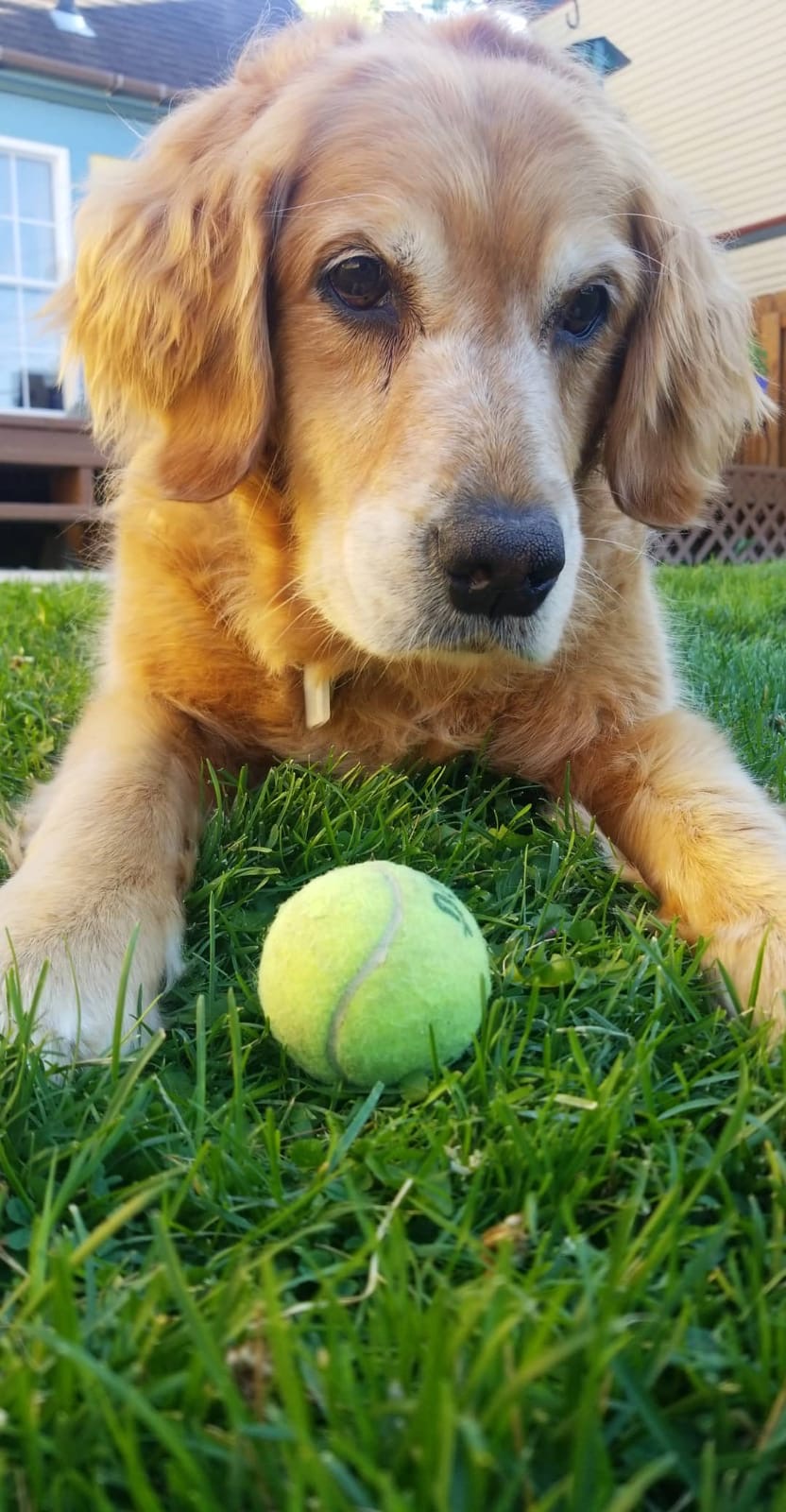
I’m lucky, though; the only thing she hoards is her tennis ball. She adopts a ball each morning — the one I throw for her the first time we play ball. Then, that is the only ball she will play with for the rest of the day. I can toss three balls (or 30), and she’ll sniff each one, but she’ll pick up only her ball.
The game starts like a normal dog-and-human ball game. I throw. She runs, catches or picks up the ball … then things fall apart. Ignoring the “retriever” part of her heritage, instead of bringing the ball to me, she runs off. She’ll choose a corner of the yard, usually in the shade, and lie there, holding her ball. All day if I let her.
If I want to continue the game, I have to chase her. She plays keep-away. Sometimes, this is what she wants. She’s clearly enjoying running, faking me out, being chased, and “letting me win” after we play a brief tug game with the ball. I then throw the ball — which she loves (in fact, she seems to have written a comic about it!) — and the whole thing starts over.
Or doesn’t.
When she’s had enough, she retreats to her corner and gets up and moves away if I approach her. Hoarding.
When we’re near water, there’s a different pattern — she’ll swim after the ball, bring it onto the bank, drop it, shake as much water onto me as she can, and eagerly wait for me to throw it again. She’ll do this over and over again, far longer than she pretends to play fetch on land. When we’re done, though, she wants to carry the ball as we continue our walk to head back to the car. I am clearly not to be trusted with it.
She’s right. Sometimes, when a ball is really dirty and slimy, just the way Cali likes it, I have been known to make it disappear.
Cali is in love. When the object of her affection is heading our way, she knows, instinctively. She gets increasingly excited until he walks in the door.
Then she dances and squeals with joy. And grabs a toy to run around with because that’s just her thing.
Ken is a digital nomad, and he’s spent the past few months in Montana. We were lucky enough to have him in Missoula for 4 weeks!
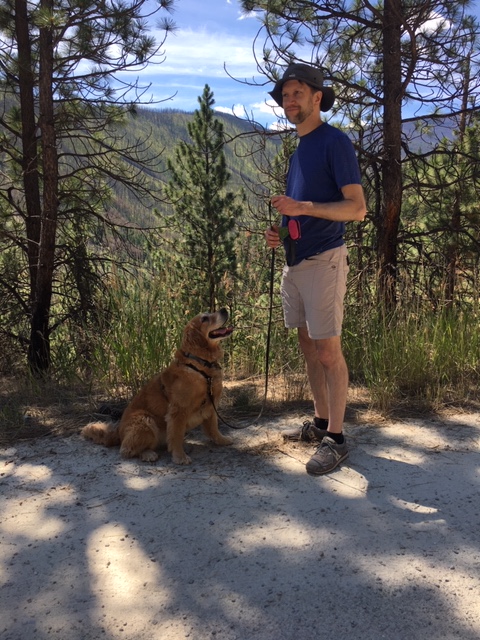
For Cali, it was love at first sight. They played in the back yard together. They picked raspberries. They played ball. We all went on several hikes. Cali even got to have a sleepover at Ken’s house! And, through it all, Cali spent plenty of time gazing adoringly at Ken.
Sadly, the nomad is moving on. To Arizona, of all places! Where he will foster a dog from Best Friends, just over the state line in Utah. (I’m not telling Cali that part; she’d be crushed.)
Poor Cali. I wonder if she’s the type to heal her broken heart with ice cream …
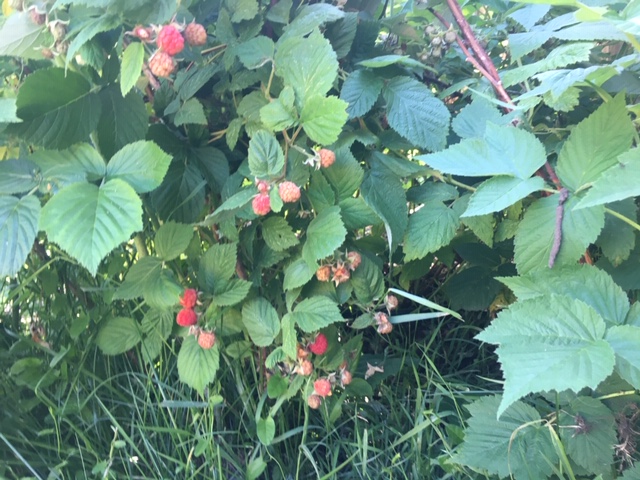
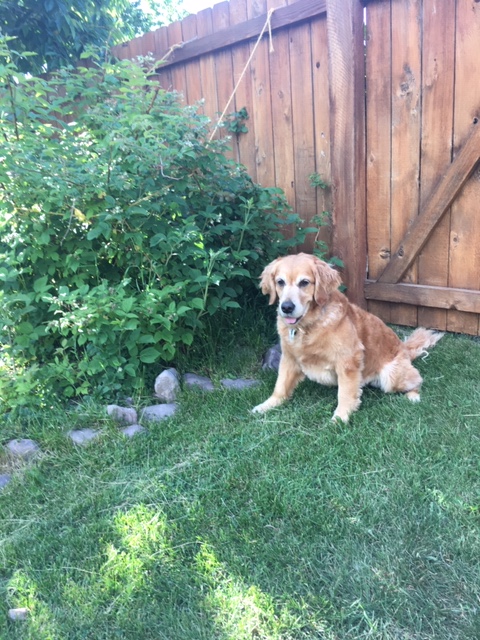
All that waiting has finally paid off. Cali is enjoying her daily harvest of raspberries. Fortunately, I have a secret stash — the bushes on the outside of my back fence, in the alley behind my house. If I had to rely on only the patch inside the fence, well, let’s just say that Cali wins the daily race for ripe berries.
The first ripe berries were just at Cali’s height
What was unexpected though, was which berries ripened first. It turns out that having a dog trample and chew and slobber on the raspberry canes is surprisingly good for the raspberries.
In fact, the little opening where Cali enters the cane forest is where the first raspberries ripened up. It’s also where almost all of the ripe berries are to be found.
The ones higher up and outside are ripening more slowly. And I am competing with the birds for those.
Despite the many critters vying for raspberries, we’re getting plenty. It’s a good year for them — thanks to Cali’s year-round tending and trampling of the bushes, I am sure.
I like to reward Cali and Koala when they are especially helpful or face down a challenge. For example, Cali gets a cookie for bringing in the paper in the morning; Koala gets one for picking up the breakfast dishes. On our walks, we pass several yards with loud, aggressive dogs. If our girls walk by without reacting or pulling on the leash, they get a cookie.
But they don’t get free cookies just for being cute.
Koala especially seems to think she should. If she knows I have treats in my pocket — or have had treats in a pocket at some point in the past, oh, lifetime or so, she knows it. And wants one.
She sits in front of me an fixes those big, dark eyes on me. She does her mind meld. Sometimes she badly miscalculates and she whines. Or she nudges my pocket. Over and over. Harder and harder. The whining and repeated nudging are met with a very sharp rebuke.
Cali is more subtle. She’ll sidle up next to me as I am working and verrryyyy gently, almost imperceptibly, touch me. Sometimes I am not even sure I really felt it. Then I look down and see a hopeful face.
Argh!
Those big brown eyes are hard to resist. But that nudging and begging. No! I am not a Pez dispenser or a gumball machine. You cannot just push a magic button on my leg and get a treat!
Cali and Koala get plenty of earned rewards. They also eat very well, between their top-quality regular meals, their puppy lunch and snuffle breaks, and their nighttime snack of kefir and a cookie. I don’t know where they got the idea that they can also have snacks on demand but … it’s not going to happen.
It started out as a cancer study, and, with the huge amount of data collected, has evolved into a study of risk factors for many diseases that affect dogs — and some that affect humans as well. The Foundation recently held a webinar that presented some information on the study; it took place the day after Cali’s annual physical exam.
Cali’s exam went well — she’s fit and healthy. She was really annoyed by the lack of breakfast, of course. And, as usual, she steadfastly refused to provide me (or Deni) with any samples whatsoever, no matter how long we spent walking her around the back yard with a plastic container at the ready. She refused to pee at the vet’s too — until 1:30 in the afternoon.
All of this got me thinking about her participation in the study. Why we’re doing it and whether it’s worth the Day of Suffering that she seems to endure each year. So the webinar was very well timed.
5 million points of data
The researchers have gathered 5 million data points from the 3,044 dogs who enrolled in the study. As of mid-June, 221 dogs had died, and 100 had withdrawn for other reasons. Of the dogs who’ve died, 139 deaths were from cancer of some type.
Among the participants are 1,225 doggy siblings, including 2 of Cali’s brothers.
The data relate to genetics, environmental exposures, nutrition, and the dogs’ lifestyles. The dogs could enroll at age 6 months to 2 years, and the first dogs enrolled just about 8 years ago — August 2012. Cali enrolled as soon as she turned 6 months old, in June 2013. The researchers are studying a long list of issues, from the role genetics plays in obesity and the role the dog’s age at spay or neuter plays in obesity to various studies on the gut biome to causes of hypothyroidism, allergies, epilepsy, renal failure, and heart diseases.
They have found that early spaying or neutering does not correlate to a higher risk of obesity as dogs mature. But spaying or neutering dogs under the age of 6 months does correlate strongly to a higher rate of orthopedic injuries in adult dogs.
The most common health problem in study participants is ear infections. Cali is proud to say she’s never had one of those!
They’re looking at the lifespan of goldens — and studying whether there are genetic cues to why some dogs live longer.
The Foundation is launching a related study, called Golden Oldies. They are enrolling golden retrievers aged 12 or over who have never had cancer. This is perfect for older sibs of study participants who were not eligible — or any senior goldens who want to make a difference! If you are a senior golden, or you share your life with one, please consider participating.
Back to Cali
So is Cali’s suffering worth it?
The truth is, she still gets very excited about going to the vet. And even though she doesn’t get treats the first 1,000 times she asks, once she’s given up her samples, she is showered with treats. That’s in addition to all the attention she laps up while she’s there. I know she hates the delayed meal and is stressed by the crazy spectacle of her mom or a vet tech chasing her with a plate or a ladle when all she wants is some privacy … but I think it is worth it. She recovers instantly; that is, the instant a cookie enters her mouth.
But I realized that the real bottom line is that she’d have an annual checkup each year even without the study. And, as Cali’s officially a senior golden, that check would always include blood tests. So … whether she loves it or hates it is not really the issue. The real question is whether she’s going through all of the sampling and stress for herself only — or for a bigger cause. Considering the range of studies — and the number of researchers who are or will use the data to improve dogs’ health — I’m glad that Cali is part of this group of golden heroes!
Cali is a raspberry fiend. When our bushes have raspberries, she’s constantly nosing through the canes, looking for ripe, almost ripe, or just about any berries she can reach. She somehow manages to avoid the thorns.
Throughout the winter, she also kept nosing around, trampling the canes and occasionally chewing on one. I kept telling her that she’d be sorry in the summer because if she ate the bushes, there’d be no raspberries.
I was wrong. I was completely ignorant of the benefits of a dog nosing through, trampling, and chewing on raspberry canes. Our patch is bigger and stronger than ever. And both old and new canes are loaded with potential raspberries. They are not even at the stage of underripe berries as I write this, but within a few weeks … Cali will be stuffing herself.
She’s excited. Every day she goes to check on them. She conducts a thorough inspection of every cane. She sniffs every emerging berry. She sits patiently next to the canes — for hours — waiting for them to ripen.
We’re going to have a bumper crop of raspberries. I hope that the humans get to eat a few.
Like many golden retrievers, Cali has some arthritis pain. And like a growing number of dogs (and humans) she’s trying CBD for relief.
CBD is derived from hemp but, unlike medical (or recreational) marijuana, it has no THC and Cali does not get a “high” from her Special cookies.
According to a recent study, the benefits are real and measurable — dogs getting CBD, vs. a placebo, had reduced inflammation and pain and greater mobility. Owners and veterinarians reported on the dogs’ condition and any changes in their gait. All the dogs had bloodwork done before and after the treatment. No ill effects were recorded — but the study lasted only 4 weeks. Nine out of 10 dogs who got the CBD showed improvement that lasted for a couple of weeks after the treatments ended.
The participating dogs got daily treatments, though, and Cali is probably taking far less CBD. She may need more of her CBD treats… a prescription she will be delighted to follow!
She’s also getting chiropractic adjustments and laser therapy. She is cheerful, playful, and happy, and eager to run and jump for a tennis ball, so I don’t think she’s in a lot of pain. But she’s still young, and her arthritis is likely to get worse, so I am learning what I can about available therapies.
This small, short-term study is promising. It could lead to studies with humans. CBD is popping up everywhere, including local pet stores. It’s great to have some indication that it could be effective.
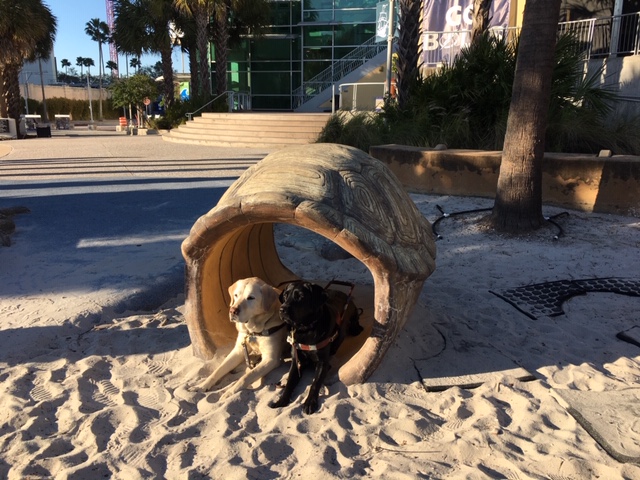
Ryan, left, and Koala, caught up on guide school news during Ryan’s visit to Florida in late February.
Our friend Ryan finally got to retire.
Ryan, a yellow Labrador, is — or was — a guide dog. He was all set to retire in March. He had his retirement planned and new toys lined up. He thoroughly enjoyed his last work trip, a visit to friends in Florida, and he looked forward to hanging up his harness.
Then COVID-19 hit.
Ryan wasn’t the only essential canine worker who had to do overtime due to the pandemic. Hundreds, maybe thousands more, had the opposite problem: Their start dates for their new jobs were delayed indefinitely.
But things are slowly starting to reopen, and Ryan was finally able to retire in early June. He even got to help train his successor. Since Ryan’s human wasn’t able to attend training camp in New York, the new dog and a human trainer came to Ryan’s house. The human trainer showed the new guy the ropes in the mornings, while in the afternoons, Ryan let the youngster know how things were going to work around the house.
Finally, just in time for summer, Ryan is retired. He’s looking forward to some well-earned rest and relaxation.
Cali and Dora are sisters. Dora’s parents are among my closest friends and our favorite humans.
For the first four and a half years of their lives, we lived near enough to one another that Cali and Dora got together regularly.
They each have other friends. Dora was part of a regular pack of dogs who walked and played together. Cali has always had friends who come for play dates. But their time together was always special. I am sure that they knew they were sisters. Cali was comfortable enough with Dora to play without inhibition. She also made herself right at home in Dora’s house, on Dora’s bed, with Dora’s toys …
Then Cali and I moved to Montana.
We’ve been back twice for visits. We drove back and spent a couple of weeks there each time, and of course the girls got together.
They definitely know each other and remember their special connection. Cali gets excited when we’re many miles out but getting close to Dora’s house. As soon as Dora senses us outside she gets excited. Cali’s only problem is who to hug, dance around, and squeal over first — Dora, Dora’s mom, or Dora’s dad. The three of them are really Cali’s extended family and she’s so excited when we are all together.
Another chance encounter a long time ago convinced me that dogs do recognize their birth-family members: I was walking Jana once and we ran into her mom. Jana was grown, maybe even a year old. She hadn’t seen Mom since the day I took her home when she was just 8 weeks old. Jana was delighted to see mom and bounded up to say hi, all wags and smiles. I think Mom recognized her, too … but her response was to curl her lip, give a little warning, and turn away. Jana was crushed and came back to my side, sad and subdued.
Maybe her mom didn’t recognize her and just didn’t want to say hi to this bouncy young dog. I cannot know for sure. But I’m pretty sure I read Jana’s excitement and disappointment accurately. Jana was an extremely introverted dog and never approached strange dogs or tried to greet dogs we met on our walks. Her surprise and delight at seeing her mom were obvious. My best guess is that dogs recognize family members, friends, enemies, and others they’ve met before based on smell. I’ve seen dogs after a long, long absence, some who I knew as puppies and re-meet as adults, and they definitely recognize me.
The bottom line is that I have to get Cali together with Dora as often as I can!