A Nose for … Ferrets?

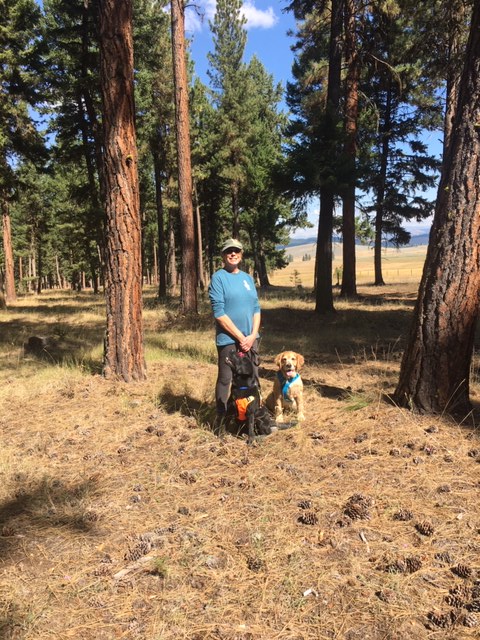
Deni stands with golden retriever Cali and Guiding Eyes Koala in the woods
A gorgeous day for a hike in Montana!

I’ve written about Working Dogs for Conservation before, but I thought it was time for an update. They’re on my mind because we spent a recent Sunday hiking around a beautiful Montana property as part of a fundraiser for them. Tough work, I know, but Cali and Koala decided that we were up for it, so off we went.

Working Dogs for Conservation trains dogs to search for all kinds of rare and endangered wildlife and plants. They’re based here in Missoula, and they do a variety of interesting projects here and around the world.

Working Dogs for Conservation logo features a dog standing in the grassLocally, besides the hike / run fundraiser, they also partner with REI to clean up popular dog-walking and hiking areas.

But their real work is in conservation, obviously. A new project in Arizona uses telemetry — remote data collection and transmission — and radio-collared ferrets to hone their dogs’ ferret-tracking skills. They use the telemetry equipment to locate ferrets. The handler doesn’t know the exact location of the ferret, only the general area. The dogs signal a find by lying down next to a burrow that has a ferret inside. The handler can then check the data report to verify the dog’s find. The dog’s reward is a ball game. (Cali would love this job!)

The dogs in training are good at this. They successfully identify burrows where a ferret is or has recently been 97% of the time. I don’t know about you, but I probably make a lot more errors than that in my work …

Their dogs also identify watercraft infected with invasive mussels in Montana, detect invasive insects and weeds, combat poaching and trafficking in endangered wildlife … and more.

There’s a lot to like about Working Dogs for Conservation. They train rescued shelter dogs, for one. They’ve started a program called Rescues 2the Rescue that networks with shelters all over the US to identify high-energy, intense dogs. These dogs are hard to place in family homes, but are often ideal candidates for search, detection, law enforcement, or other skilled work that requires a high drive. Rescues 2the Rescue matches up the candidate dogs with trainers and organizations who can employ them.

They also really “get” dogs and respect dogs’ abilities. “Their extraordinary abilities help us collect more and better data in the field, and their potential to find conservation targets is seemingly endless,” the website says.

Check out this organization. Better yet, if you’re in a position to donate or volunteer, consider helping them out.
 

Afraid of Thunder

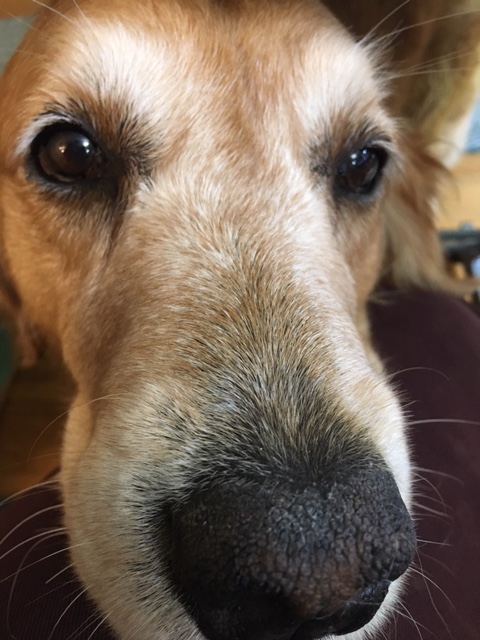
a close up shows cali's nose. Cali is a golden retriever.


Lots of dogs are “afraid” of thunder. Or, to be more precise, they become anxious during thunderstorms. Some become anxious well before the storm starts (they are far more reliable than the weather forecasts; Weather Puppy should consider hiring Cali, for example, to improve the accuracy of their predictions …).

BUT.

Not all fear and anxiety is alike and therefore it cannot be treated in the same way.


Cali is afraid of thunderstorms.

Cali is not afraid of loud noises. The thunder itself is not what bothers her. But she can anticipate a storm that is miles away and hours in her future. She senses the approaching storm and paces, clings, and shakes. When the storm starts, she drools and shakes harder. She’s miserable. She is helped by aromatherapy, melatonin, CBD cookies, and lots of hugs and cuddling. Fortunately, we have all of those options available.

Cali’s fear of thunderstorms does not transfer to anything else. She regards fireworks with mild curiosity and hardly reacts to other loud noises.

Cali’s friend is afraid of thunder.

Cali’s friend shall not be named, as they fear career consequences if their (mild) phobia were to become known. However, this friend fears thunder. And fireworks. Presumably, the sonic booms and air raid sirens Jana grew up hearing frequently (in Israel) would send this dog around the bend.

It’s the noise. CBD cookies and melatonin don’t help much. Aromatherapy is hit or miss. Cuddling does help. So does hiding in the basement. This dog is grateful that they were not destined to become a gun dog.

It can be challenging to figure out what, exactly, a dog is worried about. Both dogs act the same way — clingy, trembling, maybe drooling. But they’re not reacting to the same thing. When the noise stops, “friend” is fine; when the air pressure changes back to non-storm normal, Cali is fine. Different problems; different solutions.

Actually, different problems, same solution: Cuddling!

Reward or Punishment?

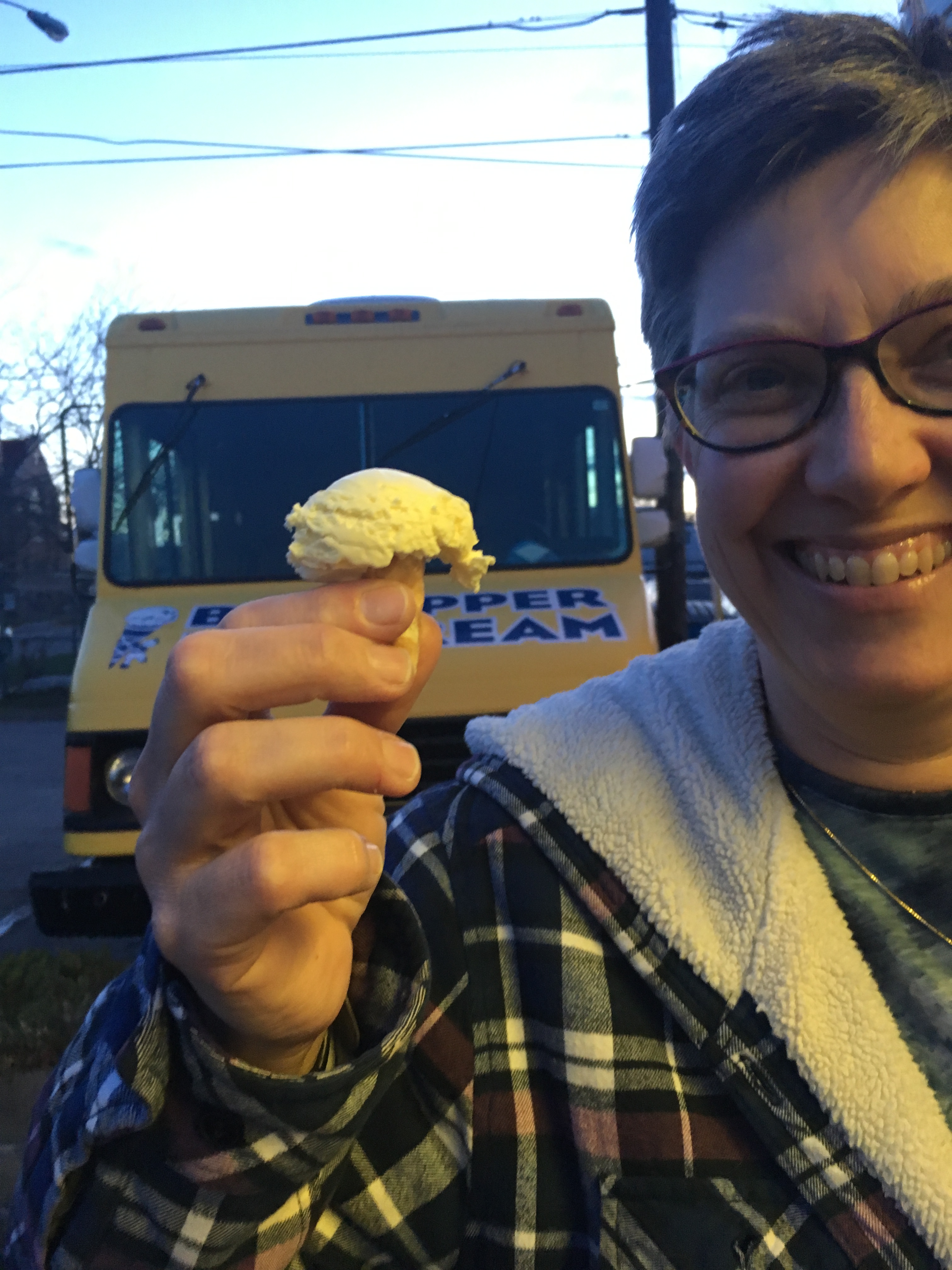
A tiny, perfect ice cream cone, about an inch tall
Photos by Allison Lester

Cali barked at someone walking past our back gate. I shushed her. When she did it again, I ordered her inside.

Koala looked at me quizzically, then walked to the door and asked to go in. Deni told her that no, she had to stay outside. Her next look clearly asked why Cali got rewarded for barking — and why she was being punished.

For Cali, going inside is punishment. But spending time outside is often, for Koala, punishment.

The dog decides what’s a reward — and what’s not.

In our relationships with our dogs, and especially in training ,the dog decides what’s rewarding and what’s not. If a dog doesn’t care much about food, most food treats won’t be rewarding enough to motivate her to learn or to do something she really doesn’t want to do. If a dog hates having her ears rubbed or dislikes pats on the head, some types of physical “affection” can be unpleasant — not the bonding experience the human might be aiming for.

Cali knows that getting her ears done is worth more — both in number and in value — in treat-payment than getting the newspaper or putting a toy away. She knows that some great things, like coconut ice popsicles and opportunities to play snuffle-mat, are free — while others, like her special meat treats, have to be earned.

Cali’s pretty strongly food motivated, but if she’s got a tennis ball and a prospective ball thrower, she’s not at all interested in any kind of treat. And when she’s at the vet and the tech wants to lead her somewhere — whether a soup ladle is involved or not — it takes an extremely high-value treat to get her to go. Koala, on the other hand, will pretty much do anything for a treat.

For some dogs, especially the high-drive dogs who tend to excel at search, scent detection, and police training, active play with a ball or tug toy is the best training reward they can imagine. Other dogs will give the toy — and the human offering it — some side-eye and then (again) demand their pay — in food.

The owner or trainer or dog-walk can have whatever ideas they want about what the dog should like or want. But if something isn’t rewarding to the dog, it’s not going to work. That’s true whether the human is trying to train, get the dog to do something — or get the dog to stop doing something.

It’s worth figuring out what foods work best as treats and what non-food rewards — praise, petting, toys or other play — work for your dog. Save the very best ones for special occasions — times you need the dog to come over in a hurry or cooperate with a particularly unpleasant experience (ears, nails, vet) — and use the “good” and “very good” ones for everyday training and rewards.

How Old Is Your Dog?

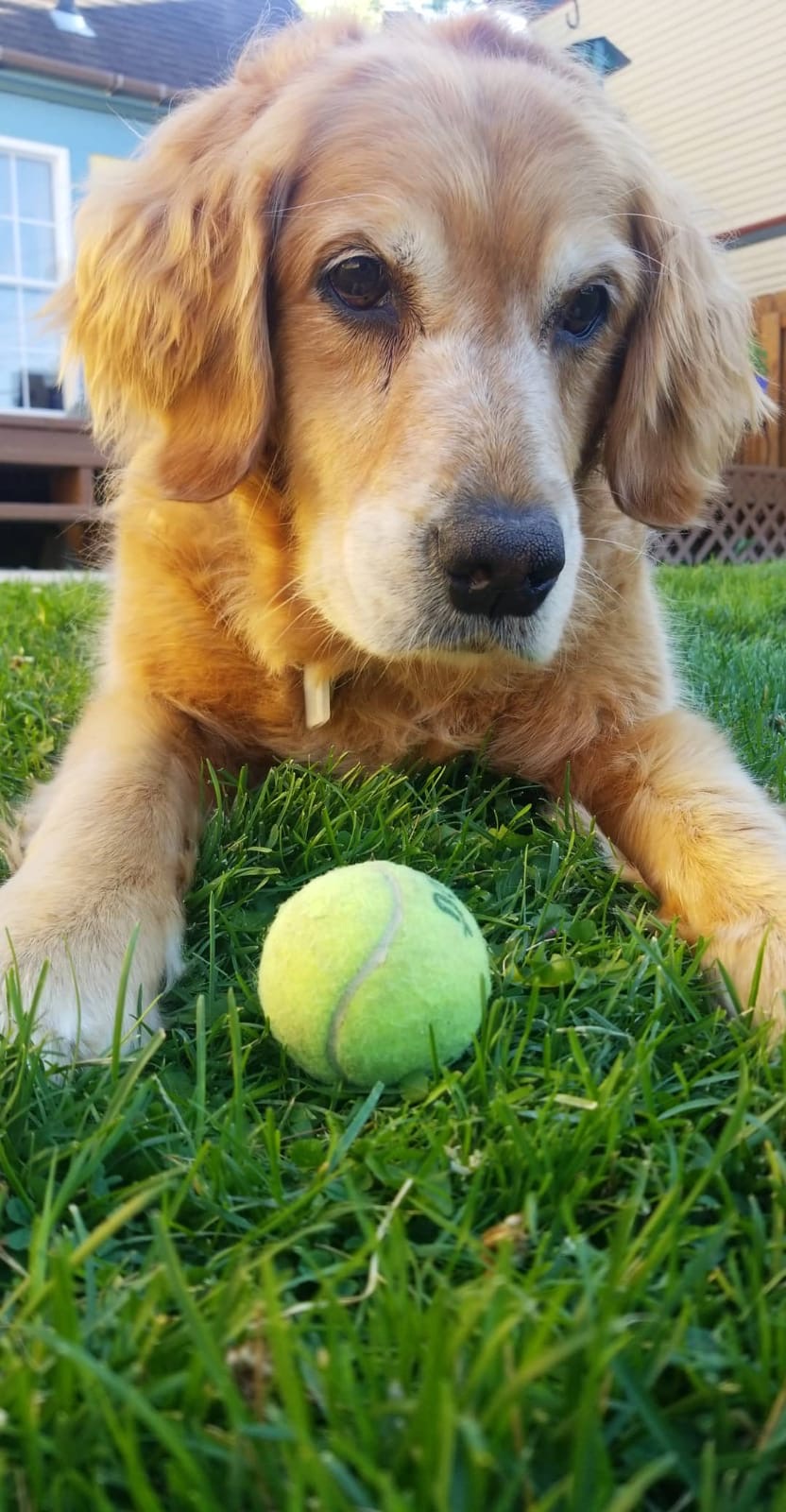
Golden retriever Cali relaxes in the grass with a tennis ball
Cali keeps fit to stay youthful

How old is your dog in “human” years?

We used to just assume that a “dog year” equaled seven human years and estimate our dogs’ human-age-equivalent with a simple multiplication. Cali is 7 1/2 years old (calendar years) so she’s  … roughly my age in human years. (She still has a lot more fun though.)

Turns out that that doesn’t work.

Sometime last year, I first saw a chart that estimates dogs’ ages with adjustments for smaller- and larger-breed dogs since smaller dogs tend to live longer. Cali’s vet has this chart hanging on the wall, and I have seen it several places online. Essentially, in a dog’s first calendar year, she matures about as much as a human does during her first fifteen years. Then in year two, while your human offspring is a terrible two, your dog becomes almost civilized — roughly as mature as a 24-year-old human adult.

Guess what? According to this chart, Cali’s human-age equivalent is … drum roll … roughly the same as my age. And exactly the same as the old “7 years” trick.

But … yeah, that one doesn’t work anymore either.

Now we’ve got a shiny new method of calculating dogs’ ages. All you need is an advanced degree in mathematics …

Seriously. According to the Washington Post, all you have to do is “Multiply the natural logarithm of the dog’s age by 16, then add 31.”

Easy-peasy. Wait, what’s a natural logarithm??

Wikipedia to the rescue: “The natural logarithm of a number is its logarithm to the base of the mathematical constant e, where e is an irrational and transcendental number approximately equal to 2.718281828459.”

Or … not.

I have no idea what Cali’s age-equivalent would be with this formula. I’m going to just pretend it’s something like 25. And holding.


Hands Off My Ball …

Golden retriever Cali holds on to her tennis ball

Cali is a hoarder.

I’m lucky, though; the only thing she hoards is her tennis ball. She adopts a ball each morning — the one I throw for her the first time we play ball. Then, that is the only ball she will play with for the rest of the day. I can toss three balls (or 30), and she’ll sniff each one, but she’ll pick up only her ball.

The game starts like a normal dog-and-human ball game. I throw. She runs, catches or picks up the ball … then things fall apart. Ignoring the “retriever” part of her heritage, instead of bringing the ball to me, she runs off. She’ll choose a corner of the yard, usually in the shade, and lie there, holding her ball. All day if I let her.

If I want to continue the game, I have to chase her. She plays keep-away. Sometimes, this is what she wants. She’s clearly enjoying running, faking me out, being chased, and “letting me win” after we play a brief tug game with the ball. I then throw the ball — which she loves (in fact, she seems to have written a comic about it!) — and the whole thing starts over.

Or doesn’t.

When she’s had enough, she retreats to her corner and gets up and moves away if I approach her. Hoarding.

When we’re near water, there’s a different pattern — she’ll swim after the ball, bring it onto the bank, drop it, shake as much water onto me as she can, and eagerly wait for me to throw it again. She’ll do this over and over again, far longer than she pretends to play fetch on land. When we’re done, though, she wants to carry the ball as we continue our walk to head back to the car. I am clearly not to be trusted with it.

She’s right. Sometimes, when a ball is really dirty and slimy, just the way Cali likes it, I have been known to make it disappear.